
Peter was born in Derby in 1950, and went to Long Eaton Grammar School (a school I went to for an interview at back in 1988, and was actually offered a job there, but the day previously I'd accepted an offer at a school in King's Lynn, and the rest is... geography). Peter has also written about the history of Derby, and contributed to a number of other books over the years.
From Long Eaton he went on to study at Nottingham Trent University.
When he became President of the Association, he was still involved in teaching, and this makes him a rare thing: a teacher President. He was proud to be one of the first Presidents to be teaching in a state school. I need to just double check but I think all the other teacher Presidents before him were teaching at Independent schools, so he may have been the first, and indeed the only state school teacher President...
I think I'm only the fifth person to be a teacher President, and have managed to speak to almost all of the others in the process of writing this blog, apart from E C Marchant.
 Peter has a strong background in teaching, and has held different roles including Teacher of Geography, Head of Faculty and Assistant Head.
His particular interest has been in educational technology, and he has served on the ICT SIG of the Association for many years. The SIG has been going since the 1970s.
The ICT Special Interest Group is one of many I visited while working for the GA as Secondary Curriculum Leader, and has created a great deal of content for the GA's website in this respect, as well as providing guidance to others.
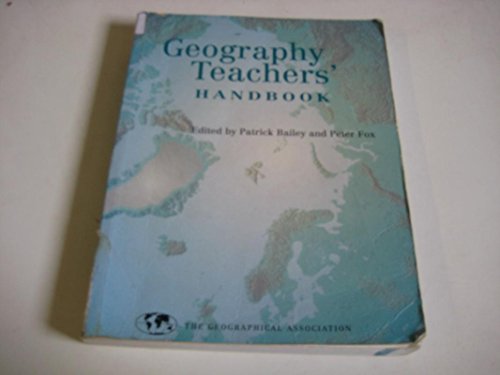
Peter co-edited the first (more recent) edition of the Secondary Geography Handbook with another former GA President: Patrick Bailey - the cover is shown above.
Review here: https://www.tes.com/news/keep-changes
Peter told me that Patrick Bailey was very much his mentor, and his involvement with this publication led on to other things within the GA.
I am also grateful to Peter for allowing me to interview him on the early days of the use of computing, for a chapter that I wrote in the 'Debates in Geography Education' book. I looked back at my notes on this chat as well and found lots of helpful thoughts - the book is now in a 2nd edition, and people have referenced the chapter recently in other books, which is always good to see.
I am also grateful to Peter for allowing me to interview him on the early days of the use of computing, for a chapter that I wrote in the 'Debates in Geography Education' book. I looked back at my notes on this chat as well and found lots of helpful thoughts - the book is now in a 2nd edition, and people have referenced the chapter recently in other books, which is always good to see.
Along with Andrea Tapsfield, Peter wrote a number of books and guides relating to the early use of ICT, when its true potential was as yet unrealised, and the idea of CAL or Computer Aided Learning was key.
I have a copy of the book, which is pictured below:

Peter told me that his first published work for the GA was a list of computer software which was available at the time.
He told me:
"Interesting looking back on this list to see more software available then than now and many gaming and simulation items - missing from more recent apps - but this was before Internet times!"
His Presidential theme was on the Development of the Media and ICT in Geography.
His Presidential theme was on the Development of the Media and ICT in Geography.
His Presidential Address was on the same topic, and connected to the use of images in particular. It was called 'Images in Geography: Great Expectations'.

Image: Bryan Ledgard / GA - Derby GA Conference - Association at Work day - Derby was my favourite conference venue.
He was also involved in the creation of the Digital Learning at KS4 project for the GA which went up onto the website some years ago and which I helped with a little. I remember this happening while I was working for the GA and I worked out a way to do a drag and drop style activity in Google Earth.
He was also involved in the creation of the Digital Learning at KS4 project for the GA which went up onto the website some years ago and which I helped with a little. I remember this happening while I was working for the GA and I worked out a way to do a drag and drop style activity in Google Earth.
Here he is being introduced by Chris Kington.

As with other recent Presidents, since Sheila Jones, Peter was also kind enough to answer some questions to me on a Google form.
Why does the GA matter?
Peter told me:
"Geography matters and therefore the teaching and learning of geography matters."
Thanks to Peter for replying to my request for help, and completing my questionnaire to help with the creation of this entry.
I have a particular extra link with Peter.
In 2008, I went to Sheffield to have an interview for a job at Solly Street as Secondary Curriculum Leader, and Peter was one of the four people on the interview panel who gave me and the other candidates a real grilling. Other people on that panel have been identified in other blog posts, or will be in due course.
"I would hope that the GA has always had a role in the development of technology and learning - Sound, Vision, Media, ICT..." - as I recently completed several consultancy jobs in this very area, this certainly seems to be the case at the moment.
"Geography matters and therefore the teaching and learning of geography matters."
Peter has served on the ICT Working Group, been Honorary Secretary of the GA, and was even the stand-in CEO [part time for a term following the departure of the previous person, as described earlier in the blog], He has also been, for many years, the Honorary Treasurer of the GA (a post now held by Bob Digby), and is currently Chair of the ICT SIG.
Thanks to Peter for replying to my request for help, and completing my questionnaire to help with the creation of this entry.
I have a particular extra link with Peter.
In 2008, I went to Sheffield to have an interview for a job at Solly Street as Secondary Curriculum Leader, and Peter was one of the four people on the interview panel who gave me and the other candidates a real grilling. Other people on that panel have been identified in other blog posts, or will be in due course.
Peter continues to serve on a number of committees, although he is scaling back his involvement a little. I also interviewed him for a chapter for a book I wrote for Routledge, asking him for his memories of the early days of ICT in the school classroom as mentioned earlier in the post. Looking back, Peter said:
Peter has attended a number of the GA Study Tours and was involved in one tour which was also mentioned by Chris Kington. This was to Poland, and I blogged about it here.
His involvement with the GA continues to this day and he and I are involved in a current project which will be publicised later in the year.
If anyone else has memories of Peter Fox and his work with the GA please get in touch.
References
Fox and Tapsfield (Andrea) - an early book on the use of technology in schools, and published by the GA. I have a copy of this book in my collection.
References
Fox and Tapsfield (Andrea) - an early book on the use of technology in schools, and published by the GA. I have a copy of this book in my collection.
Presidential adress: FOX, PETER S. “Images in Geography — Great Expectations.” Geography, vol. 90, no. 1, 2005, pp. 3–17. JSTOR, www.jstor.org/stable/40574025. Accessed 12 Mar. 2021.
https://www.geography.org.uk/Project-Team - Digital Learning Project
https://www.geography.org.uk/Project-Team - Digital Learning Project
Peter led a team creating resources for GCSE students, funded by BECTa (a sadly missed organisation, which I completed several projects for, before it disappeared)
Coates, Bryan E., et al. “Annual Report of The Geographical Association.” Geography, vol. 76, no. 2, 1991, pp. 177–188. JSTOR, www.jstor.org/stable/40572070 - one of many similar reports that Peter will have given his name to over the years.
Chronology of the GA: https://www.geography.org.uk/download/ga%20chronology.pdf
Coates, Bryan E., et al. “Annual Report of The Geographical Association.” Geography, vol. 76, no. 2, 1991, pp. 177–188. JSTOR, www.jstor.org/stable/40572070 - one of many similar reports that Peter will have given his name to over the years.
Chronology of the GA: https://www.geography.org.uk/download/ga%20chronology.pdf


