Showing posts with label Sydney Wooldridge. Show all posts

Friday, 3 November 2023

Michael Cross' memories

I enjoyed this account of going to Oxford University in the 1950s... by Michael Cross.

There are mentions of quite a few former GA Presidents along the way.


A few extracts

There were also, I remember, the Admiralty Handbooks. These were written by geographers in both Oxford and Cambridge during the War years to inform the military of the history, geography and culture of countries in the sphere of war.

We were all well aware of the Davisian cycle of erosion and it seemed almost to be geomorphologically 'fashionable' to look for erosion surfaces - they seemed to play such a major part in the interpretation of landscapes. Wooldridge and Morgan's Geomorphology along with Wooldridge and Linton's Structure, Surface and Drainage in South East England were necessary 'reads'. We were also made aware of a new (to most of us) hypothesis challenging Davis's, one formulated by Penck - summarised by "wearing back as opposed to wearing down". Little were we to realise that over the decades to follow another half dozen or so hypotheses would be suggested by competing geomorphologists. (I have often thought that it would be true to say that wherever two geomorphologists are gathered together, they will disagree!)

Research on frontal systems had only properly got underway in the inter-War period. Air masses were new to us. The then latest edition of Austin Miller's Climatology had what appeared to be an added chapter, Air Masses, and we were advised to buy this edition and avoid older second-hand copies without it. I find it remarkable that today it is routine for TV weather forecasters to refer to air masses in their forecasts. Similarly, most had not heard of the jet stream. I believe some empirical knowledge of jet streams was gained by fighter pilots over Japan in WW2 but it only 'filtered through' to the general public with the growth of high-level airline flights in the 1960s and beyond. During my three years I cannot recall any mention being made, detailed or otherwise, of the jet stream.

Jean Brunhes 'classic' text La Geographie Humaine, although nearly forty years old, was recommended reading, as was The British Isles by Dudley (later Sir Dudley) Stamp - aka 'Deadly Dudley'! 

I wonder why he was Deadly Dudley... as in deadly dull?

In 1954, the annual meeting of the British Association was held in Oxford and thus the accompanying volume The Oxford Region was an up to date source. Edited by my tutor A F Martin and by R W Steel, other familiar names are listed on the Contents page (Dr Steel left midway through my time at Oxford and went on to become Professor of Geography at Liverpool.)

Reference:

https://www.geog.ox.ac.uk/alumni/news/181127-mcross-1950-geog.html

Sunday, 24 September 2023

The development of Geography

Quite a few GA Presidents are mentioned in this piece by Ivor Goodson, on how geography gained its status as a discipline.

It references several key times in geography's development, including the Madingley lecturers and the emergence of the 'new geography'

Source:

Goodson, Ivor. “Becoming an Academic Subject: Patterns of Explanation and Evolution.” British Journal of Sociology of Education, vol. 2, no. 2, 1981, pp. 163–80. JSTOR, http://www.jstor.org/stable/1393016. 

Wednesday, 22 July 2020

1972: Mr. Alan Durward Nicholls

Updated November 2023

Alan Nicholls
was another of those relatively rare people who was a geography teacher when he became GA President, and a great proponent of Environmental Studies. 


In Balchin's Centenary book, he is described as an "active Head teacher" and in an Annual Report in 1971 as a "revered practising schoolmaster".

I delved and found out that he served on the Secondary Section Committee (as I did for many years) and was a member of the Central London Branch of the GA - which suggests he taught in London, and later found out that he succeeded another GA President Leonard Suggate as the Head of Geography at St. Clement Danes School in Hammersmith, London.

Here's an image from a Facebook page for the school. For a while, the only one I could find.

New Geographies over Forty Years was the name of his Presidential Address, given in January 1973, and by all accounts from the description, a humorous one, although it was not apparently printed in 'Geography' and not available to view unfortunately. I wonder whether a copy exists anywhere?

1971 saw a surge of interest in the quantitative methods, so perhaps he referred to those, and how the might translate into school geography? I would like to guess that he did, given the timing of his address a few years after the Madingley Conferences.

In that year, the GA Spring Conference (as it was called) was held at the London School of Economics, where it was held quite regularly.
Prior to being President, Nicholls was also Assistant Honorary Treasurer of the GA as well - another President to hold that significant (and voluntary) role.

Environmental Studies was one area of interest which he pursued, and this is a reminder of the different strands of geography which are picked up by different Presidents for their theme, address and also perhaps areas of interest while in the Presidency.
This area was also picked up in the Professorial Address of C. A Fischer, I have previously blogged about from my British Library research.

Nicholls article on Environmental Studies was also useful - see the link below


This was featured in a book on the development of this branch of Geography


Nicholls was chosen as the GA's representative on the Inner London Education Authority (ILEA) geography board in 1966, and I assumed from early research that he was more of an academic geographer, but this was not the case.

I presumed from that appointment he taught in London, and that was what Richard Daugherty (another former GA President) thought when I asked him about connections with Presidents who were in post near to his own Presidency.

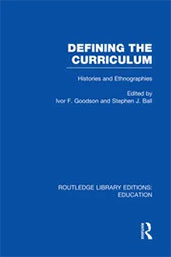
Defining the CurriculumHe is mentioned in this book 'Defining the Curriculum'.

Ten years ago almost to the day and from this platform, Professor Kirk said 'modern geography was created by scholars, trained in other disciplines, asking themselves geographical questions and moving inwards in a community of problems; it could die by a reversal of the process whereby trained geographers moved outwards in a fragmentation of interests seeking solutions to non-geographical problems'. Might not this be prophetic for us today? Could it not all too soon prove disastrous if the trained teachers of geography moved outwards as teachers of environmental studies seeking solutions to non-geographical problems? (Nicholls, 1973, p. 201)

A contribution described here is from Nicholls too.

This quote would also chime with those who explore the value of teacher subject knowledge, a current interest of many.

Following another thread, I found a small obituary tucked away in Geography in 1981.
He was born in 1910 in Cornwall, and died in 1981. He went to Truro School. He was made an Hononrary Member in 1980 just before his death.


I'm grateful to Fiona Hirst, archivist from the Clement Danes School for sending me another image of Alan Nicholls from later in his career.


References

Book link: https://books.google.co.uk/books?id=W9GHPA3zK0IC&lpg=PA1651&dq=mr%20a%20d%20nicholls%20geographical%20association&pg=PA1651#v=onepage&q&f=false 

NICHOLLS, A. D. “Environmental Studies in Schools.” Geography, vol. 58, no. 3, 1973, pp. 197–206. JSTOR, www.jstor.org/stable/40568109.

“The Geographical Association.” Geography, vol. 66, no. 4, 1981, pp. 320–322. JSTOR, www.jstor.org/stable/40570442.

I managed to find some images on a Facebook group page that was dedicated to the school, including an excellent image shared from a field trip back in 1953. This is one of my favourite images on the whole blog.

Thanks to the people who put the website together.
Here's Alan Nicholls on a Geography fieldtrip (presumably to North Wales)
Top of Snowdon, North Wales, 1953. Photograph taken by Jack Harvey and sent in by Geoff Skinner


He is fourth from the right on the front row and is described as "Old Nick" which seems fair. He seems to be having a good time as well. Some good fieldwork wear on display here, and great to see a President actually 'in action' doing some geography.

Thanks to Fiona Hirst for the additional details and image from the school magazine 'The Dane'

Updated November 2023

Revisiting past Presidents to see if I could find updates and came across an obituary in the RGS's Geographical Journal.


This reinforces his links with the RGS as well as the GA. He was the Chairman of their Education Committee and also served on Council. He studied at the University of Exeter. He travelled extensively.
He was a Cornishman.

"Good teachers are keen on their chosen subject and find it stimulating."


“Obituary: Alan Durward Nicholls (1910-1981).” The Geographical Journal, vol. 147, no. 3, 1981, pp. 394–394. JSTOR, http://www.jstor.org/stable/633763. Accessed 1 Nov. 2023. 

Friday, 3 January 2020

3.1.33: Progress in Geography - the Record of the IBG

There are references to a whole host of GA Presidents in this piece by David Stoddart.

Many former GA Presidents were involved in the formation of the IBG.
This article outlines the involvement of a whole range of geographers including Alice Garnett, Ogilvie Buchanan, Wooldridge, Stanley Beaver, H J Fleure and Arthur Austin Miller. You will be familiar with many of those names from previous entries on the blog I hope.


A key figure in the formation of the IBG was C. B. Fawcett, pictured here.

The first meeting of the IBG was held on the 3rd of January 1933, when C B Fawcett was elected as President, Arthur Austin Miller was elected as Secretary and Treasurer.

Ogilvie Buchanan became President in 1953.

There were Annual Conferences with Presidential and other lectures once again. I like this description of Sidney Wooldridge's lecture, which I may need to have a go at finding...


Here are the Presidents up to the merging with the RGS:


Plenty of GA Presidents there.

References

Stoddart, D. R. “Progress in Geography: The Record of the I. B. G.” Transactions of the Institute of British Geographers, vol. 8, no. 1, 1983, pp. 1–13. JSTOR, www.jstor.org/stable/622270

Wednesday, 9 October 2019

The GA and the Second World War (cont.)

Rex Walford's book has a chapter exploring the 1940s and 1950s.
He explains how membership dropped during WWII as teachers enrolled in the forces, but publications and conference kept going, with Mackinder still active in his 80s. This was a period when the nature of the subject, and the different elements were much discussed. Was it a science or a humanity?
During the War, there was much preparation for post-war period and reconstruction.
There was also disruption from 1930 onwards because of evalucation of children from the London area, and other industrial cities which were potentially targets.

1940: The GA postponed the Annual Conference scheduled to be held in London in January. The Conference was held in March 1940 in Blackpool. In December the High School of Commerce in Manchester, containing the GA’s Library and Offices, was saved from an air raid fire by the courage of the caretaker, Mr. Sim, who brought the blaze to a halt by working a hose for several hours. The Land Utilisation Survey, used by the County War Agricultural Executive Committees charged with the task of increasing food production, lost many valuable records in a London air raid. 

The 1944 Education Act was one part of the post-war changes that affected geography teaching.
It was led by Rab Butler, and introduced the 11+ and a tripartite system promising "secondary education for all" but in different institutions depending on 'ability'.

This produced a number of different potential geography 'curricula' to prepare for. There was also a focus on Primary geography, and textbooks were produced for this age range, often involving quite stereotypical stories of young people such as "Bombo of the Congo", but even this was a little more enlightened in its coverage than some of the earlier textbooks had been. Oliver Garnett, sister of GA President to-be Alice, wrote the 'Foundations of School Geography' book used in many schools.
Textbooks by authors such as Thomas Pickles and Preece and Wood were much used in secondary schools.

E. W. 'Bill' Young was teaching at Norwich School when he started writing his series called 'Our World' before teaming up with J. H. Lowry to write books that I remember using in the 1960s at school. These included Sample Studies, such as the Kazakhs of the Steppes and Tooktoo of the Eskimos. More on that to come later... these persisted for decades.

There was also pressure from Social Studies to amalgamate, which placed geography's identity under question. The GA was part of the work to maintain its place within the curriculum, and see a change from Regions towards the Models which appeared during the 1960s. More on that to come as the blog develops and further Presidents show their influence.

Bill Marsden's paper (see references) describes some changes during this period:

Wooldridge was to resurface as a key figure in the geography versus geographical education encounters of the post-war period. He was a trenchant peer critic. In 1950 he addressed the IBG and scorned the contentment of his audience with ‘agreeably titillating’ articles on subjects of minor interest which made ‘no claim whatsoever to scholarship’ (Stoddart, 1983, p. 5). 
To Wooldridge a firm physical basis was the sine qua non of a high quality geography. He claimed that the social/urban orientation of the subject was becoming too strong. Geography, he maintained, was about ‘place’ and not about ‘man’ (Graves, 1975, p. 56). 
On the educational front he abhorred the analogous post-war trends towards introducing social studies into the curriculum. These he blamed on geographical educationists. The tendencies threatened to take ‘the ge- out of geography’, as he put it (1949, pp. 9–18). Social studies would On Taking the Geography Out of Geographical Education Some Historical Pointers in Geography Page 7 of 15 ‘destroy the value of geography as an important medium of education’ asserted the Education Committee of the RGS (1950, p. 181), in a report reputedly the work of Wooldridge. Like Geikie, he argued that the priority in schools should be detailed fieldwork in the rural landscape, developing a ‘laboratory spirit and the careful, indeed minute study of limited areas’ (1955, p. 80)

More on Wooldridge in a future blog post.

There was plenty of note in a chronology by G R Crone.


and this too


Image: my own school exercise book from 1976 ish

Reference

Walford, Rex. “On the Frontier with the New Model Army: Geography Publishing from the 1960s to the 1990s.” Geography, vol. 74, no. 4, 1989, pp. 308–320. JSTOR, www.jstor.org/stable/40571739.

Boardman, David, and Michael McPartland. “A Hundred Years of Geography Teaching: From Regions to Models: 1944—1969.” Teaching Geography, vol. 18, no. 2, 1993, pp. 65–68. JSTOR, www.jstor.org/stable/23753284

https://www.open.edu/openlearn/ocw/pluginfile.php/631169/mod_resource/content/1/geog_sk6_06t_5.pdf

Crone, G. R. “British Geography in the Twentieth Century.” The Geographical Journal, vol. 130, no. 2, 1964, pp. 197–220. JSTOR, www.jstor.org/stable/1794582.

Margaret Mackintosh RIP

Updated post. Sad news at the end of last week from colleagues who have organised the Charney Conference over the years of the passing of Ma...