Showing posts with label Norman Graves. Show all posts

Thursday, 30 January 2025

We are all Gravesian

 Earlier this week was Norman Graves' 100th birthday, as mentioned in a previous post.

John Morgan has written a piece on the enduring importance of his work for those involved in curriculum design and teacher education for the GERECO blog. This blog has infrequent posts, but they are always worth reading.

GEReCo is the Geography Education Research Collective / UK Commission on Geographical Education of the International Geographical Union

Members are listed here. Some very well known names there, including former GA Presidents.


Monday, 27 January 2025

Happy 100th birthday to Norman Graves

Norman Graves was GA President in 1978. 

He reaches the milestone age of 100 years old today.

Happy Birthday Norman!

Read all about him here.

There are quite a lot of very long-lived former GA Presidents (I hope that's a good omen) but I think Norman may be the first to have reached the century...

Norman's work on curriculum continues to be referenced in academic work, and many of a certain age (such as me) will remember using his white school textbook written with John Talbot White.

A picture of my personal copy can be seen below:


Thursday, 9 January 2025

Norman Graves - a special milestone celebration

As part of my GA Presidential journey, I created a blog which features a biography of every President of the Geographical Association.

The GA President in 1978 was Professor Norman Graves.

Norman told me in an e-mail back in 2020 that: "I am conscious that the year of your birth, 1963, was the year I arrived at the Institute of Education to head the Geography Department."

I had a message earlier from his daughter via the blog:

"Norman is celebrating his 100th Birthday on 28th January 2025.

For those that might want to wish him well, please contact me on: 
 helenescott@virginmedia.com.
We are holding a celebratory lunch for him at a local hotel and are expecting quite a crowd. He is an exceptional man, and I am more than proud of him."


I am sure there will be many people who may wish to congratulate him. Please forward this message to those who may have known him or, like me, were influenced by his work or used his books when they were at school.

All your messages will be passed on to Norman.

Wednesday, 20 September 2023

GA Conference 1977

A report by Sheila Jones


There was also a lecture by Lord Nathan... a connection with the past, as he had been GA President over twenty years earlier.

The Macmillan Education Lecture Energy and the environment was given by the Rt Hon. Lord Nathan, Chairman of the Working Party which produced a report under the same title in 1975. His lecture assessed the balance of energy needs and potential related to the consequent damage inflicted upon the environment, reminding the audience that there is a limit to the capacity of the environment to absorb waste. Of all forms of energy, Lord Nathan seemed to favour solar energy as it does not cause pollution, does not create new heat and is not restricted to certain locations. It is especially suitable for developing countries. He concluded that the solution to prob lems of conflict between environmental conservation and the demands for energy could only be found by a multi-disciplinary team to which geographers made a full contribution.
On the last day, at the Annual General Meeting, the constitutional changes were approved and the new structure of the Association has now become a fact rather than a blueprint. It is hoped that this structure will mean that there will be an improved servicing of the membership and also that it will, as Prof. Wise hopes, be easier to make our voices heard in present and future educational debate.

Source:
Jones, Sheila M. “Report: Education and Economic Geography at the Geographical Association.” Area, vol. 9, no. 3, 1977, pp. 214–15. JSTOR, http://www.jstor.org/stable/20001238. Accessed 16 Sept. 2023.

Sunday, 17 September 2023

John Bale

This post updated with some sad news in October 2023.

Also updated in January 2025 - plus a nice comment added too.

A review of John Bale's biography - by Trevor Higginbottom.

This is a very well-written and absorbing autobiography that tells us much about geographical education from 1960 to 2001. During this period John Bale's career included posts at Townfield Secondary Modern School for Boys, where he encountered 'deadbeat teachers' and 'lively' boys, Avery College of Education and the University of Keele. In 1998 he was appointed to a professorship in the latter's Education Department. 

The book contains many insights into the important influences during this period of, for example, the Geographical Association, the London Schools Geographical Group and the 1970 Charney Manor Conference. Individual geographers played an important role in Bale's career, including 'the dynamic walking whirlwind' Rex Walford and Michael Wise. Bale was a sportsman with a specialist interest in sport geography, in which he became a leading world figure. The book contains reflections on the influence of subject trends on his thinking in this respect, including 'quantitative' and 'welfare' geography. 

He became less interested in teacher training, finding lesson observation 'often a numbing experience where the main objective seemed to be one of control'. 

Arguably, Bale's influential work could have been used much more in lower secondary and primary geography to develop both the cognitive and affective dimensions of the subject, given that sport is an important motivational topic for many young people. For example, the very influential 'Geography for the Young School Leaver' Project's learning materials included very little on this theme. 

In 2001 Bale took early retirement from Keele 'severing (his) increasingly tenuous (and increasingly tedious) links with geographical education'. 

In the same year he assumed a new role in the Centre of Sports Studies at the University of Aarhus where, until his retirement in 2006, he made very significant contributions in the humanistic and social scientific fields of sport. 'Professional' autobiography is a genre which other geographers might consider: for example, some long standing geography teachers might usefully describe their involvement in the 'golden years' of curriculum development in geographical education in the latter third of the last century. It is important that this is recorded given that, hopefully, there might one day be a return to these exciting processes of curriculum change in the subject.

Source:

Higginbottom, Trevor. Geography, vol. 100, no. 2, 2015, pp. 121–121. JSTOR, http://www.jstor.org/stable/43825437. Accessed 16 Sept. 2023.


I'd love to take a read if anyone has a copy lurking on their shelves. It's proving elusive via eBay / ABE Books etc. which are my usual ports of call.

John was a PGCE Tutor at Keele University, and is fondly remembered by those he taught.

He also co-edited this book with Rex Walford and Norman Graves (two former GA Presidents)
It is well worth a look at - there are some useful chapters on the development of geographical education.

His book on Primary Geography is also one that I have in my library of old educational books at school. 

Updated October 2023

I was contacted by Jeremy Krause, a former GA President with the sad news that John passed away recently.

He said:
This is a sad loss of someone who, in their own way, influenced so many of us as a geographer and especially as someone committed to Primary Geography.
'Geography in the Primary School' published in 1987 came at a time when there was much debate about what the Primary Geography Curriculum should contain. The first chapter of John’s book entitled ‘Young geographers and the worlds inside their heads’ clearly indicates his take on children’s education. 
I have lost one of the greatest influences on my geographical and education career. I met John when he was Head of Geography at Nobel School in Stevenage. He supported me with my undergraduate dissertation. A few years later I met him at Avery Hill and then at Keele Uni. It was John that encouraged me to undertake my Masters.
He was one of those people 'you meet along the way’ - he shaped who I am. He gets mention in my GA Presidential Blog

The Guardian Obituary is here.

It describes the importance of a teacher: Frank Baber, in igniting John's love for Geography.

Another memory via Facebook


And an RGS obituary. By Christopher Philo.

"His work spoke to embodied, performative dimensions of largely ‘pre-cognitive’ human-being long before that was a big theoretical attraction in the discipline; it engaged debates about the spatial organisation of spectacles, events and ‘disciplining’ regimes, as well as about many more empirical subjects such as sports stadia/events and the contestation of urban social space; and it addressed many different sports – football, cricket, running, and more – played and spectated in many different worldly contexts, in which regard John was also prescient in contrasting colonial visions/practices regarding the sporting body with the rather different ‘body-cultures’ indigenous to peoples and places beyond Europe and the West."


Wednesday, 30 August 2023

GA Publications in the Internet Archive: Geography in Secondary Education (1971)


One of quite a few books that can be borrowed from the Internet Archive free of charge if you are interested in finding out more about the development of school geography (and the GA).

Published in 1971.

Written by former GA President Norman Graves.

https://archive.org/details/geographyinsecon0000grav


An updated version was published in 1980 also from Norman Graves

https://archive.org/details/geographicaleduc0000grav

Monday, 25 July 2022

Professor Reginald Crawshaw Honeybone

A name to conjure with and someone who worked at the Institute of Education and later in Tanzania and also presented at the GA Conference in the past.

An obituary written by Norman Graves was published in Geography

He was trained by James Fairgrieve and also served on GA committees including the Standing Committee for Visual Aids in the teaching of Geography. He worked with Brian Roberson and I Molly Long, who were of course heavily featured on the blog back in the day, with Molly being a former President of the Association.

Source

Graves, Norman. “Professor Reginald Crawshaw Honeybone CBE, 1913-2002.” Geography, vol. 87, no. 4, 2002, pp. 367–367. JSTOR, http://www.jstor.org/stable/40573771. Accessed 25 Jul. 2022.

Reginald wrote a number of books, some with Roberson and also with George Joseph Cons - a President who 'never was' sadly.


Sunday, 12 December 2021

IGU - a call for paper abstracts

This information will be appearing in a number of locations, including the GA website over the next month.

There is a month to the deadline for submitting a paper as part of a session that I have had approved at the IGU in Paris in July 2022. It's also a month to the deadline for early bird booking.

This may be of niche interest to some reading this, but it is posted so that I can direct those who may be interested and attending the event to see the full details. The final results will also be of direct interest to those who teach in any capacity as we explore the idea of a curriculum framework.


This will be the 100th IGU Conference in Paris in July 2022.

My session at the IGU’s centennial conference will continue a long tradition of GA / IGU engagement, involving former GA Presidents including Norman Graves and Sir Dudley Stamp. I will draw on previous employment as the GA’s Secondary Curriculum Leader and experience in developing curriculum artefacts and vignettes to help bring curriculum documents to life. This will hopefully be the start of a renewed international conversation about curriculum: to reconnect with each other after several years of enforced separation.

Title of proposed session:
Developing a curriculum framework for Geography at national level

The session is described as follows:

The Geographical Association (GA) has pursued its mission ‘to further geographical knowledge and understanding through education’ since 1893, during which time it has undertaken successive exercises to reframe the school geography curriculum in the UK and further afield.

One of the GA’s flagship initiatives at present is a fundamental review of curriculum thinking in geography education.

This initiative has taken a very wide range of evidence and perspectives into account to work on the production of a geography curriculum framework that is informed by research and practice, reflects the contemporary world and discipline and can be used by the Association to exert influence on national and international curriculum conversations in the future. This work is being led by Eleanor Rawling, Honorary Research Fellow, University of Oxford Department of Education, and will emerge during 2022.

The curriculum framework will be introduced at the session, along with a description of some of the other projects which influenced the thinking. Key issues around such work will be explored, with reference to other national curricula. The curriculum framework also creates opportunities for teachers to develop deeper (powerful) knowledge and equip students with choices about whether and how they wish to act, as well as a better understanding of how and why others do/do not act in the same way.


Alan will outline his ‘Curriculum Vitae’ - a curriculum for life: to engage young people and equip them with key questions that they will carry forward with them beyond their schooling. The Climate Emergency and other global issues should be threads running through any new curriculum, but teachers need support in considering how such issues can become objects of study, so that they may be examined in school without the attendant real-world pressures we otherwise face when dealing with complex social, political and environmental challenges. Should this be part of the framework, or the associated guidance? Such questions will be discussed.

If you would like to get involved, please get in touch. The IGU website has reopened during December and early January for the submission of papers and there will then be a selection process to create the programme for the session that I will chair.

The IGU website will be open for submissions until January the 11th 2022. These are abstracts at this stage.

Go here to submit your abstracts

https://www.ugiparis2022.org/fr/soumission-de-resumes/29

Summaries are possible in two formats:

Oral communication: Presentation of 15 minutes maximum, in one of the working languages ​​of the session (see the presentation sheet of the session to which you are submitting your proposal)

E-poster: If your e-poster proposal is accepted by the session organizer (s), the poster must respect the charter (.pdf format) and be placed in the E-Poster area accessible with your identifier, before June 15, 2022 .

Summary format
The sessions will be organized on the principle of one or more session (s) lasting 1h45, each corresponding to 4 presentations of 15 min maximum and 5 min of discussion.

Submission of an abstract
Abstracts must be submitted in French or in English.

The submission form must clearly specify the working language of the communication, with reference to the languages ​​proposed in the session. There will be no interpretation service during the sessions, unless the session organizers offer and provide it themselves.

The sessions will take place face-to-face or virtually; there will be no hybrid sessions.

Submission format

Title : 255 characters maximum, spaces included
Summary : 2000 characters maximum, spaces included
Keywords : 5 maximum
References : 5 maximum

Make sure your paper is linked to the session in the Geographical Education section of the event.


We will share the date and time of the session in the final programme as soon as we can.

Get in touch if you would like to know more details.

Sunday, 28 November 2021

Norman Graves and the IGU

A few weeks ago, we heard that a sesssion proposal that I put in has been accepted for the IGU.

The International Geographical Union (IGU) has its centenary conference in Paris in 2022.

Its title is: 

Developing a curriculum framework for Geography at national level

The session is described as follows: 

The Geographical Association (GA) has pursued its mission ‘to further geographical knowledge and understanding through education’ since 1893, during which time it has undertaken successive exercises to reframe the school geography curriculum in the UK and further afield. 

One of the GA’s flagship initiatives at present is a fundamental review of curriculum thinking in geography education. 

This initiative has taken a very wide range of evidence and perspectives into account in order to produce a geography curriculum framework that is informed by research and practice, reflects the contemporary world and discipline and can be used by the Association to exert influence on national and international curriculum conversations in the future. 

Its presentation, for discussion, at the IGU’s centennial conference continues a long tradition of GAIGU engagement, involving former GA Presidents including Norman Graves and Sir Dudley Stamp. There will be inputs, possibly remote or pre-recorded from those people involved in the development of the curriculum framework: an initiative led by Eleanor Rawling, Honorary Research Fellow, University of Oxford Department of Education. 

The curriculum framework will be introduced, along with a description of some of the other projects which influenced the thinking. Key issues around such work will be explored, with reference to other national curricula. 

One aim is to create a ‘Curriculum Vitae’ - a curriculum for life: to engage young people and equip them with key questions that they will carry forward with them beyond their schooling. The Climate Emergency and other global issues should be threads running through any new curriculum, but teachers need support in considering how such issues can become objects of study, so that they may be examined in school without the attendant real-world pressures we otherwise face when dealing with complex social, political and environmental challenges. Should this be part of the framework, or the associated guidance? Such questions will be discussed. 

The curriculum framework also creates opportunities for teachers to develop deeper (powerful) knowledge and equip students with choices about whether and how they wish to act, as well as a better understanding of how and why others do/do not act in the same way. 

Current GA President Alan Parkinson was previously the Geographical Association’s Curriculum Leader and is a practising teacher with much experience in developing curriculum artefacts and vignettes to help bring curriculum documents to life. Ideas for breathing life into the framework will also be explored and shared. This will hopefully be the start of a renewed international conversation about curriculum: to reconnect with each other after several years of enforced separation.

If you would like to get involved, please get in touch. The IGU website will be reopened during December and early January for the submission of papers and there will then be a selection process to create the programme for the session that I will chair.

I will be channelling a former GA President who was heavily involved with the IGU for many years, and wrote this excellent book in 1979: Professor Norman Graves. He has his own entry on the blog. It will also draw on the current work of another former GA President: Eleanor Rawling.

Wednesday, 25 August 2021

IGU - CGE

The IGU (International Geographical Union) will have their 100th conference next year in Paris.

This year's IGU-CGE conference was held last week in Prague.

The keynote speakers and several of the other sessions involved people who I have been privileged to work with over the years on ERASMUS+ funded projects including Michael Solem and the third phase of GeoCapabilities is well represented too.
On the IGU site, there is history of the IGU, which was originally co-written by Norman Graves, former GA President and added to by other people. (Downloadable as PDF or Word document)

He talks about the original seminars organised with the UN, which included Neville Scarfe from the UCL IoE.

In 1950, UNESCO organized their first seminar on the teaching of geography in Montreal. This seminar was chaired by Neville Scarfe (1908-1985), who at that time was Head of the Geography Department at the University of London Institute of Education. The result of this seminar was UNESCO’s A Handbook of Suggestions on the Teaching of Geography (Unesco, 1951) mainly drafted by Neville Scarfe.

Following the book, the next stages of the development drew in L Dudley Stamp. This followed the early UK Land User Survey which has appeared on the blog before.

Neville Scarfe reported his association with L. Dudley Stamp, a British geographer at the London School of Economics. Scarfe, a British geography teacher, became senior lecturer at the London Institute of Education in 1935. He was a professional acquaintance of Stamp’s since the London geographers were, in Scarfe’s words, a friendly and sociable group. Both were members of the Royal Geographical Society, which was a further reason for contact. It is likely that Stamp and Scarfe collaborated during the 1930s and 1940s when Stamp organized the school children of the United Kingdom to map the land use near their schools. Scarfe had a network of many geography teachers and students who participated in the mapping. Stamp and Scarfe both participated in the first post war IGU conference in Lisbon, Portugal in 1949, where geographical education and international cooperation were topics being addressed with considerable interest. It was during the Lisbon Congress that the IGU appointed a Committee on the Teaching of Geography under the chairmanship of Neville Scarfe.

The history also talks about the publication of the 1965 UNESCO New Source Book for Geography Teaching.
It features several chapters by Norman Graves on the teaching of geography which make interesting reading, and also a chapter by Tom W Brown who was a teacher at the King's School, Gloucester on the organisation of the geography classroom.


Friday, 15 January 2021

Bertie Roberson

Bertie Roberson worked at the Institute of Education: which has links with many former GA Presidents, particularly Molly Long.

His obituary was published in 'Geography' in 1995, and written by Norman Graves. He was also a colleague of former GA President Molly Long. He was also a long-serving member of the Secondary Section Committee, of which I was also a member for many years.

Reference

Graves, Norman. “B.S. Roberson 1911-1994.” Geography, vol. 80, no. 3, 1995, pp. 290–290. JSTOR, www.jstor.org/stable/40572678. Accessed 15 Jan. 2021.

Wednesday, 11 November 2020

Reflexions on Geography Education

A piece kindly passed to me by the GA President in 1978: Norman Graves, who got in touch with me just after the first lockdown.

Reflexions on a Life in Geographical Education by Alan Parkinson on Scribd

Wednesday, 30 September 2020

UCL IoE and the GA

Updated January 2021

There has been a long association with UCL IoE and GA Presidents over the years, and also the Chief Executive Professor David Lambert of course.
Some Presidents were involved in teacher training at the Institute of Education, others were academics. Others gave lots of service to the GA but were not Presidents, such as Bertie Roberson, who served on the Secondary Section and other committees for many years while working at IoE

In 2004, there was a Centenary celebration and reunion and several former GA Presidents were there, notably Bill Mead, who is the next President to be featured on the blog.

A Geography Education MA has been offered for over 50 years.

Also worth exploring the following GA Presidents who have a connection:
Norman Graves
Molly Long
Ashley Kent and others... 

When I started to volunteer and serve on the GA's Secondary Phase Committee in 2004 (which seems like a lifetime ago now) we used to meet on Saturdays in the geography lab at UCL with the wave tank and other equipment, on the Bedford Way site. I also led quite a few CPD sessions, and attended others, in the hotel opposite the IoE.

I also made a few visits to the office shared by David Lambert and John Morgan, and later Alex Standish, over the years, including when I worked on the GeoCapabilities project. I attended several seminars there over the years as well, including a memorable one with Michael Young and Margaret Roberts, and also David Lambert's Professorial lecture "Lost in the Post" for which I produced the visuals for David's presentation.

James Fairgrieve was perhaps the most famous IoE colleague of them all, and featured in the Presidential Address of the 1996 President Ashley Kent, where he outlined his life and also the strong connections between the IoE and the GA. It is well worth reading to get an idea for the links and the changing nature of Geography. Ashley's Presidential Address was given at the Institute of Education. Fairgrieve worked from 1912-1935 at the IoE (previously known as the London Day Training College) and became GA President when he retired.

Reference

KENT, ASHLEY. “Challenging Geography: A Personal View.” Geography, vol. 82, no. 4, 1997, pp. 293–303. JSTOR, www.jstor.org/stable/40572948. Accessed 15 Jan. 2021.

He provides additional detail on Fairgrieve's life.
Source:
https://www.geog.ucl.ac.uk/news-events/news/alumni-news/former-students-newsletters/FSN%2015.pdf  (PDF download)

All memories of UCL and the GA welcome as we move into the final year of the blog project and enter the 1980s...

Wednesday, 2 September 2020

1978: Professor Norman Graves

Last updated January 2025

Norman Graves' name will be known to many for his involvement in the authoring of school textbooks over many years. His other significant contribution was in the development of the IGU.

Norman taught in a number of secondary schools in his career.
He was also involved with the University of Liverpool and latterly the Institute of Education, from where he retired 30 years ago.

He will turn 100 in January 2025. 
There is a comment at the end of the blog post providing details of how you can send Norman best wishes on his birthday.

Norman told me in an e-mail that: "I am conscious that the year of your birth, 1963, was the year I arrived at the Institute of Education to head the Geography Department."

He was also mentioned early on in David Mitchell's PhD thesis:

In 1979 Norman Graves produced a model of ‘curriculum planning’ in geography which places the responsibility for the ‘curriculum problem’ with the teacher. 

‘Essentially a teacher’s curriculum problem should be that of deciding what he is going to try to get his students to learn.’ (Graves, 1979: 1)

Norman attended a seminar at the Institute of Education during my time working for the GA, as part of a seminar series organised by the late Duncan Fuller, which also had inputs from Andrew Bonnett and Michael Young. That was a good day of learning for me.

Here are just a small selection of some of the books that Norman authored during his long career:

Geography in Education;
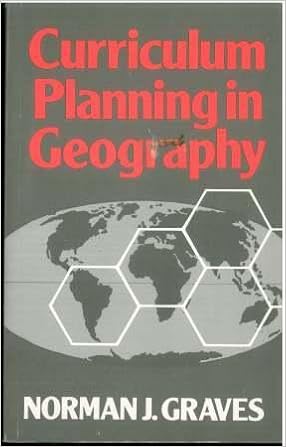
Curriculum Planning in Geography;
Geography in Secondary Schools,
The Education Crisis;
School Textbook Research: the case of geography;
Editor: Teaching Geography 
Series; New Movements in the Study and Teaching of Geography; 
New Unesco Source Book for Geography Teaching;
Initial Teacher Education;
Learner Managed Learning;
Working for a Doctorate;
Education and the Environment.

Norman Graves was GA President at a time when there were some financial issues for the Association. It had a deficit of around £10 000 and efforts were made to try to reduce expenditure to cope with the situation at the time.
https://www.jstor.org/stable/40569009?seq=1#page_scan_tab_contents

I contacted Norman by e-mail in August 2019, and he passed through the following information to me, along with the image which is included at the top of the blog post. The image shows Norman speaking at the 1976 IGU Conference in Leningrad, Russia.

Thanks to Norman for the following information on this entry, which he provided for me. He is the 2nd 'oldest' GA President to be alive, (and also the oldest as it happens I believe) and therefore able to offer me his own personal perspectives, following Sheila Jones' memories from her time as President in 1975 in an earlier blog post.

Norman was born in Sainte Adresse, Seine Inférieure (now Maritime), France, and lived there briefly before moving to the UK.

Education:
Ecole Communale de Garçons de Sainte Adresse,1931-35
London: Finsbury Park Junior School, 1935-36;
Tollington Park Central School, 1936-38;
Highbury County Secondary School, 1938-41;
The Polytechnic, Regent Street 1945-46 (part-time);
The London School of Economics and Political Science, 1946-49 (2 years part-time, 1 year full-time) - the LSE links with the GA are very strong
The University of London Institute of Education, 1949-50 (full-time). Subsequently, part-time study for higher degrees, 1952-63.

Employment
Norman started working life in 1941as a "Youth in Training" in the Post Office Engineering Department, then as a Technical Officer in the Engineer in Chief's Circuit Laboratory until 1948.

Teacher of Geography and Economics at East Ham Grammar School for Boys, 1950-54; responsible for Geography at Borough Beaufoy Secondary Technical School in Lambeth, 1954-58; Head of Geography and housemaster at Malory Secondary Comprehensive School in Lewisham,

Good to see another GA President who had spent time as a teacher of geography.

1958-60: Lecturer in Education at Department of Education University of Liverpool 

1961-63: Senior Lecturer in Education

1963-74: Reader in Education at the Institute of Education.

In an e-mail communication, Norman told me that he
1974-78: Professor of Education
1978-80: Robert Ogilvie Professor of Geography Education
1980-90: Pro-Director Professional Studies

When he became GA President he was working as Professor of Education at the IOE (UCL)


Norman told me:
"I entitled my Presidential Address "Contrasts and contradictions in Geographical Education". In the 1970s, I expressed the tensions which existed between the scientific nomothetic approach manifest in the then conceptual revolution, and the ideographic and humanistic approach epitomised in Yi Fu Tuan's book 'Topophilia'. "

He also said:
"Contradictions were evident in the attitudes of teachers who had difficulty in reconciling the instrumental aims of education, for example, coaching students to pass examinations, and the intrinsic mind-opening aims of guiding students to question the validity of certain theories, for example the Davisian view of landscape evolution."

This is an ongoing issue for many - dealing with the question of "is this on the test?" and making time for those additional discussions and criticality which helps build geographical thinking.

Norman told me: "I joined the GA as a student and maintained my membership throughout my career. I found it useful to read its publications and attend its meetings and Annual Conferences where I could discuss with other teachers our teaching problems."

Here's Norman's Curriculum Planning Model, which has stood the test of time as far as I can see.


Here's a publication that Norman produced for the GA during this period.
Of his association with the GA Norman said:

"The GA was a professional association of geography teachers whose meetings and publications provided me with in service development, which at that time was not provided by my first employers. I subsequently participated in the "training college" section and contributed occasional lectures, but my main contributions were to the GA's publications. For example: articles in" Geography"; A Tropical Peasant Holding in Ceylon in Asian Sample Studies (169); Geography in Secondary Education (1971); Geography in Education: a Bibliography of British Sources (with Clare Lukehurst, 1972); Geographical Education in Secondary Schools (1980); I also edited the series "Teaching Geography" (1968-72)."

Norman told me of his wider work in the field of Geographical Education which included his chairmanship of the Commission on Geographical Education of the International Geographical Union, his membership of the Schools Council Geography Committee and its Geography 16-19 Project led by his colleague, Michael Naish. 

A report on the work of the Commission on Geographical Education was written by Norman as Chairman and published in 'Geography' in 1980


Graves, N. (1980). THE COMMISSION ON GEOGRAPHICAL EDUCATION. Geography, 65(3), 230-231. Retrieved August 26, 2020, from http://www.jstor.org/stable/40569278
He also recalls being asked to lecture to various GA local branches in Oxford, Bristol and Leicester, and attending the Scottish Geography Teachers Association conference in Edinburgh - something I've done many times myself, and now with a reciprocal arrangement with the SAGT for our conferences.

He also sent some memories recently about his links with the previous GA President Stan Gregory:

Stan Gregory and I were students in the Joint School of Geography which was then shared by Kings College and the LSE, though he did a straight Geography degree while I did a BSc (Econ) which actually included a course in statistics which proved useful during the quantitative revolution. 
Our paths crossed again in Liverpool when I joined the Education Department, while he was in the Geography Department headed by Professor Steele at that time.

Along with Michael Naish, he wrote an important publication for the GA called 'Profiling in Geography', which was published in 1986.

Norman was awarded the RGS's Victoria Medal in 1993.

A picture of Norman Graves still hangs in the office at UCL which is used currently by Alex Standish, previously used by David Lambert and John Morgan. Alex kindly took a photo of it for me some time ago and shared it with me for use on the blog.


And here's the book that perhaps will be most well known to many of a particular age: the classic textbook that was used in schools and which was part of my own 'A' level studies. This is my own personal copy which is part of my growing library of textbooks which I have been collecting as part of this project.


References
Norman Graves (2008) Reflections on a Life in Geographical Education, International Research in Geographical and Environmental Education, 17:1, 1-5, DOI: 10.2167/irgeeed171.0

https://www.ucl-ioe-press.com/books/history-of-education/school-textbook-research/

https://link.springer.com/article/10.1007/BF02736948

REF: https://impact.ref.ac.uk/casestudies/CaseStudy.aspx?Id=44328 - mentions how the APG that I worked on, and the work of David Lambert built on Norman's work:

It develops Norman Graves's innovative work at the IOE in the 1970s and 1980s on the theory and application of `rational curriculum planning' in school geography.

Also a mention from Brian Hobbs: https://www.asdan.org.uk/blog/2013/02/19/a-geog-down-memory-lane as part of the GA's work to create an ASDAN course.

IGU:
http://www.igu-cge.org/wp-content/uploads/2018/02/The-IGU-Commission-on-Geog-Education-modified-0915.pdf

GRAVES, N. (1978). Changes in Attitude towards the Training of Teachers of Geography. Geography, 63(2), 75-84. Retrieved August 25, 2020, from http://www.jstor.org/stable/40568886
Non-GA book publications may be grouped into three groups: 
1 Text books: 
North America and Asia 1966 (with R C Honeybone), Geography of The British Isles 1971 (with John White), People and Environment 1987 (with John Lidstone and Michael Naish) 
2 Academic books on geographical education: 
eg Geography in Education (1975), Curriculum Planning in Geography (1979), School Textbook Research: The case of geography (2001); New Movements in the Study and Teaching of Geography (Editor, 1972); New Unesco Source book for Geography Teaching (Editor 1982) 
3 Academic books on education: 
eg The Education Crisis: Which way now, (1988); Initial Teacher Education: policies and progress (Editor 1990); Working for a Doctorate (Editor 1997); Education and Environment (Editor 1998)

Image: top image supplied by Norman Graves, office photo by Alex Standish, textbook image by Alan Parkinson

Please pass through any other memories of Norman Graves influence on your own practice.

Update September 2020
Norman kindly sent me a range of items to help this (and other) posts, including a copy of his article Reflexions on his career and on geography education, which was published in IRGEE journal in 2008. It contains further thoughts which has its own blog post in October 2020.

Additional details added in November 2020.

Simon Catling sent me the following memory:

"I have enjoyed reading your blog on Norman Graves, the inspiration for many of us. When I did my MA in geography education at the Institute in 1971-3 (the 3rd or 4th year it ran, I think) I was one of a group of 4 students. We had superb seminars where one of us would read our essay for that week (we wrote 24 essays over the 3 terms of the year, weekly) and then it would be debated. Alongside Norman, Molly Long, Bertie Roberson and Michael Naish were our tutors. It was a fascinating, invigorating, rigorous and very informative first year of the MA. Mick Naish supervised my MA thesis. I think that was, part-time on a Monday late afternoon, an invaluable course for my geographical education. The reading, thinking and writing was a very real education, demanding but just right.

While a young primary teacher I did two week long courses which were influential. In early 1975 I did a Place, time and Society 8-13 course run by Ray Derricot, Hazel Sumner and Gordon Elliot at an ILEA centre. In early 1978 I did an environmental course at Avery Hill College in Eltham, run by Colin Ward. Both were influential in my thinking. 

Gordon Elliott introduced me to a producer at the BBC which led from the autumn of 1975 to me being an adviser, alongside Michael Storm (who had just become the geography adviser in the ILEA), to a new series of primary geography programmes."

Check out Michael Storm's entry on the blog as well.

Updated July 2022

I prepared a paper for the IGU 2022 in Paris - the centenary event and was invited to chair a session. A link back to the work of Norman.

Archive material is also available apparently at the IoE - I wonder whether I might be able to get access to this material in the new academic year.


It includes handwritten notes by Elisie Beaver (the wife of Stanley?) and also mention of James Fairgrieve and also Robert Ogilvie Buchanan in these papers. They include handwritten notes on lectures related to curriculum development.

Updated August 2023

A family photo on Facebook showed Norman is still around and enjoying another French summer with family. Good news.

Updated January 2024

Again via Facebook, January 28th was Norman's 99th birthday. The oldest living GA President. Coincidentally I started a presentation at the Geography Teacher Educators' Conference with a messsage Norman sent me when I started writing this blog.

Thursday, 9 July 2020

1970: Mrs. I Molly Long

Updated August 2023

Molly Long was a tutor in the School of Education at the Institute of Education. She was particularly interested in education, and the role that children had to play in their own conception of the subject.
Her Presidential Address was called 'The Interests of Children in School Geography' and as such was a rare Presidential address with a focus on pedagogy and the classroom.


She explored the sorts of activities that children said they did and did not like, following a survey which was sent out to the GA membership (an innovative move at the time.... much easier to do these days with Google Forms).

When she was younger, Molly gained a scholarship to Godolphin and Latymer School, before studying at Bedford College, London, her home city. She trained as a teacher at the University of London Institute of Education (ULIE) in 1946, and became a lecturer in teacher education in 1948.

At that time Neville Scarfe had recently been appointed to succeed James Fairgrieve as Head and sole member of staff of the Geography Department. Molly must have made a great impression on Neville Scarfe, as after teaching in schools in Reading and Beckenham, she was appointed to the Institute's staff, in 1946 as Assistant Tutor, and in 1948 as Lecturer in Education (with special reference to the teaching of geography). There are some strong links here with the history of the Association.

When I trained as a geography teacher in 1949-50, Molly Long was one of the three tutors in the Geography Department working alongside Neville Scarfe and Reginald Honeybone

(from Norman Graves' Obituary of Molly)

In 1952, Molly published work in 'Geography' on children's reactions to geographical pictures. This was a main research interest.

In 1969, it was announced that Molly would be GA President in the Annual Report, published in 'Geography'


Molly worked at the Institute of Education until her retirement in 1976.
She worked on quite a few publications, which were influential at the time, particularly following the Second World War.

Books included:
World Problems: A Topic Geography (Secondary school series)
Teaching Geography - published in 1966 - (https://www.abebooks.co.uk/9780435345402/Teaching-Geography-Molly-Long-Robertson-0435345400/plp ) - a blog post on this book was added a few weeks ago - I have a copy of the book in my library.

Rex Walford describes her work with Bertie Roberson (a colleague at UCL) to produce a secondary teacher manual in the 1960s. They both employed "creative pedagogy" at a time when the old style geography was beginning to be challenged.
The preface of their teacher manual sets the tone from the outset:

"The whole trend of our argument is that children should be led to think about the subject matter offered.....the idea of geography as a 'soft option' for the unintelligent remains".

Molly's Presidential Lecture was called "The interests of children in school geography".

The 2nd chapter of her book, Rex explained, featured a 'Regional' approach. This was going to be a feature of geography for some decades to come. When I first started teaching 'A' level Geography in the late 80s, the Cambridge board specification we used was regionally based.

Molly died in 1997, and her obituary was written by the textbook author (and former GA President) Norman Graves.

I am grateful to Alex Standish from the IoE for the image of Molly, from a framed picture which is in his office at UCL - a reminder of the legacy of the past for today's teacher educators.

References
Long, Molly. “CHILDREN'S REACTIONS TO GEOGRAPHICAL PICTURES.” Geography, vol. 38, no. 2, 1953, pp. 100–107. JSTOR, www.jstor.org/stable/40563406.

https://issuu.com/davidward7/docs/ora_newsletters_volume_iii_1990-1999 - memories of Molly Long by her husband

LONG, MOLLY. “The Interests of Children in School Geography.” Geography, vol. 56, no. 3, 1971, pp. 177–190. JSTOR, www.jstor.org/stable/40567553.

Long, Molly. “CHILDREN'S REACTIONS TO GEOGRAPHICAL PICTURES.” Geography, vol. 38, no. 2, 1953, pp. 100–107. JSTOR, www.jstor.org/stable/40563406

Graves, Norman. “I. L. M. (Molly) Long (1916-1997).” Geography, vol. 82, no. 2, 1997, pp. 148–148. JSTOR, www.jstor.org/stable/40572829

Complex Locations: Women's Geographical Work in the UK 1850-1970By Avril Maddrell

Her main biography details were sourced from this book, which has also informed numerous other entries on the blog regarding the important female contribution to the GA over the decades.


Source:
https://books.google.co.uk/books?id=p_xfuY8CJ48C&pg=PT115&lpg=PT115&dq=%22marguerita+oughton%22+sheffield&source=bl&ots=xln_U09sEO&sig=ACfU3U0BVaFI8t74PC7xxPHMiijd8QoLyQ&hl=en&sa=X&ved=2ahUKEwjbrsfys43pAhXKQEEAHeGlCCIQ6AEwAnoECAoQAQ#v=onepage&q&f=false

As always, if anyone has further information relating to Molly Long please let me know so that I can expand on this post.

Updated December 2020
Thanks for Simon Catling for sending through some memories of Molly:

"I have enjoyed reading your blog on Norman Graves, the inspiration for many of us. When I did my MA in geography education at the Institute in 1971-3 (the 3rd or 4th year it ran, I think) I was one of a group of 4 students. We had superb seminars where one of us would read our essay for that week (we wrote 24 essays over the 3 terms of the year, weekly) and then it would be debated. Alongside Norman, Molly Long, Bertie Roberson and Michael Naish were our tutors. It was a fascinating, invigorating, rigorous and very informative first year of the MA. Mick Naish supervised my MA thesis. I think that was, part-time on a Monday late afternoon, an invaluable course for my geographical education. The reading, thinking and writing was a very real education, demanding but just right. While a young primary teacher I did two week long courses which were influential. In early 1975 I did a Place, time and Society 8-13 course run by Ray Derricot, Hazel Sumner and Gordon Elliot at an ILEA centre. In early 1978 I did an environmental course at Avery Hill College in Eltham, run by Colin Ward. Both were influential in my thinking. Gordon Elliott introduced me to a producer at the BBC which led from the autumn of 1975 to me being an adviser, alongside Michael Storm (who had just become the geography adviser in the ILEA), to a new series of primary geography programmes."

Via Ashley Kent


My memory of Molly Long....former president and my tutor ....was my first meeting with her. 
Whilst smoking....she smoked a lot!...she asked me to sit down and asked me ‘if I was one of those new quantitative people’. 
She knew my background was the University of Cambridge then University of Wisconsin, Madison...and both at the forefront of new developments. 
She and Bertie (Roberson) had ‘nailed their colours to the regional mast’ and saw the ‘new’ geography as threatening...sadly since she was a wise and good tutor. 
The divisions were clearly evident in the split between the tutors at the time....Graves and Naish...the new guard...Long and Roberson the opposite!

Updated August 2023

Molly's 'Teaching Geography' book is available to borrow from the Internet Archive.

I also referenced Molly in an article on the GA Presidents project that I had published in Routes journal in 2021. It's well worth reading in my opinion (although I may be biased)

Wednesday, 15 April 2020

1963-7: Haggett and Chorley and Madingley

In the sixties, there was a revival of quantitative geography, and the use of statistical models to help explain some geographical patterns and processes.

Peter Haggett was one of the lead lecturers in this movement, but people who were associated with the GA were also there too.

Madingley Conferences took place at this time, convened and organised by Haggett and Richard Chorley. They ran between 1963-7 and spawned several influential textbooks.


At the Geography Teacher Educators's conference in 2010, I had the privilege of speaking to the late Rex Walford (of which many more posts to come) after he did a talk on his memories of attending these conferences.
He had brought some of his memorabilia to the event and it was fascinating to see those original documents from those conferences that he had brought along.

Image from University of Cambridge Alumnus magazine (see source below)

Walford is quoted in Ivor Goodson's book talking about this time:
The Madingley Lectures proved a watershed in the emergence of the subject. Two years before, E.E. Gilbert - in an article on 'The Idea of the Region' - had stated that he regarded new geography in the universities as an 'esoteric cult'. After Madingley, this was no longer the case, as a college lecturer who was secretary of his local Geographical Association recalled: 'After Madingley my ideas were turned upside down... That's where the turn around in thinking in geography really started'. But as Walford later noted, Madingley was 'heady to some, undrinkable brew to others'. Following the second Madingley Conference in 1968, Chorley and Haggett sought to consolidate the changes they were advocating by a new book entitled Models in Geography. By this time opinions were becoming progressively polarized about the 'new geography'. Slaymaker wrote in support of the book:
In retrospect, a turning point in the development of geographical methodology in Britain. After the exploratory and mildly iconoclastic contents of the first Madingley lectures, recorded in Frontiers in Geographical Teaching, a more substantial statement of the methodological basis and aims of the so-called 'new geography' was required... with the publication of this book [it is demonstrated that] the traditional classificatory paradigm is inadequate and that in the context of the 'new geography' an irreversible step has been taken to push us back into the mainstream of scientific activity by process of model building. 
Neville Grenyer wrote about this time for the GA in 1972.

The Madingley Seminars were held between 1964 and 1967, following first lectures in 1963. 'Frontiers in Geographical Teaching' captured the atmosphere of the seminars. 'Trends in Geography' by Cooke and Johnson also came out of these events.

It also inspired my PGCE tutor Vincent Tidswell, who will appear later in the blog in his work.

Here's Chorley in an early interview.


More to come on this in future posts.

References
Wikipedia page for Peter Haggett:
https://en.wikipedia.org/wiki/Peter_Haggett

Madingley Conferences:
https://www.ivorgoodson.com/becoming-a-school-subject?p=12 - and other pages near this

Grenyer, N: "An introduction to Recent developments in Geography teaching: an annotated
bibliography" (Geography, Vol 57, No. 4, November 1972)
https://www.jstor.org/stable/40567919

https://www.geography.org.uk/Journal-Issue/ea4a0ee3-5175-48c2-a8ae-1789df0ffec7 - Peter Haggett

References: Rex Walford's book on School Geography.

Image: Madingley Hall - shared under CC license by Alan Parkinson (2010)

Margaret Mackintosh RIP

Updated post. Sad news at the end of last week from colleagues who have organised the Charney Conference over the years of the passing of Ma...