Biographies of all the Presidents of the Geographical Association since the founding of the Association in 1893. Researched by Alan Parkinson (GA President 2021-22), with contributions from others, including the former Presidents themselves where possible.
I worked on behalf of the GA to produce the Education materials for the project.
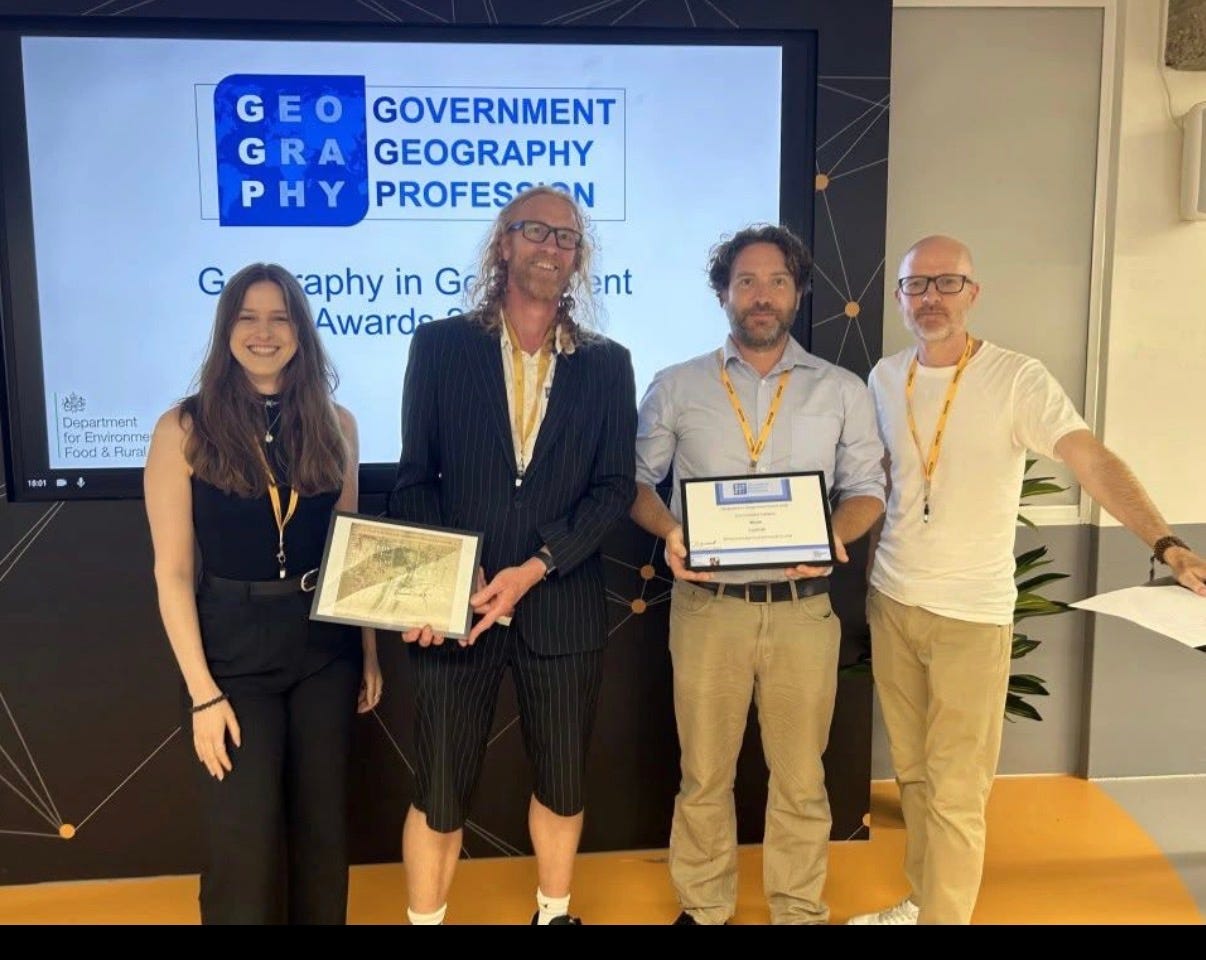
The Geography in Government (GiG) Awards are annual awards organised by the Government Geography Profession, recognisng outstanding applications of geographic knowledge and skills in government policy and practice.
The CoastCraft educational game was shortlisted for in the Communications category, which recognises government teams, individuals or products who effectively use geographic knowledge and skills to improve public communication. This includes creating clear, engaging and informative materials that help policymakers, stakeholders, and the public understand complex geographic data and its real-world impact.
The project is overjoyed that the CoastCraft game won in this category. It is a reflection of the value of educational gaming in improving coastal literacy and helping game users understand the challenges associated with adaptation pathways.’
This follows the BETT Award the project won in January of this year.
Learn about the features of coastal landscapes along with coastal processes.
Understand the characteristics of sand dune ecosystems, sand dune succession and how sand dunes are used as a nature-based solution for flooding and coastal erosion.
Explore a range of coastal management strategies to respond to predicted changes resulting from climate change and sea level rise.
Explore and visualise a range of potential futures influenced by the interactions with communities and stakeholders and the choices made by coastal managers.
And did I mention that we won a BETT award!
The Judges praised Coast Craft as an
“authentic digital learning experience that brings climate change and coastal geography vividly to life. By connecting curriculum content with real-world data and presenting it in a Minecraft-style environment, it enables pupils to learn through interactive simulations and understand the future impact of decision-making."
I worked on Coastcraft to create the Teacher Pack and also inform the creators about the best way to link to the curriculum, and what it should focus on. This work was as a consultant to the Geographical Association - another of many projects I've completed.
Good to see the Coastcraft game that I helped create educational materials for (on behalf of the GA) was featured on ITV regional news. Thanks to the students and teachers who trialled the game and provided feedback.
CoastCraft places the player in the role of managing the coast and making decisions for the needs of the community and the environment. The player can explore and visualise the future impacts of the decisions made and evaluate varying approaches to managing the coast.
CoastCraft is an educational game designed for students aged 9-14 (in England - Upper Primary Key stage 2 and lower secondary key stage 3.).
This game transports players to the coastal town of Bude in North Cornwall, modelled in Minecraft Education™ by BlockBuilders. Playing CoastCraft introduces students to the dynamic processes shaping coastal areas and challenges them to make decisions that balance the needs of various stakeholders while protecting the environment.
It was great to work with Tom Collins and colleagues from the Environment Agency. I learned a great deal from the coastal experts that were also involved in the project.
Learning objectives General
Learn about the features of coastal landscapes along with coastal processes.
Understand the characteristics of sand dune ecosystems, sand dune succession and how sand dunes are used as a nature-based solution for flooding and coastal erosion.
Explore a range of coastal management strategies to respond to predicted changes resulting from climate change and sea level rise.
Explore and visualise a range of potential futures influenced by the interactions with communities and stakeholders and the choices made by coastal managers.
Stage 1: Mini-games Mini-game 1: Storm Tower Erosion: 1. Learn about the processes of weathering and erosion acting on the coast. 2. Understand the impacts of coastal erosion on people and the environment. Mini-game 2: Dune Rollback and Succession: 1. Learn about the processes of sand dune formation. 2. Understand the characteristics of sand dune ecosystems, the process of sand dune succession and how healthy dune ecosystems develop. 3. Learn how sand dunes are used as a nature-based solution for flooding and erosion at the coast.
Stage 2: Main Game 1. Understand the concept of sustainability in relation to sustainable decision making in coastal locations. 2. Learn about the strategies and complexities of coastal management and how experts make informed decisions to manage coastal challenges. 3. Model how climate change, physical processes, and human decision-making interact to shape and transform coastal landscapes over time. 4. Explore and visualise a range of potential futures influenced by the interactions with communities, stakeholders and the choices made by coastal managers.
Please refer to the CoastCraft Teachers Pack in Supporting Files for more information.
I worked on this and I'm really pleased with how it's turned out. Here's the front cover. This can be downloaded from the link above and acts as a guide to coastal erosion as well as providing guidance on how the game works.
Finally, here's an excellent video guide made by Block Builders.
Caroline Douglass, Executive Director for Flood and Coastal Risk Management at the Environment Agency, said:
Coastal erosion is a natural and ongoing process and England’s coastline has never been static, but we know climate change is increasing the risks.
CoastCraft inspires young people to use their creativity to experiment with solutions to real world problems within the virtual Minecraft world, ensuring the next generation has the knowledge they need to face challenges now and in the future.
Floods Minister Emma Hardy said:
As a former teacher, I’m thrilled that CoastCraft will help young people understand the impacts of our changing climate, empowering a new generation of scientists.
This virtual Minecraft world brings coastal change in communities like Cornwall to life, to show how the risk of flooding and coastal erosion is increasing due to climate change.
We’re investing a record £7.9 billion in capital funding over 10 years to better protect these coastal communities and are committed to making sure flood risk management is fit for the challenges we face now and in the future.
Loic Rich, Cornwall Council’s cabinet member for environment and climate change, said:
We’re really proud that our coastal community of Bude serves as the backdrop to this innovative game that teaches young people about coastal and flood resilience.
We want to say a big thank you to students at Sir James Smith School in Camelford and Windmill Hill Academy in Launceston, both of whom worked with our climate adaptation team to help develop and test CoastCraft which can now be played by young people across the globe.
Alan Nicholls was another of those relatively rare people who was a geography teacher when he became GA President, and a great proponent of Environmental Studies.
In Balchin's Centenary book, he is described as an "active Head teacher" and in an Annual Report in 1971 as a "revered practising schoolmaster". I delved and found out that he served on the Secondary Section Committee (as I did for many years) and was a member of the Central London Branch of the GA - which suggests he taught in London, and later found out that he succeeded another GA President Leonard Suggate as the Head of Geography at St. Clement Danes School in Hammersmith, London. Here's an image from a Facebook page for the school. For a while, the only one I could find.
New Geographies over Forty Years was the name of his Presidential Address, given in January 1973, and by all accounts from the description, a humorous one, although it was not apparently printed in 'Geography' and not available to view unfortunately. I wonder whether a copy exists anywhere? 1971 saw a surge of interest in the quantitative methods, so perhaps he referred to those, and how the might translate into school geography? I would like to guess that he did, given the timing of his address a few years after the Madingley Conferences.
In that year, the GA Spring Conference (as it was called) was held at the London School of Economics, where it was held quite regularly.
Prior to being President, Nicholls was also Assistant Honorary Treasurer of the GA as well - another President to hold that significant (and voluntary) role.
Environmental Studies was one area of interest which he pursued, and this is a reminder of the different strands of geography which are picked up by different Presidents for their theme, address and also perhaps areas of interest while in the Presidency.
This area was also picked up in the Professorial Address of C. A Fischer, I have previously blogged about from my British Library research.
Nicholls article on Environmental Studies was also useful - see the link below
This was featured in a book on the development of this branch of Geography
Nicholls was chosen as the GA's representative on the Inner London Education Authority (ILEA) geography board in 1966, and I assumed from early research that he was more of an academic geographer, but this was not the case.
I presumed from that appointment he taught in London, and that was what Richard Daugherty (another former GA President) thought when I asked him about connections with Presidents who were in post near to his own Presidency.
Ten years ago almost to the day and from this platform, Professor Kirk said 'modern geography was created by scholars, trained in other disciplines, asking themselves geographical questions and moving inwards in a community of problems; it could die by a reversal of the process whereby trained geographers moved outwards in a fragmentation of interests seeking solutions to non-geographical problems'. Might not this be prophetic for us today? Could it not all too soon prove disastrous if the trained teachers of geography moved outwards as teachers of environmental studies seeking solutions to non-geographical problems? (Nicholls, 1973, p. 201)
This quote would also chime with those who explore the value of teacher subject knowledge, a current interest of many.
Following another thread, I found a small obituary tucked away in Geography in 1981.
He was born in 1910 in Cornwall, and died in 1981. He went to Truro School. He was made an Hononrary Member in 1980 just before his death.
I'm grateful to Fiona Hirst, archivist from the Clement Danes School for sending me another image of Alan Nicholls from later in his career.
NICHOLLS, A. D. “Environmental Studies in Schools.” Geography, vol. 58, no. 3, 1973, pp. 197–206. JSTOR, www.jstor.org/stable/40568109.
“The Geographical Association.” Geography, vol. 66, no. 4, 1981, pp. 320–322. JSTOR, www.jstor.org/stable/40570442.
I managed to find some images on a Facebook group page that was dedicated to the school, including an excellent image shared from a field trip back in 1953. This is one of my favourite images on the whole blog.
Thanks to the people who put the website together.
Here's Alan Nicholls on a Geography fieldtrip (presumably to North Wales) Top of Snowdon, North Wales, 1953. Photograph taken by Jack Harvey and sent in by Geoff Skinner
He is fourth from the right on the front row and is described as "Old Nick" which seems fair. He seems to be having a good time as well. Some good fieldwork wear on display here, and great to see a President actually 'in action' doing some geography.
Thanks to Fiona Hirst for the additional details and image from the school magazine 'The Dane'
Updated November 2023
Revisiting past Presidents to see if I could find updates and came across an obituary in the RGS's Geographical Journal.
This reinforces his links with the RGS as well as the GA. He was the Chairman of their Education Committee and also served on Council. He studied at the University of Exeter. He travelled extensively.
He was a Cornishman.
"Good teachers are keen on their chosen subject and find it stimulating."
“Obituary: Alan Durward Nicholls (1910-1981).” The Geographical Journal, vol. 147, no. 3, 1981, pp. 394–394. JSTOR, http://www.jstor.org/stable/633763. Accessed 1 Nov. 2023.
1964: Nearly disastrous expedition from the
Falmouth Spring Conference to the Scilly Isles, in the SS Scillonian - one of the roughest passages
for many years.
This passage in Peter Fox's chronology intrigued me.
At the time there were some summer and spring field excursions, which were very popular as they predated (just) the main travel agents / package holiday business.
The excursion formed part of the 1964 Spring Conference in April, which took place in Cornwall.
You woll see reference to many former Presidents in the speakers list, including David Leslie Linton. who will be coming up next in 1964, talking about tors and granite, which must have been a great pleasure for those involved.
It seems that there was a voyage on a ship to the Scilly Isles which encountered particularly rough weather.
Source: “The Geographical Association.” Geography, vol. 49, no. 3, 1964, pp. 346–348. JSTOR, www.jstor.org/stable/40566391. Accessed 22 Apr. 2020.