Showing posts with label Presidential Address. Show all posts

Monday, 13 April 2026

GA Conference 2026 #3: Some key sessions

A few of the sessions at the conference were broadcast live on YouTube and will be available for a while...

Catherine Owen's Presidential Lecture


Ilan Kelman's Keynote Lecture


The Rex Walford Memorial Lecture by Vicki Pountney

Wednesday, 31 December 2025

'The Geographer as Scientist'

From my visit to a wonderful second-hand book shop called ‘Peter’s Books’ (probably the best in East Anglia), I now have a 1956 copy of ‘The Geographer as Scientist’ by S.W. Wooldridge. 

He was GA President in 1954 and also President of the IBG and Chair of the Field Studies Council. 

There are some excellent essays, including his own GA Presidential address, with plenty to say about teaching and the rle of the GA, RGS and FSC and how it has changed.


Saturday, 16 August 2025

Dudley Stamp's "Geographical Agenda'"

I've been reading around the future of geography and came across a piece by Michael Wise in a collection which was edited by Russell King for the GA back in 1985.

He referred to Dudley Stamp's "Geographical Agenda" which was laid out in his Presidential address when he was President of the Institute of British Geographers in 1957 before they joined up with the RGS.

Available on JSTOR.

Wednesday, 24 January 2024

GA Conference Programme 2024

Those who have already booked their early bird tickets, or are yet to book their tickets can now see the full programme for the GA Conference 2024.

I've got two inputs into the event. I'm running a book club featuring the book 'Dust' by Jay Owens. I'm hoping Jay will also be there in person.


I'm also presenting a lecture plus called 'Wake up and smell the Geography!' on the first session of the 5th of April.

Excited to see friends old and new and particularly the sessions from John Wilkinson and Sharon Witt and Helen Clarke - always wonderful....

Sunday, 8 September 2019

1934: Rt. Hon Lord James Scorgie Meston

Last updated August 2023

When I started this blog post, I couldn't find a great deal about Lord Meston's geographical 'credentials', so had to do a little more digging than usual. 

We are moving into a period when the Presidents don't have Wikipedia pages which are as detailed in all cases as some of the earlier, or slightly later ones.

I then came across a piece on the RSGS website, which gave me a way in to finding out more.

Lord Meston was involved with Geography for many years it seems, particularly in Scotland, although there was still little about his time at the GA.

On 24th October 1934, the Royal Scottish Geographical Society celebrated its Golden Jubilee. The newspapers were full of the arrival of the Duke and Duchess of York, who were visiting the Society as representatives of its Patron, King George V.
In the Usher Hall in Edinburgh, RSGS members joined delegates from other scientific and geographical societies at an afternoon reception for 2,000 guests. This was the opening session of the Society’s Edinburgh branch, and the Duke of York had agreed to present some awards. Among the recipients were Isobel Wylie Hutchison, who was awarded the Mungo Park Medal for her explorations in the Arctic, and Lord Meston of Agra and Dunnottar, who received the Scottish Geographical Medal “for distinguished services to geography over a period of many years.” 

After the ceremony, Lord Meston, a statesman whose family hailed from Aberdeen, addressed the company on the subject of India.

Source: https://rsgs.org/the-kings-speech/

His interests were wide, and he was also the President of the Royal Statistical Society.
There was a strong connection with the Royal Scottish Geographical Society, which continued.

He received the Scottish Geographical Medal from the Royal Scottish Geographical Society in 1934. This led me to a useful biography, and as an RSGS medal winner myself gave me a connection with Scorgie Meston.

Sir James Scorgie Meston. 1st Baron Meston KCSI, was a prominent British civil servant, financial expert and businessman. He served as Lieutenant-Governor of the United Provinces of Agra and Oudh from 1912 to 1918. He passed the Indian civil service examination in 1883 and was posted to the North-Western Provinces and Oudh in 1885 (which later became the United Provinces of Agra and Oudh), where he was director of land records between 1897 and 1899 and financial secretary to the government between 1899 and 1903. From 1905 to 1906 he briefly left India to act as an adviser to the Cape Colony and Transvaal governments in South Africa.

After his return to India in 1906, Meston was secretary to the finance department of the government of India until 1912, when he was appointed Lieutenant-Governor of the United Provinces of Agra and Oudh. He remained in this position until 1918, when he became finance member of the Viceroy of India's executive council. In 1917, along with Sir Satyendra Prasanno Sinha and Maharaja Ganga Singh, he assisted the Secretary of State for India in representing India in the Imperial War Cabinet and Conference.
After the war, Meston, along with Lionel Curtis, was the main designer of the Institute of International Affairs, and served as chairman of its first governing body from 1920 to 1926, of its publications committee and of the editorial board of International Affairs. Apart from this, Meston was also vice-chairman of the Supervisory Commission of the League of Nations. He sat on the Liberal benches in the House of Lords and served as President of the Liberal Party organization. He was also involved in business and served as chairman and as a board member of several companies.

Meston was made a CSI in 1908 and a KCSI in 1911 and in 1919 he was further honoured when he was raised to the peerage as Baron Meston, of Agra in the Indian Empire and Dunottar in the County of Kincardine.

In 1935, he gave his Presidential Address, which was on 'The Geography of an Indian Village.' He had spent a considerable time involved in the administration of India.


In the Address, he described his travels in India, from the perspective of someone who had lived there for a long period.
He also suggested that, as Fairgrieve explained the following year, the object of the Association was to spread interest in the population about the subject through supporting teachers.
I could find little else about his time working for the GA, but then came across an obituary. See the Update.

Image from the National Portrait Gallery.
Image - shared under CC license
James Scorgie Meston, 1st Baron Meston
by Bassano Ltd
whole-plate glass negative, 9 October 1923
NPG x122702
© National Portrait Gallery, London

A plaque with his name can be seen at Aberdeen University.

References
https://rsgs.org/the-kings-speech - link to medal ceremony at the RSGS

https://en.wikipedia.org/wiki/James_Meston,_1st_Baron_Meston - more details once I'd established the correct Lord Meston. Added his GA Presidency to the page.

“THE GEOGRAPHY OF AN INDIAN VILLAGE. ADDRESS TO THE GEOGRAPHICAL ASSOCIATION, By the Rt. Hon. BARON MESTON OF AGRA AND DUNOTTAR President, 1934-35.” Geography, vol. 20, no. 1, 1935, pp. 1–12. JSTOR, www.jstor.org/stable/40559216.

Obituary: G. F. S. “Lord Meston 1865-1943.” Journal of the Royal Statistical Society, vol. 106, no. 3, 1943, pp. 294–296. JSTOR, www.jstor.org/stable/2979981.
I amended this entry to add his GA Presidential role and RSGS Medal award.

Some papers: https://discovery.nationalarchives.gov.uk/details/c/F42492

https://saalg.blogspot.com/2018/04/meston-formation-of-civil-servant.html

If anyone has further information on this President and his time at the GA please get in touch. This is quite a slight entry compared with some of the others.

Update - late September

“LORD MESTON.” Geography, vol. 28, no. 4, 1943, pp. 120–120. JSTOR, www.jstor.org/stable/40562330

Updated November 2020
Sir James Scorgie Meston succeeded Sir John Hewett as the Lieutenant Gov. of the United Provinces of Agra & Oudh in 1912. He was looked upon as progressive and was very keen on public constructive works.

This may not have been the view of those in the United Provinces at the time of course.

Updated August 2021


James Scorgie Meston, 1st Baron Meston

by Bassano Ltd
whole-plate glass negative, 9 October 1923
NPG x122705

© National Portrait Gallery, London

Updated August 2021


Updated August 2022

I came across this document with his Presidential Address in 1934 from the Scottish Educational Journal. It has been posted separately.

Updated August 2023


He was appointed Secretary to the Finance Department, the Government of India in 1906 and, while holding that position was a temporary Finance Member of the Governor-General's Council and a member of the Imperial Legislative Council. Awarded the C.S.I. in 1908, he was knighted in 1911.
In 1912, he was made Lieut-Governor of the United Provinces and was in that post when the last World War began.
His wide knowledge of conditions in India led to his being summoned to London in 1917 and made representative for India in the Imperial War Cabinet.

Monday, 1 July 2019

1921: Professor Gilbert Murray, LLD, FBA, MA, OM

Updated August 2023

“I could not give up Greek; but for the rest I seemed to have no choice. I saw what War was; I saw many of my best friends and pupils killed in the flower of youth; I saw the cruelties, the lapse into barbarism, and the ultimate poisoning of all human relations that followed from the Great War. I had to give what powers I possessed to the movement for making secure some peaceful life for mankind, not merely avoiding war, but preventing war by the formation of a Society of Nations.” 

Gilbert Murray, speaking at a dinner held on 13 February 1936 in honour of his 70th birthday.

Professor Gilbert Murray was an important figure in philosophy and classics, and Greek in particular, and from the biographies I have discovered, he had a remarkable life and varied career, although he was not particularly a geographer, and is well remembered even today as well as being honoured during his lifetime.

He was born in Australia, but was sent to study in the UK, with some time spent being educated at the Merchant Taylor's School.

As with several Presidents I have written about at this time, he didn't have an obvious connection with geography and education. He was another person involved in this period of change in the Association, when the plan was to bring in distinguished outsiders with geographic interests to strengthen the standing of the Association.

Murray was the Regius Professor of Greek at Oxford (Somerville College) from 1908 to 1936 (so was in post during his time at the GA), and also a Professor of Greek at Glasgow University. They have a Gilbert Murray Memorial Lecture which is held every three years.

He seems to have been quite supportive of female scholars.


His Presidential Address also had a 'Classical' feel to it.
It was called
Orbis Terrestris


Source: https://archive.org/details/geography11a12geoguoft/page/n33/mode/2up

This is an interesting address, which has very little actual 'geography' in it to begin with, but explores some ways in which the Earth was conceived of by early scholars.
He uses less than PC language about 'foreigners", although he says that some of our views on them comes from not really understanding the differences and the similarities between us.

"With increased knowledge of the world", he says, "we get to see the reasons for the differences of custom, and they cease to be so upsetting."

However, the next section is not quite as forgiving. "It is the same with physical characteristics. Europeans are often conscious of the smell of negroes and dislike negroes accordingly."
And then redeems himself again.
"But a very little anthropology teaches us that all human beings smell.... a Japanese waiting maid is apt to fall in a faint at the smell of a number of Europeans... When knowledge and understanding come in, the peculiar sense of horror connected with the unknown vanishes."

He continues by speculating on relations between countries which may be to come, referring to the League of Nations, and possible relationships between Africa and Europe with regards to "exploitation".
I came across this film of Murray speaking, on YouTube.

This is very early stuff.... Hilaire Belloc's clip on his post from 1915 is slightly earlier, but there is only audio of him.
Could this be the first of the GA Presidents for whom some video footage remains? I think it must be! 
Not sure when this was filmed, but obviously quite a long time ago, and when Gilbert Murray was older.


One of his lasting legacies is that he was an original and active member of the Oxford Committee for Famine Relief, founded in 1942, which later became Oxfam.

Another profoundly important GA Presidential contribution - no pressure then...

Order of Merit Dorothy Hodgkin (cropped).jpg
He was deeply affected by the First World War, and became one of the leading figures in promoting world peace through the League of Nations, as did the President who came after him (of which far more to come later)

He was a particular scholar of the poetry of Shelley.

He was awarded the French Order of Merit (OM) - pictured to the right... again, I'm not sure of any other Presidents who were similarly honoured.

I may need to go and visit this at some point. Any images of the memorial welcome.

Are any other GA Presidents similarly honoured in the place of their burial?

The inscription on the grave is translated as:

GILBERT MURRAY O.M. An example of true humanity, while he lived the letters of the ancient Greeks lived again, nor was there any reason to despair of the harmony of peoples. 1866 1957

References
https://wikivisually.com/wiki/Gilbert_Murray

https://gilbertmurraytrust.weebly.com/about-gilbert-murray.html - Gilbert Murray Trust

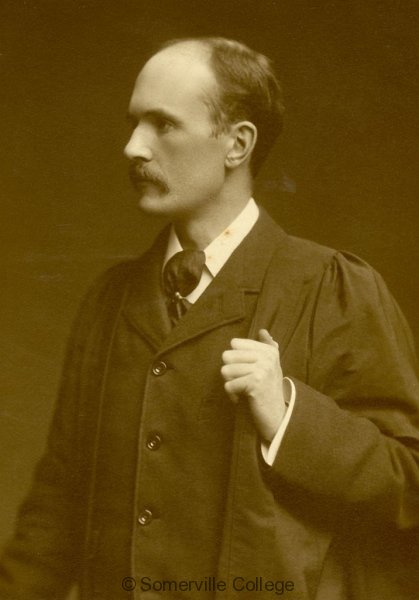
Somerville College: http://blogs.some.ox.ac.uk/archive/2011/09/22/gilbert-murray/ - source of the image, to which they hold the copyright - used here under Fair Use.
https://universitystory.gla.ac.uk/biography/?id=WH2276&type=P
 - Glasgow University

His papers are held at the Bodleian Library: http://www.bodley.ox.ac.uk/dept/scwmss/wmss/online/modern/murray/murray.html

GA Presidential Address:
“Orbis Terrestris.” The Geographical Teacher, vol. 11, no. 1, 1921, pp. 5–14. JSTOR, www.jstor.org/stable/41553245.

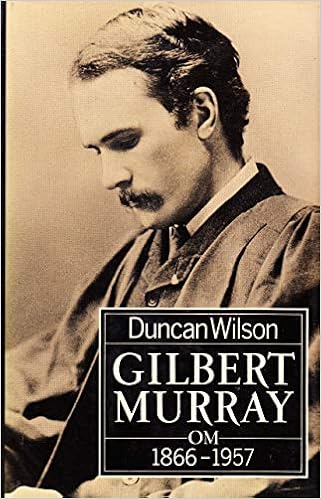
Biography of Gilbert Murray, written by Duncan Wilson


As always, if anyone has anything else to add about Murray's contributions to the GA, particularly during his time in office, get in touch.

Updated August 2023
A Somerville College link here:


An intriguing connection here with the Second World War and anti-Nazi activity.

And an even more interesting (perhaps) link here is to the formation of the charity Oxfam. This started as the Oxford Fund for Famine Relief, and Gilbert Murray was in the group that founded it, along with Vera Brittain and Edith Pye.


I looked at this in more detail:

On January 27, 1942, George Bell, the bishop of Chichester, spoke to the House of Lords in support of an appeal for Greece. Later that day the House of Commons announced that a shipment of wheat would be sent from Egypt, through the Allied blockade, and on to Greece. Within several weeks, regular shipments of supplies began to reach the devastated nation.

Writer Vera Brittain, who had been involved in humanitarian issues as well, believed that a relief campaign by pacifists Pacifism would not be taken seriously by the British parliament. She encouraged the development of an organization, which would convey a sense of seriousness and focus. Members of the Friends’ Service Council Friends’ Service Council[Friends Service Council](the permanent relief organization of the Quakers) met on April 22 to discuss forming a national famine relief committee; the planned organization was announced on May 29. Longtime Quaker activist Edith M. Pye was named the fledgling committee’s honorary secretary, and she worked to ensure the group’s success by securing supporters.

On October 5, the Oxford Committee for Famine Relief had its first meeting. 
Founding members included Bell and Gilbert Murray, professor of Greek at Oxford University, among many others. 

The committee’s initial objectives were to obtain information on food conditions in Greece and to promote food relief in other occupied countries. In December, London businessman Cecil Jackson-Cole was appointed the new honorary secretary of Oxfam. Jackson-Cole remained a driving force behind the committee for many years, and in 1947 he would help to open the world’s first permanent charity-run gift shop (operated by Oxfam). Situated in Oxfam’s main offices on Broad Street, the store was a drop-off location for donations. Profits from the sale of donated goods went directly to the organization to support its relief efforts.

So a GA President indirectly helped create the charity shop as we know it...


Source: https://wikisummaries.org/oxford-committee-for-famine-relief-is-founded/?utm_content=cmp-true

Margaret Mackintosh RIP

Updated post. Sad news at the end of last week from colleagues who have organised the Charney Conference over the years of the passing of Ma...