Showing posts with label Peter Fox. Show all posts

Sunday, 9 October 2022

Geographers' Gaze Project

I worked on this project with Peter Fox, another former President for over a year and a half on and off, with several meetings at Solly Street and some other work remotely.

Isabel Richardson had done a great deal of preparatory work at Solly Street on the lantern slide collection, which used to number in the tens of thousands. Isabel had been cataloguing the collection.


The plan was to make use of a fund generously donated by former Honorary Treasurer Brian Ellis, to bring these images back out into the open, and provide some ideas for their use in the classroom as well as some context.

I worked with Peter Fox and we co-wrote the accompanying text for each image on the GA website.

The website area is now live, and there is also an article that I have written for the latest GA Magazine.

My original version of the text was a little longer than the final version, which we agreed needed to be a bit tighter to increase the instant accessibility of the resource.

For those who may want a little extra detail on the images, you can download the longer version from Slideshare here - it's over 30 pages long:

Friday, 3 December 2021

A Geographer's Gaze

A couple of months ago, I went up to Solly Street to have another meeting for our Geographers' Gaze project.


We have identified some images from the archive and have created some lesson materials for their use in a number of contexts. They will be appearing on the GA website in 2022, along with other guidance for using images generally and a little context about the significance of lantern slides in the GA's history (and geography).

Thanks to the other members of the team, and to Brian Ellis for funding the project.

Image: Alan Parkinson, shared under CC license

Friday, 12 March 2021

2003: Peter Fox

Peter Fox is one of the contemporary stalwarts of the GA, and has been involved in a wide range of committees, and other activity, including publications for many decades, and continues to work tirelessly to support the association in many ways, serving on Education Group, which is one of the key committees leading thinking and supporting the Chief Executive and trustees.


Peter was born in Derby in 1950, and went to Long Eaton Grammar School (a school I went to for an interview at back in 1988, and was actually offered a job there, but the day previously I'd accepted an offer at a school in King's Lynn, and the rest is... geography). Peter has also written about the history of Derby, and contributed to a number of other books over the years.

From Long Eaton he went on to study at Nottingham Trent University.

When he became President of the Association, he was still involved in teaching, and this makes him a rare thing: a teacher President. He was proud to be one of the first Presidents to be teaching in a state school. I need to just double check but I think all the other teacher Presidents before him were teaching at Independent schools, so he may have been the first, and indeed the only state school teacher President... 

I think I'm only the fifth person to be a teacher President, and have managed to speak to almost all of the others in the process of writing this blog, apart from E C Marchant.
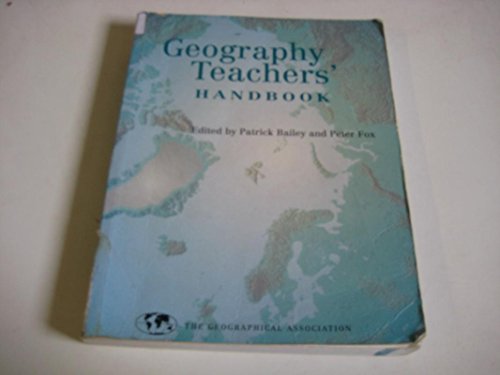

Geography Teachers' HandbookPeter has a strong background in teaching, and has held different roles including Teacher of Geography, Head of Faculty and Assistant Head.

His particular interest has been in educational technology, and he has served on the ICT SIG of the Association for many years. The SIG has been going since the 1970s.

The ICT Special Interest Group
is one of many I visited while working for the GA as Secondary Curriculum Leader, and has created a great deal of content for the GA's website in this respect, as well as providing guidance to others.

Peter co-edited the first (more recent) edition of the Secondary Geography Handbook with another former GA President: Patrick Bailey - the cover is shown above.

Peter told me that Patrick Bailey was very much his mentor, and his involvement with this publication led on to other things within the GA.

I am also grateful to Peter for allowing me to interview him on the early days of the use of computing, for a chapter that I wrote in the 'Debates in Geography Education' book. I looked back at my notes on this chat as well and found lots of helpful thoughts - the book is now in a 2nd edition, and people have referenced the chapter recently in other books, which is always good to see.

Along with Andrea Tapsfield, Peter wrote a number of books and guides relating to the early use of ICT, when its true potential was as yet unrealised, and the idea of CAL or Computer Aided Learning was key.
I have a copy of the book, which is pictured below:

Peter told me that his first published work for the GA was a list of computer software which was available at the time. 
He told me: 
"Interesting looking back on this list to see more software available then than now and many gaming and simulation items - missing from more recent apps - but this was before Internet times!"

His Presidential theme was on the Development of the Media and ICT in Geography.

His Presidential Address was on the same topic, and connected to the use of images in particular. It was called 'Images in Geography: Great Expectations'.


Image: Bryan Ledgard / GA - Derby GA Conference - Association at Work day - Derby was my favourite conference venue.

He was also involved in the creation of the Digital Learning at KS4 project for the GA which went up onto the website some years ago and which I helped with a little. I remember this happening while I was working for the GA and I worked out a way to do a drag and drop style activity in Google Earth.
Here he is being introduced by Chris Kington.

As with other recent Presidents, since Sheila Jones, Peter was also kind enough to answer some questions to me on a Google form.

Why does the GA matter?
Peter told me:
"Geography matters and therefore the teaching and learning of geography matters."
Peter has served on the ICT Working Group, been Honorary Secretary of the GA, and was even the stand-in CEO [part time for a term following the departure of the previous person, as described earlier in the blog], He has also been, for many years, the Honorary Treasurer of the GA (a post now held by Bob Digby), and is currently Chair of the ICT SIG.

Thanks to Peter for replying to my request for help, and completing my questionnaire to help with the creation of this entry.

I have a particular extra link with Peter.

In 2008, I went to Sheffield to have an interview for a job at Solly Street as Secondary Curriculum Leader, and Peter was one of the four people on the interview panel who gave me and the other candidates a real grilling. Other people on that panel have been identified in other blog posts, or will be in due course.

Peter continues to serve on a number of committees, although he is scaling back his involvement a little. I also interviewed him for a chapter for a book I wrote for Routledge, asking him for his memories of the early days of ICT in the school classroom as mentioned earlier in the post. Looking back, Peter said:

"I would hope that the GA has always had a role in the development of technology and learning - Sound, Vision, Media, ICT..." - as I recently completed several consultancy jobs in this very area, this certainly seems to be the case at the moment.

Peter has attended a number of the GA Study Tours and was involved in one tour which was also mentioned by Chris Kington. This was to Poland, and I blogged about it here.

His involvement with the GA continues to this day and he and I are involved in a current project which will be publicised later in the year.

If anyone else has memories of Peter Fox and his work with the GA please get in touch.

References

Fox and Tapsfield (Andrea) - an early book on the use of technology in schools, and published by the GA. I have a copy of this book in my collection.

Presidential adress: FOX, PETER S. “Images in Geography — Great Expectations.” Geography, vol. 90, no. 1, 2005, pp. 3–17. JSTOR, www.jstor.org/stable/40574025. Accessed 12 Mar. 2021.

https://www.geography.org.uk/Project-Team - Digital Learning Project
Peter led a team creating resources for GCSE students, funded by BECTa (a sadly missed organisation, which I completed several projects for, before it disappeared)

Coates, Bryan E., et al. “Annual Report of The Geographical Association.” Geography, vol. 76, no. 2, 1991, pp. 177–188. JSTOR, www.jstor.org/stable/40572070 - one of many similar reports that Peter will have given his name to over the years.

Chronology of the GA: https://www.geography.org.uk/download/ga%20chronology.pdf

Sunday, 14 February 2021

The move to Solly Street #3

I've been writing a few posts about the GA's move to Solly Street. Here's the third and final one.

The next person I consulted over the move to Solly Street was Ashley Kent, who was mentioned by Frances Soar as having been present in the car when the building was first spotted.

160 Solly Street has imposing steel doors, which were manufactured in the building itself as it was owned by a steel fabricator.

When you enter the building, there is also a stair case with steel bannisters.

I hadn't previously been aware of the reason why there so much steel around the place, although Sheffield is 'steel city' of course (and my dad was a steelworker for over 40 years).

Ashley gave me his memories of the move to Solly Street:

"My flawed - no doubt!? - memories were of driving round...with Frances I am sure at least, looking at premises in the Meadowhall area.
These were very much new retailing / warehousing / still industrial areas away from the city centre, and the GA staff were a little unhappy about that! 
Also we looked at rental premises at / next to the station but clearly inadequate re size / cost, but accessible for many! 
Solly Street felt like a rundown inner city area but with a big advantage of size and rent. Bizarrely it seems to have been a good decision!"

The premises next to the station were also mentioned by Peter Fox, who I also consulted about this move.

"The recollections are much as I remember them. The Fulwood Road site had its attractions - a nice old stone house with the ground floor used as the GA Library with oak shelves and members of staff housed in different 'bedrooms'. The search for a new home too is as I remember it. I was involved in the search - two properties we looked at were the old bus garage out towards Meadowhall and the refreshment rooms at Sheffield railway station. Very grand still with a huge long mahogany bar in a very good location but the storage space was very limited.
The fire of some of the book stock did mean we had a good clear-out of old stock but we were lucky to keep the Fluere Library books and a complete run of the journals which were not stored there. We got a very good deal on the building which the daughters of the previous owner wanted to get rid of at the time and we did not have too much work to do to get it into shape - it had been a specialist stainless steel factory. We had an official opening by Wendy Morgen - President at the time but most of the GA meetings were still held in London."

It turned out we had our beermeet in the premises that Peter and Ashley looked at the last time that the GA was held in Sheffield.

Image: Alan Parkinson, shared under CC license

Beermeet picture taken by Matt Podbury


Saturday, 14 November 2020

1986-8: Geography 5-16

The DES / HMI published a paper in 1986 exploring the shape of school geography.

The GA published a response to the paper.

This paper is an outcome of GA Task Force' discussion meetings held at Leicester (8th November 1986) and London (7th February 1987) and with HMI representatives at the DES in London (11th November 1986). All these Task Force meetings were under the chairmanship of Patrick Bailey. Other Task Force members - David Boardman, Simon Catling, Graham Corney, Peter Fox, Paul Gwilliam, Paul Machon, Derek Mottershead and Tony Pearce - also contributed to the discussion on which this paper is based. 


References

Rawling, Eleanor, et al. “Comments from the Geographical Association on the HMI Discussion Paper Geography from 5 to 16.” Geography, vol. 73, no. 1, 1988, pp. 41–46. JSTOR, www.jstor.org/stable/40571340. Accessed 14 Nov. 2020.

Wednesday, 15 July 2020

1970s: ICT - the GA at the forefront...

In 1971, the GA joined the Standing Conference of School's Science and Technology (SCSST). This was concerned with the teaching of science and technology.

Computer software was increasing in availability and complexity and although it was expensive and of limited use, the potential was there for it to be used in the classroom. It took a while from here for it to gain traction, and when I started my training in 1986, there were still limited opportunities in many schools.
The GA started its GAPE initiative in 1978.
GAPE: Geographical Association Package Exchange.
The Geographical Package Exchange (GAPE) project enabled computer software to be produced, listed, reviewed and distributed. This was the forerunner of the ICTWG working group.
I have a number of books from this time, which will feature in future blog posts.


Peter Fox was particularly active at this time, and is still involved in the GA's ICT SIG and Education Group. Peter Fox and Andrea Tapsfield also wrote an important book on the use of technology, which will be featured in future blog posts.
I interviewed Peter for a chapter that I had been asked to write for the Routledge 'Debates in Geography Education' book and he told me more details of the support for GA members at that time.
Teaching Geography wasn't published until 1975, but when it was it included a regular feature on software packages with reviews.

Sources:
Hall, David, et al. “Computer Assisted Learning in Geography: The State of the Art.” Teaching Geography, vol. 10, no. 2, 1985, pp. 73–76. JSTOR, www.jstor.org/stable/23751122. Accessed 1 July 2020.

Ron Johnston writing about Stan Gregory's career and links with the GA and ICT appearing:
https://books.google.co.uk/books?id=kVtwDwAAQBAJ&lpg=PA90&ots=AHT4_XIJ21&dq=Geographical%20ASsociation%20Package%20Exchange&pg=PA87#v=onepage&q=Geographical%20ASsociation%20Package%20Exchange&f=false

Margaret Mackintosh RIP

Updated post. Sad news at the end of last week from colleagues who have organised the Charney Conference over the years of the passing of Ma...