Biographies of all the Presidents of the Geographical Association since the founding of the Association in 1893. Researched by Alan Parkinson (GA President 2021-22), with contributions from others, including the former Presidents themselves where possible.
Showing posts with label Field Studies Council. Show all posts
Showing posts with label Field Studies Council. Show all posts
teachers want new ideas for carrying out fieldwork within their school grounds and local area
they want to embed these ideas within their current curricula
they want resources that non-specialists can pick up and deliver
they want resources that will build progression and don’t just repeat the same techniques but in a different context
The sets of spiralised fieldwork resources were created to support teachers by creating a starting point for fieldwork that can be done in the school grounds and local area. They can be embedded in schemes of work, but also can provide suggestions for activities during transition days or simply when the sun is shining and you want to get outside!
There are four sets to get you started; two themes based on water and trees and woodlands and two techniques, Environmental Quality Assessment and questioning techniques. However, we will be adding more over the coming months.
Jon Cannell, GA Primary Curriculum Lead said:
‘The GA and FSC are extremely excited to release a brand-new collection of FREE resources to support the integration and progression of fieldwork through the geography curriculum. Each set of resources provides easy to use activities connected to key themes from across the geography curriculum as well as introducing geographical ways of thinking and understanding.’
This review of an early piece of computer software, created for the BBC, was featured in 'Teaching Geography'. It came out in 1986.
This product was a set of three programs: a simulation model for storm hydrographs, river data analysis package, and a statistical package. It was designed for 'A' level students.
The creators were Steve Hanstock, who was my own GCSE and 'A' level geography teacher at Wickersley Comprehensive and David Butcher, who was my tutor in my final year at Huddersfield Polytechnic. Tim Burt was my original tutor but left during the final year of my course. We have met each other periodically since, and he is still very active in the Field Studies Council.
Reference
“Software Reviews in Teaching Geography.” Teaching Geography, vol. 12, no. 5, 1987, pp. 232–232. JSTOR, www.jstor.org/stable/23751771. Accessed 25 June 2021.
Nick Lapthorn works for the Field Studies Council, and was previously Head of Centre at Nettlecombe Court in Somerset.
He has written extensively on fieldwork, and helped tens of thousands of students experience learning outside the classroom.
Nick was educated at Kingsbridge School and Community College before doing a BSc degree in Topographic Science and Geography at the University of Wales, Swansea.
He has worked at a number of FSC Centres since 1996, including Amersham, Juniper Hall and Nettlecome Court (which was the first FSC centre I visited, with Tim Burt, as an undergraduate geographer)
Nick was an active member of the Geographical Association's 'Fieldwork' group since 2000. During this time he has acted as member, Secretary and Chair of the group since 2010.
He has contributed regularly to GA publications, articles for journals and consultations, and is a regular presenter at GA Conference and more widely promoting fieldwork.
To help communicate with as many people as possible he established the @geogfieldwork Twitter account which now has over 3,500 followers in the UK and overseas.
As with some of the more recent Presidents, he was kind enough to pass on some information via my Google Form.
Nick was born in 1973 South Devon (Torbay)
He attended Kingsbridge School and Community College (now Kingsbridge Academy). and the University of Wales, Swansea (now Swansea University)
He told me of his carreer path:
"After university I moved from washing dishes in a pub in South Devon to washing dishes as a general assistant at FSC Juniper Hall. Coming from a family of teachers I have vowed not to become involved in education and thought that an address at a field centre, whilst looking for gainful employment was better than a pub. During my time off shift I used to support the geography tutor with fieldwork on Box Hill and quite enjoyed and found out that I was also not too bad at it.
When the tutor left to take up a PGCE, I was encouraged to apply for the post and got it. I was already considering by this time doing a PGCE, but hadn't decided if I wanted to do primary or secondary (my father was a primary teacher). I progressed from Tutor to Senior Tutor at Juniper Hall to being Head of Centre at FSC Amersham and then back to Juniper Hall as Head of Centre.
In 2010 I moved back to the west country to become Head of Centre at FSC Nettlecombe Court."
Nick was working as Head of Centre at Nettlecombe Court when he was GA President.
Nick's conference theme was 'Real World Geography'.
He told me:
"In spite of having a love for geography as a subject it wasn't really until I started to assist with fieldwork that my passion really came alive. So many elements of the subject seemed to make much more sense when it became a hands-on subject - things just started to make more sense. I knew that if this was the case for me, then that must be the case for many others too. My theme was to highlight the role of geography in the many aspects of daily life. In the last couple of years of being Chair of FOLSIG we pushed forward the 'Year of Fieldwork' that worked across the subject community involving GA, RGS-IBG, Esri, Ordnance Survey, FSC and 21 further partner organisations. As a result I was shortlisted for a LOtC Advocate Award by the Council for Learning Outside the Classroom."
Of his links with the GA: "I became involved with the GA in the late 1990s when the Field Studies Council's Chief Executive Tony Thomas suggested that I became involved with the Field Studies Working Group. I was a member for many years followed by being Secretary and then Chair (2010-2016) as it became the Fieldwork and Outdoor Learning Special Interest Group (FOLSIG). I stepped down as Chair as I took up the role of Junior Vice President."
This is a reminder that if you have some ambition to be GA President, a first step is to involve yourself more closely with the GA. SIGs and PCs offer the chance to be a corresponding member to get involved in their work.
Nick told me that it was a good year to be President when he was...
"It was amazing to be GA President during it's 125th year - something that was brought to my attention about half way through my year as Junior Vice-President when it was agreed that it needed to be marked and celebrated. I spent the next few years suffering regularly from imposter syndrome as you realise the many illustrious footsteps in which you walk and the intellectual shadows you sit beneath.
However the GA was, is and will remain a welcoming and supportive community.
Two main memories - the 125 year celebration event in Christ Church College, Oxford. Wonderful to be part of the celebration at the location where the GA was established 125 years earlier. "
I have previously posted about this event, and shared images.
He shared his memory of conference:
"Everything about it was so special, it feels like a geography wedding! One particular memory I have is bumping into Sharon Witt after my Presidential lecture. Sharon asked if Margaret Roberts had found me yet? No I replied. "Well, she wants a word, I think you are going to like it" she laughed. Later that afternoon I did meet Margaret. "Ah, Nick, I'm glad I found you. I just wanted to say how much I enjoyed your lecture. Not very academic, but entertaining nonetheless." I did like it. I was more than satisified with the review!"
I can share that feeling.... I have presented a few times with Margaret in the audience and it certainly sharpens the mind :)
You can see Tony Thomas and Rob Lucas on the right of the photo above, supporting Nick.
Of his memories of his GA year he also says: "Working with the Worldwise Challenge weekends with Mark Higginbottom, Sue Lomas and John Lyon - I can't think of many weekends in my life that I have enjoyed more. Working with young people, engaged in the subject that they enjoy and that we love in beautiful locations and often laughing until the tears rolled down my cheeks."
Image: Bryan Ledgard / Geographical Association
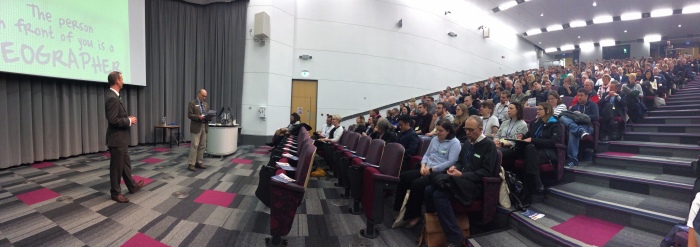
In his Presidential lecture Nick talked about how everyone is a geographer, and why Geographers should always be able to claim the window seat on planes.
Professor Simon Catling is a true gentleman, and a giant in the field of geography education, with a particular interest in Primary Geography and outdoor education, as well as the education of Primary teachers. Here he is in his study in a recent image sent by Simon himself.
For many years he has been involved in steering the development of the Charney Manor Conference - one of the key events in the Primary calendar for teacher educators.
I'm proud to have a chapter in this book which Simon Catling edited and collated for the 20th Charney Primary Conference, which took place in 2017, which I attended.
He is also someone who has always been receptive to new ideas, particularly in the field of outdoor education. Here he is chatting to Daniel Raven Ellison: an innovator himself, at a previous GA Conference.
One additional reason to get a copy (in addition to getting my piece) is a auto(geo)biography written by Simon in the introduction to the book.
Simon has been involved in and with the GA from the 1970s onwards.
I came across a contribution that Simon made to the GA Conference all the way back in 1980, when he was working at a Junior School in London, as he mentioned in his CV.
I'm grateful to Simon for passing me through a whole range of information on his career and contributions to geography, which have been immense.
Here is what Simon told me:
Simon was born in Leicester, UK on September 3rd, 1947.
Where did you go to school/
university? Town Close Preparatory School, Norwich, Norfolk. September 1954 to April 1956.
Melbourne Lodge Preparatory School, Claygate, Surrey. April 1956 to December 1960.
Tonbridge School, Tonbridge, Kent. January 1961 to July 1965. Gained O levels and A
levels (including geography at both levels).
St. Mark and St. John College of Education, Chelsea, London. September 1967 to June
1971.
Gained a BEd degree in geography and education, qualifying as a primary teacher.
University of London Institute of Education. September 1971 to September 1973. Part-time. Gained an MA in Geography Education. The image here was provided by Simon, and shows him aged 21. What has your career been?
1965-67: Teacher at Daneshill Preparatory School, Oxshott, Surrey. I taught geography
through the school, as well as mathematics and English to some younger classes.
[This was to check that I wanted to teach. I was unqualified and a teenager (18 and 19 years old).]
1971-72: Full-time Sabbatical President of the University of London Institute of Education
Students’ Association (ULIESA). ULIESA was the federation of all the Colleges and
Departments of Education which were accredited by the Institute of Education, University of
London (about 35 all told). [I got involved in student politics from 1969, which led to being
elected to this post and becoming involved a little in NUS politics.]
1972-1975: Class 3 and 4 teacher at Melcombe Junior School, Fulham, London. Also
promoted to be responsible for humanities and boys’ games: 1973-75.
1975-1980: Class 5 and 6 teacher at Sheringdale Primary School, Southfields, Wandsworth,
London. Appointed to this promoted post with responsibility for boys’ games and humanities,
then later school journeys.
1980-1984: Deputy Head teacher at Southmead Junior School, Southfields, Wandsworth,
London. Also responsible for humanities and school journeys. [From where I moved into HE
and ITE.]
1984-2012: Variety of posts and roles in the School of Education, Oxford Brookes University
(Oxford Polytechnic to 1992), Oxford, including senior lecturer in education (1984-1990),
lead for primary geography (across the whole period), lead for primary humanities (1984-
2000), principal lecturer responsible for initial teacher education (1990-1995),
Deputy Head of the School (1995-1998)
Acting Head of the School (1998-2000),
Deputy Head of the (retitled) Institute of Education (2000-2008).
From 2001 I was appointed Professor of Education, which in 2008 became Professor of Primary Education, and Emeritus Professor in 2012.
Simon has contributed to, or written hundreds of books, chapters, papers and articles, including many articles of GA journals.
e.g.
Geographer and the Child in 1992.
Catling, Simon. “Guest Editorial: The Geographer and the Child: A Fragment in the Story of Geography.” Geography, vol. 77, no. 4, 1992, pp. 289–291. JSTOR, www.jstor.org/stable/40572250. Accessed 6 Dec. 2020.
Simon told me about his long association with the Geographical Association:
"I have been a member of The Geographical Association since 1967 and first became involved with
its committees in 1975. In 1984 I was privileged to be invited to chair its Education Committee,
during a period of considerable upheaval, change and decision making in relation to geography in
the school curriculum, in which I was centrally involved. We emerged from this successfully. This
included leading and writing the GA’s response to the proposals for a national curriculum and in
relation to the proposals for the first geography national curriculum, including initiating and
contributing to a book submitted to the Geography Working Group in 1989.
In 1990 I was invited to become President of the Association for 1992/93. This involved chairing
and leading the planning of the Annual Conference in 1993, the Centenary Year of the
Association, which involved entertaining the Princess Royal and other dignitaries as well as giving
my Presidential address.
I was the first primary specialist to hold this role.
I have always been involved with the Primary Committee since 1975, rejoining it after a period away from it in 2005.
1975-90 Member of Primary and Middle Schools Section Committee
1983-87 Chair of Primary and Middle Schools Section Committee
1984-90 Chair of Education Standing Committee
1985-88 GA representative on the Education Committee of the Historical Association
1985-88 Geographical Association Representative on the Ordnance Survey/Royal Geographical Society Education Committee
1990-91 Junior Vice President of The Geographical Association
1991-92 Senior Vice President of The Geographical Association
1992-93 PRESIDENT of The Geographical Association
1993-94 Past President of The Geographical Association
1994-95 Member of the Teacher Education Working Group
1994-2002 Chair, Geographical Association's New Initiatives Fund
2002-05 Honorary Vice-President of The Geographical Association
2005-present Member of Early Years and Primary Schools Committee
2010-15 Member of the Independent Schools Special Interest Group
2017 Appointed an Honorary Member of the Geographical Association (for services to geographical education)"
When Simon was the GA President, he was Principal Lecturer for Initial Teacher Education at the School of Education, Oxford Brookes University, tutor for geography education and primary humanities lead.
Simon's Presidential theme was The Whole World in Our Hands, which was the 1993 Conference title, and also the title of his Presidential lecture. Simon decided on this theme because he felt that it encapsulated the nature and role of geography in education, in school geography and in higher education.
He told me:
"It was a busy year, as the new National Curriculum Geography requirements began to be implemented (from 1991-92), which the GA encouraged members and many more teachers to take seriously. There was much follow up work, particularly in developing support and in-service activities. I was involved in inviting the Princess Royal to open the GA Conference in Sheffield in 1993; she spoke very supportively of the Association and about the value of geography and was very well received (her second husband and her nephew both hold geography degrees). I engaged well-known speakers for the Conference from in and beyond the geography education world, including a government education minister, and the UK’s past UN representative, Sir Crispin Tickell. My Presidential Lecture reminded its large audience of the reasons for setting up the GA and its purpose, about what children are able to bring to geographical learning, significant aspects of geography education, and its links with development education. It concluded in setting some goals for the future for the Association (see Geography Autumn, 1993) This seemed to go down well!
Simon is an Honorary Member of the Geographical Association (appointed 2017). He told me a great deal more and I will perhaps add those to a supplementary post. He continues to work hard, and has some papers and other publishing outputs to come in 2021.
Thanks must also go to Simon for subsantive contributions made to some of the other entries on the blog, particularly those of Michael Storm and Norman Graves.
References
There are too many books and articles to mention here, so there is no bibliography here as with some previous Presidents.
Here's Simon talking about the importance of geography quite recently:
Recent papers:
Catling, S (2020) Primary Geography: Onwards and Upwards. Primary Geography, 101, Spring.
Catling, S (2020) Feedback to feedforward: An Author's perspective. Primary Geography, 101, Spring.
Catling, S (2019) Key concepts, In Willy, T (Ed) Leading Primary Geography. Sheffield: Geographical Association.
Eaude, T and Catling S (2019) The role of the humanities in a balanced and broadly-based primary curriculum. Impact, 6, Summer, 59-61.
Willy, T and Catling, S (2018) Geography at the heart of the primary curriculum. Impact, 4, Autumn, 52-55
Catling, S (2018) To know maps: Primary school children and contextualised map learning, Boletim Paulista de Geografia, 99, 268-290.
Recent books:
Catling, S (2020) Everyday Guide to Primary Geography: Locational Knowledge. Sheffield: Geographical Association.
Catling, S & Willy, T (2018) Understanding and Teaching Primary Geography. London: Sage.
Catling, S. (Ed.) (2017). Reflections on Primary Geography. Sheffield: The Register of Research in Primary Geography (via The Geographical Association).
Society Memberships:
1965-68 Associate of The Royal Geographical Society
1968-present Fellow of The Royal Geographical Society
1967-present Member of The Geographical Association
1984-93 Member of The Historical Association
1984-1992 Member of the Historical Association’s Education Committee
1986-94 Member of The Curriculum Association
1995-2013 Fellow of the Royal Society for the Arts
1997-2013 Member of the Field Studies Council
1997-2003 Member of the Executive Council of the Field Studies Council
Important committees:
1979-84 Member of Schools Council Geography Committee
1980-82 Member of Schools Council Graphicacy Working Party
1990-91 Member of National Curriculum Council (NCC) Committee B (covering Science,
Mathematics, Geography and Technology)
1990-91 Member of the National Curriculum Council (NCC) Task Group on Geography
1992-93 Member of the Geography Committee of the School Examinations and Assessment Council (SEAC)
1998 Member of Key Stages 1 and 2 Geography Schemes of Work Working Group of Qualifications and Curriculum Authority (QCA)
2005 Member of QCA Futures Project National Geography Forum
2005 Member of the GA/RGS-IBG Power of Geography Forum
2013 Member and Vice-Chair of the Expert Group for Geography in ITE of the
DfE/National College of Teaching and Leadership
2013-14 Co-Chair of the Geography Expert Advisory Group of the DfE
2014-16 Member of the Geography Expert Advisory Group
Simon has also been the Governor of Primary Schools for over 25 years, completing the 'set' of school involvement.
To end Simon's entry, here's a characteristically important statement that he thought to make with regards to the value of the Solly Street staff:
".... the most important thing as a past President of the GA is to honour and thank the staff of the GA Headquarters office, who have provided invaluable, exemplary and ever-present support over the past few decades that I have been involved in the GA. During my Presidential year they were superb. Much has changed in the way the GA works since I became involved in 1975 and particularly since I began chairing committees in the 1980s. I have contributed to some of these developments, in small part, from time to time. The staff have always been there for us all, have provided the service we needed and ensured in the kindest ways that we followed up on what we committed ourselves and the Association to do. During my involvement I have seen the publications of the GA burnished and prosper hugely to the Associations’ benefit. The publications staff do an amazing job getting out three journals and the members’ magazine three times a year, and a wide variety of topical and significant publications to support and enable primary and secondary teachers to keep improving and developing geography teaching, as well as now keeping us up-to-date digitally. The publications are of the highest quality and are envied by other subject associations and many national publishers. Through good and rough times the GA staff have been and remain our mainstay."
If anyone has any further memories of Simon please pass them through.
If you go to Solly Street and go through the door immediately to the right of the entrance, you will be in his Primary archive room.
Update - December 2020
I was reminded that Simon was also involved in the development of this article: on the idea of geographical significance.
There is also a personal connection here. When Liz Taylor was writing the book and trialling the ideas in it, she was leading the PGCE course at Homerton College, University of Cambridge. We always had colleagues from Homerton in the school where I taught - in fact I worked closely with two of them when working as Head of Department, who we employed when they finished their placements with us. We got a mention at the end of the article:
Reference
Taylor, Liz, and Simon Catling. “Geographical Significance a Useful Concept?” Teaching Geography, vol. 31, no. 3, 2006, pp. 122–125. JSTOR, www.jstor.org/stable/44633462. Accessed 23 Dec. 2020.
I have previously blogged about the Field Studies Council's 75th Anniversary celebrations which were attended by quite a few former GA Presidents, and the Past and present GA President. They presented and were mentioned in other presentations, particularly one by Professor Tim Burt, my former tutor when I was an undergraduate at Huddersfield Polytechnic back in the day.
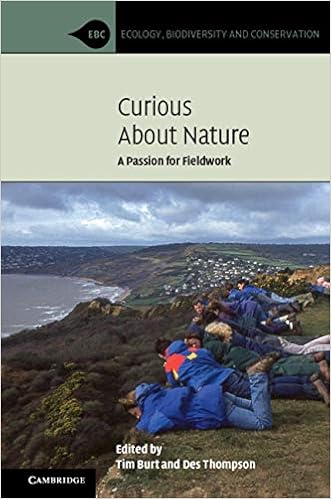
This event was also a launch event of a kind for a new book called 'Curious about Nature', which was written by Tim along with Des Thompson. This explores the development of field studies and the contributions of individuals. It is available to purchase from all good book shops, and a sample can be viewed on Google Books - see the link at the bottom of this post.
A few GA Presidents of note are mentioned in the book, when they had a link with the development of fieldwork.
There is a mention for Geoffrey Hutchings, the master of the fieldsketch.
This is followed by a paragraph on the influence of Sidney Wooldridge and Dudley Stamp.
There is also a picture of J A Steers, which I was after for ages until Andrew Goudie found me one - I have added this, along with other information to an update on the post for J A Steers elsewhere on this blog. Use the SEARCH function to find any previous Presidents.
A review from the present GA President Gill Miller, who has been associated with FSC for many years:
'This book amply delivers its strapline 'passion for fieldwork'. With its informal yet informed writing, this eclectic collection of practitioners and research findings provides something for everyone. There is no denying its central message, that field studies inspire and ignite curiosity and remain central to our guardianship of the planet.'
Gill Miller, President of The Geographical Association, 2019-20
Source:
https://books.google.co.uk/books?id=2onPDwAAQBAJ&lpg=PA80&dq=cuchlaine%20king%20nottingham&pg=PP1#v=onepage&q=cuchlaine%20king%20nottingham&f=false
Geoffrey Hutchings' background was in fieldwork, which is surprisingly rare amongst GA Presidents, given the nature of the subject.
More recent Presidents with this as an interest include Sidney Wooldridge of course, and very recently, we have had Nick Lapthorn, who has also been associated with some of the same Field Centre experiences as Geoffrey. Nick self-identified as an accidental geographer though during his Presidential lecture. More to come in a future post.
Hutchings was elected as President by the GA Council in 1960, in place of George Joseph Cons, who sadly died prior to taking up office, and who I described in recent blog posts, along with his work for the BBC.
Announcing his appointment in the GA's Annual Report of 1960, it says of Geoffrey Hutchings that: "this will be the first occasion when we shall welcome as our President a distinguished field geographer and teacher"
Hutchings was the Warden and geography tutor of Juniper Hall centre in the Weald during the late 40's and early 50's.
At the time, it was run by the Council for the Promotion of Field Studies which later became the Field Studies Council.
He wrote a lot about the scenery of this area, and these were often illustrated books too as Hutchings was an accomplished illustrator.
A book on fieldwork was also published, co-written with another former President, S. W Wooldridge in 1957.
This book had a focus on London's Countryside, a reminder of the connection with the regional and local studies that was a feature of Geography at this time. It's a lovely looking volume as well.
He also published a book called 'Landscape Drawing' in 1960 which had plenty of information on field sketches and examples of the craft.
I was also interested to read about the influence of Geoffrey Hutchings on the development of the Field Studies Council., which celebrated its 75th anniversary recently. A Cambridge University Geography department alumni page provides more detail on this relationship with the FSC. There is an image in the Balchin book too, which I have included above. Images are hard to come by.
This section is taken from the document and describes his role in developing the FSC's offering for students and teachers which have remained so important.
Source: Freeman and Pinchemel, 2016
I like the description of the GA Presidency as 'the culmination of his career".
Hutchings felt that his selection as President could not have been for services to the Association as, like many members, he felt he benefitted more from being a member than vice versa.
Unsurprisingly, his Presidential Address was on the theme of field teaching, and is well worth reading - follow the JSTOR link in the references section. It was given at the LSE in January 1962 (when the conference was still held at that time of year, as it was until relatively recently).
In the address, he provides lots of useful guidance for those preparing for fieldwork such as: "It is a mistake to conduct an instructional expedition which has not
been thoroughly rehearsed. Teaching does not go smoothly if the
leader has trouble in finding his way, or if the timing goes wrong.
There may be something appealing in the idea of teacher and students
joining together in the spirit of exploration and discovery, but a teacher
who tries to break new ground in company with his students can be
putting himself to a severe test. He may come out of it well as a
companion but he will seldom in such circumstances be able to give
a first-class piece of teaching". He also talked about the importance of drawing:
Hutchings located landscape drawing in a tradition of geographical field teaching which sought to challenge students who seemed “to accept the rural scene as
something inevitable, immutable, earthy, picturesque,” and “build up for themselves
the geographical picture of the piece of country they were exploring,” both in itself
and to extend their visual experience.
“Without such pictures they could not consider the operation of physical processes, organic relations and human activities”
(Hutchings 1962: 3–4).
He is remembered here by a Cambridge graduate who he spoke to while a grammar school pupil.
Brendan Conway also sent an image he had created including a field sketch done in the 1950s.
'Geographers: Some biobibliographical studies Vol 2' - T. W. Freeman, Philippe Pinchemel
Bloomsbury Publishing, 28 Jan 2016
This has an image and some very useful biographical detail on Geoffrey.
HUTCHINGS, GEOFFREY E. “Geographical Field Teaching: Address to the Geographical Association.” Geography, vol. 47, no. 1, 1962, pp. 1–14. JSTOR, www.jstor.org/stable/40565627
David Mattless:
Landscape and Englishness: Second Expanded Edition (2018) also mentions him, as do other books.
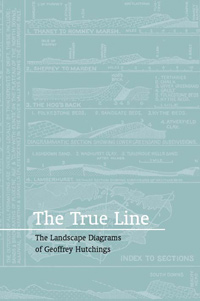
There is also a mention of Hutchings on the excellent Some Landscapes blog, which is also well worth checking out for those interested in writing on landscapes. https://some-landscapes.blogspot.com/2007/10/true-line.html He was also referenced in this presentation here by Tim Burt, who was one of my lecturers, and also tutor of my dissertation at Huddersfield Polytechnic, and went on to Durham University, and to become President of the Field Studies Council. He was also mentioned at the recent 75th Anniversary of the FSC which I was privileged to be able to attend, at the Linnean Society in London.
"In the face of the increasing popularity of photography in geography texts, and
what he saw as its limitations as a medium of landscape interpretation (as opposed
to reproduction), Hutchings set out a series of basic graphical guidelines, including
advice on materials as well as techniques. Allied to the arts of drawing maps, sections, and profiles, landscape drawing could portray articulations of structure and
scenery, land and life, and with annotations, specify details of land use, vegetation
cover, and settlement pattern. Geographical drawing did not just reflect an informed
knowledge of what is seen, it was itself an act of observation." From 1960s Geography journal, comes this ad:
A relatively brief entry - would love a few more images of Geoffrey at work if possible, and any more memories from his time working with the GA. Updated May 2020
I came across a book on the history of fieldwork in geographical education, which can all be read in full on this link. In the 1940s we get a mention for Geoffrey Hutchings, and the opening of Flatford Mill centre. Ideally Hutchings thought that "educational field work should
continue through the whole of a child's school life. If it did
so the curiosity of the young child and his joy in the world of
nature, would never end abruptly as they so often do, but
would lead in later youth to a critical interest in his environment and a capacity to gain reliable and usable knowledge
from what he sees around him [sic]."
Hutchings transmitted his expertise and enthusiasm for the study of geography by first-hand observation and
deductive methods to the many teachers and pupils who came
under his influence. Under his guidance field-work activities
grew rapidly. As president of the Geographical Association in
1960, Hutchings realized the unique opportunity within his
reach to further geographical field-work. The title of his address "Geographical Field Teaching" outlined the theme of the Association's Annual Conference. Methodology related to outdoor work dominated the
entire conference. Papers on related topics were read by
some of his colleagues, and an exhibition in field work in
schools was successfully organized. Geographical field activities, therefore, were firmly established by the 1960s, and
prospered under enthusiastic guidance. Source: https://files.eric.ed.gov/fulltext/ED331742.pdf
Professor Wooldridge was the first Professor of Geography at King's College, University of London, where he stayed for many years.
His name has already appeared on the blog ahead of his rise to the Presidency, having been associated with other Presidents in terms of publishing and other endeavours, and his name will reoccur with later Presidents too. He was also active in the fight against the suggestion of geography joining with Social Studies during the 1940s and keeping its own identity. There are other GA Presidents with links to King's College as well.
Some details here are taken from his Wikipedia entry - shared under CC license - we are getting close to the point where Wikipedia entries stop being provided for GA Presidents. Perhaps we need to contribute some more.
Sidney Wooldridge was born in Hornsey, North London in 1900, the younger son of a bank clerk. His early childhood was spent in Surrey, and his later schooling in North London, where he also took evening classes in geology. He read geology at King's College London (1918–1921), graduating with a first-class degree.
In the 1920s and 1930s Sidney Wooldridge lectured at King's on a combined geography and geology course with the London School of Economics (LSE).
In the Joint School of Geography, King's offered Geomorphology, Meteorology, Biogeography and the History of Geographical Discovery. During WWII this arrangement was disrupted by the evacuation of King's to Bristol requiring Wooldridge to teach human geography. His conversion to geography complete, he became professor of geography at Birkbeck College, London in 1944, returning to King's in 1947 as its first professor of geography and remaining until his death in 1963.
He was described in a piece from the Royal Society as "the doyen of British geomorphologists and a great champion of field studies of all kinds". In 1954.
as President of the Geographical Association, his subject was ‘The status of
geography and the role of field work’. In his address he stressed the need for
developing at an early stage ‘an eye for country’—i.e. the capacity to read
and interpret a piece of country, an accomplishment distinct from mapreading in that the ground and not the map is the primary document. Only
those who have seen him in action with a field class can fully appreciate his
mastery of the power to impart this accomplishment. On his skill as a teacher: Wooldridge had remarkable qualities as a teacher. He had the capacity
to transmit his enthusiasm for his subject and the gift of clear exposition.
He had a pungency of phrase which delighted his audiences and at times he
took pleasure in being as provocative as he could. He enjoyed lecturing and
gave freely of his time to universities, to training colleges, to field centres and
to the Working Men’s College, Camden Town, with which he was for many
years closely associated. In the words of a colleague writing in The , ‘it
was his passion to bring to young and old the joy that comes from discovering
for one’s self some new fact of landscape history and from fitting it into a
developing pattern of new scientific knowledge’
Here is the announcement of his new post in 'Geography' in 1947
In 1949, he published an article 'On taking the 'GE' out of 'Geography'. This explored the status of physical geography (something which is still an issue for some - I remember some comments that many of the resources on the GA website were skewed towards what might be called 'human' topics.)
He also referred to the talk that was going on about the merging of history and geography, and the development of 'Social Studies' (something which has certainly been the case in the USA and some other curricula as well)
There were a few quotes in the article which are useful.
"Geography has never been the science of man, it is the science of land, of the Earth's surface"
(Sauer and Leighly)
It was during this time that he became the President of the GA. He had already held posts on the Council and Executive and therefore joined a group of Presidents who had held a great many roles to support the Association.
Wooldridge was a founder-member of the Institute of British Geographers (1933) and was later IBG president (1949–50). He did not break completely with the RGS, serving on its council (1947–51). More details on Wooldridge are contained in an article on the early days of the IBG, linked to here: https://www.jstor.org/stable/622270?read-now=1&seq=6#page_scan_tab_contents
The following two images are taken from this source:
The Presidential address can be read on JSTOR for free with a free account.
Wooldridge, S. W. “Reflections on Regional Geography in Teaching and Research: Presidential Address.” Transactions and Papers (Institute of British Geographers), no. 16, 1950, pp. 1–11. JSTOR, www.jstor.org/stable/621209
He started his address by explaining while regional geography is the real geography, despite the various different views.
This quote is a famous one...
He talks about the emphasis being placed on research work carried out overseas compared to work carried out in the UK, and this idea of 'otherwhereitis' is an interesting one.
Wooldridge also chaired the Field Studies Council in 1952. This was known as the Council for the Promotion of Field Studies at the time, before it became the FSC. I attended a special event to mark the FSC's 75th anniversary just before Christmas 2019.
The 'Wooldridge and Linton Model' of landscape evolution was dependent on the identification of remnants of three widely developed erosion surfaces. It was influential at the time, and is included in a range of textbooks. Linton read several papers to the IBG as well.
Wooldridge also collaborated with fellow King's alumnus (and GA President) L Dudley Stamp. Wooldridge's interest lay in relating early human settlement and land use to the physical landscape. In 1951 Stamp at LSE and Wooldridge at King's jointly edited London Essays in Geography. He also wrote with another GA President, S. H. Beaver.
He was also a major influence on another president Denys Brunsden, a student at King's College.
He described him as "a monumental presence". His conference was described in this piece here. https://link.springer.com/content/pdf/10.1038/175198a0.pdf
Like L Dudley Stamp, Wooldridge married a King's geography student. He was a keen golfer and cricketer, a lay preacher (converting later to the Church of England and an amateur operetta enthusiast - shades of Rex Walford here.
He continued to work after a stroke in 1954.
He was made a CBE in 1954.
In 1957 he received the Royal Geographical Society's Victoria Medal and in 1959 was elected a Fellow of the Royal Society.
He died in 1963, the year I was born.
In 1980 the Institute of British Geographers marked the fortieth anniversary of Structure, Surface and Drainage in South-East England by the publication of The Shaping of Southern England, a collection of papers which both emphasised the importance of the work, and showed how dated it had become. Fundamentally, the 'Wooldridge and Linton Model' was based on the view that the south-east region had been tectonically stable except for two brief periods, in the Upper Cretaceous and the mid-Tertiary. Subsequent work has shown that this view is far too simplistic, throwing much of the interpretation of cycles of landscape evolution into doubt. (Source: Wikipedia)
He is quoted in this extract from a piece by Rex Walford (another GA President)
"'Go out into the field, for through the soles of your boots shall ye
learn' . That somewhat simplistic dictum was often quoted to me in my
school days, by a geography teacher ever eager for his pupils to have
fieldwork experience. We clocked up the miles on field trips with
missionary zeal, anxiously believing that virtue would accrue in large
quantities if the hike was more than six miles and we came home
raw-soled and properly exhausted. In a generation nurtured on the
philosophy of the Le Play Society, inspired by the example of S. W.
Wooldridge, and receptive to the outdoor exploits of the Baden-Powell
organisations, field teaching and the development of an 'eye for
country' became the Holy Grail for many geographers from the twenties
to the sixties."
Rex Walford, 1984 Research is something that Sidney Wooldridge felt was particular important, and felt the association needed to both continue to support it, and be involved in it.
‘IF THE ASSOCIATION were to turn its back on research geography, there would
indeed be small hope of engaging and retaining the interest and support of the
university geographers’
1938 article: Wooldridge, S. W. “TOWN AND RURAL PLANNING. THE PHYSICAL FACTORS IN THE PROBLEM.” Geography, vol. 23, no. 2, 1938, pp. 90–93. JSTOR, www.jstor.org/stable/40561780.
On taking the 'Ge' out of 'Geography' - https://www.jstor.org/stable/40562793 (1949)
Stoddart, D. R. “Progress in Geography: The Record of the I. B. G.” Transactions of the Institute of British Geographers, vol. 8, no. 1, 1983, pp. 1–13. JSTOR, www.jstor.org/stable/622270 - source of the image above
Wooldridge, S. W. “Reflections on Regional Geography in Teaching and Research: Presidential Address.” Transactions and Papers (Institute of British Geographers), no. 16, 1950, pp. 1–11. JSTOR, www.jstor.org/stable/621209
Wooldridge, S. W. “THE PHYSIQUE OF THE SOUTH WEST.” Geography, vol. 39, no. 4, 1954, pp. 231–242. JSTOR, www.jstor.org/stable/40564986
"The Status of Geography and the role of fieldwork" - Geography,. 40, p.73-83 (1955)
Image used under Fair Use from this Source
Bill Marsden https://www.open.edu/openlearn/ocw/pluginfile.php/631169/mod_resource/content/1/geog_sk6_06t_5.pdf Describes Wooldridge's concern about the divide between school and academic geography - an area also touched on by another President Andrew Goudie. Wooldridge was to resurface as a key figure in the geography versus geographical
education encounters of the post-war period. He was a trenchant peer critic. In 1950
he addressed the IBG and scorned the contentment of his audience with ‘agreeably
titillating’ articles on subjects of minor interest which made ‘no claim whatsoever to
scholarship’ (Stoddart, 1983, p. 5). To Wooldridge a firm physical basis was the sine
qua non of a high quality geography. He claimed that the social/urban orientation of
the subject was becoming too strong. Geography, he maintained, was about ‘place’
and not about ‘man’ (Graves, 1975, p. 56). On the educational front he abhorred the
analogous post-war trends towards introducing social studies into the curriculum.
These he blamed on geographical educationists. The tendencies threatened to take
‘the ge- out of geography’, as he put it (1949, pp. 9–18). Social studies would
On Taking the Geography Out of Geographical Education
Some Historical Pointers in Geography Page 7 of 15
‘destroy the value of geography as an important medium of education’ asserted the
Education Committee of the RGS (1950, p. 181), in a report reputedly the work of
Wooldridge. Like Geikie, he argued that the priority in schools should be detailed
fieldwork in the rural landscape, developing a ‘laboratory spirit and the careful,
indeed minute study of limited areas’ (1955, p. 80) Also a piece on the Britannica website:
According to a leading British geographer, Sidney William Wooldridge, in The Geographer as Scientist: Essays on the Scope and Nature of Geography (1956, reprinted 1969), regional geography aimed
to gather up the disparate strands of the systematic studies, the geographical aspects of other disciplines, into a coherent and focused unity, to see nature and nurture, physique and personality as closely related and interdependent elements in specific regions.
According to this view, all geographers—whatever their systematic interests in particular classes of phenomena—should be regional specialists who appreciate the full complexity of phenomena combinations.
Image: 'The Spirit and Purpose of Geography' - pictured at Charney Manor Conference 2017 - image by Alan Parkinson shared under CC license Update - from a piece on Marguerita Oughton - March 2020
In the early summer schools Miss Oughton played a more direct and
personal part. The first, at Rhoose, Glamorgan, with Dr. Margaret Davies
in 1952, was a vigorous introduction to course organization that left her with
a conviction that there are few things that the Association can do for many of
its members that are better worth while than the provision of practical courses
in fieldwork and field teaching methods in our own countryside. This
conviction was enhanced by the stimulating experience of assisting the late
Professor Wooldridge at a summer school at Pulborough in the Sussex Weald
in the following year. Of this I was to hear a good deal in my own home not
many weeks later from Wooldridge himself. He confessed to being "much
impressed by that young woman", who had obviously handled him, as she
had handled any difficult members of the party, with firmness and sympathy,
and had surprised him with what he called an "unfeminine capacity for
administrative detail." It is not difficult to detect here a note of admiration
and affection on Wooldridge5 s part that remained with him in some measure
till his death.
Linton, David L. “Miss Marguerita Oughton: An Appreciation.” Geography, vol. 50, no. 2, 1965, pp. 172–176. JSTOR, www.jstor.org/stable/40565934. Accessed 27 Mar. 2020.
Updated August 2023
Im not the first @kclgeography academic to focus on Kent. S W Wooldridge first professor of geography wrote on the Weald, Alice Coleman wrote a guide to east Kent. Obviously important connections between London and Kent, now as ever! pic.twitter.com/ZhMlck8fOS
Catherine Duigan’s tweet reminded me of records I have of my mother, with her cousin, on a Kings College London geography field trip in the mid 1930’s. It is a mixed class, probably some geology students as well, with probably lead by Wooldridge #fieldtrippic.twitter.com/FGnRIhfFfI
Those who were at Juniper Hall will remember the final evening’s entertainment of Wise on the piano and Wooldridge rendering songs by Gilbert and Sullivan.