He is now retired, but is still involved with GA committees and the creation of 'Primary Geography' magazine.
“GEOGRAPHY IS A SUBJECT THAT BECOMES A WAY OF LIFE.”
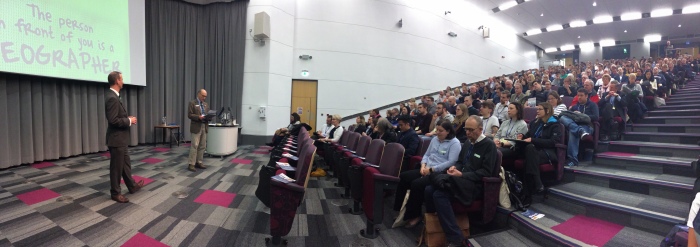
This was at the forefront of Steve's GA Presidential lecture in April 2016.
His lecture can be viewed here on SlidePlayer (note the 115 slides... that's one to aim to beat...)
I'd also like to thanks Steve as he was one of the people who were involved in me ultimately becoming the Junior Vice President of the GA.
Here's Rebecca Priest's summary of
Steve's Presidential Lecture from the OUP blog:
Steve Rawlinson’s Presidential Lecture set the tone for the whole conference. He spoke on the topic of ‘making connections’, by drawing on experiences from his own life and career. Steve encouraged every person in the room to think about their own connections with geography and how they can inspire and discover the geographical connections of those whom they teach.
He spoke first of ‘personal connections’ to geography and how it is important to take a step back from our busy lives as teachers and reflect on how people, places and events have affected our own personal geographies. This can be as simple as thinking about landscapes that have inspired your love of the subject or appreciating the professional relationships you have fostered and how these have shaped your understanding and your career. He then moved on to make an important point about ‘curriculum connections’ which emphasized how the integrated nature of our subject is at its core. This inherent characteristic of geography should not be undervalued and Steve made historical, cultural, technological, scientific, economic and artistic connections to just one of his favourite places; the mining town of Blaenau Ffestiniog in Wales. This has inspired me to take the time to think of one of my favourite places and to make as many interdisciplinary connections to it as I can – geography has the ability to connect many different elements of the world. The lecture ended with the notion of ‘future connections’ and how the future of geography, of teachers and of our pupils needs to be carefully nurtured.
Steve left us with this: geography is a subject that becomes a way of life – embrace it, and yours and the life of the children and young people you teach will be richer because of it.
Steve is an Honorary Member of the Geographical Association.
He is also Chair of the Primary Geography Editorial Board
Geographical Association Primary Geography Champion
Consultant to the Geographical Association
Fellow of Royal Geographical Societyhttp://www.rgs.org/
Steve kindly wrote a detailed summary of his experiences with the GA and it is used for the main body of this blog entry. As with some of the more recent Presidents,
Steve is on TwitterI'm assuming Dudley Stamp would have been as well :)
Image supplied by: Steve Rawlinson
The following text was also provided by Steve.
When and where were you born?
"Weston Turville in Buckinghamshire in the early 50’s. The village used to be the centre of the Aylesbury Duck industry. The village pond was still a feature when I was young. It was a very typical Buckinghamshire village where everyone knew everyone."
Career details:
1963-1970 – Aylesbury Technical High School (now the Sir Henry Floyd Grammar school)
1970 – 1973 – University College of Wales Aberystwyth – BSc Geography
1973 – 1974 – Assistant lecturer in Geography and Statistics – Cassio College Watford
1974- 1975 – University College of Wales Aberystwyth - MSc in Biogeography. University demonstrator
1975 – 1991 – Senior Lecturer in Geography & Environmental Studies – Cricklade Community College, Andover – teaching all ages primary, secondary and up to and including senior citizens!
1991 – 2012 – Principal Lecturer in Geography Education – teaching on Primary ITE (PGCE & UG), & UG Geography. Also Senior admissions tutor – responsible for admissions to all education courses (Primary and Secondary).
2008 – present became Chair of the Primary Geography Editorial Board
2012 Retired – became GA consultant, continued with work on Primary Geography Quality Mark and as Chair of the Primary Geography Editorial Board. Member of the Geography Expert Group.
2012 -16 Member of the DfE Geography Expert Group.
2013 Elected as Junior Vice President of GA
2015-2016 President of GA.
2018 – present – Member of the WorldWise Committee
2020 – awarded Honorary Membership of the GA
Where did you go to school/university?
"I went to the local primary school, just a mile from my house, and for a while was taught by the same Headmaster and his wife as taught my mother and father. Johnny Lawton described himself as ‘a nice kind man with a nice kind face’. Though his strict disciplinary tactics made some of us question this! He probably started my interest in the environment by the frequent nature walks we undertook around the village. Geography was about drawing maps carefully and of course colouring the sea and the land! I also developed a love for exploration, during the daily walk to school – often resulting in a frantic run as the bell tolled at the start of the school day. No one wanted to be late for school with Mr Lawton waiting by the gate! I passed the 11 plus and rather than going to the local grammar school I went to the Technical High School – now the Sir Henry Floyd Grammar school. It rather saddens me to think it lost its ‘technical name’ as this was a new type of school which offered so much. Going to ‘the Tech’ was really at the behest of my father who had dreams of me becoming an engineer like him. But it was an inspired decision because the Tech had a visionary Headmaster who really was ahead of his time. Though another strong disciplinarian he worked hard to offer what we would now call a ‘rounded education’ to everyone and was at pains to avoid gender stereotyping. Boys and girls were positively encouraged to cross gender boundaries. Thus, we had girls in our metalwork and woodwork classes, and I learnt touch typing – a skill for which I am forever grateful. This of course now looks quite revolutionary for the time. Dad’s ambitions for me were thwarted when I struggled with the sciences – I have the distinction of failing chemistry 3 times each time with a lower grade. My A level choices were therefore English, Geography and British Constitution (the latter really coming in handy with the Brexit discussions!).
Geography was chosen because of an inspirational teacher – Mr Geography Green (yes, we also had a Mr History Green!). He had a way of bringing the subject to life even if he was constrained by a very rigid syllabus. I well remember ‘doing’ the whole of the USSR and SE Asia for A level.
He sent my friend and I to Dale Fort FSC centre for our fieldwork study. There I was enthralled by the enthusiastic and friendly tutors and found an ambition to be a field tutor – an ambition still unfulfilled though I did build all my teaching around fieldwork.
I was the first person from the Tech to go to University. Aberystwyth was chosen simply because I had fallen in love with Wales while on holidays with my parents and I wanted to be near the mountains. The presence of the sea was an added bonus – Weston Turville is one of the furthest places from the sea in the country. There followed three very happy years studying under some inspiring if sometimes eccentric lecturers. I initially went to study geology – a foolish decision in retrospect given my chemistry record – and after 6 weeks of struggling with crystallography - changed to geography.
It was at Aber that I first encountered the GA – the history of geography module had references to the Association and the Aber GA connection with
H.J. Fleure. And of course, there was the ever-delightful presence of
E.G. Bowen a former president of the Association who did so much to fuel my passion for the subject and teaching –
see the entry for E G Bowen. I got very involved in the Geography department’s Geog Soc. and was their expeditions officer organising field trips utilising the wealth of knowledge available at the university and outside. This experience was invaluable in my later teaching and running of fieldwork.
On graduation I got a job in an FE college in Watford which had many resonances with the novel ‘Wilt’ by Tom Sharp. But my mentor, Peter Baker, was wonderfully supportive and somehow, I got through that first year without too many mishaps. It was then that Aber called me back – I got the offer of a research place to study animal diseases under ‘Big Jim’ Taylor – the prospect of another year by the sea visiting farms all across Mid-Wales was too alluring and I blew most of the money I had saved from my first years teaching on taking up the place! My parents thought I was crazy giving up the job in Watford, but it was another good decision. I loved the research year and learnt so much about how academic/research geography works and offers relevance to the wider world. My thesis identified some improvements that vets in the area could make to their strategies for combating animal diseases, which were based less on the physical constraints of the disease but more on the farmers perception of the causes. It was during this work that I shifted from being a physical geographer to one with a behaviourist approach."
What has your career been e.g. teacher / academic / author / other work outside the obvious geography sphere?
"My first job in Watford on graduation was less a calling but a necessity to get a job. But I loved teaching thanks to the wonderfully supportive colleagues. I think I learnt an important lesson from them – that support during those early years in the profession is crucial. After my MSc year I was lucky enough to be offered a job at Hampshire’s new show college in Andover and there I found myself working with under Geoff Dinkele who was in the middle of writing the 'Reformed Geography' series with Rex Walford and Stephen Hancock.
Suddenly I was in the middle of a revolution in geography teaching and rubbing shoulders with some of the key people in the subject. It was Geoff who encouraged me to make my first foray into writing with an article on using Lego to represent Population Pyramids which appeared in 'Classroom Geographer'. (See the earlier post which showed this article)
I was also blessed to have as Principal of the college another visionary. We were encouraged to engage with the wider community in our teaching and as a result my day could find me teaching in the local primary schools in the morning, grappling with A level geography in afternoon and then teaching on the adult education provision in the evening.
My first job was also at a community school with similar courses.
Running a course on weather forecasting for gardeners sticks in my mind as particularly challenging, but I was never short of vegetables. As a result of my time in Andover I have been lucky enough to have taught all ages and abilities! The GA became a natural part of my work. I ran the local GA WorldWise quiz for many years shamelessly using it as a recruiting tool for geography O and A level!
Somehow, I managed to run 4 fieldwork courses a year for A levels in Geography and Environmental Education, as well as one for the GCE geography evening class.
My love of fieldwork seemed to be recognised and encouraged, again thanks to a highly supportive Principal.
It is really because of this work and my subsequent work at the university that I have led 100+ fieldtrips up Cadair Idris – the mountain where my ashes will be scattered when the time comes!
The retirement of the Principal who had appointed me signalled changes in the college which I began to get uneasy about and resulted in the move to Northumbria University to take up the post of Senior Lecturer in Primary Geography Education. It was a speculative application based really on the desire to live ‘up north’ following a number of holidays in the area. Another lucky decision. I was teamed with a brilliant humanities team and an incredibly effervescent geography colleague – Liz Essex-Cater.
I had never enjoyed a working relationship like the one we forged – we often talk about teamwork, but I like to think Liz and I took it to a different level – we were able to complement each other’s skills and knowledge to the extent as one ran out of the steam the other was able to take over seamlessly. We brought different skills to our role: Liz loved timetabling which I hated; she did not enjoy organising fieldwork which I found easy. So, our relationship enabled us to bring a high level of enthusiasm and a variety of experiences to our students. We both worked on and were members of the committee for the local GA so the links with the Association continued.
We presented our first contribution at one of the LSE conferences – remember those paternoster lifts?
In 2004 Liz attended the Charney Primary Geography conference and encouraged me to go the next year and that started a long-standing relationship with that wonderful community. I now find myself part of the co-ordinating group organising the annual event in Oxfordshire which has become a showcase for all that is excellent about Primary Geography.
Liz took early retirement to ‘live the dream’ in France and then was cruelly struck by Motor Neurone Disease. I lost my best friend, colleague and critic in one fell swoop and life at the university was never quite the same.
When I had been appointed, I could not understand why there was no link between the education department and the geography department – it just seemed to make no sense especially as at that time there was shortage of geography teachers – an issue on which Liz and I had researched and written about. It took a while but eventually I was teaching on the fieldwork module undertaken by the 1st year students. This eventually led to me developing and teaching an assessed module on Geography in Education which sought to encourage more geographers to enter teaching. This quickly became an important module for the department and the university in raising their employment on graduation statistics. I am pleased so many other universities are adopting similar approaches to cultivate members of the teacher profession from their home-grown students. Expanding access to education became a theme for the later part of my career at Northumbria, particularly when I gained promotion and became the Admissions Tutor for all education courses in the department. I led courses which specifically sought to encourage Men into Primary Education and Ethnic Minorities into Teaching. This work was undertaken with our Access department which offered adults non-standard routes into the university – another example of how innovative courses can lead to having a home-grown market for teaching. We were so successful in this work that we were praised by Ofsted for the number of high-quality mature students we consistently attracted onto our courses.
A spin off from this work was the development of a link with the London Borough of Newham which saw all our undergraduate and postgraduate students on education courses benefitting from an experience of working in the Borough’s schools. This experience was highly praised by Ofsted and saw us become an official London provider of teachers – which felt a little ironic as we were one of the most distant providers in England for the capital!
Fieldwork continued to be the golden thread through all of my teaching. Modules on all courses were based around giving students the confidence to take children outside and provide a variety of experiences in different environments. This led to both articles and conference presentations which got me increasingly engaged with the national GA community, a move not always positively received by the Senior Management – who did not seem to appreciate how important those contributions were to me both personally and professionally.
Change is inevitable in education and sadly the university decided that it wanted to raise its status in the research field, and as a result abandoned all those innovative approaches to access opportunities, which had gained it such a high reputation in the local area. As the wonderfully satisfying work I was doing with my admissions hat on began to get closed down, and my geography work was increasingly having to be undertaken under the management radar, the job became less attractive and more demanding in ways that were not ‘me’.
A voluntary redundancy package offered a way out which I eagerly took.
The prospect of more time to do what I wanted, when I wanted it coupled with the lure of the nearby Northumberland hills was too a good a chance to overlook.
In 2012 I left Northumbria and entered retirement..."
Image: Bryan Ledgard
What was your job when you became President?
"I became President in 2015 so I had three years of enjoying exploring the glorious Northumberland countryside, and pursuing aspects of geography that I had not had time for before retirement. I had become Chair of the Primary Geography editorial board in 2008 and now I had a bit more time for this work. I felt it was particularly important to try to shape the journal to changing needs and demands and ensuring a strong voice for primary geography within the Association and beyond. The GA continued to be an important part of my life – I continued to attend conference and work with the local GA. I was also a moderator for the Primary Geography Quality Mark – work I found to be incredibly inspiring, and which kept me firmly in touch with schools and the changing primary world, even though I was theoretically ‘retired’.
It was especially rewarding to help schools achieve the award and to see departments thrive in not always inspiring circumstances. The resilience of geography teachers, and their ability to enthuse the children in their care never fails to humble me.
But the most significant change that occurred after I retired was a strengthening friendship with Paula, Sharon and Tess which was to blossom into the WildThinkers research group.
I cannot thank them enough for all the inspiration they gave me and how they slowly and subtly changed my thinking, opening my eyes to a whole new world of geography. I look back on my career and think how I could have done things so much better now I know what I know… I am not quite sure when the plot developed to nominate me for President.
I know there was some talk at a Charney conference but how it all became a reality and who was ultimately responsible I can’t really remember. The reality struck me for the first time at the Derby conference when it was announced that I was the next Junior Vice President. From the reaction it was clear I had a lot to do to convince others I was up to the job! I hope subsequent events have vindicated the decision to vote me in."
What theme did you choose when President, and why did you pick it?
What had been your involvement with the GA leading up to that time, and since that time?
"I chose the theme of Making Geographical Connections. This is the piece advertising the conference which explains the theme.
I am looking forward to welcoming you to the 2016 Annual GA Conference in Derby, which will explore the connections that give geography its dynamism and relevance to the lives of our students, whatever their age and ambition. By its very nature geography is a ‘connected subject’ with obvious spatial and temporal links across many subjects as well as connections to research in a variety of fields, ranging from emotional, cultural and socio-economic environments to climate change and glaciology. The Annual Conference is an opportunity to not only celebrate and share those links which we have developed in all phases and across all areas, but also consider future connections that could and should be made. It provides an arena for considering questions such as:
• How do young children connect with the world around them and how could this change in the future?
• Our older students appear to be globally connected via technology, but how does this impact upon their knowledge and understanding of geography?
• What is the nature of the connections we, as professionals, make that influence the content and approaches to our teaching?
• How can we become ‘better connected’ and how can we achieve this?
The theme asks important questions about the nature, development and future of our subject. Contributions from all sectors of the geographical community are welcomed to encourage a shared understanding of geography and its vital place in education. It would be especially valuable to have examples of how a connection with geography has offered a pathway, and utility, to other professions. The Conference will offer something for all those connected with geography, from the EYFS teacher to the academic researcher. Don’t miss it!
Steve Rawlinson GA Senior Vice President 2014-15
Being elected as President of the GA by the members is both an honour and privilege which I never really expected."
Memories of the conference 2016 - Manchester
"Within days of becoming President in Sept 2015 I faced my first crisis – we had to pull out of our planned commitment to holding the conference at Derby. A pity as Derby was my favourite conference venue.
Luckily, Manchester became a viable alternative and indeed looking back, Derby’s loss was our gain. The centre at Manchester was an exciting location, the facilities excellent and the conference was a great success. The sessions were inspiring and the exhibition one of the best we had held, the facilities at Manchester provided exhibitors with a really stunning space to show off their wares. And everything went off like clockwork thanks to the incredible planning and attention to detail of all the staff at HQ but especially Lucy Oxley, who was the dynamo behind the scenes.
My other memories of the conference include:
• The Young Geographers event (guided by the ever supportive and much missed Mike Bradford and facilitated by the staff at Manchester University) - we invited Myra Rose Craig (@Bird Girl) to address the young students. She has gone on to make a name for herself in many fields
• The conference dinner held underneath the dinosaur in the museum
• The amazing buzz of excitement and inspiration that persisted throughout the three days and meeting so many enthusiastic geographers – there really is something about being part of the geography community.
• Bringing a dog into the conference – my chosen charity was Dogs for Good and we were delighted to have one of their trainees join us – he caused quite a stir wherever he went as he knew how to play to the crowd.
• Thoroughly enjoying giving the presidential lecture, despite the hours spent planning it. It is probably the one thing that people remember from your year as President so getting it right is so important. As I got into my stride on the morning, I suddenly realised I did not need my copious notes. I hope people remember my lecture for more than the fact that I threw them across the stage!
• Having my daughter at the event – she was the only member of my family able to be there at that time, but I know my parents would have been so proud.
• Seeing people leaving the conference enthused and excited about their subject and eager to put into practice what they had picked up."
What would you say were the successes / main memories of your GA Presidential year?
"What were my successes?
I think that is for others to judge but my own thoughts include:
• Raising the profile of primary geography both within and outside the Association and encouraging others from the primary field to step into the Presidency role – which of course has happened with Stephen Scoffham and Susan Pike
• Bringing a touch of humanity to the Association, in the way it works and trying to make it more welcoming and accessible for everyone. Interesting that this has now become a major initiative with the positive attempts to broaden representation.
• Trying to bring more transparency in decision making and ensuring the Association really does represent all its members.
• Bringing some fun and creativity into geography at all levels."
Memories of being president.
"Aside from the frantic but inspiring three days of the conference my other memories of being president include:
• Working with the wonderfully supportive team at Solly Street to further the cause of geography in all our schools. Their dedication to the cause is second to none.
• Visiting branches and engaging with geographers and geography teachers doing some inspiring work with young people.
• Visiting schools to see what was happening at grass roots level to ensure I was grounded in reality.
• Representing the Association at a number of events e.g. Scottish Association of Geography Teachers where I made so many good friends and is a conference I always go out of my way to attend still
• Being at the centre of a thriving community both leading and supporting teachers to instil in others my own love of our subject.
• Great sadness when it all came to an end and a feeling that I could do an even better job if I were start again… "
Involvement with the GA since being President:
"I have to confess that once I left the Presidential group, I felt rather bereft. From being at the centre of things, one moves to the periphery and it does leave a bit of a void. I do think that greater use could be made by the Association of the expertise and experience embedded in the body of Past Presidents. Some moves have been made in this direction but it would be good to see these develop further for everyone’s benefit. I continue to be very honoured to be part of the Primary Geography editorial team. I feel that we have developed a style and approach to the journal which makes it stand out and offer leadership to all primary teachers. It is the only journal of its type in the world, so we have a big responsibility! The team have worked hard to ensure that contributions come in from a wide spectrum of authors, schools and of course children – we strive to ensure that children’s voices are heard e.g. ten-year-old Aedhan Brown probably never dreamed that his story would spread across LEGO Foundations and enthusiasts around the world. Winner of Liberty’s ‘Human Rights Young Person of the Year’ Award and The Herald’s ‘Public Campaigner of the year’
Martha Payne had won numerous awards for her NeverSeconds blog, the subject of a BBC documentary, fêted by celebrity chefs, and raised nearly £130,000 for the charity ‘Mary’s Meals’ and had her own book out. She was ten years old when she was interviewed. We are also very pleased to have had a kind of ‘who’s who’ of ‘celebrity’ contributors.
There are some big names in the list as well as rising stars e.g. in the last edition we interviewed teenagers Amy and Ella Meek, founders of Kids Against Plastic.
Our list of luminaries includes Simon Reeve, Rob Macfarlane, Tim Marshall, Dame Alison Peacock, Justine Greening, when she was Secretary of State for International Development, Commander Chris Hadfield, actor Timothy Spall, Dame Ellen MacArthur, Michael Rosen, Christopher Somerville, Steve Backshall, Alastair Humphreys and Satish Kumar to name but a few!
We are also especially pleased to have interviewed members of minority groups such as Sascha Kindred OBE paralympian, and (then) 14-year-old zoologist Kabir Kaul.
I have recently become part of the WorldWise team and am enjoying the challenges and opportunities that working with young people in that context presents. It is an aspect of GA work which is inspiring and should have greater recognition both inside the Association and without – something I hope I can help achieve. When you are elected as President of the GA you wonder how anything can top that - where else is there to go as a geographer and teacher?
So, it was an amazing honour to receive, in 2020, the Association’s highest honour – Honorary Membership. That was a really proud moment and one I will never forget.
Why does the GA matter to you?
• It has been a way of life and a constant for me throughout my career.
• It provided the occasions and opportunities to meet some of the most wonderful colleagues and friends who I continue to work with and whose company I enjoy
• It gave me the support and opportunities that would otherwise would have passed me by
• Expanded my horizons and developed my thinking – I would not now be working on a book with a colleague if it were not for the experiences the GA gave me
• I got involved at university, supported it throughout my teaching career, held a variety of posts with my local branch and of course became the President. I cannot encourage young geographers enough to take up membership and become involved…it is a doorway to so many paths for your career. I still find it hard to believe that my name appears alongside so many giants of the geography world – I am both proud and humbled to be in such company. "
Teaching/Research Interests:
• Developing awareness of the value of fieldwork in the primary sector
• The development of all aspects of environmental education within the curriculum, and the link with outdoor education
• Promoting excellence in Primary Geography teaching via research and chairing the Primary Geography Editorial Board
• Developing and delivering CPD programmes based around the Wildthink approach
• Looking for fun and happiness in all my continuing geography adventures and promoting this wherever and whenever I can
Nothing gives me greater pleasure than exploring the more remote, secret and wilder places of the British Isles with my dog, especially the border country in my home county of Northumbria. I am always very happy to share this love of the outdoors and its mysteries with friends and colleagues.
Steve’s Desert island discs:
"Crispian St Peters – You Were on my Mind – Weston Turville Memories – audio lessons with dad – this was the test record used on our sound equipment
Led Zeppelin – Stairway to Heaven – Aberystwyth Memories – most memorable concert while a student in the now vanished King’s hall
Kate Bush – Them heavy people from the album the Kick inside – Andover Memories – taking students up Cadair Idris on fieldwork.
One group bought this album for me and this song with the lyric ‘Rolling the ball’ became the anthem for all future parties sung on the way up
Queen – These are the Days of our Lives - Andover – watching Live Aid with my daughter – went out and bought Queen albums as result of performance.
Bruce Springsteen – Born to Run – Newcastle Memories – running the great north run – annual event of personal significance to me as I have ‘run’ it 24 times
Holst – Mars from the Planet Suite - Weston Turville Memories – listening to classical music with my granddad on a home-built record player and big bass reflex speaker. He could play the piano – I tried the violin but failed.
The Four Seasons – December, 1963 (Oh what a night) - Andover Memories - meeting Sally, my wife The Who – Tommy - Newcastle Memories – taking my eldest daughter to her first musical
The one disc I would save would be ‘These are the days of our lives’ by Queen simply for its optimism My book would be Wainwright's complete Lake District guides so I can capture the feel of wild places
My luxury would be a complete set of 1:25000 OS maps so I can revisit past adventures in the hills and plan those I will undertake when I finally escape."
References
Rawlinson, S. & Willy, T. (2019) Introduction. In Willy, T. (Ed) Leading Primary Geography Sheffield: Geographical Association, 7-15
Rawlinson, S. (2019) Celebrating 30 Years of Primary Geography GA Magazine 42, p24
Rawlinson, S. & Willy, T. (2019) Editorial. Primary Geography 99, p4-5
Ballin, B., Owens, P., Rawlinson, S. & Willy, T. (2019) Graveyard Geography Primary Geography (98), pp16-17
Rawlinson, S. (2017) From Charney to President. In Catling, S (Ed). In Reflections on Primary Geography. Sheffield: The Register of Research in Primary Geography, 28-36
Rawlinson, S. (2016) It's all a matter of connections...', Primary Geography (91), pp5-6
Rawlinson, S. (2011) Look to the Future’ Primary Geography, 74 pp 5-6
Martin, F & Rawlinson, S. (2009) Britain and Britishness Primary Geographer, Summer, pp 6-7
Catling, S. et al (2007) Education Matters: The State of Geography in English Primary Schools Geography, 92 (2), pp118-136
Boyle, A et al (2007) Fieldwork is good: the student perception and the affective domain, Journal of Geography in Higher Education, Vol 31 (2) pp299-317
Rawlinson, S., Essex-Cater, E., Bolden, D., Constable, H., (2003) Have Geographers Lost Their Way? Issues Relating to the Recruitment of Geographers into School Teaching Journal of Geography in Higher Education, Vol. 27(1), pp39-56
Rawlinson, S. & Soni, V. (2002) Improving the Recruitment of Ethnic Minorities into Primary Teaching; Developments in the North-East of England in Emerging Issues in Teacher Supply and Retention Proceedings of the second conference of the Teacher Supply and Retention Project, North London University, an IPSE publication.
Fuller, I., Rawlinson, S., & Bevan, R. (2000) An Evaluation of Students Learning Experiences in Physical Geography Fieldwork: Fluvial Studies. Paddling or Pedagogy?” Journal of Geography in Higher Education. Vol. 24 (2), pp. 199-215
Book contributions
Rawlinson, S. & Willy, T. (2019) Introduction. In Willy, T. (Ed) Leading Primary Geography Sheffield: Geographical Association, 7-15
Rawlinson, S. & Essex-Cater, E. (2010) revised chapter on Environmental Geography in Scoffham, S. (2010) Primary Geography Handbook The Geographical Association.
Rawlinson, S. & Essex-Cater, E. (2005) Chapter on Environmental Geography in Scoffham, S. (2005) Primary Geography Handbook The Geographical Association.
Rawlinson, S. (2004) ‘Don’t forget the Trainees: Issues relating to the Recruitment of Geographers into Primary Teaching’ Special Publication No 1 Researching Primary Geography Ed
Simon Catling and Fran Martin Conference papers: February 2021 Gathering the Light: MindWalking, presented at the Charney Primary Geography Conference February 2017
The Machine Stops: exploring children’s futures through storytelling, presented with Tessa Willy at the Charney Primary Geography conference April 2016
Presidential Address: Making Geographical Connections presented at GA Annual Conference, Manchester February 2016
Every picture tells a story presented at the Charney Manor Primary Geography Conference. April 2012 The Sensual Geographies of Difference presented at the GA Annual Conference, Manchester April 2010 Living Geography: 8 Ways thinking with iPods and new technology, Presented at GA Annual Conference, Derby April 2009
Living Geography – 8 Way Thinking; Evolution and Evaluation. Presented at Geographical Association’s Annual Conference, Manchester February 2009
Primary ITE Recruitment: Issues, quality and retention. Presented at Charney Manor Primary Geography conference April 2008
Living Geography - 8 Ways Fieldwork. Presented at Geographical Association's Annual Conference, Guildford Feb 2005
Developing the Fieldwork Experience of Trainees; some thoughts and approaches. Presented at Charney Manor Primary Geography conference June 2004
Encouraging Students to Consider Teaching as a Career. Presented with Cath White at the IGU Congress Glasgow March 2004
So You Want to Teach? Or how we get the students in! Presented at the Charney Manor conference – Enhancing Primary Geography Sept 2003
Change and the Newcastle Quayside: a report on at TTA funded initiative to encourage more students into teaching. Presented with Catherine White at the RGS Annual Conference, London June 2001
Where Have All the Geographers Gone? Presented with Liz Essex-Carter at the conference on Teacher Supply and Retention: Emerging Issues North London University April 1998
Geographical Simulations within the context of Fieldwork: A Northumberland Experience Presented at the Geographical Association’s Annual Conference, University of Leeds. April 1997
You Can Do It Too - introducing environmental education in primary schools Presented with Liz Essex Cater at the Geographical Association Annual conference, LSE
Top image copyright: Bryan Ledgard / Steve Rawlinson
As always, memories of Steve Rawlinson and his time as GA President welcome.