Showing posts with label W G V Balchin. Show all posts

Friday, 26 May 2023

Professor Alice Coleman - RIP

'Bad design does not determine anything, but it increases the odds against which people have to struggle to maintain civilised standards'

Alice Coleman


I recently heard that Alice Coleman had sadly passed away just short of her 100th birthday.

We had prepared a celebration of her work with the help of Peter Vujakovic. It was published in the Summer 2023 issue of GA Magazine.


GA Magazine is received three times a year by GA members.

There will be further comment later, but the piece can be seen below. Alice leaves a tremendous legacy of work and did a great deal to support and further the cause of the GA in several respects. I have a copy of the handbook for the Land Use Survey she coordinated. 

She was a teacher, as well as working at King's College, London - with which the GA has had many close connections over the years.


Update

Telegraph obituary. 

Reading

Utopia on Trial - available from the Internet Archive. 

Update August 2023

Here's an image of Alice with a former GA President: W G V Balchin.

He was the guest speaker at the GA Thanet Branch in 1996

Alice wrote Balchin's Obituary for the GA.

Monday, 22 August 2022

Centenary Royal patronage in 1993 - the Centenary year

In 1993, Princess Anne visited the GA's Centenary conference as a result of an invitation, which I came across when looking in the GA Archives earlier in the week. 

She was asked to be Patron of the GA's Centenary celebrations. I came across a number of original letters relating to this visit.

Here's the invitation to her, written by Simon Catling from the GA Archive - copyright with the GA as with all archive images, newspaper and journal extracts etc.

I also found the original version of the image below, which has been reproduced elsewhere.... I recognised Simon Catling on the right but not the other two gentlemen. 

It turns out that the person on the left in this image is Paul May, who was teaching at Wickersley Comprehensive School at the time. This was the school I went to (and left in 1982 to start my degree).

Here's the caption that I came across:

She is seen holding a copy of the GA's 'Teaching Geography' journal, and also a copy of W G V Balchin's Centenary volume, which has been a major source of information for many of the entries on this blog.

There was a report on the visit in the GA News. I came across a complete bound copy of all early issues of GA News.


Princess Anne spoke for 25 minutes, and pointed out the value of Geography in several different ways. 

Source:

Boardman, David, and Michael McPartland. “A Hundred Years of Geography Teaching Towards Centralisation: 1983—1993.” Teaching Geography, vol. 18, no. 4, 1993, pp. 159–63. JSTOR, http://www.jstor.org/stable/23754550. Accessed 19 Aug. 2022.

Saturday, 14 August 2021

Spring Conference Programmes

A few from the archives at Solly Street.

Spring Conferences were a theme for some decades. Some well known names and former Presidents involved in these particular events. More detail to come as time permits once I visit Solly Street again.


The last one was held in the year I was born. Note the address of the GA at the time: at the Park Branch Library on Duke Street.

Also note Marguerita Oughton, who has been mentioned on the blog.

Thursday, 22 July 2021

Down in the stacks

After over two years, I was able to head to Solly Street earlier in the week to do some of the research that I would otherwise have been doing throughout the creation of this blog.

In the 'basement' (although there are other lower floors) sit the rolling stacks which contain quite a bit of archive material which has so far been catalogued and placed into archival boxes and filing systems and given reference numbers. 

These include lots of papers and documents, including the W G V Balchin papers, which were used to help create the centenary volume published in 1993. 

I was able to find a number of books and other documents which will be added in to some of the existing posts, and also go towards new posts. Some very exciting finds. Here's a catalogue of Norwegian slides, probably taken from images taken by James Fairgrieve.

Friday, 25 June 2021

1966: Puerto Rico

In 1966, W G V Balchin and Alice Coleman led a GA Summer School in Puerto Rico.

There was an article in 'Geography' in 1965 describing the island written by the two authors.


Perhaps it's time we went back to Puerto Rico.

References


BALGHIN, W. G. V., and A. COLEMAN. “Puerto Rico.” Geography, vol. 50, no. 3, 1965, pp. 274–286. JSTOR, www.jstor.org/stable/40567047

Wednesday, 27 January 2021

St. Catharine's College, Cambridge

I have previously mentioned St. Catharine's College, Cambridge, and have heard a lot about it via Presidents who went there themselves.

Ashley Kent told me something about this, as being one of the 'hotspots' for Geography - something I'm going to develop a little more perhaps, by focussing on some of these other hotspots such as Hull and Bristol.

A number of Presidents can connect themselves to this college in some way, and I have previously blogged about them.

The St Catharine's College website is here.

There is an archive of magazines dating back many decades, and in which one can find mentions of the GA Presidents who have been connected with the college. I had a quick look and 

Here's Ashley Kent with some memories of St. Catharine's:

My college...St Catharine’s College Cambridge....has always been a Geography ‘hotspot’....a great place where quite a few people who were prominent in the GA...attended.
These include...Steers, Balchin, Spooner, Kent, Bradford, Keeble et al. Many of us were very fortunate to have been tutored by ‘Gus’ Caesar.......arguably the ‘source’ of an extraordinary group of geography professors across the world.....Haggett/Dury/Hall/Randall/ et al...a remarkable ‘father figure’ to many.

Someone who Ashley mentions is 'Gus' Caesar.

More on Gus was added in a separate blog post previously.

J A Steers was someone who was very definitely linked with the college.

His memorial has been mentioned as well. It can be seen in the college magazines, which would also reveal other details on the geographers who passed through the college. This was a signed silver salver presented to J A Steers in 1966 on the occasion of his retirement:

Saturday, 9 January 2021

Chris Kington - 'the spark'

In late 2019, I met up with GA President for 2002: Chris Kington at an early screening of the film 'The Lighthouse' in Cambridge.


He told me about something that he had done when he was GA President to prepare for his Presidential lecture.
He had asked former GA Presidents, and also long-standing GA members to tell him when they first got the 'spark' that meant they pursued geography rather than other subjects, and moved into academic or other roles with a geographical theme. In early 2020, Chris gave me a series of letters: some tpyed, some word-processed and some hand-written. I was going to give them back to him, but then the first lockdown occurred and I haven't had a chance since.

I've added elements of those letters into the relevant biographies of several GA Presidents, and have another 10 or so to add in as we get nearer to the present day. Some of them are for Presidents who have not had their biography added yet. They are all really interesting letters and hugely variable. There are many references to particular teachers or university lecturers (including other former Presidents in some cases) and one can see the influences on these people who later became GA President in due course.

They include a copy of a letter sent by David Attenborough from his desk at the BBC in reply to a letter by Mike Morrish, who was the previous post on the blog, and the latest President to be added.
I've added some of these contributions to earlier blog posts, particularly when they are relevant...

Image: part of the letter sent by W.G.V. Balchin: author of the GA's Centenary book (1893-1993) and GA President in 1971.

Thursday, 12 November 2020

1987: Dr. Graham Humphrys

Updated February 2021 with a major update from Graham himself...

Dr. Graham Humphrys was the Head of the Geography department and previously sub-Dean of the Faculty of Economic and Social studies at the University of Swansea.

He served as the Chair of the GA's Publications and Communications Committee during the late 1970s and into the 1980s.

I was unable to find a decent image of Graham, close-up. When I first started the project I did come across a small image on a Flickr account by Tehmina Goskar.

She sent me the image here and told me:
It's not that high res but in the photo he is talking about the Lower Swansea Valley Project which was one of the first post-industrial reclamation projects. 
The symposium took place in November 2010 at the National Waterfront Museum, Swansea. All the best with the project.
Tehmina

From the GA Annual Report of 1983:
Dr. Graham Humphrys completed six years as Chairman of the Publications and Communications Standing Committee. Under his chairmanship this committee has been responsible for the recent surge in GA publications and the organisation of successful national and regional conferences.

In this capacity, he wrote reviews of quite a few publications which were published in GA journals - have been looking at journals from this period to try to get some images.
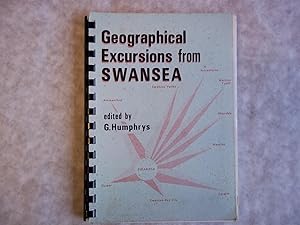
Geographical Excursions from Swansea.: Humphrys. G.He also edited and wrote or co-wrote a series of books related to his geographical work, which included economic and industrial geography and heritage a subject about which he was obviously passionate according to this account of an event in the year 2000.

He was an expert on Swansea and Cardiff's industrial heritage and the restoration of old industrial landscapes and gave regular talks on this theme.
His fieldwork excursions publications series ran to several editions and were a good seller as well apparently.
Graham contributed an article on Swansea Bay City to the 'Geographical' magazine in 1971.

A special edition of 'Teaching Geography' in 1986 was all about economic and industrial geography, and Humphrys contributed to this, as well as other journal articles on this theme as part of his Presidential year.

He is also remembered here, from a former student who remembers his lectures on industrial change and the development of the S Wales area as a city region.

Graham's GA Presidential Address was on a theme which has gained recent currency: 'Changing Places'.


The idea of Changing Places is now more significant than it was back then.
In his Address, Graham explored the factors that influence places.

A former student, David Herbert reflected on that time and his influence here:

I was away from the Department of Geography for six years during which time I completed a PhD at Birmingham University and had my first academic appointment at Keele University. During the early summer of 1965 a post of Lecturer in Human Geography was advertised at Swansea and it was suggested that I should apply. This I did successfully and after a semester at Toronto University I returned to Swansea in the Autumn of 1965. 
My former teachers were still there but there had been new arrivals, most notably Graham Humphrys, the first South Wales-based staff member. His interests were in Economic Geography focused on South Wales and often his concept of the Swansea Bay City.

At Swansea University, Graham was following on from the legacy of W. G. V. Balchin.

In 2015, a journal article said:

Graham Humphrys has degrees from the universities of Bristol, McGill and Swansea, and is a former Senior Lecturer in Geography and former Dean of the Faculty of Social Sciences at Swansea University. His research interests focus on economic geography, the environment and geographical education. He is currently acting chairman of the Canadian Studies in Wales Group.

Updated February 2021

Thanks to Richard Daugherty for putting me in touch with Graham, who provided the following significant personal details to add to the post:

I was born in 1934 in the town of Maesteg in the middle of the South Wales Coalfield. 
I went to the local Grammar School and then in 1953 I won an entrance scholarship to Bristol University to study for an Honours Degree in Geography. In my second year Bill Birch, one of my lecturers, persuaded me to take out a student membership of the Geographical Association.

I graduated in 1956 and then spent a year working at the McGill Subarctic Research Laboratory in Schefferville, northern Quebec to start working towards a Masters degree. The next two years I was at McGill University in Montreal as a Teaching Assistant and finishing my M.A.. As part of this I spent the summer of 1958 in the West Indies looking into the alumina industry in Jamaica, Trinidad and what was then British Guiana. I also visited the research centre that McGill had in Barbados. I gained my MA in 1959 and was then appointed as an Assistant Lecturer in Geography at Edinburgh University for the academic year 1959-60.

In 1960 I was appointed as an Assistant Lecturer in Geography at Swansea University. 
I gained my Ph.D. in 1967, and then stayed until I retired as a Senior Lecturer in 1997. 
My Head of Department at Swansea was Professor W.G.V. Balchin who was a keen member of the GA and very active in the Swansea GA Branch. (He served on the GA Council from 1949 until 1976, was a Trustee 1955-76, and President in 1971.) 
I re-joined the GA as a full member when I came to Swansea, and was active in the local Branch until the early 1990s. I was a Committee Member throughout that time, and at various times I was Chairman and Secretary of the Branch. During my career I gave lectures at other Branches whenever I was invited. I also contributed to various GA publications. In the early 1970s I was one of the leaders on two field excursions to North America for Geography Teachers organised under the GA banner. 
The first was Trans Canada in 1971 and the second down the western Cordillera in 1973. (Bill Balchin and Alice Coleman were the main organisers for both and I think they may have been based in the Isle of Thanet GA Branch). 

I was elected as an ordinary member of the GA Council in 1976. The GA at Headquarters was reorganising at the time and in 1977, much to my surprise, I was invited to Chair the newly formed Publications and Communications Committee. (The Honorary GA Secretary for that committee was Michael Williams).
At the time he was in the Education Department at Manchester University but subsequently he was appointed to a Chair in Education in Swansea where he still lives. We met regularly until the lockdown.

The Publications Committee was worked hard. The GA urgently needed a publications policy which it did not have previously, and this had financial implications. For example, there were shelves stacked with unsold publications which, if my memory serves me rightly, went back to pre-war days. Until then decisions on occasional publications were very ad hoc which had resulted in further accumulation of unsold stock. I also remember that there were decisions to be made to get Primary Geography published.

Fortunately the Headquarters staff provided tremendous support. They were very professional and well organised and got through an enormous amount of work. I stayed as Chairman until 1983 but remained on the Council until my year as President : 1987-8. 
During my year as President it was the GA’s turn to Chair the joint meetings of representatives of British Geography organisations. At the time the three main national organisations were the RGS, the IBG and the GA, but there were others on the committee representing the Heads of University Geography Departments, The Royal Society, The Royal Scottish Geographical Society and so on. By the end of 1988 it had been decided to reform the Committee into The Council of British Geography which I believe still meets. 
My involvement with the GA reduced after my year as President. At the Swansea level, restructuring of local schools had reduced the number of geography school teachers involved and it was difficult to maintain a programme. By this time there was little support for the local GA from the staff of the University Geography Department. I was away from Swansea for a couple of semesters in the 1990s, at Rhodes University in South Africa and at a University in Hokkaido and the Swansea GA Branch faded away, which was very sad. To end on a more cheerful note. Swansea did make a useful contribution to the GA at the local and national level in the second half of the twentieth century, with three national Presidents - Bill Balchin, Richard Daugherty and me, and an Honorary Secretary – Michael Williams, and three of us are still here. 
All happy memories. 
Good luck with your year as President.

Thanks so much to Graham for sending that through.

References

HUMPHRYS, GRAHAM. “Japanese Industry at Home.” Geography, vol. 80, no. 1, 1995, pp. 15–22. JSTOR, www.jstor.org/stable/40572605.

https://ucl.scienceopen.com/hosted-document?doi=10.14324/111.444.ljcs.2015v30.002 - from 2015

Humphrys, Graham. “Changing Places.” Geography, vol. 73, no. 4, 1988, pp. 298–307. JSTOR, www.jstor.org/stable/40571462.
https://www.iwa.wales/click/2010/11/making-our-past-work-for-the-present/

https://www.researchgate.net/publication/240442920_The_economic_development_of_the_British_coal_industry_From_industrial_revolution_to_the_present_day

Humphrys, Graham. “Recent Trends in Industrial Geography.” Teaching Geography, vol. 11, no. 3, 1986, pp. 120–121. JSTOR, www.jstor.org/stable/23751638

Humphrys, G. (1972) South Wales: An Industrial Geography, David and Charles, Newton Abbot.

https://collections.swansea.ac.uk/s/swansea-2020/page/on-our-doorstep - memories by David Herbert, who was associated with the University of Swansea for over 40 years.


Updated December 2020

In 2003, Chris Kington asked a number of former Presidents what had sparked their interest in geography. He lent me the letters and here is the response that Graham sent. At the time he was living in Swansea.

He talked about the place in which he was born and grew up in: Maesteg, and how he came to appreciate the importance of the physical geography of this place on the people who lived there, and the rise of the coal industry He didn't appreciate this until he got into the 6th form of the local Grammar School. 
"What made this all click academically was good teaching. I had two good geography teachers, a man who taught physical geography and a woman who taught human geography...."

GA Publications 
The regional distribution of Growth Industries in Britain, Geography, V 39, 1964. 
Industrial change; Lessons from South Wales, Geography, V 61, 1976
What University Geographers expect from their new students, Teaching Geography, V 3, 1977
Patterns on the map: Land utilisation survey maps as resources for teaching and learning, (with Alice Coleman, H. A. Sandford and J Bale), Geographical Association, Sheffield, 1982. 
Trends in Textiles, Geography, V. 69 (2), pp. 150 ‑ 153, 1984. Recent trends in Industrial Geography, Teaching Geography, V. 11, No. 3, 120 ‑ 121, 1986

Thanks to Chris Kington for the loan of the letters.

As always. further memories of Graham Humphrys would be welcome.

Updated August 2025

Graham also received the RGS Gill Memorial award in 1994.

Friday, 17 July 2020

1970: Canada Study Tour

The 1970 Study Tour was 50 years ago. It was the Trans-Canada tour, and an interesting event for the GA. The tour took a large group of educators to Canada - the largest ever GA tour.  There were 152 people involved, who travelled to locations across Canada.

Graham Humphrys told me of his involvement in February 2021
In the early 1970s I was one of the leaders on two field excursions to North America for Geography Teachers organised under the GA banner. 
The first was Trans Canada in 1971 and the second down the western Cordillera in 1973. (Bill Balchin and Alice Coleman were the main organisers for both and I think they may have been based in the Isle of Thanet GA Branch)

Study tours are still continuing now - run by the International SIG.
2020 saw the tour to Malawi.
I have previously blogged about a tour to Poland run by Patrick Bailey, which Chris Kington told me all about.

The 2021 GA tour to Nicaragua was launched in the latest issue of the GA Magazine.
More details will come later in the year.


Thursday, 16 July 2020

1971: Professor W G V Balchin

Last updated August 2023

W. G. V. Balchin (William George Victor) was the author of a book which has been one of the most useful sources when writing this blog, and he finally gets his own entry in 1971, when he was chosen as the President of the GA for that year. He had a very interesting life.

In the intro to the book, he is named as:
MA, PhD
Emeritus Professor of Geography, University College of Swansea, Fellow of King's College London and he was certainly a tremendous geographer.

He was born in Aldershot, and was known as Billy.

"When he went up to Cambridge and found a treasure house of geography books, he described it as an Aladdin's cave and read voraciously." (from Coleman's Obituary)

After graduating he joined the Cambridge academic staff as a demonstrator. The next summer he became an Arctic explorer, based beside a glacier about 600 miles from the Pole at the head of Billefjord in Spitsbergen (another of several GA Presidents to have visited) 
While sailing up the fjord he spotted something that enabled him to test another contemporary speculation - isostasy. This postulated that the immense weight of the Quaternary ice had depressed the land surface and squeezed out some of the plastic sima layer at depth. When the melting ice front retreated, the sima gradually oozed back, raising the land again.

He knew that such recent uplift would not have allowed time to cut wide beach platforms like the Cornish ones but noticed shingle ridges, which are sometimes the product of a single storm. The further from the ice front, the more the returning sima would have lifted the land, so that while the ridges were only at sea level near the glacier, they should fan up southward. He proved this by professionally surveying 50 miles of coast, camping out when it became too far to return to the base at night.

The Norwegian government added his work to the incomplete survey of Spitsbergen and named a 5000-ft mountain after him at 79° North, now called Balchinfjellet.
This makes him, after Debenham, another GA President who literally has his name on the map.

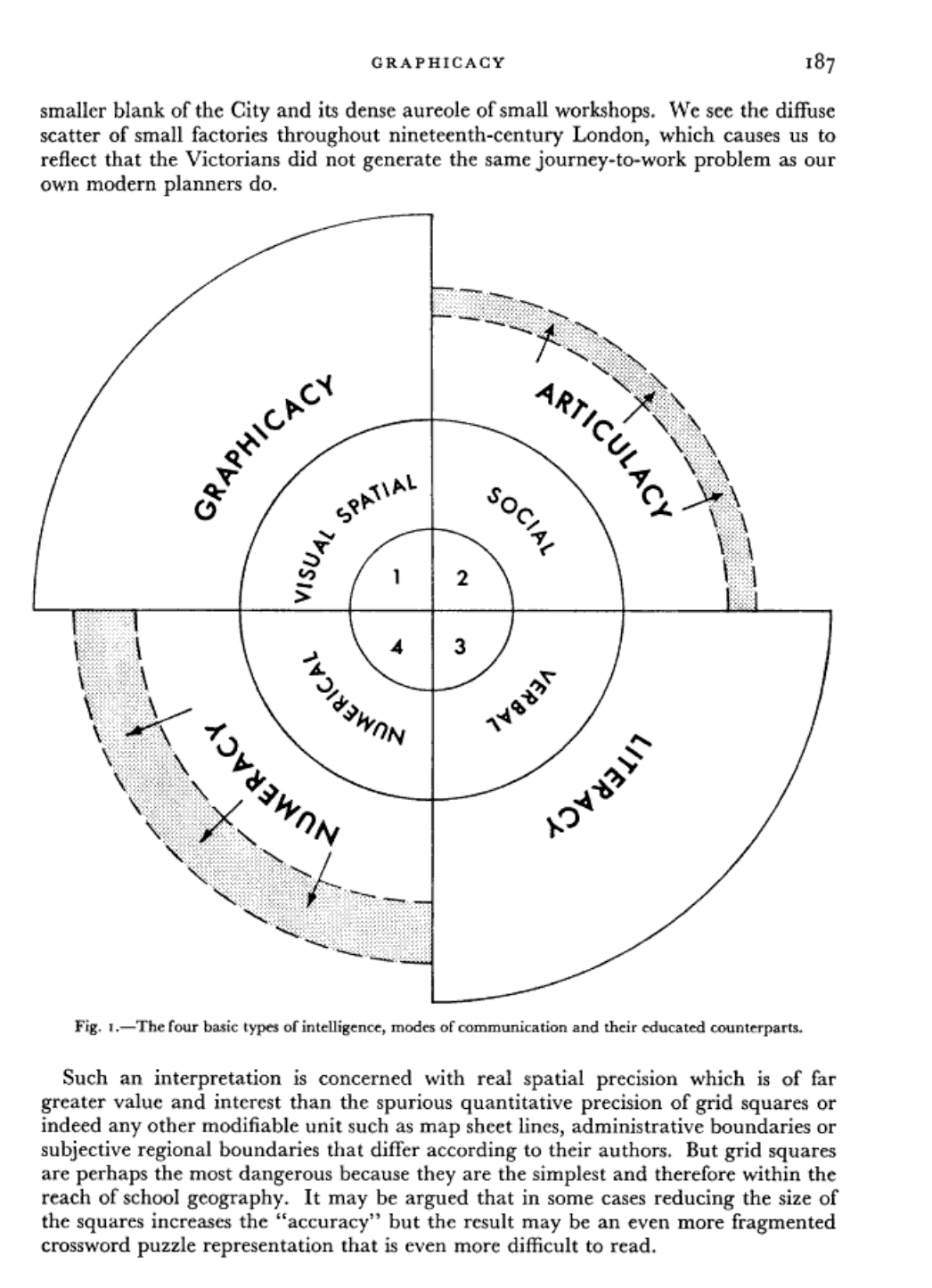
Balchin's Presidential Address, delivered at the London School of Economics was called just 'Graphicacy". It included some useful images such as the one shown here, and has been referenced by other people quite recently and I recommend that you read it.
He had become closely linked with the GA in 1954 when he was first elected as a trustee of the GA, following the death of a number of former Presidents in close succession.


At the end of Balchin's Presidential year, there were proposals for a new Standing Committee on Graphicacy, which was the title of Balchin's Presidential Lecture.

From the obituary listed earlier...

William and Alice Coleman coined the term ‘graphicacy’ and when he was President of the Geographical Association, he chose speakers on this subject for the Presidential day, beginning with his own address. 

He created a warm welcome for the concept, which was taken in the art world also and potentially included engineering. At the time of the National Curriculum, graphicacy was considered an important element for Geography and Rex Walford has recently written that the graphicacy concept ‘… will always remain a defining landmark in the history of geographical education and those articles you [both] wrote about it in the 60s are still regularly quoted today in geographical magazines.’

Graphicacy was still important when I trained as a teacher in Hull in the late 80s. Here's a scan of some notes I typed up during my PGCE course, from October 1986 to be specific.


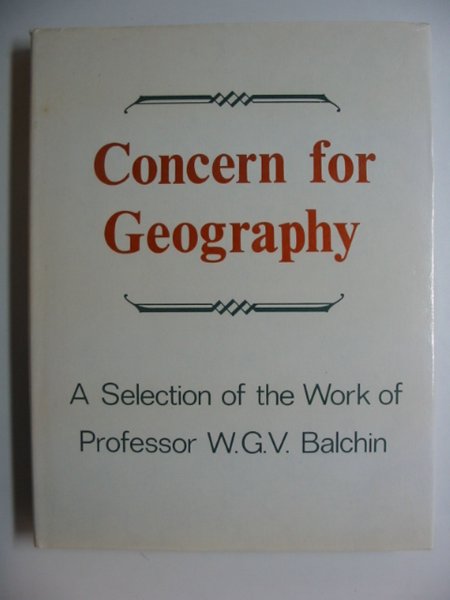
Balchin retired in 1981, and to mark the occasion, a book was published, of which 500 copies were printed.
It is called 'Concern for Geography'.
I got myself a copy, in a different binding. Mine is number 137 of 500.

Here's Balchin's photo from the front of the book.


In 1996, he was guest of honour at a dinner for the Isle of Thanet GA Branch.
Here's a description:
The 40th Anniversary Dinner was celebrated at the Walpole Bay Hotel in December 1996; the guest speaker was Professor Balchin of University College, Swansea. The attendees were welcomed by Elsie Weir, the Chairman. After an excellent meal, everyone was entertained by ‘The Serenaders’ led by Mrs Janice Reagan. This was followed by reminiscences from Alice Coleman, Prof William Balchin, Marjorie Woodward and Fred Fielder

Also a wonderful image: Source and Copyright: https://www.geography.org.uk/write/MediaUploads/Get%20involved/GA_IOT_History_booklet.pdf


From the Balchin Society Obituary

He and Lily retired to her home county of Yorkshire, to the lovely little town of llkley, not far from Leeds where two of their children were working. He continued his work for Geography, supporting the various organizations. In the Royal Geographical Society he won the distinction of serving on the Council for 17 years. Thirteen of these were as Chairman of the Education Committee, when each year he arranged for speakers on a range of careers for geographers to speak to packed audiences of sixth-formers, and as the careers were different every year, the accompanying teachers also found these occasions fascinating. In retirement he helped frame the lecture programme of the Society’s branch in York.

He was also a keen supporter of the Geographical Association. During his years at King’s College he was the organizer of its annual conference, and he was a Trustee for many years. In Yorkshire he joined the committee of the GA’s Bradford Branch.
William always had a great sense of perspective, both looking ahead to the future and relating it to the past. For example, he was well ahead in his recognition of impending anniversaries, such as the 150th of the Royal Geographical Society where he outlined a schedule of celebrations that was closely adhered to in the event. He also wrote a the history of the Geographical Association on the occasion of its centenary and edited a book on the 75 years of the Joint School of Geography – a saga of cooperation between King’s College and the London School of Economics.

For the Royal Geographical Society he prepared an archive of all the geographers who contributed to the success of World War II, with some intriguing revelations. For example, it was a geographer, J F N Green, who cracked the Italian code, using his meteorological knowledge to identify and interpret their weather bulletins. This feat must have been just as impressive as the well-known non-geographical cracking of the German code, but unfortunately it was never written up in similar detail.


I also got hold of a digital copy of an excellent book that Balchin edited in 1970, with contributions from several other Presidents along the way. 
This is from the Internet Archive. 
Check out other books that can be borrowed and read after a download of Adobe Digital Editions.

Balchin died quite recently, in 2007, aged 91 - another GA President to live a very long life.

His obituary was written by Alice Coleman - a familiar name linked with many GA Presidents during her time at the GA.


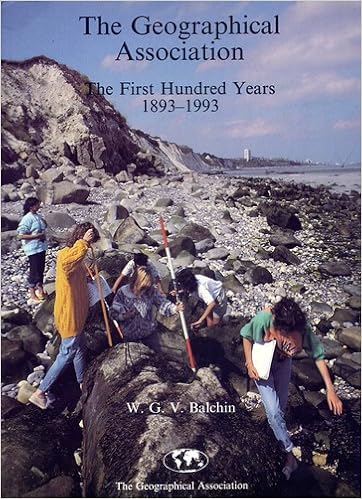
Of course, Balchin has also been influential in most entries so far as he was the author of a centenary history of the Association which is pictured below, and is worth seeking out as a second hand copy as I did.
Image result for w g v balchin

There is a Balchin Family Society, which provided the image for this post.

References

The Internet Archive has scans of several of Balchin's books, and others you can borrow.

No Wikipedia page - perhaps one is needed for Balchin, and several other Presidents too.

Balchin obituary: https://www.questia.com/library/journal/1P3-1521973781/obituary-professor-w-g-v-balchin

Image source: https://medium.com/nightingale/dvs-historic-datavisualization-may2019-6885f80780d5

https://balchinfamily.uk/professor-william-balchin-and-mount-balchin

https://books.google.co.uk/books?id=nbGcAQAAQBAJ&lpg=PA47&ots=FWDWaCsx5p&dq=norman%20pye%20geographical%20association&pg=PA48#v=onepage&q=norman%20pye%20geographical%20association&f=false - Oxford Dictionary of National Biography 2005-8

If anyone has further information on W.G.V Balchin, please get in touch.

Updated October 2020

I've been sent a number of other images featuring Billy Balchin by Sheila Jones. Here he is talking to Sheila at the start of a GA Centenary Quiz in 1993 which will appear in a more detailed report on that event nearer the time. Bill Mead is standing in the background. I am not sure of the identity of the lady in red.


This image above is thanks to Sheila Jones. More to come when I reach 1993.
It shows the longevity of his involvement with the GA that this was over 20 years after he was President and he was still heavily involved.

https://collections.swansea.ac.uk/s/swansea-2020/page/on-our-doorstep - some memories of Balchin are here too, by David Herbert.

One of the features of the Geography course was field-work. Apart from scouring the Gower and adjacent areas, we went off once a year to distant field-week locations. One year it was Devon and Cornwall, based in Exeter, another it was Ireland, based in Dublin. Memorable from the former were a long, seemingly endless trek across Dartmoor looking for tors. Each time our leader, John Oliver stopped at one, Derek Maling would say “Call that a tor” and on we went until he was satisfied. All of this would have been more tolerable if it had not been pouring with rain the whole time. 

In Ireland, we viewed numerous overflow channels and there was a typical Balchin moment. We stopped in an abandoned rural area, walled empty fields and broken down buildings and Professor Balchin asked for comments. As I had been to lectures by Stuart Cousens on the famine and its consequences, I waxed lyrical about the impact on landscape of poverty, starvation and migration. Professor Balchin listened and then said, “That is all very well, but what are the walls made of?” Granite was really the answer he wanted; the course was still mainly seen through the lens of physical geography!

Herbert later says of Balchin:

Bill Balchin was a warm and caring person when I had the chance to know him better; he even turned up from his home in Yorkshire at my retirement dinner when he was in his 90s.

Updated August 2023

From the GA Magazine in 2006 on the occasion of his 90th birthday.


Friday, 19 June 2020

Geographers in Wartime

We are coming to a period when many survivors of the Second World War are in their 80s and 90s and the memories are fading.
Many geographers played an important part in the Second World War.
In 1985, the Royal Geographical Society asked W. G. V. Balchin, who was then the Chairman of the RGS' Education Committee (and a former GA President), the job of collating a report and interviewing survivors on their role.

A report was published in 1987 and can be read on JSTOR (free accounts available)

Balchin explains that geographers proved their worth already in the First World War. He also outlines how an understanding of geography is important during wartime, particular when preparing.

He mentions a number of people with connections to the GA and the Ordnance Survey's role is featured prominently of course.

There are several areas where Geographes are particularly mentioned as being important.
These included the aerial interpretation CIU unit which looked at aerial images and worked out what was on the ground and what had changed since the area had last been photographed.

People like Frank Debenham and David Linton worked in this field.

See previous blog post for more details on this.

Source:
Balchin, W. G. V. “United Kingdom Geographers in the Second World War: A Report.” The Geographical Journal, vol. 153, no. 2, 1987, pp. 159–180. JSTOR, www.jstor.org/stable/634869. Accessed 16 June 2020.

Wednesday, 22 April 2020

1964: A Scilly excursion

1964: Nearly disastrous expedition from the Falmouth Spring Conference to the Scilly Isles, in the SS Scillonian - one of the roughest passages for many years. 

This passage in Peter Fox's chronology intrigued me.
At the time there were some summer and spring field excursions, which were very popular as they predated (just) the main travel agents / package holiday business.

The excursion formed part of the 1964 Spring Conference in April, which took place in Cornwall.


You woll see reference to many former Presidents in the speakers list, including David Leslie Linton. who will be coming up next in 1964, talking about tors and granite, which must have been a great pleasure for those involved.

It seems that there was a voyage on a ship to the Scilly Isles which encountered particularly rough weather.


Source: “The Geographical Association.” Geography, vol. 49, no. 3, 1964, pp. 346–348. JSTOR, www.jstor.org/stable/40566391. Accessed 22 Apr. 2020.

Friday, 21 February 2020

1950s - Committees were busy, and plenty of other changes

Balchin's Centenary volume describes some of the work of the GAs Phase Committees during the 1950s, a time when financial pressures forced the GA to raise the annual subscription to a guinea from 1955.

  • Secondary Schools Committee published a new handbook in 1952, then turned to producing school atlases. It's chairman for 25 years, Mr. C B Thurston, stepped down apparently 'reluctantly' in 1953.
  • The Primary Schools Committee revised 'Geography in the Primary School' in 1953.
  • The Public and Preparatory Schools Committee opened its membership to women teachers in 1951.
  • The Training College Section organised a series of one day conferences to meet the criticism that 'much of the geography teaching in secondary modern schools was being undertaken by individuals without any geography training' (Balchin, p.43)
  • Visual Aids Section produced 'The Geography Room in the Secondary School' in 1954, and started to investigate the use of OS Map extracts with aerial photographs which were to become a feature of Geography exams for decades to come.
  • Two new committees were formed: Further Education (1953) and Field Studies (1954)
  • The Executive Committee was continuing discussions with the BBC about geography school programming. At this time, there was a feeling that changes were happening too quickly for textbooks to keep up and that radio and TV could help.
One particular way that the GA tried to keep teachers up to date with the pace of change in the modern world was a feature called 'This Changing World' which was introduced into the 'Geography' journal in 1954, edited by Leonard Sydney Suggate followed by G. J Butland when Suggate retired to New Zealand, as described in his blog post.

The 1950s also saw the passing of several former GA Presidents who have previously appeared on the blog:

  • Dr. Hugh Robert Mill in 1950 (who was closely associated with the GA from its founding)
  • James Fairgrieve in 1953 (over 40 years of service to the GA)
  • Dr O J R Howarth in 1954 (over 40 years of service to the GA)
  • Sir John Linton Myres in 1954

These led to the appointment of other GA Presidents to come to key roles: L Dudley Stamp, E G Bowen and W.G.V Balchin.

Finally, Balchin reminds us that the 1950s were a time when the country was recovering from WWII - rationing had ceased and rebuilding of bombed cities was underway. Membership climbed steadily and the GA was settled in its new home city of Sheffield.

The Annual Conferences were still being organised by the very efficient R. C Honeybone and Dr. J H Bird and attendance was close to 1000.
Professor Emeritus E G R Taylor reached the age of 80 in 1959, and funds were raised for an annual lecture in her name.


Image: early Handbook, on display in Solly St - image by Alan Parkinson

Sunday, 5 January 2020

From the archives

As you'll have guessed, the creation of this blog has already taken me many hundreds of hours so far, and will continue to take hundreds of more before it is completed. It's a bit of a labour of love.

I've been doing some research on the histories / biographies / genealogies / publications / contributions of each of the GA Presidents since the first, over 125 years of GA history (and geography).
Here are some of the sources I've used in case you want to follow this, and add anything else from what you can find.

Sources
Websites
GA website

Wikipedia pages have been produced for many of the past Presidents, but not for many of the recent ones, which could be something to rectify as part of the project perhaps.

Journals
The Geographical Teacher and Geography have both printed Presidential addresses in the past. For those who subscribe to 'Geography' at the moment, free access is provided to both of these journals going back to the first issue, via JSTOR.
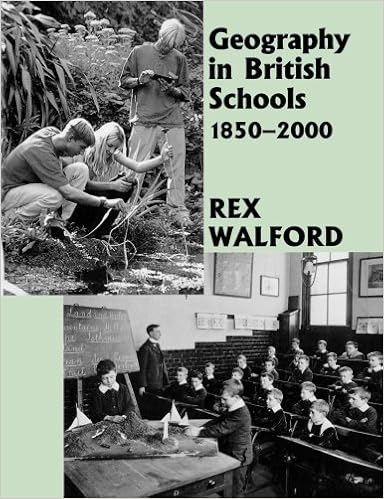
Image result for rex walford geography in british schools
Peter Jackson put together a brief biography of the Association for the 125th year, and that is available from the GA website.

Books

Rex Walford wrote an excellent book on the history of Geography Education in secondary schools in the UK, which I got a second hand copy of some time ago. This is more open in its descriptions than just the GA's role, but there are plenty of mentions of the impact of

Rex Walford: "Geography in British Schools 1850-2000" (Woburn Press, 2001) - Paperback, 260pp ISBN: 0-7130-4027-0

Some second hand copies are available for 1p (plus P&P) on Amazon.

W. G Balchin wrote an excellent biography of the 'first hundred years' of the Association, and this has also been one of the main books I've referred to. This ends in 1993 of course.

W.G.V Balchin: "The Geographical Association: The First Hundred Years 1893-1993" (The Geographical Association, 1993) - Paperback, 113pp
ISBN: 0-948512-57-1

Both of these men are also Past Presidents of the Association, so they will get their own entries in the blog when the time comes.

A chronology of the Association - download as a PDF file

There have also been numerous other books by the Presidents, and many are available to view digitally on the Internet Archive site.
There is a published history of the Manchester Branch of the Geographical Association which has some details on the Geographical Association as well.
Also thanks to Dorcas and Aaron at Solly St. for finding me the past copies of the GA News (which aren't available digitally earlier than 2004)
Thanks also to the former Presidents who have filled in a special Google form questionnaire I sent round, and others who have sent me e-mails. Chris Kington has a special package for me too, which I am going to collect in a few weeks.

And finally, thanks to archivists from a number of institutions and other colleagues, who have already proved very helpful in sourcing images and other documents to flesh out some entries which were looking quite brief without their help. They are all individually thanked on the relevant posts.

Tuesday, 9 April 2019

Welcome to the blog

Welcome to this new blog, which was launched at the Geographical Association Conference 2019, held at the University of Manchester.

Over the next two years, I will post a brief biography of a past President of the Geographical Association, roughly one per week, along with other posts relating to their work, and the changing nature of the Association itself.
There have been just over 100 people who have held the post of President, and each one has their own story, and made their own contribution to the workings of the Association.

The biography will also include connections between the people and the broader geographical education landscape. It will describe changes in the Association itself, and also the wider world within which British school geography found itself.

I will draw on a number of key texts for the early years, particularly Rex Walford's history of Geography in British Schools, 1850-2000 and W.G.V Balchin's history of the First Hundred Years of the GA 1893-1993.
Separate blog posts will also mention other sources which will grow as the project develops. These will include books on teaching, on geography education and those with a wider scope, or which were written by the Presidents themselves. I have a fairly good collection of historical textbooks.

I have started writing each of the 100+ posts, and prepared a questionnaire for those Presidents who are still active, and I hope to write about them in a more collaborative way than I will with some of the older Presidents from past decades.

I have looked at many past copies of both 'The Geographical Journal' and 'Geography' to find out more about each President's work within the Association, and read their Presidential Address if it was available. There are also other GA publications which I have drawn on as well. These are all credited where relevant in the appropriate blog post.
There are also numerous connections that have become more apparent with the Royal Geographical Society, and later the Institute of British Geographers as well. The two organisations have worked in the same sphere for over a century, and many of the prominent figures in the GA's history have also been involved with the RGS, and other organisations such as as the LSE.

I am also happy to receive memories and other documents relating to the life, work and achievements of past Presidents from those who may know more about particular people, or know of a source which has further detail. I have learned a great deal about the development of the subject as well as the Association through my work on the project so far.

At the planned rate of progress, it will be a project that will unfold over several years, so there is plenty of time to let me know if you have an image or information that you would like to add in. This is a fascinating history which shows the interesting characters who have held the position of President. These include Lords, adventurers, academics and writers.

This is a personal project, and is not connected to the Geographical Association or the Royal Geographical Society with IBG, other than the obvious subject matter. All opinions are the author's own.

Image: Alan Parkinson

Margaret Mackintosh RIP

Updated post. Sad news at the end of last week from colleagues who have organised the Charney Conference over the years of the passing of Ma...