Showing posts with label London. Show all posts

Sunday, 1 September 2024

2024: Hina Robinson

For the third year out of the last four, the GA President will be a teacher, and a female state-school teacher for the second year in a row.

Hina Robinson is the new GA President for 2024-25


I sent Hina the questions that I had given to all other Presidents and used them to create the post below. I'm grateful to Hina for the level of detail she provided and taking the time to help create this entry on the blog.

When and where were you born? 

I was born in Edgware, North London in 1977. My parents were immigrants, having moved from Kenya the year before. So I always say my ethnic background is East African Asian.
The principle of my religion – Jainism – make for a passion in geography – we strongly believe in looking after the Earth and all that is on it. 

Where did you go to school / university?

Primary school was Deansbrook Infant and Juniors. 

My first memory of geography was actually being made to feel stupid – the first time I saw the British Isles on a globe and commenting that it was a bit small – my year 4 teacher was clearly not impressed!

The year six school journey to the Lake District started to get me thinking about landforms – the first time I had been to a National Park. Parents who are first generation immigrants spend a lot of time at work and so I had only been to local country parks before. 

Secondary school was Henrietta Barnett School in Hampstead Garden Suburb – regularly topping league tables! 
The school was very fortunate to have its own field centre in Dorset which everyone went to for a week in years 8, 9 and 10. On my first visit there we did some orientation with OS maps. One of the teachers commented that I must do that a lot as I was so good with maps – but it was my first time map reading! 

I was incredibly lucky to experience these field trips – influencing my attitude to field work. The teacher that inspired me to want to take geography further was Mrs McIsaac Hall. 
Looking back it was her passion for the subject that came across in lessons to make them so good. 
My A levels were Geography, Economics and Politics. 
An Iceland trip in year 13 fuelled my interest, and work experience in a secondary school geography department in year 12 made my career path clear!

I went to my insurance university – Salford and changed my degree choice to joint honours Geography and Economics. 
I’m still not sure this was the right decision as some of the economics which involved maths was particularly tough, however the link between the two subjects is so important and I was able to study units such as environmental economics. I loved cultural geography and environmental units alike. 

I went the PGCE route at Brunel University and was lucky enough to have Bob Digby and Graham Yates as my course tutors. 

What has your career been to date?

My first job was at the Eastwood School in Leigh on Sea. In my first year there I was teaching four different subjects. I stayed two years before moving to The King John School where I stayed for 20 years! In my time there I had various roles including Head of Geography. 
After returning from maternity leave this was not a role I could keep as I went part-time. However I was Rights Respecting Schools lead and eventually picked up key stage 4 Geography lead. 
Some of my colleagues were integral to my understanding and love of geography – Alan Greenway and Anna Edwards in particular. 
My move to my current school (Southend High School for Girls) saw me lose my responsibility point in geography (my choice!). However I joined a department with a clear passion for geography and I could not be happier in my role. 

Other roles I have undertaken in school link in with geography well, which is probably why I am passionate about them. 
Currently I am Rights Respecting Schools lead and Diversity lead. Both of these roles have a grounding in human geography and the desire to ensure that all have equal opportunities regardless of any protected characteristic or where they live. 

Wider than teaching, I became interested in doing more within the subject community in 2020 during the first Covid lockdown. Decolonising geography and also making it a more inclusive subject which appealed to all became passions of mine. This started through Twitter and getting to know other geographers remotely. My first taste of presenting was a Geogchat Teachmeet, thanks to Rachael Robinson who invited me to speak as part of her slot. Emma Rawlings Smith then invited me to write part of an article for Teaching Geography. I have presented a few times since online for various groups – GeReCo amongst others. I have also edited an 'A' level Revision Guide's 2nd edition and have given some awarding bodies some EDI guidance.


What is your Presidential theme, and why did you pick it? 

My theme is Connected Geographies. 

Geography is what explains how the world works – on a physical level but also how people have developed the world. Learning about our interconnectedness is key to sustainability and equity. Geography connects different subjects together – it is difficult to find another area of education that does not have some geographical element! To develop our students into global citizens who take care of their environment they need to understand how the world is interconnected. This is so important in tackling the misconceptions that cause so many issues across the world. 


Why does the GA matter to you? 

I have been a member of the GA for 26 years – ever since Bob Digby strongly advised membership during PGCE. 
I have read all the magazines and Teaching Geography since then! It was in 2021 when a member Trustee position came up that I first thought about doing more. Susan Pike was the person who encouraged me to do this! 
I attended my first conference online in 2021 and have presented at each one since. 
It was in 2022 when Emma Rawlings Smith suggested that I should think about the President's role, followed by Bob Digby. I had never even considered this was something I could do! I have tried to develop EDI within the GA.

The GA is integral to the education community – it is vital to have a body that can represent our subject at all levels and can provide support to all educators of geography – whatever stage they teach and whatever their experience.

I have learnt so much from Denise Freeman over the past year – she has been an inspiration in her passion for the role and I hope I can do it the same justice!


Images copyright: Hina Robinson / Geographical Association / Shaun Flannery

Thursday, 22 August 2024

IGU - 1964 - London

While exploring something else, I was reminded of the IGU meeting in London in 1964. I've blogged about this before, as I got a copy of the stamp set which was released at the time as a First Day Cover. (PDF download)

I also have a copy of the booklet which was used for field excursions in London during the event. It has some interesting details to this date. Would be interesting to follow the route of one or two and see how much it has changed in the intervening 60 years.


The RGS was involved in hosting the event, and one can imagine the delegates entering the building from Kensington Gore, and then heading along the road to the Royal Albert Hall.


I'm going to see if I can find details of this event.

There was also a dinner at Regent's Park Zoo.

Source:

https://research-portal.st-andrews.ac.uk/files/263517541/Clayton_2019_AAAG_geography_sempire_AAM.pdf

Wilma Fairchild's piece in the RGS journal:
https://www.jstor.org/stable/212857

“The Record.” The Geographical Journal, vol. 129, no. 2, 1963, pp. 242–50. JSTOR, http://www.jstor.org/stable/1792705. Accessed 18 July 2024.

Thursday, 31 August 2023

2023: Denise Freeman

Denise Freeman will be the GA President for next year: 2023-24

Denise is another serving teacher President, which is rare but also a female state school teacher President, which is very rare indeed. I think she may be the first to be a secondary classroom teacher rather than in a leadership role.

Denise is a Fellow of the Royal Geographical Society.

I sent Denise the questions that I had given to all other Presidents and used them to create the post below. I'm grateful to Denise for the level of detail she provided.

When and where were you born? 

"I was born in May 1977, in Ipswich, Suffolk."

Where did you go to school / university?

"I grew up in Ipswich, having what can only be described as a very standard and uneventful childhood. I went to school in Ipswich, starting at Britannia Primary School, before moving onto Copleston High School and then Northgate High School to do my A Levels, where I was taught by Mr. Murray, who I'm still in touch with.

Mr. Murray of SLN and Geography Photos (GA Award-winner) fame it turns out.

I didn’t begin to show any great passion for geography until year 10. 
I had attempted to make a Plaster of Paris volcano with my Dad and it failed terribly (we found we had used some sort of paint rather than plaster). I was also well known for my terrible knowledge of where places were, something I am ribbed for to this day (I am much clearer on this now!)
Throughout Primary school and early on in Secondary school I had been very interested in History, particularly the Tudors and was most concerned that I wouldn’t get to study it at GCSE due to limited availability on the course. 
Then I went to the options talk for Geography, heard all about the Amazon Rainforest, and the rest (as they say) is history!

I was completely captivated by my geography teacher, Mr Moon and his almost lecture-style delivery (perhaps even geographical sermons) on consumerism, the planet and urban issues. 
Highlights for me, at school, were learning about Glasgow, urban models and visiting Milton Keynes. I loved learning about redevelopment and new towns. I also had Mr Moon for Sociology and found so many connections between the two subjects, and in particular my growing interest in urban geography. I could apply knowledge from sociology to my geographical studies e.g the cycle of poverty, the culture of poverty, race, class and gender. The focus on research methods in Sociology is really useful to help with fieldwork planning. Today, I find myself cross-referencing Sociology in my lessons a lot.

My Dad also played a key part in fostering my love for geography, taking me places, including Sheringham to do my A Level fieldwork! 

We still enjoy a good geographical discussion today, usually about energy and climate change."

Image: Denise's dad on a fieldwork trip to Sheringham

"I took three A Levels: English, Sociology and Geography. I also did AS Photography. I continue to make links between all my subjects, including taking endless photographs of the places I visit.

I went to the University of Reading to study for a BSc in Human Geography. 

I am still slightly amused (along with my Dad) that I have a BSc, as my Science and Maths are not always great. 
I made some poor module choices in my first year and often wish I could go back today, and do it again! I was so committed to my Human Geography (and terrified of Physical Geography) that I took all the Human modules I could, including those outside of the Geography department. This led me to a Law module, which I did terribly at! 
I regret this choice now and wish I had had the confidence to study more Geography in Year 1. Ironically, I now really enjoy teaching some Physical Geography topics and can of course see the interconnections between all areas of our discipline. 
There was a great module, about the representation of Place in films. I still regret not picking this!

At university my main areas of interest were Development Studies with Dr Sally Lloyd Evans and Tourism with Erlet Cater. I also enjoyed some Planning modules with Michael Breheny. A real highlight for me was a field trip to Glasgow, in which we visited some of the edge of city housing estates I had learned about at High School. We spent a day on one estate in the local community centre, interviewing people. I was captivated and Glasgow remains a top fieldwork destination for me and my students today.

I went on to complete my PGCE and an MA in Geography in Education, both at the Institute of Education, University of London. 
My PCGE year was a special time for me, with so many fires lit! 
I embraced both of my teaching practices and was inspired by those around me, including David Balderstone as my tutor, and later during my MA, Dr Claire Brooks and Dr Alun Morgan."


Tell us about your career to date:

"When I left University, I worked for a year for Eastern Power and Energy Trading, part of the Eastern Group (energy company). I worked in the accounting department (another ironic move for me). I had no idea what I wanted to do when ‘I grew up’! My Dad said I would make a good teacher but I scoffed at such a suggestion…

One day I visited a recruitment fayre in Islington. I got chatting to two Primary teachers on a teaching stand. Again, the rest is history.

I currently work as a geography teacher at Oaks Park High School in the London Borough of Redbridge, where I have been teaching since September 2003! 
Having previously been Head of Geography, Head of Humanities and ITT lead, I now have responsibility for our own bespoke ECF programme and I look after the many ECTs who complete it."

What theme did you choose when President, and why did you pick it? 
What had been your involvement with the GA leading up to that time, and since that time?

"I joined the Geographical Association when I was a trainee teacher in 1999. 
We were advised to join by UCL (Institute of Education), which was very good advice! Membership was free in this training year and I really made use of the support the organisation offered. I have very distinct memories of sitting in the staff room of my placement school with my first copy of Teaching Geography magazine open, fervently reading through looking for examples of classroom resources, teaching ideas and anything that helped me understand my new role as a teacher better. I can still picture some of the pages I read and the front cover (see below)

I could see real teachers doing what I was starting to love doing, and they had some great ideas and thoughts on good classroom practice. 

Of particular interest was an article by Susan Bermingham on ‘multiple Texts, alternative texts and multiple readings’. 

I was passionate about this topic at the time and remember devouring it all.

I should declare my training year was a great one and is a period that is clearly etched in my memory!


I attended the GA Conference frequently in the early years of my teaching career. I have very fond memories of going to Brighton with another teacher from my PGCE course: Caroline Kemp, and taking part in one of the field trips around the city. I also remember Alun Morgan and his giant Earth Balloon and taking part in a panel discussion in Derby, giving advice to NQTs.

Since this time, I have written a number of chapters for the GA Secondary Handbook and contributed to Teaching Geography magazine myself, most recently writing about supporting students with visual impairments in geography. I am also active in the geographical community, online and beyond, which the GA and its members are a key part of.

As part of the Presidential cycle, I have spent the past year as a Trustee for the GA, sitting on the Governing Body, something I have found to be great CPD for me and an enjoyable experience. I have also met so many interesting and inspiring people.

I am really enjoying planning the GA Conference for 2024 and am looking forward to the event."

What is your Presidential theme, and how did it develop?

"My chosen theme for the conference is ‘Geography for Everyone’. 
I chose this as I am really captivated by the idea that we all have our own geographical journeys and areas of interest. I am keen to hear about (and celebrate) all of these personal passions for Geography at the conference, but also to consider how our lived experience shapes our geographical interests and the way we see the world around us. I am also passionate about discussions around how we can make geography as inclusive and accessible to all (particularly in the classroom).

I have been very lucky over the past few years to collaborate with so many wonderful and inspiring people in the GA, including Past Presidents. I can’t even begin to list them all here but thanks to everyone in the GA for all their encouragement so far, on my journey.

After meeting at the GA Teachmeet in 2019, I have enjoyed ‘working’ with Dr. Susan Pike on many occasions including hosting an online session for our students and her trainees, leading a workshop at the recent Guildford conference and writing a chapter together for an upcoming publication. 


Denise in action in 2022 - Image copyright Shaun Flannery / Geographical Association

All of this arose from sharing our nerves in a packed room at the University of Manchester (although I am sure Susan was just being polite and wasn’t nervous at all)! 

I have future ideas for collaboration with Susan, as part of my Presidential year, she just doesn’t know it yet! 
In Manchester, I also met Kit Marie Rackley and the wonderful Bob Digby. Both have been very supportive of me, with Kit visiting and leading a session for my local East London teacher hub. Another great support over recent years has been Brendan Conway. Again, I met him in Manchester in 2019. Although we had chatted via Twitter, a face to face meeting was great and led to collaboration, including hosting a joint workshop at the 2023 Sheffield conference. Brendan has supported so many of my online hub events and answered many an IT question. 

In 2019, I also met Alan Parkinson face to face. Again, we had conversed online but it was great to meet in person. Alan's support for the GA and those undertaking roles in the Governing Body and as President is intensely valuable. It goes to show, so much can come out of attending the GA conference and making strong connections! 2019 was a great conference year for me!


Denise is announced as the GA President elect in 2022.
Image copyright: Shaun Flannery / Geographical Association

Finally, over the past year, I have worked with Professor Alastair Owens, supporting him in my role as Vice President. It has been such a pleasure to do this and we have made a great team and I now have a great ‘outside of work colleague’ that I can turn to for advice and guidance. Thanks Alastair. Can’t wait to grow the same relationship with Hina Robinson!"

Good luck to Denise in her role.

Denise's Presidential conference will take place from the 4th to the 6th of April 2024 at the University of Manchester. You can find out more here.

Most images provided by and copyright Denise Freeman unless otherwise captioned

Sunday, 15 August 2021

SPC - 2013

An image I found earlier from an SPC meeting in 2013 - at the October Gallery in London.

Some familiar faces there to many readers perhaps. Happy to receive more images taken at Phase committee and Special Interest Group meetings.

Picture by Victoria Ellis.

Saturday, 15 May 2021

1945 GA Conference

I am grateful to Alastair Owens, who will be GA President for 2022-3 as many readers will know, for finding and sharing images of this programme from the 1945 GA Conference which he came across earlier.

As shown here, the 1944 conference had had to be cancelled due to falling bombs...


The 1945 Conference was the first for a while. Thomas Cotterill Warrington was the President: he served from 1942-5 so was the last President to serve more than a year. The Conference was held at the City Literary Institute in Holborn, London.

The conference was held in early January, as they used to be before the move to April.


There are some sessions which sound really fascinating, and I would love to have been there... Tea in the refectory sounds fun too.
There are some familiar names there as well, many of whom have featured on the blog already.

The Conference was opened with a lecture on 'Post-War Europe' by Sir Walter Layton.
He was an economist, and lectured at Trinity College.

The lecture is available here, as it was published in a future issue of 'Geography' later that year:
Layton, Walter. “THE FUTURE OF EUROPE.” Geography, vol. 30, no. 2, 1945, pp. 44–50. JSTOR, www.jstor.org/stable/40563426. Accessed 15 May 2021.

This was followed by a lecture on fruit growing from Raymond 'Bush'.

At 2pm a Symposium featured a range of other future GA Presidents: Leonard Sydney Suggate and Leonard Brooks (who would both become President in the 1950s) which was chaired by the legendary James Fairgrieve. 
The first day ended with a session on the Geography of Poland, actively involved in the conflict that had just ended.

Text from Wikipedia:

Equally the 2nd day started with a session which probably referred back to recent military service, with Brigadier Ralph A Bagnold on the sand dune of N E Africa. He had already made a crossing of the Libyan Desert in the 1930s. During the Second World War, he was a soldier in the British Army, in which he founded the behind-the-lines reconnaissance, espionage and raiding unit that was named the "Long Range Desert Group", serving as its first commanding officer in the North Africa Campaign.

After the war Bagnold continued make significant contributions to the understanding of desert terrain such as sand dunes, ripples and sheets. He developed the dimensionless "Bagnold number" and "Bagnold formula" for characterising sand flow, and also proposed a model for "singing sands". In 1971 he received the Wollaston Medal, the highest award granted by the Geological Society of London, and in 1981 the David Linton Award of the British Geomorphological Research Group (named after another former GA President). He lived to the age of 94.

The session on the Future of Primary Geography featured Olive Garnett (see her entry) and also Mrs. Katz (who got a mention in my Charney Primary Geography conference presentation as she chaired the Primary committee when it launched. It was chaired by G J Cons, who had been due to be the President in 1961 but sadly died in 1960.
Here is part of the contribution of Olive Garnett.


“GEOGRAPHICAL ASSOCIATION. Annual Conference Discussions on the Future for Geography.” Geography, vol. 30, no. 2, 1945, pp. 50–62. JSTOR, www.jstor.org/stable/40563427. Accessed 15 May 2021.

The session on the Future of Secondary Geography had some interesting participants.

“GEOGRAPHICAL ASSOCIATION. Annual Conference Discussions on the Future for Geography.” Geography, vol. 30, no. 2, 1945, pp. 50–62. JSTOR, www.jstor.org/stable/40563427. Accessed 15 May 2021.

I looked back at 'Geography' to try to find some outcomes from this conference in the journal and found the report of the conference and links to some of the lectures:

Thomas Cotterill Warrington was also asked to be President for another year at the end of the conference in the business meeting.

References

Wikipedia entry on Sir Walter Layton:
Image Wikimedia
Raymond Bush article:
Bush, Raymond. “FROST AND THE FRUITGROWER.” Geography, vol. 30, no. 3, 1945, pp. 80–86. JSTOR, www.jstor.org/stable/40563438. Accessed 14 May 2021.

Image Wikimedia

“GEOGRAPHICAL ASSOCIATION. ANNUAL REPORT FOR 1944.” Geography, vol. 30, no. 1, 1945, pp. 18–19. JSTOR, www.jstor.org/stable/40562425. Accessed 15 May 2021.


Thanks to Alastair Owens for the images. Hopefully more documents like this will come to life when I can next get to Solly Street and get into the archive.

Tuesday, 16 March 2021

2003 Conference - thanks to Joseph Kerski

Thanks to Joseph Kerski for offering this illustrated report from the conference held at the University of London. One of several that he kindly sent me the link for.

Tuesday, 2 February 2021

GA Conference 1990

Thanks to former President Richard Daugherty for sending through a copy of the conference handbook for the conference in his Presidential year. It was held at LSE. There's plenty of lovely details in here from that year's conference, and will post some of them our on the blog as we go through the next week or so. All such ephemera and conference documents and images welcome.


Tuesday, 12 January 2021

Abandon ship!

Over the years, the GA has had some dalliances with alternative locations for the GA Presidential dinner at Conference, and tried different formats. It has become a buffet affair in the last few years. I've only attended one such event, and ended up on the top table as a friend had a spare ticket.

The image below was sent to me by former President Richard Daugherty, who has contributed a number of other blog posts to the project as well.

Richard told me:

At the 1990 Annual Conference the President’s Evening dinner broke with convention by being held on a Thames river boat that cruised down river to the Thames Barrier and back. This photo shows that year’s GA President, Richard Daugherty, making what must have been one of the shortest ever after dinner speeches at the event.
Unable to make himself heard on the boat’s PA system Richard soon gave up which was no doubt good news for everyone else, happily enjoying the food and drink on offer. The expression on the face of the other person in the photo Denys Brunsden, GA President in 1986-7, makes clear what he felt about it all.


Two years later, Eleanor Rawling tried a similar cruise which ended up having to cancel its plans to sail to the Isle of Wight because of bad weather, and there was a previous trip some decades ago to the Isles of Scilly which apparently nearly ended in disaster when bad weather struck.

Any other memories of these events, or other Presidential dinners past? Good speeches? Long speeches? I remember Sheila Jones saying she stopped talking at one event as she was aware of a sweepstake on how long she would talk for...

Image courtesy of Richard Daugherty

Thursday, 3 December 2020

The early period of the RGS-IBG

The first part of Tariq Jazeel's lecture mentions some overlap with the early days of the RGS-IBG.

Can be watched again on Vimeo. The first half is by Professor Tariq Jazeel, who also serves on the GA Governing Body. The second half is by Professor Anson Mackay, whose specialist area is climate change and palaeoclimates. It's aimed at UCL students, but if you listen to the questions that Tariq poses, there is plenty there to consider when one thinks about the emergence of the subject discipline.

Friday, 29 November 2019

1951: Leonard Brooks

Major update March 2026 - see later

On going through the list of past GA presidents, it is rare to just see the two names of the person without them being preceded by Sir or Professor, or followed by strings of letters and awards, particularly during the first fifty years of the Association. 
This has changed a little in recent decades. I am pleased to have broken some recent trends in the Presidency, and I certainly don't have any of those titles (yet)

Leonard Brooks was President in 1951, following Professor L Dudley Stamp. This must have been a challenge in itself to follow on from such a well-known figure, but it seems like Mr. Brooks was up to the challenge, and had a different energy.

He had earlier been involved in a significant event for geography.

In 1945, the new Director of the RGS: Lt Col L. P. Kirwin, aided by Leonard Brooks, established a new era of co-operation between the three geographical societies (the GA, IBG, RGS).

The House of the RGS, which escaped undamaged from the war, was made available to both other societies. It was used for conferences for some years, such as in 1951, when Brooks became the President. This is an interesting moment in the shared history of the two organisations.

Here is Leonard Brooks in an image including some other GA notaries. The gentleman in the black overcoat and white scarf second from the left is Frank Debenham, who was President the following year (it was the 70th anniversary of Debenham's Presidency in 2022 - my own Presidential conference year - and he got a mention).
Third from the left is Leonard Brooks, with the spectacles. On his left is the unmistakeable H J Fleure.
Image from Balchin's centenary volume.


Leonard Brooks served on the GA's council for several years during the 1940s and his name appears in 'Geography' numerous times during this period.


This greater collaboration between the GA and RGS-IBG is something I hope to work on over the years to come, as I did previously as part of the Action Plan for Geography Team, and since on various projects. 

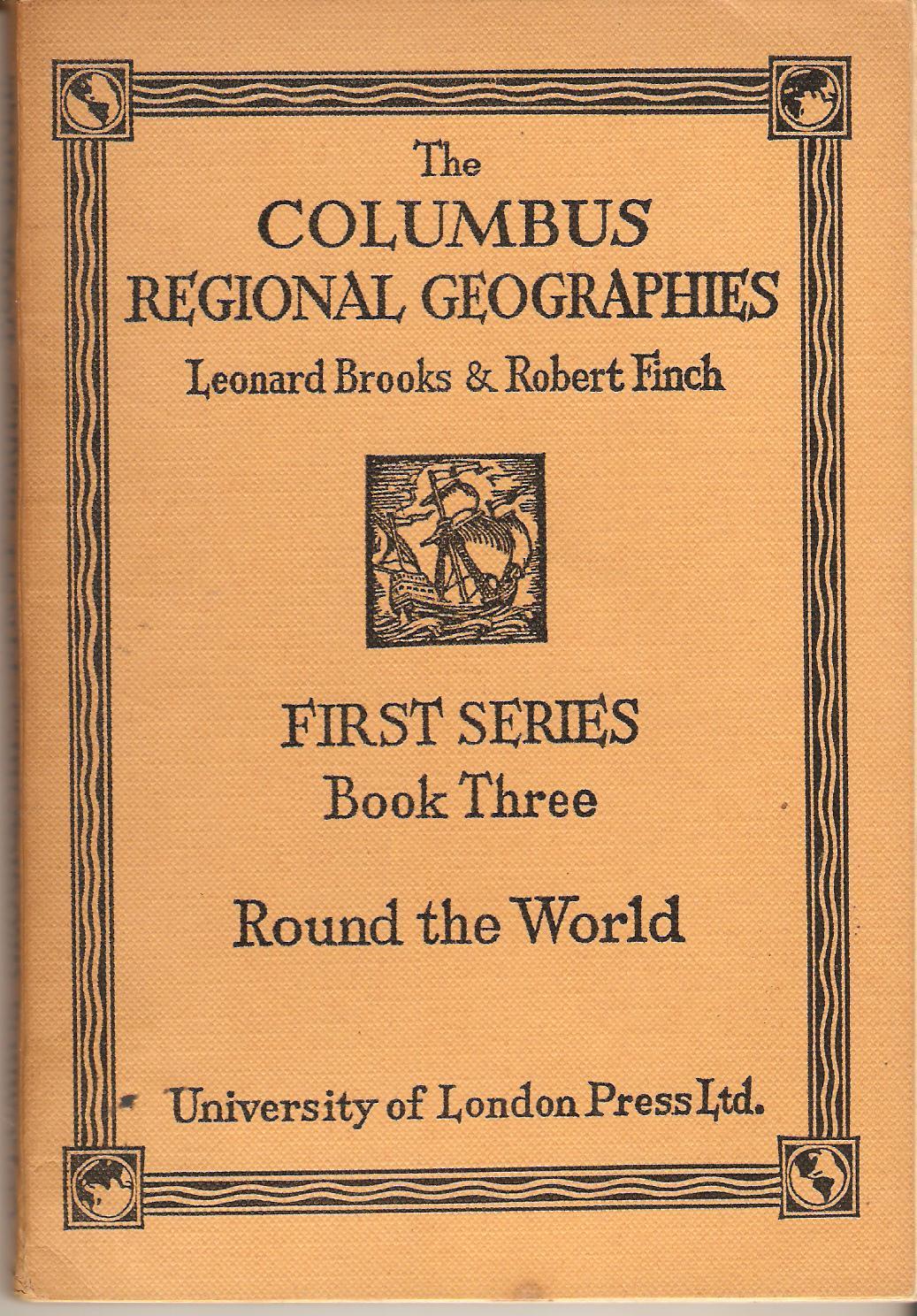
Brooks wrote and co-wrote a series of books on Regional geographies of the World, this one pictured with Robert Finch.
Brooks had a lot of teaching experience, which is also excellent to see, as well as plenty of experience in school inspection.

At the time of his Presidential lecture, Brooks had spent 15 years as a teacher, and 26 years in school inspection.

Brooks' Presidential Lecture was on the theme of 'Some thoughts on the Present day teaching of Geography in schools".


I like how he started by saying that if delegates read Fleure's pamphlet from 33 years earlier on 'Geography in Education' he would find that things had come round full circle. It was ever thus.

He proposes to do 2 things in his Presidential address which would still make a good focus for any CPD session.


The talk is well worth reading. It touches on a great many things which one can hear talked about at teacher conferences today, over 70 years later.

I don't agree with everything he has to say, but nine times out of ten he is fairly spot on.

His obituary talks about the work he did connecting the GA with the RGS, acting as liaison between the two organisations.


One of the projects that Leonard Brooks started (along with another President Sydney Suggate) was  to develop a scheme where schools could "adopt" ships and send letters to their Captains. It was called the Ship Adoption Society.
This provided a chance for students to write to, and receive letters from ships' crews travelling around the world. This was a great initiative.

I was unable to find an image of Leonard Brooks other than the one above, so had to do some digging, and contact various people.

Brooks' obituary by Fleure and Suggate outlines some further details on his earlier life and career, having been born in Lancashire.

In 1955, he was awarded an OBE "for services to Geography".

I think we should see that sort of citation more often in Honours Lists. I can think of a few people who have done a great deal for the subject but haven't been honoured yet (unless they were, and turned it down).

References

Fleure, H. J., and L. S. Suggate. “Leonard Brooks.” Geography, vol. 50, no. 1, 1965, pp. 82–84. JSTOR, www.jstor.org/stable/40567028. Obituary details.

Presidential Address:
Brooks, Leonard. “SOME THOUGHTS ON PRESENT DAY TEACHING OF GEOGRAPHY IN SCHOOLS: Address to the Geographical Association.” Geography, vol. 37, no. 2, 1952, pp. 63–71. JSTOR, www.jstor.org/stable/40564773.

If anyone knows more information about Leonard Brooks, please get in touch, as with other posts on this blog. I'm particularly keen to get a larger image too, as he is one of the very few Presidents I don't have a high quality image of.

I decided to pursue the school route here.
William Ellis School was mentioned in his obituary.

I found this image on their website - I taught in a room with a similar vibe early in my career, and my own school days were in a room with one of those globes in the corner, which tended to get stuck in position. There were also roller boards, and a raised dais at the front, and heavy dark wood furniture with moldings on the top. I like the addition of explorers names around the top of the walls.


The copyright for this image is the London Metropolitan Archive, and the teacher is named as V C Spary. Spary was also connected with the GA, and helped organise the conference for some years.

I was contacted by school archivist/historians after sending an e-mail and they have been very helpful.
My heartfelt thanks to Christopher Willey, Jim Corbett and Fiona McWilliam.

The source of the following section, sent to me by Chris Willey, is principally the school history (T D Wickenden, William Ellis School 1862-1962, privately printed).

It includes something on the purpose built Geography room of 1913. I see that it is recorded as the inspiration of James Fairgrieve, the senior Geography master who preceded Leonard (and another former GA President who has his own entry on the blog)

Imagine following in Fairgrieve's footsteps as a Geography teacher.

The information about Leonard in Wickenden is as below. This also makes a connection with James Fairgrieve:

Appointed by E B Cumberland in 1912 Leonard Brooks succeeded James Fairgrieve as the Endowed school’s Geography teacher. He was ‘… a writer of textbooks, an eminent Inspector of the London County Council and a Fellow and one time Honorary Treasurer of the Royal Geographical Society. In all this and as a Governor, in which capacity he is still with us, the School owes Mr. Brooks a great debt.’ (p75)

‘Early in 1916 the School was asked to join a new Cadet Battalion then being formed in the Borough of St Pancras; for various reasons that was not acceptable but it led to negotiations as a result of which the School threw in its lot with the 1st Cadet Battalion of the Royal Fusiliers, City of London Regiment and constituted ‘D’ Company. Mr Leonard Brooks, the geography master, was an inspiring Captain and Company Commander …’ (p100)


‘Mr. Brooks went to the London County Council in 1920 and was almost immediately engaged with another ex-master, Mr. Beresford Ingram, in organising the new Day Continuation Schools.’ (p116)

During the later 1930s:

‘Partly an outside activity, and partly educational in keeping with the School’s reputation in the teaching of geography was the ‘adoption’ by the School of the S.S. Willesden. 

Mr. Leonard Brooks, then a Senior Inspector of the London County Council, was largely responsible for the ship adoption scheme and for William Ellis being one of the first four schools participating in it. The object was to bring geography ‘alive’ by following the course of the ship in its journeys and its trading – maintaining a chart of the ship’s movements, a logbook of progress, records of cargoes together with their origin, destination, and processing for shipment, and so on. … A steady correspondence between the Captain of the ship and the boys was a principal source of information and interest. 

 Files, charts and posters were kept in the Geography Room and were available there for inspection and use by any boy who wished. The association, first with Captain Anderson and then Captain Martin, was a very happy one for they were good letter writers and went to great pains to answer the host of questions sent them, and in arranging visits to the Willesden; talking with the crew was of special interest to the boys on these occasions. The owners presented a large model of the S.S. Willesden to the School, a gift greatly appreciation. 
Just before the outbreak of war, the P&O liner Stratheden was adopted as a second ship..'

The Stratheden seems to have survived the war: here is a picture of a school visit to the ship led or accompanied by AP Smith in the early 1950s, a revival of the ship adoption scheme, at the least 'in spirit'.


More images to come of the Geography classrooms at WES in due course in a separate blog post... they are really excellent.

Leonard will have taught in the dedicated Geography room at Allcroft Road. 
On the subject of the room itself, Wickenden says the following:

‘… in 1913 the additions were made to the Allcroft Road buildings, namely a special geography room and two new classrooms. … The geography room was the first of its kind in the country, and owed its conception and design to the enthusiasm of Mr. James Fairgrieve, then geography master at the School and a pioneer in modern methods of teaching that subject. He had put forward his proposals first in 1911, and one must applaud the business-like dispatch which saw the three rooms ready for use at the beginning of the 1913-14 school year, the London County Council having provided a building grant of £2,500 towards the cost.’

I am hopeful that there may be another image of Leonard forthcoming as Chris sent details of my request round in a newsletter. The group photo above is currently the only one I have.

Image credit: Balchin's Centenary volume of the GA - the first Hundred Years

Update July 2021

In July I was able to go up to Solly Street and head into the archives, and found that there was a pallet of boxes from the William Ellis School, where Leonard taught.
These were later catalogued.

What I did find was a copy of the World by Leonard Brooks which appeared to have been used by Leonard himself, which was exciting and a connection back to a previous President.


Major update March 2026

I'm extremely grateful to members of Leonard's family for getting in touch with some further information on Leonard having seen this entry, and having completed some work as a family researching their history. 

This included a huge amount of extra detail on both Leonard and his wife which I hadn't discovered from any other source.

One of the things they sent me was a family tree - here's a section of it that features Leonard.


One part of the detail I was given features Beatrice Kennerley. She was born in 1883 near Bolton. At the age of 18 she was a paper bag maker. Her brothers had emigrated to America. She decided to become a school teacher. She gained her Teacher's Certificate from the Board of Education in 1905, and after two years of probation was granted another certificate in 1907 and started work as an elementary school teacher in Farnworth.

She met Leonard Brooks around this time, who was also working as a school teacher and they were married in 1911.


Leonard and Beatrice Brooks - thanks to Leonard's family.

Leonard and Beatrice moved to London after their marriage and lived in the Hampstead Garden suburb in Wildwood Road.
Beatrice moved into property, and helped set up an estate agents called McCraith and Brooks.

Beatrice and Leonard had 3 daughters.

Now onto the detail of Leonard's life:

Leonard was born in December 1884 in Farnworth near Bolton, Lancashire. The family was recorded as living in Market Street in the 1881 Census.

At the age of 16 he was recorded as working as a clerk in a cotton mill, so probably left school at the minimum age. His father was the manager of the Cotton Mill where he worked.

He attended Halshaw Moor Chapel, and in 1905 was recorded as being both a librarian and a pianist. Leonard was an accomplished musician as well as a geographer. This was very helpful.

Despite leaving school so young, he wanted to study geography at Cambridge. He discovered that FitzWilliam Hall was offering an organ scholarship. He studied the organ and music for a year, took the exams and was awarded the scholarship.

He matriculated in 1908 and gained a BA in Geography in 1910.
His first teaching appointment was in 1911, when he was appointed as an assistant master at the boys' municipal secondary school in Leamington Spa in Warwickshire. This was a busy year, as he married Beatrice and his pay was increased from £160 to £170 per annum.

In 1912 he moved to the William Ellis Endowed School at Gospel Oak in North London.

I've mentioned this earlier in the blog as I was able to get some help from the school and discovered that Leonard's predecessor as teacher had been another GA President James Fairgrieve.

He taught geography at the school, where he "pioneered the use of geography as an instrument of humanity".

He was the author of many textbooks - some of which are mentioned earlier on the blog. 

Leonard's family provided lots of useful additional detail of his later career:

In 1919 he had a part time job at Birkbeck College, lecturing on historical geography.

In 1920 he became an Inspector of Schools for London County Council.

He was Honorary Secretary, Honorary Treasurer and Vice-President of the Royal Geographical Society.

Leonard sadly died in 1964, with Beatrice passing away in 1966.

Special thanks to Annie and Andrew Britton and family members for the information in this update.

Wednesday, 25 September 2019

1937: Professor Leslie Patrick Abercrombie (later Sir)

Sir (Leslie) Patrick Abercrombie - NPG x82059.jpg
Last updated June 2024

Patrick Abercrombie was a major person in the development of town planning, and was another of the Presidents who were chosen because of their public profile, rather than a connection with geography teaching per se.
I remember learning about his work in a module on planning which formed part of my degree in the early 1980s.
His name has since cropped up with respect to BAAS Section E and links with Sir Peter Hall, who is referenced quite a bit on the blog.  

He was born in Cheshire, and studied at Liverpool School of Architecture.

His work's legacy persists today and is still influential in discussions around town planning.

When he became GA President, the Second World War was approaching, but there was still a lot of change occurring in the British landscape.

Following the Second World War, Abercrombie became a leading person in the rebuilding of London and other places. This was also a time when planning was a big focus of the BAAS Section E.

His work led to the New Towns Act which has left a legacy of cities across the UK, and work on other cities which have been influenced by the movement, spreading worldwide.


From his Wikipedia page (shared under CC license)

Sir Patrick trained as an architect before becoming the Professor of Civic Design at the University of Liverpool School of Architecture in 1915, and later Professor of Town Planning at University College London. 

Afterwards, he made award-winning designs for Dublin city centre and was involved in the replanning of several other cities, including Hull.

He was also closely involved in the founding of the Council for the Preservation of Rural England (CPRE). After its formation in December 1926, he served as its Honorary Secretary. This is yet another important institution with a link to a GA President.

When Abercrombie became GA President, he had not yet completed his most famous work, which was yet to come after the Second World War.

His Presidential Address was entitled 'Geography, the basis of Planning'.

ABERCROMBIE, PATRICK. “GEOGRAPHY, THE BASIS OF PLANNING.” Geography, vol. 23, no. 1, 1938, pp. 1–8. JSTOR, http://www.jstor.org/stable/40560522. Accessed 24 Aug. 2023.

Duncan Hawley (and other geologists) need to look away from this extract.


He championed the idea of a Green Belt around London, and contributed to the Royal Commission on the Distribution of the Industrial Population, the report of which (Barlow Report) appeared in 1940. Green Belts are very much in the news in the summer of 2023 in terms of their suggested impact on new housing which is needed.

He is perhaps best known for the post-Second World War replanning of London. He created the County of London Plan (1943) and the Greater London Plan (1944) which are commonly referred to as the Abercrombie Plan. 

I've seen the plan / map referred to as the potato map.

He appears in the film The Proud City presenting his plan to the public - a rare film of a GA President talking:

The Proud City. Patrick Abercrombie from Planum. The Journal of Urbanism on Vimeo.


In 1945 he published A Plan for the City & County of Kingston upon Hull, with the assistance of Sir Edwin Lutyens. Lutyens had died the year before publication whilst much of the plan was being finalised, and the plan was ultimately rejected by the Councillors of Hull.

From the Abercrombie Plan came the New Towns movement which included the building of Harlow and Crawley. He produced the Clyde Valley Regional Plan in 1946 with Robert H Matthews that proposed the new towns of East Kilbride and Cumbernauld.

During the postwar years, Sir Patrick was commissioned by the British government to redesign Hong Kong.
In 1956 he was also commissioned by Haile Selassie to draw up plans for the capital of Ethiopia, Addis Ababa.

Patrick Abercrombie was Knighted in 1945.  In 1948 he became the first president of the newly formed group the International Union of Architects, or the UIA (Union Internationale des Architectes). The group now annually awards the Sir Patrick Abercrombie Prize, for excellence in town planning. In 1950 he received the AIA Gold Medal. The University of Liverpool's Department of Civic Design also continues to award an Abercrombie Prize annually to its top-performing student.

He died in 1957.

A Blue Plaque has been erected at a house formerly occupied by Patrick Abercrombie (lived there 1915-1935), in Oxton, Merseyside. 

References
Wikipedia: https://en.wikipedia.org/wiki/Patrick_Abercrombie

Source of image - Creative Commons

I amended the entry to add his GA Presidency - something I have done for each GA President who has a Wikipedia page.

Presidential Address: https://www.jstor.org/stable/40560522?seq=1#page_scan_tab_contents

David Matless piece: Matless, David. “Appropriate Geography: Patrick Abercrombie and the Energy of the World.” Journal of Design History, vol. 6, no. 3, 1993, pp. 167–178. JSTOR, www.jstor.org/stable/1316006.

https://www.ft.com/content/97afa1b2-44a3-11e4-ab0c-00144feabdc0

https://www.theguardian.com/uk-news/davehillblog/2014/mar/22/london-county-plan-abercrombie-forshaw

https://www.oxfordreference.com/view/10.1093/oi/authority.20110803095343737

Update (late September 2019)
Thoughts on Abercrombie's legacy from Brendan Conway

Update (October 2019)
Image result for jenkins history londonAbercrombie's legacy is also discussed in the new Short History of London by Simon Jenkins - a current read of mine.
The author is not a fan of the period where a lot of the historical streets of London were replaced, buildings removed, and threats to other buildings such as St. Pancras, in the period after the Second World War.
Abercrombie talked about London's past as a time of 'obsolescence, bad and unsuitable housing, uncorrelated road systems and inequality in the distribution of open spaces'.

I have a copy of a book which features the plan. A green belt was proposed to stop the expansion of the city, and there would be up to five 'ringways' to take traffic around the city centre.
People would be moved out of the city to new towns to take the pressure of the centre. The 1947 Town and Country Planning Act gave Abercrombie the power to change the lives of the 7 million inhabitants of the city, but it met opposition from the realities of a city which had survived the Blitz and needed to be rebuilt and given a new energy.

Jenkins' books is well worth reading.

In G. R. Crone's chronology of Geography in the 20th Century, there is a brief mention of Abercrombie's Presidential address.


Reference
Crone, G. R. “British Geography in the Twentieth Century.” The Geographical Journal, vol. 130, no. 2, 1964, pp. 197–220. JSTOR, www.jstor.org/stable/1794582.

Update
A video describing the plan.


 And a dramatised film describing the rebuilding of Plymouth based on Abercrombie's planning after the war.


Updated November 2020

In November 2019, Abercrombie got an English Heritage blue plaque unveiled at his house in his honour. Here's the ceremony...


Updated August 2021
A plan for a future Dublin - from 1922

Updated July 2022

I'm adding in additional perspectives on the work of Presidents and the people themselves as I find them, particularly where they may be problematic and relate to the current need to decolonise the subject itself but also revisit what are accepted narratives.
This thread is an interesting one with respect to the reasoning behind some of Abercrombie's planning decisions - this is of course a great responsibility.


Updated August 2023


Abercrombie met Patrick Geddes... another person linked with the GA...


Abercrombie was apparently influenced by Feng Shui

Matless, David. “Appropriate Geography: Patrick Abercrombie and the Energy of the World.” Journal of Design History, vol. 6, no. 3, 1993, pp. 167–78. JSTOR, http://www.jstor.org/stable/1316006. Accessed 24 Aug. 2023.

A piece in Nature from 1938 by S H Beaver (another former GA President to be...)

THE Geographical Association's annual conference usually has a theme corresponding to the interests of its president for the time being, and since in its choice of presidents the Association does not confine itself to academic geographers, considerable service to the subject is often done by this importation of a new viewpoint. This year the keynote of the Conference held at the London School of Economics on January 4–6 was the part that geography can play in planning. The presidential address, delivered by Prof. Patrick Abercrombie, professor of town planning at University College, London, was entitled “Geography, the Basis of Planning” ; and a symposium on town and rural planning was the principal individual item in the programme. To a certain extent these items in the Conference may be considered as corollary to the important discussion on “Planning the Land of Britain”, which was held at the Nottingham meeting of the British Association, as reported in NATURE of November 6, 1937, p. 791.


On his work on the Green Belt


Updated June 2024

Plenty of Tweets shared by the @createstreets account....


This post talks about the Green Belt as being 'The curse of Patrick Abercrombie' 

Also a comment on his plans for Hong Kong.


Margaret Mackintosh RIP

Updated post. Sad news at the end of last week from colleagues who have organised the Charney Conference over the years of the passing of Ma...