Showing posts with label King's College London. Show all posts

Thursday, 18 December 2025

Professor Eric Brown

I'm still interested in adding further details of people and connections with the GA - the blog is not over, although the main phase has been completed in terms of writing biographies of all former Presidents.
Please get in touch if you have things you might want to add.

I came across this obituary of Professor Eric Brown from 2018, who had a number of connections with the GA and the RGS.

An edited version of a remarkable career, with plenty of RGS and IBG related work as well.

Eric Herbert Brown died at Berkhamsted on 5 January 2018 at the age of 95. He taught geography at University College London for almost four decades, inspiring generations of undergraduates and mentoring dozens of research students. His doctoral work, published as The Relief and Drainage of Wales (1960) earned him the Back Award of the Royal Geographical Society and has become a classic work in physical geography. Eric was President of the Institute of British Geographers in 1978 and served as Honorary Secretary of the RGS from 1977 to 1987, and then Vice-President (1988–1989). He edited Geography Yesterday and Tomorrow (1980) to commemorate the 150th anniversary of the Society. 

The son of Samuel and Ada Brown, Eric was born on 8 December 1922 at Melton Mowbray, Leicestershire. His exploration of the surrounding countryside, on foot or on bicycle, awakened his interest in geography, and a game of “brook jumping” introduced him to the meandering of streams. Having excelled in his secondary education at King Edward VII Grammar School in Melton Mowbray, he was accepted to study geography at King's College London. His first academic year was spent as an academic evacuee in Bristol, where he was tutored by Sidney Wooldridge who had a profound influence on his approach to geography and his subsequent career. From 1941 to 1945, Eric was a Royal Air Force pilot, after training at several bases in Britain and Canada. As a member of 517 Squadron, Coastal Command, he was involved in anti-U Boat operations over the Bay of Biscay and collected meteorological data on long patrols over the Atlantic to assist forecasting of weather in Europe. This contributed to the forecast from which General Eisenhower decided to postpone D-Day by 24 hours. 

Based in Pembrokeshire, Eric met a local farmer's daughter named Eileen Reynolds whom he married in 1945. After the war, he resumed studies at the King's College-London School of Economics Joint School of Geography and obtained a first class degree in 1947.

Following Wooldridge's advice, Eric accepted an assistant lectureship at the University College of Wales, Aberystwyth, where Emrys Bowen was professor. With support from geologist Alan Wood, Eric researched the geomorphology of Cardiganshire for his MSc (University of Wales, 1949), and started work on his doctoral project covering Wales (University of London, 1955). He made field observations throughout Wales, usually travelling by motorbike. His investigations impressed Professor Henry Clifford Darby, whom he had met at an IBG conference, and he was invited to join UCL. After advice from Wooldridge, Eric began teaching in London in January 1950. 

Throughout his career, Eric's main teaching responsibilities lay with geomorphology and North America, the latter popular course being shared with Bill Mead. 

Beyond the British Isles, Eric gained field experience in Poland in the early 1960s of periglacial features and the techniques of geomorphological mapping developed there during the 1950s. This led to him making a significant contribution to all of the four meetings (one of only three such “regulars”) between November 1958 and January 1961 that began by proposing a Land Form Survey of Britain, and ended with the agreement to establish the British Geomorphological Research Group (BGRG). The minutes of these meetings reveal Eric to have been a strong advocate for the Polish style of geomorphological mapping (of landforms) rather than the morphological mapping (of slope attributes) favoured by some others; as well as for the foundation of the BGRG (together with David Linton and Wooldridge). 

Eric retired in 1988 but retained many links with UCL and especially the Remote Sensing Unit. In 2002 his long and dedicated service to geography was marked by an honorary doctorate from the University of York, where his former student Sir Ron Cooke was vice-chancellor. Eric continued to be an active member of his local community in Berkhamsted, including its branch of the Geographical Association. He attended academic events at the RGS-IBG and meetings of the Geographical Club. 

He deepened his appreciation of rugby football and fine wines. UCL Geography emeriti enjoyed regular “pub lunches” until last year, when Eric would recall wartime experiences as if they were yesterday. A visit, with Bill Mead, to Gerry and Marion Ward in the south of France became an annual fixture. After the death of Eileen in 1984, he lived alone for three decades, moving into a retirement home only for his final months. Professor Eric Brown is survived by his daughters, Jane and Megan, and by his grandchildren in whom he took great pride.

Saturday, 8 July 2023

From the archive - Dudley Stamp Memorial Service

I need to get back to Solly Street and spend a little more time in the archives. 

I came across the details of Dudley Stamp's Memorial Service in one of the boxes of files.

It was held in November of 1966.

Friday, 26 May 2023

Professor Alice Coleman - RIP

'Bad design does not determine anything, but it increases the odds against which people have to struggle to maintain civilised standards'

Alice Coleman


I recently heard that Alice Coleman had sadly passed away just short of her 100th birthday.

We had prepared a celebration of her work with the help of Peter Vujakovic. It was published in the Summer 2023 issue of GA Magazine.


GA Magazine is received three times a year by GA members.

There will be further comment later, but the piece can be seen below. Alice leaves a tremendous legacy of work and did a great deal to support and further the cause of the GA in several respects. I have a copy of the handbook for the Land Use Survey she coordinated. 

She was a teacher, as well as working at King's College, London - with which the GA has had many close connections over the years.


Update

Telegraph obituary. 

Reading

Utopia on Trial - available from the Internet Archive. 

Update August 2023

Here's an image of Alice with a former GA President: W G V Balchin.

He was the guest speaker at the GA Thanet Branch in 1996

Alice wrote Balchin's Obituary for the GA.

Tuesday, 10 November 2020

Alice Coleman

Upated February 2023

Alice Coleman
has been a great supporter of the GA throughout her long life and particularly associated with the Isle of Thanet GA Branch.
She is now aged 99 and an Emerita Professor of Geography from King's College, London, according to her Wikipedia entry.  There is also another GA link with King's College.

Alice is particularly noted for directing the 1960s Second Land Use Survey of Britain and for analyses of land use planning and urban design which have influenced the design of residential developments since the 1980s.

The 2nd Land Use Survey of Britain followed on from that led by Dudley Stamp, but was more detailed in its approach.

As I have previously reported from the Thanet Branch Centenary document: (PDF download from this link)

"In late 1955, Alice Coleman, of King’s College London came to the now defunct Medway Towns branch of the Geographical Association to speak about the then unexplored aspects of the Moon. Marjorie Woodward at the time was the Secretary of the branch. Both had been educated at Clarendon House Grammar School (Photo 2 in Appendix A) for Girls and both Marjorie and Alice had their roots in the Isle of Thanet. After a geographical discussion, each promised one another that if ever either of them should return to live there, they would form a branch of the Geographical Association. After the meeting of these 2 ladies, the birth of the Isle of Thanet Geographical Association was quite sudden. A pilot committee was set up in November 1955 where it was decided that the new GA Branch would be open to all who were interested in the post-war developing world. Students would be particularly welcome and take part in the increasingly popular fieldwork with excursions to a wider area and that a magazine would be published."
After many meetings of the committee consisting of Alice Coleman and Marjorie Woodward, George Wooster and Ken Girkin of Chatham House Grammar School, Peggy Hopkins of Clarendon House Grammar School, Ken Maggs, then in the Army, and Alan Kay of Margate, the first meeting of the Branch took place at Charles Dickens School in Broadstairs on 30th January 1956. A classroom had been booked but so many people arrived at the meeting that chairs had to be hastily removed to the Assembly Hall for the meeting to convene. Friends were quickly co-opted as committee members to help with the collection of the subscriptions; 80 signed on as members on that first night. Despite the inclement snowy weather, a triumphant Committee celebrated next day at the “Little Vienna” café on Broadstairs Jetty.

She was President from 1955 onwards and her name is scattered throughout the Branch history for the next 60 years!
She attended the 1993 Centenary weekend of the GA as well. I have looked through the batch of photos that Sheila Jones sent on but can't see her shown there.

I purchased a copy of the 2nd Land Use Survey Handbook, which Alice Coleman wrote along with Ken Maggs from the Thanet Association.

The full story is told in the Thanet Centenary document:

In 1975, Alice Coleman won an award: "Woman in a Man's World", which is an award of its time, but very well deserved - hopefully there was some champagne involved.

Alice is an urban geographer, and I was very interested to see that she was also the subject of an article by one of the urbanists I most admire: Jane Jacobs, and that she actually popularised the idea of defensible space in urban planning in the UK.

What a service to the Association, and a life well lived.

References

https://en.wikipedia.org/wiki/Alice_Coleman

https://onlinelibrary.wiley.com/doi/abs/10.1111/1468-2427.12047 - Jane Jacobs article on defensible space.

“The Geographical Association.” Geography, vol. 60, no. 2, 1975, pp. 146–152. JSTOR, www.jstor.org/stable/40568383. Accessed 8 Nov. 2020. - her award mentioned in the Annual report for 1975

Updated section

This will be Alice Coleman's centenary year which will hopefully be marked in some way.

This article from Create Streets talks about her work with Margaret Thatcher to influence housing policy in the 1980s. (PDF download)

There are some images here (licensed) and here (Shutterstock) showing her at work.

Further research articles:

https://escholarship.org/uc/item/9sw3c9vf - details on her urban research
Her books can still be located:


Sunday, 8 November 2020

1986: Professor Denys Brunsden

Last updated January 2024, with some sad news.

"Field time is your most precious time - how precious you will know only when its days are past" 
(Sauer, 1956)

Emeritus Professor Denys Brunsden is a legendary geomorphologist, whose work will be familiar to many, particularly with respect to coasts. He has also collaborated frequently with another former President: Andrew Goudie.

He was a leading person in the successful campaign for the designation of the Jurassic Coast as a World Heritage Site, acting as a Trustee for many years, and is now a Patron of this classic Coastal location - a venue for generations of geography fieldtrips, and classic case study in many textbooks. This has been a coastline which has been part of his life for decades.

Denys is still active, and this video is one that I have used each year for my teaching, looking at the potential impact of coastal erosion on the town of Lyme Regis, and the need to manage it. I try to get to Lyme Regis at least once a year, and we just managed it this year... Denys has written about this area in a large number of books and other papers.


The International Association of Geomorphologists, which Denys helped to instigate, has a Brunsden medal which is awarded annually for work in this area.

Denys was born close to the Jurassic Coast area as well, in Torquay in 1936.

He was educated at Torquay Boys Grammar School, before earning a place at King's College, London.

Here he is talking about his life at this time, and the influence of another GA President Sidney Wooldridge.

In 1956 I went up to Kings College, London, and was advised to study under Sidney Wooldridge, at that time the great geomorphologist. Geomorphology is the study of the shape of the earth, the landforms, and the processes that create them. I was mesmerised by his teaching, and being a bit more mature than the other students I worked harder and got a good degree. When I finished my degree, Wooldridge asked me if I’d like to join as a junior member of staff—straight out of graduation—and I jumped at it, teaching 6 hours of tutorials a week and completing my PhD at the same time. 

And there I stayed, for the rest of my working life, finishing up as Emeritus Professor and Fellow of the College. It has been my place.

I am sure that I remember Denys speaking about the Karakoram trip at Sheffield University when I was doing my 'A' level Geography around 1982 and we visited to hear the talk. I had the article clipped out of a magazine for some years.

Denys was a Professor of Geography when he became GA President. He has also worked as a consultant in Engineering Geomorphology.
From 'Bridport Life' in 2015:

"I was part of the British Geomorphological Research Group, a new growing group of “young Turks”. We were creating a new subject, writing all the textbooks, each one of us a specialist—one on deserts, one on glaciers, me on landslides. I was one of four people who started a company called Geomorphological Services Ltd—later we went on to create the International Association of Geomorphologists—and that took me to consultancies in some 28 countries and incredible situations; the Ok Tedi gold mine landslide disaster in Tibet; Papua New Guinea, the Dharan to Dhankula Highway in Nepal; all the work in Dubai surveying for the new airport and dry dock infrastructure, at a time when only 18,000 people lived there, there was no high-rise, and dhows were going back and forth across the creek. Even now I’m working for BP offshore looking at the sea bed for pipelines and well sites."

His Presidential Address was called 'The Science of the Unknown' and referred to the importance of fieldwork as well as other things.


There are quite a few quotes from this address relevant to my own proposed conference theme.

Denys explored some ideas that I've also used over the years when teaching CPD courses for the GA on fieldwork, local studies (heimatkunde) - which goes back to Keltie and Mackinder, and Physiography.
He also mentions Wooldridge who was a geologist turned geographer and had a great interest in fieldwork, which is something woven through the history of the GA. 
He also refers directly to some of the themes that had occupied his time as President of the Association with regard to the well-being of the subject.


Denys told me some other things about his time at the GA.

Denys told me about his various involvement in the GA, which is very impressive.
1956-9 Student Member 
1960-to date Member 
1962-7 Assistant Conference officer. All conferences and the annual Conference were held at the London School of Economics
1968. Published Dartmoor in the 'Geography through Maps' Series 
1968-74 Honorary Conference Officer. Annual at LSE. 
1968-74 Member Executive Committee. 
1974-79 Member of Council. 
1973-76 Member of the Organisation and Development Committee which re-organised the whole committee structure of the GA and much remains to this day. We also proposed the Council for British Geography (CoBRIG) and set up the new publications such as Primary Geography: Great movers in this period were Sheila Jones and Pat Cleverley. 
1975-78 Representative on the Council for Environmental Education for the GA
1984-6. Vice-President
1986-7. President
1987-8 Senior Past-President
1988 GA representative on the Nature Conservation Working Party for Science at the Dept. Educ. Science. 
Denys also organised the GA Consultation on the 'Future of Geography' with J. K. St Joseph, Minister for Education at the time.

I also asked Denys about his memories of other GA Presidents at the time. 

The longest serving was probably Alice Garnett. She 'owned it". The most faithful supporters were Robert Steele and all the Presidents of that time. 
The most influential in my time was Michael Wise (also a fabulous Treasurer), before that S.W.Wooldridge was a monumental presence and Dudley Stamp put the GA on a sound financial course especially with his advice to Michael and in many 'hidden' ways.

Denys also pointed out the particular influence that King's College, London has had on the development of the GA, in the same way as other key institutions which have kept cropping up through the last century or so that I have been blogging about. Those include LSE, Oxford University, Aberystwyth University, Manchester University and Sheffield University amongst others.

Denys told me:

You should mention the important role of the KCL/LSE contribution during the 1950-1990 period. The annual conferences were always held at LSE. 
The successive members of staff who did the work of organising conference included the following people, who I will try to find out more about.

Tom Elkins - Professor of Geography at the University of Sussex
Jim Bird
Peter O'Dell (or Odell)
Denys Brunsden 
David Jones
Barrie Morgan - strongly linked to King's College, London
https://www.strandlines.london/2012/08/01/memories-of-the-strand-dr-barrie-morgan/
David Green
A massive un-recognised contribution. Something for me to pursue further. 
We also all served on the lecture circuit, all of the academics (all universities) lectured to the branches and to school conferences. The link to Universities at that time was very strong.

Sheila Jones told me of the importance of the GA conference organiser in her messages to me, and mentioned that Denys helped organise her own conference.

Denys also got involved in the production of a Channel 4 TV series called Landshapes, which I remember using when I first started teaching as I had the series on video. It also included Rita Gardner - Director of the RGS-IBG, David Jones and Professor Andrew Goudie.
It was presented by Tim Preece.

It was made in 1988.

A series of seven programmes looking at the geomorphology of Britain and Ireland.

Part 1: The stiperstones of Shropshire, which are representative of some of the most ancient rocks found in the British Isles.
Part 2: The landscape created since the last Ice Age, concentrating mainly on Norfolk where the sands and gravels represent some of the youngest and weakest rocks of the British Isles.
Part 3: How the ice sheet influences land shapes in the mountainous regions of Britain, showing the glacial cradles of North Wales and the rivers estuaries of Ireland and Cornwall.
Part 4: The landscapes created by the melting waters of the Ice Age. Shows some spectacular scenery such as Devil’s Dyke, Cheddar Gorge and the waterfalls of Teeside.
Part 5: The erosion of the coastline caused by the sea undermining the soft rocks. Concentrates on southern and eastern England where land is being reclaimed by the sea.
Part 6: Because the British Isles lie on the edge of one of the earth’s plates, the 10,000 miles of coastline are very varied. The shoreline is shaped by the constant battle between the waves and the rocks.
Part 7: The effects of man’s actions on the landscape since his earliest ancestors used ‘slash and burn’ techniques to clear the ancient forests. Soil erosion caused by agriculture in places where the forest was completely felled created the wetland landscape. Human activity has thus changed the landscape sometimes for better, sometimes for worse.

The episodes in bold are ones I remember using in my teaching. The music was very memorable as well.

References
Denys doesn't have a Wikipedia page, although he certainly deserves to have one. More recent GA Presidents don't have pages yet, perhaps that will be a follow up to this project.

Jurassic Coast website: https://jurassiccoast.org/trustees/prof-denys-brunsden/

http://www.marshwoodvale.com/people/2015/12/denys-brunsden/

http://www.bridportlife.co.uk/people/denys-brunsden/ - this has a range of fascinating information on Denys from his own words, including the fact his son plays bass in 'Hothouse Flowers'.... also goes into more detail on his work on the Jurassic Coast.

"Education is key; if people understand what they’re observing then they respect it, and from respect comes a sense of ownership, a stake in something which then has a far better chance of being looked after and conserved for the future."

Presidential Address: https://www.jstor.org/stable/40571619 - "The Science of the Unknown" (1987)


A classic book here:

Denys has written and contributed to a great many books, papers and articles.
I have a copy of this particular guide book of the Jurassic Coast he was involved in creating.

Denys also worked on a number of projects with another former GA President Andrew Goudie, who will be featured on the blog in a few weeks' time. He wrote an Atlas of the Environment of the UK with Andrew.

As always, if anyone has further information relating to Denys Brunsden please let me know so that I can expand on this post.

Top image: provided by Denys Brunsden, taken by Professor Jesse Walker of Louisiana State University

Update November 2020
Alan Kinder let me know that Denys first joined the GA in 1956, when Lord Nathan was the GA President - a very different era of Presidents to now.

A report on Deny's Conference was published in 'Geography' in 1988
Source:

Humphrys, Graham, et al. “Annual Report of The Geographical Association 1987.” Geography, vol. 73, no. 2, 1988, pp. 162–178. JSTOR, www.jstor.org/stable/40571395. Accessed 14 Nov. 2020.

Some tweets:
Advice to young geomorphologists in his #IAG2013 keynote 'Think outrageously, be unconstrained'.

Update March 2021


Updated July 2022

A lovely piece written for the KCL Geography newsletter by Denys, now 85.

It provides a nice potted biography of his life and achievements, sixty years on from doing his degree.


Here's a lovely interview with Denys too:


Updated August 2023

New out in November 2022 from Denys and Andrew Goudie.


A sad update in January 2024.


Thursday, 16 July 2020

1971: Professor W G V Balchin

Last updated August 2023

W. G. V. Balchin (William George Victor) was the author of a book which has been one of the most useful sources when writing this blog, and he finally gets his own entry in 1971, when he was chosen as the President of the GA for that year. He had a very interesting life.

In the intro to the book, he is named as:
MA, PhD
Emeritus Professor of Geography, University College of Swansea, Fellow of King's College London and he was certainly a tremendous geographer.

He was born in Aldershot, and was known as Billy.

"When he went up to Cambridge and found a treasure house of geography books, he described it as an Aladdin's cave and read voraciously." (from Coleman's Obituary)

After graduating he joined the Cambridge academic staff as a demonstrator. The next summer he became an Arctic explorer, based beside a glacier about 600 miles from the Pole at the head of Billefjord in Spitsbergen (another of several GA Presidents to have visited) 
While sailing up the fjord he spotted something that enabled him to test another contemporary speculation - isostasy. This postulated that the immense weight of the Quaternary ice had depressed the land surface and squeezed out some of the plastic sima layer at depth. When the melting ice front retreated, the sima gradually oozed back, raising the land again.

He knew that such recent uplift would not have allowed time to cut wide beach platforms like the Cornish ones but noticed shingle ridges, which are sometimes the product of a single storm. The further from the ice front, the more the returning sima would have lifted the land, so that while the ridges were only at sea level near the glacier, they should fan up southward. He proved this by professionally surveying 50 miles of coast, camping out when it became too far to return to the base at night.

The Norwegian government added his work to the incomplete survey of Spitsbergen and named a 5000-ft mountain after him at 79° North, now called Balchinfjellet.
This makes him, after Debenham, another GA President who literally has his name on the map.

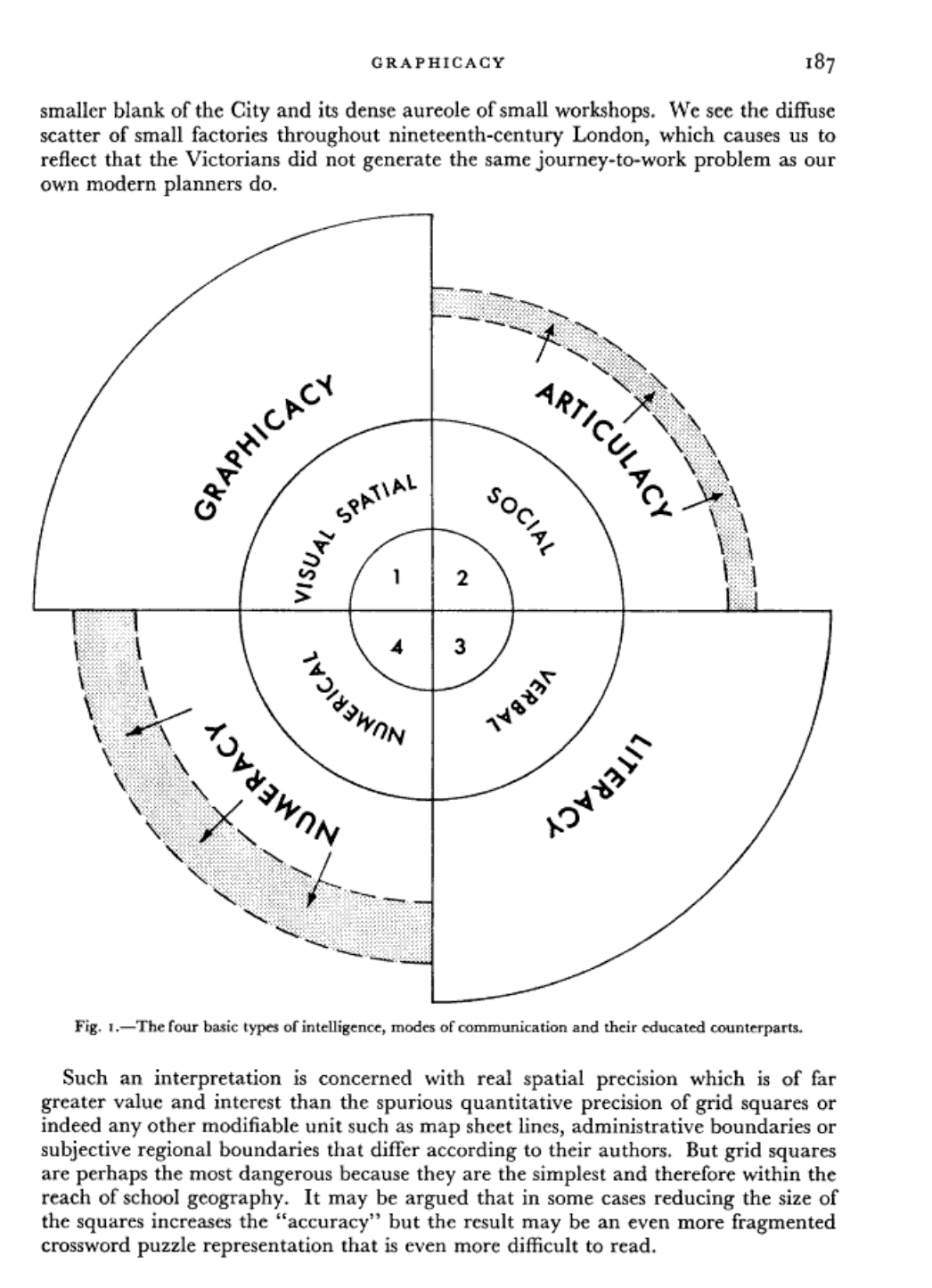
Balchin's Presidential Address, delivered at the London School of Economics was called just 'Graphicacy". It included some useful images such as the one shown here, and has been referenced by other people quite recently and I recommend that you read it.
He had become closely linked with the GA in 1954 when he was first elected as a trustee of the GA, following the death of a number of former Presidents in close succession.


At the end of Balchin's Presidential year, there were proposals for a new Standing Committee on Graphicacy, which was the title of Balchin's Presidential Lecture.

From the obituary listed earlier...

William and Alice Coleman coined the term ‘graphicacy’ and when he was President of the Geographical Association, he chose speakers on this subject for the Presidential day, beginning with his own address. 

He created a warm welcome for the concept, which was taken in the art world also and potentially included engineering. At the time of the National Curriculum, graphicacy was considered an important element for Geography and Rex Walford has recently written that the graphicacy concept ‘… will always remain a defining landmark in the history of geographical education and those articles you [both] wrote about it in the 60s are still regularly quoted today in geographical magazines.’

Graphicacy was still important when I trained as a teacher in Hull in the late 80s. Here's a scan of some notes I typed up during my PGCE course, from October 1986 to be specific.


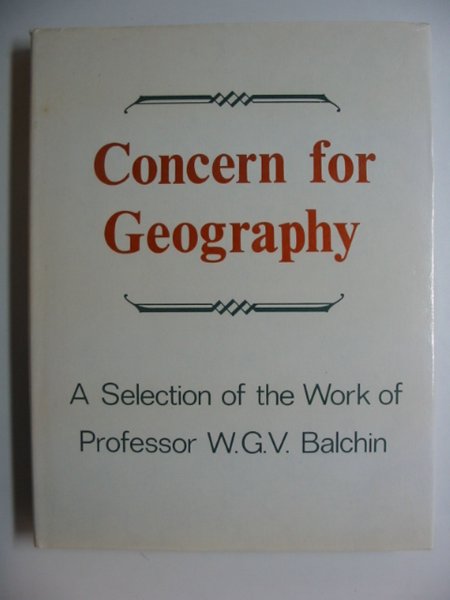
Balchin retired in 1981, and to mark the occasion, a book was published, of which 500 copies were printed.
It is called 'Concern for Geography'.
I got myself a copy, in a different binding. Mine is number 137 of 500.

Here's Balchin's photo from the front of the book.


In 1996, he was guest of honour at a dinner for the Isle of Thanet GA Branch.
Here's a description:
The 40th Anniversary Dinner was celebrated at the Walpole Bay Hotel in December 1996; the guest speaker was Professor Balchin of University College, Swansea. The attendees were welcomed by Elsie Weir, the Chairman. After an excellent meal, everyone was entertained by ‘The Serenaders’ led by Mrs Janice Reagan. This was followed by reminiscences from Alice Coleman, Prof William Balchin, Marjorie Woodward and Fred Fielder

Also a wonderful image: Source and Copyright: https://www.geography.org.uk/write/MediaUploads/Get%20involved/GA_IOT_History_booklet.pdf


From the Balchin Society Obituary

He and Lily retired to her home county of Yorkshire, to the lovely little town of llkley, not far from Leeds where two of their children were working. He continued his work for Geography, supporting the various organizations. In the Royal Geographical Society he won the distinction of serving on the Council for 17 years. Thirteen of these were as Chairman of the Education Committee, when each year he arranged for speakers on a range of careers for geographers to speak to packed audiences of sixth-formers, and as the careers were different every year, the accompanying teachers also found these occasions fascinating. In retirement he helped frame the lecture programme of the Society’s branch in York.

He was also a keen supporter of the Geographical Association. During his years at King’s College he was the organizer of its annual conference, and he was a Trustee for many years. In Yorkshire he joined the committee of the GA’s Bradford Branch.
William always had a great sense of perspective, both looking ahead to the future and relating it to the past. For example, he was well ahead in his recognition of impending anniversaries, such as the 150th of the Royal Geographical Society where he outlined a schedule of celebrations that was closely adhered to in the event. He also wrote a the history of the Geographical Association on the occasion of its centenary and edited a book on the 75 years of the Joint School of Geography – a saga of cooperation between King’s College and the London School of Economics.

For the Royal Geographical Society he prepared an archive of all the geographers who contributed to the success of World War II, with some intriguing revelations. For example, it was a geographer, J F N Green, who cracked the Italian code, using his meteorological knowledge to identify and interpret their weather bulletins. This feat must have been just as impressive as the well-known non-geographical cracking of the German code, but unfortunately it was never written up in similar detail.


I also got hold of a digital copy of an excellent book that Balchin edited in 1970, with contributions from several other Presidents along the way. 
This is from the Internet Archive. 
Check out other books that can be borrowed and read after a download of Adobe Digital Editions.

Balchin died quite recently, in 2007, aged 91 - another GA President to live a very long life.

His obituary was written by Alice Coleman - a familiar name linked with many GA Presidents during her time at the GA.


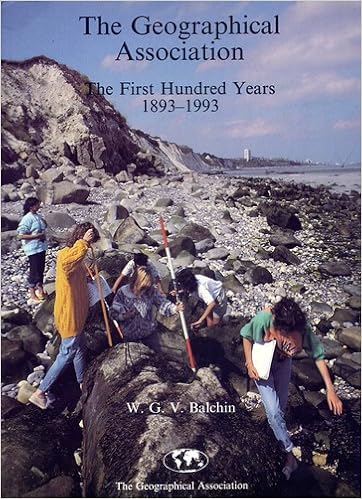
Of course, Balchin has also been influential in most entries so far as he was the author of a centenary history of the Association which is pictured below, and is worth seeking out as a second hand copy as I did.
Image result for w g v balchin

There is a Balchin Family Society, which provided the image for this post.

References

The Internet Archive has scans of several of Balchin's books, and others you can borrow.

No Wikipedia page - perhaps one is needed for Balchin, and several other Presidents too.

Balchin obituary: https://www.questia.com/library/journal/1P3-1521973781/obituary-professor-w-g-v-balchin

Image source: https://medium.com/nightingale/dvs-historic-datavisualization-may2019-6885f80780d5

https://balchinfamily.uk/professor-william-balchin-and-mount-balchin

https://books.google.co.uk/books?id=nbGcAQAAQBAJ&lpg=PA47&ots=FWDWaCsx5p&dq=norman%20pye%20geographical%20association&pg=PA48#v=onepage&q=norman%20pye%20geographical%20association&f=false - Oxford Dictionary of National Biography 2005-8

If anyone has further information on W.G.V Balchin, please get in touch.

Updated October 2020

I've been sent a number of other images featuring Billy Balchin by Sheila Jones. Here he is talking to Sheila at the start of a GA Centenary Quiz in 1993 which will appear in a more detailed report on that event nearer the time. Bill Mead is standing in the background. I am not sure of the identity of the lady in red.


This image above is thanks to Sheila Jones. More to come when I reach 1993.
It shows the longevity of his involvement with the GA that this was over 20 years after he was President and he was still heavily involved.

https://collections.swansea.ac.uk/s/swansea-2020/page/on-our-doorstep - some memories of Balchin are here too, by David Herbert.

One of the features of the Geography course was field-work. Apart from scouring the Gower and adjacent areas, we went off once a year to distant field-week locations. One year it was Devon and Cornwall, based in Exeter, another it was Ireland, based in Dublin. Memorable from the former were a long, seemingly endless trek across Dartmoor looking for tors. Each time our leader, John Oliver stopped at one, Derek Maling would say “Call that a tor” and on we went until he was satisfied. All of this would have been more tolerable if it had not been pouring with rain the whole time. 

In Ireland, we viewed numerous overflow channels and there was a typical Balchin moment. We stopped in an abandoned rural area, walled empty fields and broken down buildings and Professor Balchin asked for comments. As I had been to lectures by Stuart Cousens on the famine and its consequences, I waxed lyrical about the impact on landscape of poverty, starvation and migration. Professor Balchin listened and then said, “That is all very well, but what are the walls made of?” Granite was really the answer he wanted; the course was still mainly seen through the lens of physical geography!

Herbert later says of Balchin:

Bill Balchin was a warm and caring person when I had the chance to know him better; he even turned up from his home in Yorkshire at my retirement dinner when he was in his 90s.

Updated August 2023

From the GA Magazine in 2006 on the occasion of his 90th birthday.


Monday, 27 April 2020

1964: Professor David Leslie Linton

Last updated October 2023

"Mankind must be made much more aware of the world it lives in, its rigorous limitations and its limited possibilities. Above all it must be assisted and persuaded to think of the world as a whole"
D. L. Linton

David Leslie Linton was a Professor of Geographer at the University of Sheffield, and a renowned geomorphologist. His name lives on in the form of prizes in this field.


He was a close colleague of Professor Alice Garnett who, we will discover, was the beating heart of the GA for many years, following her taking up the post of Honorary Secretary in 1947 and overseeing the GA's move to Sheffield in 1950.

Alice Garnett later became GA President four years after Linton.

Linton was a geomorphologist, and also did some influential work with another former GA President: Sidney Wooldridge.

He was born, apparently, in a grocers' shop on the Old Kent Road, to Irish parents, and went on from there to Haberdasher's Aske's school. 
He was a gifted musician, and apparently wanted to do a degree in Chemistry originally. 
He was also a keen artist, and sketched the landscape, from where the geomorphological features emerged, waiting to be explained. In the 1930s, he was active with the Le Play Society, leading fieldtrips to locations including Iceland. This Society was very much tied up with the early history of the GA.

Linton went to King's College, London and was persuaded by Sidney Wooldridge (who was working as a Demonstrater at the time) to add geography to his subjects for his degree, and he was drawn into the exciting geomorphology work that was being done at the time. This university has been linked to quite a few GA Presidents, notably another geomorphologist Denys Brunsden.

He spent the war (1940-1945) with the Royal Air Force Volunteer Reserve working in aerial photography interpretation - solid work for a geographer, and which gave him a deep knowledge of landscapes. There is definitely a book here to trace the work of the geographers who were later linked with the GA in the post-war period. It seems that he was rather good at this sort of work as his obituary explained:


After the war, he went over to check out the sites, and was just about tracked down by the University of Sheffield, who wanted to interview him for a post there where he was appointed as Professor of Geography.

Summary of his career:
King's College London, BSc (Geography), 1927, MSc, 1930; DSc 1945; Demonstrator in Geography and Geology, University of London, 1927-1929; Lecturer in Geography, University of Edinburgh, 1929-1945; served in the RAF (Photographic Intelligence), 1940-1945; Professor of Geography, University of Sheffield, 1945-1958; DSc, 1955; Professor of Geography, University of Birmingham, from 1958; William Evans Visiting Professor, University of Otago, 1959; Honorary Editor of Geography, the Quarterly Journal of the Geographical Association , 1945-1965; President of the Institute of British Geographers, 1962, and of the Geographical Association, 1964; Fellow of King's College London (FKC), 1971; received the Murchison Award, Royal Geographical Society, 1943.

What an impressive CV...

At a meeting in Sheffield (with Wooldridge and others) in 1958, he was a founder member of what became the British Geomorphological Research Group, which he chaired in 1961, and also a founder member of the Institude of British Geographers. He became President of the IBG in 1962.

Linton was honorary editor of the GA's 'Geography' journal too, between 1947 and 1965, and his name appears in numerous copies of 'Geography' in the front matter and also in the pages.

He contributed a range of articles to the journal 'Geography' through the 1940s and 1950s. One was on the rise of the million city - I wonder what he would have made of the rapid rise of megacities, particularly in China.


He also wrote a piece on Geography and the Social Revolution in 1957 in 'Geography'.
His Presidential Address. published in 1965 was on 'The Geography of Energy'


The address included some classic illustrations such as this one.


It also finished with an important message for all teachers.


I remember that he also developed a theory of the formation of Tors, and was taken to the quarry where this theory was apparently first visualised when on an undergraduate fieldtrip at Two Bridges on Dartmoor.
I've visited the quarry here. It's on the path to Wistman's Wood.


Tor formation theory is shown below, in an influential textbook of the time by David Waugh, who is mentioned elsewhere on the blog.


In 1964, he became President of the Geographical Association - probably quite a coup for the GA at the time given how prominent and busy he was.

Linton died unexpectedly in 1971, when he was nearing retirement at the end of a long career while in post at the University of Birmingham. He was still very active.


Obituary published in several journals.

A tribute to him was written by Alice Garnett and published in 1966 on the occasion of his retirement as Honorary Editor.


He received the RGS's Murchison Award.

References
Wikipedia
https://en.wikipedia.org/wiki/David_Linton_(geographer)

I amended this to add in his GA Presidency, as I have done to all entries for former Presidents.

Address: LINTON, D. L. “The Geography of Energy.” Geography, vol. 50, no. 3, 1965, pp. 197–228. JSTOR, www.jstor.org/stable/40567042
Obituary:
“David Leslie Linton.” Transactions of the Institute of British Geographers, no. 55, 1972, pp. 171–178. JSTOR, www.jstor.org/stable/621729

Garnett, Alice. “A Tribute to D. L. Linton: Honorary Editor 1947-65.” Geography, vol. 51, no. 1, 1966, pp. 65–66. JSTOR, www.jstor.org/stable/40566046. Accessed 12 Apr. 2020.
LESZCZYCKI, STANISLAW, and David L. Linton. “The Development of Geography in the People's Republic of China.” Geography, vol. 48, no. 2, 1963, pp. 139–154. JSTOR, www.jstor.org/stable/40565574.

LINTON, DAVID L. “Geography and the Social Revolution.” Geography, vol. 42, no. 1, 1957, pp. 13–24. JSTOR, www.jstor.org/stable/40563897

LINTON, DAVID L. “Millionaire Cities To-Day and Yesterday.” Geography, vol. 43, no. 4, 1958, pp. 253–258. JSTOR, www.jstor.org/stable/40564208
Linton, David L. “THE LANDFORMS OF LINCOLNSHIRE.” Geography, vol. 39, no. 2, 1954, pp. 67–78. JSTOR, www.jstor.org/stable/40564569
https://www.ed.ac.uk/geosciences/about/history/school-history


Image of Haytor - copyright Alan Parkinson, shared under CC license
Image of Linton from the Balchin Centenary Book

Update August 2020
In 2017, my own degree tutor and former lecturer at Huddersfield Polytechnic: Professor Tim Burt was awarded the Linton Award
https://www.dur.ac.uk/geography/news/allgeognews/?itemno=31007

Updated October 2023 with a quote at the start of the post.

He worked to locate V1 and V2 launch sites which is a remarkable period of history for him to have been involved with.

Margaret Mackintosh RIP

Updated post. Sad news at the end of last week from colleagues who have organised the Charney Conference over the years of the passing of Ma...