Showing posts with label Examiner. Show all posts

Monday, 10 July 2023

Thanks Bob

A quick thanks to Bob Digby, who had his final Governing Body meeting recently after many years of supporting the Geographical Association as a trustee, named trustee and Honorary Treasurer.


Bob also served as President of the GA in 2012 of course.

Bob's entry on the GA Presidents Blog that I wrote is here.

He is also an examiner and author of many books which will have helped young people to exam success.

A reminder of the collage that Anne Greaves made of some of Bob's many interests back in 2012.

We will see Bob at GA Conferences and supporting the GA in many other ways too of course.

Image: Bryan Ledgard


Sunday, 23 May 2021

2012: Bob Digby

Bob Digby's name will be known to many from the numerous textbooks and other examination work he has been involved with over the years, and he is still a very active geographer within the subject community offering consultancy, online sessions and continuing to examine, as well as writing numerous textbooks and resources.

He has worked as a teacher, with a career in several schools to give him the grounding that he draws on in his other work. Bob has spent a great deal of time working with Awarding Bodies, and has written and co-written numerous textbooks and worked on other educational resources during that time, as well as leading fieldwork.


He has led many hundreds of days of fieldwork, particularly around the Olympic Park, along with John Widdowson and others, going back to a time before the Olympics.

This was the opening slide from Bob's Presidential lecture, which was themed around the Olympics of course. At the last minute, Bob decided that having taught about it for so long, he couldn't miss out on the once in a lifetime opportunity to see the ceremony that opened the games, and paid an as yet undisclosed sum for a ticket... That also means he saw what was probably Mike Oldfield's last 'live' performance into the bargain...


Bob kindly answered my questionnaire on the Google Form and filled in some additional details as can be seen below:

Bob was born in 1949, in Chelmsford, Essex
His family moved to Cornwall in 1960 shortly before he began his secondary education, which took place at St Austell Grammar School between 1960-67. Like many who have contributed to the Presidents' Blog before him, Bob told me that he owes much of his professional life to one man, Courtney Rice, who taught him geography - a kind and lively man, who was a firm socialist, having grown up in the Welsh valleys. 
Bob went to Keele University (1967-71), where he studied the four-year course; everyone did the same Foundation Year (FY) course cutting across all subject disciplines. He told me:

"I encountered everything from new (to me) disciplines such as astronomy, philosophy and sociology. I didn't make the most of it - who does, aged 18? - but 'FY' gave me a broader appreciation of academic subjects than I could ever have gained by studying a single-subject degree. My degree course consisted of Geography and History (everyone did dual honours at Keele), together with subsidiaries in Geology (which I still love now) and English. My teacher training at Nottingham (1971-2) was unusual at the time, but it determined my career path. I joined a group which trained in Humanities, and did my placement (one, full term at that time) at a new comprehensive school (Toothill, in Bingham) which explored links across the Humanities subjects. It gave me the experience that I needed to get my first job in teaching, which was again in a new school."

He describes his career (so far) as "A mix!"

"My first job was at John Smeaton High School in east Leeds (1972-80), which was a large 13-18 all-ability school drawing from a social cross section from suburban east Leeds to the south of the school, and Europe's largest council estate to the north in Seacroft and Whinmoor. The school was very informal, with no uniform, led by a former Brigadier as Head Teacher, for whom his staff would have walked on water had they the ability. I taught a wide variety of subjects (all in mixed-ability groups to age 16), ranging from integrated Humanities and Social Studies, to Geography to A level and Geology O level. At the time, schools could assess most of their intake through Mode 3 CSEs and O levels, so I was setting exam papers at CSE in my third year of teaching and O level by my fifth year. You wrote the syllabus, you set and marked the exam, all overseen by a Moderator who fed back at all stages. Teachers were trusted and annual meetings took place where teachers cross-marked each others work to moderate standards. It all worked rather well. 

My first Head of Department role was at Morley High School (1980-90), a former West Riding Grammar School in a small town SW of Leeds. Unlike John Smeaton, it was much more formal (staff addressing each other as Mrs or Mr even in the staffroom (that still happens in some schools now - why?) with setted classes. But it was a wonderful time to be a geography teacher. The 14-18 Bristol Project was well-established, and we began teaching that - again, a curriculum which individual schools wrote within the broadest and most basic of frameworks, and an assessment system which was 50% coursework (five items over the two years x 10%) and 50% exam. The Chief Examiner, Keith Orrell , set the most creative exam papers for O level that I've ever seen, then or since. 
See the previous post on this blog on Keith Orrell.
My years at Morley High laid the foundations for the thing which changed my life - the 16-19 Geography Project. Led from the Institute of Education by Mick Naish (a major influence in my career), the project curriculum fired me up like nothing had ever done at school or university. 
It had curriculum depth (fewer topics, taught and assessed in more depth), breadth (a max of core and option topics - there were 23 of the latter and if you didn't like them all you could write your own), and innovation (the first decision-making exercises came from 16-19, together with three coursework assignments which could be designed as you wished based on techniques research and timed essays. I became a Regional Moderator and Regional Co-ordinator for the Project in the Yorkshire region just as the demand and uptake was increasing rapidly. It gave me my first experience in leading CPD and in leading an annual 16-19 conference through Leeds University which lasted over 20 years. 
Thanks to that experience, I was approached to author materials for a new GCSE book (it never got off the ground but it got me noticed) and then a new 16-19 topic book 'The Geography of Health'. From that came Heinemann's "Physical Environment' and its human companion, with others following. I loved - and continue to love - writing, especially on things I'd taught and about places I'd been to 

(I once had a discussion with Margaret Roberts where we agreed that no author should ever write about places they don't know). I've had a few discussions with Margaret on a similar theme of authenticity.

In 1990, my career changed when I was appointed as Lecturer in Education / Geography at Sheffield University (1990-2) to work with Margaret Roberts. 

"I brought experience to the role, but working with Margaret made me raise my game. Her capacity for using frameworks for thinking - about what we teach, how we teach, about writing in geography, as well as her research into enquiry in geography - turned my 18 years almost on its head. I realised I had been planning and teaching almost intuitively without consciously being aware of WHY I was doing things. It was like having to re-learn. I loved it but my goodness it was challenging."

"I realised just how much I'd learnt from working with Margaret when I was appointed to what was West London Institute of Higher Ed (later to become part of Brunel University) to run my own course (1993-2001). 

I invited Margaret to come and run a day one year, and one of the students said to Margaret 'I've wanted to meet you because Bob talks about you all the time'. I did - and if you've read this far and read Margaret's work, you'll know why, and just how unimaginably lucky I had been to work with her."

There were a few other interesting experiences:
"There was a gap in 1992-3 - when I worked at Manchester University as Project Leader for National Curriculum, working with a team to develop what were to be (but were later abandoned) tests for children at 7, 11 and 14. All I'll say is that I should never have taken the job. I wasn't cut out for it, nor it for me; my fault, no-one else's. Don't ever take a job when your heart is shouting 'Walk away'. "

Of his time at Brunel:

"The Brunel years were enjoyable, fun and challenging - just what a job should be. I worked with Fran Martin and Graham Yates, each of whom I love dearly, across a range of primary and secondary courses: undergraduate as well as post-graduate. I worked with school colleagues from a range of school types which were as varied and as interesting as our students. I observed PE lessons (anyone who knows me will splutter at this point) as well as lessons in Geography, English, RE ... whatever teachers taught, I observed. The School of Education was like a school in that it was a real community. PGCE students spend nine months with you and they're gone; with four-year undergraduates you get to know them and how they think just as you would with students in a school. It was rich, exciting, and fun."

"Why did I not stay then? 
Brunel appointed a Vice-Chancellor who could not understand why a third of the Education budget had to be paid to schools, and why as a consequence the School of Education made a deficit. I don't believe in being the last one at a party so began job searching. I'd also had enough of Ofsted by then - 29 inspections across the courses we taught within six years. 

A job was advertised at University College School in north London. Its liberal ethos appealed together with the education freedom that goes with independent schools. I didn't then, and I don't now, support the existence of independent schools in theory, but nor do I support the idea of academy trusts without any democratic accountability. I believe passionately in academic freedom, and the professionalism of teachers to do their jobs without being micro-managed, either by an authoritarian academy management or by the State. I'm not against school inspections at all, but monitoring is very different from feeling that your every move is being watched - and judged. So I took the job at UCS (2001-07) and loved every minute.

When Bob became the GA President he was working as a freelance consultant and author

Bob's Presidential Theme was 'Looking to the Future'. He told me:

"I picked it because it seems to me that this is what we should be thinking about all the time - our students and the world they face, and the responsibilities and challenges they'll face as we hand over to them. I remember Mick Naish saying at the first 16-19 conference that I ever attended, that the purpose of a geographical education was political - that students should be in a position to vote when they are eighteen as informed and thinking citizens. That's our responsibility. 
It seemed that the theme would sit well with keynotes about climate change (a keynote given by Prof Terry Callaghan - I remember it well), teaching about controversial issues (given by Margaret Roberts - I remember that well too) and peace (given by David Hicks) would fit well with this. 
One of the features I was keen to introduce - and which has become a regular feature, I'm delighted to say - was the 'Future Geographers' parallel conference for sixth form students. I owe that thought to Sue Bermingham who brought along some school students to Manchester in 2012. 

I'd been a member of the GA since 1990. I'd attended conferences before that, for example at LSE. I attended conferences and ran sessions for the 16-19 Project during the 1990s, and then on curriculum change in both 2000 and 2006-7. When, in 2005, London won the bid for the 2012 Olympic and Paralympic Games, I'd continued writing materials as I had on Sydney's and Athens' Games in 2000 and 2004. I took the voluntary post of Community Geographer with the GA in 2007 to develop materials on Beijing in 2008, and then on London. I started working with Pumpkin TV and obtained funding from the Learning Skills Council to place a free copy of a DVD 'Aiming for Gold' in every secondary school in the UK.

Bob is a huge supporter of the GA:

"I love the GA. I don't mean that to sound cheesy, but I love the fact that this is a thriving community of people who love geography and love education. It matters because it's a strong voice for the subject when we need it within the community of teachers, within the wider public and (especially now) in a political forum. My roles have been Community Geographer as a volunteer, and then since 2010 when I began my four-year Presidential cycle as a member of Governing Body (2010-14). I continued as a Named Trustee 2014-17 and Honorary Treasurer since 2017."

Of his time as President: Bob said:
"I loved it, and especially annual conference at Derby in April 2013. 
Conference is a wonderful occasion by any standards, and the feeling that you have helped create the theme and the list of speakers is powerful. I was touched by how many people that I valued and admired wanted to accept invitations to speak. It felt 'successful', whatever that means; a large attendance, including the first sixth form students and their teachers, real quality sessions as judged by the evaluations afterwards, and it was also a much younger conference - a trend which has continued since.

It's a great feeling to see PGCE and NQT students attending in large numbers. Then there was the Presidential Lecture. 
I guess every President will tell you that it's the thing that kept them awake at night the most. Good to know. I'd better get started on it soon. I decided to play to strengths with a reflection of the 2012 London Games. I wanted to speak about something geographical. It seemed to me (and still seems) that London's Games were groundbreaking, and I wanted to show why geographers would want to study them. I loved being there at that conference in that lecture room, and looking at the audience. It was and remains the honour of my life to be there, no question."
My Presidents blog project has certainly revealed lots of stories around Presidential lectures, which will form part of my own...

He has some good memories from that time, and of other Presidents as well:

"Above all, I remember Margaret's Roberts' year as the only Presidential lecture I never made it to. I reached the (huge) hall in Manchester at the right time only to find everyone had a far better idea and had used their coffee break to get a seat. So - no seats left. Margaret's lecture is to my knowledge the only Presidential lecture that had to be held twice, the second time on the Saturday morning! 
I was about to make this a firm appointment in the diary when I received a text from BMI with whom I was flying home to Newquay on Saturday evening to say that my flight had been cancelled and I could only get home by taking the morning flight instead. It took off as Margaret would have been starting to speak ..... 
Another lecture that stands out is Eleanor Rawling's at Southampton (I think) in 1992, where she spoke quietly and powerfully about how the geography National Curriculum had been framed in the later 80s / early 90s. It was a devastating insight into the political process. 
Every President brings something special. 
The GA has been fortunate to have had an array of talent from which to draw for its Presidents - teachers, primary and secondary educators, local authority geography advisers, university-based teacher educators, academic geographers, a head of field centre .. we are lucky indeed."

Generations of students have benefitted from Bob's advice and he remains a popular speaker in all sorts of circumstances including online of course over the last year or so.

Until the pandemic, Bob was regularly travelling up to London and other locations from his home in rural Cornwall where he lives with his husband Mike and several dogs. As the GA's Honorary Treasurer. he has followed in the footsteps of his predecessors and continues to hold a very important position in the GA. The last year has shown the value of his financial 'nous' and prudence, backed up by Richard Gill and Alex Forsyth.

This image was produced at the same time as his GA Presidential lecture, and presented to Bob.


References

Far too many books and digital resources to mention, but a few notable items include:
Digby, Bob. “This Changing World: The London 2012 Olympics.” Geography, vol. 93, no. 1, 2008, pp. 40–47. JSTOR, www.jstor.org/stable/40574215. Accessed 15 May 2021.

There was also a special issue of 'Teaching Geography' on the London Olympics:
https://www.rgs.org/CMSPages/GetFile.aspx?nodeguid=bc40d439-8a25-4761-ad2c-74fda48cd525&lang=en-GB

Bob has co-written, written and edited for the GA's 'Top Spec' series.
He has written materials to accompany Pumpkin Videos.
Check out these textbooks:


Image at the top: copyright GA / Bryan Ledgard.

As always, if anyone has further memories of Bob please pass them through or add a comment.

Tuesday, 24 November 2020

1989: Professor Richard A Daugherty

Updated July 2025

After a first degree in geography at the University of Oxford and a Diploma in Education, Richard Daugherty taught geography at Manchester Grammar School before moving into academia.

He became Lecturer/Senior Lecturer at Swansea University and Dean of the Faculty of Educational Studies before becoming Professor of Education and Head of the Education Department at Aberystwyth University, providing a connection back to the early days of the GA, when H J Fleure moved to work there, and took the growing GA library and office with him.

Richard also became Dean of the Faculty of Arts at Aberystwyth where he is an Emeritus Professor.  In October 2010 he was appointed Director, of the Oxford University Centre for Educational Assessment (OUCEA). 

Richard writes: 
My working life in education was in two distinct parts. From the mid 1960s to the late 1980s I was very much involved in geography both as a teacher and through GA activities at national level. After teaching at Manchester Grammar School I moved to Swansea University as a Lecturer in Education. That brought me into fruitful contact with many geography teacher colleagues, through initial teacher training, in service courses, the Swansea GA branch and a term as Chief Examiner for WJEC A level Geography. I was learning from them about the day to day realities of teaching the subject that my own experiences at MGS had only partly prepared me for. 

Being appointed in 1987 to be a Council member of two Government advisory bodies, the School Examinations and Assessment Council (SEAC) and the Curriculum Council for Wales (CCW) took my career in a new direction. Since then my work has focussed, as an adviser and an academic researcher, on the school curriculum more broadly, educational assessment and education policy. Among publications from that period are those with colleagues in the U.K. based group of assessment researchers, the Assessment Reform Group, and policy papers commissioned by governments. Some of those papers date back to the early 90s when I chaired the CCW and others include the Daugherty Assessment Review Group’s report for the Welsh Government In 2004. More recently I have been contributing as an adviser to the Welsh Government and to Qualifications Wales on the radical school reforms currently under development following the 2015 report, Successful Futures. 

My life has, however, always been coloured, professionally and privately, by my love of geography. That goes back to an inspirational teacher at my grammar school in Birkenhead, George Willan, who later became an HMI. It was further fostered by two of my tutors at Oxford, Ian Scargill and Frank Emery. When I moved to Swansea I discovered that Frank Emery had been a much respected local landscape historian, in particular of the Gower peninsula, before he moved on to a distinguished academic career in historical geography. Returning in retirement to my own interest in landscape history, inspired originally by Frank Emery as my tutor, I have joined the ranks of local landscape historians myself with several articles in the two local history journals.

Richard has spent a lot of his career exploring curriculum and worked along with Eleanor Rawling on this sort of work, another former GA President, who was President three years after Richard.

‘The idea of progression is implicit in any discussion of the nature of the learning we hope students will engage in. If we did not hope that our students would, in some sense, progress we would have no foundation on which to construct a curriculum or to embark on the act of teaching’ 
(Daugherty, 1996).

Here, taken from an issue of GA News in 2005, is the news of the award of an OBE to Richard for his services to education in the New Year's Honours List that year.

1989, Richard's Presidential year was an important one for school Geography given the changes to the National Curriculum and the need to cover many attainment targets as they were called. I started teaching in 1987 when the National Curriculum was coming in, along with changes to other assessments. He wrote a book for Macmillan to help teachers prepare for the changes that were to come - this was at a time when I was just starting teaching, so I never actually taught the 'O' Level as the change to GCSE came in just as I started teaching.

Richard had already been working as Honorary Secretary of the GA from 1976-1981 and he has kindly provided more information on Presidents from that period from his own memories of the time, which saw quite a few important events. He also wrote a book for the GA, "Geography in the National Curriculum", published in 1989.

GA NC Book Cover 1989 by Alan Parkinson on Scribd


To a greater or lesser extent I knew all the GA presidents from 1971 (Bill Balchin) through to 1999 (Mike Bradford). I worked more closely over a longer period with some of them - Sheila Jones, Rex Walford, Graham Humphrys, Bryan Coates, Eleanor Rawling - and have a particular respect for how much certain others on the list, such as Michael Wise, Stan Gregory, Patrick Bailey and Denys Brunsden, gave to the Association.
I am grateful to Richard for his additional details on many of these Presidents that he worked with, but also for sending this biographical note which adds extra details to those I was able to discover from my own research. He has also reported on the GA's involvement in curriculum development.

"My involvement with the GA at national level was from the mid 1960s to the early 1990s, from the exciting prospect of a 'new geography' challenging what should be taught, and how, in schools to the near disaster of a poorly designed National Curriculum for Geography. 

I was a newly appointed teacher in 1965 for whom a sleepy and unchallenging degree course at Oxford had told me nothing about the way the academic subject was transforming itself (at Cambridge, amongst other places). The chance in 1966 of a GA weekend course in Sheffield, led by Professor Stan Gregory, was too good to miss. Much to my surprise I then found myself invited ("we need young classroom teachers") to join a newly formed GA committee. It must still surely lay claim to have had the longest GA committee title ever - 'Standing Committee on the Role of Models and Quantitative Techniques in Geography Teaching'. I was thus fortunate to find myself learning from an exceptional group - including Rex Walford, John Everson, Brian Fitzgerald and Vincent Tidswell (my own PGCE tutor at Hull University) - who were seeking to translate the academic 'new geography' into approaches appropriate to school level learning. 

My own first book, 'Science in Geography: Data Collection' (OUP 1974), would not have happened if Brian Fitzgerald had not been series editor. That period was also the beginning of a longer term collaboration with another schoolteacher and future GA President, Sheila Jones (see recent post on Sheila by Richard). 

By the early 1970s I was Chair of what had thankfully become known more snappily as 'M&QT' and I was also therefore a GA Council member. I picked up on a general recognition that the GA's committee structure was in need of reform which led to a working party chaired by another future President, Denys Brunsden. The proposed reforms would prove to be vital in that they ensured the Association was much better able than most subject teacher associations to respond when the 'secret garden' of the school curriculum was opened up to wider scrutiny following Prime Minister Callaghan's Ruskin College speech in 1976.

Concurrently with the GA's committee structure reforms the Association also responded to pressure from a group of younger teachers, including myself, to establish a second journal, 'Teaching Geography'. Although the initiative had come from others, Patrick Bailey, as its first editor, was to provide the shrewdness and energy to ensure that the new journal was an immediate success (see article in Teaching Geography, October 2003). 

From 1976 until 1981 I was the GA's joint honorary secretary, a role initially shared with Malcolm Lewis and then with Bryan Coates. The new committee structure meant that the Association now had two main policy committees, one dealing with Publications & Communications and the other with Education. As secretary to the latter I shared responsibility for responding to radical changes to the school curriculum being proposed in England with its Chair, Rex Walford, plus a committed group of committee members. The national developments led to lively internal debates about justifying geography as a school subject, policy papers and presenting our case to a House of Commons Committee.

Richard told me:

"My term as President coincided with the turbulent period when the way the subject should be defined in the new Natonal Curriculum was being hotly debated. A delegation from the GA made representation to the Government's Working Group and I found myself involved in the case made to the Group by the Curriculum Council for Wales. Even when I turned up at the Group a third time, as the then Chair of the Assessment Council's (SEAC) Geography Committtee it was to no avail. In spite of the valiant efforts of some Working Group members, notably Eleanor Rawling, it was determined to define what later emerged, a deeply flawed blueprint for geography in the schools of England and Wales."

More to come on this area in the years ahead...

Richard was also present at the 125th Anniversary of the GA dinner. The image above was taken by Bryan Ledgard at this event, and shows Richard with a number of other former Presidents.
References
GA News - Summer 2005 - OBE announcement
Images: Richard Daugherty and Derek Spooner (GA President 2000) at the 125th Anniversary Celebration of the GA and other former Presidents group - copyright Bryan Ledgard / Geographical Association
If anyone has other details on Richard's time as GA President, please get in touch.
Update: December 2020
In 2003, Chris Kington asked a number of former Presidents what had sparked their passion for geography. He lent me the letters and here is the response that Richard sent:
He talks about being a new Scholarship boy arriving at Birkenhead School at the age of 10 and enjoying and achieving in geography. He talks about his teacher: George Willan, who was then HoD at Birkenhead and subsequently an HMI before retiring to the Lake District being a great influence on him.
He describes George generously as being:
"an exceptionally efficient and endlessly enthusiastic teacher who was able to embrance the full range of geography syllabus content from the regional geography that was then in vogue to the recent developments in geomorphology. His field trips were classic experiences in the best tradition of Wooldridge. It is some measure of his success with my year group that at least two of my exact contemporaries: Ian Evans and Glen Norcliffe went on to careers in academic geography".
George Willan apparently went to Tbilisi in the 1970s and helped formulate an important environmental declaration.
Many thanks to Chris Kington for the loan of the letters.
Update April 2022
What a real pleasure to meet Richard for the first time at the GA Conference 2022. Thanks once again for all your help with the blog Richard, and for attending the Long Standing Members' meal. I hope to see you again next year.
Lovely to meet up with Richard once again in April 2023 at the GA Conference in Sheffield.
Updated 2025
Lovely to meet Richard and have a meal with him in Oxford in April this year.

Thursday, 23 January 2020

1955: Leonard Sydney Suggate

Last updated August 2023

Leonard Sydney Suggate, who became GA President in 1955 published several regional Geography books along with L Dudley Stamp.

The 1950s were interesting times for the GA in the post-war period, as with the years following the First World War, when many changes happened as a result of the recovery from war.

Suggate originally worked in the printing trade, but then studied psychology before taking the University of London's Teacher's Diploma in geography.

This led to him becoming a teacher, a fairly rare beast as we have seen so far with the blog. 
Few teachers become GA Presidents historically.

Suggate taught geography at Dorking High School, and later at St. Clement Danes Grammar School during the First World War (eventually retiring from there in 1949), which means he is one of a minority of people who had substantial experience of teaching geography before becoming President.

He took over the Presidency six years after retiring from what seems to have been an outstanding teaching career at a number of schools, and it is great to see that someone who was predominantly in the classroom for their career was able to step up to the role.

He was very much influenced by the 'new' geography of Halford MacKinder, and used these ideas in his teaching as well (although by now they were not as new as they once were), writing about them in his work.

He also attended lectures by Mackinder, Garwood, Lyde and Unstead - familiar names from this blog. The War also provided for him an opportunity to radically rethink school geography. This is great to see someone taking on the chance to hear the important people of the time, and factor those ideas into his practice - something which teachers of today do with some success, building on the evidence of research and taking inspiration from academic geographers and practitioners.

There are several contributions that Suggate made to geography teaching in the post-war period.
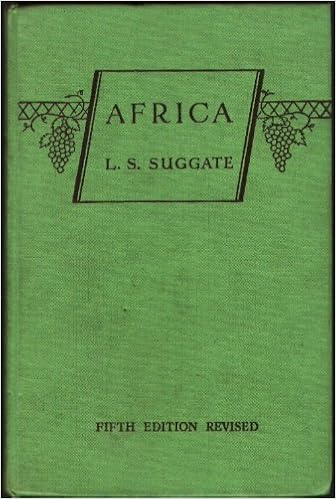
He wrote some of the first textbooks for the new analytical geography, such as 'Africa' - pictured to the right (one of the first school texts on the continent), and which ran to several editions.

He also campaigned for the use of maps and photos to be made available to candidates in school geography examinations, as well as greater use of visual aids in teaching.

He served concurrently on the Council of the RGS as well as the GA, and was elected a Fellow of the Royal Geographical Society in 1921. Another GA President to have a strong connection with the RGS.

He was also a Chief Examiner for the London General School Certificate - another GA President with  significant examining experience as well.
He served on the RGS Education Committee as well, which is of interest as another connection between the two organisations. The work of the RGS's Education Committee continues to be important, and I was involved in supporting the application of several representatives for RGS Council positions in the last few years.

Suggate attended the GA Conference every year apparently, "pipe in hand" - no smoking allowed these days of course.

He was also a Labour party councillor for Hendon.

In 1928, he started to make some changes at Clement Danes School.

When the school moved to a new site, Suggate created a special "Geography room" with a light table (which I remember from geography classrooms I sat in during the 1970s) and cases for equipment and showing artefacts.

I liked the story from his obituary, regarding his apparently indicipherable handwriting. A student asked what he had written at the bottom of their work, to which he replied "you must improve your handwriting, obviously...."

One of the projects that he started (along with another President Leonard Brooks was to develop a scheme where schools could "adopt" ships and send letters to their Captains. It was called the Ship Adoption Society. This has been featured in more detail in the entry for Leonard Brooks, as he mentioned it in his Presidential Address.

Also in 1955, he attended the 125th Anniversary dinner of the Royal Geographical Society, along with other former Presidents such as L Dudley Stamp and J A Steers.

His Presidential year's conference is also described here - in this Nature piece.

Suggate wrote a series of books, which went into several editions.
He described his Presidential election as "at once an exciting and sobering elevation", which I sympathised with.

His Presidential Address was on the theme of geography teaching in Grammar Schools, making it of particular relevance to his audience no doubt.


Two years after completing his GA Presidency, Suggate and his wife emigrated to New Zealand at the age of 67, to join their two sons. 
There, he was also (at that age) Secretary of the Second Triennial Conference of the New Zealand Geographical Association, and continued to write for books. A well deserved and long retirement was enjoyed.


He died in 1970 - another GA President to live to an old age (81) and with 60 years of service to the GA.

I am grateful to Fiona Hirst, Archivist at Clement Danes School for the wonderful image of Leonard from the school magazine at the top of this entry. She very kindly sent me a range of documents and other information to help add detail to what was previously quite a slight entry on the blog compared to some of the previous ones.

An obituary was published in 'Geography' in 1971, written by A D Nicholls, who was a long standing colleagues as well as also being a Former GA President by that time - he is yet to appear here.


References

No Wikipedia entry available. Perhaps a further extension of this project would be to create them for the missing GA Presidents.

Nicholls, A. D. “LEONARD S. SUGGATE, B.Sc., A.K.C. 1889-1970.” Geography, vol. 56, no. 2, 1971, pp. 152–153. JSTOR, www.jstor.org/stable/40567514.

https://archive.org/details/in.ernet.dli.2015.224015/page/n5 - one of Suggate's books

SUGGATE, L.S. Aspects of Geography Teaching in the Grammar School Geography 1956 41 1-14

https://www.questia.com/library/journal/1G1-78392752/oskar-h-k-spate-1911-2000 - a pupil of Suggate's remembers his teaching

“The 125th Anniversary Dinner.” The Geographical Journal, vol. 121, no. 3, 1955, pp. 392–404. JSTOR, www.jstor.org/stable/1790929.

Something in the IoE archives: https://archive.ioe.ac.uk/DServe/dserve.exe?dsqIni=Dserve.ini&dsqApp=Archive&dsqDb=Catalog&dsqCmd=Show.tcl&dsqSearch=(RefNo==%27IE/JUB/B/1%27)

R. J. Harrison Church. “Obituary: Leonard Sydney Suggate, BSC, AKC.” The Geographical Journal, vol. 137, no. 1, 1971, pp. 136–137. JSTOR, www.jstor.org/stable/1795429.
Africa Book: https://archive.org/details/in.ernet.dli.2015.227333

If anyone knows anything else about this President, please get in touch. This is a relatively brief entry.

Thanks to Fiona Hirst for the additional details and image from the school magazine 'The Dane'

Updated August 2023


Margaret Mackintosh RIP

Updated post. Sad news at the end of last week from colleagues who have organised the Charney Conference over the years of the passing of Ma...