He had earlier been involved in a significant event for geography.
In 1945, the new Director of the RGS: Lt Col L. P. Kirwin, aided by
I think we should see that sort of citation more often in Honours Lists. I can think of a few people who have done a great deal for the subject but haven't been honoured yet (unless they were, and turned it down).
References
Fleure, H. J., and L. S. Suggate. “Leonard Brooks.” Geography, vol. 50, no. 1, 1965, pp. 82–84. JSTOR, www.jstor.org/stable/40567028.
Obituary details.
Presidential Address:
Brooks, Leonard. “SOME THOUGHTS ON PRESENT DAY TEACHING OF GEOGRAPHY IN SCHOOLS: Address to the Geographical Association.” Geography, vol. 37, no. 2, 1952, pp. 63–71. JSTOR,
www.jstor.org/stable/40564773.
If anyone knows more information about Leonard Brooks, please get in touch, as with other posts on this blog. I'm particularly keen to get a larger image too, as he is one of the very few Presidents I don't have a high quality image of.
I decided to pursue the school route here.
William Ellis School was mentioned in his obituary.
I found this image on their website - I taught in a room with a similar vibe early in my career, and my own school days were in a room with one of those globes in the corner, which tended to get stuck in position. There were also roller boards, and a raised dais at the front, and heavy dark wood furniture with moldings on the top. I like the addition of explorers names around the top of the walls.

The copyright for this image is the London Metropolitan Archive, and the teacher is named as V C Spary. Spary was also connected with the GA, and helped organise the conference for some years.
I was contacted by school archivist/historians after sending an e-mail and they have been very helpful.
My heartfelt thanks to Christopher Willey, Jim Corbett and Fiona McWilliam.
The source of the following section, sent to me by Chris Willey, is principally the school history (
T D Wickenden, William Ellis School 1862-1962, privately printed).
It includes something on the purpose built Geography room of 1913. I see that it is recorded as the inspiration of James Fairgrieve, the senior Geography master who preceded Leonard (and another former GA President who has his own entry on the blog)
Imagine following in Fairgrieve's footsteps as a Geography teacher.
The information about Leonard in Wickenden is as below. This also makes a connection with James Fairgrieve:
Appointed by E B Cumberland in 1912 Leonard Brooks succeeded James Fairgrieve as the Endowed school’s Geography teacher. He was ‘… a writer of textbooks, an eminent Inspector of the London County Council and a Fellow and one time Honorary Treasurer of the Royal Geographical Society. In all this and as a Governor, in which capacity he is still with us, the School owes Mr. Brooks a great debt.’ (p75)
‘Early in 1916 the School was asked to join a new Cadet Battalion then being formed in the Borough of St Pancras; for various reasons that was not acceptable but it led to negotiations as a result of which the School threw in its lot with the 1st Cadet Battalion of the Royal Fusiliers, City of London Regiment and constituted ‘D’ Company. Mr Leonard Brooks, the geography master, was an inspiring Captain and Company Commander …’ (p100)
‘Mr. Brooks went to the London County Council in 1920 and was almost immediately engaged with another ex-master, Mr. Beresford Ingram, in organising the new Day Continuation Schools.’ (p116)
During the later 1930s:
‘Partly an outside activity, and partly educational in keeping with the School’s reputation in the teaching of geography was the ‘adoption’ by the School of the S.S. Willesden.
Mr. Leonard Brooks, then a Senior Inspector of the London County Council, was largely responsible for the ship adoption scheme and for William Ellis being one of the first four schools participating in it. The object was to bring geography ‘alive’ by following the course of the ship in its journeys and its trading – maintaining a chart of the ship’s movements, a logbook of progress, records of cargoes together with their origin, destination, and processing for shipment, and so on. … A steady correspondence between the Captain of the ship and the boys was a principal source of information and interest.
Files, charts and posters were kept in the Geography Room and were available there for inspection and use by any boy who wished. The association, first with Captain Anderson and then Captain Martin, was a very happy one for they were good letter writers and went to great pains to answer the host of questions sent them, and in arranging visits to the Willesden; talking with the crew was of special interest to the boys on these occasions. The owners presented a large model of the S.S. Willesden to the School, a gift greatly appreciation.
Just before the outbreak of war, the P&O liner Stratheden was adopted as a second ship..'
The Stratheden seems to have survived the war: here is a picture of a school visit to the ship led or accompanied by
AP Smith in the early 1950s, a revival of the ship adoption scheme, at the least 'in spirit'.

More images to come of the Geography classrooms at WES in due course in a separate blog post... they are really excellent.
Leonard will have taught in the dedicated Geography room at Allcroft Road.
On the subject of the room itself, Wickenden says the following:
‘… in 1913 the additions were made to the Allcroft Road buildings, namely a special geography room and two new classrooms. … The geography room was the first of its kind in the country, and owed its conception and design to the enthusiasm of Mr. James Fairgrieve, then geography master at the School and a pioneer in modern methods of teaching that subject. He had put forward his proposals first in 1911, and one must applaud the business-like dispatch which saw the three rooms ready for use at the beginning of the 1913-14 school year, the London County Council having provided a building grant of £2,500 towards the cost.’
I am hopeful that there may be another image of Leonard forthcoming as Chris sent details of my request round in a newsletter. The group photo above is currently the only one I have.
Image credit: Balchin's Centenary volume of the GA - the first Hundred Years
Update July 2021
In July I was able to go up to Solly Street and head into the archives, and found that there was a pallet of boxes from the
William Ellis School, where Leonard taught.
These were later catalogued.
What I did find was a copy of the World by Leonard Brooks which appeared to have been used by Leonard himself, which was exciting and a connection back to a previous President.
Major update March 2026
I'm extremely grateful to members of Leonard's family for getting in touch with some further information on Leonard having seen this entry, and having completed some work as a family researching their history.
This included a huge amount of extra detail on both Leonard and his wife which I hadn't discovered from any other source.
One of the things they sent me was a family tree - here's a section of it that features Leonard.
One part of the detail I was given features Beatrice Kennerley. She was born in 1883 near Bolton. At the age of 18 she was a paper bag maker. Her brothers had emigrated to America. She decided to become a school teacher. She gained her Teacher's Certificate from the Board of Education in 1905, and after two years of probation was granted another certificate in 1907 and started work as an elementary school teacher in Farnworth.
She met Leonard Brooks around this time, who was also working as a school teacher and they were married in 1911.
Leonard and Beatrice Brooks - thanks to Leonard's family.
Leonard and Beatrice moved to London after their marriage and lived in the Hampstead Garden suburb in Wildwood Road.
Beatrice moved into property, and helped set up an estate agents called McCraith and Brooks.
Beatrice and Leonard had 3 daughters.
Now onto the detail of Leonard's life:
Leonard was born in December 1884 in Farnworth near Bolton, Lancashire. The family was recorded as living in Market Street in the 1881 Census.
At the age of 16 he was recorded as working as a clerk in a cotton mill, so probably left school at the minimum age. His father was the manager of the Cotton Mill where he worked.
He attended Halshaw Moor Chapel, and in 1905 was recorded as being both a librarian and a pianist. Leonard was an accomplished musician as well as a geographer. This was very helpful.
Despite leaving school so young, he wanted to study geography at Cambridge. He discovered that FitzWilliam Hall was offering an organ scholarship. He studied the organ and music for a year, took the exams and was awarded the scholarship.
He matriculated in 1908 and gained a BA in Geography in 1910.
His first teaching appointment was in 1911, when he was appointed as an assistant master at the boys' municipal secondary school in Leamington Spa in Warwickshire. This was a busy year, as he married Beatrice and his pay was increased from £160 to £170 per annum.
In 1912 he moved to the William Ellis Endowed School at Gospel Oak in North London.
I've mentioned this earlier in the blog as I was able to get some help from the school and discovered that Leonard's predecessor as teacher had been another GA President James Fairgrieve.
He taught geography at the school, where he "pioneered the use of geography as an instrument of humanity".
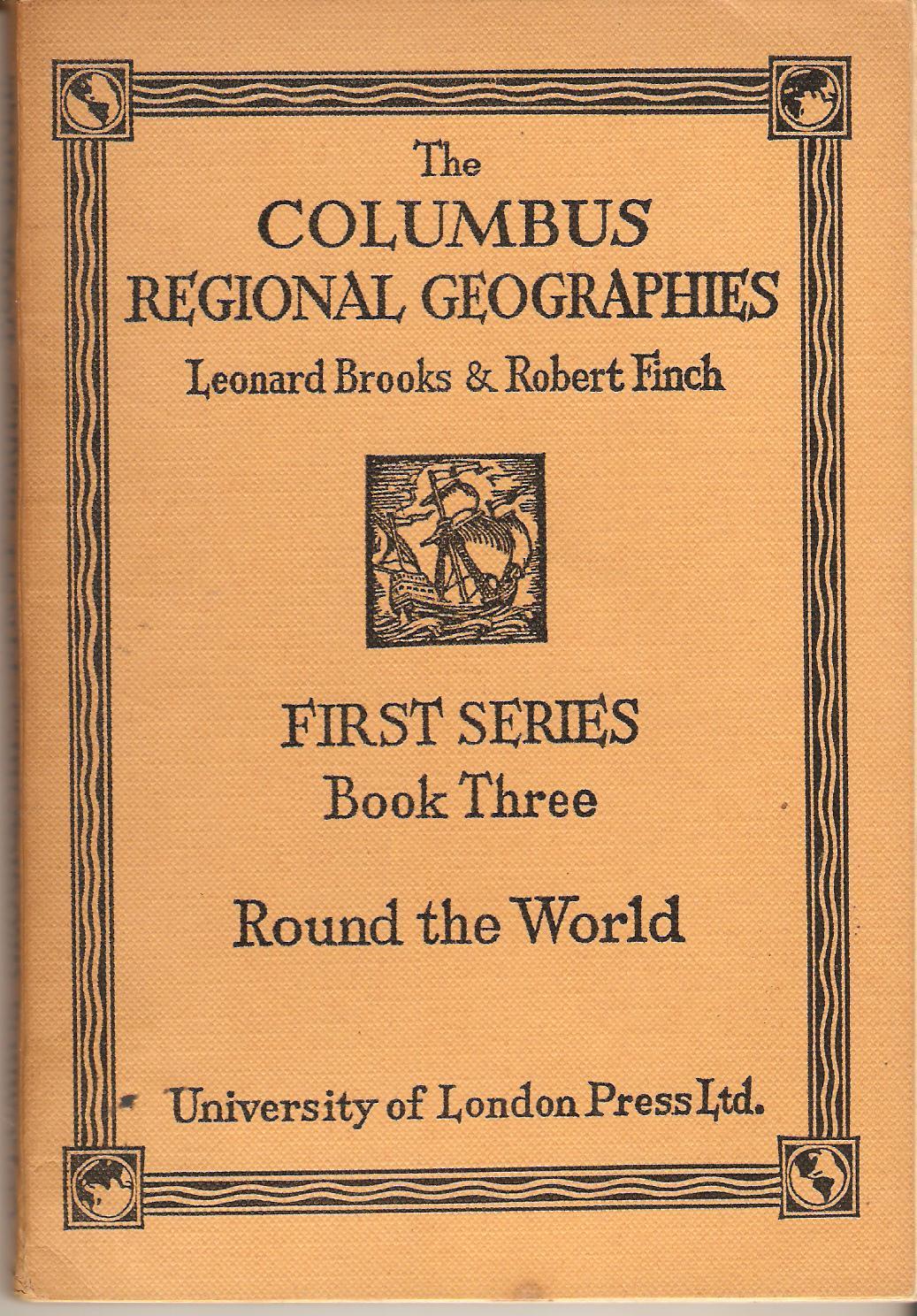
He was the author of many textbooks - some of which are mentioned earlier on the blog.
Leonard's family provided lots of useful additional detail of his later career:
In 1919 he had a part time job at Birkbeck College, lecturing on historical geography.
In 1920 he became an Inspector of Schools for London County Council.
He was Honorary Secretary, Honorary Treasurer and Vice-President of the Royal Geographical Society.
Leonard sadly died in 1964, with Beatrice passing away in 1966.
Special thanks to Annie and Andrew Britton and family members for the information in this update.