Showing posts with label Geography Teaching. Show all posts

Wednesday, 3 December 2025

Your views on teaching geography...

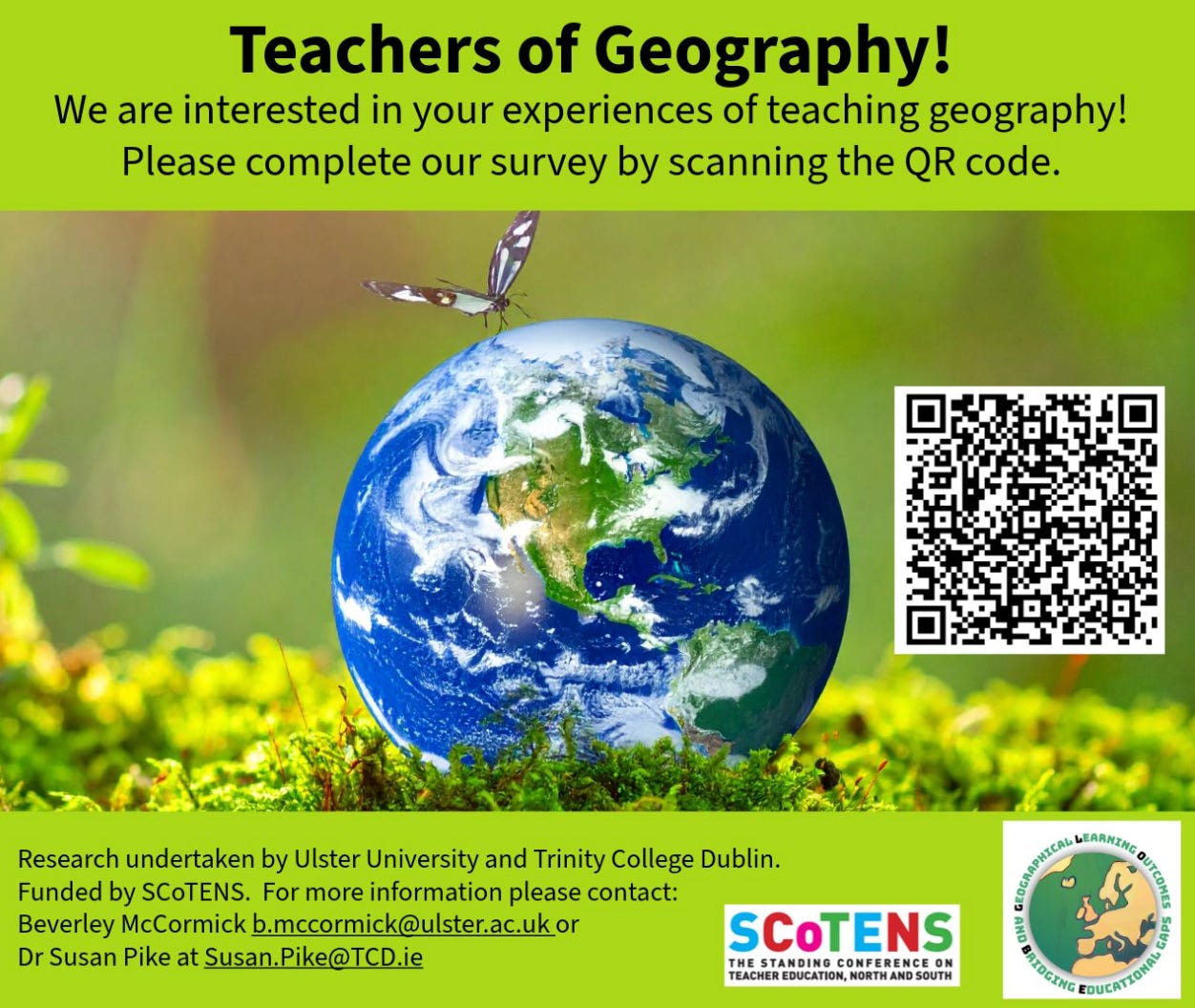
Your views are needed by Dr Susan Pike and her fellow researchers. Details below and scan the QR code to find out more.

Friday, 22 September 2023

The Teaching of Geography (1974)

A report on a gathering of Polytechnic geographers. 

Speakers included Professor Richard Lawton and Rex Walford (both GA Presidents). Rex talked about the use of gaming as a teaching method and had most of the attendees "hopelessly in debt to him" apparently. 

Source:

Cooper, A. D. “Report: The Teaching of Geography.” Area, vol. 7, no. 2, 1975, pp. 95–95. JSTOR, http://www.jstor.org/stable/20000969. Accessed 16 Sept. 2023.

Tuesday, 29 November 2022

GTE Conference 2023

Geography Teacher Educators Conference 2023

Trinity College Dublin

27th – 29th of January 2023


I have attended quite a few GTE Conferences over the years. Unfortunately I am going to have to prioritise the GA Conference and the Charney Manor Conference this year, but I recommend this event to you, and the venue is a lovely one. 

The GA has helped with the administration of this event, and numerous former GA Presidents have spoken at the event. I've always offered a session when attending over the years, which have included talking about ERASMUS and also the development of my GA Presidents blog.

I've done a couple of events in Dublin over the years including a Google Teachers' Institute and a trip for the Geography of Happiness project with Simon Renshaw.

The GTE brings together researchers, lecturers and teachers involved in research and scholarship in Geography Teacher Education.

The draft programme is below so that you can see rough timings. Conference fee includes all coffees and lunches within Trinity College. 

Well done to the conference team for putting the programme together.
  
Friday 27th January 2023

• 15:30 Welcome and coffee in the Education Department in the Arts Building, TCD – included

• 16:00-17:30 Session A: 6 presentations of 15 minutes

• 17:30-18:30 Keynote 1: Dr Ruth McManus, President of the Geographical Society of Ireland and
Associate Professor in Historical Geography at Dublin City University


• 18:30-20:00: Break

• 20:30 Dinner and networking upstairs at Café Amore, George’s Street – €20 (approximately £17)

• 22:00 Optional pint of Guinness in the Stag’s Head – cost €7 (approximately £5)

• Return to accommodation

Saturday 28th January 2022

• 8:00-9:00 Breakfast at the hotel or elsewhere

• 9:30-11:00 Session: 6 presentations of 15 minutes

• 11:00 Coffee – included

• 11:00-11:45 Session: Lived experiences of Geography in Ireland, from a panel of ITE student geography teachers

• 11:45-12:45 Keynote 2: Zainab Boladale TV presenter on RTÉ, Ireland’s National Broadcaster

• 12:45-13:30 Lunch - included

• 13:30-14:30 Session: 4 presentations of 15 minutes

• 15:00-15:30 Coffee break – included

• 15:30-!6:30 Session: 4 presentations of 15 minutes

• 16:30-18:30 Tour of Trinity College followed by reception in the Department of Geography, Museum

Building hosted by Professor Iris Moeller, Head of Geography

• 18:30 Dinner at the Cedar Tree, St Andrew St, Dublin 2 – cost €30 (approx. £27)

• Return to accommodation

Sunday 29th January 2023

• 8:00-9:00 Breakfast at accommodation

• 9:30-11:00 Session: 6 presentations of 15 minutes

• 11:00 Coffee – included

• 11:30-13:00 Session: 6 presentations of 15 minutes

• 13:00-14:00 Lunch and future plans for GTE – included

• 14:00 Optional trip to the National Museum of Dublin: Antiquities and National Museum of Dublin: Natural History Museum www.museum.ie/en-ie/home All free admission

Conference costs

• Hotel - €120 (approximately £100) per night, includes breakfast

Conference Fee:
Face to face 2 days - £140 or Conference, 3 days – £160, includes coffees and lunches

Online – £60


Accommodation and some meals (and the Guinness) extra.


Image: A pint of Guinness in Dublin, Alan Parkinson, shared under CC license

Friday, 8 January 2021

1995: Mike Morrish

Mike Morrish was one of the few people to be a teacher at the time of his Presidency: at The Haberdashers' Aske's School, Elstree, Hertfordshire.

As we have seen during the many posts added to the blog there have only been a handful of other people who were in that position, which is interesting given the particular role of the Association in supporting geography teachers and developing their craft and pedagogy. This is partly a product of the time commitments involved in getting involved to this degree with the GA and its running.

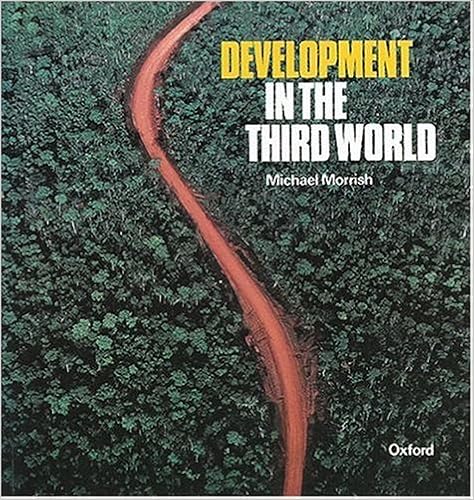
Mike Morrish is known to many teachers of a certain age for his books, which I used when teaching back in the day, including the one pictured later in the post on Development, which was excellent as I recall, although the phrase 'Third World' gives away its age a little.

There is an excellent biography of Mike's involvement with both the school and also the Geographical Association in an issue of the school magazine.

The magazine is called 'Skylark' and an issue from 2008 features an interview with Mike.
It describes his early career when he rode a motorbike to work. He was famously organised apparently with piles of exercise books ready for marking. I can't say I'm quite as organised.

Michael was born in London. He enjoyed camping with the scouts and a trip to the Austrian Alps gave him a taste for travel. He studied for a degree in Geography at Exeter University.

The 'Living Geography of China' was the subject of Mike's Presidential Address.
This continues in the tradition of other GA Presidents who were interested in the country: notably Percy Maude Roxby.


When taking over as President, Mike was Head of Geography at The Haberdashers' Aske's School, Elstree, Hertfordshire which makes him that rare thing: someone who was teaching when they became the President - quite a few had previous experience but had moved on to other careers or retired before they actually took over as GA President.

Book cover of one of Mike's books here. I remember using this to teach back in the day.

Mike is one of the assessors of the Rex Walford Award, and also wrote an obituary of Rex. He shared a passion for amateur dramatics and performance with Rex as well, which is where he first met him in fact.

He has also written a number of the GeoActive resources, which are popular with schools.


Mike kindly told me further information about him and his career by filling in the questionnaire that I sent to all living Presidents. The following information was provided by Mike.

Born: 1948, Finchley, North London

Education: 
Orange Hill Grammar School, Edgware, N. London
BA in Geography, Exeter University 1967 - 1970 
PGCE, Leicester University 1973/74

Career:
Marketing executive, Lever Brother Limited 1970 - 1973 
Secondary school geography teacher: Guthlaxton College, Leics. 1974 - 1975 
Haberdashers' Aske's Boys School, Elstree 1975 - 1983 
Head of Geography, Alleyn's School, Dulwich 1983 - 1995 
Head of Geography, Haberdashers' Aske's Boys School 1995 - 2008 
Author/editor of geographical textbooks, resources and magazine articles 1980 - 2018

He told me more about his Presidential year and theme:
'Living Geography' - I wanted to emphasise both the vital, dynamic and contemporary nature of the subject, and also the relevance it has to the way everyone lives their life. 
I attended GA branch lectures (Harrow) and annual conferences (LSE, London) from early on in my teaching career and joined the GA when Rex Walford recruited me as the GA's first Publicity Officer in 1982. I had known Rex Walford since my sixth form years in Edgware in 1966/67 through involvement in youth drama.

Mike held a number of roles within the GA and feels that it is particularly important for people to engage with it, and become part of the wider subject community. 
He told me:
"The GA was an important influence on me as a young teacher, and a valuable support in terms of information, resources, advice, representation and curriculum development. Once I became directly involved with its work, it opened up a wide network of like-minded individuals, both academics and fellow teachers, who shared my enthusiasm for the subject and a desire to enhance its position in the school curriculum."

My roles were: 
Publicity Officer 1982 - 85
Editor of GA News 1985-89
Chair of Worldwise Quiz National Committee 1983 -93
Junior VP 1993/4
Senior VP 1994/5
President 1995/6
Past President 1996/7

Mike was featured in the images that Sheila Jones sent me from the 1993 Centenary conference.
Here he is on the front cover of GA News in 1995.


Of his GA Presidential year, Mike said:

The joint focus of my year was the national Land Use UK survey carried out by schools, in conjunction with the GA's first Geography Action Week. Preparations for these had been going on for the preceding two years. My main memories are of the many meetings that the preparations involved, and the crucial role of Rex Walford in bringing these joint projects to fruition. Of course, the Annual Conference at Southampton University in 1996 was an exciting end to the year, especially delivering my Presidential Lecture (on China).

References

Mike's pieces for the TES in 1996-2000: https://www.tes.com/author/mike-morrish

MORRISH, MIKE. “The Living Geography of China.” Geography, vol. 82, no. 1, 1997, pp. 3–16. JSTOR, www.jstor.org/stable/40572861.
https://issuu.com/bainespsa/docs/a31822_haberaske_skylark_2008/122 - biography and school history - links with Rex Walford

Personal communication thanks to Google Form and emails.

Main image of Mike taken at the official 'opening' of Solly St in 2010 by Bryan Ledgard.
Copyright: Bryan Ledgard / Geographical Association

All other memories and images of Mike and his time as GA President welcome.

Thursday, 19 November 2020

1988: Mr. Michael J Storm

Updated September 2026 with some sad news. See the end of the post.

Michael Storm is another geographer who will be familiar to many from the books he has published over the years. He was the ILEA Advisor for Geography and Environmental Studies and worked across London in a range of roles including school inspections and international visits.

One of these was mentioned by Keith Grimwade, GA President in 2006, who told me:
"I did a PGCE at Goldsmiths and was accepted into the ILEA ‘pool’, having been interviewed by another future GA President, Michael Storm".

Michael was Staff Inspector for Geography and Environmental Studies for London (the Inner London Education Authority or ILEA as it was called, from 1976 to 1990) and was active throughout that period.

He was also the Chairman of the GA's International Committee for some years too, showing a long-term contribution to the work of the GA through that important committee which makes international connections.

From the snippet above, he obviously worked widely in other countries in the sphere of teacher education as well as in the UK.

He was involved in the assessment of the National Curriculum which was in place when I started teaching in 1988, and development of Attainment targets, in a group which also included a range of prominent GA people. This was a busy time for the GA, dealing with th DES. He also helped with the improvements that were made to Fulwood Road during the late 1980s to improve working conditions for GA staff. 1988 was a busy year to be President with the discussions over the National Curriculum and geogarphy's place in it. Michael worked closely with Richard Daugherty.

1988 was also the year when Primary came to the fore, with Primary Geographer magazine launching and a new feature of conference as well. Primary has gone from strength to strength since then.

From the 1988 Annual Report

His Presidential address was on Geography in Schools: The State of the Art.
He reflected on the fact that it had been 20 years since an inspector had been President, and discussed the contribution the GA had made to teacher education and also the influence on the new curriculum. He also talked about the importance of positive reinforcement: by teachers to students, and also to teachers and headteachers. He makes mention of the Higginson proposals, of which more in a separate blog post.


I enjoyed reading this address, and there is plenty that would be familiar to teachers today, over 30 years on from the conference. A few sections that I particularly liked were:

"Geography teachers have been active in releasing information technology from the ghetto of computer studies, and have pioneered the inventive and analytical development of video material."

He refers in his address to his predecessor Dr Eric Briault, who was the Education Officer for ILEA.

He was pleased about the popularity of geography, particularly the curriculum development projects such as Avery Hill (GYSL) and the 16-19 project. 
Of the subject he says:

"Not even the most intellectually megalomaniac geographer, I imagine, would claim that the suject delivers all the knowledge, understanding, insights and values needed by tha environmentally-educated citizen.... geography's enduring concern with the nature of places, their connections and dynamics, inevitably means that the subject becomes the major repository for the hopes of those who look to the schools to implant an environmental ethic".

He also shared a few memories from his time inspecting teachers, with a few funny anecdotes of teachers coming a cropper by over-thinking their observation lesson. 

Late in the address, he moves onto some 'growth areas' for school geography. First is the subject of a lot of debate at the time (I remember this as I was starting my teaching career at this time): which is geography's "general locational knowledge". He revisits familiar territory: the newspaper stories saying that 'kids don't know where places are"... and the contradictions this would place on curriculum design, and geography's role in this 'pub quiz' acquisition.
I liked his stories from Soviet Russia, which wasn't well covered by UK textbooks at the time.

Teacher shortages were a problem at the time - although I don't remember finding it easy to find a job back then - I had loads of interviews before securing my first job, and even then I was second choice. Michael says that:

"Geography in schools is affected by hidden shortages. 

He also mentions an issue which I remember well at the time: the transfer of content which was obviously geographical into the science curriculum, so that earth science, acid rain, weather etc. was taught twice in slightly different ways.

More to come on Michael Storm in a future blog post.

He also developed a key set of questions for Primary Geography, which are shown below.

The Five Basic Questions for Primary Geography
Michael Storm.
·      What is this place like?
Where is this place?
·      Why is this place as it is?
·      How is this place connected to other places?
·      How is this place changing?

·      What would it feel like to be in this place?

The following images were taken by Jo Norcup, and shared on Facebook during the compilation of her thesis, which referenced some of Michael's work.


In 1998, he wrote a letter to the Independent during a debate about the 3 Rs and the 'literacy hour'.

Children have to want to communicate. Many primary teachers would acknowledge that the investigation of their local environment, and some contrasting environments elsewhere, not only accommodates the child's basic curiosity, but generates this all-important motivation. Such work, far from being an optional curricular frill, creates a genuine need to talk, read, write, calculate, draw.
In contrast, jumping through linguistic hoops for an hour a day is likely to be far less motivating.


Michael J. Storm,
Chairman, Geographical Association International Committee.


I also came across this document in my PGCE folder from 1986-7, showing his influence and work at this time into ITE.

Another document of interest perhaps


Sheila Jones told me:
Michael Storm shares a love of cricket and we have met annually at the Cheltenham cricket festival

Here is a picture of Michael from an image sent by Sheila Jones, speaking at an event during the GA's Centenary year, in 1993

I was also pleased to get Michael Storm's memories on what gave him the 'spark' for geography which was part of Chris Kington's project around his own Presidency. Chris loaned me the letters.

Michael Storm talked about the importance of his teachers. These included Maurice Beresford and Maurice Kirk.

He talks about the importance of the BBC's geography series on the radio when at school. He describes the importance of books with maps, such as Treasure Island, and the writings of the author 'BB'. Stamp collecting was another influence, such as the names and shapes of countries like Djibouti.

Michael's father was a Master Mariner who connected him with the world through his stories.

References
He has no Wikipedia page.
https://api.parliament.uk/historic-hansard/written-answers/1989/may/05/geography

Storm, Michael. “Geography in Schools: the State of the Art.” Geography, vol. 74, no. 4, 1989, pp. 289–298. JSTOR, www.jstor.org/stable/40571737.
https://www.tandfonline.com/doi/pdf/10.1080/0305763800060212

Storm, Michael. “The Geographical Association.” Geography, vol. 73, no. 3, 1988, pp. 268–271. JSTOR, www.jstor.org/stable/40571429. Accessed 15 Nov. 2020.

Storm, Michael, et al. “Annual Report of The Geographical Association 1988.” Geography, vol. 74, no. 2, 1989, pp. 173–183. JSTOR, www.jstor.org/stable/40571611. Accessed 15 Nov. 2020.

Thoughts on Development Education (PDF download): https://think-global.org.uk/wp-content/uploads/dea/documents/dej_7_1_storm.pdf

Image credit: Jo Norcup
Jo's THESIS is fascinating by the way: http://theses.gla.ac.uk/6849/1/2015NorcupPhD.pdf


I'm particularly grateful to Michael's wife Jacqueline for further information, and also to John Westaway for more assistance.

Thanks also to Mike Rigby, who sent me the image of Michael at the top of the post, which was taken on a study visit to South Africa.

Any further memories of Michael Storm would be appreciated.

Updated November 2020
I am grateful to Steve Brace, Head of Education and Outdoor Learning at the RGS-IBG for the following additional story about Michael:

Michael was a great support particularly at the start of my career in the early 1990s when I arrived at the GA conference in Manchester with three – soon to be empty - boxes of the Chembakolli a Village in India pack. I’d just written this resource for ActionAid & Michael was one of the GA's ‘elder statesmen’ who took time out to help connect me with the wider community, encourage my work & also give feedback on ActionAid’s developing education work. 
 He was really generous with his time and networks & I always looked forward to catching up with Michael over subsequent GA conferences.

Updated December 2020

I referenced Michael in a Presentation for the TeachmeetGeographyIcons event, which was scheduled to take place in early December but was postponed for technical reasons on the day. It mentioned his Presidential Address and the term that he used: "professional zest".


I also received some memories of Michael from another former GA President: Professor Simon Catling.

"While a young primary teacher I did two week long courses which were influential. In early 1975 I did a Place, time and Society 8-13 course run by Ray Derricot, Hazel Sumner and Gordon Elliot at an ILEA centre. In early 1978 I did an environmental course at Avery Hill College in Eltham, run by Colin Ward. Both were influential in my thinking. Gordon Elliott introduced me to a producer at the BBC which led from the autumn of 1975 to me being an adviser, alongside Michael Storm (who had just become the geography adviser in the ILEA), to a new series of primary geography programmes."

He told me a little more about Michael in another personal communication:

"Way back in June 1993, we had a centenary conference in Oxford and quite a number of past presidents were present when a photograph was taken in the room in Christchurch College where the meeting which initiated the GA was held. Other photographs were taken over the years at Past Presidents' lunches at GA Conferences, quite a few of which Michael attended. 

I knew of him back in the 1970s but first met him when we both acted as advisers for the BBC's new primary geography series for schools, which I think was called Landmarks, but that title could be wrong. That was in 1975! 
He moved to be the Geography Adviser for the ILEA from September 1975 and he developed a strong reputation for developing geography in schools. He initiated a geography education centre, which John Westaway ran, and he managed to add a second secondary adviser to his team and engage a part-time primary head as a primary adviser.
He was active in the GA, but I know little more about that, other than during his junior, senior and past presidential years.
In the later 1980s, around 1987, several of us pushed for the introduction of a Primary geography newsletter ( similar to that which the ASE had recently begun to provide). This led to a small working party being set up, chaired by Michael, to explore the proposal. It recommended an annual newsletter. This was taken to GA Council, at which Patrick Bailey proposed in 1988 that we be more adventurous and go for a full magazine/journal issued three times a year. He said the GA could fund it, and it was agreed. Wendy Morgan then became the first editor. So Michael had a key role in initiating Primary Geographer/Geography.

Michael was instrumental in promoting geography in the ILEAs primary schools. In the early 1980s he set up a group of us, including myself as a primary deputy head in those days to produce geography guidance for primary schools. His co-adviser, Michael Hewitt headed the group. The outcome was "The Study of Places in the Primary School". Michael Storm always wrote and spoke very strongly about the importance and value of geography in primary schools."

Updated September 2023

He contributed a chapter to the book 'Perspectives in Geographical Education', co-edited by John Bale, Norman Graves and Rex Walford.

Accessed via Internet Archive.


Update:

Sadly, I was informed at the end of the summer that Michael sadly passed away recently.
Condolences to family, friends and former colleagues.

Saturday, 23 May 2020

Teaching Geography

By Lionel William Lyde


Source:
https://books.google.co.uk/books?id=7BQSBwAAQBAJ&lpg=PA16&ots=qyoQUQmILd&dq=lyde%20geography%20definition&pg=PA8#v=onepage&q&f=false

Sunday, 29 March 2020

1961: Mr. George Joseph Cons

Updated September 2023

Just a note on the 1961 Presidency from 'Geography'. 
It appears that Mr. George Joseph Cons was due to have been the president for this year, but unfortunately died quite suddenly in 1960 so was unable to take up the post.


Mr. G J Cons was the author of a Handbook on teaching, and was also a member of the Standing Committee for Visual Aids (which later become Teaching Aids)

He was a Senior Lecture in Geography at Goldmsiths' College.

Balchin's Centenary volume talks about him playing an active role in the Association for many years.
He is quoted in a paper on the teaching of war and peace.
Front Cover
Cons wrote that Geography is probably the best equipped subject for training the young in ‘world citizenship’ and internationalism (Cons, 1932)

This quote was included in a GA Handbook edited by Miss D M Forsaith

Cons also Chaired a number of events over the years, including a debate on the future of Geography at the 1945 conference.

He was the editor of a handbook for Geography Teachers, published by Methuen in the 1950s

Mr. Geoffrey Hutchings was elected as President in his place at the Spring meeting of the GA Council.

I noticed that he was obviously involved in helping make a number of short TV pieces.
I noticed a few fieldwork related pieces on the channel called Talking Pictures TV which shows brief vintage documentaries and films in between vintage films.


An Obituary was published in 'Geography'


Thanks to Brendan Conway for the tipoff to these films in these tweets.
Here's the 2nd tweet


And here is the film, from the Huntley Film Archives


References

W. Wallace (1956) Geography in further education, The Vocational Aspect of Education, 8:16, 40-46, DOI: 10.1080/03057875680000061

“GEOGRAPHICAL ASSOCIATION. Annual Conference Discussions on the Future for Geography.” Geography, vol. 30, no. 2, 1945, pp. 50–62. JSTOR, www.jstor.org/stable/40563427

Bull, G. B. J. “GEORGE JOSEPH CONS.” Geography, vol. 45, no. 1/2, 1960, pp. 123–124. JSTOR, www.jstor.org/stable/40565120
If anyone knows more about Mr. G. J. Cons, or has an image of him that would be appreciated.


Updated September 2023

The McNair Report gets a mention here.

H was linked with the NW Kent Branch of the GA.
He served for many years on the Education Committee of the GA.


https://www.raremaps.com/mapmaker/6716/G_J_Cons - an article that describes his map collecting.

Cons was a pioneer in pioneer in the field of geography films for schools and authored ‘Films and Living Geography’, Sight and Sound, 4/14 (Summer 1935)

The following is excerpted from Traces

A very different proposal comes from one of the few professional geographers involved in animated mapmaking for documentary films – G. J. Cons, who collaborated with the British Film Institute as scientific consultant for the production of educational documentaries. Referring to the series Indian Town Studies made by Gaumont-British Instructional, Cons highlights that ‘these films were made effective geographically by the use of animated maps’. It is evident that this effectiveness is based on the power of the trace since it allows a purely explanatory discourse which consists of the plain transmission of data and information even though no element really legitimises it. For him, there is little difference here between animated maps and informational images; the constitutive properties of motion and animation, whose consequences are far from being neutral, is relegated to a blurry allusion to a ‘living accurate’ vision. Does this prove the ineffectiveness of the attempt to acquire animated maps into the project of geography for ordering the world, or does it confirm Cons’ statement that ‘the genius of documentary film reveal[s] the screen as a magic casement through which our geographical vision of the Earth and its peoples is heightened’? In other terms, does the author’s faith in documentaries negate any concerns about the fabricated spectacle that animated maps present?

Apparently, and with a certain naivety, Cons seems to advocate a perfect analogy between the map, the mirror, and the screen – a position that may surprise coming from a professional geographer. However, as explained by Priya Jaikumar in an insightful essay on the series, the result is not the faithful and plain reproduction of Cons claims but rather an attestation of the role of animated maps in the building of that ideology that put together positivist, modernist, and colonial contents: ‘[t]owns in India were visualised to make them intelligible and transparent, with vision transforming a place, its people and fullness of their lives, into abstract space.’ Again, thanks also to the power of the trace the pretensions of correct visualisation and geographical accuracy have been overthrown and transformed into something completely different: the colonial fiction of mastery and control through alleged scientific instruments used in narrative and visual devices for making this very same fiction true.

Giuseppe Fidotta: Animated maps and the power of the trace.

He also participated in the creation of visual maps such as the one here.

https://www.raremaps.com/gallery/detail/65476/the-peopling-of-the-usa-cons


If anyone can find an image of G J Cons that would be appreciated.

Margaret Mackintosh RIP

Updated post. Sad news at the end of last week from colleagues who have organised the Charney Conference over the years of the passing of Ma...