Showing posts with label New Zealand. Show all posts

Friday, 1 January 2021

1994: Professor James Anthony (Tony) Binns

Tony is currently the Ron Lister Professor of Geography at the University of Otago in New Zealand, and still working, in fact he was planning to come over to the GA Conference in Guildford in 2020 before it was cancelled.

This entry includes information provided by Tony himself, via the Google form questionnaire I created.

Tony was born in Prestwich in 1948.

Education:
Stand Grammar School, Whitefield, Lancashire. 
In 1967 I went to Sheffield University to study Single Honours Geography. I graduated in July 1970 and then stayed at Sheffield to Study for a Diploma in Education, which I gained (with distinction) in July 1971. I joined the GA in 1969 in my second year as an undergraduate at Sheffield and made good use of the GA library which was then in the ground floor of a large house at 343, Fulwood Road.

Career - quite a varied one:
I taught at Adwick High School in Doncaster in 1971 and 1972. 
I became fasciated with Africa through my studies at Sheffield and also from teaching a Sixth Form General Studies course at Adwick High School. So in October 1972 I went to the Centre of West African Studies at Birmingham University to study for an MA and then a PhD. 
I spent the whole of 1974 in Sierra Leone researching on the relationships between rural development and diamond mining. 
I took up a position as Research Fellow at the University of Sussex in October 1975 and stayed at Sussex as Lecturer, Senior Lecturer and Reader until September 2004 (30 years). 
In October 2004 I took up the position as Ron Lister Professor of Geography at the University of Otago in Dunedin, South Island, New Zealand where I still work. I have published 21 books and over 160 book chapters and journal articles. 
My writing has focused mainly on development issues in Africa, South Asia and the Pacific, and also on aspects of geographical education.

An impressive output, similar to the previous 2 Presidents who have also had long academic careers in the field of geography education.

Of his own GA Presidential year, Tony told me that at the time he was Reader in Geography in the School of African and Asian Studies at the University of Sussex, Brighton.

"My theme focused on understanding processes of development in poor countries and, in particular, appreciating indigenous knowledge and perceptions."


This is important work which still needs to be done.
He told me about his appreciation for the work of the GA.

"The GA plays a vital role as guardian of the school Geography curriculum. Among GA members there is a vast amount of knowledge and expertise on all aspects of geographical study. It is vital that the strength of Geography in our schools is maintained and indeed enhanced, to ensure the success of Geography in higher education and the contribution of the discipline to understanding so many aspects of the world we live in."

Tony co-produced the GA's response to Keith Joseph's questions following the 1985 speech to the GA special event I have blogged about previously, working with Patrick Bailey. 


Mike Morrish told me that he was good friends with Tony, who ran a number of GA Study Tours to China and one to the Gambia.

Tony also told me about his memories of his Presidential cycle:

"We achieved a membership of 11,000 during my time as President. The GA primary initiative was gaining momentum and the national curriculum had been launched. 
In 1988, as GA Hon Secretary (1985-1989), I played a key role in setting up the Teacher Education Working Group, the International Committee, the International Fund and the New Initiatives Fund. 

I also played a key role in launching the GAs overseas study tours through the International Committee, and I took part in the first study tour to China in 1988. 

In 1993, we had a very succesful tour to Pakistan and China to celebrate the centenary of the GA. 

My Annual Conference in April 1995 was the first and only conference to be held in Lancaster. 

The theme of the conference at Lancaster University was 'Developing Geography'. We had a memorable President's Evening held in the splendid Victorian edifice of Lancaster Town Hall with the Mayor of Lancaster hosting us. After the dinner I had arranged for an African band to come up."

Recently, Tony co-wrote a paper with Alan Kinder, which can be obtained from the Geo-Ed website.


In 1993, Tony attended the Centenary conference events and was featured in several photos which were sent to me by Sheila Jones and have been appearing on the blog in recent years. Several of those have appeared on previous posts.
 
I'd hoped to have an image taken with Tony at the 2020 GA Conference, as Tony was coming over to lead a session. He had to cancel of course, before the whole event went virtual.
He did, however still take part by offering a session. This can be accessed via the GA website.

Tony has travelled widely in Africa, leading trips for other geographers and involving himself in projects.
Here he is in Freetown , Sierra Leone in 2011


Image credit: Kenny Lynch

Thanks to Tony for answering my questions and contributing to this post.

You can find out more about Tony's work in supporting Geography, which mentions his GA Presidency in the introduction to the Ron Lister Lecture in October 2020. He talks about his work in Sierra Leone, and ideas of place.


Professor Binns has been visiting and researching in Sierra Leone, West Africa, for 46 years and has developed strong links with the remote community of Kayima in the north-east of the country. The United Nations ranks Sierra Leone as one of the world’s poorest countries, where development has been constrained by political and economic instability, a decadelong civil war, an Ebola epidemic and now COVID-19. In this lecture, Tony will draw on his experiences since 1974 to examine the changes the community has experienced and to appreciate the underlying causes of poverty in Kayima. Very few longitudinal studies have been undertaken in Africa, and this study reveals a remarkable level of community resilience and ability to adapt to changing scenarios.

References
Wikipedia: https://en.wikipedia.org/wiki/Tony_Binns
Image taken from Otago University newsletter.


If anyone has other memories of Tony and his time as GA President please get in touch.

Tuesday, 25 February 2020

1958: Professor Robert Ogilvie Buchanan

Updated July 2024

Professor Robert Ogilvie Buchanan was an academic geographer, with a particular interest in economic geography, and with a connection to the London School of Economics (as did many Presidents).

There is also another link with the RGS-IBG here in that he was a founding member of the Institute of British Geographers, along with other GA Presidents L Dudley Stamp and Stanley Wooldridge among the committee of 10 that founded it.

He was known as 'R. O. B'.

He was born in Otago, New Zealand.  

This means he has a strong connection with another GA President to come - bonus points if you can name him in advance of his entry. 

His father was a mariner, and his mother was Scottish. They were pioneer settlers of the NZ region, and he apparently travelled to school on horseback or by foot. He graduated in History and Economics rather than Geography - he had a lot in common with other GA Presidents in this respect.

He served during the First World War, in the Middle East, and on the Western Front, and was injured.
Immediately after the war, he became a teacher in Auckland. He moved to London, and studied at the LSE, graduating with a first. Following his degree, he got a job as a demonstrater with C.B. Fawcett, a name which has cropped up several times on the blog. He was a close contemporary of Dudley Stamp and Robert Steel.

He worked within Africa and also in New Zealand and with the LSE.

A description by Hugh Counsell Prince:


He contributed a piece to the 'Geography' journal as long ago as 1931, with some 'grumbles' on how geographical ideas were being presented in some publications.

He also served in World War II.

His Presidential Address was on the theme of 'Agricultural Geography', and he reflected on the choice of an overarching theme for the conference.
As in previous years, the Address was delivered at the LSE.


Image result for "R Ogilvie Buchanan"
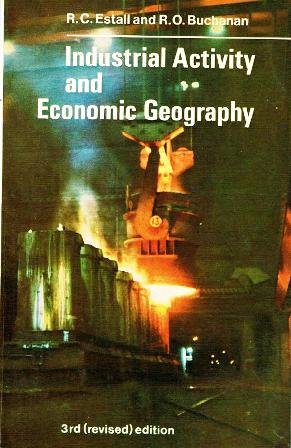
His interest in agriculture and industry was shown in several books which he authored and co-authored such as the one pictured here.

According to a piece in 'Geography' at the end of his Presidency, he had done a good job as GA President. He continued to be involved with the GA, for example, he contributed to a special 6th form Geography conference which was held in Bolton in February 1961, where he spoke to hundreds of 6th formers.


His obituary was written by Michael Wise, another former GA President who will appear here in due course.

A book which also involved Wise is described below:


References

Obituary: https://www.jstor.org/stable/622281?seq=1#page_scan_tab_contents - written by Michael Wise (another GA President)

https://www.jstor.org/stable/622275?seq=1#page_scan_tab_contents

Buchanan, R. Ogilvie. “SOME GRUMBLES.” Geography, vol. 16, no. 4, 1931, pp. 308–310. JSTOR, www.jstor.org/stable/40559914.

“Front Matter.” Transactions and Papers (Institute of British Geographers), no. 24, 1957, pp. iv-vii. JSTOR, www.jstor.org/stable/621235


Briggs, K. “A Sixth-Form Geography Conference. A REPORT.” Geography, vol. 46, no. 3, 1961, pp. 254–256. JSTOR, www.jstor.org/stable/40565272

Presidential Address: BUCHANAN, R. OGILVIE. “Some Reflections on Agricultural Geography: Address to The Geographical Association.” Geography, vol. 44, no. 1, 1959, pp. 1–13. JSTOR, www.jstor.org/stable/40564227.

Buchanan, R. Ogilvie. “A NOTE ON LABOUR REQUIREMENTS IN PLANTATION AGRICULTURE.” Geography, vol. 23, no. 3, 1938, pp. 156–164. JSTOR, www.jstor.org/stable/40560673

GARNETT, ALICE. “The Geographical Association: ANNUAL REPORT 1958.” Geography, vol. 44, no. 1, 1959, pp. 54–62. JSTOR, www.jstor.org/stable/40564237
Review of the book above

If anyone has further information on this President, please get in touch.

Additional image:

Here's another image from the Flickr LSE Archive as well, an image taken in the 1950s after the earlier one. Follow the links and you can see what other LSE images are available - some other GA Presidents are included in this archive.

https://commons.m.wikimedia.org/wiki/File:Robert_Ogilvie_Buchanan,_c1950s_(4302912675).jpg

Cenotaph NZ: https://www.aucklandmuseum.com/war-memorial/online-cenotaph/record/83709


Updated August 2023

References

https://search.library.wisc.edu/catalog/999752557302121 - a book which was a shortened version of his doctoral thesis.

Updated July 2024

Buchanan was one of the Presidents with the shortest entries. I then came across an article on his involvement in Nigerian universities and other Commonwealth countries along with Robert Steel.

I was particularly interested in this section:

Buchanan was a colourful character who refused to conform to the expectations of senior university administrators. According to his colleague Pugh, Buchanan ‘had a wide range of acquaintances in Ibadan Town … and never hesitated if he saw a party of drummers heading somewhere – he would follow …’. He would wear shirts ‘made from cloth from the local market with a pattern of rosebuds or Crown birds’. His lectures touched on issues of colonialism and development, and showed signs of the more radical critiques of his later scholarship. Eventually the UCI principal deemed that Buchanan’s clothing showed he was inappropriate for the job, leading to his departure in 1951 for LSE, then what was to become the University of Wellington in New Zealand.

Source:

Thursday, 23 January 2020

1955: Leonard Sydney Suggate

Last updated August 2023

Leonard Sydney Suggate, who became GA President in 1955 published several regional Geography books along with L Dudley Stamp.

The 1950s were interesting times for the GA in the post-war period, as with the years following the First World War, when many changes happened as a result of the recovery from war.

Suggate originally worked in the printing trade, but then studied psychology before taking the University of London's Teacher's Diploma in geography.

This led to him becoming a teacher, a fairly rare beast as we have seen so far with the blog. 
Few teachers become GA Presidents historically.

Suggate taught geography at Dorking High School, and later at St. Clement Danes Grammar School during the First World War (eventually retiring from there in 1949), which means he is one of a minority of people who had substantial experience of teaching geography before becoming President.

He took over the Presidency six years after retiring from what seems to have been an outstanding teaching career at a number of schools, and it is great to see that someone who was predominantly in the classroom for their career was able to step up to the role.

He was very much influenced by the 'new' geography of Halford MacKinder, and used these ideas in his teaching as well (although by now they were not as new as they once were), writing about them in his work.

He also attended lectures by Mackinder, Garwood, Lyde and Unstead - familiar names from this blog. The War also provided for him an opportunity to radically rethink school geography. This is great to see someone taking on the chance to hear the important people of the time, and factor those ideas into his practice - something which teachers of today do with some success, building on the evidence of research and taking inspiration from academic geographers and practitioners.

There are several contributions that Suggate made to geography teaching in the post-war period.
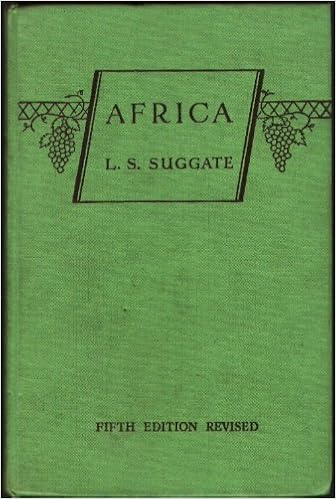
He wrote some of the first textbooks for the new analytical geography, such as 'Africa' - pictured to the right (one of the first school texts on the continent), and which ran to several editions.

He also campaigned for the use of maps and photos to be made available to candidates in school geography examinations, as well as greater use of visual aids in teaching.

He served concurrently on the Council of the RGS as well as the GA, and was elected a Fellow of the Royal Geographical Society in 1921. Another GA President to have a strong connection with the RGS.

He was also a Chief Examiner for the London General School Certificate - another GA President with  significant examining experience as well.
He served on the RGS Education Committee as well, which is of interest as another connection between the two organisations. The work of the RGS's Education Committee continues to be important, and I was involved in supporting the application of several representatives for RGS Council positions in the last few years.

Suggate attended the GA Conference every year apparently, "pipe in hand" - no smoking allowed these days of course.

He was also a Labour party councillor for Hendon.

In 1928, he started to make some changes at Clement Danes School.

When the school moved to a new site, Suggate created a special "Geography room" with a light table (which I remember from geography classrooms I sat in during the 1970s) and cases for equipment and showing artefacts.

I liked the story from his obituary, regarding his apparently indicipherable handwriting. A student asked what he had written at the bottom of their work, to which he replied "you must improve your handwriting, obviously...."

One of the projects that he started (along with another President Leonard Brooks was to develop a scheme where schools could "adopt" ships and send letters to their Captains. It was called the Ship Adoption Society. This has been featured in more detail in the entry for Leonard Brooks, as he mentioned it in his Presidential Address.

Also in 1955, he attended the 125th Anniversary dinner of the Royal Geographical Society, along with other former Presidents such as L Dudley Stamp and J A Steers.

His Presidential year's conference is also described here - in this Nature piece.

Suggate wrote a series of books, which went into several editions.
He described his Presidential election as "at once an exciting and sobering elevation", which I sympathised with.

His Presidential Address was on the theme of geography teaching in Grammar Schools, making it of particular relevance to his audience no doubt.


Two years after completing his GA Presidency, Suggate and his wife emigrated to New Zealand at the age of 67, to join their two sons. 
There, he was also (at that age) Secretary of the Second Triennial Conference of the New Zealand Geographical Association, and continued to write for books. A well deserved and long retirement was enjoyed.


He died in 1970 - another GA President to live to an old age (81) and with 60 years of service to the GA.

I am grateful to Fiona Hirst, Archivist at Clement Danes School for the wonderful image of Leonard from the school magazine at the top of this entry. She very kindly sent me a range of documents and other information to help add detail to what was previously quite a slight entry on the blog compared to some of the previous ones.

An obituary was published in 'Geography' in 1971, written by A D Nicholls, who was a long standing colleagues as well as also being a Former GA President by that time - he is yet to appear here.


References

No Wikipedia entry available. Perhaps a further extension of this project would be to create them for the missing GA Presidents.

Nicholls, A. D. “LEONARD S. SUGGATE, B.Sc., A.K.C. 1889-1970.” Geography, vol. 56, no. 2, 1971, pp. 152–153. JSTOR, www.jstor.org/stable/40567514.

https://archive.org/details/in.ernet.dli.2015.224015/page/n5 - one of Suggate's books

SUGGATE, L.S. Aspects of Geography Teaching in the Grammar School Geography 1956 41 1-14

https://www.questia.com/library/journal/1G1-78392752/oskar-h-k-spate-1911-2000 - a pupil of Suggate's remembers his teaching

“The 125th Anniversary Dinner.” The Geographical Journal, vol. 121, no. 3, 1955, pp. 392–404. JSTOR, www.jstor.org/stable/1790929.

Something in the IoE archives: https://archive.ioe.ac.uk/DServe/dserve.exe?dsqIni=Dserve.ini&dsqApp=Archive&dsqDb=Catalog&dsqCmd=Show.tcl&dsqSearch=(RefNo==%27IE/JUB/B/1%27)

R. J. Harrison Church. “Obituary: Leonard Sydney Suggate, BSC, AKC.” The Geographical Journal, vol. 137, no. 1, 1971, pp. 136–137. JSTOR, www.jstor.org/stable/1795429.
Africa Book: https://archive.org/details/in.ernet.dli.2015.227333

If anyone knows anything else about this President, please get in touch. This is a relatively brief entry.

Thanks to Fiona Hirst for the additional details and image from the school magazine 'The Dane'

Updated August 2023


Margaret Mackintosh RIP

Updated post. Sad news at the end of last week from colleagues who have organised the Charney Conference over the years of the passing of Ma...