Showing posts with label H. J. Fleure. Show all posts

Monday, 15 April 2024

From the archive - Fleure to Mill

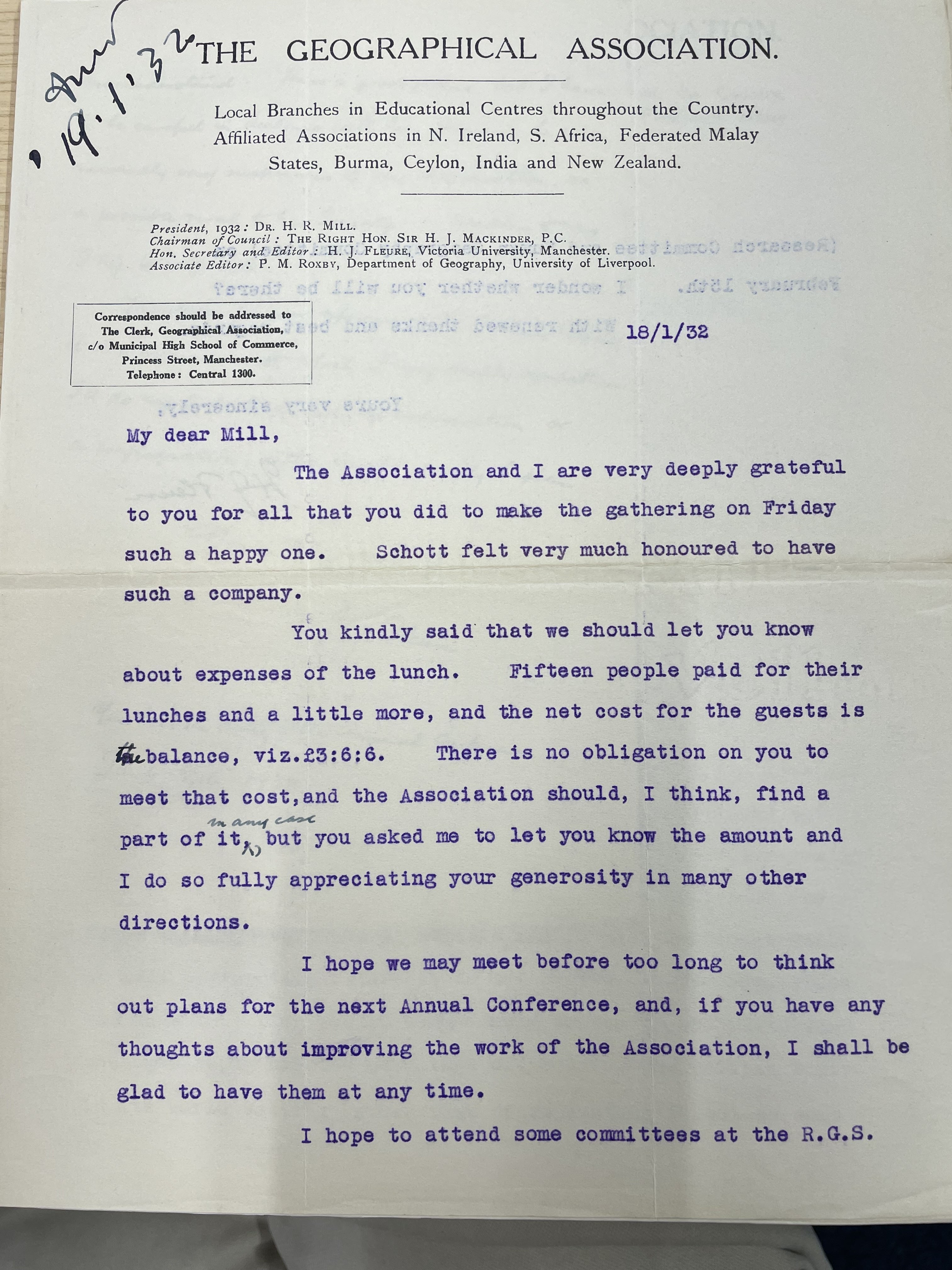
A letter from H J Fleure to Hugh Robert Mill, sent in 1932 thanking him for attending a gathering. The letterhead is interesting too.


Thursday, 7 September 2023

Cross-channel Geographers

A find while researching Stanley Henry Beaver.

It explores collaboration across the channel.


He conceived the idea of genre de vie, which is the belief that the lifestyle of a particular region reflects the economic, social, ideological and psychological identities imprinted on the landscape.

The influence of Halford Mackinder and Andrew John Herbertson at Oxford was highly important in the training of teachers and university lecturers. The ‘new geography’ of Vidal and his disciples became widely known in Britain and served as a model for the first half of the century since French was far more readily accessible to a British audience than the German geographical classics.

Former GA Presidents who are referenced include:

H. J. Fleure - a French speaker and early visitor
Emrys Bowen
Stanley Henry Beaver
Percy Roxby
John Linton Myres
Bill Mead
Sidney Wooldridge
David Leslie Linton

There is also reference to Monkhouse and Darby.

There is also reference to the work of Hilda Ormsby - the French expert at the LSE

Source: https://journals.openedition.org/cybergeo/2966

Image source: Wikimedia - CC licensed

Tuesday, 9 June 2020

1967: Mr. E C Marchant HMI

Last updated October 2023

E C Marchant was a teacher at Marlborough College, a Headteacher in India and HM Inspector of Schools, but also a cartographer and scholar who travelled with J A Steers.

I was not able to find out as much about Ernest Cecil Marchant as I was about some of the other, older Presidents, which is a feature of this period generally, but eventually developed a suitable post with the thanks of others.
Marchant had featured in a previous article from 1960, describing a conference in Manchester, where he spoke in his position as HMI. He was also mentioned by Michael J Storm, when he became President 20 years later, who was also a school inspector. 

I then discovered a link with Marlborough College, C C Carter and Cyril Norwood. This led me to go back to the very helpful Archivist at the college - see later.
https://www.geos.ed.ac.uk/~rsgs/cgi-bin/ifa_series1.pl?series=3624

The link, which can be seen above describes a bequest of lantern slides to the Royal Scottish Geographical Society, who I may have to visit perhaps as well during my Presidential year to discover any further artefacts they may have relating to previous GA Presidents with a Scottish connection in particular.

This collection was donated to the RSGS in 1997 when Marlborough College was undergoing refurbishment. The materials date largely from between WW1 and WW2. At that time the Geography Department at Marlborough College was directed by E C Marchant who later became Senior Inspector of Schools. He was assisted by C C Carter whose text "Landforms and Life" was one of the best sellers for a generation. Carter and Marchant established a tradition in which Geography was firmly rooted in practical work and case studies long before these became so fashionable elsewhere. A great deal of mapwork was done, and the relief models were clearly made to illustrate famous areas, such as the Isle of Purbeck. 
Lantern slides were used to illustrate teaching and practical work, largely surveying, was employed.

Acknowledgements to Christopher Joseph, Head of Geography, Marlborough College for text.

During this time, in the late 1960s, the GA's Council was being chaired by H. J. Fleure.

Marchant is also quoted in Ivor Goodson's book, with some thoughts from inspections.

The advances in university geography after the Second World War partly aided the acceptance of geography as a subject suitable for the most able children, but problems remained. In 1967 Marchant noted: 'Geography is at last attaining to intellectual respectability in the academic streams of our secondary schools. But the battle is not quite over'. He instanced the continuing problem: 'May I quote from just two reports written in 1964, one of a girls' grammar school and the other on a well-known boys' independent school. First, 'geography is at present... an alternative to Latin, which means that a number of girls cease to take it at the end of the third year... there is no work available at A level'. Or second, perhaps a more intriguing situation: 'In the ‘O’ level forms, the subject is taken only by those who are neither classicists, nor modern linguists, nor scientists. The sixth form is then drawn from this rather restricted group with the addition of a few scientists who failed to live up to expectations'
To seal its acceptance by the universities and high status sixth forms, geography had to embrace new paradigms and associated rhetoric.  The supreme paradox is that the crisis in school geography in the late 1960s led not to change which might have involved more school pupils but to changes in the opposite direction in pursuit of total academic acceptance. This push for university status centred around the 'new geography', which moved away from regional geography to more quantitative data and model building. The battle for new geography represented a major clash between those traditions in geography representing more pedagogic and utilitarian traditions (notably the fieldwork geographers and some regionalists) and those pushing for total academic acceptance.
Marchant's Presidential Address connected with his interest in school inspection - which I guess went down well with the audience - and was called 'Some responsibilities of the Teacher of Geography'.

In it, he talks about the role of the teacher, with some interesting quotes, from the perspective of the school inspector, and also relating to his travels in what he called the 'Old World'.
He started by mentioning Professor Haggett, who had spoken at the IBG conference he had attended the previous year in Sheffield, and said that although it had been fascinating the discussions that had taken place had mostly been beyond what most teachers would usefully apply.

I wonder what impact that work had on schools from the perspective of the school inspectorate of the time.
He said of the geography teacher that, "he (sic) must remember that he is preparing the majority of his pupils not for degrees in geography, but pretty soon for living to the full, and perchance for contributing to the full, in a bafflingly complex and ever-changing world".

This was an era of the quantitative revolution, and the Madingley Conferences, which I have blogged about previously, which happened about this time. Marchant's views are interesting.
He referred to the comments of Joseph Acton Morris in 1965 who called for more reality in teaching.
He said of some teachers that they "deceive themselves intop believing that once a pupil has drawn a sketch map or looked at one in a textbook, he knows what a landscape looks like, and what it is like to live there." He shared a map of most of the SE which was labelled "Fruit and Vegetables", and of a textbook in a primary school on the Geography of Norfolk which had a map labelled "Wheat and Turkeys".

A few other quotes from his address:
"we have a vital responsibility to ensure that our subject is not superficial, but is intellectually rigorous".

He also introduced me to a new word: pabulum.

He talked of a student whose "mind had been cloyed with a pabulum of what were, to him, quite meaningless abstractions".
He says that this (the late 60s) was "the era of mathematical geography".

Marchant also wrote a book called 'The Teaching of Geography at School level' which contained his thinking, based on his experience of school inspection.

He also co-wrote a book on geography of Europe with another GA President: C C Carter, with whom he was connected at Marlborough College. Carter was also mentioned in his Presidential address, where he talked about the need to have the grammar in geography to help with the rigour of dealing with its vocabulary.

At this point, I had no image or further information, but contacted Marlborough College.

The archivist Grainne proved very helpful once again and provided further details for me.

Ernest Cecil Marchant
Perse School
Scholar of St John’s College, Cambridge
1st class Geography Pr.1
Marlborough College 1931-38
Principal of Daly College, Indore 1939

An impressive building, built from concrete it appears.
CIE 1946
HM Inspector of Schools

The link with the Perse School proved to be interesting as that is local to me, in Cambridge.
I also managed to get an image from Grainne, taken as part of a staff photo. ECM is the gentleman in the middle of the photo.

In 1972, he led a Working Party of the GA and RGS exploring Geography and Careers.

"The eminent French geographer, Henri Baulig, insisted that there was nothing in the realm of the natural sciences which gave a more fundamental training of the mind than "placing the student in front of a landscape, or a map or photograph, and inviting him, drawing also on his previous knowledge, to make certain individual deductions and to be prepared to defend his conclusions. He may not get very far: certain aspects of the problem may escape him : but his conclusions will be none the less valuable; for they will be based on his own observations, supported by previous knowledge, and arrived at through the chain of argument by which he links up the one with the other."
Source: MARCHANT, E. C. “Geography for Careers. REPORT OF THE FINDINGS OF A WORKING PARTY OF THE GEOGRAPHICAL ASSOCIATION AND ROYAL GEOGRAPHICAL SOCIETY.” Geography, vol. 57, no. 4, 1972, pp. 327–332. JSTOR, www.jstor.org/stable/40567916. Accessed 3 June 2020.


Marchant died in September 1979, aged 77.

References
No Wikipedia page - perhaps one needs to be made for Marchant.

Shepherd, W. H. “A One-Day Conference on the Teaching of Geography: A REPORT.” Geography, vol. 45, no. 4, 1960, pp. 300–303. JSTOR, JSTOR, www.jstor.org/stable/40565188.

Presidential Address
MARCHANT, E. C. “Some Responsibilities of the Teacher of Geography.” Geography, vol. 53, no. 2, 1968, pp. 129–144. JSTOR, www.jstor.org/stable/40566906.

Obituary in Geography by J W Morris
Morris, J. (1980). MR. E. C. MARCHANT. Geography, 65(1), 58-58. Retrieved August 26, 2020, from http://www.jstor.org/stable/40570277


Book: https://www.goodreads.com/book/show/3554461-the-teaching-of-geography-at-school-level

Thanks to Grainne for her help with this entry.

More on Daly College:
Daly College website also had a small photo of Marchant when he was the Principal from 1939-1945, before returning to the UK to work in school inspection.

He was mentioned in a Principal's report from 2007, attended by his children apparently.

The fourth and last personality I will highlight is a former Principal who again has nothing named in his memory. Mr. E C Marchant, with the support of the then President, Nawab of Bhopal, and the then Vice President, the Maharaja of Panna, visualised an independent and egalitarian India and had the courage to transform the Daly College from a Chief’s College into a Public School. He not only reorganised the system along modern day lines but met with the Heads of some other schools and thus made the Daly College a founder member of the Indian Public Schools Conference.

He helped found the Indian Public Schools' Conference in 1939, and attended the inaugural meeting.


He was made a Companion of the Order of the British Empire (CIE) in the Birthday Honours List in 1946.
Companion of the Order of the Indian Empire (CIE)

If anyone has further information on E C Marchant (ECM) please get in touch.

Updated July 2022

A small piece in Marchant's obituary mentions the Great Barrier Reef exhibition, which he undertook with J A Steers.
This led me back to that expedition

And a Maplab article with an example of a map that he produced.


The Low Isles, from a survey by M.A. Spende, T.A. Stephenson, and E.C. Marchant, 1929.
Great Barrier Reef Expedition 1928-1929 Scientific Reports, Volume III, No. 2

Updated August 2023

He lived at 7 Melbourne Place, Cambridge in 1911- his father was born in Downham Market - a town I pass through on the way to work.

Updated October 2023

He took part in a 1960 conference in May, at Manchester University, attended by 200 teachers.

The opening lecture was given by Mr. E. C. Marchant, H.M.I., who spoke on Geography and Education. Mr. Marchant suggested that the impact of geography on the education of the pupil might be looked at at three levels

1. The level of purely factual information
2. The level of intellectual training

he late Mr. C. C. Carter, remembering his own training in the classics, wrote a Geographical Grammar which had to be learnt as a preliminary to a course in geography, by which means he hoped to impose a rigorous training equivalent to the one he himself had enjoyed. Mr. Marchant believed that there is a "grammar" of geography and that it is salutary to the discipline of the subject that that grammar be at some time acquired. However, modern language teaching largely derives the grammar from the language, not the language from the grammar; and scientific method requires that generalizations be built up empirically, not learnt at the outset. Working from the particular to the general is desirable also in order to enlist the active interest of the child. In geography, field work and its methods - observation, recording, interpretation of pictures and statistics - are important illustrations of this.

3. The level of geography as a humanity

 If in addition to selection the geographer can use the overtones of words to evoke the spirit of a region then he is truly being both a scientist and a humanist. Roxby, Fleure, Mill and Vidal de la Blache have used the evocative power of words.

"Mankind must be made much more aware of the world it lives in, its rigorous limitations and its limited possibilities. Above all it must be assisted and persuaded to think of the world as a whole"
D. L. Linton

Tuesday, 14 April 2020

1962: Professor Emrys George Bowen - 'EGB'

Emrys George Bowen.jpg
Last updated July 2022

1962 saw another academic Geographer take over as President.

Professor Bowen worked at Aberystwyth University as a human geographer, where the GA was based for many years. 
He was known to all as 'EGB'.
He was born in 1900 in Carmarthen, Wales.

He studied at the University of Aberystwyth under another previous President: H. J. Fleure, graduating in 1923.
He also later wrote an obituary for Fleure on behalf of the Royal Anthropological Institute.

The following year he entered the Education department and obtained a teacher's diploma. Subsequently, and after a year's research at Aberystwyth, he became the first Cecil Prosser Fellow at the Welsh National School of Medicine at Cardiff.

During 1928-9 he was an assistant editor with the 14th edition of the Encyclopedia Britannica (writing some geography content) before being appointed an assistant lecturer in the department of Geography and Anthropology at Aberystwyth in 1929. There he stayed for the rest of his academic career as lecturer, senior lecturer and ultimately Gregynog Professor from 1946.
During the Second World War he remained at Aberystwyth and lectured in meteorology to the Initial Training Wing (ITW) of the RAF which was located there - like many Presidents of this time, he had wartime experience.

He had pieces published in GA journals as early as 1932, over 30 years before he eventually became the President - this was a time when longevity and continuity of GA membership was perhaps greater than today, with a few notable exceptions who I always look forward to seeing at the GA conference.

Bowen's Presidential Address was on the theme of 'The Geography of Nations', connecting with his interests in anthropology, and was given in 1963 at the London School of Economics.


EGB was President of The Institute of British Geographers in 1958, President of section E of the British Association in 1962, and President of the Cambrian Archaeological Society in 1967.

He was awarded the Murchison grant of the Royal Geographical Society in 1958.

This makes him another one of many GA Presidents to have gone on to receive RGS Medals.

In 1949 Bowen was elected a Fellow of the Society of Antiquaries. He was awarded an honorary Ll.D. by the University of Wales and an honorary Doctorate by the Open University. He was also an honorary member of the Gorsedd of Bards.

The Annual E. G. Bowen Lecture was established by Aberystwyth University in 2014 in memory of Professor E. G. Bowen, who had a particular interest in the social and physical geographies of Wales.

I liked this final honour, because it links in with my own ideas of storytelling as being one of the great gifts of any teacher, and the Bardic tradition is strong in this element of teaching and listening.

The Biography of Wales piece also has this comment:

"it was in the tradition of the cyfarddwyddiaid, of the story-tellers of early Wales and of the Welsh preachers of later times rather than of the academic disquisition, just as his research was based on intuition rather than on the systematic analysis of data bases."

Former GA President Steve Rawlinson (who will have his own entry in due course) has some very happy memories of Professor Bowen. They are included here:

EG Bowen – memories from Steve Rawlinson.

My first meeting with EG was during Freshers week. It was a long tradition that he would give a
lecture to all the new students at the university in the Kings Hall – a building now sadly demolished. I
was warned by roommate who knew about this event not to dress up for the occasion. We freshers
were herded into the stalls while the second and third years occupied the upper tiers. EG appeared
on the stage to riotous applause and then promptly disappeared behind the lectern – he was a
diminutive figure, although as I was to later discover one with a huge personality. From then on we
only saw the top of his head as he gave what I subsequently heard was a superb lecture delivered in
an inimitable style. His words were rather lost to us as we fended off an almost continuous hail of
missiles of water and flour and the occasional egg from above. This barrage only stopped when the
pictures of the fire in 1885 that engulfed the original college appeared to huge applause and cheers
from those above. The end of his lecture was marked by further enthusiastic applause from the
whole audience though none had heard very much of it.

Always smiling EG was a legend at the uni – long retired by the time I got there he was still an almost
continuous presence during my undergrad years and I was highly privileged to get to know him when
I became expeditions officer for the Geog Soc. I enjoyed many trips to various locations with him
sitting next to me giving an almost continuous commentary about the places we passed through. It
was a privilege to hear him speak in more formal settings where I came to appreciate his
consummate skill as a presenter and teacher. He always had three points/themes/threads to his
arguments and his timing was that of the professional actor. It was a delight to be in his company.
It seemed he never turned down a speaking engagement and put as much energy into talking to a
village WI meeting as he did that of more academic gatherings. No one got short changed at an EG
lecture. His enthusiasm and that twinkle in his eyes always drew his audience in. His travelling
around Wales giving lectures was truly in the spirit of the founders of the University who undertook
such trips to convince people of the importance of having a university on their doorstep.
Personally he gave me an immeasurable amount of encouragement during my MSc year and was
always interested to hear how the research was going and offer advice and thought. I think it was EG
that suggested I employ a Welsh speaker to carry out my interviews with farmers – a cunning move
as it increased the response rate considerably. It was a delight to have him on the stage at my
graduation for that degree and meet my parents afterwards. I always remember him removing his
hat when introduced to my mother – a real gentleman. I was so pleased to recently discover the
reference he wrote for me.

EG tales are part of the myths and legends of Aber – everyone has their favourites. I have two
particular stories that seem to sum up EG. 
When his yellow mini was sold – the car in which he travelled all over Wales – it was advertised as never having been out of second gear. Having survived two journeys with him I can vouch that the garage had got that right.
Others have written that being an administrator was not his forte – his filing system was really to
have tables on which piles of papers accumulated. How he found anything always was a mystery. He
had offices in the old college originally which had a rather ancient heating system consisting of gas
fires in each room. EG was very wary of these and would turn the gas on and then retreat to the far
side of the room and proceed to throw lighted matches at the fire. The eventual loud explosion as
the gas caught was the signal that ‘the prof is in’.

EG really was a one off – a story teller, a supreme teacher and communicator whose passion for and curiosity for all things geographical was irresistible. 
His twinkling eyes, his every present smile and his ability to talk to anyone made him the best of company. He features hugely in my many happy memories of Aber and my deep love of the ‘college by the sea’.

Updated January 2021

Steve included a picture of EGB in his Presidential lecture in 2016.

https://slideplayer.com/slide/10339855/ 

Bowen also wrote many reviews of other GA Presidents' work, including H J Fleure, as mentioned in his own blog post from 1948.

He was welcomed to the Presidency in a piece in 'Geography', where he was described as being "already well known to numerous members through his own inspired teaching and scholarship".


EGB died in 1983.

An obituary, written by Harold Carter, was published in the Transactions of the IBG


He was also remembered by another former GA President Sheila Jones as "a very kind member of the hierarchy". Further memories of EGB may follow, and I am happy to add them here, along with other images and memories.

References

Wikipedia: https://en.wikipedia.org/wiki/E._G._Bowen - source of the image above

Added the GA Presidency role to this entry.

https://www.therai.org.uk/archives-and-manuscripts/obituaries/herbert-john-fleure


BOWEN, E. G. “The Geography of Nations: Address to the Geographical Association.” Geography, vol. 48, no. 1, 1963, pp. 1–17. JSTOR, JSTOR, www.jstor.org/stable/40565501.

Bowen, E. G. “EARLY CHRISTIANITY IN THE BRITISH ISLES: A STUDY IN HISTORICAL GEOGRAPHY.” Geography, vol. 17, no. 4, 1932, pp. 267–276. JSTOR, www.jstor.org/stable/40558508.
Biography: https://biography.wales/article/s8-BOWE-GEO-1900

British Geography 1918-1945, Edited by Robert.W Steel - published in 1987.
Chapter 12 was by J A Patmore, where he gave a personal perspective on the period.

Obituary: Carter, Harold. “Emrys G. Bowen, 1900-1983.” Transactions of the Institute of British Geographers, vol. 9, no. 3, 1984, pp. 374–380. JSTOR, www.jstor.org/stable/622242. Accessed 4 Apr. 2020.

Emrys Bowen is described as "with nonconformist fervour, always happy to show that every worthwhile innovation had its roots in Aberystwyth"

“Obituary: E. G. Bowen, 1900-1983.” The Geographical Journal, vol. 150, no. 2, 1984, pp. 297–297. JSTOR, www.jstor.org/stable/635050. Accessed 4 Apr. 2020.

Updated August 2021
A portrait of EGB:
One of his books

Updated July 2022

These are mostly on themes related to Wales.


If you have further information relating to EGB, please get in touch.

Monday, 18 November 2019

1950: Ellis W Heaton

Occasionally on the blog, we feature people who were never GA Presidents, but gave a lot to the Association - after all, not all those who work for the GA can take up the Presidential role.

It seems like Ellis Heaton did a great deal to support the Association, as do the many hundreds of activists / volunteers / SIG and committee members, branch officials and Trustees who give of their time voluntarily to support the work that we do.

Here's the obituary of Ellis Heaton, written by H J Fleure, and published in 1950.

Reference
Fleure, H. J. “OBITUARY: Ellis W. Heaton.” Geography, vol. 35, no. 3, 1950, pp. 194–194. JSTOR, www.jstor.org/stable/40563034

Thursday, 7 November 2019

1948: Professor Herbert John Fleure FRS


Last updated December 2023

This is another of the most long serving of the Geographical Association's Presidents, and whose work ensured its survival when it was fairly young.

We come next to Professor Herbert John Fleure - another of the great names who will be forever associated with the Geographical Association, and to whom is owed a great deal by the present day Association, but whose legacy is problematic because of some of the views he held at the time.

In compiling this blog, it is clear that there are several names who are intertwined with the DNA of the Association as it is now, and one of those is H. J. Fleure or HJF as he wrote on so many documents, articles, book reviews and other documentation throughout his long time at the GA.

By the time Fleure became President, he had been linked with the GA for many decades, acting as its librarian and holding other roles, including the compilation of the Annual Report as far back as 1920 in his role as Secretary.

The Annual Report in 1920, for example talked about the progress of the association. The 2020 Conference theme, chosen by Gill Miller, is "Geography really matters", and in 1920, H. J. Fleure was already onto Gill's idea of each teacher doing something to show that geography matters,  in this statement.

"The Report of the progress of the Association should encourage teachers all over the country to put an extra dose of enthusiastic interest into their exposition of Geography and their co-operation with other subjects for a more synthetic education..... [Geography] is a subject that the pupils can go on with, must go on with, all through their lives. It is the one subject which really tries to face the problem of the interpretation of our modern world. it is the most hopeful line of work towards a better understanding between the peoples of the world.... the opportunity and responsibility of teachers of Geography is a great one, and we are confident they are rising to it."

Fleure, in addition to being a long serving Secretary of the Association, was also the editor of 'Geography' for a time, amongst many other contributions that he made to the workings of the GA.
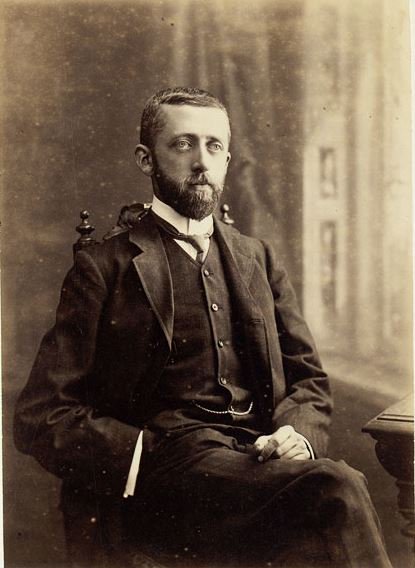
ImageHe was born in Guernsey in 1877.
He went to Aberystwyth University, and also studied in Zurich, Switzerland.
Fleure was an academic geographer for his lengthy career, and was associated with the Universities of Aberystwyth and Manchester in particular where he held posts which allowed him to support the development ot the GA as well.

His research in Wales is described here.

Fleure wanted to look at how place influenced people, and the way that geography affected identity


During his Presidential year, he did a great deal also for the Le Play Society. The Le Play society organised overseas tours as the earlier Touring Branch had done, and also held an annual conference. I also notice the address of the Secretary on the bill below.
I wonder if the Birlings at Birling Gap is still there, or has succumbed to the coastal erosion that has taken place there in recent decades particularly.

The Le Play Society continued after the end of the GA's own Touring Branch had to close.
Someone who is also associated with the Le Play Society and the GA is Frederick Soddy, in whose name grants are now provided for teachers to provide fieldwork opportunities for their students, for both the GA and the RGS.

Here is Fleure in 1927 - 2nd from the right on the Front Row

Source: https://www.llyfrgell.cymru/fileadmin/fileadmin/docs_gwefan/amdanom_ni/cylchgrawn_llgc/cgr_erth_XXXVrh1_2010_4.pdf

Fleure was awarded an Honorary Fellowship from the American Geographical Society in 1930, and its Daly Medal in 1939.
He received the Victoria Medal of the RGS in 1946, as have a few former Presidents of the GA. A precedent that I think is worth renewing ;)

Fleure was also one of only three geographers to have been elected as a Fellow of the Royal Society - bonus points if you can name the other two...

The Fleure Library is the name of the GA's archive of materials, and it has been quite mobile, and found several homes, as has been described in the blog. Some elements of the library are now on display in the Patrick Bailey room at Solly Street (a room named after another former GA President)

As I blogged about previously, back in 1917 Fleure took the library with him when the GA relocated to Aberystwyth and he was able to secure premises in the town with appropriate space for the archive.


https://royalsocietypublishing.org/doi/pdf/10.1098/rsbm.1970.0009

He later relocated to the University of Manchester, where he had a Professorship, and the library followed him there, until 1947.
Here is an announcement from 'Geography' in 1947


As one can imagine, as with many other Geographers of the time, we have to look at his work through the lens of history.
According to this piece, Fleure made his name originally through writing about Race, although he was not a racist, and spoke out against those who were.

I wonder what this publication suggested were the particular problems... answers on a carte postale.

When he retired from the Professorship at Manchester, this piece was written about his time at the GA.
https://www.nature.com/articles/153489c0
It describes his major work called 'The Corridors of Time' which ran to several volumes.
A Natural History of Man in Britain Hardcover  by
Fleure also wrote several books on the landscape of the UK and the influence of man, and worked with Harold Peake on a series of archaeological books.

No scholar in Great Britain has done more to justify the claims of human geography, closely linked with both the natural sciences and the humanities but pursuing its own distinct objectives and devising its own technique and methods, to be one of the most illuminating approaches to the study of civilisation and its problems.
From a notice in 'Nature' in 1944

Fleure also wrote an excellent 33 page long account of the first 60 years of the GA and Education, which I have referred to several times during the production of this blog.
This is proper scholarship though, compared to my scribblings on this blog.

Updated May 2021
Fleure retired in 1944 and travelled in the USA. This was ahead of him taking up the Presidency.

Source:
“GEOGRAPHICAL ASSOCIATION. ANNUAL REPORT FOR 1944.” Geography, vol. 30, no. 1, 1945, pp. 18–19. JSTOR, www.jstor.org/stable/40562425. Accessed 15 May 2021.

Fleure died at the age of 92, having a lived a life full of geography. He finally had his own obituary, after the very many that he had written for other GA Presidents before that.

Addendum
While communicating with Ricky Buck at the GA recently, he told me that he had been in touch with an academic who was researching the life of H J Fleure.
She is exploring his life, and I hope to perhaps find out more about H. J. Fleure through chatting to her.

Another of Fleure's books, with M. Davis.
Related image

References

Matless, David. “Nature, the Modern and the Mystic: Tales from Early Twentieth Century Geography.” Transactions of the Institute of British Geographers, vol. 16, no. 3, 1991, pp. 272–286. JSTOR, www.jstor.org/stable/622948.


I have edited the page to add Fleure's Presidency to the page, as I have with all those who didn't have this information.

Fleure, H.J. (1953) "Sixty years of geography and education", Geography, vol.38, pp.231-264

https://royalsocietypublishing.org/doi/pdf/10.1098/rsbm.1970.0009 - biography from Royal Society pages.

Fleure, H. J. “GEOGRAPHY AND THE SCIENTIFIC MOVEMENT.” Geography, vol. 22, no. 3, 1937, pp. 178–188. JSTOR, www.jstor.org/stable/40560279.

Mentioned in: https://www.geography.org.uk/write/MediaUploads/Journals/Boardman_McPartland_Building_on_the_foundations.pdf

Invited to speak at Edinburgh University: https://www.ed.ac.uk/geosciences/about/history/school-history

His part in the founding of the IBG: Stoddart, D. R. “Progress in Geography: The Record of the I. B. G.” Transactions of the Institute of British Geographers, vol. 8, no. 1, 1983, pp. 1–13. JSTOR, www.jstor.org/stable/622270.
Obituary: https://www.therai.org.uk/archives-and-manuscripts/obituaries/herbert-john-fleure - written by another former President: E G Bowen (or EGB as he was known)

Fleure's account of the 60 years of the GA on JSTOR. I've mined this for lots of details on other Presidents as well, and they will appear in the next few months.

Fleure, H. J. “NEW ENGLAND-AND OLD.” Geography, vol. 31, no. 3, 1946, pp. 105–110. JSTOR, www.jstor.org/stable/40563882.
https://www.llyfrgell.cymru/fileadmin/fileadmin/docs_gwefan/amdanom_ni/cylchgrawn_llgc/cgr_erth_XXXVrh1_2010_4.pdf

http://www.geocurrents.info/geographical-thought/racial-classification-h-j-fleure-and-the-decline-of-geography

As always, if anyone has further information relating to H. J. Fleure and his time at the GA. he is one of the most influential figures in the history of the Association. Please let me know so that I can expand on this post.
 I am sure there is plenty more to say about him. 

Image - books from the Fleure library

Added August 2019

Fleure is also mentioned in Crone's chronology of Geography in the 20th Century.

Reference
Crone, G. R. “British Geography in the Twentieth Century.” The Geographical Journal, vol. 130, no. 2, 1964, pp. 197–220. JSTOR, www.jstor.org/stable/1794582.

Updated November 2019

Thanks to Jamie Woodward from the University of Manchester. He references a document which relates to Fleure's work at the University.


Also thanks for the lead to this article by another former GA president E.G.Bowen, who is yet to feature.


https://books.google.co.uk/books?id=N81mDwAAQBAJ&lpg=PT67&ots=RtCfAEEQvA&dq=charles%20close%20OS%20geographer&pg=PT79#v=onepage&q=charles%20close%20OS%20geographer&f=false

Updated March 2020

In Balchin's Centenary volume, he describes how, when Fleure reached the age of 85 in 1962, he was presented with a book of congratulatory messages and good wishes from several hundred members, together with a portrait in oils, which hung on the wall at Fulwood Road. I wonder where that is now.
At this age, he was still working as Chairman of the GA Council.

Updated July 2022

As with other Presidents I have been adding any details that emerge with respect to controversial views helf by Presidents, alongside the EDI work of the GA.
H J Fleure was a proponent of eugenics, and this needs to be remembered alongside his other achievements. Many of his books have elements of this racist theory within them.

A new image is found in a book of essays to mark the centenary of the department, which was edited by another former GA President: 'EGB' or Emrys Bowen.

This has a new image to me of Fleure.

The book was dedicated to H J Fleure.
It provides a summary of his time at Aberystwyth as well.


There is also mention of how Halford J MacKinder asked Fleure to be the Honorary Secretary of the GA, which resulted in the GA moving to Aberystwyth.


There is mention later in the foreword of the essay collection of Fleure's research:


Updated August 2023

A few tweaks and amendments.


Last updated Decembr 2023

An appreciation by Alice Garnett for the Royal Society.

Fleure was elected as a member in 1936.


Garnett, Alice. “Herbert John Fleure. 1877-1969.” Biographical Memoirs of Fellows of the Royal Society, vol. 16, 1970, pp. 253–78. JSTOR, http://www.jstor.org/stable/769590. Accessed 19 Dec. 2023.
From this article:

The last occasion when he addressed a formal gathering of geographers was in his ninety-first year. Then, from his home in Surrey, 'cocooned'-as his family described him-in rugs and shawls, in a wheel chair, he was transported to participate in 'The President's Evening' in the course of the Geographical Association's Annual Conference held at the London School of Economics.

It was a raw, bitterly cold night early in January that must have daunted many far younger than himself but for Fleure this was an occasion that come what may, no matter how 'hard the going' might be-he refused to miss, as it was designed also to mark the retirement of his successor in office after twenty-one years of service since his own day.

Unable himself to read close print, his son had read to him-at his request-every detail of the Association's Balance Sheet and Statement of Accounts presented at a recently held Annual Meeting. Fleure astonished officers whom he met that evening by the searching questions he then asked, seeking explanations for numerous small changes and variations in financial procedures, in what would, at any age, have been a prodigious feat of memory.

Before a large audience - and inevitably without the help of notes - he then delivered without faltering, a most memorable and moving speech, reiterating in this, his last public utterance, his plea through the teaching of geography, for toleration and mutual understanding amongst peoples.


Eighteen months later, he died peacefully on 1 July 1969 at his home in his ninety-second year, after an unexpected and short attack of bronchitis. Amongst geographers, he was a leader whose ideals, wisdom and strength of purpose can hardly be surpassed.

Presidential Address:
 1949. Geography and evolution. Geography, 34, 1-9. Presidential

Update December 2023
A series of tweets on the Relief Model of Wales. 

Tuesday, 29 October 2019

Fleure Library

Over the years, the GA has accumulated a huge wealth of printed material, and what remains of this is currently held at Solly Street, the GA HQ in Sheffield.
There is also a large Primary-focussed collection owned by Simon Catling, some of which is also held at the GA's HQ in a special room.
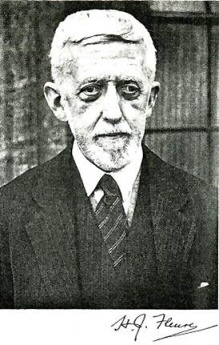
A great deal of this was initially collected and curated by H. J. Fleure, who is pictured opposite.

He looked after all donated books to the Association - some of which were sent in for review in the journals, and others from teachers who wanted to leave something tangible in the Association's archive.
Fleure was a former President, who has his own entry on the blog shortly.

He managed to find a number of premises for the library in Aberystwyth, where it stayed for many years. Fleure was the GA's Honorary Secretary at the time. It then moved to Manchester where, as I have previously mentioned, it was saved from a fire by a fast acting caretaker.

The library was housed in the Sheffield University library for many decades after it was moved from Fulwood Road in 1983 following a decision approved by the GA Council at the time. I remember visiting it there as an undergraduate.
The collection is now housed at the GA HQ in Solly Street, and several glass display cases featuring items from the library are in the Patrick Bailey room (a former GA President who will also have his own post on the blog)

For the 125th Anniversary conference, I was asked to curate a selection of items from this collection, and was aided by Ricky Buck, who retrieved the items that I suggested might tell a story of the Association, and together I chose about 100 items and provided captions for the exhibition, along with a Primary section.

One of the things that I have available to add to this collection is a set of journals called 'Classroom Geographer, which was published by Hugh Sealey. More on this in a later blog post, as the journal saw the first published work by several GA Presidents who will get their entries in time.

I have a spreadsheet containing details of all the 10 000 items which were in the collection at the time, and there is an impressive range of books and other materials there. 

Monday, 2 September 2019

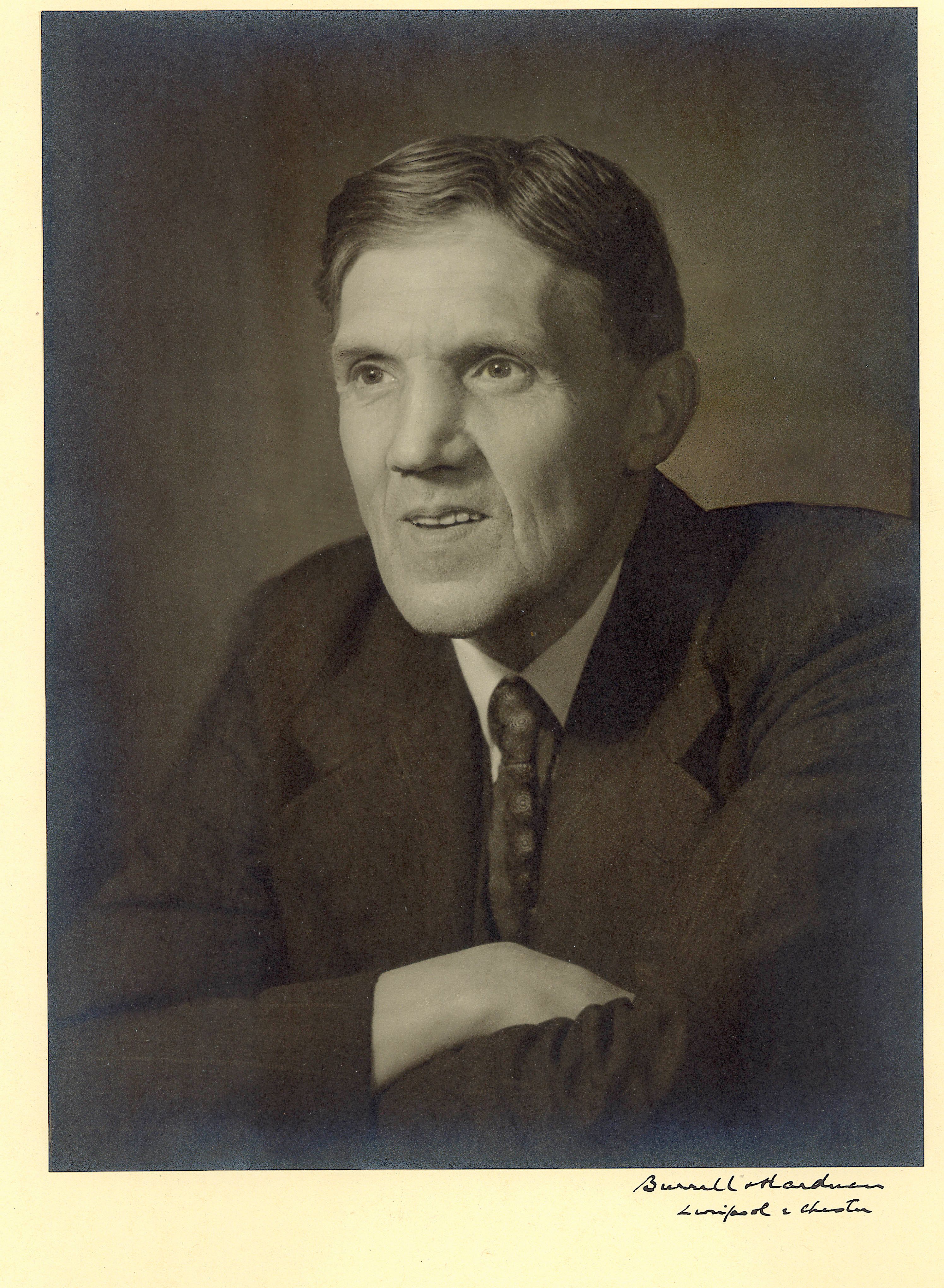
1933: Professor Percy Maude Roxby

Image result for percy maude roxbyLast updated June 2024


Percy Maude Roxby was  an academic geographer connected with the University of Liverpool, and an expert on the geography of China.

He was born in 1880, and educated in History at Oxford University, but was appointed as lecturer in Regional Geography at the University of Liverpool in 1906.

He was one of the many people who were influenced by, and responded to, the work and teachings of A. J. Herbertson, who has featured previously on the blog.

He wrote a paper called "What is a natural region" in response to Herbertson's work and set out ideas for organising how geography could be taught in secondary schools. This connection with school geography has been an important part of many GA President's roles and legacies, and Roxby was particularly important in this regard.

He was also involved with the GA for a considerable period of time before being President, and so became one of the group of GA Presidents who were being 'rewarded' for their service to the Association during this period in its history.

The honours school of Geography at the University was formally approved in 1917-18, when Percy Maude Roxby was appointed as the first named chair of Geography in the British Isles.

Roxby visited China several times and wrote a book on the country as well, at a time when relatively little was known about the country. This is one of his great contributions to the work of the GA.

He traveled extensively in China, and both studied and wrote about Chinese geography. This was his particular passion.
Meanwhile, he promoted mutual understanding between China and Britain through geography. He also supervised the Department of Geography at Liverpool University and trained Chinese geographers. 
Overall, Percy Maude Roxby played a significant role in Chinese geography including his own research, the internationalization of Chinese geography, and cultivation of Chinese scholars, all of which should be included in the history of modern Chinese geography.
This becomes even more significant now, given the growing power of China on the world stage.

He wrote a whole series of articles for GA journals. His Presidential Address was on the theme of China as an Entity, compared with Europe, as one would have expected.


Roxby died in 1947, and a prize in his name was introduced at the University of Liverpool after his death. This was to pay for a geographer to travel - something Roxby was a big promoter of.

His name was also connected with another, later President, who will have his own entry in due course.

Dick Lawton was inspired by lectures from Roxby to pursue his own geographical career at the University of Liverpool and become involved with the GA in due course.

He was also mentioned by another GA President, Roger Carter in his Presidential address:

"I came across the details of the Staffordshire Geographical Exhibition of 1934. The Exhibition gave rise to an account, edited by Jasper H. Stembridge. Here is an extract from Stembridge's account:

 'The Staffordshire Geographical Exhibition proved that the popular press and the general public are deeply interested in education. On the second day the Exhibition was thronged. On the third and subsequent days it was so crowded in the afternoons and evenings that it was often difficult to make one's way round the rooms. Owing to requests received from all parts of the country it was decided to keep it open for a further three days' (Stembridge, 1934, p. 12). 

 The then President of the GA, Professor PM. Roxby, was equally enthusiastic about the event: 

'Here was the new geography - pulsating with life - presented with a freshness of outlook, but with a deep conviction of the importance of the subject and its underlying principles' (Roxby quoted in Stembridge, 1934, p. 13).

References

No Wikipedia entry exists. Perhaps one needs to be written.

There is an archive of his lectures and notes held at the University of Liverpool.
https://discovery.nationalarchives.gov.uk/details/c/F58505
https://www.liverpool.ac.uk/geography-and-planning/about/
https://www.nature.com/articles/159462a0
Lei ZHANG. Percy Maude Roxby and Chinese geography[J].Acta Geographica Sinica, 2015, 70(10): 1686-1693.
Available in Chinese it seems... anyone able to translate?


In May 2017, his centenary was announced in a Tweet from the Liverpool University account, including his portrait.
Roxby, Percy Maude. “CHINA AS AN ENTITY: THE COMPARISON WITH EUROPE. ADDRESS TO THE GEOGRAPHICAL ASSOCIATION.” Geography, vol. 19, no. 1, 1934, pp. 1–20. JSTOR, www.jstor.org/stable/40558758.

https://www.jstor.org/stable/40563887?seq=1#page_scan_tab_contents - details of Roxby Prize

Liverpool University Facebook page: https://d.facebook.com/livunigeog/photos/a.579114048787869/1640924519273478/?type=3&__tn__=EH-R

A prize winning essay from 1902 while studying at Christchurch, Oxford: https://archive.org/details/henrygrattanbein00roxb/page/n10

As always, if anyone knows anything more about Percy Maude Roxby, or has a contribution to make to the blog, please get in touch... 

Major update October 2019
Quite a lot of additional detail on Roxby and his work is included in an article by Professor H C Darby, who was also a Professor at Liverpool University. He talks first about the time following the First World War.


I like the idea of Roxby's long cycling tours, particularly in East Anglia and like to think that I have travelled along the same routes as Roxby. He wrote a chapter in a volume on Great Britain.
When searching for this book, I found this biographical reference in another book.


This told me the book was called 'Great Britain' and edited by A. Ogilvie (1928) and that he also contributed chapters to other publications. such as 'The Geographer's Craft'.

H C Darby then talked about the time when he succeeded Roxby at Liverpool University.


I also found an obituary of Roxby, which I hadn't found previously, written by H J Fleure.


References
Darby, H. C. “Academic Geography in Britain: 1918-1946.” Transactions of the Institute of British Geographers, vol. 8, no. 1, 1983, pp. 14–26. JSTOR, www.jstor.org/stable/622271.


https://archive.org/details/henrygrattanbein00roxb/page/n10 - prize-winning essay

https://archive.org/details/chinaproper0002grea/page/n425 - China manual for naval intelligence - showing his great knowledge of the city

Crone, G. R. “British Geography in the Twentieth Century.” The Geographical Journal, vol. 130, no. 2, 1964, pp. 197–220. JSTOR, www.jstor.org/stable/1794582.

Fleure, H. J. “OBITUARY: PROFESSOR P. M. ROXBY.” Geography, vol. 32, no. 1, 1947, pp. 36–36. JSTOR, www.jstor.org/stable/40562545.

CARTER, ROGER. “Connecting Geography: An Agenda for Action.” Geography, vol. 84, no. 4, 1999, pp. 289–297. JSTOR, www.jstor.org/stable/40573334. Accessed 22 Nov. 2020.

Update: December 2020
In 2003, Chris Kington asked a number of former Presidents what had sparked their passion for geography. 
He lent me the letters and Dick Lawton mentioned the influence of Roxby and other geographers including Clifford Darby and Bill Mead on his own academic career at the time.
He says they taught him not only about geography, but how to be a geographer...
Upated July 2022
Roxby contributed to some guides to China written for military intelligence, found on the Internet Archive. Another wartime contribution by a former GA President.
Updated August 2023
As with many Geographers, Roxby was involved with the British Association's Section E committee meetings. He became the President in the 1930s and spoke about his work. He had many interests aside of his trips to China.
Finally found his Biogeographical volume description:


On his links with the GA it has this to say:


Updated June 2024

From 'The Geographer's Craft' by T.W. Freeman (1967) 
Available from the Internet Archive

A superb half chapter all about Roxby and his life and career. 


Margaret Mackintosh RIP

Updated post. Sad news at the end of last week from colleagues who have organised the Charney Conference over the years of the passing of Ma...