Showing posts with label Douglas Freshfield. Show all posts

Saturday, 18 May 2024

New role... new blog...

As you'll have perhaps seen from a post at the end of April, I'm going to be working as the Vice President: Education of the RGS from June. 

As with any major project that I get involved with, or new role, I've started a new blog. This will track my work over the coming years, and also publicise relevant RGS-IBG activity. 

When I started out on my GA Presidential journey,  I started a blog which now has over 850 posts on it, and includes a biography of every GA President to date as well as much more on the history of the Association and its activities.

No. 1 Kensington Gore is known as "the Home of Geography". 


I've taken that as the name for my new blog, as I'll be visiting more regularly than I have for a few years.

Lowther Lodge has been the home of the Royal Geographical Society for over 100 years. 


You can visit the new blog here. 

Sunday, 17 September 2023

RGS 125th Anniversary Dinner - 1955

There was a strong representation of former GA Presidents at this event, held at the Dorchester Hotel - very posh.

In the speech that followed, the GA gets a mention, alongside the previous explorations and expeditions.


There is also a mention for recent Medallists, including Sir John Russell (another former GA President)


“The 125th Anniversary Dinner.” The Geographical Journal, vol. 121, no. 3, 1955, pp. 392–404. JSTOR, http://www.jstor.org/stable/1790929. Accessed 16 Sept. 2023.

Wednesday, 7 April 2021

GeogPod: Alan Kinder

The latest GeogPod podcast, and the last for a few weeks, is an interview with Alan Kinder who talks about his journey to becoming the GA's Chief Executive, and the work of the Geographical Association. He says lots which are of relevance to this blog, and mentions some former GA Presidents who have featured here, such as Rex Walford and Douglas Freshfield.

John talks about his own experiences with the Geographical Association, going back to 1976 and visiting the library at Fulwood Road. He and Alan also say something which I've heard quite a few times before - that visitors to Solly Street can't believe how much is done by such a small number of staff.

Alan talks about the purpose of the GA and its link with the subject discipline and the notion of community and lays out with his usual clarity the key purposes of the GA, and how those are communicated and sometimes contested.

The GA is an association of geography educators, and developed to enable discussions of shared values and the exchange of ideas.

John discusses Douglas Freshfield's introduction to the first journal 'The Geographical Teacher', something I've also covered over on the blog, and the impact of the internet on teacher development and communicating.

Alan reminds us of the importance of the GA, and how it has got to where it is now... influenced by the 100+ GA Presidents who have held the role over the decades, and those who have got involved in whatever way they have with the GA - and there are several options for that. 

He also talks about the value of being a GA member, and why some people may not become members.

Alan talks about the future of the GA, and the challenges ahead as well as the powerful work that continues to be done, and discusses the GA's new Strategy as well as trailing the GA Conference ahead - conference began in 1921, so this is the centenary year for that.

Tuesday, 18 August 2020

Geography and Education


I was looking for something else when I came across this book which has been made available as a PDF and written by Kieran O Mahony.
Published by Educare Press.

It explores the development of school geography in the UK with a focus on fieldwork in places.

It mentions some of the very early 'geographers', the work of Comenius, Erasmus, Vives and others, through to the interest shown by the Royal Geographical Society for a while, and on through the Keltie report, and the work of Douglas Freshfield and Pestalozzi's thinking on 'look and see' fieldwork.

It's worth taking a look at as it mentions no end of former GA Presidents who have appeared in this blog over the last couple of years.

It talks about Captain Maconochie, the first Professor of Geography in the UK in 1833 before becoming the Governor of a penal colony in Australia. He was also one of the founders and first secretary of the Royal Geographical Society.
His Wikipedia entry includes quite a lot more information on this interesting character.
http://adb.anu.edu.au/biography/maconochie-alexander-2417

As we move into the 20th Century we are inevitably introduced to characters such as Halford Mackinder,  A J Herbertson, Patrick Geddes and Le Play and Reclus.
Herbertson and colleagues were busy in 1902 when they realised they would not only have to train new teachers, but also retrain existing ones - running courses through the summer vacation. C B Fawcett (after whom there is a fellowship still in existence) and Blanche Hosgood were active here.

By the time H J Fleure is mentioned, Herbertson had involved the Ordnance Survey and standards were improving. He was also behind the launch of 'The Geographical Teacher' journal in 1901, which became 'Geography'.

The book goes on to describe the impact of the two world wars. One of these was a Ministry of Education circular 140, published in 1947 which paved the way for more fieldwork. The GA started to offer courses very quickly after this allowed for more work to be done off the school premises without HMI approval, and the FSC opened their first centre at Flatford Mill. Geoffrey Hutchings is mentioned here (another former GA President) in helping with this movement which soon saw over 200 field centres operating across the country.

A later chapter covers Grenville Cole, an early GA President.

Source:
You can read the whole book here.
https://files.eric.ed.gov/fulltext/ED331742.pdf

Thursday, 11 July 2019

Magic Lantern Slides

One of the facts that is often quoted about the formation of the Geographical Association's origins is that is was founded in part because of the desire for teachers to share resources in the form of lantern slides, which were accompanied by lesson materials. The GA worked with a company called the Diagram Company, which started by loaning slides, and moved on to selling them. I have a few lantern slides, which are not of any great age, and there used to be a large selection down in the warehouse at Solly Street for a while. Some of these were donated by Presidents, such as Vaughan Cornish, and others. H J Fleure and his assistant in the library also used to coordinate the loan of these slides from Aberystwyth (see Fleure's entry for more details)
A later blog post will outline some of the work that this company did, and influences on Pedagogy.

There are some connections here with the Royal Geographical Society once again, of course, as they also have a large collection of lantern slides.
Emily Hayes has been researching the different views on the use of magic lantern slides, which mirror some of the debates currently being had around the use of traditional and progressive pedagogies.

I am grateful to Emily for sending me a copy of her paper, which made good reading. The events here predate the blog largely, as they took place in the run up to the formation of the Association in 1893, but the role of the RGS is mentioned.


The role of women within the RGS was significant of course, as previous blog posts have outlined.

Emily's thesis broadens out the use of lantern slides into the 1920s, but from the title and synopsis focusses on the role of the RGS rather than the Geographical Association.
The chapters below explore how these innovations in visual technologies and practices arose, how they circulated knowledge and their effect on geographies of geographical knowledge making. By harnessing the lantern the RGS attracted an expanding and diversifying audience demographic. The thesis demonstrates the interactive nature of RGS lantern-slide lectures and audiences' important role in shaping the Society’s practices and geographical knowledge. The chapters below argue that it was via the use of the lantern that geography was disseminated to new places. The thesis therefore brings additional perspectives and dimensions to understandings of the circulation of geographical knowledge.
Read more at https://ore.exeter.ac.uk/repository/handle/10871/23096#PSdvQPc7baSCXDiL.99


I read about the way that slides turned some lectures into a type of 'performance', the forerunner to the Powerpoint driven sessions that many of us will have given, or sat through.


COVIC is the Colonial Office Visual Instruction Committee. It was set up in 1902, and lasted through the First World War. Mackinder was associated with its work.


As Emily goes on to say:

"The Map Room accepted lantern-slide donations from 1888. 543 Donations increased from 1892-93 when the GA was founded.  The Society advertised the fact that it was seeking to acquire lantern-slides in the Year Books throughout the late 1890s. From 1918 Fellows or their executors, family and friends offered the sale of lantern-slide collections to the RGS."

When following up on this, I came across reference to an article by Professor Joan Schwarz, which sounded like it might be useful. I contacted Joan, who works at the Queens University in Ontario, Canada and she kindly sent me a copy of the article, and showed interest in the blog project.
More on this to come in a future blog post.


References
Emily Hayes: 'Geographical light: the magic lantern, the reform of the Royal Geographical Society and the professionalisation of geography c.1885-1894
https://www.sciencedirect.com/science/article/pii/S0305748817300427

Thesis:
https://ore.exeter.ac.uk/repository/handle/10871/23096

Fleure, H. J. “SIXTY YEARS OF GEOGRAPHY AND EDUCATION. A RETROSPECT OF THE GEOGRAPHICAL ASSOCIATION.” Geography, vol. 38, no. 4, 1953, pp. 231–264. JSTOR, www.jstor.org/stable/40564702.

C. Herbert, Culture and Anomie: Ethnographic Imagination In The Nineteenth Century, University of Chicago Press, 1991, 153-54 and 262-5; Driver, Geography Militant; and Withers, Science, scientific instruments and questions of method in nineteenth-century British geography, 167-179.

Ryan 'On visual Instruction' in
The Nineteenth-century Visual Culture Reader

https://books.google.co.uk/books?id=JAuPcgxiT0QC&lpg=PA149&ots=1Klyeu0FxB&dq=canadian%20high%20commission%20COVIC&pg=PA145#v=onepage&q=canadian%20high%20commission%20COVIC&f=false

MACKINDER, H. J. “THE TEACHING OF GEOGRAPHY FROM AN IMPERIAL POINT OF VIEW, AND THE USE WHICH COULD AND SHOULD BE MADE OF VISUAL INSTRUCTION.” The Geographical Teacher, vol. 6, no. 2, 1911, pp. 79–86. JSTOR, www.jstor.org/stable/40554112

Image: Lantern Slide from my collection, image CC licensed by Alan Parkinson

Update
You can buy a postcard set of lantern slide images from the GA shop.


Friday, 3 May 2019

1913: Professor Edmund Johnston Garwood

Last updated August 2023

Edmund Johnston Garwood was another person involved as part of the drive to bring in distinguished outsiders with geographic interests to strengthen the standing of the Association in its early years.

Garwood was born in 1864 in Bridlington, and educated at Eton College and Trinity College, Cambridge, where he took his degree in 1886.

Between 1887 and 1892, he served as director of the Jarrow Chemical Company and as lecturer at the Cambridge University Extension Lecture Syndicate between 1891 and 1898.

In 1896, he accompanied the British Exploring Expedition (led by Sir William Conway) to Spitzbergen where he studied glaciological phenomena and geology. For this work, he was awarded the Gill Memorial Fund by the Royal Geographical Society and the Wollaston Fund by the Geological Society of London. This provided his entry into the sphere of geography.

The following year he returned to Spitzbergen. At the end of July, Garwood and the assistant Nielsen ascended Nielsenfjellet to survey the scene inland, later setting off inland up the Kongsvegen glacier. They ascended the glacier to the vicinity of Kongsfjella, then turned back to examine the vicinity of Tre Kroner before finally returning to Kongsfjorden. Conway named the region of this exploration King James Land (now James I Land).

Read their journals from this expedition here. They are beautifully illustrated and well worth reading.

Here's a comment on Garwood's involvement in the party:


In 1899, Garwood accompanied Douglas Freshfield (a previous President of the GA) on an expedition to Kangchenjunga and was responsible for the accounts of the geological structure and physical features of Sikkim. 

In 1901, he was appointed Professor of geology and mineralogy at University College, London, a chair he held until his retirement in 1931. Another link with UCL for GA Presidents.

He produced a series of maps during this time - one of which can be seen here. This is a wonderful piece of cartography from the days before GIS and StoryMaps.

In 1913, Garwood was proposed and seconded into the post (these were the days before a ballot of members was held to decide between those who were proposed and named). This article describes the AGM where this took place, and Garwood's contribution to it, as he took the Chair.

Garwood's Presidential Address was on 'Arctic Glaciers and British Ice Sheets' and can be read on JSTOR by 'Geography' subscribers.

Presidential Address: Garwood, Edmund J. “ARCTIC GLACIERS AND BRITISH ICE SHEETS.” The Geographical Teacher, vol. 7, no. 2, 1913, pp. 73–89. JSTOR, www.jstor.org/stable/40554273.

Between 1930 and 1932, Garwood served as President of the Geological Society of London as well as other posts of responsibility. He published a number of articles in the Society's journals during this period, and also in the period before he took up the post. 
He was also succeeded in that post by another former GA President, Thomas Henry Holland.


From 'The Geographical Teacher' 1921

His published work includes:

The first crossing of Spitsbergen by (Sir) Martin Conway, J W Gregory, Aubyn Trevor-Battye and E J Garwood, J M Dent & Co. London (1897) SPRI Library Shelf (32)91(08)[1896 Conway
A northern highway of the Tsar by Aubyn Trevor-Battye, Constable London (1898) SPRI Library Shelf (50)91(08)[1894-95

During the time of Garwood's Presidency, there was another significant change in the development of the Geographical Association. Prior to this, there wasn't the same financial strength, but now it had significant financial assets, which meant that the GA needed Trustees and a Constitution. 

The GA President is now a Trustee for the period of their Presidency, but there is a Chair of Trustees, who Chairs the Governing Body meetings.

The GA's Constitution was formally adopted on the 9th of January 1913.

At this time, life membership of the Association could be purchased for £3.50. Quite a bargain.


Garwood died on 12 June 1949 after a long and varied career of which this entry only tells a fraction.

References:
Source:
https://archiveshub.jisc.ac.uk/search/archives/4888f487-98b6-30e3-aad9-f081d053f20f

https://en.wikipedia.org/wiki/Edmund_Johnston_Garwood

I edited the Wikipedia entry to add the fact that he was the President of the Geographical Association. I shall do that for each President, as hardly any of their entries mentioned that before I started the blog.

“THE ANNUAL MEETING OF THE GEOGRAPHICAL ASSOCIATION.” The Geographical Teacher, vol. 7, no. 1, 1913, pp. 40–41. JSTOR, www.jstor.org/stable/40554231
Some details from Balchin's centenary History of the Association were used in this post.

Presidential Address: Garwood, Edmund J. “ARCTIC GLACIERS AND BRITISH ICE SHEETS.” The Geographical Teacher, vol. 7, no. 2, 1913, pp. 73–89. JSTOR, www.jstor.org/stable/40554273.

Spitzbergen Journals at SPRI: https://discovery.nationalarchives.gov.uk/details/r/N13920016

Image copyright details:

Edmund Johnston Garwood
by Walter Stoneman
bromide print, 3 March 1926
NPG x162525
© National Portrait Gallery, London

As with each post, if you know more about E J Garwood, please get in touch. This is a relatively brief entry, and I'd love to know more.

Updated May 2019

1913 was the year when the RGS admitted women as Fellows. This brought an end to what previous GA President, Douglas Freshfield had referred to as 'the lady question' and was the reason why he wanted to start a new Association.

Read more about this in:

Bell, Morag, and Cheryl McEwan. “The Admission of Women Fellows to the Royal Geographical Society, 1892-1914; the Controversy and the Outcome.” The Geographical Journal, vol. 162, no. 3, 1996, pp. 295–312. JSTOR, www.jstor.org/stable/3059652.


Further research opportunities:
Geological Society of London Archives

Updated May 2020
When he was teaching at UCL, he taught another former GA President: Stanley Henry Beaver.

Updated November 2020


Updated August 2023

A geology map of NW England by Garwood - follow the search for a few more items.

https://picryl.com/media/geological-map-nw-england-garwood-1912-01-9075a0 


Wednesday, 10 April 2019

1897 - 1911: Douglas William Freshfield

Image result for douglas freshfieldUpdated September 2023

In 1897, following a period during which the Association was developing its constitution and statutes, Douglas W Freshfield became the first President of the Geographical Association (GA). 

This followed his resignation from the Royal Geographical Society, apparently partly because the organisation would not admit women Fellows. 
He remained in office until 1911, a period which has not been surpassed since, and will not now be, as the Presidency is a one year post (bracketed by other related responsibilities)

From the chronology written by Peter Jackson for the GA website. (see separate blog post)

Douglas Freshfield was one of the people who attended the first meeting when the Association was formed. He was the first Honorary Secretary of the Royal Geographical Society.

He was born on the 27th of April 1845, and died on 9th of February 1934. 

He was a lawyer, mountaineer and author and also edited the 'Alpine Journal'. 
He was educated at Eton College, and University College, Oxford.

He also wrote a quote that I have used many times in my CPD sessions in the first issue of 'The Geographical Teacher': the first journal that the GA published (of which more to come later in the blog) about the importance of teachers coming together to learn from each other.

This can be read in the image to the right.

This was published in 1901, and was free to members, (but cost one shilling for non-members). This was an important element of the work of the GA, and remains so today.

Douglas Freshfield was heavily involved with the GA from the very early days of the Association.

In 1899,  Freshfield accompanied another future President: E. J. Garwood, on an expedition to Kangchenjunga and explored the geological structure and physical features of Sikkim. Images taken during trips like this helped build the lantern slide library owned and shared by the GA as part of its founding purpose, and which was revisited for the Geographers Gaze project.

In 1900, GA membership opened to all teachers of geography irrespective of age, gender or type of school.

Key lectures were given at this time by H. J. Mackinder on 'Geography as Training for the Mind' and B. B. Dickinson on 'The Use of the Lantern Slide'.

Update
These were referenced by Emily Hayes in her PhD thesis - more on that to come in future blog posts as I discuss the early importance of the lantern slide as a resource for geography teaching and knowledge exchange.

Douglas Freshfield was working as Honorary Secretary to the RGS when he became involved in the founding of the Association. He had made some decisions which were apparently not always welcome by the President at the time: Clements Markham.

On his mountaineering exploits:

He also became the first mountaineer to examine the western face of Kangchenjunga, which rises from the Kanchenjunga Glacier. Freshfield described Siniolchu as "The Most Superb Triumph of Mountain Architecture and The Most Beautiful Snow Mountain in the World".

He made some notable first summits, including in the Caucasus - see later tweet update towards the bottom of the post.


In 1905 he attempted to climb Rwenzori Abruzzi in Uganda but failed due to bad weather. 

However the Freshfield Pass on the mountain was named after him. This makes him one of several GA Presidents who have geographical features named after them. Keep an eye out for them as the blog develops. There are various examples of different features.

Mount Stanley from Freshfield Pass. Photo by Vittorio Sella.

Freshfield Pass and Mount Stanley - Image source and copyright

Rex Walford's book on School Geography (an important source for this blog) reminds us that Freshfield also had concerns that the membership of the RGS (at the time) did not allow women to become Fellows, although the RGS had given them awards and indeed Fellowships, until the full society forced the Council to back down on this issue later on.
Freshfield penned a brief quatrain at the time:

The question, our dissentients bellow
Is can a woman be a Fellow?
That, sirs, will be no question, when
Our Fellows are all Gentlemen!

Freshfield did re-establish his connections with the RGS later in the later part of his period as GA President. He was also awarded the RGS Founder's Medal in 1903.
(Walford, 2001) - pp.68-9

The work that Freshfield led can be followed by visiting the JSTOR archive of the 'Geographical Teacher' journal. He chaired the AGM and other meetings of the Association and these are reported each year, often held in different venues offered free of charge at the time.

At the AGM of 1903, Freshfield reminded those present that:

"The Geographical Association began its corporate existence as a body militant, a body struggling against a national and professional apathy, of which they recognised the dangers".

At the same event, there was a reminder of the ties between the Ordnance Survey and the GA, which have persisted for over a century as well, with Charles Close being a later President.

During this period, there was continued growth in the Association, and branches opened in Sheffield and Huddersfield (1907), Leeds (1911) and other cities - I have visited and spoken at these branches, as well as many others. Efforts continued to develop the position of geography in universities at degree level to allow Honours degrees to develop.

When Freshfield stepped down in 1911, the Presidency became an annual appointment, and efforts were made to bring in distinguished outsiders with geographic interests to strengthen the standing of the Association. This pattern persisted for a few years.

At the 50th Anniversary conference in 1943, T. C. Warrington reflected on Freshfield's contribution to the GA, saying this about him:

Douglas Freshfield, who became leader of the movement in the Royal Geographical Society for the improvement of geographical education, had been a member of its Council since 1878 and Secretary from 1881. By the end of 1893, he had retired from the Council and from the secretaryship in protest against the action of the Society in denying ladies admission as Fellows. From the beginning his interest in the Geographical Association was keen.

In 1898 he became its first President and remained in office till 1911. His interest in the improvement of the teaching of geography was primarily enlisted for public schools and universities, but he was president of this Association when, in 1900, its doors were thrown open to all teachers of geography. Our debt to him for the improvement of the teaching of geography, for his help and guidance and encouragement in the formative years of the Association cannot easily be measured.

In 1911, he gave his Valedictory Address after 14 years as President, where he reflected on his time as President, and the changes in the nature of the discipline.

In this address he returned to the reasons for his original exit from the RGS.

"The reason why some of us wanted to see ladies in the Society was that many ladies are engaged in geographical teaching and often in high posts. The Geographical Association was founded to give those ladies facilities denied them elsewhere."

Freshfield went on to be elected as President of the Royal Geographical Society between 1914-17 - cementing the relationships between the two organisations.

References

Valedictory Address: FRESHFIELD, DOUGLAS W. “VALEDICTORY ADDRESS.” The Geographical Teacher, vol. 6, no. 1, 1911, pp. 5–9. JSTOR, www.jstor.org/stable/40554086.

This is well worth reading!

An obituary following Freshfield's death in 1934 is linked to here

https://www.britannica.com/biography/Douglas-William-Freshfield - an entry in Encyclopaedia Britannica - not many GA Presidents have one of those.

Some details from Balchin's Centenary history of the Association used in this post.

https://en.wikipedia.org/wiki/Douglas_Freshfield - I edited the Wikipedia entry to add the fact that he was the President of the Geographical Association. I shall do that for each President, as hardly any of their entries mentioned that before I started the blog.

Image: Wikimedia - Creative Commons

ABE Books for 2nd hand copies of books by Freshfield - if I was doing this properly I would try to get books from as many of the Presidents as possible - I still might over the years to come, although I guess they are in the GA archive, and I will try to get access to those during my time as President and perhaps turn this blog into a proper book: https://www.abebooks.co.uk/servlet/SearchResults?sts=t&cm_sp=SearchF-_-home-_-Results&an=Douglas+Freshfield&tn=&kn=&isbn=

At the end of each post, there will be a request for anyone who has further additions to add them as a comment. 

UPDATE (May 2019)

While compiling the entry for John Scott Keltie, I came across some words from Douglas Freshfield following Kelties' Presidential Address in 2014
You can read it here:

Presidential Address: KELTIE, J. SCOTT. “THIRTY YEARS' PROGRESS IN GEOGRAPHICAL EDUCATION.” The Geographical Teacher, vol. 7, no. 4, 1914, pp. 215–227. JSTOR, www.jstor.org/stable/40555979.


Freshfield was referenced in Keltie's address, for his work in the early years of the Association, but there was a nice quote in Freshfield's comments, which also referred to the GA's founding and the link with the RGS and their position on female fellows. He thanks Keltie for having "created and maintained the leading Geographical Journal of the World"

There is an interesting quote on fieldwork or "out of door work" as Keltie referred to it. He describes a visit to Japan and France where he had seen teachers taking students outside. He makes the connection with the Boy Scouts, which at that stage was quite a new organisation, having been founded in 1908....

"Give the Boy Scouts a rough map of some very think and difficult wood, with instructions to look for their lunch at a particular spot, and they will develop remarkable skill in map-reading." - I may hide the packed lunches on our next field trip accordingly....

Updated June 2019 - additional links to Emily Hayes PhD thesis

Updated November 2019
Image of his grave from Wikipedia


Plus details on Ugandan mountaineering
https://www.rwenzoriabruzzi.com/highest-peaks-of-the-Rwenzori

For further research:

The Alpine Club has a series of Douglas Freshfield's papers including correspondence and other documents
https://discovery.nationalarchives.gov.uk/results/r?_q=douglas+freshfield+alpine+club

The RGS Archives - apparently his writing was "very hard to read" - there are documents here relating to the Everest expedition of the 1920s, so will have to try to access those
https://discovery.nationalarchives.gov.uk/details/r/b46cabd2-de41-4d6d-9a91-06ca17dde4d9

Search on items
https://rgs.koha-ptfs.co.uk/cgi-bin/koha/opac-detail.pl?biblionumber=217804&query_desc=kw%2Cwrdl%3A%20douglas%20and%20kw%2Cwrdl%3A%20freshfield

These include some lantern slides from his Ugandan climbs, which were apparently destroyed in February 1951 as they had faded.

Updated November 2020

In 1899 the noted British explorer Douglas Freshfield accompanied by the great Italian photographer Vittorio Sella did a circuit around Kangchenjunga. Freshfield described Siniolchu as “The Most Superb Triumph of Mountain Architecture and The Most Beautiful Snow Mountain in the World” in his book Round Kangchenjunga. Here Siniolchu is seen from the "Rest Camp" on the Zemu Glacier one day short of the Green Lakes Base Camp.

Updated August 2021

A set of Freshfield's journals from the Caucasus expedition sold for £4750 at Sotheby's auction house in London - part of a collection that was being auctioned.

Here's the description of the lot:

Freshfield first climbed Mont Blanc as a schoolboy, made at least twenty first ascents in the 1860s and 1870s, chiefly of lesser known-peaks in the Italian Alps, and was president of the Alpine Club from 1893 to 1895. "In 1868 he explored, together with Charles Tucker, Adolphus Moor, and his lifelong friend François Devouassoud, the central Caucasus, which, except for the lower heights, were then unknown. He made the first ascent of Kazbek (16,546 ft), Elbrus (18,470 ft), and several other peaks, and recorded the existence of large glaciers in the regions between them. After returning to the Caucasus in 1887 and 1889 he published his Exploration of the Caucasus (1896), which was for a time a standard work. In 1899 he visited India, Burma, and Ceylon, and made, with Dr Edmund Johnston Garwood, the circuit of Kanchenjunga through unmapped territory in Sikkim and Nepal, recorded in Round Kanchenjunga (1903) [see lot 532]. Lastly, in 1905, at the age of sixty, he tried, with A. L. Mumm, to ascend Ruwenzori in Uganda, then known as the Mountains of the Moon, but was stopped by bad weather and mud at 12,000 ft." (ODNB).

Updated July 2022

Freshfield in later life supported others.
He was particularly active in mountaineering.

And a local example:


I then found his entry in the series of Biobibliographical Studies. 


A little more about his later life:


A good quote in this final extract from that book as well:


And more on his work at the GA: "a militant body"


Updated August 2023

Some further tweaks and amendments.


I discovered a book about Douglas W Freshfield and have ordered a second hand copy. It says that he was the youngest schoolboy to climb Mt. Blanc in 1863.

From the Alpine Journal obituary (source of the image above) which shows his remarkable career and how highly he was held in regard.

https://www.alpinejournal.org.uk/Contents/Contents_1934_files/AJ46%201934%20166-198%20In%20Memoriam.pdf

He was in Anthony Wolley-Dod's house at Eton. - an interesting character himself.

It is hard to realize that he made a 'first ascent' as far back as 1861. He may be said to have descended from mountaineering stock, for his mother, Mrs. Henry Freshfield, was a mountain wanderer before the Victorian era and the gifted authoress of A Summer Tour in the Grisons and Italian Valleys of the Bernina (1862)

In 1923 the University of Geneva conferred on him the Honorary Degree of Doctor of Laws. He married, in 1869, Augusta Charlotte, daughter of the Ron. William Ritchie; sh~ died in 1911. He leaves four daughters, his only son dying as a schoolboy. He was a barrister at the Inner Temple and a J.P. 'for Sussex. 

It features a memory from E J Garwood (another former GA President)

https://charlottemasonpoetry.org/the-teaching-of-geography-by-r-a-pennethorne/ - 1956

Some of us remember the first stirring of the dry bones—and how our founder gave the results of her personal walks and investigations of our own country to the world as The Forty-two Shires—of how the London University Lectures on the subject were given in the ‘Eighties’—of how the Schools of Geography were founded, and largely through the inspiration of Dr. Douglas Freshfield, the ‘Geographical Association’ grew out of the Royal Geographical Society, and the path was ready for the mental explorer and discoverer to tread.

Referenced here:

Updated September 2023
The controversy over women fellows at the RGS-IBG and Freshfield's involvement is outlined in this article:


Source:
Bell, Morag, and Cheryl McEwan. “The Admission of Women Fellows to the Royal Geographical Society, 1892-1914; the Controversy and the Outcome.” The Geographical Journal, vol. 162, no. 3, 1996, pp. 295–312. JSTOR, https://doi.org/10.2307/3059652. Accessed 16 Sept. 2023.

“DOUGLAS WILLIAM FRESHFIELD.” Geography, vol. 19, no. 1, 1934, pp. 60–60. JSTOR, http://www.jstor.org/stable/40558766. Accessed 16 Sept. 2023.

1893 - 1897: The no-President years

Updated: August 2022

On the 4th of April, 1893, a letter was sent to a number of geography educators informing them of a meeting which was to be held in Oxford.
It was signed by a number of prominent geographers of the time.

Image: Copyright Geographical Association

A room was found by Halford Mackinder, who was Reader in Geography at the University of Oxford, and the group met in the new Common Room at Christ Church college.
The meeting was held on the 20th of May, 1893, and during that meeting the Geographical Association was founded.
More can be read in an article written by Peter Jackson in 2018.

For the next four years of the Association, there was no President however, with an Honorary Secretary and various committees running the Association as it found its feet and started to attract members.

The original ideas of sharing resources started to develop in this early meeting, lantern slides in particular were part of what was called the 'pictorial method'.

Between 1893 and 1897 there was no GA President as the post didn't exist.

B.Bentham Dickinson (of whom more to come in a future post) was Honorary Secretary (1893-1900)

He had collected over 230 catalogued lantern slides to start the process of sharing these, along with lesson notes.

The first AGM was held at the Colonial Institute in London in December 1894, by which time membership stood at 50. These meetings weren't helping Grammar schools become aware of the existence of the Association, which needed to become more active in this area. As Dickinson was a working teacher, an extra pair of hands were needed. An assistant was appointed in 1895 in the shape of  J.S Masterman, who had retired from teaching at University College School helped out until 1900, when Masterman became Treasurer.

At this time, when there was no President, there were 4 questions which drove a lot of the activity and discussions of Association members and officers:

Balchin, in his Centenary history of the Association lists them:

1. Should examination papers in geography be prepared and/or reviewed by experts?
2. Should a knowledge of physical geography be an essential feature in a course in Geography and in any subsequent examination, and if so what should be the syllabus?
3. Should one ask for a knowledge of the whole world in general or for a more detailed knowledge of a continent or region?
4. Should geography be a compulsory subject for some competitive examinations?


You can perhaps guess what the answers to the consultation were...

A number of specimen schemes were published by the Association, who also requested that geography form part of what we might now call the Common Entrance Exam (although the request was turned down initially)

Dr Hugh Robert Mill (who will also get his own entry in due course), published a very useful compilation called 'Hints to Teachers of Geography on the Choice of Books for Research and Reading'
This can be read on this Internet Archive entry along with other of Hugh Robert Mill's books. This was an interesting observation from the footnote of the introduction. It gives the address of the RGS at the time, on Savile Row, and also the correspondence address for the Secretary's assistant Mr. Masterman.


It is also interesting to read some of Hugh Robert Mill's thoughts in the book.

Read more about the initial meeting here, in a piece by Alan Kinder and Nick Lapthorn (the latter will have his own entry on this blog in due course as a Past President)

In 2018, a group of Geographers was invited to a special meal at the venue where the Association was founded.
Images from that event can be seen here.
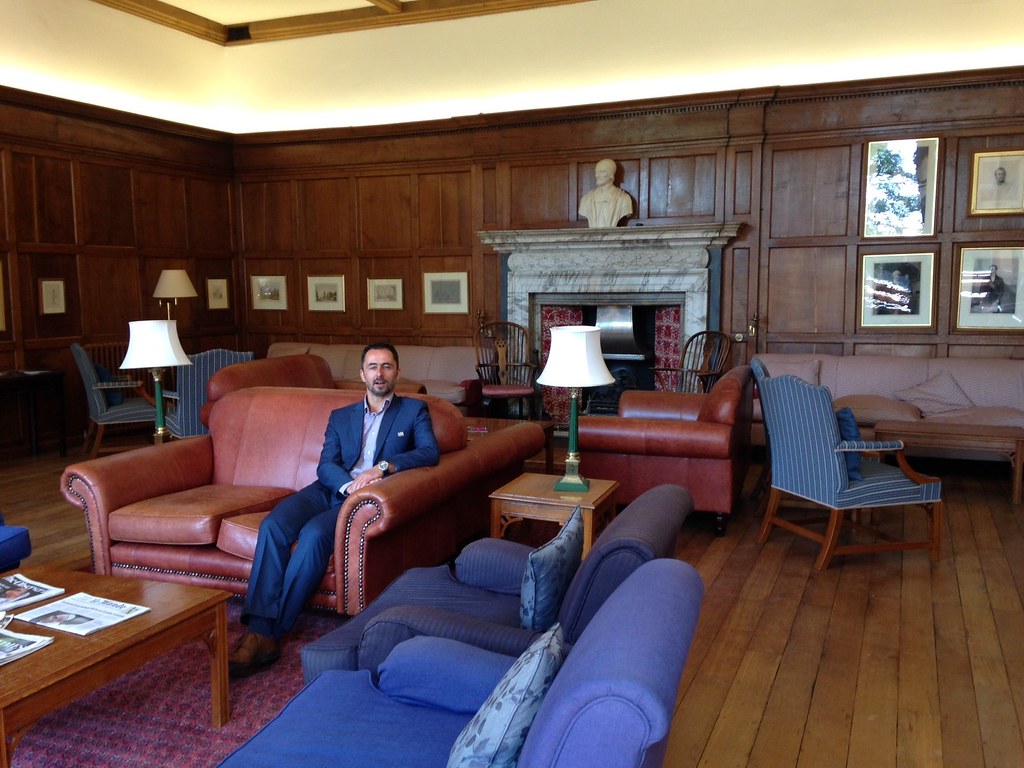
Here is the CEO, Alan Kinder in the same room where the association was founded, during the 125th Anniversary year.


Image copyright: Geographical Association / Bryan Ledgard
https://farm1.staticflickr.com/972/41597586484_9f605f41b7_b.jpg 

References
W.G.V Balchin: 'The Geographical Association, The first Hundred Years' (GA, 1993)

Update (June 2019)

Perhaps the definitive account of this period of the GA was written by H. J. Fleure, and can be read on the JSTOR by subscribers to 'Geography'
Access it here.

Update
Brian Bentham Dickinson shared his reminiscences of this period later (in 1931)
It can be read here.
https://www.jstor.org/stable/40557794

He described the first meetings of the Association, including the initial founding meeting in Oxford.

The first formal meeting of the GA was held on August 3rd 1893 at University College School, then at 16 Gower Street, with the Headmaster M. H. W. Eve in the Chair. 

Venue is shown below on Google Earth - near the British Library / Bloomsbury.


I found some letters in Hugh Robert Mill's archive relating to this period and they have been posted separately.

Margaret Mackintosh RIP

Updated post. Sad news at the end of last week from colleagues who have organised the Charney Conference over the years of the passing of Ma...