Showing posts with label A. J. Herbertson. Show all posts

Wednesday, 4 October 2023

The Herbertson Society

From time to time, echoes of the GA's past, and some of its most illustrious names resurface.

The Oxford University Geography Society appeared on my Instagram earlier and it turns out that it was originally called the Herbertson Society after A. J. Herbertson.

Previously called the Herbertson Society, Oxford’s original geography society was named after renowned geographer Andrew John Herbertson (1865-1915), one of the first Readers at the University’s School of Geography – which was itself one of the first geography departments at a university in Britain!

The original society ceased to exist in 2011, but in the academic year 2014-15 we relaunched Oxford Geography Society to celebrate the 100th anniversary of Herbertson’s death.


That event is also mentioned here. This is a very useful source of information.

There is some useful additional information here about his work.

Sadly, the heavy work-load and an ongoing heart condition took their toll on him and his family: On 31st July 1931 Herbertson died at his home near Chinnor, just short of this 50th birthday. His wife died two weeks later. They lie buried together in Holywell Cemetery, not far from the School of Geography.


1924 - Foundation of the Herbertson Society

"The idea of having a student society was first put forward in 1923 when a Hertford undergraduate, E. W. Gilbert, wrote two pages in the departmental suggestions book. He argued that a society should be formed for the students of Geography and that it should seek to promote social activities as well as the holding of meetings with lectures. He went on to suggest that it be called the Herbertson Society in memory of Herbertson." (Scargill, 1999, p. 39)

Thursday, 7 September 2023

Cross-channel Geographers

A find while researching Stanley Henry Beaver.

It explores collaboration across the channel.


He conceived the idea of genre de vie, which is the belief that the lifestyle of a particular region reflects the economic, social, ideological and psychological identities imprinted on the landscape.

The influence of Halford Mackinder and Andrew John Herbertson at Oxford was highly important in the training of teachers and university lecturers. The ‘new geography’ of Vidal and his disciples became widely known in Britain and served as a model for the first half of the century since French was far more readily accessible to a British audience than the German geographical classics.

Former GA Presidents who are referenced include:

H. J. Fleure - a French speaker and early visitor
Emrys Bowen
Stanley Henry Beaver
Percy Roxby
John Linton Myres
Bill Mead
Sidney Wooldridge
David Leslie Linton

There is also reference to Monkhouse and Darby.

There is also reference to the work of Hilda Ormsby - the French expert at the LSE

Source: https://journals.openedition.org/cybergeo/2966

Image source: Wikimedia - CC licensed

Sunday, 25 June 2023

From the archive - correcting proofs and an invitation

 I hope to perhaps get up to Sheffield for a root around in the GA archives at some point during the summer as I did last summer. I took some pictures, and not sure I've shared them all yet, so there follows some posts with images of some findings.

Two contributions featuring the handwriting of A.J. Herbertson.


Sunday, 9 October 2022

From the archive...

A name from the past on a document in Solly Street. One of several findings from my recent trip... more to come in future posts here.


Saturday, 20 August 2022

Professor Eva G R Taylor

Updated August 2023

Eva Taylor was the first woman to hold a Chair in Geography in the UK: at Birkbeck.


Eva G R Taylor worked with R J Unstead on work on regions and within the Birkbeck Geography department.

She was a ground-breaking female geographer and historian.

Regional geography was a key idea in geography for many decades, even through to the 1980s when I started my teaching career.


Source:

British Geography, edited by Robert Steel. (PDF download)

PROFESSOR Eva G. R. Taylor, an Honorary Member of the Institute since 1954, died in Wokingham on 5 July 1966, aged 85. She was a Fellow of Birkbeck College and Victoria Medallist of the Royal Geographical Society. From 1930 to 1934 she was Professor and Head of the Department of Geography in the University of London, and in 1944 became Professor Emeritus.

There are links here to a range of former GA Presidents and also A J Herbertson.

Image source:

https://www.cambridge.org/core/services/aop-cambridge-core/content/view/2F941C5513B80DB4D1C8F4BCEF0F6B57/S0373463300042946a.pdf/div-class-title-eva-g-r-taylor-div.pdf

https://en.wikipedia.org/wiki/Eva_Germaine_Rimington_Taylor

According to this, the first woman to hold an academic chair of geography in the United Kingdom.

From the document above:

In a broadcast talk about town-planning, Professor Taylor once said that to plan a new town on the lines she was criticizing was like 'trying to stop Tommy growing by refusing to buy him a new pair of boots'. It was typical of her forthright use of English. 

Many people know and respect her as a geographer and historian, but to many she is endeared by her absolute mastery of language: no stylist in the prissy sense of the word, but a writer in whom two great literary virtues were eminently found. First, the absolute reflection of the writer in the words—so that her tone and personality come through so unmistakably that no other person could have written them. And secondly, so complete a certainty of what she had to say that the language she used took on a natural, unforced, direct form that gave it immense pungency and punch. 

That clarity of mind extended not simply to the construction of each sentence but to the whole plan of the essay or book—an essentially classical virtue even more admirable when found in a person who had a poor opinion of the exclusively classical—to put it in terms that are probably historically out of date and that would (God rest her) perhaps infuriate her, an Oxford rather than a Cambridge virtue. As a historian, Professor Taylor was constantly dealing with movements, inventions, discoveries, manifesting themselves in persons: and no matter which of her writings you turn to, you will find (and this is what gives her writing such ease and clarity) that she never wrote until she had a clear picture of the personality behind the person. There are no lay figures in her work. It is supreme craftsmanship, even supreme artistry. 

RENE HAGU

Updated August 2023

Obituary in Transactions of the IBG

“Eva Germaine Rimington Taylor.” Transactions of the Institute of British Geographers, no. 45, 1968, pp. 181–86. JSTOR, http://www.jstor.org/stable/621401. Accessed 24 Aug. 2023.


She was the President of Section E

She started out as a Chemistry Teacher

In 1905, while attending a vacation course in education at Oxford, she was introduced to geographical field studies. Early in 1906, she moved to a teaching post at a convent school in Oxford in order to complete her study for the Diploma in Education. In October of the same year, she became a student at the School of Geography and two years later obtained the Certificate of Regional Geography and the Diploma of Geography, both with a mark of distinction. 

From 1908 to 1910, she served as a private research assistant to A. J. Herbertson who 'considered her the most brilliant and able of the many women students trained under him at Oxford' (H. O. Beckit, in a testimonial dated 27 April 1916). 

She spent the years 1910 to 1916 writing school text-books and drafting wall-maps (in collaboration with J. F. Unstead whom she first met at Oxford in 1906); and in starting her family. From 1916 to 1918, she lectured in geography and in educational method at Clapham Training College for Teachers and at the Froebel Educational Institute. In 1920, she gave a course of lectures at Queen Mary College (then the East London College).

Also published in 'The Geographical Teacher' - 1916

Taylor, E. G. R. “THE FIRST STEPS IN GEOGRAPHY TEACHING.” The Geographical Teacher, vol. 8, no. 4, 1916, pp. 224–30. JSTOR, http://www.jstor.org/stable/40554496. Accessed 24 Aug. 2023.

Worth a read.

Source:

Beaver, S. H. “Geography in the British Association for the Advancement of Science.” The Geographical Journal, vol. 148, no. 2, 1982, pp. 173–81. JSTOR, https://doi.org/10.2307/633769. Accessed 24 Aug. 2023.

Eva Taylor lectures were started in 1960.
The one described here was chaired by another former GA President: Michael Wise.
Of the speaker here he described his work during the war...


Wise, M. J., et al. “Planning and Geography in the Last Three Decades: Discussion.” The Geographical Journal, vol. 137, no. 3, 1971, pp. 330–38. JSTOR, https://doi.org/10.2307/1797270. Accessed 24 Aug. 2023.

Further memories of Eva Taylor are very much welcome.

"Professor Eva Taylor of Birkbeck College London University, the foremost authority on Tudor geography, arranged a facsimile publication and provided commentary on Forty Plates from John Speed’s Pocket Atlas of 1627.

Professor Emeritus Taylor, 1879–1966, was the first female professor of geography in the U.K., published prolifically, and was also renowned for her unconventional use of a walking stick: 

An academia.edu bio describes how “she used to point it at students when asking a question, as well as using it to hail taxies or even to hook Professor Darby’s leg to join her taxi from a crowd of people waiting.”

“Her writings were characterized by the extensive use of original sources and documentary evidence and they were always a delight to read.” This included “her two monumental volumes of the mathematical practitioners of Tudor and Stuart England (1954), and then those of Hanoverian England (1966)….”

Source: https://simanaitissays.com/2022/03/15/touring-tudor-england-with-professor-eva-taylor-and-google-maps/


And another biography here:

Taylor continued working well into her 80s, dying at Wokingham on July 5, 1966.

https://www.encyclopedia.com/women/encyclopedias-almanacs-transcripts-and-maps/taylor-eva-1879-1966

https://www.hakluyt.com/downloadable_files/Journal/DeClercqTaylor.pdf - an updated version of a lecture given in 2005. Mentions Bill Mead.

She was a partner of one of the Dunhills of tobacco fame it seems.

A Bill Mead mention of her lecturing at the GA Conference here (in 1946 just after WWII)


Another Eva Taylor lecture transcript:

Friday, 19 August 2022

R J Unstead

While in the GA Archive I came across the manuscript of an appreciation of the work of A J Herbertson: a legend from the very origins of the GA, handwritten by R J Unstead.

R J Unstead was a connection with the early days of the GA as well, having been a teacher who was influenced by hearing Halford Mackinder speak. He wrote about Herbertson, and that was featured in a 1955 issue of 'Geography'.

Source:

UNSTEAD, J. F. “A. J. Herbertson and His Work.” Geography, vol. 50, no. 4, 1965, pp. 343–47. JSTOR, http://www.jstor.org/stable/40565958. Accessed 19 Aug. 2022.

Here is the piece as it featured in 'Geography', in a special issue devoted to A J Herbertson.


Here is the manuscript:


He wrote a great many books which were published during the middle part of the 20th Century.

His obituary was published in 'Geography' in 1966, and written by Olive Garnett.


Source

Garnett, Olive. “JOHN FREDERICK UNSTEAD.” Geography, vol. 51, no. 2, 1966, pp. 151–53. JSTOR, http://www.jstor.org/stable/40566076. Accessed 19 Aug. 2022.

I lack an image of R J Unstead if anyone has any memories or is able to provide one from the 1960s.

Saturday, 23 July 2022

Fawcett Fellowship 2022-23

I was pleased to hear yesterday that I have been awarded one of the Fawcett Fellowships for 2022-23

Fawcett Fellowships are awarded each year by the UCL Institute of Education.

Edith Fawcett endowed annual Fellowships in the Department of Geography at UCL in 1987 in memory of her father, Professor C B Fawcett, who was head of the department between 1928 and 1949. 

C B Fawcett's obituary is here. He served as Vice President of the RGS from 1949-1951.

Charles Bungay Fawcett had a link with the early years of the Geographical Association in that he joined the staff under A. J Herbertson at the then-new School of Geography at Oxford University. He was later a lecturer at University College, Southampton, and Leeds University. In 1928, he was appointed Professor of Geography at University College London, where he remained until his retirement in 1949.

The Fellowships were originally designed to enable UK-based teachers and other professional geographers in mid-career to spend a sabbatical term studying at UCL. The teaching Fellows continued to be paid their full salary and the scheme funded replacement geography teaching.

In 2018, a second option was added, which provided a format based around twilight workshops and a focus for research rather than the sabbatical term. Fellows are given access to research libraries and the experienced staff of UCL IOE.

I wrote a statement outlining my proposed focus of Everyday Geographies and their place within the curriculum, to allow me to pursue the thinking I had already completed in preparation for my GA Presidential year, the lecture and related sessions through that year.

This classic book by C B Fawcett is still in print. He also wrote a Political Geography of the British Empire first published in 1933.
In the introduction to the book he thanks Robert Ogilvie Buchanan, another former President of the GA.


I shall be sharing my progress and thinking here, so that others can see what is involved and perhaps considers putting themselves forward for a Fellowship next year.


Updated August 2023

While researching a number of updates for other Presidents I came across the papers of Charles and Frank Fenner and their travels to the UK.
Describing a visit to the BAAS Section E committee in the 1930s...

2 to 3 September 1937, Nottingham, BAAS Meeting

Professor Fawcett (London) gave his Presidential address on World Movements of Population. He stressed the fact, and supported it with unanswerable figures, that the Southern Hemisphere could never be of any great importance in world history. Have often stressed to my students the same thing, based on the same facts, but presented differently. He brought out many other remarkable facts about world tendencies in population. It was a very fine effort, indeed, one of the best I’ve heard at any time.

I am just back from the Geography dinner. A most excellent and pleasant meeting. I was seated by the President as an honoured guest, with Mrs Haile, wife of the Trent waterworks engineer, who has made all those wonderful flood models, on my right. And Mrs Roach, sister of Brigadier General Winterbottom, who has had charge of surveys all over the world, on my left. Both were very pleasant and we talked freely so that the hours went by without noticing. Next on the left was Dr Bews, of Natal, South Africa, who has written a geographical book that I must get hold of. 
Next on the right was, of course, Professor Fawcett.

Fawcett, London, is a very fine man, and I have told you of his excellent Presidential address. Opposite was Dudley Stamp, who has written geographies of all the world, and all its countries. We talked of possible Land Utilization mapping in Australia. He it was, I suspect, who gave the President material for the remark in his speech of the quiet-spoken man from Australia whose books they knew and who had lately travelled 35,000 miles at the rate of 150 miles per day. A bit of a stretch of my figures. Just before I left a young man of the London University came up and said he must meet me, as he gave two lectures every year from my books! And, in general, everyone was very friendly and nice. Saw Stevens and Maclaren to say goodbye. General Winterbottom is the most charming fellow, fine after-dinner speaker.


Source:

Thursday, 26 August 2021

Geography in the Long Vacation

An excellent blog post from the Bodleian Libraries account is helpful for providing some further information on the summer schools that were organised by Frances and A J Herbertson in the early days of the Oxford University geography department.

They were particularly influential and drew on the expertise of other geography educators as well as helping the next generation of geography educators with their innovative ideas. As the blog says:

The summer vacation courses were designed chiefly for schoolteachers. Held to coincide with the school holidays, they were open to anyone. Those attending spent a couple of weeks in Oxford during August for a special course of lectures and practical work in geography. The courses included field trips (for surveying and map drawing) as well as excursions to local places of geographical interest.

Wednesday, 2 June 2021

Image of the Day - 1901


Source:
GILBERT, E. W. “Andrew John Herbertson 1865-1915: An Appreciation of His Life and Work.” Geography, vol. 50, no. 4, 1965, pp. 313–331. JSTOR, www.jstor.org/stable/40565956

Tuesday, 2 March 2021

Oxford University Geography Department and women

An interesting lecture on video which features many former GA Presidents and also Fanny Herbertson along the way as it tells the story of the department's changing relationship with women students (and tutors). The Herbertsons established summer schools and there are some useful insights into this time, when a great many graduates were introduced to new ways of thinking and working. Even today, maleness is still a major factor, such as the names of the Chair and prizes.

This event forms part of the University’s celebrations marking 100 years since women were first permitted to take degrees in Oxford. Dr Elizabeth Baigent, Reader in the History of Geography at the University of Oxford and former Research Director of the Oxford Dictionary of National Biography, uncovers the contribution of women to Oxford’s School of Geography – an institution whose history is generally told in terms of historic male endeavour. By uncovering the lives of women staff and students from the establishment of the School at the end of the nineteenth century, Liz explores the varied contributions of the School’s women and their connections with wider movements such as women’s suffrage – as well as asking why we have until now regarded them as marginal and unimportant.

Sunday, 10 January 2021

1996: It's all happening at Herbertson High

Rex Walford wrote many documents and other articles and resources for the GA.

When I got my British Library reader's card, I needed to try it out and had a browse through Rex's work to see if I could find some unusual items. The title of this document piqued my interest.

I'm not sure of the original source of the document, which is a 4 page 'story' of a fictional Geography department. It was, I believe, an insert into a GA journal to publicise the Land Use Survey and encourage people to participate in it.

One of the department members finds a dusty book of the original Land Use Survey with L Dudley Stamp's name on the cover (see earlier posts) and a discussion begins over whether to get involved in the latest GA initiatives.

1996 saw the last Land Use survey which Rex was involved in coordinating.

It was accompanied by cartoons, which were fun. Some of those are shown below.
There were also fictionalised teachres representing stereotypes of teachers at the time, and they were obviously celebrating Geography Action Week.

Roger Perkins, the bright young NQT
Gillian Bennett the Head of Geography at Herbertson High
Marcia McMurdo
etc.


Tuesday, 18 August 2020

Geography and Education


I was looking for something else when I came across this book which has been made available as a PDF and written by Kieran O Mahony.
Published by Educare Press.

It explores the development of school geography in the UK with a focus on fieldwork in places.

It mentions some of the very early 'geographers', the work of Comenius, Erasmus, Vives and others, through to the interest shown by the Royal Geographical Society for a while, and on through the Keltie report, and the work of Douglas Freshfield and Pestalozzi's thinking on 'look and see' fieldwork.

It's worth taking a look at as it mentions no end of former GA Presidents who have appeared in this blog over the last couple of years.

It talks about Captain Maconochie, the first Professor of Geography in the UK in 1833 before becoming the Governor of a penal colony in Australia. He was also one of the founders and first secretary of the Royal Geographical Society.
His Wikipedia entry includes quite a lot more information on this interesting character.
http://adb.anu.edu.au/biography/maconochie-alexander-2417

As we move into the 20th Century we are inevitably introduced to characters such as Halford Mackinder,  A J Herbertson, Patrick Geddes and Le Play and Reclus.
Herbertson and colleagues were busy in 1902 when they realised they would not only have to train new teachers, but also retrain existing ones - running courses through the summer vacation. C B Fawcett (after whom there is a fellowship still in existence) and Blanche Hosgood were active here.

By the time H J Fleure is mentioned, Herbertson had involved the Ordnance Survey and standards were improving. He was also behind the launch of 'The Geographical Teacher' journal in 1901, which became 'Geography'.

The book goes on to describe the impact of the two world wars. One of these was a Ministry of Education circular 140, published in 1947 which paved the way for more fieldwork. The GA started to offer courses very quickly after this allowed for more work to be done off the school premises without HMI approval, and the FSC opened their first centre at Flatford Mill. Geoffrey Hutchings is mentioned here (another former GA President) in helping with this movement which soon saw over 200 field centres operating across the country.

A later chapter covers Grenville Cole, an early GA President.

Source:
You can read the whole book here.
https://files.eric.ed.gov/fulltext/ED331742.pdf

Monday, 15 June 2020

Geddes and Le Play

Updated April 2021


The Le Play Society has been mentioned in quite a few posts on the blog so far.
It was linked with the work of someone else who has been mentioned: Patrick Geddes.
Le Play was actually named after a French sociologist.
Patrick Geddes influenced, and helped to train several GA Presidents, and also present day geographers remain intrigued by his work.


Sources:
https://en.wikipedia.org/wiki/Pierre_Guillaume_Fr%C3%A9d%C3%A9ric_le_Play

Beaver, S. H. “The Le Play Society and Field Work.” Geography, vol. 47, no. 3, 1962, pp. 225–240. JSTOR, www.jstor.org/stable/40565418. Accessed 3 May 2020.

Update April 2021
According to this piece in the GA journal 'The Geographical Teacher' (1921), Patrick Geddes was a GA Vice President... I wonder whether he may have become President.

“Editorial.” The Geographical Teacher, vol. 11, no. 2, 1921, pp. 3–5. JSTOR, www.jstor.org/stable/40555898. Accessed 11 Apr. 2021.

Find out more about him in this short film - plenty more to explore here.

Patrick Geddes - Renascence Man from Stephen Robinson on Vimeo.

Patrick Geddes was an amazing late Victorian polymath who had far reaching ideas about the environment and Man's place within it. I was commissioned by McManus Galleries, Dundee to film and direct a short documentary to accompany an exhibition about his professional life.

Friday, 22 May 2020

1966: Professor Stanley Henry Beaver

Last updated August 2023

Professor Stanley Henry Beaver was an academic geographer, who was particularly associated with the LSE and Keele University, as well as being a great supporter of the work of the GA.

A prolific author, he authored books on a wide range of topics, from Sand and Gravel, to more general human geographies of the world, and geomorphology.
He had a very long association with the GA, as did many Presidents of course, working with them for over 30 years before becoming President in a number of roles, and providing content for journals.
He was involved with L Dudley Stamp's Land Utilisation Survey, and co-authored many of the reports that came out of that survey in the 1930s and beyond.

He also became involved in the planning and delivery of the Annual Conference in 1933, after Dr. H J Wood stood down.
During the 1930s, the GA Conference actually moved around a lot more than it had previously, where it was mostly held at the LSE. The 1930s saw it in cities including Liverpool, Glasgow, Nottingham and Sheffield. In 1932, the conference was even planned to be overseas in Heidelburg, but political and currency problems meant it had to be cancelled.

He had an association with the RGS (as many other GA Presidents have) and the IBG.

When he left the LSE he was succeeded by Michael Wise: another former GA President.

He also co-wrote a classic book with another GA President, L Dudley Stamp called 'The British Isles' as part of the 'Regional Geography' series.

He was born in London in 1907, and went to UCL where he graduated with first class honours in Geography in 1928. He completed his Diploma in Education in 1929, and according to an obituary published in the Transactions of the IBG, was influenced by L. W. Lyde, who apparently regarded geography as:
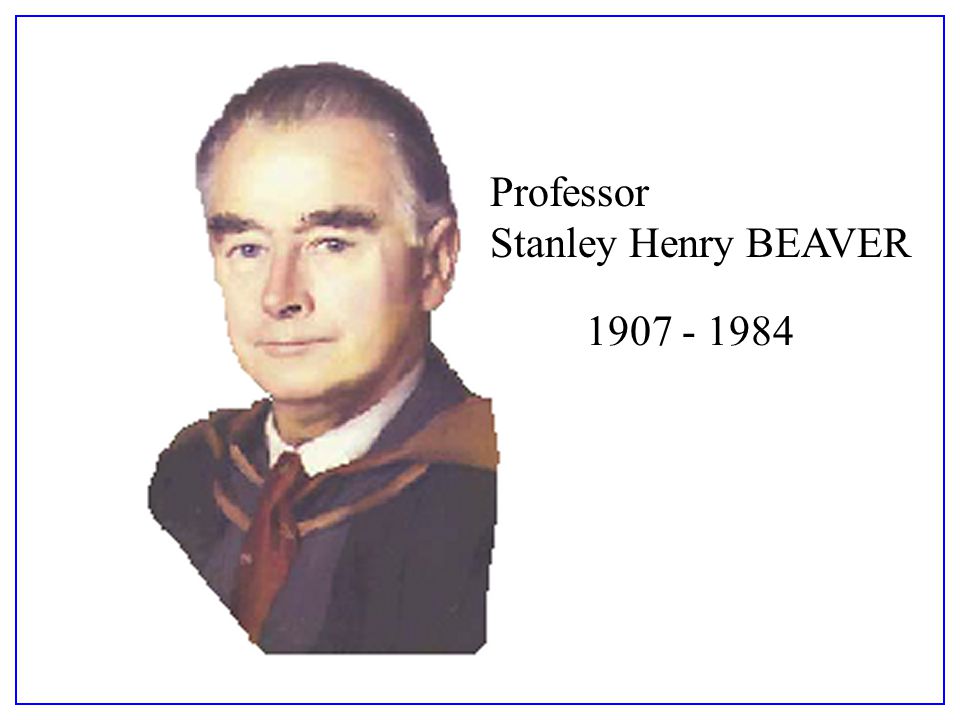
Image result for Professor Stanley Henry Beaver
"a body of knowledge coupled with an attitude of mind". 

He worked at the LSE between 1929 and 1950,  along with L Dudley Stamp

For some time, I couldn't find a contemporary image of Stanley Beaver, but was fortunate to receive one from Dr. Philip Kivell which can be seen at the top of the blog post.

In 1962, he had a piece published in 'Geography' on the Le Play Society and their contribution to fieldwork.

By this time, he was Head of the Geography department at the University of Keele. He stayed at Keele until his retirement in 1974 when he became Emeritus Professor.


In it, he references the work of Patrick Geddes, who had A. J. Herbertson as his assistant.


I am grateful to Dr. Peter Knight for helping me get in touch with Dr. Philip Kivell, who very kindly gave me a range of additional details on Professor Beaver's career and personal life. 
What follows was provided very kindly by Dr. Kivell.

S.H.BEAVER 1907-1984
Stanley Henry Beaver was born in Willesden, North London in August 1907. He graduated from University College London in 1928 with first class honours in Geography having already been awarded the Morris Prize and a University Scholarship in Geology. His first academic post was at the London School of Economics, where a very productive period resulted in appointment as Ernest Cassel Reader in 1946. His major work at this time, together with L Dudley Stamp was “The British Isles: a geographic and economic survey” which went though many editions before and after the war and provided a geographical grounding for  many thousands of students. 
During the war he worked for Naval Intelligence and used his geographical training to produce a number of regional handbooks. 
He was appointed as the founding professor of Geography at the new University College of North Staffordshire, subsequently Keele University, in 1950. 
Here he built up the first new post- war Geography Department in the country, including being closely involved in the physical design of the building. 
This included finding a home for millions of RAF air photographs taken over Europe during the war, and the establishment of a meteorological station on the campus.
Beaver could fairly be described as a traditional geographer, a product of an age that largely pre-dated the increasing specialization that reshaped the discipline from the 1960s. 
Having said that, his interests and skills were enormously diverse.  Most obviously he was a Human Geographer concerned with economic and regional matters, but his interests also ranged widely over transport geography, land use and dereliction and he was equally well informed about climate, meteorology, and mineral extraction. He was a practical academic, always interested in how environments and human processes worked and in this context he helped enormously to put “The Potteries” region on the map of public and academic awareness.
He was a superb and well organised teacher and was always in demand as a guest speaker by organisations across the country. From a student point of view he was extremely well respected but perhaps not the most approachable teacher. He belonged to an era when staff- student relations were more formal and respectful so the informality and student politics of the 1960s and 70s did not always sit easily with him. 
He could appear austere and remote but those who experienced his excellent field excursions soon saw a more relaxed side of him and were perhaps party to his dry sense of humour, his love of puns and his stock of limericks. At heart he was kind and immensely supportive to his staff and colleagues.
Apart from his teaching and research Beaver played a very active role in numerous groups and committees. Some of these were tied up with the University and local region, but others were national or international.  For many years he chaired Keele University Grounds Committee, responsible for the largest, and some would say, most attractive university campus in the country. It was not unknown for him to open his office window to berate students who were walking on the grass. 
He was President of the Geographical Association, active in the RGS and in the founding of the IBG, the IGU and the Anglo-Polish seminars. 
As Chair of the Geography Board of the CNAA he played a major role in promoting the new Polytechnic sector. Amongst all of this he found time to translate several important French texts into English.
During his quarter century at Keele  Stanley lived on the campus with his wife Elsie, who also worked as curator in the departmental map library, and four children. He enjoyed his large garden which he said (tongue in cheek) lay astride the watersheds between the Trent, Severn and Weaver catchments. One of his enduring passions had been steam railways, about which he was enormously knowledgeable. When the locomotive Keele Hall was withdrawn from service in 1963 Stanley Beaver bought the nameplate and displayed it proudly in his new department. On numerous overseas travels he would manage to arrange a trip on the footplate of whatever local steam locomotive took his fancy.
Upon retirement he and Elsie bought a large house in Eccleshall , a few miles from the campus, where he continued to garden, to enjoy his stamp collection and to continue his involvement in local Staffordshire organisations, especially the CPRE. He and Elsie endowed separate funds for student prizes and for fieldwork in the local area. 
Stanley Beaver was undoubtably one of the great geographers of his generation.
Professor Beaver died in 1984.

References
http://worldcat.org/identities/lccn-n50006237/

Obituary: “Stanley Henry Beaver, 1907-1984.” Transactions of the Institute of British Geographers, vol. 10, no. 4, 1985, pp. 504–506. JSTOR, www.jstor.org/stable/621896

Beaver, S. H. “The Le Play Society and Field Work.” Geography, vol. 47, no. 3, 1962, pp. 225–240. JSTOR, www.jstor.org/stable/40565418

British Geography 1918-1945, Edited by Robert.W Steel - published in 1987.
Chapter 12 was by J A Patmore, where he gave a personal perspective on the period.

Article in Geography in 1978
BEAVER, S. (1978). Some Observations on the Climate and Weather of New Zealand. Geography, 63(1), 14-22. Retrieved August 25, 2020, from http://www.jstor.org/stable/4056883
Patmore describes Beaver in this chapter.
A chapter in this book is here:
https://books.google.co.uk/books?id=9NSDx4DxfVcC&lpg=PA76&ots=uk5vMrcPG4&dq=stanley%20henry%20beaver%20geographer&pg=PA76#v=onepage&q&f=false

RGS Archives: http://discovery.nationalarchives.gov.uk/details/c/F46114 - I won't be able to visit the archive for a while, but there are quite a lot of papers

Updated - May 2020

A few updates to add following the posting.

There was a connection revealed between Professor Beaver and another former GA President who will have his own entry in due course (sometime in 2021) Bob Digby.
Bob told me that:


Bob apparently spent the £25 in the Keele University bookshop, buying geography textbooks from the time.

I also discovered another bit of information on Professor Beaver, from when he was a student at UCL in the 1920s. He was taught by Lionel William Lyde, another high profile Geographer from the early part of the 20th century.

His wife Elsie Rogers was also a student at UCL, and her memories of Lyde's teaching were also featured in the same document.


Taken from UCL Geography Department Archives.

Keele University offers an Elsie Beaver Prize for the best undergraduate dissertation by final year student involving fieldwork in physical geography, so the connection to Beaver continues.
It seems that she worked in the Map Library at the University as Map Curator. 


Beaver was also taught by another former GA President: Edmund Garwood. More connections...

Source:
https://books.google.co.uk/books?id=7BQSBwAAQBAJ&lpg=PA16&ots=qyoQUQmILd&dq=lyde%20geography%20definition&pg=PA8#v=onepage&q&f=false
- this link is to one of the many Biogeographical Studies, which are 'proper' versions of what I'm doing on this blog.

I also found his own entry, after all that, in the Biogeographical Studies series.


This included an image of him, and also details of his links with the GA, as well as a lot more detail.

Beaver was Honorary conference organiser from 1934-1949 and also declared an intention to visit every branch in Britain while President - something I hoped to do, but didn't quite manage it.


https://books.google.co.uk/books?id=R-48DwAAQBAJ&lpg=PA130&ots=vx3Y5ASsYg&dq=lionel%20lyde%20UCL&pg=PA129#v=onepage&q=lionel%20lyde%20UCL&f=false 

As always, if you have further information relating to this President please get in touch. 

Thanks to Dr. Philip Kivell for the image of Professor Beaver used at the top of the blog and substantive text later on.
Thanks to Dr. Peter Knight for his assistance as well.

Updated March 2023

Mentioned on first page of J B Priestley's 'English Journey'.

Updated August 2023


This flagged up his involvement with Section E of the BAAS, which I have been investigating over the last few days and have found plenty of details in the Transactions of the IBG and elsewhere that show Beaver's substantial involvement in discussions around geography in schools and universities. 


GA Obituary

Rodgers, H. B. “The Geographical Association.” Geography, vol. 70, no. 1, 1985, pp. 77–80. JSTOR, http://www.jstor.org/stable/40571501. Accessed 24 Aug. 2023. 

Wednesday, 20 May 2020

Fanny Herbertson

Updated August 2022

Sometimes (but not always) remembered in the telling of A J Herbertson's tremendous contribution to the GA was that of his wife Fanny. Frances Dorothea Herbertson is described below:


Her story, and those of other female geographers are told in this book here.

She was a teacher herself, at Cheltenham Ladies College, and there is also a connection with Patrick Geddes, who will also be featured on the blog in a future post.
There is a link to Robert Neal Rudmose Brown, who featured recently on the blog.
See the A J Herbertson post on the blog for more on the work that he completed with his wife, including jointly authored books.


Source
https://books.google.co.uk/books?id=p_xfuY8CJ48C&lpg=PT115&ots=xln_U09sEO&dq=%22marguerita%20oughton%22%20sheffield&pg=PT115#v=onepage&q&f=false


Updated August 2022

A Chronology of Fanny Herbertson 


Sunday, 17 May 2020

Charlotte Simpson

Another important female contributor to the history of the GA was Charlotte Simpson. She was associated with A J Herbertson.


She had work published in the 'Geographical Teacher', and was also linked with the Le Play Society, as were many Geographers at the time (the 1920s and 30s).
Source:


https://books.google.co.uk/books?id=p_xfuY8CJ48C&pg=PT115&lpg=PT115&dq=%22marguerita+oughton%22+sheffield&source=bl&ots=xln_U09sEO&sig=ACfU3U0BVaFI8t74PC7xxPHMiijd8QoLyQ&hl=en&sa=X&ved=2ahUKEwjbrsfys43pAhXKQEEAHeGlCCIQ6AEwAnoECAoQAQ#v=onepage&q&f=false

Sunday, 10 May 2020

Robert Neal Rudmose Brown


I came across this geographer while researching Marguerita Oughton, who was a stalwart of the GA for many years, and retired in 1965. 'Ruddy' Brown or RB is described as an 'explorer' geographer. He fell out with former GA President Percy Maude Roxby over his thoughts on China.
His father was a prominent Geographer of the time, who went on expeditions to Spitsbergen and wrote popular books.
Rudmose Brown also worked as an assistant to another person who has reappeared several times: Patrick Geddes.

He wrote about the influence of Geddes and Herbertson in a paper in Geography in 1948, which I missed at the time of going through the 1940s.

According to the link below, he also raised funds for an expedition to Antarctica. It is worth reading his Herbertson Memorial Lecture from 1948 which is referenced at the end.

Updated August 2023
Source above:

The section on Rudmose Brown references a great many GA Presidents, plus Patrick Geddes - who was a GA Vice President.

A nice quote from J L Myres.

Source: Robert Neal Rudmose Brown - Delivered to geographers at the University of Sheffield
Scottish Geographical Magazine (Vol 30) 1914 p.467-79

Wednesday, 6 May 2020

Ellen Jenifer Rickard

Ellen Rickard seems to have been something of a pioneer for female geographers and teachers.


Her story was told in this book by the RGS-IBG. It describes her involvement with the GA, which included a place on the GA's council - one of the first female officers. She was particularly important during the war, taking over from J F Unstead (who also had his own post on the blog a few days ago). She was also connected with A J Herbertson, as were many during that period, when they became involved with the GA. She had a great many roles within the GA.

It would be lovely to be able to source an image of Ellen Rickard.


Source:
https://books.google.co.uk/books?id=p_xfuY8CJ48C&lpg=PT115&ots=xln_U09sEO&dq=%22marguerita%20oughton%22%20sheffield&pg=PP1#v=onepage&q=%22marguerita%20oughton%22%20sheffield&f=false


An Obituary was published in 1963

Oughton, M. “WILLIAM WALLACE.” Geography, vol. 48, no. 4, 1963, pp. 418–19. JSTOR, http://www.jstor.org/stable/40565722. Accessed 16 Sept. 2023.


Can download the book:

The book describes how Ellen Rickard was involved in the GA

pp.142-3 describes the work she did during the war years, which were difficult times for the GA.

Margaret Mackintosh RIP

Updated post. Sad news at the end of last week from colleagues who have organised the Charney Conference over the years of the passing of Ma...