 Updated July 2022
Professor (John) Allan Patmore was an academic geographer linked to the University of Hull with a particular interest in leisure and tourism.
I wasn't able to find out much about his time at the GA from the usual sources, and to begin with not much about the man himself. I still have very little about his time as President.
He was
Professor of Geography at the University of Hull, which he arrived at in 1973, with a particular interest in leisure and recreation, a subject he wrote a lot about, including a series of books, articles and papers, including writing about this for GA journals. Regular readers of the blog will know that I did my teacher training at the University of Hull, so have a connection with this place, although we didn't mix much with the actual undergraduate geographers, and the postgrads had a better dining hall. Allan lived in North Ferriby on the outskirts of Hull.
It seems that he was also linked with the
University of Liverpool to begin with, before moving to the
University of Hull, where he eventually became a Professor.
He was born on the 4th of November 1931, and graduated from the University of Oxford. in 1952 according to a book edited by Robert W Steel.
I found a mention of him in a newsletter published by the Assocation of Jewish Refugees in Great Britain in 1967. He was given some money from the 'Thank-you Britain Fund' to pursue his research on Leisure and Land Use.
I gained further information from a newsletter associated with the LUPTS (showing his lifelong interest in the railways).
Liverpool University Public Transport Society (LUPTS) was formed in 1958 by a group of undergraduate students at the University with a mutual interest in all kinds of transport. Patmore was the first President of the Society http://www.lupts.org.uk/downloads/Patmore_Foreword.pdf
His inaugural Professorial lecture was given in 1974, and called 'People, place and pleasure', and published at the time. He was an expert in tourism and leisure and is referenced in a great many books and PhD theses. Here he is on people's holiday choices:
"The two prime factors in the choice of holiday destination
are the friction of distance and the lure of the sun, factors
that are equally applicable abroad and at home." (Patmore, 1983)
I wonder what we would have made of the current state of the tourist industry after Covid-19.
He was eventually the Vice Chairman of the Sports Council, now known as Sport England.
In his obituary, he is described as follows
“…a strong religious conviction - he was a Methodist lay preacher - and a moral compass that underscored all that he did. For us, we will remember his interest in and knowledge of railways in all their aspects but, in particular, his friendship and support."
In 1980, his Presidential lecture was entitled
"Geography and Relevance" and had some illustrations when it was reproduced in 'Geography'.

Patmore, J. (1980). Geography and Relevance. Geography, 65(4), 265-283. Retrieved August 26, 2020, from
http://www.jstor.org/stable/40570301
It also included one of the most well known quotes on the value of fieldwork in it:
Observation is the key to the importance of landscape to the geographer. It links him firmly to reality, it develops his appreciation and poses the questions he must answer to develop understanding.
Contact with the actual landscape is contact with reality. Confined within classroom walls, geography is an impoverished shadow, like chemistry without experiments or biology without recourse to tangible specimens of plants and animals.
J Allan Patmore, 1980
He went on to say:
A training in geography enhances appreciation not through its intrinsic merit but
because it is concerned to go far beyond the simple visual record and experience to consider
context and process. The resulting understanding may be partial and incomplete, limited both
by the extent of the observer's training and experience and by the inherent problems posed by
elements in the landscape itself, but of almost equal worth is the curiosity aroused in the
attempt.
Patmore, J. (1980). Geography and Relevance. Geography, 65(4), 265-283. Retrieved August 26, 2020, from http://www.jstor.org/stable/40570301
He was also made a CBE as part of his work with the
Sports Council.
Allan sadly died in 2018, aged 87, he lived in North Ferriby, Hull for some years.
I also found some reference to him at the University of Hull thanks to Justin Woolliscroft.
References
http://worldcat.org/identities/lccn-n50050666/
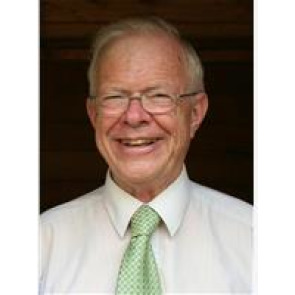
Obituary notice:
https://funeral-notices.co.uk/Yorkshire+%26+the+Humber-East+Riding+of+Yorkshire-Hull/death-notices/notice/PATMORE/4558758
British Geography 1918-1945, Edited by Robert.W Steel - published in 1987.
Chapter 12 was by J A Patmore, where he gave a personal perspective on the period.
He describes
Stanley Wooldridge with his "eyebrows bristling" (note to self, get eyebrows sorted before the GA Conference)
Elements from this have appeared in other Presidents' entries from the period.
Yorkshire beyond the Millennium:
https://www.yorkpress.co.uk/news/7957703.countys-future-to-be-put-under-spotlight/
A rather nice tribute to Patmore was published in the magazine of the North Yorks Moors Association (NYMA) journal 'Voices of the Moors' in Summer 2018 - written by Tom Chadwick. He was associated with the organisation for some time, and
President of the YNMA from 1993 to 2001.
https://www.nyma.org.uk/_webedit/uploaded-files/All%20Files/Voice%20of%20the%20Moors/VOICE-132.pdf
Allan’s connection with the North Yorkshire Moors goes
back to his childhood when he lived with his parents in
Wetherby and was a regular visitor to the moors and
coast.
This brief summary of Allan’s academic career and his
involvement in the study of recreation and the
countryside is a mere snapshot of his huge contribution
to understanding the problems of balancing the human
activities of recreation and sport and preserving the
beauty of the countryside. Nowhere is this more
important than in our National Parks and Areas of
Outstanding Natural Beauty.
https://core.ac.uk/download/pdf/2731527.pdf - PhD thesis he supervised
If anyone can provide me with some more information on Professor Patmore that would be appreciated. This is a fairly brief entry compared with other recent ones.
Updated September 2020
Thanks to Brendan Conway for his additional contributions...
Also his work on 'Access to Water'
He attended the 1993 Centenary celebrations and is pictured top right on this image - standing in a grey suit.
Updated November 2020
I am particularly grateful to Derek Spooner, GA President 2000-2001 for the following details on the life of his friend Allan Patmore:
Allan Patmore and I were colleagues for 18 years in the Department of Geography at the University of Hull. He was appointed in 1973 as the Department’s second Professor (joining Professor Harry Wilkinson) and moved across from the hugely influential Liverpool Department of Geography.
He had been at Liverpool since he left Oxford in 1974, after graduating from Pembroke College with a First Class B.A. in 1952, followed by a B.Litt.
Allan had a wide range of interests in human geography, including urban development (his B.Litt thesis was a study of Harrogate) and the historical geography of transport (he was infatuated with railways). But his academic career was shaped by the award of a British Academy Thank Offering to Britain Research Fellowship 1967-69.
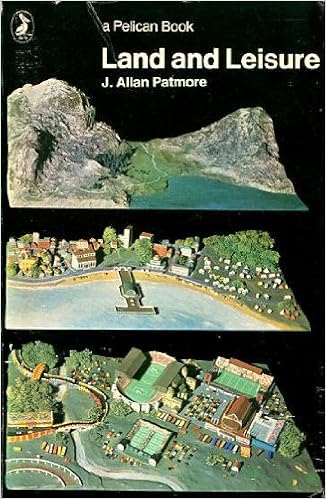
This enabled him to develop his interest in the geography of recreation, and led to the publication by Pelican of Land and Leisure in 1972. This highly successful book linked recreation and environment and kick-started the emerging field of recreational geography.
A second book, Recreation and Resources followed in the 1980s.
Twenty years after Land and Leisure his influence was celebrated in the publication Leisure and the Environment : Essays in Honour of Professor J.A.Patmore (including some by former graduate students).
Allan was a Yorkshireman, born in Wetherby, and from his childhood had a particular affection for the North York Moors.
Student field trips with Allan were characterised by a fluent and stimulating commentary on the landscape, environment, and, of course, recreational issues. He seemed to know every inch! It was hardly surprising that from 1977 to 1992 he was to be a member of the North York Moors National Park Committee (appointed by the Secretary of State for the Environment).
This was just part of an extraordinary record of public service.
He was a member of the Sports Council from 1978 to 1994 (sitting alongside the likes of Jack Charlton and Seb Coe), with several years as Vice-Chairman. I used to pull his leg about this, pointing out that he was not apparently either a sportsman or a sports fan! He also had close associations with the National Railway Museum at York, with spells on its Advisory Committee and as Chairman of the Museum’s Friends. He was awarded the CBE in 1993 for his services to sport and recreation.
At Hull he had two spells as Head of Department, and also a spell as Dean of Social Sciences, and then became a Pro-Vice-Chancellor.
He was an immaculate Chair of meetings, always well briefed, articulate and courteous.
As my Head of Department he was always most supportive. As Head of Department he was keen to put the Department on the map, and persuaded his somewhat reluctant colleagues that it was time for Hull to host the Institute Of British Geographers Annual Conference. He pushed for it to be held in 1978 to follow the opening of the Humber Road Bridge (at the time the longest span in the world). Unfortunately the construction of the Bridge did not keep pace with Departmental plans, and it was not open by the time the Conference took place, leading to some interesting logistical gymnastics for the planned programme!
When Allan arrived in Hull he assisted greatly in the invigoration of the Hull branch of the GA, in which Vincent Tidswell was also strongly involved. It was through Allan that I became involved in the GA, and my first lecture to a GA Annual Conference came when he was President.
Allan was also a Methodist lay preacher. He was a teetotaller. His Christian religion was a central part of his life, and I always think of him as a model Christian gentleman. Sadly his last years were clouded by serious health problems, including dementia. He and Barbara moved from North Ferriby by the Humber to Chesterfield to be close to some of his family, and in time he moved into a nursing home, where he died in 2018 at the age of 87.
Derek told me:
"He was a remarkable man, and I don't know how he found time to do all the things he did.
The influence of the Department of Geography at Liverpool is very interesting. The Liverpool Department under Darby and Steel exported many of their lecturers to other universities as Professors, (and Darby himself moved to Cambridge). We used to refer to it as the Liverpool Mafia!"
Upated July 2022
On his retirement a collection of essays was published, edited by Sue Glyptis. This featured an introduction by another former GA President: Robert Steel.
Some useful additional background there, as well as his links with the Geographical Association:


