Showing posts with label Daniel Raven Ellison. Show all posts

Thursday, 1 September 2022

GA Presidency Month 12: August 2022

OK, the final month of the GA Presidency arrives, and with it comes the annual meetings and work on the moderation for the Primary and Secondary Geography Quality Marks.

I started this month during the summer holidays, enjoying the break from the classroom down in Devon. 
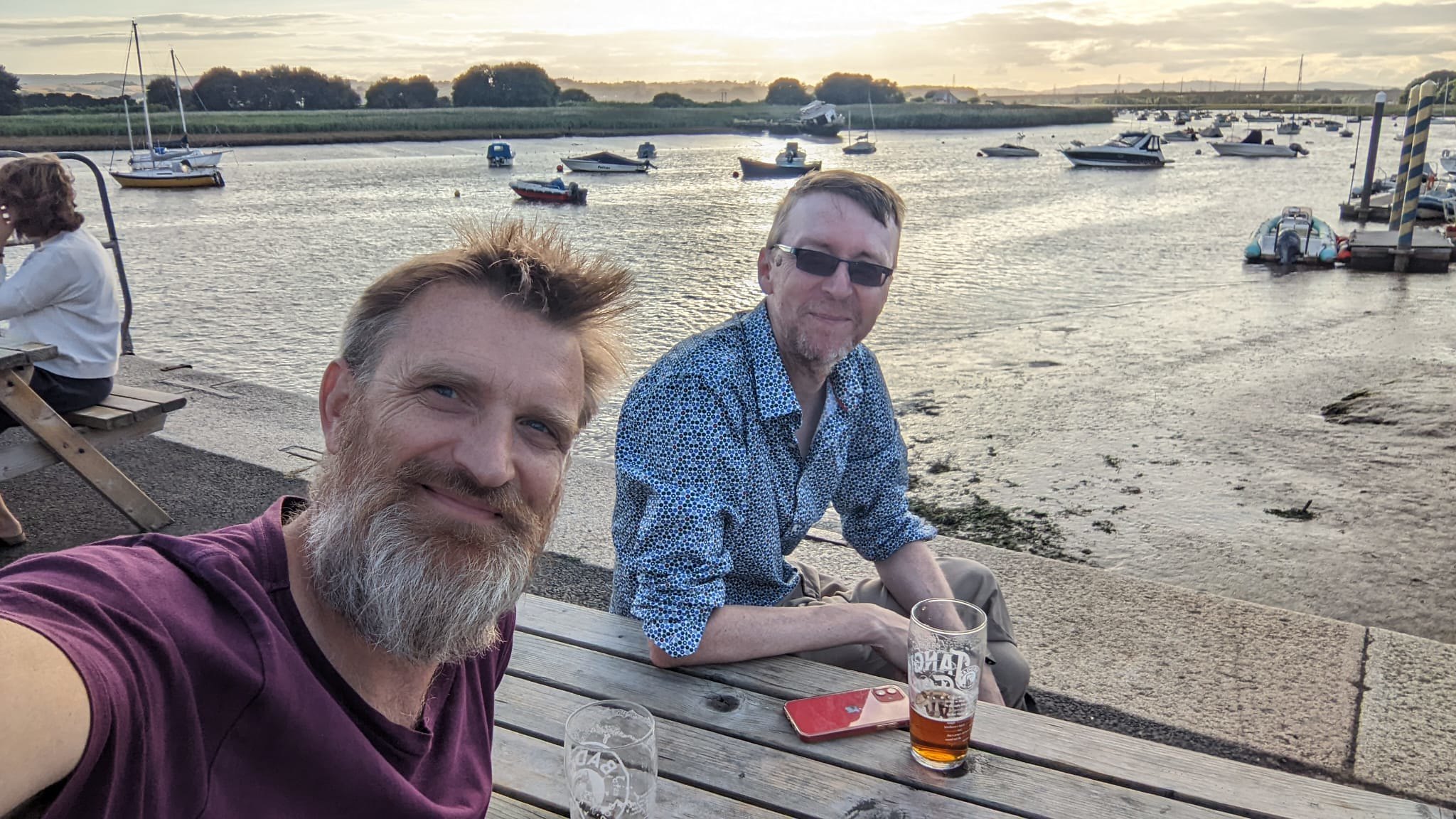
Topsham is a place we return to each summer. During the week I caught up with some old friends - Dan Raven Ellison and Noel Jenkins. 

With Dan, I walked one of the Slow Ways routes.

I'd previously worked with Claire Kyndt and Kate Stockings to create some ideas for geography teachers to engage with the Slow Ways project. Perhaps you have walked one of the routes this summer?

SGQM is the Secondary Geography Quality Mark. I have been involved in the moderation of this since the beginning of the award. Moderation meetings were done online this time round. I had nine  schools to moderate in the first round of moderation and then took another look at several others in the second round of moderation. There were some excellent applications this year. Those who have applied will find out the results at the start of the academic year.

I spent quite a lot of the month reading - a mixture of books for future teaching and others on topics of personal interest. I also spent quite a lot of days at home rather than out and about because of the climate change induced heat we experienced this August - which will hopefully trigger some sort of policy response amongst politicians. I won't hold my breath though.

Sheffield is where the GA's HQ is located. I haven't been up there as regularly as almost all GA Presidents due to the advent of Zoom. Previously, regular visits to Solly Street were part of the Presidential year, but this is no longer the case, which potentially broadens the range of people who may be able to apply.

I was able to get involved with some early conference planning decisions.

I also helped with the plans for some new features for the GA website - an updated version of which is coming at the end of the year all being well. There are thousands of pages on the website.

I also looked at applications to join the GA's register of consultants. This is a list of people who can be approached to potentially work on projects with you if you are business or school and need help with writing resources, or some other sort of staff development. I've completed quite a lot of consultancy work over the years on behalf of the GA.

I also wrote some text for a new GA Blog, which is going to be launched soon to help share what the Association is up to.

A GI Pedagogy meeting was also planned to take place towards the end of the month and was pushed to the very end of the month, when I started to prepare for the return to school for the start of yet another academic year. I had been due to go to Iasi in Romania this month as part of the project but that has now been postponed and we may end up going later in the year, or perhaps to another location closer to home.

I have several things already in the pipeline for the next year to fill the gap:

- mentoring a new GA Trustee as well as supporting other members of the Presidential team as Past President.

- going back to writing my Everyday Geographies book which I had made a start on before it got overtaken with other projects this year. It's taking shape quite nicely.

- I've joined the GeographySouthWest team. I had a meeting with Simon Ross and John Davidson who started the website and are now developing it a little more. I am going to be working with Emma Espley to create some resources and also 

- I will be completing my Fawcett Fellowship which I have received funding for - there are six other Fawcett Fellows and I look forward to working with them and Alex Standish over the year ahead, researching Everyday Geographies and the curriculum.

- I have some final work to do on the GI Pedagogy project.

- I also have some writing projects to complete

Best of luck to the new President for 2022-23.

Twitter stats

Later on, I shall post a biography of Professor Alastair Owens.

I will move on to a year as Past President.

Also welcome to Denise Freeman as the new Vice President of the Geographical Association - possibly the first serving female state school President I believe... we have had a few other female teacher Presidents including Pat Cleverley, Sheila Jones and Wendy Atkins (Morgan) but they were either working in Independent schools or had retired when they became President I think from my research.

It's important that we have teacher Presidents and it would be lovely for them to be more diverse than previously.

Wednesday, 28 April 2021

2006-11: Young People's Geographies

"Childhood has always been a disputed territory, its true geography quickly forgotten as we grow older, replaced by an adult-imagined universe." 

Libby Brooks, 2006

I've mentioned the Young People's Geographies project before, but this is a more detailed post as we enter the period of the GA's history when funded project work became more significant.

I wrote about it at the time in my GeographyPages website.

YPG was about making school geography more exciting and relevant to students by involving them in curriculum making and by focusing on their own lived geographies. 
Young people have their own distinct geographies, often very different to those of adults, and the YPG team investigated whether the learning process was richer for students if these geographies were taken into account.

At the heart of the project was the idea of conversation. These changes required teachers and students talk to each other. A big part of the first phase of the project was about establishing those conversations, and the was a key ingredient for keeping those conversations going throughout the next phase.

A key element of the YPG project was the way it crossed boundaries between academic and school geography. By working together, academics, teacher trainers, school teachers and students explored ways in which academic ideas can effectively develop the school geography curriculum and students' geographical learning.
I remember the first project meeting very well. The second one took place on a very windy day and we nearly cancelled the travelling because of it. We had a school minibus which we parked at Peterborough Railway Station to pick up the train to Leicester and on the way the train hit a fallen tree. By the time we finished for the day, the trains were all cancelled. Luckily we were a small enough group to just grab a taxi from outside Leicester train station and ask it to take us to Peterborough station. 

The project was also the first time that I met people who I have since met several times and been involved with in projects and other work.

We all met a few more times with the students. and had a final presentation event in Leicester.

Some more details below taken from documents and my own GeographyPages website (which ran from 2001 to 2013)

The Young People’s Geographies Project 

Further Information 

Phase One 

Phase One of the YPG project was split into two years, covering September 2006 – July 2008 

Year One: September 2006 - July 2007 

 Four key groups of collaborators: school students, teachers, professional geographers with research interests in young people’s geographies and teacher educators 

 Seven schools from East Midlands, Kings Lynn, London, Reading and Bedford 

 One or more teachers from each school 

 Four students from each school (Years 9, 10 & 12) variously selected 

 Open-ended approach 

 Four project days and school-based work 

 Project days (November, January, March, July) involving all groups coming together to share ideas and support the development of the project in individual schools 

 School-based work: ‘taking ideas back’, students and teachers in conversation about young people’s lived geographies and how their experiences can be used to develop the geography curriculum and ways of learning. Developing new aspects of the geography curriculum. 

Year Two: September 2007 - July 2008 

 Individual schools continue to develop YPG project 

 Development of YPG project website 

 Evaluation of Year Two and Phase One of the project Key Activities Year One: September 2006 - July 2007 

 Young People’s Geographies Project developed by project co-ordinators: Mary Biddulph and Dr Roger Firth, University of Nottingham; David Balderstone, Sharnbrook Upper School; Di Swift, Geographical Association 

 Professional geographers recruited with research interests in young people’s geographies: Dr Ian Cook, University of Exeter; Dr Tracey Skelton, then at the University of Loughborough; Helen Griffiths, a PhD student, University of Exeter 

 External evaluator appointed: Dr Nick Hopwood, University of Oxford 

 Consultant appointed: Dr John Morgan, Institute of Education, University of London 

 Seven partner schools recruited: 

King Edward VII School, King’s Lynn - my school at the time

Archbishop Tenison’s C of E School, London; 

Langtree School, Reading - where Dan Raven Ellison was teaching at the time

Sharnbrook Upper School, Bedfordshire - including Dee Saran and David Balderstone

Nottingham Emmanuel School, Nottingham 

Arnold Hill School, Nottingham 

Bramcote Hills Sports and Community College, Nottingham 

 Four project days organised (November 2006, January, March, July 2007) to bring the four participating groups together to work on activities in order to: 

  • create a context for perspective and ideas sharing 
  • support the ongoing development of the project within individual schools
  • showcase and share the work of each school 

 Individual schools develop their own YPG project

Year Two: September 2007 - July 2008

Seven schools continue to develop the geography curriculum 

 Two project days (November 2007, July 2008) to support the ongoing development of the project within individual schools, share a framework for curriculum development and showcase the work of each school and evaluate Phase One 

 Project coordinators visit individual schools 

 Development of YPG website 

 Evaluation of Year Two and Phase One of YPG project

We ended with the presentation event which was in a room at Leicester City Hall.

I also have DVDs showing the footage of the day, and will hunt them out and snip some little elements from that.

More to come on this project in future posts as we get nearer the present day.


Images from the teacher evaluation day and exhibition in 2008 at Solly Street, while I was working for the GA - images by Alan Parkinson

Margaret Mackintosh RIP

Updated post. Sad news at the end of last week from colleagues who have organised the Charney Conference over the years of the passing of Ma...