Showing posts with label BBC. Show all posts

Sunday, 26 November 2023

Domesday Discs - 1986

The BBC's Domesday Disc project appeared in 1986.

It involved students collecting data, and adding to a digital laser disc the size of an old LP, which was read using a special reader, and navigated using a tracker ball which could be rotated by the hands. The final product was quite costly to purchase - a real investment for a school. I believe the price included the BBC Micro that was required to run the associated software and hardware.


Initially estimated to require the involvement of 10,000 schools and about one million children, the intention was to make the role of schools central in a data gathering project that would assign each school to a geographical area, have parents and local societies collect data, with the schools "acting as a focus and providing the computer". Questionnaires about geography, amenities and land use were to be completed, with school pupils and other contributors also able to write about their local area and "the issues affecting them" in their own words

Source: Wikipedia

As with the Land Utilisation Surveys of Stamp and Coleman, students were involved in its production and data collection, and it was a BBC project aimed at commemorating the 900th anniversary of the original 'Domesday' survey of 1086 ordered by William the First of England.

I still have one of the discs - although not the player and tracker ball to make use of it. There was an also an EcoDisc based on Slapton Ley which we also had in my geography department.

This website provides further details on the project.

There is an article from former GA President Margaret Roberts on the use of the Community Disc in an issue of 'Teaching Geography' from 1990. An early contribution to TG from Margaret.


I remember some external organisation coming in and filming me demonstrating the discs - I wonder what that was for, and whether it still exists somewhere - it would be wonderful to see it as I was fresh into my teaching career....


References:

Roberts, Margaret. “Locations, Lines and Areas: Exploring the Community Disc in the BBC Domesday System.” Teaching Geography, vol. 15, no. 1, 1990, pp. 17–18. JSTOR, http://www.jstor.org/stable/23752172. Accessed 23 Sept. 2023.


Some of the resources that came from the project:

Research Paper (Open Access)

https://www.researchgate.net/publication/232993632_The_Domesday_Project--an_educational_review


The BBC later produced two further discs: an EcoDisc and one on Volcanoes.

I remember seeing them both - and also the very detailed instruction manuals.

A web based version existed for a while with an update for places in 2011. It's now on the National Archive site.

And a video of it in action:

Keen to hear from anyone who has memories of using the BBC Domesday Discs.

Tuesday, 5 September 2023

John Beddoe

John Beddoe was mentioned in a piece called 'Wayside Geography' by John Linton Myres (GA President in 1925), which I blogged about recently. He was a doctor who pioneered some of the techniques of observation in scientific recording which are still used in some of the ethnographic fieldwork that is carried out even now.


Source:

Image: Wikimedia Commons

Wednesday, 10 August 2022

Your starter for ten

I mentioned in my blog entry for the late Rex Walford (President in 1984) that he had appeared on 'Mastermind'.

Thanks to the BBC's Genome site, I have tracked down one of his appearances - he was a high scoring loser and was therefore invited back to a 'semi-final' held in Swansea.

His specialist subject was 'The Life and Works of Charles Rennie Mackintosh'.

From 'The Gower', the magazine of the University College London school, I also discovered this information on his first round appearance:

Rex A. Walford (1945-52) appeared on 'Mastermind' on BBC1, his 20 chosen subject being "The Life and Travels of Amy Johnson". 

In the second part, general knowledge questions, had he known the name of the famous soldier who had recently died, (General Horrocks), and the correct location of the Gobi Desert, he would have won in a very high scoring contest.

Source:  https://www.ucs-digitalarchives.org.uk/Filename.ashx?tableName=ta_gower&columnName=filename&recordId=120

All together now:

Sunday, 13 June 2021

The Third Degree

Thanks to Frances Soar for sending me details of a radio quiz which features Barnaby Bear. Start from around 13 minutes in.

The link to listen is here.


The specialist subjects this week are Marine and Freshwater Biology, Education and Forestry Management and Conservation, and the questions range from brothels and bats to Barnaby Bear. There's also a chance to brush up on your fronted adverbials. 

Friday, 2 April 2021

Doreen Massey - Honorary Vice President

For a while, the GA has had several Honorary Vice Presidents, and they will also feature on the blog as they offer guidance to the Governing Body, which the President serves on as a Trustee and played a part in the history of the Association.

Doreen Massey was a geographical legend.

When I joined the Geographical Association in 2008, my first meeting, even before I started officially with the GA, was at the Open University with Doreen, Clive Barnett and Joe Smith.  I travelled over to the Open University with David Lambert. I remember being particularly excited as I was just about to embark on a new career after 20 years in the classroom and was suddenly in the company of such wonderful thinkers and listened carefully to what Doreen had to say about the way that the OU and the GA could work together - in the end, our plans never quite came to fruition. Joe Smith has certainly gone on to slightly different things in recent years of course... It was such an exciting time for me personally.

Doreen was such a great sport that she also joined in with our Mission:Explore missions at the University of Derby, flicking the V's to Bryan Ledgard.


Doreen went from Manchester High school for Girls to St Hugh’s College, Oxford, where she gained a first in geography, and became more politically aware. Between 1968 and 1980 she worked at the Centre for Environmental Studies, researching into urban and regional problems, and a sabbatical enabled her to study for a master’s at the University of Pennsylvania (1971-72). Doreen was a great fan of Liverpool football club and would no doubt have been celebrating their victory in the Premier league last year.
My review of her lecture at the GA Conference is here. It was a wonderful talk which got rave reviews at the time. (PDF download)

I remember going to see Doreen at the BBC as well, for a recording of the Radio 4 Thinking Allowed programme, with Will Self and Richard Sennett. An edited version of their discussions is available here.

I also had a chat with her when I met her with Margaret Roberts at the Derby Conference. I was wearing a Google T-shirt with a map pin and the words 'I am here'. It remains a favourite t-shirt of mine. She saw it and commented on the fact that noone was really anywhere for very long... this was later the theme of her lecture of course.

She was involved in a little posthumous dispute at the University of Oxford when a picture of her was joined by a picture of another Oxford geography graduate Theresa May. This led to a campaign to remove the picture of Theresa May #notallgeographers
Some people wondered how she would have felt about sharing a wall with a picture of a Conservative PM.
There was a tribute to Doreen at the GA Conference the following year.

Check out Doreen's work. There is plenty to go at with an internet search or two.

There are some YouTube clips where you can hear Doreen speak. A few of them are included below.

I remember hearing of Doreen's death. I was awake early at Rhyd-y-Creuau in March 2016 and the news came up on my Twitter feed... the day started and I took a wander in the grounds and thought about what she had achieved. When I told my colleague Claire she was similarly upset at the news.

An obituary in the Guardian: https://www.theguardian.com/education/2016/mar/27/doreen-massey-obituary

An obituary by Rob Kitchin. This gives a really full picture of her massive contribution to truly radical geography and deep thinking on space and place in the tradition of David Harvey.

Image: Bryan Ledgard / Geographical Association

Memories of Doreen would be very welcome...

Saturday, 27 March 2021

BOLT Education

Who remembers this resource? I think I may have spent some e-learning credits on this.

e-learning credits came in after the cancellation of BBC Jam. Having worked on this, I know what amazing resources were going to be shared with the geography community, and also wrote The Guardian's BETT preview in the year they were going to be released, but the other software and publishing companies complained this would be unfair competition. In return, secondary schools received about £5000 of credits (possibly more, depending on size) to be spent on an approved list of software and technology.
My anecdote here is that our Deputy Head at the time told us that we could bid for a share of this money. We had to provide a document with the details of the software, and an explanation of how we were going to use it, and what particular project or activity it would be helpful for. Curriculum Online provided lists. Suppliers rushed to provide options which were compatible with the scheme.

The Deputy Head in question finished his explanation at a HoDs meeting by saying the bids were 'first come first served' until the money ran out. 
That night, I went through the site, and put together the requested document with a bid for about £2000 worth of items and gave it to him the following morning. I asked him roughly how much of the bid was likely to be approved, and he told me that I would get all the items as it was first-come first-served.... I had deliveries of software and other items regularly for the next few months.

This ad was in 'Teaching Geography' for Spring 2005

Saturday, 6 March 2021

Chris Durbin and SLN - 1997

A letter from Chris Durbin was published in the January 1997 issue of 'GA News' (No. 46)
Chris worked for some time with the BBC on a series of programmes in the futuristic sounding 2000 series e.g. Japan 2000 (an excellent series) and Brazil 2000, both of which were on heavy rotation in my classroom around that time. Cue the big telly being wheeled in from the office and the curtains being closed...

Chris was also one of the co-founders of the SLN Geography Forum which was behind a great deal of the innovative practice that started to be shared into the early 2000s. I've mentioned SLN Forum in a previous post. This was the Staffordshire Learning Network. It was co-founded with Kate Russell, and Andy Holt.

I know that there will be many teachers whose practice was influenced by this bulletin board, and will remember the supportive atmosphere it engendered.

I had a chance to meet Chris at the GA Conference in Canterbury, 2004, where he was presenting, and also met up at a later GA conference as well which Chris attended.

From the SLN Wiki:

The SLN Geography Forum began on 7th Sept. 1999 when Chris Durbin posted the first message. A week later he replied to his own message. On 16th Sept. Kate Russell posted her first message - no-one replied! That same day, the first of the local Staffordshire teachers, Richard West, posted a message. Chris Durbin provided the only reply. On the 21st Sept. Kate had a second try - no-one replied!

Chris now lives in the Netherlands, and would normally be travelling in his role inspecting schools around the world.
An article on SLN in TES provides this quote on its evolving nature:
"is a bit like a shanty town - it grows and changes with the people who do things".

References
The Forum link now tries to sell you Hemp Oil
https://www.tes.com/news/staffordshires-learning-net-unites-geographers-world-wide-web

Memories of SLN are welcome - I am sure there are many teachers of a certain age who remember being part of this community.

Friday, 1 May 2020

1965: Programmes for Schools


Given the BBC's current support for Lockdown learning on BBC Bitesize with David Attenborough called in as a supply teacher it's good to see some of the early geography offerings from the BBC.

Monday, 30 March 2020

G. J. Cons - Educational Films

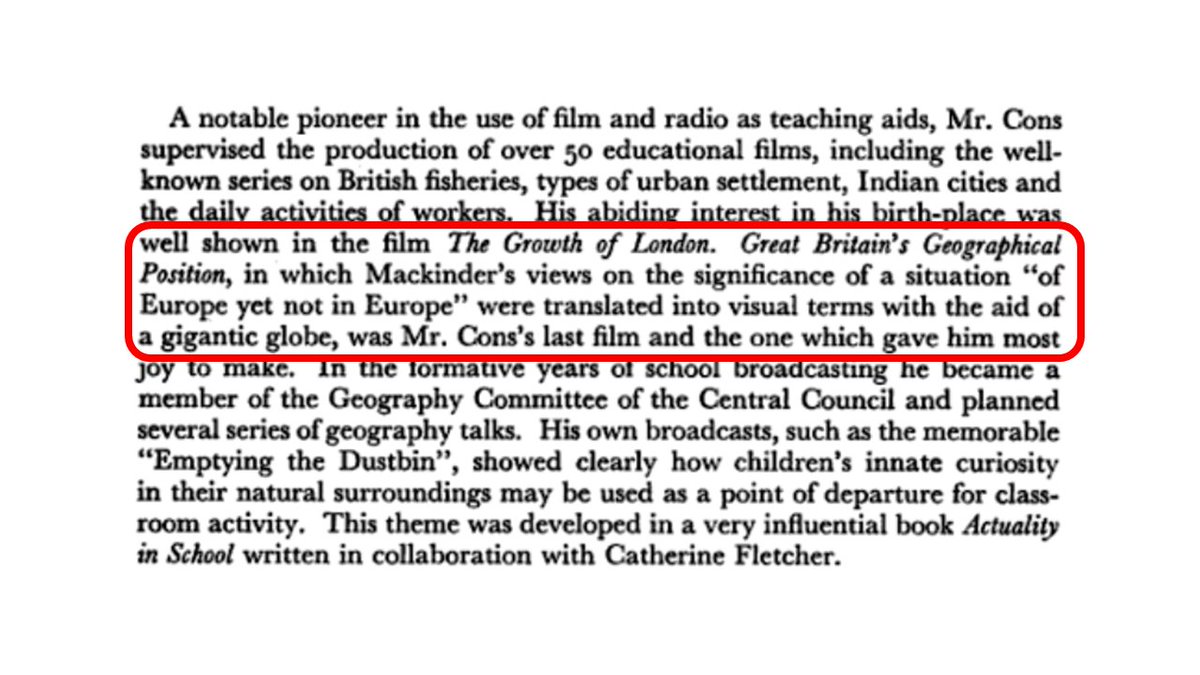
Brendan Conway noticed my post yesterday on the late George Joseph Cons and a reference to a film in his obituary as shown below.
Image
and sent a link through to the film. I need to find 'Emptying the Dustbin' next.


There is also a list of films made with his input on the BFI website which Brendan sent through.


I found a few on the British Council website - here's one on Newark

And here is another of his films in the BBC Schedules in 1938.

Image

Wednesday, 26 February 2020

1959: The value of TV


While writing this blog, one book peering from my shelves is by G. H. Gopsill, and he seems to have done a lot to popularise the use of BBC broadcasts.
The School Broadcasting Council report from 1954 points out the value of TV broadcasts generally.

References
GOPSILL, G. H. “Television Broadcasts in Geography.” Geography, vol. 44, no. 3, 1959, pp. 186–194. JSTOR, www.jstor.org/stable/40565051

Friday, 21 February 2020

1950s - Committees were busy, and plenty of other changes

Balchin's Centenary volume describes some of the work of the GAs Phase Committees during the 1950s, a time when financial pressures forced the GA to raise the annual subscription to a guinea from 1955.

  • Secondary Schools Committee published a new handbook in 1952, then turned to producing school atlases. It's chairman for 25 years, Mr. C B Thurston, stepped down apparently 'reluctantly' in 1953.
  • The Primary Schools Committee revised 'Geography in the Primary School' in 1953.
  • The Public and Preparatory Schools Committee opened its membership to women teachers in 1951.
  • The Training College Section organised a series of one day conferences to meet the criticism that 'much of the geography teaching in secondary modern schools was being undertaken by individuals without any geography training' (Balchin, p.43)
  • Visual Aids Section produced 'The Geography Room in the Secondary School' in 1954, and started to investigate the use of OS Map extracts with aerial photographs which were to become a feature of Geography exams for decades to come.
  • Two new committees were formed: Further Education (1953) and Field Studies (1954)
  • The Executive Committee was continuing discussions with the BBC about geography school programming. At this time, there was a feeling that changes were happening too quickly for textbooks to keep up and that radio and TV could help.
One particular way that the GA tried to keep teachers up to date with the pace of change in the modern world was a feature called 'This Changing World' which was introduced into the 'Geography' journal in 1954, edited by Leonard Sydney Suggate followed by G. J Butland when Suggate retired to New Zealand, as described in his blog post.

The 1950s also saw the passing of several former GA Presidents who have previously appeared on the blog:

  • Dr. Hugh Robert Mill in 1950 (who was closely associated with the GA from its founding)
  • James Fairgrieve in 1953 (over 40 years of service to the GA)
  • Dr O J R Howarth in 1954 (over 40 years of service to the GA)
  • Sir John Linton Myres in 1954

These led to the appointment of other GA Presidents to come to key roles: L Dudley Stamp, E G Bowen and W.G.V Balchin.

Finally, Balchin reminds us that the 1950s were a time when the country was recovering from WWII - rationing had ceased and rebuilding of bombed cities was underway. Membership climbed steadily and the GA was settled in its new home city of Sheffield.

The Annual Conferences were still being organised by the very efficient R. C Honeybone and Dr. J H Bird and attendance was close to 1000.
Professor Emeritus E G R Taylor reached the age of 80 in 1959, and funds were raised for an annual lecture in her name.


Image: early Handbook, on display in Solly St - image by Alan Parkinson

Tuesday, 20 August 2019

BBC: educational broadcasts

Geography teachers have always been enthusiastic viewers of videos. The connections that the GA has with the production of these goes back to the beginning.

The BBC first started to explore educational broadcasts in 1924, shortly after it was founded. Sir Francis Younghusband (who I have mentioned elsewhere on the blog) contributed to a film called "Climbing Everest". Talks between the GA and the BBC included Fleure, Dudley Stamp, James Fairgrieve and G. R. Taylor. 'Travel Talks' were developed, and the early radio shows were hampered by a lack of visuals, which were needed for context.


References

“How B.B.C. Lectures and Films Are Utilised.” Geography, vol. 15, no. 8, 1930, pp. 672–672. JSTOR, www.jstor.org/stable/40559754.

Fairgrieve, J. “USE OF BROADCASTING IN TEACHING GEOGRAPHY IN SCHOOLS.” Geography, vol. 16, no. 1, 1931, pp. 34–44. JSTOR, www.jstor.org/stable/40557798.

Margaret Mackintosh RIP

Updated post. Sad news at the end of last week from colleagues who have organised the Charney Conference over the years of the passing of Ma...