Via British Pathe YouTube channel...
Showing posts with label Films. Show all posts
Showing posts with label Films. Show all posts
Thursday, 9 July 2020

Monday, 30 March 2020
G. J. Cons - Educational Films
Brendan Conway noticed my post yesterday on the late George Joseph Cons and a reference to a film in his obituary as shown below.
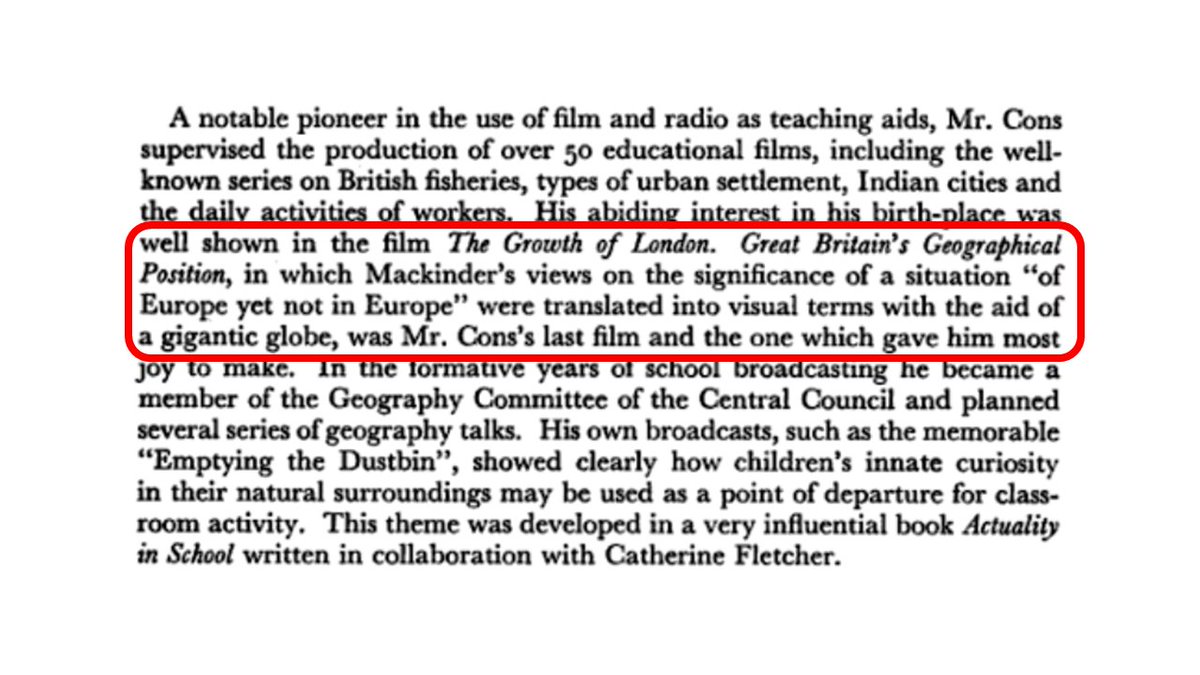
and sent a link through to the film. I need to find 'Emptying the Dustbin' next.
There is also a list of films made with his input on the BFI website which Brendan sent through.

I found a few on the British Council website - here's one on Newark
And here is another of his films in the BBC Schedules in 1938.

and sent a link through to the film. I need to find 'Emptying the Dustbin' next.
There is also a list of films made with his input on the BFI website which Brendan sent through.

I found a few on the British Council website - here's one on Newark
And here is another of his films in the BBC Schedules in 1938.
Sunday, 29 March 2020
1961: Mr. George Joseph Cons
Updated September 2023
Just a note on the 1961 Presidency from 'Geography'.
It appears that Mr. George Joseph Cons was due to have been the president for this year, but unfortunately died quite suddenly in 1960 so was unable to take up the post.

W. Wallace (1956) Geography in further education, The Vocational Aspect of Education, 8:16, 40-46, DOI: 10.1080/03057875680000061
“GEOGRAPHICAL ASSOCIATION. Annual Conference Discussions on the Future for Geography.” Geography, vol. 30, no. 2, 1945, pp. 50–62. JSTOR, www.jstor.org/stable/40563427
Bull, G. B. J. “GEORGE JOSEPH CONS.” Geography, vol. 45, no. 1/2, 1960, pp. 123–124. JSTOR, www.jstor.org/stable/40565120
If anyone knows more about Mr. G. J. Cons, or has an image of him that would be appreciated.


Just a note on the 1961 Presidency from 'Geography'.
It appears that Mr. George Joseph Cons was due to have been the president for this year, but unfortunately died quite suddenly in 1960 so was unable to take up the post.

Mr. G J Cons was the author of a Handbook on teaching, and was also a member of the Standing Committee for Visual Aids (which later become Teaching Aids)
He was a Senior Lecture in Geography at Goldmsiths' College.
Balchin's Centenary volume talks about him playing an active role in the Association for many years.
He is quoted in a paper on the teaching of war and peace.

Cons wrote that Geography is probably the best equipped subject for training the young in ‘world citizenship’ and internationalism (Cons, 1932)
This quote was included in a GA Handbook edited by Miss D M Forsaith
Cons also Chaired a number of events over the years, including a debate on the future of Geography at the 1945 conference.
He was the editor of a handbook for Geography Teachers, published by Methuen in the 1950s
Balchin's Centenary volume talks about him playing an active role in the Association for many years.
He is quoted in a paper on the teaching of war and peace.
Cons wrote that Geography is probably the best equipped subject for training the young in ‘world citizenship’ and internationalism (Cons, 1932)
This quote was included in a GA Handbook edited by Miss D M Forsaith
Cons also Chaired a number of events over the years, including a debate on the future of Geography at the 1945 conference.
He was the editor of a handbook for Geography Teachers, published by Methuen in the 1950s
Mr. Geoffrey Hutchings was elected as President in his place at the Spring meeting of the GA Council.
I noticed that he was obviously involved in helping make a number of short TV pieces.
I noticed a few fieldwork related pieces on the channel called Talking Pictures TV which shows brief vintage documentaries and films in between vintage films.

An Obituary was published in 'Geography'

I noticed that he was obviously involved in helping make a number of short TV pieces.
I noticed a few fieldwork related pieces on the channel called Talking Pictures TV which shows brief vintage documentaries and films in between vintage films.
An Obituary was published in 'Geography'

Thanks to Brendan Conway for the tipoff to these films in these tweets.
And here is the film, from the Huntley Film Archives
References
Here's the 2nd tweet🔊'Great Britain's Geographical Position'🔊— BC (@mildthing99) March 30, 2020
Includes a great explainer about #GulfStream (term not used strangely) + formation of N Atlantic #depressions with 3D graphics! #GeographyTeacher @PeterGWeather
See Cons biog by @GeoBlogshttps://t.co/N5iUQ1x5xUhttps://t.co/R6ILkoMjAS pic.twitter.com/cgcozcHMmL
🔊 'Great Britain's Geographical Position'🔊— BC (@mildthing99) March 30, 2020
'...really part of the European structure'
GJ Cons' classic film infl by #Mackinder #GeographyTeacher #IceAgeLegacy
Advanced graphics e.g. world upside down
See Cons biog by @GeoBlogs https://t.co/kuohTk4Cgchttps://t.co/c8yF4Ba35Y pic.twitter.com/g0CVZslA6Z
And here is the film, from the Huntley Film Archives
References
“GEOGRAPHICAL ASSOCIATION. Annual Conference Discussions on the Future for Geography.” Geography, vol. 30, no. 2, 1945, pp. 50–62. JSTOR, www.jstor.org/stable/40563427
Bull, G. B. J. “GEORGE JOSEPH CONS.” Geography, vol. 45, no. 1/2, 1960, pp. 123–124. JSTOR, www.jstor.org/stable/40565120
If anyone knows more about Mr. G. J. Cons, or has an image of him that would be appreciated.

Updated September 2023
The McNair Report gets a mention here.
H was linked with the NW Kent Branch of the GA.
He served for many years on the Education Committee of the GA.

https://www.raremaps.com/mapmaker/6716/G_J_Cons - an article that describes his map collecting.
Cons was a pioneer in pioneer in the field of geography films for schools and authored ‘Films and Living Geography’, Sight and Sound, 4/14 (Summer 1935)
The following is excerpted from Traces
A very different proposal comes from one of the few professional geographers involved in animated mapmaking for documentary films – G. J. Cons, who collaborated with the British Film Institute as scientific consultant for the production of educational documentaries. Referring to the series Indian Town Studies made by Gaumont-British Instructional, Cons highlights that ‘these films were made effective geographically by the use of animated maps’. It is evident that this effectiveness is based on the power of the trace since it allows a purely explanatory discourse which consists of the plain transmission of data and information even though no element really legitimises it. For him, there is little difference here between animated maps and informational images; the constitutive properties of motion and animation, whose consequences are far from being neutral, is relegated to a blurry allusion to a ‘living accurate’ vision. Does this prove the ineffectiveness of the attempt to acquire animated maps into the project of geography for ordering the world, or does it confirm Cons’ statement that ‘the genius of documentary film reveal[s] the screen as a magic casement through which our geographical vision of the Earth and its peoples is heightened’? In other terms, does the author’s faith in documentaries negate any concerns about the fabricated spectacle that animated maps present?
Apparently, and with a certain naivety, Cons seems to advocate a perfect analogy between the map, the mirror, and the screen – a position that may surprise coming from a professional geographer. However, as explained by Priya Jaikumar in an insightful essay on the series, the result is not the faithful and plain reproduction of Cons claims but rather an attestation of the role of animated maps in the building of that ideology that put together positivist, modernist, and colonial contents: ‘[t]owns in India were visualised to make them intelligible and transparent, with vision transforming a place, its people and fullness of their lives, into abstract space.’ Again, thanks also to the power of the trace the pretensions of correct visualisation and geographical accuracy have been overthrown and transformed into something completely different: the colonial fiction of mastery and control through alleged scientific instruments used in narrative and visual devices for making this very same fiction true.
Giuseppe Fidotta: Animated maps and the power of the trace.


If anyone can find an image of G J Cons that would be appreciated.
The following is excerpted from Traces
A very different proposal comes from one of the few professional geographers involved in animated mapmaking for documentary films – G. J. Cons, who collaborated with the British Film Institute as scientific consultant for the production of educational documentaries. Referring to the series Indian Town Studies made by Gaumont-British Instructional, Cons highlights that ‘these films were made effective geographically by the use of animated maps’. It is evident that this effectiveness is based on the power of the trace since it allows a purely explanatory discourse which consists of the plain transmission of data and information even though no element really legitimises it. For him, there is little difference here between animated maps and informational images; the constitutive properties of motion and animation, whose consequences are far from being neutral, is relegated to a blurry allusion to a ‘living accurate’ vision. Does this prove the ineffectiveness of the attempt to acquire animated maps into the project of geography for ordering the world, or does it confirm Cons’ statement that ‘the genius of documentary film reveal[s] the screen as a magic casement through which our geographical vision of the Earth and its peoples is heightened’? In other terms, does the author’s faith in documentaries negate any concerns about the fabricated spectacle that animated maps present?
Apparently, and with a certain naivety, Cons seems to advocate a perfect analogy between the map, the mirror, and the screen – a position that may surprise coming from a professional geographer. However, as explained by Priya Jaikumar in an insightful essay on the series, the result is not the faithful and plain reproduction of Cons claims but rather an attestation of the role of animated maps in the building of that ideology that put together positivist, modernist, and colonial contents: ‘[t]owns in India were visualised to make them intelligible and transparent, with vision transforming a place, its people and fullness of their lives, into abstract space.’ Again, thanks also to the power of the trace the pretensions of correct visualisation and geographical accuracy have been overthrown and transformed into something completely different: the colonial fiction of mastery and control through alleged scientific instruments used in narrative and visual devices for making this very same fiction true.
Giuseppe Fidotta: Animated maps and the power of the trace.
He also participated in the creation of visual maps such as the one here.
https://www.raremaps.com/gallery/detail/65476/the-peopling-of-the-usa-cons

https://www.raremaps.com/gallery/detail/65475/the-british-colonies-in-the-west-indies-cons - a map of its time for sure...

If anyone can find an image of G J Cons that would be appreciated.
Friday, 28 February 2020
1975: Bourne: a Town Study
Bourne is a town in Lincolnshire. This was the location of filming for a series called 'Studying the Landscape'. Over the years, there has been some education programming, and many GA Presidents were great supporters of this sort of resource.

Presented by David Stewart
Viewable for free on BFI player
https://player.bfi.org.uk/free/film/watch-bourne-a-town-study-1975-online
Pencils, notebooks and microphones at the ready! The people and industries of Bourne are put under the spotlight by the local kids in this unusual geography teaching film for schools. There are some surprising discoveries to be made: as well as glasshouses and iron foundries, the kids get to study the factory floor of a plastic toy manufacturer and interview the boss of racing car specialists BRM.
It's amazing how similar some fieldwork enquiries are today...
I wonder whether Bourne market is still as popular...
Any other classic schools TV that people can remember?
I remember the countdown clock before a programme started.
Perhaps you had them on VHS cassette - here's Margaret Roberts in 'Teaching Geography' on that topic...


Presented by David Stewart
Viewable for free on BFI player
https://player.bfi.org.uk/free/film/watch-bourne-a-town-study-1975-online
Pencils, notebooks and microphones at the ready! The people and industries of Bourne are put under the spotlight by the local kids in this unusual geography teaching film for schools. There are some surprising discoveries to be made: as well as glasshouses and iron foundries, the kids get to study the factory floor of a plastic toy manufacturer and interview the boss of racing car specialists BRM.
It's amazing how similar some fieldwork enquiries are today...
I wonder whether Bourne market is still as popular...
Any other classic schools TV that people can remember?
I remember the countdown clock before a programme started.
Perhaps you had them on VHS cassette - here's Margaret Roberts in 'Teaching Geography' on that topic...

Saturday, 15 February 2020
1957: Professor Patrick Walter Bryan
 Updated June 2021
Professor Pat Walter Bryan was an academic geographer, who worked at the University of Leicester.
He was known to everyone as 'Pat'.
He was educated at the London School of Economics, which has a very strong connection with the GA as we have seen.
His research interests included the landscapes of Leicestershire, which makes sense with his work at the Geography department at the University of Leicester
The text below is taken from the University's description of the department:
Geography was one of the three founding disciplines offered by the new University College of Leicester in 1921 with Gladys Sarson, a local grammar school teacher responsible for the teaching on a part-time basis.
The following year the Department was established with the appointment of P.W. Bryan (an assistant lecturer at the London School of Economics) as a full time Lecturer and Head of Department, and for the next 30 years Geography at Leicester was synonymous with Pat Bryan.


These early years were ones of intense struggle and between 1926 and 1939 15 students graduated in Geography. Accommodation was limited to a lecture room and a practical room which contained some surveying equipment and a few maps.
By the 1950s however, the number of graduates had grown to around 20 annually and there were four new lecturers. Roy Millward sadly passed away in 2016 but he and former technician Terry Garfield were guests of honour at the 90th birthday celebrations.
In 1924 he was one of the first students to be awarded by London University the – for Britain – new degree of Doctor of Philosophy with a thesis published later the same year as part of a book, North America, written with L L Rodwell Jones, which remained in print until 1968. By the 1950s however, the number of graduates had grown to around 20 annually and there were four new lecturers. Roy Millward sadly passed away in 2016 but he and former technician Terry Garfield were guests of honour at the 90th birthday celebrations.
Besides being Head of Department at the University, he was Vice-Principal for over twenty years and Chairman of numerous College Boards.
Even so, he found time to make important scholarly contributions.
Even so, he found time to make important scholarly contributions.
This was followed in 1933 by Man’s Adaptation of Nature: Studies in Cultural Landscape.
He became GA President three years after retiring from a long and successful academic career at the University of Leicester.
I came across this diagram from the book in a recent collection of pieces which were inspired by the Geographies of the French author Georges Perec. My GA Presidential address will be inspired by some of Perec's ideas as well.

His Presidential Address was on the theme of 'Geography and Landscape'.
It is well worth reading. Some quotes will appear separately.

 He was also particularly interested in photography and the use of visuals in teaching, which places him in the vanguard of the new generation of geographers who 10 years later would enter the quantitative revolution with the courses at Madingley which will be featured in this blog in due course.
Pat apparently regularly contributed a film to GA Conferences in the 1950s.
I wonder if any of those still exist in an archive somewhere - that would be rather good to find out. I contacted the Geography department at the University to see what they could offer and they were very helpful.

Having contacted the University of Leicester, they very kindly sent me a large amount of additional information, including details of his retirement here, plus details of his career.
There were some newsletters and a selection of images. I am grateful for their help.

Here he is doing some fieldwork.

Upon Professor Bryan's retirement in 1954 his successor, Professor Norman Pye, was to transform this small Department over the next 25 years into one which was a leader in teaching and research.
More on Norman Pye to come later as well, as he was heavily involved with the GA, although he never became President.

Pat Bryan died in 1968 at the age of 83, another GA President who had lived a long life.
I also found a reference to some late activity and involvement in Environmental Studies within the Department, which showed that Pat continued to be active well into his 80s, shades of James Fairgrieve there.


References
Image source:
http://www.leicesterlitandphil.org.uk/1937-p-w-bryan-bsc-phd-1937-38/
https://www2.le.ac.uk/offices/press/press-releases/2013/june/university-of-leicester-department-of-geography-invites-public-to-celebrate-its-90th-anniversary
Obituary: https://search.proquest.com/openview/2c8b72d47f0d81df3d0fd4720ef8f68e/1?pq-origsite=gscholar&cbl=1818801
Presidential Address: BRYAN, P. W. “Geography and Landscape: Address to the Geographical Association.” Geography, vol. 43, no. 1, 1958, pp. 1–9. JSTOR, www.jstor.org/stable/40564113
https://link.springer.com/content/pdf/10.1038/175198a0.pdf - link to 1954 conference piece
Images are mostly courtesy of the documents sent by the School of Geography at Leicester University, with particular thanks to Kerry Allen for responding to my e-mail most kindly.

As always, if anyone has further information or memories, please get in touch. This will hopefully become more common as we get closer to the present day.
Updated June 2020
An obituary was published in January 1969 in 'Geography'.
Source: Millward, R. “PATRICK WALTER BRYAN.” Geography, vol. 54, no. 1, 1969, pp. 93–93. JSTOR, www.jstor.org/stable/40566740. Accessed 5 June 2020
https://www.leicesterlitandphil.org.uk/1937-p-w-bryan-bsc-phd-1937-38/ - Lit and Phil Society biography
#dcweekly Did You Know? The first PhD was awarded at the University of Leicester in 1924 and was titled to (now) Dr Patrick Walter Bryan in the Geography Department! #TheDoctoralCollege #CitizensOfChange #CuriosityLedResearch #OursToChange #PhD #PGR #ECR #PostDoc #Researcher pic.twitter.com/ErjjK0QQ0f
— The Doctoral College (@doctoralcollege) November 16, 2020
Sunday, 15 September 2019
1935: James Fairgrieve
 Last update August 2023
"Anyone who leaves school without geography as part of their education cannot be considered to be fully educated..."
(1926)
Quoted by David Lambert in a conference lecture (see link at the end of the piece)
James Fairgrieve was a geographer, and author, and prior to taking up the Presidency, he had held several roles within the Association and, as so often, his name appears on the minutes of many meetings and gatherings. He was one of the most significant people in the GA's history and development and many of his documents are in the GA Archives.
He is perhaps best known for his books Geography and World Power (1915) and Geography in School (1926), which were popular at the time of publication, although he wrote others.
James was a British geographer, born in 1870, and had a long career as a teacher too, which is good to see in a GA President, and is still relatively rare. He died in the 1950s.
Fairgrieve originally had no formal training in geography, but took part-time courses in geography at the London School of Economics.
These courses were taught by geographer and geopolitician Halford Mackinder (GA President in 1916, and one of the most influential geographers of the early 20th century).
From that point forward, Fairgrieve devoted his life's work to geography (according to his Wikipedia page)
He was appointed a geography master in 1907 at the William Ellis School. He is described as "bubbling with fresh ideas and astonishing energy". He set up a geographical laboratory at the school and also wrote many textbooks. His commitment to pedagogy was equal to that of geography. He was a long way from the 'Capes and Bays' of the day, and looked at active teaching methods, and lots of fieldwork in the local area.
He is quoted as saying: "We must work from the known to the unknown, not like some teachers - work from the unknown the unknowable."
The full quote goes:
From the known to the unknown
From the simple to the complex
From the indefinite to the definite
From the particular to the general
During the First World War, he wrote 'Geography and World Power'.
Fairgrieve was an intellectual disciple of the great British geopolitical thinker Sir Halford Mackinder, and borrowed some of Mackinder’s concepts in formulating his own geopolitical worldview. Fairgrieve factored into his geopolitical analyses topography, location, climate, relative population density, the distribution of energy, the ease or difficulty of movement, and political and social organization.
Geography and World Power traced the impact of geographical conditions on the course of history, beginning with the desert, marsh and steppe lands of Egypt and Mesopotamia; to the near and readily accessible regions of Palestine and Phoenicia; to Greece, Carthage, and Rome; to the forest lands of Germany and Russia; to the great plain of Eurasia from which nomadic tribes invaded the settled peoples of Europe; to the lands of Arabia from which Mohammedans attempted to convert the known world to Islam; to the age of exploration and the discovery of the New World; to the African grasslands; to the Monsoon lands of China and India.
In 1918, he wrote a piece against environmental determinism called 'Geographical Control'.
He was also a predecessor of former GA Chief Executive David Lambert at the Institute of Education.
As with many other geographers who became President, there was a connection with previous Presidents, and the work of the RGS-IBG.
During the late 1920s and through the 30s, James Fairgrieve worked on developing support materials for teachers to help in their use of educational films. I have blogged about this work separately here.

In 1926, he published his main book "Geography in School". It attracted a lot of interest, as did his definition of Geography. It can be downloaded as a PDF from the Archive.org website. It ran to several editions.
"The function of Geography is to train future citizens to imagine accurately the conditions of the great world stage and so help them think sanely about political and social problems in the world around."
His book, and teaching approaches inspired a generation of geography teachers.
Here it is, from the GA collection

Fairgrieve later led a group of voluntary workers who watched a huge range of educational films to look at their potential for classroom use.
He served on the GA's council for several years during the 1940s, including as Chair of the GA Council in 1947.
He was a relatively rare GA President in that he was a teacher for pretty much all of his career, but had retired before taking office.
Fairgrieve was a Geography Master at William Ellis School, joining in 1907, a school which had a remarkable Geography classroom.
KENT, ASHLEY. “Challenging Geography: A Personal View.” Geography, vol. 82, no. 4, 1997, pp. 293–303. JSTOR, www.jstor.org/stable/40572948. Accessed 15 Jan. 2021.


During the First World War, he wrote 'Geography and World Power'.
Fairgrieve was an intellectual disciple of the great British geopolitical thinker Sir Halford Mackinder, and borrowed some of Mackinder’s concepts in formulating his own geopolitical worldview. Fairgrieve factored into his geopolitical analyses topography, location, climate, relative population density, the distribution of energy, the ease or difficulty of movement, and political and social organization.
Geography and World Power traced the impact of geographical conditions on the course of history, beginning with the desert, marsh and steppe lands of Egypt and Mesopotamia; to the near and readily accessible regions of Palestine and Phoenicia; to Greece, Carthage, and Rome; to the forest lands of Germany and Russia; to the great plain of Eurasia from which nomadic tribes invaded the settled peoples of Europe; to the lands of Arabia from which Mohammedans attempted to convert the known world to Islam; to the age of exploration and the discovery of the New World; to the African grasslands; to the Monsoon lands of China and India.
In 1918, he wrote a piece against environmental determinism called 'Geographical Control'.
He was also a predecessor of former GA Chief Executive David Lambert at the Institute of Education.
As with many other geographers who became President, there was a connection with previous Presidents, and the work of the RGS-IBG.
During the late 1920s and through the 30s, James Fairgrieve worked on developing support materials for teachers to help in their use of educational films. I have blogged about this work separately here.

In 1926, he published his main book "Geography in School". It attracted a lot of interest, as did his definition of Geography. It can be downloaded as a PDF from the Archive.org website. It ran to several editions.
"The function of Geography is to train future citizens to imagine accurately the conditions of the great world stage and so help them think sanely about political and social problems in the world around."
His book, and teaching approaches inspired a generation of geography teachers.
Here it is, from the GA collection

Fairgrieve later led a group of voluntary workers who watched a huge range of educational films to look at their potential for classroom use.
He served on the GA's council for several years during the 1940s, including as Chair of the GA Council in 1947.
He was a relatively rare GA President in that he was a teacher for pretty much all of his career, but had retired before taking office.
Fairgrieve was a Geography Master at William Ellis School, joining in 1907, a school which had a remarkable Geography classroom.
I have been given some wonderful images of this classroom by Chris Willey, a Historian of the school - these will feature in a future post.
I also discovered that he was succeeded as a Geography Master by another former GA President: Leonard Brooks, who we will come to in due course, when I shall also share some of the images.
In 1931, he wrote about broadcasting in schools.

Fairgrieve's Presidential Address explored the themes of pedagogy in a way that other previous GA Presidents hadn't really. It was simply called 'Can we teach Geography better?'

Save your money on some of the new teaching books that have emerged and read this address instead.
The first suggestion he has is that we need to let others see us teach and have the chance to see others teach in return.

We also have to spread a love for geography in our subjects or we have failed in our job.
Feed your geographical caterpillars geographical cabbage and they will soon learn to fly.

Remember to move from the known to the unknown, he says. Go from simple to complex. Move from concrete to abstract. There is a place for wonder.
I also discovered that he was succeeded as a Geography Master by another former GA President: Leonard Brooks, who we will come to in due course, when I shall also share some of the images.
In 1931, he wrote about broadcasting in schools.

Fairgrieve's Presidential Address explored the themes of pedagogy in a way that other previous GA Presidents hadn't really. It was simply called 'Can we teach Geography better?'

Save your money on some of the new teaching books that have emerged and read this address instead.
The first suggestion he has is that we need to let others see us teach and have the chance to see others teach in return.

We also have to spread a love for geography in our subjects or we have failed in our job.
Feed your geographical caterpillars geographical cabbage and they will soon learn to fly.

Remember to move from the known to the unknown, he says. Go from simple to complex. Move from concrete to abstract. There is a place for wonder.
Fairgrieve travelled to Scandinavia on an Orient Line ship in the 1920s and contributed a large number of lantern slides of images from that trip into the GA's collection.
Read about 'Geography and World Power'
This is a very enjoyable address and worth reading.
Fairgrieve continued to attend GA meetings for another 20 years after his Presidency, according to Rex Walford, "able to attend meetings only with the help, successively, of sticks, wheelchair and basket bed".
Quite a commitment to the Association indeed!
Fairgrieve died in 1953, active to the very last within the GA.
References
Wikipedia: https://en.wikipedia.org/wiki/James_Fairgrieve
I amended this entry to add reference to the GA Presidency role, as I have for all Presidents when that information was missing.
FAIRGRIEVE, J. “GEOGRAPHIC CONTROL.” The Geographical Teacher, vol. 9, no. 4, 1918, pp. 189–192. JSTOR, www.jstor.org/stable/40554568.
Mentioned in: https://www.geography.org.uk/write/MediaUploads/Journals/Boardman_McPartland_Building_on_the_foundations.pdf
Fairgrieve, J. “USE OF BROADCASTING IN TEACHING GEOGRAPHY IN SCHOOLS.” Geography, vol. 16, no. 1, 1931, pp. 34–44. JSTOR, www.jstor.org/stable/40557798.
Fairgrieve commented on by David Lambert in a lecture here. (from 2015)
https://thediplomat.com/2015/04/geography-and-world-power-at-100/ - Geography and World Power
Also had a section in Rex Walford's book p.97-9
Fairgrieve, J. “CLOUD AND RAIN.” Geography, vol. 27, no. 1, 1942, pp. 31–33. JSTOR, www.jstor.org/stable/40562174.
Boardman, David, and Michael McPartland. “A Hundred Years of Geography Teaching: Building on the Foundations: 1893—1943.” Teaching Geography, vol. 18, no. 1, 1993, pp. 3–6. JSTOR, www.jstor.org/stable/23754476.
https://www.open.edu/openlearn/ocw/pluginfile.php/631169/mod_resource/content/1/geog_sk6_06t_5.pdf - an interesting perspective by Bill Marsden
FAIRGRIEVE, J. “CAN WE TEACH GEOGRAPHY BETTER?” Geography, vol. 21, no. 1, 1936, pp. 1–17. JSTOR, www.jstor.org/stable/40559408.
As always, if anyone has further information relating to James Fairgrieve and his work for the GA, please let me know so that I can expand on this post.
Update
Here's an image of a contemporary Geography classroom from Fairgrieve's book, reproduced in Rex Walford's 'Geography in British Schools 1850-2000'

Update - late October
Here's a silent educational film from 1925 - of a village in the Punjab

Made by British Instructional Films Ltd of Surbiton Surrey and apparently approved by James Fairgrieve and the Geographical Association.

Can be viewed here...
And here's one of a Mediterranean island...
Fairgrieve died in 1953, active to the very last within the GA.
References
Wikipedia: https://en.wikipedia.org/wiki/James_Fairgrieve
I amended this entry to add reference to the GA Presidency role, as I have for all Presidents when that information was missing.
FAIRGRIEVE, J. “GEOGRAPHIC CONTROL.” The Geographical Teacher, vol. 9, no. 4, 1918, pp. 189–192. JSTOR, www.jstor.org/stable/40554568.
Mentioned in: https://www.geography.org.uk/write/MediaUploads/Journals/Boardman_McPartland_Building_on_the_foundations.pdf
Fairgrieve, J. “USE OF BROADCASTING IN TEACHING GEOGRAPHY IN SCHOOLS.” Geography, vol. 16, no. 1, 1931, pp. 34–44. JSTOR, www.jstor.org/stable/40557798.
Fairgrieve commented on by David Lambert in a lecture here. (from 2015)
https://thediplomat.com/2015/04/geography-and-world-power-at-100/ - Geography and World Power
Also had a section in Rex Walford's book p.97-9
Fairgrieve, J. “CLOUD AND RAIN.” Geography, vol. 27, no. 1, 1942, pp. 31–33. JSTOR, www.jstor.org/stable/40562174.
Boardman, David, and Michael McPartland. “A Hundred Years of Geography Teaching: Building on the Foundations: 1893—1943.” Teaching Geography, vol. 18, no. 1, 1993, pp. 3–6. JSTOR, www.jstor.org/stable/23754476.
https://www.open.edu/openlearn/ocw/pluginfile.php/631169/mod_resource/content/1/geog_sk6_06t_5.pdf - an interesting perspective by Bill Marsden
FAIRGRIEVE, J. “CAN WE TEACH GEOGRAPHY BETTER?” Geography, vol. 21, no. 1, 1936, pp. 1–17. JSTOR, www.jstor.org/stable/40559408.
As always, if anyone has further information relating to James Fairgrieve and his work for the GA, please let me know so that I can expand on this post.
Update
Here's an image of a contemporary Geography classroom from Fairgrieve's book, reproduced in Rex Walford's 'Geography in British Schools 1850-2000'

Update - late October
Here's a silent educational film from 1925 - of a village in the Punjab

Made by British Instructional Films Ltd of Surbiton Surrey and apparently approved by James Fairgrieve and the Geographical Association.

Can be viewed here...
And here's one of a Mediterranean island...
Updated January 2021
Fairgrieve also featured in the Presidential Address of the 1996 President Ashley Kent, where he outlined his life and also the strong connections between the IoE and the GA. It is well worth reading to get an idea for the links and the changing nature of Geography. Ashley's Presidential Address was given at the Institute of Education.
He provides additional detail on Fairgrieve's life.

"A central figure in the long struggle for the subject to which he gave a life of enthusiastic work"
H. J. Fleure (1953)
Updated April 2021
Fairgrieve seems to have spent 1921 out of the country according to this piece in 'The Geographical Teacher'

Updated June 2021

Aberystwyth University has a Prize named after James Fairgrieve.
Updated August 2021
I have been exploring some of Fairgrieve's lantern slides over the last month for a project called 'A Geographer's Gaze'

Updated July 2022
A remarkable piece of film from the 1930s.
Filmed by Scottish geographer James Fairgrieve
— Ali Asghar Khan (@AliAsgharPTI) February 3, 2019
Scenes from Abbottabad, St. Luke's Church etc. https://t.co/iGRE9KSe82
Updated August 2023
Neville Scarfe's influences included James Fairgrieve, who he described as
"a down to earth geographer bent on assisting students to imagine world characteristics accurately, the better to imagine political and social problems"
Wednesday, 14 August 2019
1930s: Geography and Films
During the 1930s, a new classroom aid appeared in the shape of educational films.
The 1928 conference saw the arrival of some work in this area as having great potential.
This was spearheaded by a future GA President: James Fairgrieve.
Fairgrieve worked with volunteers to explore the potential of cinema, even hosting an event at the Annual Conference in 1928.
People like Jon Grierson started to make documentary films, which had more geographical potential than other films. Films like 'Night Mail' (1936) were the result of his work. These were less than 30 minutes and were useful in the classroom. Modern teachers like short clips rather than feature length films (unless it's the last week of term).
Fairgrieve worked widely with London based teachers to promote the use of films.
Radio broadcasts were also started around this time too. I remember tuning in to the assembly at Primary school, and having the programme lead what we did.
In 1931, Fairgrieve wrote about the use of films.

This was well before Bernard Clarke and the rest...
References
“How B.B.C. Lectures and Films Are Utilised.” Geography, vol. 15, no. 8, 1930, pp. 672–672. JSTOR, www.jstor.org/stable/40559754.
Fairgrieve, J. “USE OF BROADCASTING IN TEACHING GEOGRAPHY IN SCHOOLS.” Geography, vol. 16, no. 1, 1931, pp. 34–44. JSTOR, www.jstor.org/stable/40557798.
The 1928 conference saw the arrival of some work in this area as having great potential.
This was spearheaded by a future GA President: James Fairgrieve.
Fairgrieve worked with volunteers to explore the potential of cinema, even hosting an event at the Annual Conference in 1928.
People like Jon Grierson started to make documentary films, which had more geographical potential than other films. Films like 'Night Mail' (1936) were the result of his work. These were less than 30 minutes and were useful in the classroom. Modern teachers like short clips rather than feature length films (unless it's the last week of term).
Fairgrieve worked widely with London based teachers to promote the use of films.
Radio broadcasts were also started around this time too. I remember tuning in to the assembly at Primary school, and having the programme lead what we did.
In 1931, Fairgrieve wrote about the use of films.

This was well before Bernard Clarke and the rest...
References
“How B.B.C. Lectures and Films Are Utilised.” Geography, vol. 15, no. 8, 1930, pp. 672–672. JSTOR, www.jstor.org/stable/40559754.
Fairgrieve, J. “USE OF BROADCASTING IN TEACHING GEOGRAPHY IN SCHOOLS.” Geography, vol. 16, no. 1, 1931, pp. 34–44. JSTOR, www.jstor.org/stable/40557798.
Subscribe to:
Posts (Atom)
Margaret Mackintosh RIP
Updated post. Sad news at the end of last week from colleagues who have organised the Charney Conference over the years of the passing of Ma...
