Showing posts with label Conference Officers. Show all posts

Saturday, 13 July 2024

GA Conference 1982

I recently had a query about the GA Conference in 1982.

From this description, it seems that due to the LSE being unavailable for the usual period of time (?) the sessions were divided between the LSE and the RGS. It was remembered by a few people in my network, who attended the event.

Here was the report from Conference Officer Barrie Morgan, published in 'Geography'

Annual Conference (Officer: Dr. Barrie S. Morgan)

The Annual Conference was held from 14th- 16th April around the theme "Focus on Europe". This was a new-style Conference since the sessions at LSE were confined to two days, preceded by a late-afternoon and evening session at the RGS. The success of these and attendant innovations were assessed in the report.

Source

Coates, Bryan E., et al. “Annual Report of the Geographical Association 1982.” Geography, vol. 68, no. 2, 1983, pp. 154–61. JSTOR, http://www.jstor.org/stable/40570663. Accessed 9 June 2024.

More to come on this...

Monday, 7 December 2020

1990-1: The Presidential hand over...

Not yet a part of the official progress through the Presidential journey, in the same way as the Olympic Nations pass on the flag at the end of each Olympiad to the country that is going to succeed them as host.

Thanks to Eleanor Rawling for the scan of the GA News showing the change over between Bryan Coates and herself.

This took place in the unusual surroundings of the cobbles of Coronation Street during a GA fieldtrip. Also a mention for Russell Chapman - conference organiser, and the National Curriculum debate.

ER and BC at 1991 GA Conference by GeoBlogs on Scribd

Sunday, 29 November 2020

Conference Officers

The GA Annual Conference has always been a highlight of the GA year, and an opportunity for the President to give their address. For many decades, this was held over the New Year at the London School of Economics. Sheila Jones told me that the conference officer was always a very important person in the GA.

In the conference document that Pat Cleverley sent me, from 1984, the conference officers were listed in the programme as David Green from the Department of Geography at King's College, and Ralph Dunkley from the Geography Section at City of London Polytechnic.

I will be researching each of these people as well as the GA Presidents, so any help with those names would also be helpful.

Denys Brunsden: a former GA President was a conference officer for some years, and passed on details of some of the other conference officers during his time connected with the GA.

Tom Elkins - Professor of Geography at the University of Sussex

“The Geographical Association.” Geography, vol. 63, no. 4, 1978, pp. 369–379. JSTOR, www.jstor.org/stable/40569009. Accessed 2 Nov. 2020.

Jim Bird
Peter O'Dell (or Odell?)
Denys Brunsden - himself a conference officer in the 1970s
David Jones
Nigel Yates
Ralph Dunkley
Russell Chapman
Barrie Morgan - strongly linked to King's College, London
https://www.strandlines.london/2012/08/01/memories-of-the-strand-dr-barrie-morgan/
Also runs the King's College London Alumni twitter feed

1981 Conference


David Green

Russell Chapman and Geoff Dunkley ran the conference for years in the 90s.

In the recent era, Lucy Oxley was in charge of the conference for many years.

The last few years' conferences have been organised by Harriet Brookes and Becky Kitchen. They have had to adapt to an online model for delivery due to circumstances.

As I mentioned before, all memories of GA conferences past, and conference officers would be very welcome.

References

Coates, Bryan E., et al. “Annual Report of the Geographical Association 1981.” Geography, vol. 67, no. 2, 1982, pp. 157–163. JSTOR, www.jstor.org/stable/40570513. Accessed 2 Nov. 2020.

Sunday, 8 November 2020

1986: Professor Denys Brunsden

Last updated January 2024, with some sad news.

"Field time is your most precious time - how precious you will know only when its days are past" 
(Sauer, 1956)

Emeritus Professor Denys Brunsden is a legendary geomorphologist, whose work will be familiar to many, particularly with respect to coasts. He has also collaborated frequently with another former President: Andrew Goudie.

He was a leading person in the successful campaign for the designation of the Jurassic Coast as a World Heritage Site, acting as a Trustee for many years, and is now a Patron of this classic Coastal location - a venue for generations of geography fieldtrips, and classic case study in many textbooks. This has been a coastline which has been part of his life for decades.

Denys is still active, and this video is one that I have used each year for my teaching, looking at the potential impact of coastal erosion on the town of Lyme Regis, and the need to manage it. I try to get to Lyme Regis at least once a year, and we just managed it this year... Denys has written about this area in a large number of books and other papers.


The International Association of Geomorphologists, which Denys helped to instigate, has a Brunsden medal which is awarded annually for work in this area.

Denys was born close to the Jurassic Coast area as well, in Torquay in 1936.

He was educated at Torquay Boys Grammar School, before earning a place at King's College, London.

Here he is talking about his life at this time, and the influence of another GA President Sidney Wooldridge.

In 1956 I went up to Kings College, London, and was advised to study under Sidney Wooldridge, at that time the great geomorphologist. Geomorphology is the study of the shape of the earth, the landforms, and the processes that create them. I was mesmerised by his teaching, and being a bit more mature than the other students I worked harder and got a good degree. When I finished my degree, Wooldridge asked me if I’d like to join as a junior member of staff—straight out of graduation—and I jumped at it, teaching 6 hours of tutorials a week and completing my PhD at the same time. 

And there I stayed, for the rest of my working life, finishing up as Emeritus Professor and Fellow of the College. It has been my place.

I am sure that I remember Denys speaking about the Karakoram trip at Sheffield University when I was doing my 'A' level Geography around 1982 and we visited to hear the talk. I had the article clipped out of a magazine for some years.

Denys was a Professor of Geography when he became GA President. He has also worked as a consultant in Engineering Geomorphology.
From 'Bridport Life' in 2015:

"I was part of the British Geomorphological Research Group, a new growing group of “young Turks”. We were creating a new subject, writing all the textbooks, each one of us a specialist—one on deserts, one on glaciers, me on landslides. I was one of four people who started a company called Geomorphological Services Ltd—later we went on to create the International Association of Geomorphologists—and that took me to consultancies in some 28 countries and incredible situations; the Ok Tedi gold mine landslide disaster in Tibet; Papua New Guinea, the Dharan to Dhankula Highway in Nepal; all the work in Dubai surveying for the new airport and dry dock infrastructure, at a time when only 18,000 people lived there, there was no high-rise, and dhows were going back and forth across the creek. Even now I’m working for BP offshore looking at the sea bed for pipelines and well sites."

His Presidential Address was called 'The Science of the Unknown' and referred to the importance of fieldwork as well as other things.


There are quite a few quotes from this address relevant to my own proposed conference theme.

Denys explored some ideas that I've also used over the years when teaching CPD courses for the GA on fieldwork, local studies (heimatkunde) - which goes back to Keltie and Mackinder, and Physiography.
He also mentions Wooldridge who was a geologist turned geographer and had a great interest in fieldwork, which is something woven through the history of the GA. 
He also refers directly to some of the themes that had occupied his time as President of the Association with regard to the well-being of the subject.


Denys told me some other things about his time at the GA.

Denys told me about his various involvement in the GA, which is very impressive.
1956-9 Student Member 
1960-to date Member 
1962-7 Assistant Conference officer. All conferences and the annual Conference were held at the London School of Economics
1968. Published Dartmoor in the 'Geography through Maps' Series 
1968-74 Honorary Conference Officer. Annual at LSE. 
1968-74 Member Executive Committee. 
1974-79 Member of Council. 
1973-76 Member of the Organisation and Development Committee which re-organised the whole committee structure of the GA and much remains to this day. We also proposed the Council for British Geography (CoBRIG) and set up the new publications such as Primary Geography: Great movers in this period were Sheila Jones and Pat Cleverley. 
1975-78 Representative on the Council for Environmental Education for the GA
1984-6. Vice-President
1986-7. President
1987-8 Senior Past-President
1988 GA representative on the Nature Conservation Working Party for Science at the Dept. Educ. Science. 
Denys also organised the GA Consultation on the 'Future of Geography' with J. K. St Joseph, Minister for Education at the time.

I also asked Denys about his memories of other GA Presidents at the time. 

The longest serving was probably Alice Garnett. She 'owned it". The most faithful supporters were Robert Steele and all the Presidents of that time. 
The most influential in my time was Michael Wise (also a fabulous Treasurer), before that S.W.Wooldridge was a monumental presence and Dudley Stamp put the GA on a sound financial course especially with his advice to Michael and in many 'hidden' ways.

Denys also pointed out the particular influence that King's College, London has had on the development of the GA, in the same way as other key institutions which have kept cropping up through the last century or so that I have been blogging about. Those include LSE, Oxford University, Aberystwyth University, Manchester University and Sheffield University amongst others.

Denys told me:

You should mention the important role of the KCL/LSE contribution during the 1950-1990 period. The annual conferences were always held at LSE. 
The successive members of staff who did the work of organising conference included the following people, who I will try to find out more about.

Tom Elkins - Professor of Geography at the University of Sussex
Jim Bird
Peter O'Dell (or Odell)
Denys Brunsden 
David Jones
Barrie Morgan - strongly linked to King's College, London
https://www.strandlines.london/2012/08/01/memories-of-the-strand-dr-barrie-morgan/
David Green
A massive un-recognised contribution. Something for me to pursue further. 
We also all served on the lecture circuit, all of the academics (all universities) lectured to the branches and to school conferences. The link to Universities at that time was very strong.

Sheila Jones told me of the importance of the GA conference organiser in her messages to me, and mentioned that Denys helped organise her own conference.

Denys also got involved in the production of a Channel 4 TV series called Landshapes, which I remember using when I first started teaching as I had the series on video. It also included Rita Gardner - Director of the RGS-IBG, David Jones and Professor Andrew Goudie.
It was presented by Tim Preece.

It was made in 1988.

A series of seven programmes looking at the geomorphology of Britain and Ireland.

Part 1: The stiperstones of Shropshire, which are representative of some of the most ancient rocks found in the British Isles.
Part 2: The landscape created since the last Ice Age, concentrating mainly on Norfolk where the sands and gravels represent some of the youngest and weakest rocks of the British Isles.
Part 3: How the ice sheet influences land shapes in the mountainous regions of Britain, showing the glacial cradles of North Wales and the rivers estuaries of Ireland and Cornwall.
Part 4: The landscapes created by the melting waters of the Ice Age. Shows some spectacular scenery such as Devil’s Dyke, Cheddar Gorge and the waterfalls of Teeside.
Part 5: The erosion of the coastline caused by the sea undermining the soft rocks. Concentrates on southern and eastern England where land is being reclaimed by the sea.
Part 6: Because the British Isles lie on the edge of one of the earth’s plates, the 10,000 miles of coastline are very varied. The shoreline is shaped by the constant battle between the waves and the rocks.
Part 7: The effects of man’s actions on the landscape since his earliest ancestors used ‘slash and burn’ techniques to clear the ancient forests. Soil erosion caused by agriculture in places where the forest was completely felled created the wetland landscape. Human activity has thus changed the landscape sometimes for better, sometimes for worse.

The episodes in bold are ones I remember using in my teaching. The music was very memorable as well.

References
Denys doesn't have a Wikipedia page, although he certainly deserves to have one. More recent GA Presidents don't have pages yet, perhaps that will be a follow up to this project.

Jurassic Coast website: https://jurassiccoast.org/trustees/prof-denys-brunsden/

http://www.marshwoodvale.com/people/2015/12/denys-brunsden/

http://www.bridportlife.co.uk/people/denys-brunsden/ - this has a range of fascinating information on Denys from his own words, including the fact his son plays bass in 'Hothouse Flowers'.... also goes into more detail on his work on the Jurassic Coast.

"Education is key; if people understand what they’re observing then they respect it, and from respect comes a sense of ownership, a stake in something which then has a far better chance of being looked after and conserved for the future."

Presidential Address: https://www.jstor.org/stable/40571619 - "The Science of the Unknown" (1987)


A classic book here:

Denys has written and contributed to a great many books, papers and articles.
I have a copy of this particular guide book of the Jurassic Coast he was involved in creating.

Denys also worked on a number of projects with another former GA President Andrew Goudie, who will be featured on the blog in a few weeks' time. He wrote an Atlas of the Environment of the UK with Andrew.

As always, if anyone has further information relating to Denys Brunsden please let me know so that I can expand on this post.

Top image: provided by Denys Brunsden, taken by Professor Jesse Walker of Louisiana State University

Update November 2020
Alan Kinder let me know that Denys first joined the GA in 1956, when Lord Nathan was the GA President - a very different era of Presidents to now.

A report on Deny's Conference was published in 'Geography' in 1988
Source:

Humphrys, Graham, et al. “Annual Report of The Geographical Association 1987.” Geography, vol. 73, no. 2, 1988, pp. 162–178. JSTOR, www.jstor.org/stable/40571395. Accessed 14 Nov. 2020.

Some tweets:
Advice to young geomorphologists in his #IAG2013 keynote 'Think outrageously, be unconstrained'.

Update March 2021


Updated July 2022

A lovely piece written for the KCL Geography newsletter by Denys, now 85.

It provides a nice potted biography of his life and achievements, sixty years on from doing his degree.


Here's a lovely interview with Denys too:


Updated August 2023

New out in November 2022 from Denys and Andrew Goudie.


A sad update in January 2024.


Friday, 22 May 2020

1966: Professor Stanley Henry Beaver

Last updated August 2023

Professor Stanley Henry Beaver was an academic geographer, who was particularly associated with the LSE and Keele University, as well as being a great supporter of the work of the GA.

A prolific author, he authored books on a wide range of topics, from Sand and Gravel, to more general human geographies of the world, and geomorphology.
He had a very long association with the GA, as did many Presidents of course, working with them for over 30 years before becoming President in a number of roles, and providing content for journals.
He was involved with L Dudley Stamp's Land Utilisation Survey, and co-authored many of the reports that came out of that survey in the 1930s and beyond.

He also became involved in the planning and delivery of the Annual Conference in 1933, after Dr. H J Wood stood down.
During the 1930s, the GA Conference actually moved around a lot more than it had previously, where it was mostly held at the LSE. The 1930s saw it in cities including Liverpool, Glasgow, Nottingham and Sheffield. In 1932, the conference was even planned to be overseas in Heidelburg, but political and currency problems meant it had to be cancelled.

He had an association with the RGS (as many other GA Presidents have) and the IBG.

When he left the LSE he was succeeded by Michael Wise: another former GA President.

He also co-wrote a classic book with another GA President, L Dudley Stamp called 'The British Isles' as part of the 'Regional Geography' series.

He was born in London in 1907, and went to UCL where he graduated with first class honours in Geography in 1928. He completed his Diploma in Education in 1929, and according to an obituary published in the Transactions of the IBG, was influenced by L. W. Lyde, who apparently regarded geography as:
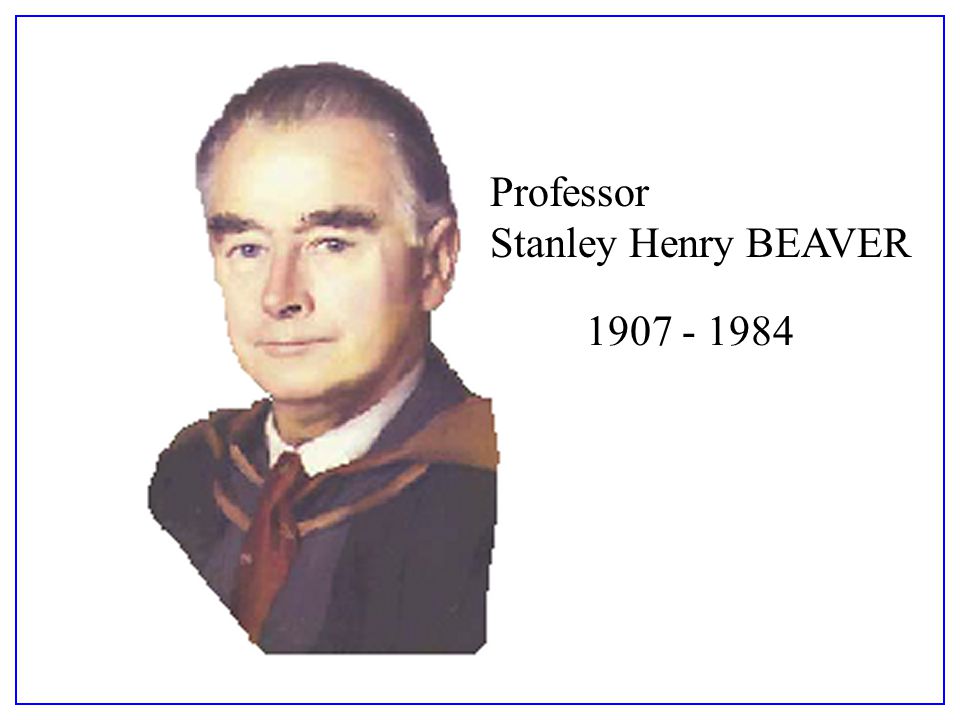
Image result for Professor Stanley Henry Beaver
"a body of knowledge coupled with an attitude of mind". 

He worked at the LSE between 1929 and 1950,  along with L Dudley Stamp

For some time, I couldn't find a contemporary image of Stanley Beaver, but was fortunate to receive one from Dr. Philip Kivell which can be seen at the top of the blog post.

In 1962, he had a piece published in 'Geography' on the Le Play Society and their contribution to fieldwork.

By this time, he was Head of the Geography department at the University of Keele. He stayed at Keele until his retirement in 1974 when he became Emeritus Professor.


In it, he references the work of Patrick Geddes, who had A. J. Herbertson as his assistant.


I am grateful to Dr. Peter Knight for helping me get in touch with Dr. Philip Kivell, who very kindly gave me a range of additional details on Professor Beaver's career and personal life. 
What follows was provided very kindly by Dr. Kivell.

S.H.BEAVER 1907-1984
Stanley Henry Beaver was born in Willesden, North London in August 1907. He graduated from University College London in 1928 with first class honours in Geography having already been awarded the Morris Prize and a University Scholarship in Geology. His first academic post was at the London School of Economics, where a very productive period resulted in appointment as Ernest Cassel Reader in 1946. His major work at this time, together with L Dudley Stamp was “The British Isles: a geographic and economic survey” which went though many editions before and after the war and provided a geographical grounding for  many thousands of students. 
During the war he worked for Naval Intelligence and used his geographical training to produce a number of regional handbooks. 
He was appointed as the founding professor of Geography at the new University College of North Staffordshire, subsequently Keele University, in 1950. 
Here he built up the first new post- war Geography Department in the country, including being closely involved in the physical design of the building. 
This included finding a home for millions of RAF air photographs taken over Europe during the war, and the establishment of a meteorological station on the campus.
Beaver could fairly be described as a traditional geographer, a product of an age that largely pre-dated the increasing specialization that reshaped the discipline from the 1960s. 
Having said that, his interests and skills were enormously diverse.  Most obviously he was a Human Geographer concerned with economic and regional matters, but his interests also ranged widely over transport geography, land use and dereliction and he was equally well informed about climate, meteorology, and mineral extraction. He was a practical academic, always interested in how environments and human processes worked and in this context he helped enormously to put “The Potteries” region on the map of public and academic awareness.
He was a superb and well organised teacher and was always in demand as a guest speaker by organisations across the country. From a student point of view he was extremely well respected but perhaps not the most approachable teacher. He belonged to an era when staff- student relations were more formal and respectful so the informality and student politics of the 1960s and 70s did not always sit easily with him. 
He could appear austere and remote but those who experienced his excellent field excursions soon saw a more relaxed side of him and were perhaps party to his dry sense of humour, his love of puns and his stock of limericks. At heart he was kind and immensely supportive to his staff and colleagues.
Apart from his teaching and research Beaver played a very active role in numerous groups and committees. Some of these were tied up with the University and local region, but others were national or international.  For many years he chaired Keele University Grounds Committee, responsible for the largest, and some would say, most attractive university campus in the country. It was not unknown for him to open his office window to berate students who were walking on the grass. 
He was President of the Geographical Association, active in the RGS and in the founding of the IBG, the IGU and the Anglo-Polish seminars. 
As Chair of the Geography Board of the CNAA he played a major role in promoting the new Polytechnic sector. Amongst all of this he found time to translate several important French texts into English.
During his quarter century at Keele  Stanley lived on the campus with his wife Elsie, who also worked as curator in the departmental map library, and four children. He enjoyed his large garden which he said (tongue in cheek) lay astride the watersheds between the Trent, Severn and Weaver catchments. One of his enduring passions had been steam railways, about which he was enormously knowledgeable. When the locomotive Keele Hall was withdrawn from service in 1963 Stanley Beaver bought the nameplate and displayed it proudly in his new department. On numerous overseas travels he would manage to arrange a trip on the footplate of whatever local steam locomotive took his fancy.
Upon retirement he and Elsie bought a large house in Eccleshall , a few miles from the campus, where he continued to garden, to enjoy his stamp collection and to continue his involvement in local Staffordshire organisations, especially the CPRE. He and Elsie endowed separate funds for student prizes and for fieldwork in the local area. 
Stanley Beaver was undoubtably one of the great geographers of his generation.
Professor Beaver died in 1984.

References
http://worldcat.org/identities/lccn-n50006237/

Obituary: “Stanley Henry Beaver, 1907-1984.” Transactions of the Institute of British Geographers, vol. 10, no. 4, 1985, pp. 504–506. JSTOR, www.jstor.org/stable/621896

Beaver, S. H. “The Le Play Society and Field Work.” Geography, vol. 47, no. 3, 1962, pp. 225–240. JSTOR, www.jstor.org/stable/40565418

British Geography 1918-1945, Edited by Robert.W Steel - published in 1987.
Chapter 12 was by J A Patmore, where he gave a personal perspective on the period.

Article in Geography in 1978
BEAVER, S. (1978). Some Observations on the Climate and Weather of New Zealand. Geography, 63(1), 14-22. Retrieved August 25, 2020, from http://www.jstor.org/stable/4056883
Patmore describes Beaver in this chapter.
A chapter in this book is here:
https://books.google.co.uk/books?id=9NSDx4DxfVcC&lpg=PA76&ots=uk5vMrcPG4&dq=stanley%20henry%20beaver%20geographer&pg=PA76#v=onepage&q&f=false

RGS Archives: http://discovery.nationalarchives.gov.uk/details/c/F46114 - I won't be able to visit the archive for a while, but there are quite a lot of papers

Updated - May 2020

A few updates to add following the posting.

There was a connection revealed between Professor Beaver and another former GA President who will have his own entry in due course (sometime in 2021) Bob Digby.
Bob told me that:


Bob apparently spent the £25 in the Keele University bookshop, buying geography textbooks from the time.

I also discovered another bit of information on Professor Beaver, from when he was a student at UCL in the 1920s. He was taught by Lionel William Lyde, another high profile Geographer from the early part of the 20th century.

His wife Elsie Rogers was also a student at UCL, and her memories of Lyde's teaching were also featured in the same document.


Taken from UCL Geography Department Archives.

Keele University offers an Elsie Beaver Prize for the best undergraduate dissertation by final year student involving fieldwork in physical geography, so the connection to Beaver continues.
It seems that she worked in the Map Library at the University as Map Curator. 


Beaver was also taught by another former GA President: Edmund Garwood. More connections...

Source:
https://books.google.co.uk/books?id=7BQSBwAAQBAJ&lpg=PA16&ots=qyoQUQmILd&dq=lyde%20geography%20definition&pg=PA8#v=onepage&q&f=false
- this link is to one of the many Biogeographical Studies, which are 'proper' versions of what I'm doing on this blog.

I also found his own entry, after all that, in the Biogeographical Studies series.


This included an image of him, and also details of his links with the GA, as well as a lot more detail.

Beaver was Honorary conference organiser from 1934-1949 and also declared an intention to visit every branch in Britain while President - something I hoped to do, but didn't quite manage it.


https://books.google.co.uk/books?id=R-48DwAAQBAJ&lpg=PA130&ots=vx3Y5ASsYg&dq=lionel%20lyde%20UCL&pg=PA129#v=onepage&q=lionel%20lyde%20UCL&f=false 

As always, if you have further information relating to this President please get in touch. 

Thanks to Dr. Philip Kivell for the image of Professor Beaver used at the top of the blog and substantive text later on.
Thanks to Dr. Peter Knight for his assistance as well.

Updated March 2023

Mentioned on first page of J B Priestley's 'English Journey'.

Updated August 2023


This flagged up his involvement with Section E of the BAAS, which I have been investigating over the last few days and have found plenty of details in the Transactions of the IBG and elsewhere that show Beaver's substantial involvement in discussions around geography in schools and universities. 


GA Obituary

Rodgers, H. B. “The Geographical Association.” Geography, vol. 70, no. 1, 1985, pp. 77–80. JSTOR, http://www.jstor.org/stable/40571501. Accessed 24 Aug. 2023. 

Margaret Mackintosh RIP

Updated post. Sad news at the end of last week from colleagues who have organised the Charney Conference over the years of the passing of Ma...