Showing posts with label OBE. Show all posts

Thursday, 31 December 2020

New Years Honours

Updated January 2021
Lovely news today that former GA President Margaret Roberts has been awarded an MBE in the New Years Honours List.

Here she is working with teachers in Singapore in 2016.

The citation mentions the GA:

Margaret Grace Roberts. 

External Examiner and President, Institute of Education and Geographical Association. 

For services to Education. 

(Sheffield, South Yorkshire)

Margaret was GA President in 2008.

Other GA Presidents to gain awards or honours:

Richard Daugherty, OBE

Eleanor Rawling, MBE

Denys Brunsden, OBE

Rex Walford, OBE

Frank Debenham, OBE

Harry Thorpe, OBE

J R James, OBE

Osbert John Radcliffe Howarth, OBE

Leonard Brooks, OBE

Kenneth Charles Edwards, CBE

John Allan Patmore, CBE

Michael John Wise, CBE

J A Steers, CBE

Sydney William Wooldridge, CBE

Robert Steel, CBE (awarded in 1983 - thanks to Elizabeth Steel for details)

Sir Halford J Mackinder

John Linton Myres, OBE (later Sir...)

Sir Charles Prestwood Lucas

Sir Richard Arman Gregory (first Baronet)

Sir Harry Alexander Fanshawe Lindsay, CBE

Sir William Mitchell Ramsay

Sir Patrick Abercrombie

Sir Alexander Morris Carr-Saunders

Colonel Sir Henry G Lyons

Colonel Sir Thomas Hungerford Holdich

Sir John Russell

Sir Charles Close

Sir William Leslie Mackenzie

Sir Cyril Norwood

Sir Thomas Henry Holland

Sir Laurence Dudley Stamp, CBE

Sir Josiah Stamp (later Lord Stamp)

Lord James Scorgie-Meston

Lord Nathan

Lord Robert Cecil - also a Nobel Prize winner

William George Arthur Ormsby Gore (later Lord Harlech)


Also good to hear that Professor Mark Brandon from the Open University has also been awarded an MBE for his work in Polar science.

He has helped support the geography teacher community in different ways over the years through his work.


“I was very surprised to receive the award and felt very honoured, particularly when there are so many people in geographical education who have worked so hard to promote good practice. I would not have been able achieve what I have done without the support of the community of the Geographical Association. Through the GA I have met and shared ideas with so many inspirational people. The GA has given me opportunities to publish my ideas and those publications have led to further opportunities to present work at conferences and to work internationally. I feel most fortunate to have had this support but feel a bit parasitic, feeding off the ideas of others and incorporating them into my own thinking.”

For those wishing to incorporate some of Margaret’s inspirational ideas into their own thinking, a good place to start would be:

Geography Through Enquiry (2013)

Or listen to Margaret talk about her life and career in education on GeogPod.


Tuesday, 24 November 2020

1989: Professor Richard A Daugherty

Updated July 2025

After a first degree in geography at the University of Oxford and a Diploma in Education, Richard Daugherty taught geography at Manchester Grammar School before moving into academia.

He became Lecturer/Senior Lecturer at Swansea University and Dean of the Faculty of Educational Studies before becoming Professor of Education and Head of the Education Department at Aberystwyth University, providing a connection back to the early days of the GA, when H J Fleure moved to work there, and took the growing GA library and office with him.

Richard also became Dean of the Faculty of Arts at Aberystwyth where he is an Emeritus Professor.  In October 2010 he was appointed Director, of the Oxford University Centre for Educational Assessment (OUCEA). 

Richard writes: 
My working life in education was in two distinct parts. From the mid 1960s to the late 1980s I was very much involved in geography both as a teacher and through GA activities at national level. After teaching at Manchester Grammar School I moved to Swansea University as a Lecturer in Education. That brought me into fruitful contact with many geography teacher colleagues, through initial teacher training, in service courses, the Swansea GA branch and a term as Chief Examiner for WJEC A level Geography. I was learning from them about the day to day realities of teaching the subject that my own experiences at MGS had only partly prepared me for. 

Being appointed in 1987 to be a Council member of two Government advisory bodies, the School Examinations and Assessment Council (SEAC) and the Curriculum Council for Wales (CCW) took my career in a new direction. Since then my work has focussed, as an adviser and an academic researcher, on the school curriculum more broadly, educational assessment and education policy. Among publications from that period are those with colleagues in the U.K. based group of assessment researchers, the Assessment Reform Group, and policy papers commissioned by governments. Some of those papers date back to the early 90s when I chaired the CCW and others include the Daugherty Assessment Review Group’s report for the Welsh Government In 2004. More recently I have been contributing as an adviser to the Welsh Government and to Qualifications Wales on the radical school reforms currently under development following the 2015 report, Successful Futures. 

My life has, however, always been coloured, professionally and privately, by my love of geography. That goes back to an inspirational teacher at my grammar school in Birkenhead, George Willan, who later became an HMI. It was further fostered by two of my tutors at Oxford, Ian Scargill and Frank Emery. When I moved to Swansea I discovered that Frank Emery had been a much respected local landscape historian, in particular of the Gower peninsula, before he moved on to a distinguished academic career in historical geography. Returning in retirement to my own interest in landscape history, inspired originally by Frank Emery as my tutor, I have joined the ranks of local landscape historians myself with several articles in the two local history journals.

Richard has spent a lot of his career exploring curriculum and worked along with Eleanor Rawling on this sort of work, another former GA President, who was President three years after Richard.

‘The idea of progression is implicit in any discussion of the nature of the learning we hope students will engage in. If we did not hope that our students would, in some sense, progress we would have no foundation on which to construct a curriculum or to embark on the act of teaching’ 
(Daugherty, 1996).

Here, taken from an issue of GA News in 2005, is the news of the award of an OBE to Richard for his services to education in the New Year's Honours List that year.

1989, Richard's Presidential year was an important one for school Geography given the changes to the National Curriculum and the need to cover many attainment targets as they were called. I started teaching in 1987 when the National Curriculum was coming in, along with changes to other assessments. He wrote a book for Macmillan to help teachers prepare for the changes that were to come - this was at a time when I was just starting teaching, so I never actually taught the 'O' Level as the change to GCSE came in just as I started teaching.

Richard had already been working as Honorary Secretary of the GA from 1976-1981 and he has kindly provided more information on Presidents from that period from his own memories of the time, which saw quite a few important events. He also wrote a book for the GA, "Geography in the National Curriculum", published in 1989.

GA NC Book Cover 1989 by Alan Parkinson on Scribd


To a greater or lesser extent I knew all the GA presidents from 1971 (Bill Balchin) through to 1999 (Mike Bradford). I worked more closely over a longer period with some of them - Sheila Jones, Rex Walford, Graham Humphrys, Bryan Coates, Eleanor Rawling - and have a particular respect for how much certain others on the list, such as Michael Wise, Stan Gregory, Patrick Bailey and Denys Brunsden, gave to the Association.
I am grateful to Richard for his additional details on many of these Presidents that he worked with, but also for sending this biographical note which adds extra details to those I was able to discover from my own research. He has also reported on the GA's involvement in curriculum development.

"My involvement with the GA at national level was from the mid 1960s to the early 1990s, from the exciting prospect of a 'new geography' challenging what should be taught, and how, in schools to the near disaster of a poorly designed National Curriculum for Geography. 

I was a newly appointed teacher in 1965 for whom a sleepy and unchallenging degree course at Oxford had told me nothing about the way the academic subject was transforming itself (at Cambridge, amongst other places). The chance in 1966 of a GA weekend course in Sheffield, led by Professor Stan Gregory, was too good to miss. Much to my surprise I then found myself invited ("we need young classroom teachers") to join a newly formed GA committee. It must still surely lay claim to have had the longest GA committee title ever - 'Standing Committee on the Role of Models and Quantitative Techniques in Geography Teaching'. I was thus fortunate to find myself learning from an exceptional group - including Rex Walford, John Everson, Brian Fitzgerald and Vincent Tidswell (my own PGCE tutor at Hull University) - who were seeking to translate the academic 'new geography' into approaches appropriate to school level learning. 

My own first book, 'Science in Geography: Data Collection' (OUP 1974), would not have happened if Brian Fitzgerald had not been series editor. That period was also the beginning of a longer term collaboration with another schoolteacher and future GA President, Sheila Jones (see recent post on Sheila by Richard). 

By the early 1970s I was Chair of what had thankfully become known more snappily as 'M&QT' and I was also therefore a GA Council member. I picked up on a general recognition that the GA's committee structure was in need of reform which led to a working party chaired by another future President, Denys Brunsden. The proposed reforms would prove to be vital in that they ensured the Association was much better able than most subject teacher associations to respond when the 'secret garden' of the school curriculum was opened up to wider scrutiny following Prime Minister Callaghan's Ruskin College speech in 1976.

Concurrently with the GA's committee structure reforms the Association also responded to pressure from a group of younger teachers, including myself, to establish a second journal, 'Teaching Geography'. Although the initiative had come from others, Patrick Bailey, as its first editor, was to provide the shrewdness and energy to ensure that the new journal was an immediate success (see article in Teaching Geography, October 2003). 

From 1976 until 1981 I was the GA's joint honorary secretary, a role initially shared with Malcolm Lewis and then with Bryan Coates. The new committee structure meant that the Association now had two main policy committees, one dealing with Publications & Communications and the other with Education. As secretary to the latter I shared responsibility for responding to radical changes to the school curriculum being proposed in England with its Chair, Rex Walford, plus a committed group of committee members. The national developments led to lively internal debates about justifying geography as a school subject, policy papers and presenting our case to a House of Commons Committee.

Richard told me:

"My term as President coincided with the turbulent period when the way the subject should be defined in the new Natonal Curriculum was being hotly debated. A delegation from the GA made representation to the Government's Working Group and I found myself involved in the case made to the Group by the Curriculum Council for Wales. Even when I turned up at the Group a third time, as the then Chair of the Assessment Council's (SEAC) Geography Committtee it was to no avail. In spite of the valiant efforts of some Working Group members, notably Eleanor Rawling, it was determined to define what later emerged, a deeply flawed blueprint for geography in the schools of England and Wales."

More to come on this area in the years ahead...

Richard was also present at the 125th Anniversary of the GA dinner. The image above was taken by Bryan Ledgard at this event, and shows Richard with a number of other former Presidents.
References
GA News - Summer 2005 - OBE announcement
Images: Richard Daugherty and Derek Spooner (GA President 2000) at the 125th Anniversary Celebration of the GA and other former Presidents group - copyright Bryan Ledgard / Geographical Association
If anyone has other details on Richard's time as GA President, please get in touch.
Update: December 2020
In 2003, Chris Kington asked a number of former Presidents what had sparked their passion for geography. He lent me the letters and here is the response that Richard sent:
He talks about being a new Scholarship boy arriving at Birkenhead School at the age of 10 and enjoying and achieving in geography. He talks about his teacher: George Willan, who was then HoD at Birkenhead and subsequently an HMI before retiring to the Lake District being a great influence on him.
He describes George generously as being:
"an exceptionally efficient and endlessly enthusiastic teacher who was able to embrance the full range of geography syllabus content from the regional geography that was then in vogue to the recent developments in geomorphology. His field trips were classic experiences in the best tradition of Wooldridge. It is some measure of his success with my year group that at least two of my exact contemporaries: Ian Evans and Glen Norcliffe went on to careers in academic geography".
George Willan apparently went to Tbilisi in the 1970s and helped formulate an important environmental declaration.
Many thanks to Chris Kington for the loan of the letters.
Update April 2022
What a real pleasure to meet Richard for the first time at the GA Conference 2022. Thanks once again for all your help with the blog Richard, and for attending the Long Standing Members' meal. I hope to see you again next year.
Lovely to meet up with Richard once again in April 2023 at the GA Conference in Sheffield.
Updated 2025
Lovely to meet Richard and have a meal with him in Oxford in April this year.

Wednesday, 1 July 2020

1969: Professor J R James

Last updated August 2023

Professor J R (John Riching) 'Jimmy' James was linked with the University of Sheffield, although he was born (as several other GA Presidents were) in County Durham

During this period, most Presidents were academic geographers or teacher educators, and had less written about them in other volumes and journals than some of the earlier Presidents. This means the entries are a little briefer at the moment. All extra contributions welcome.

Image taken from J R James' Wikipedia page (shared under Creative Commons)

James had responsibility for leading the development of  the New towns at Newton Aycliffe and Peterlee in the 1950s. He was Chief Planner to the UK government from 1961, a member of Peterborough Development Corporation, and from 1970 was the first Professor of Town and Regional Planning at the University of Sheffield. He also worked for the United Nations in a number of countries in an advisory role.

He was also another GA President to have served in military intelligence during the Second World War. There is a book here probably on the various connections of former GA Presidents at this time.

He was awarded the OBE in 1956, and became a Companion of the Order of the Bath in 1966. 

He died in Sheffield in 1980 at the age of 67.

An obituary, written by Alice Garnett, was published in 'Geography; in 1981


“The Geographical Association.” Geography, vol. 66, no. 1, 1981, pp. 66–69. JSTOR, www.jstor.org/stable/41414469. Accessed 19 June 2020.

One legacy of his work in the city is the J R James Archive.

This is collection of almost 4,000 photographic slides left by James, showing major building projects across the country during the post-war period, was digitised and made available online by the University of Sheffield in 2014. This work was done by Alasdair Rae, whose work in mapping and data visualisation is well worth seeking out.

His legacy is also kept alive at the University through the J R James Prize:
The JR James award was founded in 1981 from funds subscribed in memory of the late Professor JR (Jimmy) James. The prize can be used by any student from the department to undertake travel and/or study in Britain or abroad. The spirit of the award, in line with Professor James’s beliefs, is that it should be used to enhance students’ experience, and to widen their horizons.

The J R James Archive is now available on Flickr, and I have previously made use of this for other projects, without realising that he was also a GA President at the time.


He is not alone as a GA President in having been connected with town planning and New Towns of course, as others like Abercrombie back in the day were influential in shaping the present day layout of London.

From the J R James Archive:
This website hosts the photos, maps, plans and images of the JR James archive, digitised in the summer of 2013 by Philip Brown and Joseph Carr - MPlan graduates of the Department of Town and Regional Planning at the University of Sheffield (now the Department of Urban Studies and Planning). The project was funded by the University of Sheffield Alumni Fund and directed by Alasdair Rae, an academic in the Department of Urban Studies and Plannning.

JR 'Jimmy' James was Professor of Town and Regional Planning at Sheffield for several years before his untimely death in 1980. Prior to that he was the Chief Planner at the Ministry of Housing and Local Government. He left to the Department his large collection of fascinating planning-related photos, maps and plans spanning many decades. We have put them all online for all to enjoy. In the future, we hope to add to the collection by using photos from student field trips and site visits.


References

https://en.wikipedia.org/wiki/J._R._James - John Richings were his forenames but he was known as "Jimmy"

I amended this entry to add his GA Presidency to it.

https://www.flickr.com/people/jrjamesarchive/ - Flickr archive of images - this is well worth looking at by all geographers as there are some fantastic images

“The Geographical Association.” Geography, vol. 66, no. 3, 1981, pp. 241–244. JSTOR, www.jstor.org/stable/40570396. Accessed 19 June 2020.
Image of Jimmy James from https://www.flickr.com/people/jrjamesarchive/
Article on the archive: https://www.architectsjournal.co.uk/news/culture/the-jr-james-archive-and-a-glimpse-of-post-war-town-planning/8670561.article
This piece by Steve Parnell reminds us of how things used to be:
Only 20 years ago, preparing a lecture started several months in advance. The lecturers visited the sites in person (imagine that!), took photographs and had these developed into slides. No Google Images to filch from, no leaving it until the night before, no last-minute improvisation unless the slides were inserted upside-down or back-to-front – which they occasionally were, sometimes deliberately, to test which students were still awake or could tell their Lautner from their Ellwood, their Palladio from their Adam, their Corb from their Mies.

On the images in the archive:

James’ main interest was obviously housing, but public space and civic life also seem to have been key concerns. Unsurprisingly, the city of Sheffield dominates: Meadowhall is documented under construction; Hyde Park towers over the centre like a fortified castle; Park Hill makes an unfetishised, unaestheticised appearance; there’s even a view from a helicopter on a heliport in Shirecliffe, which must have been far more glamorous than is portrayed. There are also hundreds of images of New Towns such as Stevenage, Harlow, Hook, Skelmersdale, Peterlee, Crawley, Cumbernauld, Runcorn and Milton Keynes, along with other utopian visions from Thamesmead to Port Sunlight, and the Garden Cities of Welwyn and Letchworth, all as they were imagined, under construction, and finally in use. These aren’t just photographs of the architecture, but also of books, plans, maps, statistics and charts, reinforcing the fact that you are looking at a cross-section of any number of lectures, as if James had dropped his carousel just before the lecture and quickly reinserted them randomly. 

Another good piece on the archive here: https://timeline.com/england-brutalism-urban-housing-f7ba9158a08c

Willatts, E. C. “Planning and Geography in the Last Three Decades.” The Geographical Journal, vol. 137, no. 3, 1971, pp. 311–330. JSTOR, www.jstor.org/stable/1797269

As we get closer to the present day I'm hoping that we may have more personal memories of former Presidents, and I am happy to accept those for adding into the entries as we approach the present day. If anyone has further details on J R James life and career please get in touch.


Park Hill Flats, from the J R James Archive

Updated November 2020

A piece on the archive in Architecture Review journal from 2014

It’s hard to believe that before PowerPoint, Prezi and PDFs, lecturers used to roll up to their lectures with carousels of slides under their arm, insert them into a projector or two at the back of the hall and flick through them as though they were showing you their holiday snaps. Sometimes they actually were.

Only 20 years ago, preparing a lecture started several months in advance. The lecturers visited the sites in person (imagine that!), took photographs and had these developed into slides. No Google Images to filch from, no leaving it until the night before, no last-minute improvisation unless the slides were inserted upside-down or back-to-front – which they occasionally were, sometimes deliberately, to test which students were still awake or could tell their Lautner from their Ellwood, their Palladio from their Adam, their Corb from their Mies.

Nearly 4,000 such slides belonging to the late John Richings James were recently rediscovered at the University of Sheffield’s department of Town and Regional Planning. James was a major figure in post-war planning. He worked for the Ministry of Housing and Local Government from 1949, rising to chief planner in 1961. He moved to the University of Sheffield in 1967, becoming the department’s first professor in 1970, a post he held until his retirement. He died in 1980 at the age of 67. 

The slides then lay dormant until Alasdair Rae discovered them in his office when he started as a lecturer there in 2008. Rae finally found some money to pay recent graduates Joe Carr and Philip Brown to digitise them, and the result is an amazing resource on flickr which has achieved over 2 million views since its launch last summer.

The haul of slides is essentially a record of James’ years of town planning, from his time overseeing the development of New Towns in the 1950s to his teaching in the 1960s and ’70s. Organised into several albums, with captions attached by the diligent digitisers, the slides form a searchable history of post-war town planning. In our sanitised age of Photoshop, the amateur snapshot nature of these photos is half of their charm. They are variously under and overexposed, out of focus, uncomposed, and wonky, and some of their colours have shifted through the spectrum. Instagram could learn a thing or two from the collection.

Wednesday, 1 January 2020

1953: Dr Osbert John Radclyffe Howarth, OBE

Updated October 2023

Dr. Osbert J R Howarth was a curator of Down House (the former home of Charles Darwin), for English Heritage.
He was Secretary of the British Association, 1909-1946 and wrote a centenary history of the association in this capacity.

When I started researching Dr Howarth, there wasn't a lot of information on him to be found at all, and this still remains one of the more scant entries on the blog even after my researches. It has thankfully grown over time.

W.G.V Balchin's centenary book mentioned him in a brief few lines shown below:

Born 1877- Died: 1954. Westminster and Christ Church, Oxford. History degree and Geography diploma.
1904-1911 Geographical assistant to the editor of Encyclopaedia Brittanica.


He was linked with the British Association for the Advancement of Science, for whom he was Secretary from 1909 to 1946.
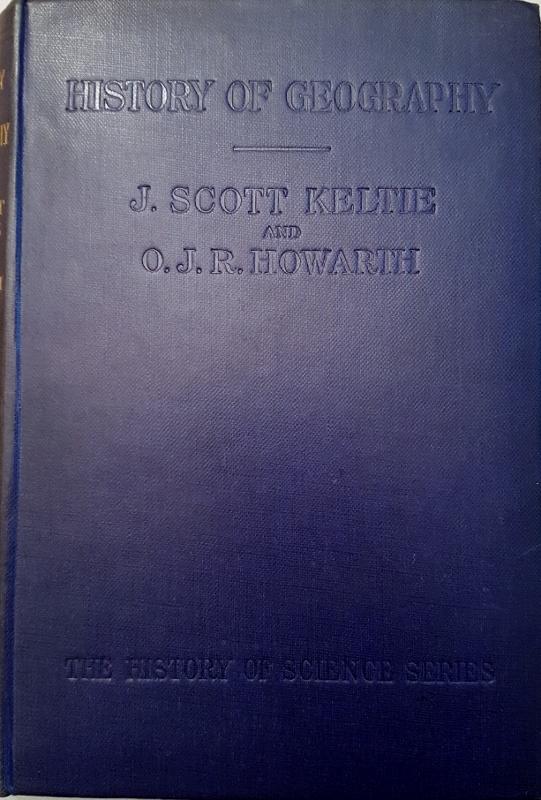
He co-wrote a history of Geography with fellow President John Scott Keltie, see references. This would have been a significant work at the time.

He wrote and edited numerous Geographical books for Oxford University Press, including 'A Geography of Ireland'. He co-wrote a book on the British Empire with fellow President A J Herbertson.

He was a great advocate of the Commonwealth replacing the Empire.

He even chose this theme for his Presidential Address, which was called "The Commonwealth in the Geography Syllabus".

"The British Association: A Retrospect" by O J R Howarth. The first edition, published in 1922 covers the years 1831-1922; a second edition published to coincide with the British Science Association’s centenary in 1931 covers the hundred years from 1831-1931.

He had a life long interest in the GA, but sadly died in 1954, just after completing his Presidential term.
This is described in this report on the following year's conference.

Some of his other publications:


Image result for O.J.R HowarthRelated image

His Presidential address was published in 1954 in 'Geography'.

I like his starting point about the positioning of the address within the President's tenure, and the ability to speak freely. He then said that having never taught geography he was going to tell geography teachers what he thought they ought to be doing, particularly teaching about 'world citizenship' and range further afield rather than a focus on the UK as it had at the time, from Howarth's perspective. This is an interesting position from which to start as GA President of course, but not uncommon in the earlier years of the GA.


It seems that he did a good job as President, as reported in the Annual Report for 1953


He wrote a 'History of Geography' with John Scott Keltie. This was published in 1913 and is available to read from this link.

References

If anyone knows anything more about this President, or has images, please let me know. I am lacking a decent photograph of this President.

One copyrighted image is here.
https://artuk.org/discover/artworks/dr-o-j-r-howarth-18771954-194318 - Artist is Robert Darwin.


Howarth, O. J. R. “THE COMMONWEALTH IN THE GEOGRAPHY SYLLABUS. Address to the Geographical Association.” Geography, vol. 39, no. 1, 1954, pp. 5–13. JSTOR, www.jstor.org/stable/40564669

Howarth, O. J. R. (Osbert John Radcliffe), 1877-1954. The British Association for the Advancement of Science: a Retrospect 1831-1921. London: The Association , 1922.

https://www.thegazette.co.uk/London/issue/31840/supplement/3791/data.pdf
- according to this he connected with the Naval Intelligence Division of the Admiralty, and his son served with the Naval Reserve I think according to this source
https://www.unithistories.com/officers/RNVR_officersH2.html
which describes him as a "scholar in geography".

1922: Book on the Scope of School Geography - book on the Internet Archive site.

The Study of the Geographical Environment - book on the Internet archive site.

https://openlibrary.org/books/OL7178190M/The_British_association_for_the_advancement_of_science
http://www.aughty.org/pdf/historical_geog_irl.pdf

A book called "History of Geography" was written with John Scott Keltie and published in 1913. It can be read on the Internet Archive site.


http://www.gutenberg.org/files/58349/58349-h/58349-h.htm - readable Project Gutenberg book which explores the 'history of geography"...

I contacted the British Association for the Advancement of Science to see whether they had an image, or more information on this President.
I'm still waiting for a response at the time of posting. Actually still waiting over two years later.

Update - this book was co-written with two others, including a familiar name in R N Rudmose Brown.


Readable on the Internet Archive and quite useful...

Updated August 2021
National Portrait Gallery photo.

Updated October 2023


He's on here somewhere then...


The Archives of Down House and BAAS have letters from Howarth in them, as does the Bodleian Library.

I discovered in an issue of the Elizabethan the confirmation that he went to Westminster School, followed by Oxford University.  This makes him an Old Westminster.

https://elizabethan.westminster.org.uk/Filename.ashx?tableName=ta_elizabethan&columnName=filename&recordId=609

The extra information about him being involved with the production of the geography section of Encyclopaedia Brittanica was also really interesting. Another avenue to explore...


The magazine also had information on his wedding.


Margaret Mackintosh RIP

Updated post. Sad news at the end of last week from colleagues who have organised the Charney Conference over the years of the passing of Ma...