Showing posts with label Educational Films. Show all posts

Saturday, 6 March 2021

Chris Durbin and SLN - 1997

A letter from Chris Durbin was published in the January 1997 issue of 'GA News' (No. 46)
Chris worked for some time with the BBC on a series of programmes in the futuristic sounding 2000 series e.g. Japan 2000 (an excellent series) and Brazil 2000, both of which were on heavy rotation in my classroom around that time. Cue the big telly being wheeled in from the office and the curtains being closed...

Chris was also one of the co-founders of the SLN Geography Forum which was behind a great deal of the innovative practice that started to be shared into the early 2000s. I've mentioned SLN Forum in a previous post. This was the Staffordshire Learning Network. It was co-founded with Kate Russell, and Andy Holt.

I know that there will be many teachers whose practice was influenced by this bulletin board, and will remember the supportive atmosphere it engendered.

I had a chance to meet Chris at the GA Conference in Canterbury, 2004, where he was presenting, and also met up at a later GA conference as well which Chris attended.

From the SLN Wiki:

The SLN Geography Forum began on 7th Sept. 1999 when Chris Durbin posted the first message. A week later he replied to his own message. On 16th Sept. Kate Russell posted her first message - no-one replied! That same day, the first of the local Staffordshire teachers, Richard West, posted a message. Chris Durbin provided the only reply. On the 21st Sept. Kate had a second try - no-one replied!

Chris now lives in the Netherlands, and would normally be travelling in his role inspecting schools around the world.
An article on SLN in TES provides this quote on its evolving nature:
"is a bit like a shanty town - it grows and changes with the people who do things".

References
The Forum link now tries to sell you Hemp Oil
https://www.tes.com/news/staffordshires-learning-net-unites-geographers-world-wide-web

Memories of SLN are welcome - I am sure there are many teachers of a certain age who remember being part of this community.

Monday, 30 March 2020

G. J. Cons - Educational Films

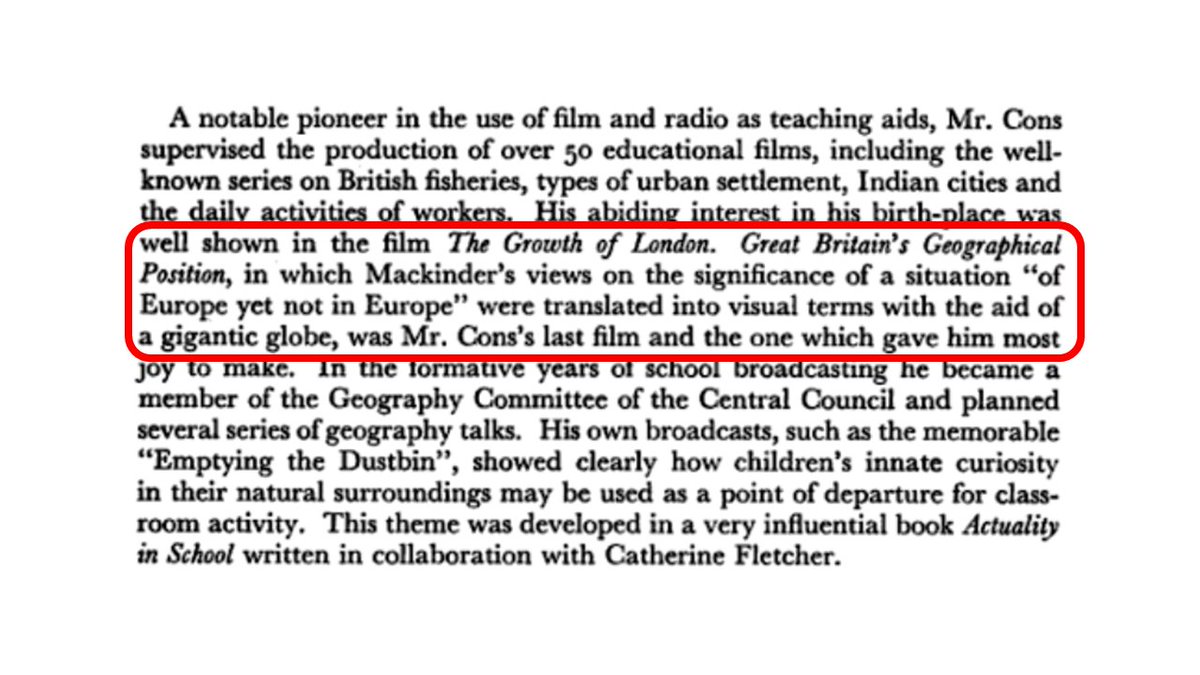
Brendan Conway noticed my post yesterday on the late George Joseph Cons and a reference to a film in his obituary as shown below.
Image
and sent a link through to the film. I need to find 'Emptying the Dustbin' next.


There is also a list of films made with his input on the BFI website which Brendan sent through.


I found a few on the British Council website - here's one on Newark

And here is another of his films in the BBC Schedules in 1938.

Image

Sunday, 29 March 2020

1961: Mr. George Joseph Cons

Updated September 2023

Just a note on the 1961 Presidency from 'Geography'. 
It appears that Mr. George Joseph Cons was due to have been the president for this year, but unfortunately died quite suddenly in 1960 so was unable to take up the post.


Mr. G J Cons was the author of a Handbook on teaching, and was also a member of the Standing Committee for Visual Aids (which later become Teaching Aids)

He was a Senior Lecture in Geography at Goldmsiths' College.

Balchin's Centenary volume talks about him playing an active role in the Association for many years.
He is quoted in a paper on the teaching of war and peace.
Front Cover
Cons wrote that Geography is probably the best equipped subject for training the young in ‘world citizenship’ and internationalism (Cons, 1932)

This quote was included in a GA Handbook edited by Miss D M Forsaith

Cons also Chaired a number of events over the years, including a debate on the future of Geography at the 1945 conference.

He was the editor of a handbook for Geography Teachers, published by Methuen in the 1950s

Mr. Geoffrey Hutchings was elected as President in his place at the Spring meeting of the GA Council.

I noticed that he was obviously involved in helping make a number of short TV pieces.
I noticed a few fieldwork related pieces on the channel called Talking Pictures TV which shows brief vintage documentaries and films in between vintage films.


An Obituary was published in 'Geography'


Thanks to Brendan Conway for the tipoff to these films in these tweets.
Here's the 2nd tweet


And here is the film, from the Huntley Film Archives


References

W. Wallace (1956) Geography in further education, The Vocational Aspect of Education, 8:16, 40-46, DOI: 10.1080/03057875680000061

“GEOGRAPHICAL ASSOCIATION. Annual Conference Discussions on the Future for Geography.” Geography, vol. 30, no. 2, 1945, pp. 50–62. JSTOR, www.jstor.org/stable/40563427

Bull, G. B. J. “GEORGE JOSEPH CONS.” Geography, vol. 45, no. 1/2, 1960, pp. 123–124. JSTOR, www.jstor.org/stable/40565120
If anyone knows more about Mr. G. J. Cons, or has an image of him that would be appreciated.


Updated September 2023

The McNair Report gets a mention here.

H was linked with the NW Kent Branch of the GA.
He served for many years on the Education Committee of the GA.


https://www.raremaps.com/mapmaker/6716/G_J_Cons - an article that describes his map collecting.

Cons was a pioneer in pioneer in the field of geography films for schools and authored ‘Films and Living Geography’, Sight and Sound, 4/14 (Summer 1935)

The following is excerpted from Traces

A very different proposal comes from one of the few professional geographers involved in animated mapmaking for documentary films – G. J. Cons, who collaborated with the British Film Institute as scientific consultant for the production of educational documentaries. Referring to the series Indian Town Studies made by Gaumont-British Instructional, Cons highlights that ‘these films were made effective geographically by the use of animated maps’. It is evident that this effectiveness is based on the power of the trace since it allows a purely explanatory discourse which consists of the plain transmission of data and information even though no element really legitimises it. For him, there is little difference here between animated maps and informational images; the constitutive properties of motion and animation, whose consequences are far from being neutral, is relegated to a blurry allusion to a ‘living accurate’ vision. Does this prove the ineffectiveness of the attempt to acquire animated maps into the project of geography for ordering the world, or does it confirm Cons’ statement that ‘the genius of documentary film reveal[s] the screen as a magic casement through which our geographical vision of the Earth and its peoples is heightened’? In other terms, does the author’s faith in documentaries negate any concerns about the fabricated spectacle that animated maps present?

Apparently, and with a certain naivety, Cons seems to advocate a perfect analogy between the map, the mirror, and the screen – a position that may surprise coming from a professional geographer. However, as explained by Priya Jaikumar in an insightful essay on the series, the result is not the faithful and plain reproduction of Cons claims but rather an attestation of the role of animated maps in the building of that ideology that put together positivist, modernist, and colonial contents: ‘[t]owns in India were visualised to make them intelligible and transparent, with vision transforming a place, its people and fullness of their lives, into abstract space.’ Again, thanks also to the power of the trace the pretensions of correct visualisation and geographical accuracy have been overthrown and transformed into something completely different: the colonial fiction of mastery and control through alleged scientific instruments used in narrative and visual devices for making this very same fiction true.

Giuseppe Fidotta: Animated maps and the power of the trace.

He also participated in the creation of visual maps such as the one here.

https://www.raremaps.com/gallery/detail/65476/the-peopling-of-the-usa-cons


If anyone can find an image of G J Cons that would be appreciated.

Friday, 28 February 2020

1975: Bourne: a Town Study

Bourne is a town in Lincolnshire. This was the location of filming for a series called 'Studying the Landscape'. Over the years, there has been some education programming, and many GA Presidents were great supporters of this sort of resource.


Presented by David Stewart
Viewable for free on BFI player
https://player.bfi.org.uk/free/film/watch-bourne-a-town-study-1975-online

Pencils, notebooks and microphones at the ready! The people and industries of Bourne are put under the spotlight by the local kids in this unusual geography teaching film for schools. There are some surprising discoveries to be made: as well as glasshouses and iron foundries, the kids get to study the factory floor of a plastic toy manufacturer and interview the boss of racing car specialists BRM.

It's amazing how similar some fieldwork enquiries are today...
I wonder whether Bourne market is still as popular... 

Any other classic schools TV that people can remember? 
I remember the countdown clock before a programme started.

Perhaps you had them on VHS cassette - here's Margaret Roberts in 'Teaching Geography' on that topic...

Monday, 2 December 2019

Technology of the Day


Hands up who remembers these.... does anyone have memories of their use in the classroom?

I remember the cassette tape with the beeps to tell you when to move the slide on by turning the reels.

Tuesday, 20 August 2019

BBC: educational broadcasts

Geography teachers have always been enthusiastic viewers of videos. The connections that the GA has with the production of these goes back to the beginning.

The BBC first started to explore educational broadcasts in 1924, shortly after it was founded. Sir Francis Younghusband (who I have mentioned elsewhere on the blog) contributed to a film called "Climbing Everest". Talks between the GA and the BBC included Fleure, Dudley Stamp, James Fairgrieve and G. R. Taylor. 'Travel Talks' were developed, and the early radio shows were hampered by a lack of visuals, which were needed for context.


References

“How B.B.C. Lectures and Films Are Utilised.” Geography, vol. 15, no. 8, 1930, pp. 672–672. JSTOR, www.jstor.org/stable/40559754.

Fairgrieve, J. “USE OF BROADCASTING IN TEACHING GEOGRAPHY IN SCHOOLS.” Geography, vol. 16, no. 1, 1931, pp. 34–44. JSTOR, www.jstor.org/stable/40557798.

Margaret Mackintosh RIP

Updated post. Sad news at the end of last week from colleagues who have organised the Charney Conference over the years of the passing of Ma...