Showing posts with label Ashley Kent. Show all posts

Wednesday, 12 May 2021

1997 - Strategic Planning

An article from Ashley Kent in the GA News outlined the strategic plan of the time. The GA has had a series of strategic plans for some time, which operates on a five yearly cycle to help guide activity, and ensure that the association continues to have an impact in the areas where it needs to. The most recent one started in 2020 and runs to 2025.
GA Magazine has an editorial which outlines progress in each issue.

Sunday, 14 February 2021

The move to Solly Street #3

I've been writing a few posts about the GA's move to Solly Street. Here's the third and final one.

The next person I consulted over the move to Solly Street was Ashley Kent, who was mentioned by Frances Soar as having been present in the car when the building was first spotted.

160 Solly Street has imposing steel doors, which were manufactured in the building itself as it was owned by a steel fabricator.

When you enter the building, there is also a stair case with steel bannisters.

I hadn't previously been aware of the reason why there so much steel around the place, although Sheffield is 'steel city' of course (and my dad was a steelworker for over 40 years).

Ashley gave me his memories of the move to Solly Street:

"My flawed - no doubt!? - memories were of driving round...with Frances I am sure at least, looking at premises in the Meadowhall area.
These were very much new retailing / warehousing / still industrial areas away from the city centre, and the GA staff were a little unhappy about that! 
Also we looked at rental premises at / next to the station but clearly inadequate re size / cost, but accessible for many! 
Solly Street felt like a rundown inner city area but with a big advantage of size and rent. Bizarrely it seems to have been a good decision!"

The premises next to the station were also mentioned by Peter Fox, who I also consulted about this move.

"The recollections are much as I remember them. The Fulwood Road site had its attractions - a nice old stone house with the ground floor used as the GA Library with oak shelves and members of staff housed in different 'bedrooms'. The search for a new home too is as I remember it. I was involved in the search - two properties we looked at were the old bus garage out towards Meadowhall and the refreshment rooms at Sheffield railway station. Very grand still with a huge long mahogany bar in a very good location but the storage space was very limited.
The fire of some of the book stock did mean we had a good clear-out of old stock but we were lucky to keep the Fluere Library books and a complete run of the journals which were not stored there. We got a very good deal on the building which the daughters of the previous owner wanted to get rid of at the time and we did not have too much work to do to get it into shape - it had been a specialist stainless steel factory. We had an official opening by Wendy Morgen - President at the time but most of the GA meetings were still held in London."

It turned out we had our beermeet in the premises that Peter and Ashley looked at the last time that the GA was held in Sheffield.

Image: Alan Parkinson, shared under CC license

Beermeet picture taken by Matt Podbury


Sunday, 31 January 2021

Neville Grenyer

Neville Grenyer died in 2008.

He was a significant figure in geographical education and a teacher at Haberdashers' Aske's School, which also has a connection with Michael Morrish. He was one of a group of teachers who saw the potential for changing the subject in the 1970s, eventually becoming an HMI. He was one of the authors of the Oxford Geography Project, along with John Rolfe, Rosemary Dearden, Ashley Kent himself, and Clive Rowe.


He was a colleague of Ashley Kent and met on PGCE placement at Haberdasher's Askes school.

He studied for his PGCE at King's College London before moving to St. Dunstan's College where he joined a department led by Brian Fitzgerald. Fitzgerald was working with John Everson to publish books which changed a lot of teachers' practice. Neville ended up marrying Rosemary Deardon and they had two children together. He also wrote the very popular book (I have a copy in my cupboard) 'Investigating Physical Geography' while at Winchester College.

He retired from his HMI role in 2006.

Reference

Obituary: By Peter R Smith in 'Geography' in 2009

https://www.tandfonline.com/doi/abs/10.1080/00167487.2009.12094255


Wednesday, 27 January 2021

St. Catharine's College, Cambridge

I have previously mentioned St. Catharine's College, Cambridge, and have heard a lot about it via Presidents who went there themselves.

Ashley Kent told me something about this, as being one of the 'hotspots' for Geography - something I'm going to develop a little more perhaps, by focussing on some of these other hotspots such as Hull and Bristol.

A number of Presidents can connect themselves to this college in some way, and I have previously blogged about them.

The St Catharine's College website is here.

There is an archive of magazines dating back many decades, and in which one can find mentions of the GA Presidents who have been connected with the college. I had a quick look and 

Here's Ashley Kent with some memories of St. Catharine's:

My college...St Catharine’s College Cambridge....has always been a Geography ‘hotspot’....a great place where quite a few people who were prominent in the GA...attended.
These include...Steers, Balchin, Spooner, Kent, Bradford, Keeble et al. Many of us were very fortunate to have been tutored by ‘Gus’ Caesar.......arguably the ‘source’ of an extraordinary group of geography professors across the world.....Haggett/Dury/Hall/Randall/ et al...a remarkable ‘father figure’ to many.

Someone who Ashley mentions is 'Gus' Caesar.

More on Gus was added in a separate blog post previously.

J A Steers was someone who was very definitely linked with the college.

His memorial has been mentioned as well. It can be seen in the college magazines, which would also reveal other details on the geographers who passed through the college. This was a signed silver salver presented to J A Steers in 1966 on the occasion of his retirement:

Sunday, 24 January 2021

The move to Solly Street #1

I've previously blogged about the GA's move from 343 Fulwood Road to Solly Street in 1996-7

Fulwood Road was the GA's HQ from the mid 1960s to the late 1990s.

Frances Soar, Chief Adminstrator of the GA for many years got me started on some of her memories of this time. She was involved in assisting with the move, and some additional complications from the time, which I have blogged about previously.

The old Roman Catholic area of St Vincent's is certainly worth further study - an excellent book about it was published by the Church when they moved up to Crookes: it's available on line The Sheffield Indexers - History of St Vincents written by Ted Cummings.
Frances is the first of several people who will share their memories. It is a pity the memories of some of the other moves of the GA are not so easy to collect.

Frances told me:

At the back of Solly Street when we first moved in, before the block of flats just above us on Solly St. was built, there were still apple trees from the time when the area had old housing, and I once met a lady who remembered visiting her grandparents in a house there when she was small. Some of the trees were still there in my time, by the access drive to the back yard.

343 Fulwood Road was a lovely old house, but totally impractical for housing the publications business that had become such an important part of the GA's service. Deliveries of new publications were by then arriving shrink wrapped on pallets in huge delivery vehicles that couldn't get down the narrow, bendy, drive. 
We had to unload boxes from pallets on big lorries parked on the main road, and cart the heavy boxes down to the house one by one, sometimes reversing my poor little Austin Metro up the drive and back down again with a few boxes in the boot each time, all under the impatient gaze of the lorry driver who was anxious to get to his next drop. 
Once inside, we had to cart the boxes up steep steps to the first floor, where they filled the spaces around and under our desks until sold, or were hauled up to the attic where we nervously stacked them as close to the walls as possible, hoping that the weight wouldn't bring down the ceiling.

Eventually we were forced to move most of our stock to the premises of a local storage company. Unfortunately, they moved our stock to a less secure location without telling us, and a fire there destroyed the lot. 

Lack of storage space also meant that each quarter we had to hope that all the deliveries of journals and their inserts would arrive at exactly the same time, on the same morning and at the same place (a local church hall) so that we could prepare everything for mailing, helped by a small army of volunteers. I lost count of the times we had to postpone the whole exercise because one journal had been delayed for some reason.

It was clear that we needed either to 'outsource' everything, or find a proper warehouse and packing space, as well as offices for the GA staff and meeting rooms for the GA committees, ideally within easy reach of the railway station and with good vehicle access for deliveries.


The problem was finding suitable alternative premises. 

After careful consideration, the GA decided to stay in Sheffield, so we started looking locally, discovering all too soon that whilst it was fairly easy to find a suitable warehouse with a small office, or suitable offices with a tiny storage area, finding the two combined was a real challenge. With the help of former GA President Professor Stan Gregory, who lived in Sheffield and who volunteered to take part in the search, we looked at various possible places in and around Sheffield, eventually drawing up a shortlist for further consideration. 
On a hot June Saturday in 1996 my Metro was pressed into service once again to take several Officers including I think Ashley Kent and Neil Simmonds to look at a few possible buildings. At some point I pulled off the road close to the town centre for us to 'take stock' before the visitors had to catch their trains home, which was when Ashley (I think) spotted a 'to let' board on a nearby building. Peering at what we could see of the empty premises we realised it was worth further investigation. 

A little bit of serendipity then in the choice of location.

Solly Street is located in an area called 'St. Vincent's', once the heart of Sheffield's Catholic community, which had developed into a centre of old Sheffield industries such as toolmakers and knife manufacturers. 
By the 1990s, further changes were happening, as manufacturers with viable businesses began to move to more suitable premises elsewhere, and others, sadly, disappeared altogether. Many of the old church buildings along Solly Street were becoming run down, St Vincent's Church itself having been empty for some years. 

I occasionally used the parking business which opened up in the old church yard as an overflow option when the spaces outside Solly Street were full, or were needed for visitors.

Our building had been built by a stainless steel architectural fabricator for his own business - hence the smart stainless stair rail and front door we inherited. 
This I did not know!
After he retired it had been let by his widow and daughters to various companies. 
As our GA geographers astutely spotted, this was a good time to take up a lease there, as the area had huge but as yet unrealised potential for upgrading. This is of course what has happened, with old factories and patches of wasteland replaced by modern apartment blocks, and the former church and its ancillary buildings improved for other uses. I remember watching foxes in the waste ground opposite the GA.

Whilst preparing the staff for the move, Frances timed how long it took to walk up to the city centre and what sort of walk it would be. Staff were going to miss the shops, bank and other services at Broomhill so it was helpful to know they could easily get to and from the city centre. 

Coincidentally, two former members of the GA's staff at Solly Street now run a business in Broomhill called Ginger. More on Lucy Oxley and Anne Greaves' involvement with the GA as we get nearer to the present day.

The Trustees agreed to take the Solly Street lease a quarter before the Fulwood Road lease expired, so we were able to prepare the old premises for our departure and the new premises for our arrival without disrupting services to members. It was quite moving to say goodbye to a building that had been such an important part of the GA's history, with its impressive fireplaces and other original features no longer boxed in or covered up, looking much more like the proud private house it once was, ready for new occupants.

An early task at Solly Street was to persuade the authorities to give the building, then called 'Greco House', a proper address with a street number - a surprisingly complex exercise. 
The GA did contemplate inventing another name for the building, but characteristically chose to be practical rather than pretentious.

Further memories of the move to Solly Street to come...

Wednesday, 20 January 2021

Gus Caesar

Updated August 2023

Gus Caesar was described by former GA President Ashley Kent as arguably the ‘source’ of an extraordinary group of geography professors across the world: Haggett / Dury / Hall / Randall et al...a remarkable ‘father figure’ to many.

He was a tutor at St. Catharine's college, University of Cambridge. (Twitter account link)

He came up on a £20 Exhibition to St Catharine's College in 1933, gained double Firsts in Geography and was elected to a postgraduate scholarship in 1936. After the war he returned to a university lectureship and fellowship at Selwyn College and in 1951 moved back to his old college. For the next 30 years he was to hold almost every senior college post except that of Master.

He was Senior Tutor for Geography, working with Dr Keeble.

The above text is taken from his Obituary, written for the Independent newspaper by the famous geographer Peter Haggett.

Peter Haggett also said of Gus:

No one who experienced the hour-long inquisitions in his rooms on Main Court at St Catharine's, delivered through a haze of Three Nuns pipe smoke, will forget the process. Essays were disassembled, the reasonable parts retained, new components added, and the whole reassembled into something that was well ordered, logical and, above all, geographically sound. 
He had an innate sense of what gave coherence to a geographical point of view and drove that relentlessly into those he taught.

A story from the memorial address for J A Steers, who taught Gus:

Gus Caesar's splendid story of his own undergraduate days, when he was woken one morning, admittedly somewhat late, by a severe pain in his chest. Opening bleary eyes, he discovered that the cause of this pain was a walking stick, jabbing him in the ribs. And at the other end of the stick was, of course, Alfred, immaculately dressed as usual, with hat and briefcase, exclaiming "get up, get up, I'm lecturing to you in ten minutes!" 

References

https://www.independent.co.uk/news/obituaries/obituary-gus-caesar-1600981.html - obituary in the Independent newspaper

With growling voice and the massive bulk of a second-row forward, Gus Caesar appeared ferocious. And as a Dean on the warpath after a rowdy boat-club supper, this image could stand him in good stead. But the reality was of a gentle and ever kindly man for whom the individual undergraduate (particularly if from St Catharine's) could always ask for support. 

His college house on Grantchester Meadows was a haven through which hundreds of visitors passed each year. 

His wife, Margaret, and daughter, Pat, could calculate to a nicety the strength of undergraduate appetites after the towpath walk back from Grantchester.

https://www.society.caths.cam.ac.uk/home/?m=page&id=1923 - St. Catharine's Society Journals

Image above is taken from the St. Catherine's Society Journal

https://www.society.caths.cam.ac.uk/Public_Magazines/1971r.pdf 

https://www.society.caths.cam.ac.uk/Public_Magazines/1987r.pdf 


Updated August 2023

Sir Peter Hall - Town Planner

https://discover.ukdataservice.ac.uk/assets/qualibank/6226themext016.pdf

I was taught by an outstanding teacher in economic geography, a guy called Gus Caesar, whose full name was almost unbelievably Alfred Augustus Levi Caesar, and he was a legendary figure in British geography...  He was not a researcher, he’d got a very poor research record, I don’t think he’d have got tenure nowadays, but he was an absolutely inspiring teacher in close supervision, because the style was, you would write an essay every week, of course, and he would read it, and he would tear the essay to pieces!  He’d say, “Look, old lad” – his favourite term – “Look, old lad, you’re putting the conclusions before the evidence.  Say what you think the hypothesis is, and then produce the evidence carefully, in logical order, and then the conclusions”.  He absolutely [analysed] your essay.  Everyone who was taught by Gus, has this extraordinary kind of intellectual discipline of being able to argue A to B to C to D, which none of us ever lost, I think.

https://discovery.ucl.ac.uk/10042912/3/Hebbert_PH%20for%20GBS%20final%20ms.pdf

His path was determined by the offer of a geography scholarship at St Catharine’s College. Hall found Cambridge initially uncongenial, what with the snobbery of privately educated undergraduates towards provincial grammar schoolboys, the relatively low 3 academic esteem of his chosen discipline, and the bias of first year teaching towards the physical geography he least enjoyed. 

But in 1951 the situation was transformed by the college's appointment of A.A.L. Caesar (an alumnus) to be Fellow and Director of Studies in Geography. 

As the only Cambridge college offering geography scholarships, St Catharine’s attracted the pick of the crop and for the next 29 years Gus Caesar was their academic mentor. The weekly supervisions in which Caesar deployed his ‘formidable powers of critical dissection and logical rearrangement’ (Haggett 1965, ii) nurtured many rising stars of the discipline (Johnston and Williams 2003, 309) and Hall recollected them as the high point of his undergraduate career (2003b, 2014f). 

He had already learned from George Orwell how to write clearly without resort to jargon; now he learned how to construct arguments, marshal empirical evidence, and submit to relentless self-criticism—‘progress is a mistake-making business’ was one of Gus’s aphorisms. 

More than this, Caesar was a committed advocate of geography as an applied science, with regional planning as its practical outcome. He had coauthored the chapter on the ‘North-east of England’ and written those on ‘Gloucester–Wiltshire–Somerset’ and ‘Devon and Cornwall’ in G.H.J. Daysh’s Studies in Regional Planning: Outline Surveys and Proposals for the Development of Certain Regions of England and Scotland (1949). The authors conceived regional planning to be a self-contained policy process in which the geographer ascertained trends, constraints, and requirements so that planner might devise proposals for administrators to implement. 

For his presidential address to section E of the British Association for the Advancement of Science at Southampton in August 1964, A.A.L. Caesar spoke on ‘Planning and the geography of Great Britain’. He emphasized the inexorable geographical trends of economic centralization on South-east England and the midlands, the decline of peripheral regions, road transport growth and extensive railway closures. ‘The Twentieth Century pattern must be accepted—there is need to contemplate that of the Twenty first Century. 

If Megalopolis is coming, let us at least be aware of it and let us plan for it’—a challenge for geography indeed (1964, 240). 

Caesar himself had little direct involvement in public policy, but his teaching of geography as an applied science was profoundly influential, as seven of his distinguished former students—Michael Chisholm, Peter Haggett, Peter Hall, David Keeble, Gerald Manners, Ray Pahl and Kenneth Warren—acknowledged in their Spatial Policy Problems of the British Economy (1971).

Memories from the late David R Wright - another legend who has appeared on the blog

https://www.geog.cam.ac.uk/files/alumni/landmark/landmark1/landmark1.pdf

Saturday, 16 January 2021

1996: W(illiam) Ashley Kent

Updated August 2023

Ashley Kent had a long career as an academic geographer.
As with quite a few other former GA Presidents, Ashley Kent worked at the Institute of Education for many years.

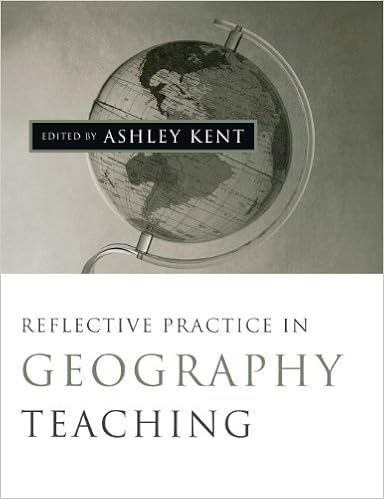
I own a copy of the book whose cover is shown below, which has proved useful in the past, and has several chapters written by a number of other former Presidents as well. Like many of his books, it has run to several editions.

His PhD thesis was on the adoption of CAL (computer assisted learning) and acts as a useful summary of the development of IT in Geography classrooms - this connects with the work of another President: Peter Fox, (and I will discuss his role at the appropriate time). See the link at the end of the post to download a copy if you are interested.

He also wrote an influential book with Michael Bradford (another former President, who sadly died in 2019) called just 'Bradford and Kent' by the many teachers who used it. I mentioned that book in a recent blog post.

He was also part of the authoring team of the Oxford Geography Project, which I used back in the day when I first started teaching. Copies of this can still be obtained second hand.

Ashley proved elusive to track down for some further information for some time, from the start of my blog writing. 

I was able to swap e-mails with Ashley earlier this year, and he provided me with further information, which is now included below:

I was born in 1945. 
I attended St. Catharine's college, Cambridge - as did at least three other GA Presidents including Derek Spooner. 
My teaching career began as a student teacher at St Dunstan’s College, Catford where Brian Fitzgerald was head of department and Neville Grenyer a member of staff…both became HMI’s!

I then taught at Haberdashers’ Aske’s School, Elstree where my colleagues included John Rolfe, Neville Grenyer, Rosie Grenyer and Clive Rowe.

I was then head of department at John Mason School, Abingdon with Eleanor Rawling as a close colleague.
What a powerful department that must have been!

Eleanor and I then moved to the Geography 16-19 Project at the Institute of Education with Michael Naish.
I then became a lecturer and eventually a professor and pro-Director at the Institute of Education.

My major textbooks were the Oxford Geography Project written by the Haberdashers’ team for years 7-9; and two textbooks written with Michael Bradford: Human Geography: Theories and their applications (1977) - and Understanding Human Geography: People and their changing environments (1993). 
Both were aimed at A level and first year university students. 
All published by Oxford University Press…and fortunately sold quite a few copies!?

I joined the GA in 1969 so have been a member for over 50 years!

Further details from his CV:
He has taught in a variety of secondary schools; the University of Wisconsin-Madison; the UK’s
Open University and was Associate Director of the Geography 16-19 Project a nationally funded
curriculum development project.
He has longstanding professional and research interests in: curriculum development and evaluation;
innovation and change (the focus of his PhD work); teaching strategies including fieldwork; the
marketing and image of geography; the school/HE interface; information technology, including
remote sensing; developments in human geography; 16-19 geography; initial teacher education;
stereotyping and bias; and environmental hazards.
He has directed a number of research and development projects including: Project HIT (Humanities
and Information Technology); Remote Sensing in the Geography National Curriculum Project; Centre
for ‘A’ level Curriculum Support; Eurogame Project, a large scale European funded multi media
development; Geography 16-19; Learning Geography with Computers; YoungNet; DUNES; and
pillar leader of the HERODOT Project.

On his involvement with the GA, Ashley sent me this resumé:

He has been fully involved with the Geographical Association (GA) since 1969. He was on GA
Council for 15 years and has been its President. He was a member of COBRIG (Council for British
Geography) and has been its chairman. Over the years, he has been engaged in a number of
geography education research projects, both in the UK and for the International Geographical
Education (IGU), Geography Education Commission. He has presented papers at IGU conferences
across the world and was both a full member of the IGU Geography Education Commission and a
former chair of the British Sub-Committee. He has published widely in geography education and
education both for professional and academic audiences. This has included a number of successful
school and university textbooks.
The common thread in his career has been an involvement and passion for education at a variety of
levels and specifically curriculum development and teacher education.

I tracked down his PhD Thesis from 1996, which was titled:
"Process and Pattern of a Curriculum Innovation".

The innovation in question was introduced at the start:
The innovation in question is the use made by secondary school geography departments of computer assisted learning.
Ashley mentioned 2 key documents that sum up his approach to Geography

‘Geography’ October 1997 ‘Challenging Geography’----my Presidential Lecture presented at the Institute of Education

KENT, ASHLEY. “Challenging Geography: A Personal View.” Geography, vol. 82, no. 4, 1997, pp. 293–303. JSTOR, www.jstor.org/stable/40572948. Accessed 15 Jan. 2021. 

James Fairgrieve featured in the Presidential Address, where Ashley outlined his life and also the strong connections between the IoE and the GA. It is well worth reading to get an idea for the links and the changing nature of Geography. 

Ashley provides additional detail on Fairgrieve's life.

His inaugural professorial lecture in 2004 entitled ‘Windows on Geographical Education’….published by the University of London Institute of Education…2004

He was the tutor on the IoE's MA in Geography Education for many years. This went online from 2001, having been offered at UCL since the 1960s
He contributed to an IoE publication on retired academics in 2009, and was described as follows:

Ashley Kent retired as Professor of Geography Education at the Institute of Education, University of London - the culmination of a lifetime as a geography teacher.

“Exciting demanding, relevant and worthwhile – geography prepares pupils to critically understand and fully participate in the changing worlds in which they live” — Ashley Kent

In 2003, Chris Kington asked a number of former Presidents what had sparked their passion for geography. He lent me the letters and Ashley replied to Chris.
He talked about a "gradual realisation" that geography was for him. His geography teacher at school was described as "rigorous - a bit terrifying and gave us lots of autonomy...". He also remembers taking part in the 2nd Land Use survey, at Pilling Marshes and realising that it was all 'rough grazing'. He remembered his PGCE year and the influence of Walford and Fitgzerald et al. He also remembered his first year teaching at Haberdasher's Aske.
Many thanks to Chris Kington for the loan of the letters.
Ashley told me about his connections with Hull University and Derek Spooner, with whom he led celebrations of the life of Michael Bradford (far more on Mike to come as we get closer to the present day)
He also had memories of my own PGCE tutor at Hull: Vincent Tidswell. He told me:
Vincent I knew through his work and the ‘new’ geography ....his Pattern and Process in Human Geography was followed by Keith Hilton’s Process and Pattern in Physical Geography. 
Keith was a colleague of mine at the Institute of Education....and knew Vincent through working at Hereford College of Education. 
Vincent also had links with Brian Fitzgerald who I met at St Dunstans College. 
That was for me as a keen young man/geographer....a really exciting time...we felt very much at the frontier of the ‘new’ geography, both new in terms of content and pedagogy. 
Oxford Geography Project was really at the leading edge....as were the Schools Council Projects....GYSL and 14-18 ...and the one I was very much part of...the 16-19 Project. 

People like Brian, Rex et al were at the forefront....it was great fun being part of it! 
The first book Mike and I wrote was a direct effort to help teachers to keep up to date with the ‘new’ geography then in several school and university syllabuses. 
Of course Mike and I were helped by being a part of Cambridge and US developments....we went to Madison Wisconsin after Cambridge...where a great deal of that stuff was going on.

Exciting times, and Vincent was very much part of that. I like to think he passed on a little of that love for exciting new approaches and pedagogies to his trainees, of which I am proud to have been one. I remember using GYSL in my first job in January 1988 at John Flamsteed School in Denby, Derbyshire.

Ashley also shared some memories of the next important phase in the GA's History: the move from Fulwood Road to Solly Street, where it has its HQ to this day. Ashley is amongst the Presidents and former staff who were involved in locating the GA's new premises. That story will be told next.

Image from GA News.

Update January 2021

Some memories of his Presidential conference from Ashley Kent.
In my Presidential Year we had the Conference at the Institute on Bedford Way, which I thought was appropriate given the long-standing links between the IOE and the GA. The Presidential Dinner was held at the Imperial Hotel on Russell Square. My guest of honour was the Crown Princess of Thailand: a much revered member of their royal family: very environmentally aware and active. He had been suggested by Professor Philip Scott: an extraordinary and alternative academic from SOAS. 
The assembled diners were kept waiting by the Princess, who had been having tea with Prince Charles at Highgrove and then visiting SOAS.
We were kept waiting by the guest of honour for quite a while...so much so I suggested more booze was supplied to all the waiting guests.
On her eventual entrance/arrival the assembled throng, on the advice we were given, all stood up and did the slow handclap, which apparently in Thailand is a mark of real respect.
She was accompanied by two armed generals and sat next to me at the top table and the generals became anxious ( I was told by folk sitting with them at one of the tables) when I engaged in a lively/animated story involving props, including a scroll given to her in memory of her visit.
It was all right on the night! 

Is there anyone who was there and has their own memories of this event?

References


KENT, ASHLEY. “Innovation, Change and Leadership in Geography Departments.” Geography, vol. 91, no. 2, 2006, pp. 117–125. JSTOR, www.jstor.org/stable/41555403. Accessed 15 Jan. 2021.

Presidential Lecture, exploring the life of James Fairgrieve
KENT, ASHLEY. “Challenging Geography: A Personal View.” Geography, vol. 82, no. 4, 1997, pp. 293–303. JSTOR, www.jstor.org/stable/40572948. Accessed 15 Jan. 2021.

I would be pleased to receive any further details of Ashley Kent's time as GA President.

Updated August 2023

A link with the forthcoming GA President (as I write this) for 2023-24: Denise Freeman.

Monday, 11 January 2021

Bradford and Kent

This book was known by that name, rather than its actual title, which was Human Geography: Theories and their Applications.

Ashley Kent tells me that it "sold rather well" and I'm not surprised as we certainly had quite a few copies in the cupboards along the corridor outside the geography rooms in my first page. 

It was published in 1977, and went through several editions over the years.

This 2nd book below, written by the same authors was published in 1993, and we had copies of this as well.

Any memories of using this book?

Wednesday, 30 September 2020

UCL IoE and the GA

Updated January 2021

There has been a long association with UCL IoE and GA Presidents over the years, and also the Chief Executive Professor David Lambert of course.
Some Presidents were involved in teacher training at the Institute of Education, others were academics. Others gave lots of service to the GA but were not Presidents, such as Bertie Roberson, who served on the Secondary Section and other committees for many years while working at IoE

In 2004, there was a Centenary celebration and reunion and several former GA Presidents were there, notably Bill Mead, who is the next President to be featured on the blog.

A Geography Education MA has been offered for over 50 years.

Also worth exploring the following GA Presidents who have a connection:
Norman Graves
Molly Long
Ashley Kent and others... 

When I started to volunteer and serve on the GA's Secondary Phase Committee in 2004 (which seems like a lifetime ago now) we used to meet on Saturdays in the geography lab at UCL with the wave tank and other equipment, on the Bedford Way site. I also led quite a few CPD sessions, and attended others, in the hotel opposite the IoE.

I also made a few visits to the office shared by David Lambert and John Morgan, and later Alex Standish, over the years, including when I worked on the GeoCapabilities project. I attended several seminars there over the years as well, including a memorable one with Michael Young and Margaret Roberts, and also David Lambert's Professorial lecture "Lost in the Post" for which I produced the visuals for David's presentation.

James Fairgrieve was perhaps the most famous IoE colleague of them all, and featured in the Presidential Address of the 1996 President Ashley Kent, where he outlined his life and also the strong connections between the IoE and the GA. It is well worth reading to get an idea for the links and the changing nature of Geography. Ashley's Presidential Address was given at the Institute of Education. Fairgrieve worked from 1912-1935 at the IoE (previously known as the London Day Training College) and became GA President when he retired.

Reference

KENT, ASHLEY. “Challenging Geography: A Personal View.” Geography, vol. 82, no. 4, 1997, pp. 293–303. JSTOR, www.jstor.org/stable/40572948. Accessed 15 Jan. 2021.

He provides additional detail on Fairgrieve's life.
Source:
https://www.geog.ucl.ac.uk/news-events/news/alumni-news/former-students-newsletters/FSN%2015.pdf  (PDF download)

All memories of UCL and the GA welcome as we move into the final year of the blog project and enter the 1980s...

Thursday, 9 July 2020

1970: Mrs. I Molly Long

Updated August 2023

Molly Long was a tutor in the School of Education at the Institute of Education. She was particularly interested in education, and the role that children had to play in their own conception of the subject.
Her Presidential Address was called 'The Interests of Children in School Geography' and as such was a rare Presidential address with a focus on pedagogy and the classroom.


She explored the sorts of activities that children said they did and did not like, following a survey which was sent out to the GA membership (an innovative move at the time.... much easier to do these days with Google Forms).

When she was younger, Molly gained a scholarship to Godolphin and Latymer School, before studying at Bedford College, London, her home city. She trained as a teacher at the University of London Institute of Education (ULIE) in 1946, and became a lecturer in teacher education in 1948.

At that time Neville Scarfe had recently been appointed to succeed James Fairgrieve as Head and sole member of staff of the Geography Department. Molly must have made a great impression on Neville Scarfe, as after teaching in schools in Reading and Beckenham, she was appointed to the Institute's staff, in 1946 as Assistant Tutor, and in 1948 as Lecturer in Education (with special reference to the teaching of geography). There are some strong links here with the history of the Association.

When I trained as a geography teacher in 1949-50, Molly Long was one of the three tutors in the Geography Department working alongside Neville Scarfe and Reginald Honeybone

(from Norman Graves' Obituary of Molly)

In 1952, Molly published work in 'Geography' on children's reactions to geographical pictures. This was a main research interest.

In 1969, it was announced that Molly would be GA President in the Annual Report, published in 'Geography'


Molly worked at the Institute of Education until her retirement in 1976.
She worked on quite a few publications, which were influential at the time, particularly following the Second World War.

Books included:
World Problems: A Topic Geography (Secondary school series)
Teaching Geography - published in 1966 - (https://www.abebooks.co.uk/9780435345402/Teaching-Geography-Molly-Long-Robertson-0435345400/plp ) - a blog post on this book was added a few weeks ago - I have a copy of the book in my library.

Rex Walford describes her work with Bertie Roberson (a colleague at UCL) to produce a secondary teacher manual in the 1960s. They both employed "creative pedagogy" at a time when the old style geography was beginning to be challenged.
The preface of their teacher manual sets the tone from the outset:

"The whole trend of our argument is that children should be led to think about the subject matter offered.....the idea of geography as a 'soft option' for the unintelligent remains".

Molly's Presidential Lecture was called "The interests of children in school geography".

The 2nd chapter of her book, Rex explained, featured a 'Regional' approach. This was going to be a feature of geography for some decades to come. When I first started teaching 'A' level Geography in the late 80s, the Cambridge board specification we used was regionally based.

Molly died in 1997, and her obituary was written by the textbook author (and former GA President) Norman Graves.

I am grateful to Alex Standish from the IoE for the image of Molly, from a framed picture which is in his office at UCL - a reminder of the legacy of the past for today's teacher educators.

References
Long, Molly. “CHILDREN'S REACTIONS TO GEOGRAPHICAL PICTURES.” Geography, vol. 38, no. 2, 1953, pp. 100–107. JSTOR, www.jstor.org/stable/40563406.

https://issuu.com/davidward7/docs/ora_newsletters_volume_iii_1990-1999 - memories of Molly Long by her husband

LONG, MOLLY. “The Interests of Children in School Geography.” Geography, vol. 56, no. 3, 1971, pp. 177–190. JSTOR, www.jstor.org/stable/40567553.

Long, Molly. “CHILDREN'S REACTIONS TO GEOGRAPHICAL PICTURES.” Geography, vol. 38, no. 2, 1953, pp. 100–107. JSTOR, www.jstor.org/stable/40563406

Graves, Norman. “I. L. M. (Molly) Long (1916-1997).” Geography, vol. 82, no. 2, 1997, pp. 148–148. JSTOR, www.jstor.org/stable/40572829

Complex Locations: Women's Geographical Work in the UK 1850-1970By Avril Maddrell

Her main biography details were sourced from this book, which has also informed numerous other entries on the blog regarding the important female contribution to the GA over the decades.


Source:
https://books.google.co.uk/books?id=p_xfuY8CJ48C&pg=PT115&lpg=PT115&dq=%22marguerita+oughton%22+sheffield&source=bl&ots=xln_U09sEO&sig=ACfU3U0BVaFI8t74PC7xxPHMiijd8QoLyQ&hl=en&sa=X&ved=2ahUKEwjbrsfys43pAhXKQEEAHeGlCCIQ6AEwAnoECAoQAQ#v=onepage&q&f=false

As always, if anyone has further information relating to Molly Long please let me know so that I can expand on this post.

Updated December 2020
Thanks for Simon Catling for sending through some memories of Molly:

"I have enjoyed reading your blog on Norman Graves, the inspiration for many of us. When I did my MA in geography education at the Institute in 1971-3 (the 3rd or 4th year it ran, I think) I was one of a group of 4 students. We had superb seminars where one of us would read our essay for that week (we wrote 24 essays over the 3 terms of the year, weekly) and then it would be debated. Alongside Norman, Molly Long, Bertie Roberson and Michael Naish were our tutors. It was a fascinating, invigorating, rigorous and very informative first year of the MA. Mick Naish supervised my MA thesis. I think that was, part-time on a Monday late afternoon, an invaluable course for my geographical education. The reading, thinking and writing was a very real education, demanding but just right. While a young primary teacher I did two week long courses which were influential. In early 1975 I did a Place, time and Society 8-13 course run by Ray Derricot, Hazel Sumner and Gordon Elliot at an ILEA centre. In early 1978 I did an environmental course at Avery Hill College in Eltham, run by Colin Ward. Both were influential in my thinking. Gordon Elliott introduced me to a producer at the BBC which led from the autumn of 1975 to me being an adviser, alongside Michael Storm (who had just become the geography adviser in the ILEA), to a new series of primary geography programmes."

Via Ashley Kent


My memory of Molly Long....former president and my tutor ....was my first meeting with her. 
Whilst smoking....she smoked a lot!...she asked me to sit down and asked me ‘if I was one of those new quantitative people’. 
She knew my background was the University of Cambridge then University of Wisconsin, Madison...and both at the forefront of new developments. 
She and Bertie (Roberson) had ‘nailed their colours to the regional mast’ and saw the ‘new’ geography as threatening...sadly since she was a wise and good tutor. 
The divisions were clearly evident in the split between the tutors at the time....Graves and Naish...the new guard...Long and Roberson the opposite!

Updated August 2023

Molly's 'Teaching Geography' book is available to borrow from the Internet Archive.

I also referenced Molly in an article on the GA Presidents project that I had published in Routes journal in 2021. It's well worth reading in my opinion (although I may be biased)

Sunday, 5 July 2020

1970: Fieldwork courses in Norfolk

We've had a lot of a focus on fieldwork at the moment with the OFQUAL consultation on the removal of fieldwork from the assessment of GCSE and 'A' level for 20201. In 1970, these courses were run at Wymondham in Norfolk and were very popular. Tutors included former GA President Ashley Kent.


“The Geograhpical Association.” Geography, vol. 55, no. 4, 1970, pp. 455–466. JSTOR, www.jstor.org/stable/40568029. Accessed 4 July 2020.

Wednesday, 29 January 2020

Geographers are useful people to know

Ashley Kent
GA News No. 10 - January 1988

This was the year when I started teaching.

When I went through the issues of GA News which are held at Solly St, I came across a number of useful items.

Interesting to see that in 1988 a Working Group was set up to improve the image and raise awareness of geography for pupils, parents, employers and others...

The result of these efforts will appear in a future post as I have a copy...


Margaret Mackintosh RIP

Updated post. Sad news at the end of last week from colleagues who have organised the Charney Conference over the years of the passing of Ma...