Showing posts with label James Fairgrieve. Show all posts

Friday, 25 August 2023

Influencing the rest of the world

The work of the Geographical Association and its Presidents has spread around the world, and while creating the blog I have come across their influences.

This article is an interview from the Geography Teachers Association of Victoria (GTAV).

It is an interview with John Collins.

He describes a two year leave of absence in 1958/9 from a teaching job in Australia where he travelled to England and to the IoE under the mentorship of a teacher called John Rigg.


"fairly boring stuff" apparently the history of the Geographical Association :)

Following that, he had a remarkable career around the world.

He returns to discussing some other well known names - including Molly Long.


Source:

https://www.gtav.asn.au/documents/item/672

Monday, 21 August 2023

V C Spary

While writing other entries, e.g. the one for Leonard Brooks (1951 President), I was linked to the William Ellis School.

I found this image on their website - I taught in a room with a similar vibe early in my career, and my own school days were in a room with one of those globes in the corner, which tended to get stuck in position. There were also roller boards, and a raised dais at the front, and heavy dark wood furniture with moldings on the top. I like the addition of explorers names around the top of the walls.


The teacher shown here, wearing a Masters gown in 1939 is identified as V C Spary.
This room was apparently unchanged up to 1972.


He was also connected with the GA for many years.
He organised meetings / conference related events in the 1920s and the 1930s.
Apparently the conference dinner organised by Mr and Mrs. Spary was a very popular social occasion at these events.
He also edited and wrote other books, and wrote book reviews for The Geographical Teacher.

Here's a mention in 1935 below:

“EDITORIAL.” The Geographical Teacher, vol. 13, no. 1, 1925, pp. 1–3. JSTOR, http://www.jstor.org/stable/40556432.


Also published in 1931:


Spary was also involved with the Tours committee. I have blogged separately about the wonderful (and very nicely priced) tours the GA ran across Europe for some years. These would have been to a Europe that has now disappeared and even then, changed after the First World War. Fascinating times!

Here's a mention from the journal 'Nature' in September 1925:


Mr. E. E. Lupton gets another mention here.

Friday, 19 May 2023

From the archive - letter to Fairgrieve

Occasional images taken in the GA archive.

This an image regarding a Geography Society set up at St. Marylebone Grammar School from 1946.


Read more about Fairgrieve here.

Wednesday, 28 July 2021

Images for Warrington

Another find from the GA Archives at Solly Street. In 1938, Thomas Cotterill Warrington was seemingly asking a whole range of GA volunteers to send him images from wherever they were travelling, or perhaps of specific locations for a book that he was compiling. I discovered a whole stack of replies to his request. This envelope was sent by Stanley Beaver, who was later to become GA President. At the time, the GA was based in Manchester as you can see from the address on the envelope.


This was labelled as mid-Severn. There were several pictures in the envelope, which also included pictures of Ironbridge Gorge from Stanley Beaver taken in 1938. Here's one below. The quality of reproduction is really good on these little prints.

Here is a letter from Percy Rowley, who was the Honorary Secretary of the Shewsbury and District Branch at the time, accompanying some images that he had provided.

And here are some images which were sent by James Fairgrieve, showing the South Wales valleys and coal mining villages.


I will return to these images on my next visit to Solly Street and investigate further.

Useful additional colour for the 'A Geographer's Gaze' project.

Thomas Cotterill Warrington was GA President from 1942-1945.

Saturday, 15 May 2021

1945 GA Conference

I am grateful to Alastair Owens, who will be GA President for 2022-3 as many readers will know, for finding and sharing images of this programme from the 1945 GA Conference which he came across earlier.

As shown here, the 1944 conference had had to be cancelled due to falling bombs...


The 1945 Conference was the first for a while. Thomas Cotterill Warrington was the President: he served from 1942-5 so was the last President to serve more than a year. The Conference was held at the City Literary Institute in Holborn, London.

The conference was held in early January, as they used to be before the move to April.


There are some sessions which sound really fascinating, and I would love to have been there... Tea in the refectory sounds fun too.
There are some familiar names there as well, many of whom have featured on the blog already.

The Conference was opened with a lecture on 'Post-War Europe' by Sir Walter Layton.
He was an economist, and lectured at Trinity College.

The lecture is available here, as it was published in a future issue of 'Geography' later that year:
Layton, Walter. “THE FUTURE OF EUROPE.” Geography, vol. 30, no. 2, 1945, pp. 44–50. JSTOR, www.jstor.org/stable/40563426. Accessed 15 May 2021.

This was followed by a lecture on fruit growing from Raymond 'Bush'.

At 2pm a Symposium featured a range of other future GA Presidents: Leonard Sydney Suggate and Leonard Brooks (who would both become President in the 1950s) which was chaired by the legendary James Fairgrieve. 
The first day ended with a session on the Geography of Poland, actively involved in the conflict that had just ended.

Text from Wikipedia:

Equally the 2nd day started with a session which probably referred back to recent military service, with Brigadier Ralph A Bagnold on the sand dune of N E Africa. He had already made a crossing of the Libyan Desert in the 1930s. During the Second World War, he was a soldier in the British Army, in which he founded the behind-the-lines reconnaissance, espionage and raiding unit that was named the "Long Range Desert Group", serving as its first commanding officer in the North Africa Campaign.

After the war Bagnold continued make significant contributions to the understanding of desert terrain such as sand dunes, ripples and sheets. He developed the dimensionless "Bagnold number" and "Bagnold formula" for characterising sand flow, and also proposed a model for "singing sands". In 1971 he received the Wollaston Medal, the highest award granted by the Geological Society of London, and in 1981 the David Linton Award of the British Geomorphological Research Group (named after another former GA President). He lived to the age of 94.

The session on the Future of Primary Geography featured Olive Garnett (see her entry) and also Mrs. Katz (who got a mention in my Charney Primary Geography conference presentation as she chaired the Primary committee when it launched. It was chaired by G J Cons, who had been due to be the President in 1961 but sadly died in 1960.
Here is part of the contribution of Olive Garnett.


“GEOGRAPHICAL ASSOCIATION. Annual Conference Discussions on the Future for Geography.” Geography, vol. 30, no. 2, 1945, pp. 50–62. JSTOR, www.jstor.org/stable/40563427. Accessed 15 May 2021.

The session on the Future of Secondary Geography had some interesting participants.

“GEOGRAPHICAL ASSOCIATION. Annual Conference Discussions on the Future for Geography.” Geography, vol. 30, no. 2, 1945, pp. 50–62. JSTOR, www.jstor.org/stable/40563427. Accessed 15 May 2021.

I looked back at 'Geography' to try to find some outcomes from this conference in the journal and found the report of the conference and links to some of the lectures:

Thomas Cotterill Warrington was also asked to be President for another year at the end of the conference in the business meeting.

References

Wikipedia entry on Sir Walter Layton:
Image Wikimedia
Raymond Bush article:
Bush, Raymond. “FROST AND THE FRUITGROWER.” Geography, vol. 30, no. 3, 1945, pp. 80–86. JSTOR, www.jstor.org/stable/40563438. Accessed 14 May 2021.

Image Wikimedia

“GEOGRAPHICAL ASSOCIATION. ANNUAL REPORT FOR 1944.” Geography, vol. 30, no. 1, 1945, pp. 18–19. JSTOR, www.jstor.org/stable/40562425. Accessed 15 May 2021.


Thanks to Alastair Owens for the images. Hopefully more documents like this will come to life when I can next get to Solly Street and get into the archive.

Wednesday, 30 September 2020

UCL IoE and the GA

Updated January 2021

There has been a long association with UCL IoE and GA Presidents over the years, and also the Chief Executive Professor David Lambert of course.
Some Presidents were involved in teacher training at the Institute of Education, others were academics. Others gave lots of service to the GA but were not Presidents, such as Bertie Roberson, who served on the Secondary Section and other committees for many years while working at IoE

In 2004, there was a Centenary celebration and reunion and several former GA Presidents were there, notably Bill Mead, who is the next President to be featured on the blog.

A Geography Education MA has been offered for over 50 years.

Also worth exploring the following GA Presidents who have a connection:
Norman Graves
Molly Long
Ashley Kent and others... 

When I started to volunteer and serve on the GA's Secondary Phase Committee in 2004 (which seems like a lifetime ago now) we used to meet on Saturdays in the geography lab at UCL with the wave tank and other equipment, on the Bedford Way site. I also led quite a few CPD sessions, and attended others, in the hotel opposite the IoE.

I also made a few visits to the office shared by David Lambert and John Morgan, and later Alex Standish, over the years, including when I worked on the GeoCapabilities project. I attended several seminars there over the years as well, including a memorable one with Michael Young and Margaret Roberts, and also David Lambert's Professorial lecture "Lost in the Post" for which I produced the visuals for David's presentation.

James Fairgrieve was perhaps the most famous IoE colleague of them all, and featured in the Presidential Address of the 1996 President Ashley Kent, where he outlined his life and also the strong connections between the IoE and the GA. It is well worth reading to get an idea for the links and the changing nature of Geography. Ashley's Presidential Address was given at the Institute of Education. Fairgrieve worked from 1912-1935 at the IoE (previously known as the London Day Training College) and became GA President when he retired.

Reference

KENT, ASHLEY. “Challenging Geography: A Personal View.” Geography, vol. 82, no. 4, 1997, pp. 293–303. JSTOR, www.jstor.org/stable/40572948. Accessed 15 Jan. 2021.

He provides additional detail on Fairgrieve's life.
Source:
https://www.geog.ucl.ac.uk/news-events/news/alumni-news/former-students-newsletters/FSN%2015.pdf  (PDF download)

All memories of UCL and the GA welcome as we move into the final year of the blog project and enter the 1980s...

Sunday, 1 December 2019

James Fairgrieve - cartoons from 1907!

Chris Willey, historian from William Ellis School has been extraordinarily helpful in providing details of two GA Presidents: Leonard Brooks and James Fairgrieve

James Fairgrieve is the feature of this cartoon. It was drawn by an artist with the initials FCW in 1907 (the year that Fairgrieve joined the school staff)

This was one of a series of staff cartoons prepared in 1907 by the 'unknown' artist FCW, assumed by to be a fellow member of staff or perhaps a student. 

The images were mounted and probably displayed in the staff room at Allcroft Road, NW5. 

A second one shows the Headmaster at the time: Edward Boyce Cumberland, who had appointed Fairgrieve to the staff, and his dog.


Image copyright: William Ellis School, and used with permission.

Friday, 29 November 2019

1951: Leonard Brooks

Major update March 2026 - see later

On going through the list of past GA presidents, it is rare to just see the two names of the person without them being preceded by Sir or Professor, or followed by strings of letters and awards, particularly during the first fifty years of the Association. 
This has changed a little in recent decades. I am pleased to have broken some recent trends in the Presidency, and I certainly don't have any of those titles (yet)

Leonard Brooks was President in 1951, following Professor L Dudley Stamp. This must have been a challenge in itself to follow on from such a well-known figure, but it seems like Mr. Brooks was up to the challenge, and had a different energy.

He had earlier been involved in a significant event for geography.

In 1945, the new Director of the RGS: Lt Col L. P. Kirwin, aided by Leonard Brooks, established a new era of co-operation between the three geographical societies (the GA, IBG, RGS).

The House of the RGS, which escaped undamaged from the war, was made available to both other societies. It was used for conferences for some years, such as in 1951, when Brooks became the President. This is an interesting moment in the shared history of the two organisations.

Here is Leonard Brooks in an image including some other GA notaries. The gentleman in the black overcoat and white scarf second from the left is Frank Debenham, who was President the following year (it was the 70th anniversary of Debenham's Presidency in 2022 - my own Presidential conference year - and he got a mention).
Third from the left is Leonard Brooks, with the spectacles. On his left is the unmistakeable H J Fleure.
Image from Balchin's centenary volume.


Leonard Brooks served on the GA's council for several years during the 1940s and his name appears in 'Geography' numerous times during this period.


This greater collaboration between the GA and RGS-IBG is something I hope to work on over the years to come, as I did previously as part of the Action Plan for Geography Team, and since on various projects. 

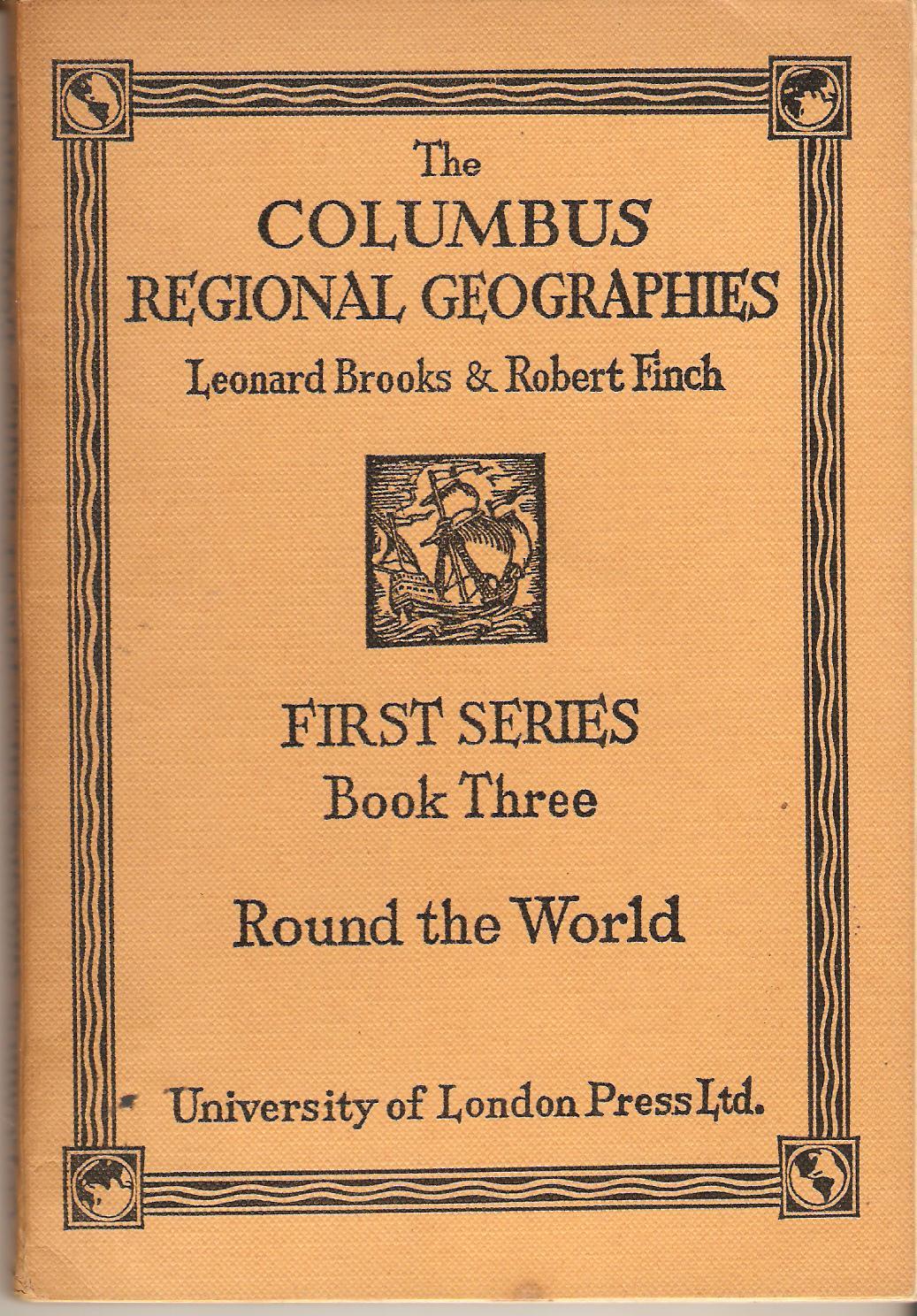
Brooks wrote and co-wrote a series of books on Regional geographies of the World, this one pictured with Robert Finch.
Brooks had a lot of teaching experience, which is also excellent to see, as well as plenty of experience in school inspection.

At the time of his Presidential lecture, Brooks had spent 15 years as a teacher, and 26 years in school inspection.

Brooks' Presidential Lecture was on the theme of 'Some thoughts on the Present day teaching of Geography in schools".


I like how he started by saying that if delegates read Fleure's pamphlet from 33 years earlier on 'Geography in Education' he would find that things had come round full circle. It was ever thus.

He proposes to do 2 things in his Presidential address which would still make a good focus for any CPD session.


The talk is well worth reading. It touches on a great many things which one can hear talked about at teacher conferences today, over 70 years later.

I don't agree with everything he has to say, but nine times out of ten he is fairly spot on.

His obituary talks about the work he did connecting the GA with the RGS, acting as liaison between the two organisations.


One of the projects that Leonard Brooks started (along with another President Sydney Suggate) was  to develop a scheme where schools could "adopt" ships and send letters to their Captains. It was called the Ship Adoption Society.
This provided a chance for students to write to, and receive letters from ships' crews travelling around the world. This was a great initiative.

I was unable to find an image of Leonard Brooks other than the one above, so had to do some digging, and contact various people.

Brooks' obituary by Fleure and Suggate outlines some further details on his earlier life and career, having been born in Lancashire.

In 1955, he was awarded an OBE "for services to Geography".

I think we should see that sort of citation more often in Honours Lists. I can think of a few people who have done a great deal for the subject but haven't been honoured yet (unless they were, and turned it down).

References

Fleure, H. J., and L. S. Suggate. “Leonard Brooks.” Geography, vol. 50, no. 1, 1965, pp. 82–84. JSTOR, www.jstor.org/stable/40567028. Obituary details.

Presidential Address:
Brooks, Leonard. “SOME THOUGHTS ON PRESENT DAY TEACHING OF GEOGRAPHY IN SCHOOLS: Address to the Geographical Association.” Geography, vol. 37, no. 2, 1952, pp. 63–71. JSTOR, www.jstor.org/stable/40564773.

If anyone knows more information about Leonard Brooks, please get in touch, as with other posts on this blog. I'm particularly keen to get a larger image too, as he is one of the very few Presidents I don't have a high quality image of.

I decided to pursue the school route here.
William Ellis School was mentioned in his obituary.

I found this image on their website - I taught in a room with a similar vibe early in my career, and my own school days were in a room with one of those globes in the corner, which tended to get stuck in position. There were also roller boards, and a raised dais at the front, and heavy dark wood furniture with moldings on the top. I like the addition of explorers names around the top of the walls.


The copyright for this image is the London Metropolitan Archive, and the teacher is named as V C Spary. Spary was also connected with the GA, and helped organise the conference for some years.

I was contacted by school archivist/historians after sending an e-mail and they have been very helpful.
My heartfelt thanks to Christopher Willey, Jim Corbett and Fiona McWilliam.

The source of the following section, sent to me by Chris Willey, is principally the school history (T D Wickenden, William Ellis School 1862-1962, privately printed).

It includes something on the purpose built Geography room of 1913. I see that it is recorded as the inspiration of James Fairgrieve, the senior Geography master who preceded Leonard (and another former GA President who has his own entry on the blog)

Imagine following in Fairgrieve's footsteps as a Geography teacher.

The information about Leonard in Wickenden is as below. This also makes a connection with James Fairgrieve:

Appointed by E B Cumberland in 1912 Leonard Brooks succeeded James Fairgrieve as the Endowed school’s Geography teacher. He was ‘… a writer of textbooks, an eminent Inspector of the London County Council and a Fellow and one time Honorary Treasurer of the Royal Geographical Society. In all this and as a Governor, in which capacity he is still with us, the School owes Mr. Brooks a great debt.’ (p75)

‘Early in 1916 the School was asked to join a new Cadet Battalion then being formed in the Borough of St Pancras; for various reasons that was not acceptable but it led to negotiations as a result of which the School threw in its lot with the 1st Cadet Battalion of the Royal Fusiliers, City of London Regiment and constituted ‘D’ Company. Mr Leonard Brooks, the geography master, was an inspiring Captain and Company Commander …’ (p100)


‘Mr. Brooks went to the London County Council in 1920 and was almost immediately engaged with another ex-master, Mr. Beresford Ingram, in organising the new Day Continuation Schools.’ (p116)

During the later 1930s:

‘Partly an outside activity, and partly educational in keeping with the School’s reputation in the teaching of geography was the ‘adoption’ by the School of the S.S. Willesden. 

Mr. Leonard Brooks, then a Senior Inspector of the London County Council, was largely responsible for the ship adoption scheme and for William Ellis being one of the first four schools participating in it. The object was to bring geography ‘alive’ by following the course of the ship in its journeys and its trading – maintaining a chart of the ship’s movements, a logbook of progress, records of cargoes together with their origin, destination, and processing for shipment, and so on. … A steady correspondence between the Captain of the ship and the boys was a principal source of information and interest. 

 Files, charts and posters were kept in the Geography Room and were available there for inspection and use by any boy who wished. The association, first with Captain Anderson and then Captain Martin, was a very happy one for they were good letter writers and went to great pains to answer the host of questions sent them, and in arranging visits to the Willesden; talking with the crew was of special interest to the boys on these occasions. The owners presented a large model of the S.S. Willesden to the School, a gift greatly appreciation. 
Just before the outbreak of war, the P&O liner Stratheden was adopted as a second ship..'

The Stratheden seems to have survived the war: here is a picture of a school visit to the ship led or accompanied by AP Smith in the early 1950s, a revival of the ship adoption scheme, at the least 'in spirit'.


More images to come of the Geography classrooms at WES in due course in a separate blog post... they are really excellent.

Leonard will have taught in the dedicated Geography room at Allcroft Road. 
On the subject of the room itself, Wickenden says the following:

‘… in 1913 the additions were made to the Allcroft Road buildings, namely a special geography room and two new classrooms. … The geography room was the first of its kind in the country, and owed its conception and design to the enthusiasm of Mr. James Fairgrieve, then geography master at the School and a pioneer in modern methods of teaching that subject. He had put forward his proposals first in 1911, and one must applaud the business-like dispatch which saw the three rooms ready for use at the beginning of the 1913-14 school year, the London County Council having provided a building grant of £2,500 towards the cost.’

I am hopeful that there may be another image of Leonard forthcoming as Chris sent details of my request round in a newsletter. The group photo above is currently the only one I have.

Image credit: Balchin's Centenary volume of the GA - the first Hundred Years

Update July 2021

In July I was able to go up to Solly Street and head into the archives, and found that there was a pallet of boxes from the William Ellis School, where Leonard taught.
These were later catalogued.

What I did find was a copy of the World by Leonard Brooks which appeared to have been used by Leonard himself, which was exciting and a connection back to a previous President.


Major update March 2026

I'm extremely grateful to members of Leonard's family for getting in touch with some further information on Leonard having seen this entry, and having completed some work as a family researching their history. 

This included a huge amount of extra detail on both Leonard and his wife which I hadn't discovered from any other source.

One of the things they sent me was a family tree - here's a section of it that features Leonard.


One part of the detail I was given features Beatrice Kennerley. She was born in 1883 near Bolton. At the age of 18 she was a paper bag maker. Her brothers had emigrated to America. She decided to become a school teacher. She gained her Teacher's Certificate from the Board of Education in 1905, and after two years of probation was granted another certificate in 1907 and started work as an elementary school teacher in Farnworth.

She met Leonard Brooks around this time, who was also working as a school teacher and they were married in 1911.


Leonard and Beatrice Brooks - thanks to Leonard's family.

Leonard and Beatrice moved to London after their marriage and lived in the Hampstead Garden suburb in Wildwood Road.
Beatrice moved into property, and helped set up an estate agents called McCraith and Brooks.

Beatrice and Leonard had 3 daughters.

Now onto the detail of Leonard's life:

Leonard was born in December 1884 in Farnworth near Bolton, Lancashire. The family was recorded as living in Market Street in the 1881 Census.

At the age of 16 he was recorded as working as a clerk in a cotton mill, so probably left school at the minimum age. His father was the manager of the Cotton Mill where he worked.

He attended Halshaw Moor Chapel, and in 1905 was recorded as being both a librarian and a pianist. Leonard was an accomplished musician as well as a geographer. This was very helpful.

Despite leaving school so young, he wanted to study geography at Cambridge. He discovered that FitzWilliam Hall was offering an organ scholarship. He studied the organ and music for a year, took the exams and was awarded the scholarship.

He matriculated in 1908 and gained a BA in Geography in 1910.
His first teaching appointment was in 1911, when he was appointed as an assistant master at the boys' municipal secondary school in Leamington Spa in Warwickshire. This was a busy year, as he married Beatrice and his pay was increased from £160 to £170 per annum.

In 1912 he moved to the William Ellis Endowed School at Gospel Oak in North London.

I've mentioned this earlier in the blog as I was able to get some help from the school and discovered that Leonard's predecessor as teacher had been another GA President James Fairgrieve.

He taught geography at the school, where he "pioneered the use of geography as an instrument of humanity".

He was the author of many textbooks - some of which are mentioned earlier on the blog. 

Leonard's family provided lots of useful additional detail of his later career:

In 1919 he had a part time job at Birkbeck College, lecturing on historical geography.

In 1920 he became an Inspector of Schools for London County Council.

He was Honorary Secretary, Honorary Treasurer and Vice-President of the Royal Geographical Society.

Leonard sadly died in 1964, with Beatrice passing away in 1966.

Special thanks to Annie and Andrew Britton and family members for the information in this update.

Saturday, 19 October 2019

1945: "Getting geography across"

The 1945 Annual Conference saw a symposium involving James Fairgrieve and Leonard Brooks (both former Presidents) called "Getting Geography Across".
This was aimed at pooling ideas for teaching. Great stress was apparently placed on "bringing reality into teaching". I suppose the current trend for authenticity is part of the ongoing debate we have as geography teachers. Look at point. 4 for example and the current discussions over for how long teachers should talk.


There was some age-old advice from Miss M. D. Hughes.


And more advice from a Miss Bennetton


Reference
“ANNUAL CONFERENCE, 1945: MODERN CLASSROOM TECHNIQUE.” Geography, vol. 30, no. 1, 1945, pp. 20–29. JSTOR, www.jstor.org/stable/40562426.

Darby, H. C. “Academic Geography in Britain: 1918-1946.” Transactions of the Institute of British Geographers, vol. 8, no. 1, 1983, pp. 14–26. JSTOR, www.jstor.org/stable/622271.

Thursday, 15 August 2019

1930s: Land Utilisation Survey

The GA established a Regional Survey Committee in the 1920s and running into the 30s when it worked on finalising the Land Utilisation Survey.
This was instigated by Laurence Dudley Stamp, who was to become GA President later.

He had previously completed other land use work, and was interested in the publication of a map of Northamptonshire, published by the OS after the work of a geography teacher called Mr. E. E. Field.

Dudley Stamp according to 'Billy' Balchin, "was quick to realise the potential value of a national Land Utilisation Survey for GB as a whole and immediately proposed through the GA committee the establishment of a central organisation at the LSE"

This had representatives from the GA, OS, Ministry of Agriculture and Education Authorities. The GA couldn't afford to fund the survey, and in 1930, it became a separate Association under the Directorship of L Dudley Stamp.

During the 1930s, the survey continued, with the rural areas being easier to complete. The Six Inch survey was completed first, followed by the One Inch survey, funded by county sponsorships and help from individual LEAs (remember those?)

The survey was carried out by teachers, pupils, Scouts and Guides, students, WI members and even nuns. Those involved were convinced that if the land could be used better, Britain would be better - some great pre-War optimism.
Once the surveys were undertaken, the maps were returned to the office. They were transcribed by hand, and Dudley Stamp went out to many parts of the country to check them for accuracy. The Survey was funded by the royalties from Stamp's books. As the maps from the survey were published, Stamp wrote memoirs for each county that had been covered.

Stamp estimated, according to Rex Walford, that a quarter of a million schoolchildren were involved in the Land Utilisation Survey. It was later repeated under the helm of Alice Coleman (more on that to come in a later blog post), and finally in 1996 (more on that to come later too). James Fairgrieve (another former President was also involved according to Fleure's reports on the Survey in 1953
The layer was made available online, so it can be accessed.
It can be seen in the Visions of Britain website.

Here is the layer for Ely, for example.


Some sections of the country have a more 'hand-drawn' look to them.

A later survey was featured in a piece by Rex Walford which I have blogged about and will appear here in time.

Reference
Rex Walford (2001) - Land Utilisation Survey is featured in detail on pp. 108-112

Stamp, L. Dudley. “THE LAND UTILISATION SURVEY OF BRITAIN.” Geography, vol. 16, no. 1, 1931, pp. 44–51. JSTOR, www.jstor.org/stable/40557799.

Fleure, H. F:  (1953) https://www.jstor.org/stable/40564702 "Sixty years of geography and education"

Wednesday, 14 August 2019

1930s: Geography and Films

During the 1930s, a new classroom aid appeared in the shape of educational films.
The 1928 conference saw the arrival of some work in this area as having great potential.
This was spearheaded by a future GA President: James Fairgrieve.
Fairgrieve worked with volunteers to explore the potential of cinema, even hosting an event at the Annual Conference in 1928.

People like Jon Grierson started to make documentary films, which had more geographical potential than other films. Films like 'Night Mail' (1936) were the result of his work. These were less than 30 minutes and were useful in the classroom. Modern teachers like short clips rather than feature length films (unless it's the last week of term).

Fairgrieve worked widely with London based teachers to promote the use of films.

Radio broadcasts were also started around this time too. I remember tuning in to the assembly at Primary school, and having the programme lead what we did.

In 1931, Fairgrieve wrote about the use of films.


This was well before Bernard Clarke and the rest...

References

“How B.B.C. Lectures and Films Are Utilised.” Geography, vol. 15, no. 8, 1930, pp. 672–672. JSTOR, www.jstor.org/stable/40559754.

Fairgrieve, J. “USE OF BROADCASTING IN TEACHING GEOGRAPHY IN SCHOOLS.” Geography, vol. 16, no. 1, 1931, pp. 34–44. JSTOR, www.jstor.org/stable/40557798.

Friday, 26 July 2019

1926: 'The Geographical Teacher' name change occurs

1926 saw a change in name of the journal: "The Geographical Teacher" to just "Geography"

The Spring 1927 issue was the first to bear the new name.

Note the address of Aberystwyth, where H J Fleure was back then.

The journal is still called 'Geography'.
Two years later, the Journal became quarterly, before going back to three issues.

James Fairgrieve (who later became President) generously offered to guarantee any losses during the period following the name change.

The first article in the newly named journal was by Charles Close: the President for 1926, shown below.


References

“Front Matter.” Geography, vol. 14, no. 1, 1927. JSTOR, www.jstor.org/stable/40557855.

Margaret Mackintosh RIP

Updated post. Sad news at the end of last week from colleagues who have organised the Charney Conference over the years of the passing of Ma...