Showing posts with label Handbook. Show all posts

Friday, 12 March 2021

2003: Peter Fox

Peter Fox is one of the contemporary stalwarts of the GA, and has been involved in a wide range of committees, and other activity, including publications for many decades, and continues to work tirelessly to support the association in many ways, serving on Education Group, which is one of the key committees leading thinking and supporting the Chief Executive and trustees.


Peter was born in Derby in 1950, and went to Long Eaton Grammar School (a school I went to for an interview at back in 1988, and was actually offered a job there, but the day previously I'd accepted an offer at a school in King's Lynn, and the rest is... geography). Peter has also written about the history of Derby, and contributed to a number of other books over the years.

From Long Eaton he went on to study at Nottingham Trent University.

When he became President of the Association, he was still involved in teaching, and this makes him a rare thing: a teacher President. He was proud to be one of the first Presidents to be teaching in a state school. I need to just double check but I think all the other teacher Presidents before him were teaching at Independent schools, so he may have been the first, and indeed the only state school teacher President... 

I think I'm only the fifth person to be a teacher President, and have managed to speak to almost all of the others in the process of writing this blog, apart from E C Marchant.
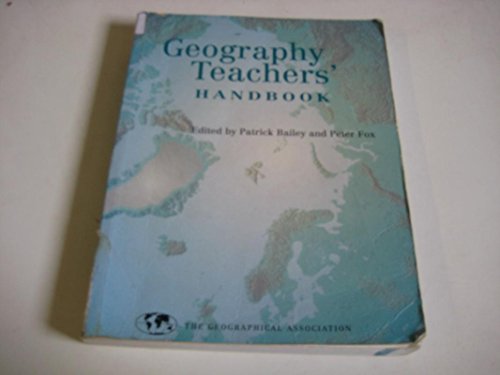

Geography Teachers' HandbookPeter has a strong background in teaching, and has held different roles including Teacher of Geography, Head of Faculty and Assistant Head.

His particular interest has been in educational technology, and he has served on the ICT SIG of the Association for many years. The SIG has been going since the 1970s.

The ICT Special Interest Group
is one of many I visited while working for the GA as Secondary Curriculum Leader, and has created a great deal of content for the GA's website in this respect, as well as providing guidance to others.

Peter co-edited the first (more recent) edition of the Secondary Geography Handbook with another former GA President: Patrick Bailey - the cover is shown above.

Peter told me that Patrick Bailey was very much his mentor, and his involvement with this publication led on to other things within the GA.

I am also grateful to Peter for allowing me to interview him on the early days of the use of computing, for a chapter that I wrote in the 'Debates in Geography Education' book. I looked back at my notes on this chat as well and found lots of helpful thoughts - the book is now in a 2nd edition, and people have referenced the chapter recently in other books, which is always good to see.

Along with Andrea Tapsfield, Peter wrote a number of books and guides relating to the early use of ICT, when its true potential was as yet unrealised, and the idea of CAL or Computer Aided Learning was key.
I have a copy of the book, which is pictured below:

Peter told me that his first published work for the GA was a list of computer software which was available at the time. 
He told me: 
"Interesting looking back on this list to see more software available then than now and many gaming and simulation items - missing from more recent apps - but this was before Internet times!"

His Presidential theme was on the Development of the Media and ICT in Geography.

His Presidential Address was on the same topic, and connected to the use of images in particular. It was called 'Images in Geography: Great Expectations'.


Image: Bryan Ledgard / GA - Derby GA Conference - Association at Work day - Derby was my favourite conference venue.

He was also involved in the creation of the Digital Learning at KS4 project for the GA which went up onto the website some years ago and which I helped with a little. I remember this happening while I was working for the GA and I worked out a way to do a drag and drop style activity in Google Earth.
Here he is being introduced by Chris Kington.

As with other recent Presidents, since Sheila Jones, Peter was also kind enough to answer some questions to me on a Google form.

Why does the GA matter?
Peter told me:
"Geography matters and therefore the teaching and learning of geography matters."
Peter has served on the ICT Working Group, been Honorary Secretary of the GA, and was even the stand-in CEO [part time for a term following the departure of the previous person, as described earlier in the blog], He has also been, for many years, the Honorary Treasurer of the GA (a post now held by Bob Digby), and is currently Chair of the ICT SIG.

Thanks to Peter for replying to my request for help, and completing my questionnaire to help with the creation of this entry.

I have a particular extra link with Peter.

In 2008, I went to Sheffield to have an interview for a job at Solly Street as Secondary Curriculum Leader, and Peter was one of the four people on the interview panel who gave me and the other candidates a real grilling. Other people on that panel have been identified in other blog posts, or will be in due course.

Peter continues to serve on a number of committees, although he is scaling back his involvement a little. I also interviewed him for a chapter for a book I wrote for Routledge, asking him for his memories of the early days of ICT in the school classroom as mentioned earlier in the post. Looking back, Peter said:

"I would hope that the GA has always had a role in the development of technology and learning - Sound, Vision, Media, ICT..." - as I recently completed several consultancy jobs in this very area, this certainly seems to be the case at the moment.

Peter has attended a number of the GA Study Tours and was involved in one tour which was also mentioned by Chris Kington. This was to Poland, and I blogged about it here.

His involvement with the GA continues to this day and he and I are involved in a current project which will be publicised later in the year.

If anyone else has memories of Peter Fox and his work with the GA please get in touch.

References

Fox and Tapsfield (Andrea) - an early book on the use of technology in schools, and published by the GA. I have a copy of this book in my collection.

Presidential adress: FOX, PETER S. “Images in Geography — Great Expectations.” Geography, vol. 90, no. 1, 2005, pp. 3–17. JSTOR, www.jstor.org/stable/40574025. Accessed 12 Mar. 2021.

https://www.geography.org.uk/Project-Team - Digital Learning Project
Peter led a team creating resources for GCSE students, funded by BECTa (a sadly missed organisation, which I completed several projects for, before it disappeared)

Coates, Bryan E., et al. “Annual Report of The Geographical Association.” Geography, vol. 76, no. 2, 1991, pp. 177–188. JSTOR, www.jstor.org/stable/40572070 - one of many similar reports that Peter will have given his name to over the years.

Chronology of the GA: https://www.geography.org.uk/download/ga%20chronology.pdf

Friday, 29 January 2021

1998: Mr. Roger C Carter

Updated August 2022
When I first started writing this blog entry, I couldn't find much about Roger C Carter, and he remained a bit of a mystery, but I have assembled more with thanks to the Presidents who served near to him, particularly Jeremy Krause.

Roger was the editor of the first Primary Geography Handbook in the year of his Presidency and was working as Geography advisor and school inspector at the time.

Jeremy Krause told me:

"Roger was born in 1938 in Hove and attended Hove County Grammar School. His childhood was spent camping on the South Downs, reading maps, earning badges and proudly becoming a Queen’s Scout before studying at Nottingham University. A grounding for his love of geography, life and Brighton and Hove Albion!"
He was the youngest of four children.
After University he embarked on a career in education, first as a teacher and then as an Inspector. He was one of those teachers who would regularly have ex-pupils approaching them to say hello, often
years after the said pupils had left school. He mixed professionalism and competence with humour, approachability and a passion for his subject: Geography. This mix would be the hallmark of his whole
professional career."

From the family eulogy, via Jeremy Krause:
"He taught at Coalbrookdale School and at Abraham Darby School, and although his professional life then moved to Staffordshire, he continued to live in Shropshire. He fell in love with this county and
lived for the majority of his life there. He loved the beauty of the countryside and the view of Wenlock Edge from the house, not to mention the interesting oxbow lakes on the Severn near Buildwas."

Roger was also involved in an intiative called TVEI, which for a while was very significant in education. In my own school, in the late 1980s we had a colleague who was actually geography trained, but worked on the TVEI initiative. TVEI stands for Technical and Vocational Education Initiative. 
Roger wrote about the TVEI and Geography as well.

Professor Simon Catling told me that he was a LEA Inspector in Staffordshire which gave me something to go on, and do some more research.

He was an advisory teacher and Inspector in Staffordshire for over 20 years, according to items submitted to 'Teaching Geography', so he must have predated Chris Durbin in the role (more on Chris in a future post as we approach the founding of SLN close to this time)

I also found him featured on the front cover of the GA News in 1998. This also mentions the appointment of the GA's first new Chief Executive Martin Curry, who will have a post on the blog later. Roger was helpful in supporting Jeremy Krause, who will also have a post on the blog in due course, in organising the running of the Association for a while around this time. There was also significant work to respond to consultations:

Carter, Roger. “A Modular Approach to a Relevant Curriculum.” Teaching Geography, vol. 13, no. 2, 1988, pp. 57–60. JSTOR, www.jstor.org/stable/23754721. Accessed 22 Jan. 2021.

Carter, Roger. “The GA Responds to the Draft Proposals for Geography.” Teaching Geography, vol. 19, no. 4, 1994, pp. 158–159. JSTOR, www.jstor.org/stable/23756163. Accessed 22 Jan. 2021.

Details of Roger's Presidential Address were published in GA News in July 1999, and in Geography in October 1999. It was delievered at UMIST, and was on the theme of 'Connecting Geography'.


Keith Grimwade also has memories of him from his own time working on GA Committees, and also the Action Plan for Geography.

"I remember Roger Carter’s choice of hotels - he was always looking to save the GA money and we stayed at some interesting places, some of which seemed very busy in the early hours of the morning!"

In his Presidential Address, Roger talked about 'An Agenda for Action' and connecting up Key Stages and other geographies.


Roger says in his address that:

"I came across the details of the Staffordshire Geographical Exhibition of 1934. The Exhibition gave rise to an account, edited by Jasper H. Stembridge. Here is an extract from Stembridge's account:

 'The Staffordshire Geographical Exhibition proved that the popular press and the general public are deeply interested in education. On the second day the Exhibition was thronged. On the third and subsequent days it was so crowded in the afternoons and evenings that it was often difficult to make one's way round the rooms. Owing to requests received from all parts of the country it was decided to keep it open for a further three days' (Stembridge, 1934, p. 12). 

Sir Frances Goodenough, wrote, in a letter to The Times: 
A remarkable and valuable exhibition. An exhibition of modern methods of teaching geography as practised in every type of institution in the county, from the infant school to Birmingham University. The Exhibition is the product of unusually complete teamwork in which teachers, the LEA, the Board of Education and the employers have all co-operated' 
(Sir Frances Goodenough quoted in Stembridge, 1934)

The then President of the GA, Professor PM. Roxby, was equally enthusiastic about the event: 'Here was the new geography - pulsating with life - presented with a freshness of outlook, but with a deep conviction of the importance of the subject and its underlying principles' (Roxby quoted in Stembridge, 1934, p. 13).

The following came from Jeremy Krause:
At the start of his GA Presidential Address in 1999 Roger looked around the packed lecture theatre and said, ‘There’s a lot of you… I’m used to seeing you in small groups in pubs and meeting rooms.’ We were those in small groups and as individuals who gained so much from being with Roger. This wasn’t a random action, it was central to Roger’s being.

It’s best summed up by a quote from the ‘Geovisions’ project, in which he played such an important part, used in the conclusion of his Address.
‘We need: A renewed emphasis on the professionalism of teachers.
We need fewer voices telling us what to do and how to do it.
Equally, we must reassert our own professional responsibility.’

Roger was so generous of spirit, we were all blessed to know him, work with him, share a joke, but also be prepared to be challenged and expected to find a better way to teach and learn geography.

His employment over the years involved schools in Shropshire and Staffordshire; Madeley College; Staffordshire LA, the GA’s Geography Adviser Network; the Geography North-West Consortium, TIDE and Government Agencies.

In the late 1990s, when he chaired the Education Committee of the GA (a position which is now held by the acting President during their Presidential year, Roger started a discussion about the future of Geography in the National Curriculum.


Roger died in 2017. His obituary was written by Jeremy Krause, who also passed me further documents on his life.

This is the cover of the first Primary Geography handbook which Roger edited - some reading this may well have copies on their shelves. Roger was also instrumental in shaping the GA's CPD programme, which continues to this day, and which I had the privilege of being involved with for many years.


If anyone knows more about Roger Carter and his work for the GA, or has other memories please get in touch. Particular thanks to Jeremy Krause here.

References

Carter, R. (ed.) (1998), Handbook of Primary Geography, Sheffield: Geographical Association

Carter, Roger. “Millennium 2000 Geography.” Teaching Geography, vol. 22, no. 4, 1997, pp. 195–195. JSTOR, www.jstor.org/stable/23755757. Accessed 22 Jan. 2021.

Carter, Roger. “A Modular Approach to a Relevant Curriculum.” Teaching Geography, vol. 13, no. 2, 1988, pp. 57–60. JSTOR, www.jstor.org/stable/23754721. Accessed 22 Nov. 2020.

LYNCH, KENNETH. “The Future of Geography: The Debate Continues.” Geography, vol. 87, no. 2, 2002, pp. 155–159. JSTOR, www.jstor.org/stable/40573671. Accessed 22 Nov. 2020.

CARTER, ROGER. “Connecting Geography: An Agenda for Action.” Geography, vol. 84, no. 4, 1999, pp. 289–297. JSTOR, www.jstor.org/stable/40573334. Accessed 22 Nov. 2020.

Ofsted Revisited
Campion, Kate, et al. “OFSTED Revisited: How to Make the Best Use of Prior Experience.” Teaching Geography, vol. 22, no. 4, 1997, pp. 170–172. JSTOR, www.jstor.org/stable/23755750. Accessed 16 Jan. 2021.
Written with Jeremy Krause.

Updated February 2021
A really interesting article that Roger wrote for Primary Geography.
Thanks to Simon Catling for the image from his archive.

The photo at the top of the blog post is courtesy of Kate Russell, via Jeremy Krause, and was taken at Roger's retirement do from his Staffordshire Advisory service job.

Updated March 2021

While doing some preparation for some CPD for Primary colleagues, I noticed that Tessa Willy's 
Primary Handbook published by the GA called 'Leading Primary Geography' is dedicated to Roger.

A memory from Jeremy Krause

At the start of his GA Presidential Address in 1999, Roger Carter looked around the packed lecture theatre and said, ‘There’s a lot of you… I’m used to seeing you in small groups in pubs and meeting rooms.’ We were those in small groups and as individuals who gained so much from being with Roger. This wasn’t a random action, it was central to Roger’s being. It’s best summed up by a quote from the ‘Geovisions’ project, in which he played such an important part, used in the conclusion of his Address.
‘We need: A renewed emphasis on the professionalism of teachers. We need fewer voices telling us what to do and how to do it. Equally, we must reassert our own professional responsibility.’ 

Roger’s impact on us as individuals was best expressed in his son Alan’s eulogy where he referred to messages from former colleagues, ’ Dad was an inspiration to them, or gave them the start which defined their subsequent career, or helped them at a difficult time. ‘ I am proud to say I was one of those who Roger valued and supported. 

Sunday, 4 October 2020

David Boardman - Publications Officer

This issue of the GA Newsletter / GA News featured some reflections from David Boardman during his time as Publications Officer.

He was also the editor of an edition of the 'Handbook for Geography Teachers'. 

He is one of many people who are unsung heroes of the association.

He is a long standing member of the Association and supported it in many ways.


Saturday, 24 August 2019

1932: Handbook for Geography Teachers

1932 saw the publication of a new 'Handbook for Geography Teachers' under the direction of Miss D. M. Forsaith.


Image; Alan Parkinson, shared under CC license

Here's a review from the 'Geographical Journal'


Margaret Mackintosh RIP

Updated post. Sad news at the end of last week from colleagues who have organised the Charney Conference over the years of the passing of Ma...