Showing posts with label Peter Haggett. Show all posts

Wednesday, 20 January 2021

Gus Caesar

Updated August 2023

Gus Caesar was described by former GA President Ashley Kent as arguably the ‘source’ of an extraordinary group of geography professors across the world: Haggett / Dury / Hall / Randall et al...a remarkable ‘father figure’ to many.

He was a tutor at St. Catharine's college, University of Cambridge. (Twitter account link)

He came up on a £20 Exhibition to St Catharine's College in 1933, gained double Firsts in Geography and was elected to a postgraduate scholarship in 1936. After the war he returned to a university lectureship and fellowship at Selwyn College and in 1951 moved back to his old college. For the next 30 years he was to hold almost every senior college post except that of Master.

He was Senior Tutor for Geography, working with Dr Keeble.

The above text is taken from his Obituary, written for the Independent newspaper by the famous geographer Peter Haggett.

Peter Haggett also said of Gus:

No one who experienced the hour-long inquisitions in his rooms on Main Court at St Catharine's, delivered through a haze of Three Nuns pipe smoke, will forget the process. Essays were disassembled, the reasonable parts retained, new components added, and the whole reassembled into something that was well ordered, logical and, above all, geographically sound. 
He had an innate sense of what gave coherence to a geographical point of view and drove that relentlessly into those he taught.

A story from the memorial address for J A Steers, who taught Gus:

Gus Caesar's splendid story of his own undergraduate days, when he was woken one morning, admittedly somewhat late, by a severe pain in his chest. Opening bleary eyes, he discovered that the cause of this pain was a walking stick, jabbing him in the ribs. And at the other end of the stick was, of course, Alfred, immaculately dressed as usual, with hat and briefcase, exclaiming "get up, get up, I'm lecturing to you in ten minutes!" 

References

https://www.independent.co.uk/news/obituaries/obituary-gus-caesar-1600981.html - obituary in the Independent newspaper

With growling voice and the massive bulk of a second-row forward, Gus Caesar appeared ferocious. And as a Dean on the warpath after a rowdy boat-club supper, this image could stand him in good stead. But the reality was of a gentle and ever kindly man for whom the individual undergraduate (particularly if from St Catharine's) could always ask for support. 

His college house on Grantchester Meadows was a haven through which hundreds of visitors passed each year. 

His wife, Margaret, and daughter, Pat, could calculate to a nicety the strength of undergraduate appetites after the towpath walk back from Grantchester.

https://www.society.caths.cam.ac.uk/home/?m=page&id=1923 - St. Catharine's Society Journals

Image above is taken from the St. Catherine's Society Journal

https://www.society.caths.cam.ac.uk/Public_Magazines/1971r.pdf 

https://www.society.caths.cam.ac.uk/Public_Magazines/1987r.pdf 


Updated August 2023

Sir Peter Hall - Town Planner

https://discover.ukdataservice.ac.uk/assets/qualibank/6226themext016.pdf

I was taught by an outstanding teacher in economic geography, a guy called Gus Caesar, whose full name was almost unbelievably Alfred Augustus Levi Caesar, and he was a legendary figure in British geography...  He was not a researcher, he’d got a very poor research record, I don’t think he’d have got tenure nowadays, but he was an absolutely inspiring teacher in close supervision, because the style was, you would write an essay every week, of course, and he would read it, and he would tear the essay to pieces!  He’d say, “Look, old lad” – his favourite term – “Look, old lad, you’re putting the conclusions before the evidence.  Say what you think the hypothesis is, and then produce the evidence carefully, in logical order, and then the conclusions”.  He absolutely [analysed] your essay.  Everyone who was taught by Gus, has this extraordinary kind of intellectual discipline of being able to argue A to B to C to D, which none of us ever lost, I think.

https://discovery.ucl.ac.uk/10042912/3/Hebbert_PH%20for%20GBS%20final%20ms.pdf

His path was determined by the offer of a geography scholarship at St Catharine’s College. Hall found Cambridge initially uncongenial, what with the snobbery of privately educated undergraduates towards provincial grammar schoolboys, the relatively low 3 academic esteem of his chosen discipline, and the bias of first year teaching towards the physical geography he least enjoyed. 

But in 1951 the situation was transformed by the college's appointment of A.A.L. Caesar (an alumnus) to be Fellow and Director of Studies in Geography. 

As the only Cambridge college offering geography scholarships, St Catharine’s attracted the pick of the crop and for the next 29 years Gus Caesar was their academic mentor. The weekly supervisions in which Caesar deployed his ‘formidable powers of critical dissection and logical rearrangement’ (Haggett 1965, ii) nurtured many rising stars of the discipline (Johnston and Williams 2003, 309) and Hall recollected them as the high point of his undergraduate career (2003b, 2014f). 

He had already learned from George Orwell how to write clearly without resort to jargon; now he learned how to construct arguments, marshal empirical evidence, and submit to relentless self-criticism—‘progress is a mistake-making business’ was one of Gus’s aphorisms. 

More than this, Caesar was a committed advocate of geography as an applied science, with regional planning as its practical outcome. He had coauthored the chapter on the ‘North-east of England’ and written those on ‘Gloucester–Wiltshire–Somerset’ and ‘Devon and Cornwall’ in G.H.J. Daysh’s Studies in Regional Planning: Outline Surveys and Proposals for the Development of Certain Regions of England and Scotland (1949). The authors conceived regional planning to be a self-contained policy process in which the geographer ascertained trends, constraints, and requirements so that planner might devise proposals for administrators to implement. 

For his presidential address to section E of the British Association for the Advancement of Science at Southampton in August 1964, A.A.L. Caesar spoke on ‘Planning and the geography of Great Britain’. He emphasized the inexorable geographical trends of economic centralization on South-east England and the midlands, the decline of peripheral regions, road transport growth and extensive railway closures. ‘The Twentieth Century pattern must be accepted—there is need to contemplate that of the Twenty first Century. 

If Megalopolis is coming, let us at least be aware of it and let us plan for it’—a challenge for geography indeed (1964, 240). 

Caesar himself had little direct involvement in public policy, but his teaching of geography as an applied science was profoundly influential, as seven of his distinguished former students—Michael Chisholm, Peter Haggett, Peter Hall, David Keeble, Gerald Manners, Ray Pahl and Kenneth Warren—acknowledged in their Spatial Policy Problems of the British Economy (1971).

Memories from the late David R Wright - another legend who has appeared on the blog

https://www.geog.cam.ac.uk/files/alumni/landmark/landmark1/landmark1.pdf

Wednesday, 15 April 2020

1963-7: Haggett and Chorley and Madingley

In the sixties, there was a revival of quantitative geography, and the use of statistical models to help explain some geographical patterns and processes.

Peter Haggett was one of the lead lecturers in this movement, but people who were associated with the GA were also there too.

Madingley Conferences took place at this time, convened and organised by Haggett and Richard Chorley. They ran between 1963-7 and spawned several influential textbooks.


At the Geography Teacher Educators's conference in 2010, I had the privilege of speaking to the late Rex Walford (of which many more posts to come) after he did a talk on his memories of attending these conferences.
He had brought some of his memorabilia to the event and it was fascinating to see those original documents from those conferences that he had brought along.

Image from University of Cambridge Alumnus magazine (see source below)

Walford is quoted in Ivor Goodson's book talking about this time:
The Madingley Lectures proved a watershed in the emergence of the subject. Two years before, E.E. Gilbert - in an article on 'The Idea of the Region' - had stated that he regarded new geography in the universities as an 'esoteric cult'. After Madingley, this was no longer the case, as a college lecturer who was secretary of his local Geographical Association recalled: 'After Madingley my ideas were turned upside down... That's where the turn around in thinking in geography really started'. But as Walford later noted, Madingley was 'heady to some, undrinkable brew to others'. Following the second Madingley Conference in 1968, Chorley and Haggett sought to consolidate the changes they were advocating by a new book entitled Models in Geography. By this time opinions were becoming progressively polarized about the 'new geography'. Slaymaker wrote in support of the book:
In retrospect, a turning point in the development of geographical methodology in Britain. After the exploratory and mildly iconoclastic contents of the first Madingley lectures, recorded in Frontiers in Geographical Teaching, a more substantial statement of the methodological basis and aims of the so-called 'new geography' was required... with the publication of this book [it is demonstrated that] the traditional classificatory paradigm is inadequate and that in the context of the 'new geography' an irreversible step has been taken to push us back into the mainstream of scientific activity by process of model building. 
Neville Grenyer wrote about this time for the GA in 1972.

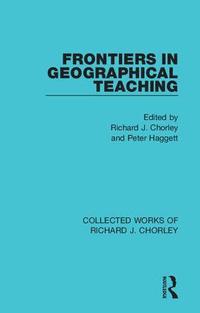
The Madingley Seminars were held between 1964 and 1967, following first lectures in 1963. 'Frontiers in Geographical Teaching' captured the atmosphere of the seminars. 'Trends in Geography' by Cooke and Johnson also came out of these events.

It also inspired my PGCE tutor Vincent Tidswell, who will appear later in the blog in his work.

Here's Chorley in an early interview.


More to come on this in future posts.

References
Wikipedia page for Peter Haggett:
https://en.wikipedia.org/wiki/Peter_Haggett

Madingley Conferences:
https://www.ivorgoodson.com/becoming-a-school-subject?p=12 - and other pages near this

Grenyer, N: "An introduction to Recent developments in Geography teaching: an annotated
bibliography" (Geography, Vol 57, No. 4, November 1972)
https://www.jstor.org/stable/40567919

https://www.geography.org.uk/Journal-Issue/ea4a0ee3-5175-48c2-a8ae-1789df0ffec7 - Peter Haggett

References: Rex Walford's book on School Geography.

Image: Madingley Hall - shared under CC license by Alan Parkinson (2010)

Friday, 3 April 2020

1960s - the New Model Army


The Life of Peter Haggett | Peter Haggett

The late Professor ChorleyRex Walford tackled the changing nature of Geography in the 60's in a pieece called 'On the frontier with the New Model Army" published in 'Geography'.

This was a part of a short series which was put together by Chris Kington, along with pieces by Balchin and Tidswell.

The original piece is available in 'Geography'.

He also wrote a chapter with the same name with his book on School Geography teaching which has been a major source when writing this blog.
There is also detail on this era in the Marsden textbook on... textbooks which I was loaned by Chris Kington.
This was "a watershed in academic geography, chiefly reflected in the dramatic shift from traditional regional to the more mathematical and scientic approaches of the so-called quantitative revolution" (Marsden, p.44)

Rex Walford described the regional approach by them as being "too static, too pat, too enclosed", although it persisted, as I taught it in the late 80s still. Key textbooks at this time included those by Everson and Fitzgerald, and one by J P Cole & N J Beynon 'New Ways in Geography', which sold over 300 000 copies of the pupil books and even more of the work packs between 1969 and 1984. The series pioneered some new ideas such as disposable worksheets. It replaced the traditional exploration of life in other lands with skills development on such things as networks, coordinates, journey patterns and kocations.

The Madingley lectures of 1963 led to the release of Chorley and Haggett's 'Frontiers in Geographical Teaching' (1965) and 'Models in Geography' (1967). These were the bibles of what Rex called the 'new model army' of teachers.
In Balchin's Centenary book he talks about the impact of the quantitative revolution on the GA, which he describes as a 'danger'.
Frontiers in Geographical Teaching (inbunden)It was starting to affect teaching in schools. Quantitative techniques were apparently embraced by younger students, but viewed critically by 'the establishment'. A new GA committee was eventually formed in 1967 called the 'Role of Models and Quantitative Techniques in Geographical Teaching', which was chaired by Professor Stan Gregory.

A full issue of 'Geography' in January 1969 was devoted to the work of this committee.

More to come on this as the blog moves through the 1960s.

References
Walford, Rex. “On the Frontier with the New Model Army: Geography Publishing from the 1960s to the 1990s.”
Geography, vol. 74, no. 4, 1989, pp. 308–320. JSTOR, www.jstor.org/stable/40571739
Balchin's Centenary volume

Images in this post:
Peter Haggett (top)
Dick Chorley (bottom) - link to Cambridge Obituary

Another name associated with this period is William Vaughan Lewis.

It is worth finding and reading Haggett's own reflections on the Quantitative Revolution, which are found in this document (a useful 17 page PDF download for free) - several other former GA Presidents get a mention in this document.

Margaret Mackintosh RIP

Updated post. Sad news at the end of last week from colleagues who have organised the Charney Conference over the years of the passing of Ma...