Showing posts with label Physical Geographer. Show all posts

Sunday, 28 February 2021

The Weight of Mountains

This is a short film about the processes by which mountains are created and eventually destroyed. It is based upon the work of British geographer L. Dudley Stamp, and was shot in Iceland.

Physical geography and geology is an enormous and fascinating subject, and this film only touches upon the surface of the discipline. For those who wish to further advance their knowledge in this field, additional reading and research is recommended. The film was created as part of The Weight of Mountains filmmaker residency program. For more information please visit twom.is/ 

The voiceover was largely based on publications from 1951, so please forgive the outmoded use of the term "mankind" and "his" actions. 

Animation courtesy of NASA/Goddard Space Flight Center Scientific Visualization Studio

Monday, 27 April 2020

1964: Professor David Leslie Linton

Last updated October 2023

"Mankind must be made much more aware of the world it lives in, its rigorous limitations and its limited possibilities. Above all it must be assisted and persuaded to think of the world as a whole"
D. L. Linton

David Leslie Linton was a Professor of Geographer at the University of Sheffield, and a renowned geomorphologist. His name lives on in the form of prizes in this field.


He was a close colleague of Professor Alice Garnett who, we will discover, was the beating heart of the GA for many years, following her taking up the post of Honorary Secretary in 1947 and overseeing the GA's move to Sheffield in 1950.

Alice Garnett later became GA President four years after Linton.

Linton was a geomorphologist, and also did some influential work with another former GA President: Sidney Wooldridge.

He was born, apparently, in a grocers' shop on the Old Kent Road, to Irish parents, and went on from there to Haberdasher's Aske's school. 
He was a gifted musician, and apparently wanted to do a degree in Chemistry originally. 
He was also a keen artist, and sketched the landscape, from where the geomorphological features emerged, waiting to be explained. In the 1930s, he was active with the Le Play Society, leading fieldtrips to locations including Iceland. This Society was very much tied up with the early history of the GA.

Linton went to King's College, London and was persuaded by Sidney Wooldridge (who was working as a Demonstrater at the time) to add geography to his subjects for his degree, and he was drawn into the exciting geomorphology work that was being done at the time. This university has been linked to quite a few GA Presidents, notably another geomorphologist Denys Brunsden.

He spent the war (1940-1945) with the Royal Air Force Volunteer Reserve working in aerial photography interpretation - solid work for a geographer, and which gave him a deep knowledge of landscapes. There is definitely a book here to trace the work of the geographers who were later linked with the GA in the post-war period. It seems that he was rather good at this sort of work as his obituary explained:


After the war, he went over to check out the sites, and was just about tracked down by the University of Sheffield, who wanted to interview him for a post there where he was appointed as Professor of Geography.

Summary of his career:
King's College London, BSc (Geography), 1927, MSc, 1930; DSc 1945; Demonstrator in Geography and Geology, University of London, 1927-1929; Lecturer in Geography, University of Edinburgh, 1929-1945; served in the RAF (Photographic Intelligence), 1940-1945; Professor of Geography, University of Sheffield, 1945-1958; DSc, 1955; Professor of Geography, University of Birmingham, from 1958; William Evans Visiting Professor, University of Otago, 1959; Honorary Editor of Geography, the Quarterly Journal of the Geographical Association , 1945-1965; President of the Institute of British Geographers, 1962, and of the Geographical Association, 1964; Fellow of King's College London (FKC), 1971; received the Murchison Award, Royal Geographical Society, 1943.

What an impressive CV...

At a meeting in Sheffield (with Wooldridge and others) in 1958, he was a founder member of what became the British Geomorphological Research Group, which he chaired in 1961, and also a founder member of the Institude of British Geographers. He became President of the IBG in 1962.

Linton was honorary editor of the GA's 'Geography' journal too, between 1947 and 1965, and his name appears in numerous copies of 'Geography' in the front matter and also in the pages.

He contributed a range of articles to the journal 'Geography' through the 1940s and 1950s. One was on the rise of the million city - I wonder what he would have made of the rapid rise of megacities, particularly in China.


He also wrote a piece on Geography and the Social Revolution in 1957 in 'Geography'.
His Presidential Address. published in 1965 was on 'The Geography of Energy'


The address included some classic illustrations such as this one.


It also finished with an important message for all teachers.


I remember that he also developed a theory of the formation of Tors, and was taken to the quarry where this theory was apparently first visualised when on an undergraduate fieldtrip at Two Bridges on Dartmoor.
I've visited the quarry here. It's on the path to Wistman's Wood.


Tor formation theory is shown below, in an influential textbook of the time by David Waugh, who is mentioned elsewhere on the blog.


In 1964, he became President of the Geographical Association - probably quite a coup for the GA at the time given how prominent and busy he was.

Linton died unexpectedly in 1971, when he was nearing retirement at the end of a long career while in post at the University of Birmingham. He was still very active.


Obituary published in several journals.

A tribute to him was written by Alice Garnett and published in 1966 on the occasion of his retirement as Honorary Editor.


He received the RGS's Murchison Award.

References
Wikipedia
https://en.wikipedia.org/wiki/David_Linton_(geographer)

I amended this to add in his GA Presidency, as I have done to all entries for former Presidents.

Address: LINTON, D. L. “The Geography of Energy.” Geography, vol. 50, no. 3, 1965, pp. 197–228. JSTOR, www.jstor.org/stable/40567042
Obituary:
“David Leslie Linton.” Transactions of the Institute of British Geographers, no. 55, 1972, pp. 171–178. JSTOR, www.jstor.org/stable/621729

Garnett, Alice. “A Tribute to D. L. Linton: Honorary Editor 1947-65.” Geography, vol. 51, no. 1, 1966, pp. 65–66. JSTOR, www.jstor.org/stable/40566046. Accessed 12 Apr. 2020.
LESZCZYCKI, STANISLAW, and David L. Linton. “The Development of Geography in the People's Republic of China.” Geography, vol. 48, no. 2, 1963, pp. 139–154. JSTOR, www.jstor.org/stable/40565574.

LINTON, DAVID L. “Geography and the Social Revolution.” Geography, vol. 42, no. 1, 1957, pp. 13–24. JSTOR, www.jstor.org/stable/40563897

LINTON, DAVID L. “Millionaire Cities To-Day and Yesterday.” Geography, vol. 43, no. 4, 1958, pp. 253–258. JSTOR, www.jstor.org/stable/40564208
Linton, David L. “THE LANDFORMS OF LINCOLNSHIRE.” Geography, vol. 39, no. 2, 1954, pp. 67–78. JSTOR, www.jstor.org/stable/40564569
https://www.ed.ac.uk/geosciences/about/history/school-history


Image of Haytor - copyright Alan Parkinson, shared under CC license
Image of Linton from the Balchin Centenary Book

Update August 2020
In 2017, my own degree tutor and former lecturer at Huddersfield Polytechnic: Professor Tim Burt was awarded the Linton Award
https://www.dur.ac.uk/geography/news/allgeognews/?itemno=31007

Updated October 2023 with a quote at the start of the post.

He worked to locate V1 and V2 launch sites which is a remarkable period of history for him to have been involved with.

Tuesday, 6 August 2019

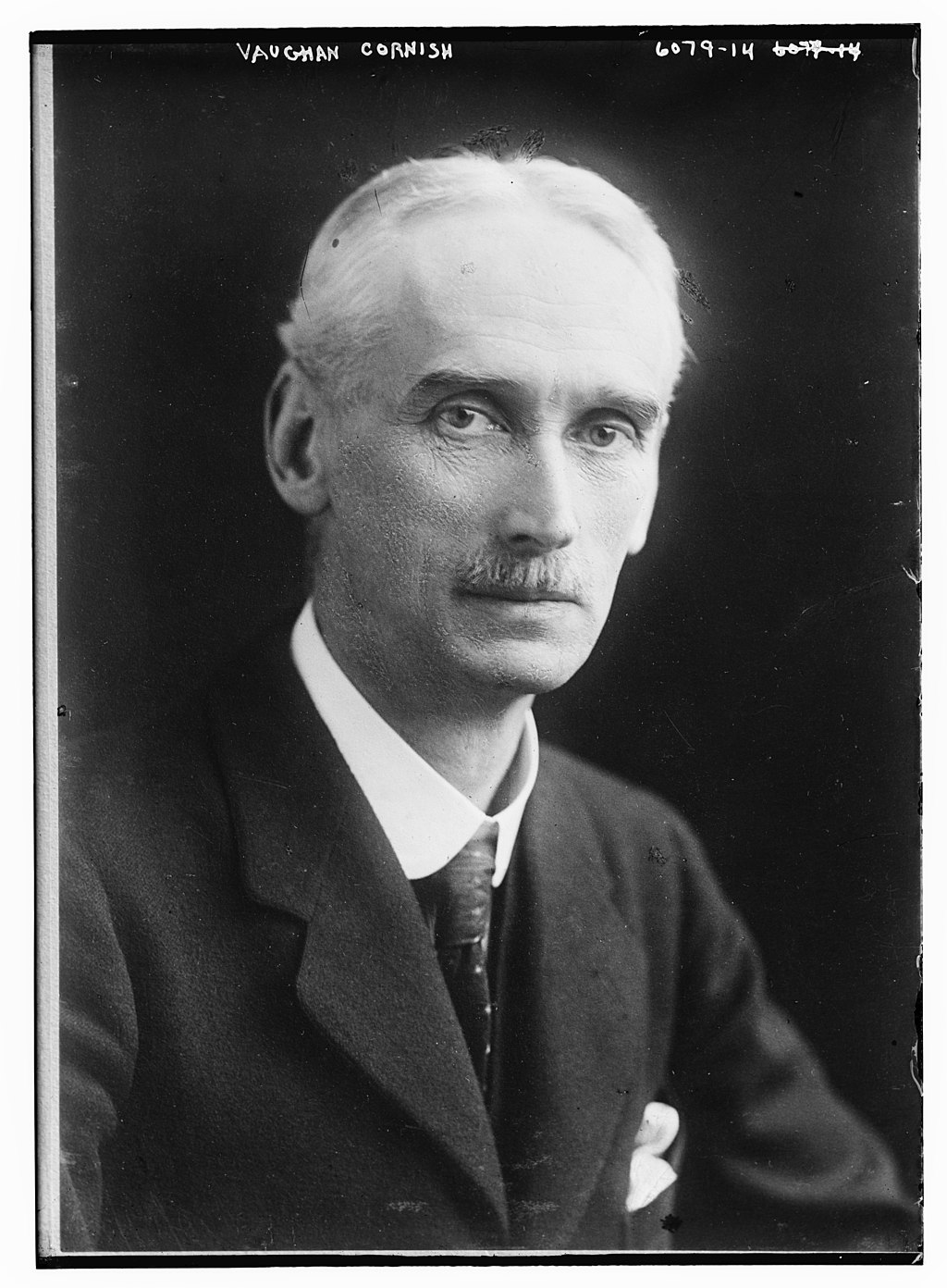
1928: Dr Vaughan Cornish

Last updated October 2023

1928 saw another President with a notable geographical pedigree take office.

Dr. Vaughan Cornish is someone I have been aware of for many years, and who has been described as one of the most prolific geographers of all time.

He was born in Debenham in Suffolk in December 1862, the third son of a vicar.

He was unusual when compared to many other of the early GA Presidents in that he never held a university post of any kind. This has remained relatively rare.

He was later selected by Carl Sauer as one of six geographers whose readings would provide a 'truly liberal geographic education', and was a worker of wide interests and versatility
Andrew Goudie (also GA President)


The other reason I am familiar with Cornish is through his association with Sidmouth, a town I have visited regularly for many years. He is buried in Salcombe Regis, just outside of the town.

When I was working for the Geographical Association, I was interested to see what was down in the GA collections and archives in the basement. In my lunch hour, I used to poke around in the filing cabinets partly to see what potential there was to unlock value in the objects the GA holds, but also to seek inspiration for my own projects. I came across some lantern slides, which I don't think were from the original collections from the original founding of the Association, as they were too new, but nonetheless interesting. One of the things I did find in one of the rooms was a series of large framed prints.
These were beautiful, and featured a range of subjects, including wave forms. They had lovely hand written captions and were signed by Cornish.


Image: Alan Parkinson - shared under CC license

Waves were one of the areas that Cornish had explored in detail. He studied waves, wave forms, and processes.
He was also the first British geographer to study dune formation and form, including desert dunes and sand dunes. It was this that drew him to the attention of Andrew Goudie (a future GA President).

In the late 1890s and the start of the 1900s, Cornish was active in delivering lectures.

These are described in a large section of Emily Hayes' PhD - this has been blogged about previously.

There were also some prints of images of the Kingston Earthquake, which I knew that Cornish had experienced in Jamaica in 1907. This was one of the journeys that he took with his wife Ellen.

I have a few of his books, including 'The Beauties of Scenery'. This describes his ideas on the aesthetics of landscape, and the involvement of people.
My copy is pictured here, a hardback 3rd edition from 1944. The book has the subtitle 'A geographical survey', and was started in 1920, following Francis Younghusband's Presidential Address to the RGS, when he said that it was the duty of geographers to undertake the analytical study of beauty in scenery'.

Here's a list from his Wikipedia entry - I have copies of the books in bold. The GA holds copies of some others in their archive / Fleure Library.
  • The Panama Canal and its Makers (1909).
  • Waves of the Sea and other Water Waves (1910).
  • The Travels of Ellen Cornish: being the Memoir of a Pilgrim of Science (1913).
  • The Waves of Sand and Snow (1914).
  • Naval and Military Geography (1916).
  • Imperial Military Geography (1920).
  • A Geography of Imperial Defence (1922).
  • The Great Capitals (1923).
  • National Parks and the Heritage of Scenery (1930).
  • The Poetic Impression of Natural Scenery (1931).
  • The Scenery of England (1932).
  • Borderlands of Language in Europe (1933).
  • Ocean Waves and Kindred Geophysical Phenomena (1934).
  • Scenery and the Sense of Sight (1935).
  • The Preservation of our Scenery (1937).
  • The Farm upon the Cliff (1939).
  • The Scenery of Sidmouth (1940).
  • Historic Thorn Trees in the British Isles (1941).
  • A Family of Devon (1942).
  • The Beauties of Scenery (1943).
  • The Photography of Scenery (1946).
  • Geographical Essays (1946).
  • The Churchyard Yew and Immortality (1946).
  • Kestell, Clapp and Cornish (1947).
  • Sketches of Scenery in England and Abroad (1949).
Cornish's images were widely exhibited too - one of the images that I came across had this label on the back:


Image: Alan Parkinson - shared under CC license

Cornish also studied the aesthetics of landscape, and the work on the beauty of landscape is one of the areas that he is best known for.
A biography and appreciation of Cornish was written by a future GA President (who will appear in a future post) Andrew Goudie, and can be read on JSTOR (a free account can be created for those who want to read it).


Cornish's acceptance of the invitation to be President was announced in 'Geography' in 1927.


Cornish's Presidential Address in 1928 was on the theme of Scenery of course, and was called 'Harmonies of Scenery: An outline of Aesthetic Geography'. It is beautifully written and contains a great deal of sense on how the landscape could be viewed.


Cornish laid out his theory of aesthetics, which started with the Scenery of Civilisation, drawing on his childhood in Debenham, Suffolk, in a parish which was "Nature adapted to Man's needs and flourishing under his care".

"Rural England owes much of its Arcadian charm to the fact that form and movement and colour are a decorative scheme which harmonises with the quiet continuity of the least changing of industrial pursuits. It is a country of gentle undulations where rivers flow quietly in winding curves, a land well timbered by deciduous trees of rounded form, of fields divided by a bushy fence, all in a climate of soft skies, where the song of birds is heard throughout the year...."

However, this Arcadia is easily broken...

"...by buildings of harsh form or staring colour, or by clatter of mechanical noise..."

In 1930, Cornish was still active in the GA, and was involved in some work around potential plans for National Parks. 
At this time, he was a Director of Technical Education in Hampshire, but resigned in 1933 to concentrate on his work.

He gave his ownl land, near Salcombe to the National Trust.


As mentioned earlier, Cornish was also a great proponent of National Parks. These finally came into being after an Act of 1949, and the Peak District was the first in 1951. In 1930, Cornish proposed his own National Park areas, some of which eventually became National Parks. He was well ahead of the game with Broadland for example.


His support for coastal protection was also well known.
This was outlined in a piece in 'Geography' at the time.


I came across a blog post from his home village of Debenham, which referenced a number of obituaries printed in The Times.

Obituary - Death of Dr. Vaughan Cornish (from The Times, 3rd May 1948)

We regret to record the death of Dr. Vaughan Cornish, which occurred at Camberley on Saturday at the age of 85 years. Dr. Cornish was a member of a well-known local family whose association with the district began in 1792. He was a great traveller and geographer and was particularly proud of his connection with Salcombe Regis. When the Sidmouth Council purchased the greater part of the land on the eastern side of Salcombe valley to prevent the establishment of a holiday camp there, Dr. Cornish gave a good deal of his land on the western side of the valley to the National Trust in order that its natural beauty should be preserved for all time.

He was a great lover of natural beauty and in spite of his wanderings it was always to Salcombe Regis he returned for refreshment and he never tired of singing its praises. With his first wife he was in Jamaica at the time of the great earthquake there and has broadcast about his experiences at the time.

During recent years Dr. Cornish has published many books, chief among them being "The Scenery of Sidmouth" which is a classic in the description of the local land- and seascape. His most recent book "Kestell, Clapp and Cornish," was lately reviewed in these columns, and as a great deal of it is autobiographical we commend it to our readers at this time.

Dr. Vaughan Cornish was buried at Salcombe Regis yesterday afternoon.


A second obituary was also published.

Obituary - Death of Dr. Vaughan Cornish (from The Sidmouth Observer, 5th May 1948)

One of Britain's best-known geographers, Dr. Vaughan Cornish, D.Sc., F.R.G.S, of "Inglewood," Gordon-road, Camberley, died on Saturday at the age of 85, in a Camberley nursing home. Dr. Cornish, who is survived by his widow, was famous among geographers for his studies of land and water waves. In later years he gave much of his time to the appreciation and preservation of the natural beauties of Britain. He had lived in Camberley since 1913.

He was a student of geography in all its aspects, and he was an author of ability who illustrated his works with his own sketches and photographs.

Dr. Cornish was born at Debenham Vicarage, Suffolk and was educated at St. Paul's School and at Victoria University, Manchester. He graduated with honours in chemistry in 1888 and later took the degree of D.Sc. He became Director of Technical Education to the Hampshire County Council, but after his marriage he entered the field of geographical scientific research. In 1900 the Royal Geographical Society presented him with the Gill Memorial for his research work into all types of waves, both on land and sea, on snow and sand and natural materials.

A world tour by Mr. and Mrs. Cornish in 1903 was the occasion for a great deal of important scientific work, and was followed by visits to many parts of the world. They were injured at Kingston, Jamaica, in January, 1907, when an earthquake wrecked the city and killed many of its inhabitants. A few months later they returned to Kingston to study earthquake effects.

During the first world war Dr. Cornish lectured to naval and military officers on strategic geography and subsequently published a number of books. He remained an active author until recently.

The funeral took place on Tuesday at Salcombe, Devon.


The GA obituary can be viewed from the link below.


T. C. W. “OBITUARY: DR. VAUGHAN CORNISH.” Geography, vol. 33, no. 3, 1948, pp. 149–150. JSTOR, www.jstor.org/stable/40564419.

One final point, from Andrew Goudie's piece is that he described himself in Who's Who as a geographer.

References

Source: Goudie, Andrew. “Vaughan Cornish: Geographer (With a Bibliography of His Published Works).” Transactions of the Institute of British Geographers, no. 55, 1972, pp. 1–16. JSTOR, JSTOR, www.jstor.org/stable/621720. 


From his Wikipedia page
Source: https://en.wikipedia.org/wiki/Vaughan_Cornish
Also provided the image of Vaughan Cornish.

I amended the entry to show that he was the GA President. I think he would have appreciated that.

Cornish, Vaughan. “ON RHYTHMIC MOTION IN RIVERS. A STUDY IN SCENERY.” The Geographical Teacher, vol. 13, no. 4, 1926, pp. 276–284. JSTOR, www.jstor.org/stable/40556129.
Emily Hayes: 'Geographical light: the magic lantern, the reform of the Royal Geographical Society and the professionalisation of geography c.1885-1894
https://www.sciencedirect.com/science/article/pii/S0305748817300427

Thesis:
https://ore.exeter.ac.uk/repository/handle/10871/23096

Matless, David. “Nature, the Modern and the Mystic: Tales from Early Twentieth Century Geography.” Transactions of the Institute of British Geographers, vol. 16, no. 3, 1991, pp. 272–286.

JSTOR, www.jstor.org/stable/622948

Cornish, Vaughan. “NATIONAL PARKS-THE CLAIM OF THE COAST.” Geography, vol. 15, no. 5, 1930, pp. 384–387. JSTOR, www.jstor.org/stable/40559155.

Goudie, Andrew. “Vaughan Cornish: Geographer (With a Bibliography of His Published Works).” Transactions of the Institute of British Geographers, no. 55, 1972, pp. 1–16. JSTOR, www.jstor.org/stable/621720.


If anyone has further information on the contributions made by Vaughan Cornish to the Association, please get in touch.

Updated August 2021
He took many lantern slides and we have found some in the 'Geographer's Gaze' project.

While searching some images of these I came across this paper by Emily Hayes, who I had previously been in touch with.

It describes Cornish as a eugenicist geographer and landscape heritage activist.
Here is Cornish writing on the Geography of eugenics. An address given in Toronto in 1924, before he became the President of the GA.
Klaus Dodds has also written about Cornish and eugenics.

The Debenham parish heritage site here provides a great deal of further family information on Vaughan Cornish.

From the New York Times - Monday May 3rd 1948

Updated July 2022
There are some of Cornish's writings and views which are problematic and link to ideas of eugenics - he is not alone in those amongst GA Presidents of the early 20th Century.


Emily Hayes, who features elsewhere on the blog, has written about Cornish.

Updated August 2023

The Public Domain Review article here has a link to his work on waves, and also an embedded copy of the books he wrote. It focusses on his work as a kumatologist: a term he coined for someone who studies waves.

Walking along the Devon coast at low tide in the autumn of 1895, geographer Vaughan Cornish (1862–1948) watched two sets of waves interact on the shore. As one set rippled across the flat strand, the other rounded a shoal and broke onto the beach. After colliding, each set then continued on its separate path, which brought to his mind how waves of light can pass through each other unaffected. Cornish’s casual association, between the behavior of light and water, speaks to how immersed he and his contemporaries were in a world of invisible waves.

American geographer Carl O. Sauer considered Cornish one of but four predecessors who could serve as a master for twentieth-century geographers.

Liberated from the need to work by his wife Ellen’s inheritance, the couple traveled around the world studying Earth’s variegated waveforms. Experiencing a catastrophic earthquake together in Kingston, Jamaica in 1907, they saw a familiar pattern: uniformitarian agency operating across crests and troughs. The pair subsequently traveled to the Panama Canal to understand waves in the volcanic bedrock, and in 1913, after Ellen’s death from cancer, Cornish penned a tribute to her scientific companionship: The Travels of Ellen Cornish. Being the Memoir of a Pilgrim of Science.


Check out Robert MacFarlane's 'The Wild Places' for a mention as well. 

I'll finish with a quote from Cornish on waves...

Most of us have felt the fascination of the wave. 
The waves of the sea, which are the prototype of all the phenomena which we now call waves, are perhaps the most fascinating of all. Great as is the beauty of their form, the mystery of their motion is the greater charm. For while they move they live and have a being, which, like our own, is but momentarily associated with the matter of which they are formed. The wave preserves its individuality, it’s recognisable through not unchanging form, its energy, party active, partly in reserve, whilst its material substance is constantly rejected and renewed. Of all manifestations of the inorganic world it is most like a living being. Yet when we watch it to its end we find none of the sad accompaniments of the exhaustion of life. It is at its most beautiful at the last, as it culminates to its fall and breaks in seething form.

From 'The Guardian'


I also found reference to his work on Section E of the BAAS


Source:
Beaver, S. H. “Geography in the British Association for the Advancement of Science.” The Geographical Journal, vol. 148, no. 2, 1982, pp. 173–81. JSTOR, https://doi.org/10.2307/633769. Accessed 24 Aug. 2023.

Updated October 2023

He undertook to preserve the land around Salcombe Hill (1937)


He features in a book on Pioneers of the Jurassic Coast


A book on the Devon Cornishes....


An article on Vaughan and his two brothers:


I perhaps need to get here too:


Updated November 2023

Cornish travelled with his wife Ellen. He wrote about their travels in 1913. She died in 1911.


Journal of the Royal Society of Arts, vol. 61, no. 3141, 1913, pp. 297–297. JSTOR, http://www.jstor.org/stable/41340507. Accessed 1 Nov. 2023.

Margaret Mackintosh RIP

Updated post. Sad news at the end of last week from colleagues who have organised the Charney Conference over the years of the passing of Ma...