Showing posts with label Norfolk. Show all posts

Monday, 6 November 2023

BAAS Publication

It was only when I started reading about the range of GA Presidents who were involved with the British Association (for the Advancement of Science) Section Committees that I remembered a dog-eared publication I bought some time ago from a second hand bookshop in Norwich.

I can't see any names involved in its production that are also closely linked to the GA on this occasion. It includes a nice map of Norfolk though.


Sunday, 27 December 2020

Rob Lodge

Every six months or so, I spot a C3 Picasso and the tall figure of Rob Lodge in Morrison's car park in Fakenham and have a chat. He lives in a neighbouring village of mine. He has been involved with geography in Norfolk for well over 30 years in various ways and has helped so many fellow teachers during that time. He is known by many, including Kit Rackley as "Rob Ledge"...


Rob Lodge
was the advisory teacher for Geography for Norfolk when I first started teaching. He ran CPD sessions and was also involved in the National Strategies when they were first introduced. We had regular meetings at the PDC on the edge of Norwich and this was where I first started presenting to other colleagues - some short inputs, one on blogging, one on using Excel to make 3D landscapes. He was also leading a session on the internet which was actually the first time I ever went on the internet... I go on it quite a bit now.

He has also had the pleasure (I think) of observing me teach several times when I was teaching in King's Lynn and his brief was supporting certain departments within the school.

He has also worked as Head of Humanities at Hamond's High School: a school I have visited several times over the years as well, and contributed support materials to the GA's 'a different view' manifesto (of which more to come in due course)

Rob Lodge was also the co-chair of the GA's SPC when I joined, along with Alan Kinder from memory, or possibly Gary Dawson, or possibly Sarah Watts.

He involved me in the SPC from around 2004, and I remember in the first meeting listening to discussions which were going well over my head, and also the train journeys to and from Norfolk, where I talked about my possible further involvement with the GA. He was also a referee when I went for a job with the GA in 2008 which I was successful in getting. I will always be grateful to him for that.

He was also behind my first time presenting at the GA Conference in 2005 - although he was on holiday at the time!

The presentation can be viewed here still.

I remember that Fred Martin was last up - we over ran but by the time Fred started talking we were already nearly at our time limit - we still blamed him for the overrun :) Looking at it now, I can see quite a few of my ideas in there - the 'Have I got News for You' animations, and the use of Only Fools and Horses... quality still, plus GeoBlogs getting an early mention, This is your Life Old Harry, and some other classics...

He later had to widen his brief into the Humanities and school improvement, and also changes to the advisory service generally before it disappeared eventually.

He was also involved with events held at Gressenhall Rural Museum that I attended and presented at, and also an event in association with Norwich Castle museum. He has written a few articles with Colly Mudie from Gressenhall as well.

He organised a CPD session where I first met Jason Sawle and saw ESRI's Digital Worlds product - I later worked with ESRI and Jason for several years on various projects.

In 2009, I was in Dereham at an event that Rob had organised

http://livinggeography.blogspot.com/2009/03/norfolk-gis-links.html

He was/is a trustee of CPRE Norfolk, and is also a governor of the local Fakenham Academy.

He also got me involved in a conference at Holt Hall, along with Anne Marie Emmett, who has widened her links with the GA since, in 2012. I remember that event well. The venue is currently threatened with closure to save funds.

https://csapps.norfolk.gov.uk/csshared/ecourier2/fileoutput.asp?id=12062

References

https://csapps.norfolk.gov.uk/csshared/ecourier2/fileoutput.asp?id=15121 - CPRE involvement mentioned here.

Mudie, Colly, and Rob Lodge. “New Ideas in Norfolk Museums.” Teaching Geography, vol. 32, no. 3, 2007, pp. 127–128. JSTOR, www.jstor.org/stable/44633497. Accessed 23 Dec. 2020.

Dawson, Gary, and Rob Lodge. “Campaigning for Geography.” Teaching Geography, vol. 28, no. 1, 2003, pp. 36–36. JSTOR, www.jstor.org/stable/23756451. Accessed 23 Dec. 2020.


Image: CPRE event in 2018 - an awards event in the Hostry at Norwich Cathedral

Postscript

At the meetings of Norfolk geography teachers, Rob handed out Norfolk Geogers awards, and I am the proud owner of a Norfolk Geogers shield, handed out in 2006 when I was still teaching in King's Lynn, and before I started my GA journey.

Hello to all those teachers from past meetings, such as Graham Ridsdale, Terry Mansfield, Ben Utting, Kit Rackley, Kirsten Remer, Gordon Stone, Chris Clarke, Peter Coote, Helen Carty and many others from these events...

I'm not the only one to have a Norfolk Geogers award either...

Sunday, 1 November 2020

1985: Patrick (John Mumford) Bailey

PATRICK BAILEY was one of Britain's finest and foremost geographical educators. Over the years, he did much to promote Geography as a school subject and to enhance the teaching of the subject in schools.

Alan Sutton, 'The Independent"


Visitors to the Geographical Association's current headquarters at Solly Street in Sheffield, may well visit the main meeting room at the front of the 2nd floor. It is called the Patrick Bailey room. 

Upated September 2023

When working for the GA between 2008 and 2011 I spent many days in the room named after him, which has his picture and a biography on the wall, and have spent a great many days in there since for meetings and Quality Mark moderation. My forthcoming Presidency will also add to the time I will spend in that room (Covid-19 permitting), and I hope to be visiting it for many years to come for various reasons.)

Patrick Bailey was the first editor of 'Teaching Geography', which was introduced in 1975, at a time when new pedagogies were emerging. He was involved with the GA for the next 25 years.

He was also the editor of an edition of the first modern edition of the Secondary Geography Handbook: one of the most prominent publications of the GA.

To conclude his Editorial of the first issue of Teaching Geography P. J. M. Bailey wrote: 

"The teaching of geography has never been so difficult or challenging as it is today. Unless geographers in the universities and schools help in some measure to interpret the problems of the changing world, geography will neither maintain nor deserve its continuing place in the curriculum. However, many of us believe that geography has important things to say about the human condition and that its distinctive message can and must be made effective in the schools."

The Obituary in the Independent provides a lot more information on Patrick's career. It was written by Alan Sutton.

He was born in London in December 1925.

He studied at Corpus Christi College, Cambridge, and then moved on to McGill University in Canada.

Patrick started his career as a Geography teacher, and he was also linked to Norfolk, and to several teaching jobs, including a school not far from where I live, called Wymondham College. We still play them at sport (Covid-19 has put an end to that temporarily).

He moved on to lecture at Ponteland College in Northumberland in 1964-8.

In 1969, he moved to the University of Leicester to get involved in teacher training and also do some teaching in the University of Geography, and stayed there for well over a decade, lending his knowledge and experience to generations of new geography teachers - something I've always thought of as a privilege when I've spoken to them.

In the late Eighties, he was significantly President of the association at a time when Geography was obliged by the then Secretary of State for Education, Sir Keith Joseph, to justify its place in the school curriculum. 
In A Case for Geography (1987, co-edited with another former President Tony Binns), a spirited advocacy of the subject was argued on behalf of the members of the Geographical Association.


This appeared in a recent blog post.

His Presidential Address was entitled "A geographer's view" contributions of geography to the school curriculum".

In his address, which was relatively rare at the time in focussing on pedagogy and teaching, Patrick suggested that teachers needed to raise awareness in young people of the powerful knowledge of the subject.
He had a particular focus on map-making and map use and the graphical representation of information, mirroring, Billy Balchin's 'graphicacy' work.

From the introduction:

Geography is a view of the world. It is a unique way of observing and recording the features of that world: of analysing our observations and experience and of setting them in order. It is both a body of knowledge and a way of thinking. 
Indeed, the way geographers think determines what they study and also how they study it. It is my conviction that the knowledge and the processes of thought which can be acquired through a study of geography are valuable parts of a general education. They need not, indeed they should not, be confined to lessons labelled 'geography'. 
All geography starts with observation: with somebody, somewhere, going out and looking at a part of the earth's surface. On that surface, two broad categories of phenomena are to be observed: those which are natural and those which Mankind produces. 
Observations show that the two are often closely linked, reminding us that geography is one subject, not two. Sometimes the links between what is natural and what is of human origin are obvious, but more often than not they are subtle, indirect, hard to observe, let alone to explain and understand.

The whole address is well worth reading.
Bailey finished by quoting the legendary H. J. Fleure.

H. J. Fleure once remarked that "Geography is the study of things becoming". 

This, I think, should be our watchword for the modern teaching of geography.

Bailey was a keen photographer, and used his Zeiss camera to explore the 'Orkneys' and wrote a book about the island. A sample of his images are shared on this RSGS project website.

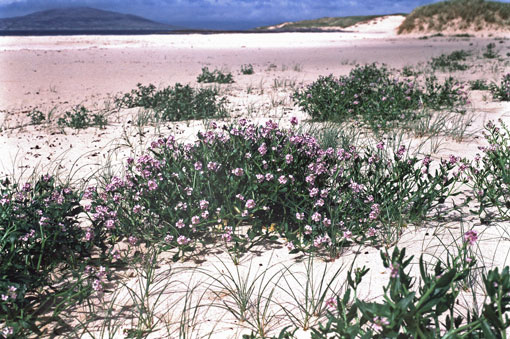
Here's one of his images of Scarista Sands on the Isle of Harris, taken in 1987
Scarista Sands, Harris, Outer Hebrides

Source: https://www.geos.ed.ac.uk/~rsgs/ifa/gems/landformscarista.html

He was heavily involved in the Leicester GA Branch, delivering many lectures and organising other visitors to their meetings.

He was a prolific writer of books, articles and reviews. 

He was the author of The Norwich Area (1971) in the British Landscapes through Maps series - I have a copy of that particular publication -  Orkney (1971), part of the Islands series, and also of Teaching Geography (1974). 

His last major publication for the association, the Geography Teachers' Handbook (1996), which he co-edited with another former GA President Peter Fox, was a mammoth effort. This remained in print for many years until more recent editions were published.

Once Patrick retired from Leicester University, he continued to get involved with the teacher training at nearby Loughborough University.

Patrick is another former President whose involvement with the GA went far beyond his Presidential year, and for which the GA will always be grateful.

Bailey's obituary by Alan Sutton paints a lovely portrait of his enthusiasm for the subject.

Bailey's enthusiasm for his subject was infectious, his love of teaching boundless - sometimes he even found it difficult not to intervene in the classroom when advising and supporting students on teaching practice. He was equally at ease introducing interested lay people into the delights of town trails and countryside walks.

Behind the teacher/scholar, Patrick Bailey was a very compassionate, thoughtful and caring man, generous in his praise of work done well, and very supportive of his close colleagues as well as his tutees. It was a measure of his inner strength and belief - he was a Christian Scientist - that in spite of a very debilitating illness he continued to be stimulating, interested, alert, and active in promoting the cause of geographical education.
 

Following his GA Presidency he became Honorary Secretary and also served as a Trustee for another decade.

Patrick Bailey was awarded an Honorary Fellowship by the Royal Geographical Society shortly before his death.

References
https://www.independent.co.uk/arts-entertainment/obituary-patrick-bailey-1195260.html -Obituary by Alan Sutton

Bailey, Patrick. “A Reply to Sir Keith Joseph's Seven Questions, from the President of the Geographical Association.” Teaching Geography, vol. 11, no. 2, 1986, pp. 64–67. JSTOR, JSTOR, www.jstor.org/stable/23751212.

https://www.geos.ed.ac.uk/~rsgs/ifa/gemlandforms.html - Patrick Bailey's images used in this book

Article on the creation of Teaching Geography: 

Richard Daugherty also mentions Patrick in his article on the origins of 'Teaching Geography'.

King, Russell. “Geography in the School Curriculum: A Battle Won but Not Yet Over.” Area, vol. 21, no. 2, 1989, pp. 127–136. JSTOR, www.jstor.org/stable/20002700. Accessed 31 Oct. 2020.

Bailey, Patrick. “A Geographer's View: Contributions of Geography to the School Curriculum.” Geography, vol. 71, no. 3, 1986, pp. 193–205. JSTOR, www.jstor.org/stable/40571121. Accessed 31 Oct. 2020.

https://www.tes.com/news/geographer-dies?amp - TES mention in 1998

Image of Patrick Bailey room by Alan Parkinson, CC licensed

If anyone has more memories of Patrick Bailey they would be gratefully recieved. This initial post is a little briefer than Patrick deserves.

Updated September 2023

As mentioned before, Bailey was awarded Honorary Fellowship of the Royal Geographical Society in 1999. Here is the transcript of the citation:


Source:
“Meetings: Session 1998-1999.” The Geographical Journal, vol. 164, no. 3, 1998, pp. 365–72. JSTOR, http://www.jstor.org/stable/3060640. Accessed 16 Sept. 2023.

Obituary


Lewis, Gareth. “Obituaries: Patrick J.M. Bailey 1925-1998.” The Geographical Journal, vol. 165, no. 2, 1999, pp. 244–244. JSTOR, http://www.jstor.org/stable/3060432. Accessed 16 Sept. 2023.


Sunday, 5 July 2020

1970: Fieldwork courses in Norfolk

We've had a lot of a focus on fieldwork at the moment with the OFQUAL consultation on the removal of fieldwork from the assessment of GCSE and 'A' level for 20201. In 1970, these courses were run at Wymondham in Norfolk and were very popular. Tutors included former GA President Ashley Kent.


“The Geograhpical Association.” Geography, vol. 55, no. 4, 1970, pp. 455–466. JSTOR, www.jstor.org/stable/40568029. Accessed 4 July 2020.

Friday, 21 February 2020

1958: The Norfolk we live in

This sounds like a book that I could get behind, particularly as it provides a "rich source of blackboard material". 
Reference
P. J. M. B. Geography, vol. 43, no. 4, 1958, pp. 285–285. JSTOR, www.jstor.org/stable/40564222

Margaret Mackintosh RIP

Updated post. Sad news at the end of last week from colleagues who have organised the Charney Conference over the years of the passing of Ma...