Showing posts with label B Bentham Dickinson. Show all posts

Saturday, 19 August 2023

1930

A spot of history. I was looking for some more detail on the connection between Sir Patrick Geddes and the GA.

Here's the Council for 1930 - a great many past and future Presidents were Vice Presidents on Council at this time. The meetings must have been quite some event...


I wonder what happened to Miss A Shipperbottom and the other female members of council mentioned here.

Friday, 19 August 2022

From the archive: B B Dickinson letter from May 1893

Visited the archive in Solly Street earlier this week.

I was able to access some letters from the personal collection of Hugh Robert Mill, received between 1893 and 1944. They were given to the GA in 2000 by Arthur Hunt, who received them from L J Jay's widow. 

L J Jay was a former GA librarian.

They included a letter sent by B B Dickinson to Hugh Robert Mill, who seems to have been addressed as Mill, and which was sent just a week after the meeting where the GA was founded, explaining that the meeting had taken place.


There was also a set of facsimiles of early documents, including a list of attendees at the meeting where ideas for geography teaching were discussed.


There is a list of those who were unable to attend but who had showed an interest. As you can see, these were public school masters generally. The first thing that was discussed was the use of the optical lantern, and ideas were shared for effective use of lantern slides. 

This is linked with the Geographer's Gaze project which is coming soon to the GA website.

Saturday, 23 July 2022

Lantern Slides

I've previously been helped by a number of researchers and posted their questions and feedback on previous blog posts.

Sue Bird is a researcher who got in touch about some images which may involve the GA.

She has been looking at slides with accompanying sketch drawings which also exist within the Oxford HEIR archive (e.g. record 49990 here http://heir.arch.ox.ac.uk/pages/search.php) and trying to source their provenance, which she believes may be with us.


“From my research I am increasingly of the opinion that the typed caption slides were the result of the work of the Lantern Slide Committee of the GA."

G.W. Palmer of Bristol was instrumental in setting this up and first proposed this in 1906 

Source:
GEOGRAPHICAL LANTERN SLIDES / G. W. PALMER : The Geographical Teacher , Spring, 1906, Vol. 3, No. 4, pp. 177-178.

This was taken up by B.B. Dickinson, who compiled a set about the Rhine Valley & arranged an Exhibition of these slides at the annual meeting of the G.A. that year LANTERN SLIDES OF THE RHINE BASIN / B. B. DICKINSON : Geographical Teacher , Autumn, 1907, Vol. 4, No. 3, pp. 133-141.

His introductory remarks to that exhibition refer to the work of the Lantern Slide Committee, esp p. 161 THE USE OF LANTERN SLIDES IN TEACHING / B. B. DICKINSON : Geographical Teacher , Spring, 1908, Vol. 4, No. 4, pp. 161-163

This will then tie in with the 1910 article which mentions the construction of the catalogue I am trying to trace and the fact that the Diagram Co. was responsible for the sale & hire of the slides. I understand that this arrangement lasted until 1939.

NEW VIEW SLIDES PREPARED FOR THE GEOGRAPHICAL ASSOCIATION / Anon : Geographical Teacher, Vol. 5, No. 6, pp. 294-295.

Some very useful information here to follow up on. Any thoughts welcome.

Our Geographers Gaze project is launching soon hopefully, in time for the new academic year.

Tuesday, 3 August 2021

1897 - 'Science' piece

I've been updating a few posts on the blog as we get closer to the posting of Susan Pike's biography shortly, which means there is only one more President to add this year: on the 1st of September.

I came across this piece:

CURRENT NOTES ON ANTHROPOLOGY
By D. G. BRINTON
Science 29 Jan 1897:
Vol. 5, Issue 109, pp. 178-179
DOI: 10.1126/science.5.109.178

References

https://science.sciencemag.org/content/5/109/178 - worth taking a look at the whole piece as the author was not overly impressed.

Sunday, 3 May 2020

1936: Founding of the GA Cambridge Branch

While doing some searching on Facebook for archive images of GA activity over the years, and trying to track down images of individuals, I came across this clipping from the newspaper, posted by Mike Petty, of the 50th anniversary celebrations of the Cambridge Branch of the GA in 1986.


There is a lovely origin story for the branch, with Edith Butcher pictured in the middle of the photo returning from a GA conference held in Sheffield and teaming up with one the original founders B. B. Dickinson, who had retired to Cambridge after finishing teaching at Rugby School.

Good to see Rex Walford here as well as Professor Clifford Darby (who deserves his own entry later, despite not having been GA President). They also had an address from Frank Debenham to kick start the branch.

Does any other GA Branch have similarly auspicious beginnings I wonder?

Tuesday, 27 August 2019

1932: Dr Hugh Robert Mill

Last updated July 2023

Hugh Robert Mill
was a Scottish Geographer and meteorologist, and a very important figure in the history of the GA and the RGS, as well as a Polar historian.
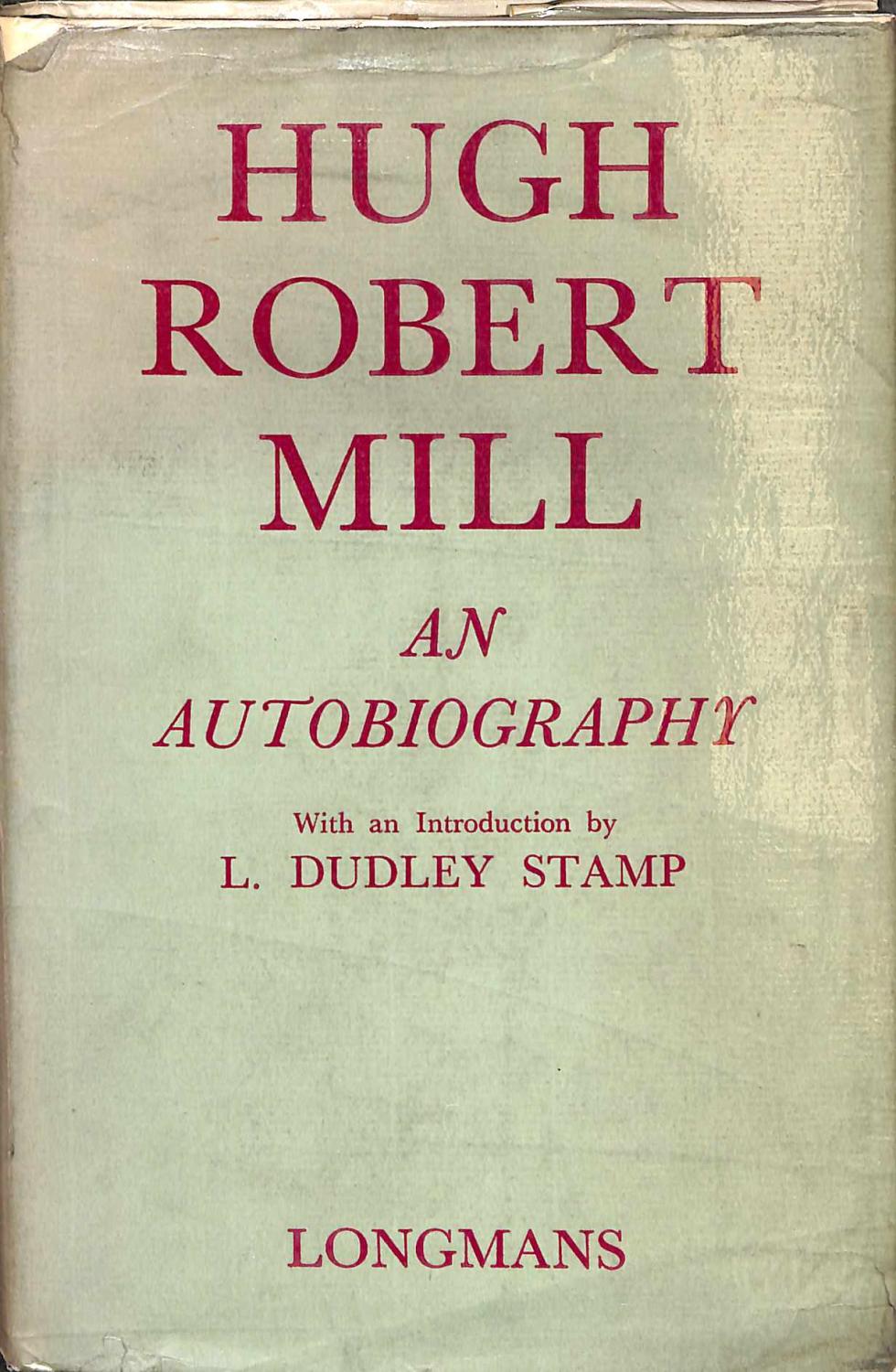

He was born in Thurso in Caithness, and educated in Edinburgh.
Follow this link to see an image

As with other Presidents of the GA, there is a strong connection with other organisations, notably the RGS, where he was Librarian from 1892. At this time, the RGS was based at 1, Savile Row in London.

There was also a strong exploration link as well, as with several other GA Presidents.

He was particularly linked with the Royal Scottish Geographical Society as well, when it was founded in 1885. This brought him into contact with all the main travellers of the day, as Mill was particularly involved with the RSGS throughout this time.

He held the post of secretary to the Royal Geographical Society during the Society's involvement with the leading British Antarctic expeditions of the late 19th and early 20th centuries.
He was a friend and confidant to Scott, Shackleton, and especially to William Speirs Bruce, who led the Scottish National Antarctic Expedition, 1902–04 (Wikipedia entry)

Early in the century he also became President of the British Rainfall Association. That's an Association I could get behind.

He published a very useful compilation called 'Hints to Teachers of Geography on the Choice of Books for Research and Reading' in 1897. He actually gave copyright of this book to the GA, which started off the GA's publishing work.

This can be read on this Internet Archive entry along with other of Hugh Robert Mill's books.
Here's a spicy little entry.


In 1921, he gave the Herbertson Memorial Lecture to the Manchester Branch of the GA. I have also had that privilege - in 2008. His was on the Value of Regional Geography.


Herbertson himself (see my earlier blog post on Herbertson in 1915) was grateful for Mill's help with his own work on the Oxford OS Sheet which formed part of his courses. He used the approach that Mill had used on his own local area of SW Sussex, which was the first to do an in-depth study of an OS sheet "from the viewpoint of the teachers' requirements".
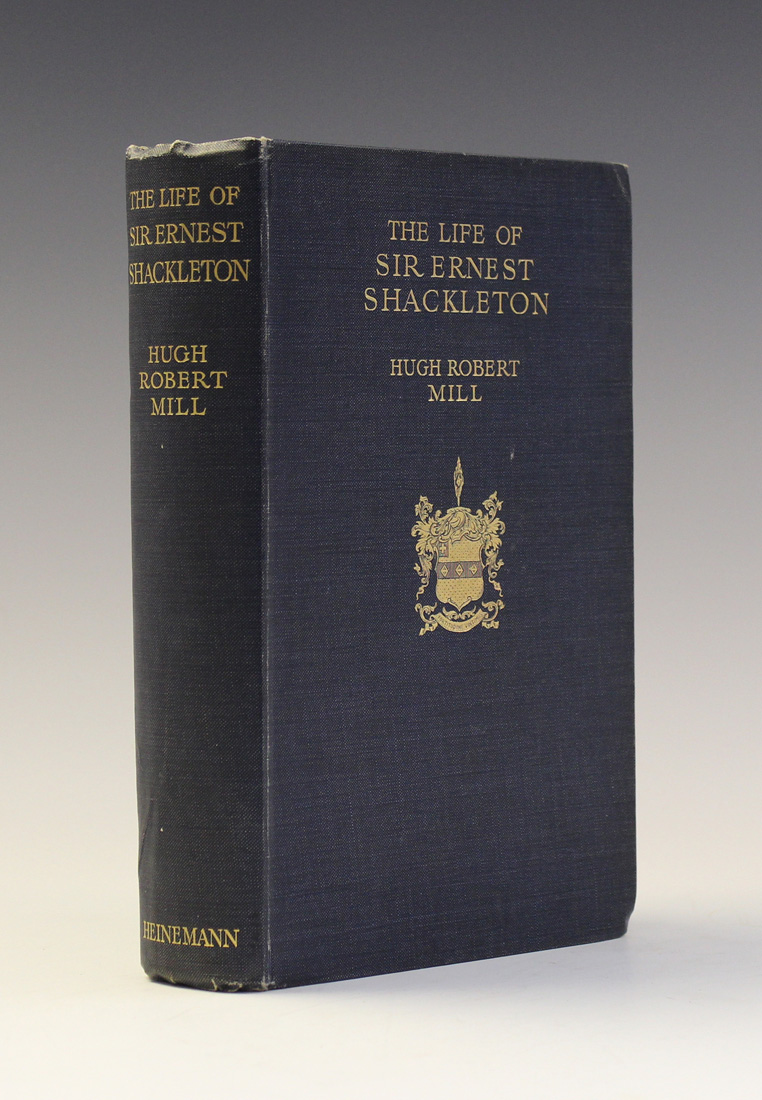

In 1923 he produced the first full-length biography of Sir Ernest Shackleton, a noted explorer and who was also connected with the RSGS. If you can find a copy be prepared to pay around £500. He wrote this with the assistance of Shackleton's widow.

He also wrote the introduction to Shackleton's book "The Heart of the Antarctic' about the 1907-9 expedition.
In his Presidential Address, he started with a nice image of the significance of geography.

The Address was called "An Approach to Geography", and he described geography as being like a picture of the world in the opening lines.


In 1934, Hugh Robert Mill gave another address to conference which is well worth reading. This time he had a focus on Scotland.
He was also connected with Imperial College.

He also had a connection with Antarctica, and the SPRI.


He has a glacier named after him in Antarctica, a branch of the Beardmore Glacier.
Frank Debenham, who we will meet in several decades time, also had some land named after him in Antarctica.

His likeness is also shown on a medal which is awarded by the Royal Meteorological Society for research into rainfall.

Mill died in 1950, in his 89th year: another GA president to live to an old age. I hope he set a precedent for future Presidents.

He also published his autobiography, which would be worth obtaining to find out even more about his time at the GA.

 There is apparently a copy in the Fleure collection that he donated to the GA.

He also left a legacy to the GA, which helped ensure its financial stability at a crucial time.

When he died, Balchin reminds us, he had been associated with the GA from the start - over 50 years of service to the Association.

References

Wikipedia: https://en.wikipedia.org/wiki/Hugh_Robert_Mill - shared under CC license and extracts used on this page.

Edited to add the GA Presidency role.

MILL, HUGH ROBERT. “ADDRESS TO THE GEOGRAPHICAL ASSOCIATION.” Geography, vol. 18, no. 1, 1933, pp. 1–16. JSTOR, www.jstor.org/stable/40560362.
Internet Archive searches. http://www.archive.org

Archibald Geikie: https://babel.hathitrust.org/cgi/pt?id=umn.31951000910377x;view=1up;seq=7

Obituary: Brown, R. N. Rudmose, and H. J. Fleure. “OBITUARY: Hugh Robert Mill.” Geography, vol. 35, no. 2, 1950, pp. 124–127. JSTOR, www.jstor.org/stable/40563009 

From the above:


Mill, Hugh Robert. “The Value of Regional Geography.” The Geographical Teacher, vol. 11, no. 2, 1921, pp. 7–19. JSTOR, www.jstor.org/stable/40555902

Please get in touch if you have anything further to add.

Updated October 2019

While investigating some resources for the entry on a later president, Percy Maude Roxby,  I came across a chronology of Geography in the 20th century written by G. R. Crone, at the time the librarian of the RGS, and it had an image of Hugh Robert Mill as shown below.... a fine moustache - perhaps I need to grow one for my Presidential year...

The article also outlines how Mill wrote the entry on Geography for the 11th edition of the Encyclopaedia Brittanica, which means that he could provide his own thoughts on what the subject actually was...
Source of image: 
Crone, G. R. “British Geography in the Twentieth Century.” The Geographical Journal, vol. 130, no. 2, 1964, pp. 197–220. JSTOR, www.jstor.org/stable/1794582. - available to read with a free JSTOR account.

Mill wrote an autobiography which was called 'The Life Interests of a Geography - an experiment in Autobiography'.

This was published privately by friends in the USA. 
A copy was presented to the Association - I tracked it down in the archive. A signed copy.

Details of this are provided in an article by another former GA President T C Warrington. 
Update: I found some letters related to this in the GA archive.


It seems his final years were one of reflecting on what he had achieved against a variety of challenges.


Warrington, T. C. “THE AUTOBIOGRAPHY OF HUGH ROBERT MILL.” Geography, vol. 32, no. 4, 1947, pp. 166–168. JSTOR, www.jstor.org/stable/40562610.

Not only was he a connection right back to the early days of the GA, when he died in 1950, he also left what is described by another future President: Alice Garnett as a bequest made from Mill's will which helped reduced anxiety about rising costs, and staff salaries

Source: Garnett, Alice. “GEOGRAPHICAL ASSOCIATION.” Geography, vol. 36, no. 1, 1951, pp. 57–62. JSTOR, www.jstor.org/stable/40563090.

JSTOR articles: https://www.jstor.org/action/doBasicSearch?Query=hugh+robert+mill&filter=


Mill, Hugh Robert. “Proposed Geographical Description of the British Islands Based on the Ordnance Survey.” The Geographical Journal, vol. 7, no. 4, 1896, pp. 345–356. JSTOR, www.jstor.org/stable/1773547

and discussion afterwards
Wilson, Charles, et al. “Proposed Geographical Description of the British Islands Based on the Ordnance Survey: Discussion.” The Geographical Journal, vol. 7, no. 4, 1896, pp. 356–365. JSTOR, www.jstor.org/stable/1773548.


Updated November 2019

https://books.google.co.uk/books?id=N81mDwAAQBAJ&lpg=PT67&ots=RtCfAEEQvA&dq=charles%20close%20OS%20geographer&pg=PT79#v=onepage&q=charles%20close%20OS%20geographer&f=false


Updated December 2019

I found another reference to his autobiography while researching Frank Debenham

H.R. Mill, Life interests of a geographer 1861-1944: an experiment in autobiography, self-issued 1946, 122. 
In print Mill felt compelled to refute media characterizations of the expedition as an “advertising stunt” as “quite unjust” – although the presence of two Boy Scouts on its crew – chosen from a nationwide competition in cooperation with the tabloid Daily Mail – might truly be described as one aspect of the expedition that was ahead of its time. 
Mill, The life of Sir Ernest Shackleton (London: Heinemann, 1923), 271. The competition to attract the Scouts is described in Frank Wild and Alexander H. Macklin, Shackleton’s last voyage: the story of the Quest (New York: Frederick A. Stokes, 1923), 14-15

In it, he described Shackleton's last voyage to the Antarctic.

ABE BOOKS has a wide range of books written by Mill. He seems to have been prolific
https://www.abebooks.co.uk/servlet/SearchResults?an=hugh%20robert%20mill&cm_sp=det-_-bdp-_-author

Mill and Debenham seem to be tied up in a number of things connected with the SPRI.
The thesis by Peder William Chellew Roberts in 2010 features a number of references to Mill.

A book by Charles Withers quotes Mill's memories of his childhood, which perhaps shows an early interest in Geography.

https://books.google.co.uk/books?id=DGRrF0CV8BYC&lpg=PA194&ots=ALTTdk_XQs&dq=Life%20interests%20of%20a%20geographer%201861-1944%3A&pg=PA194#v=onepage&q=Life%20interests%20of%20a%20geographer%201861-1944:&f=false


New image

Updated April 2021
A book that I came across...

Last updated August 2021


I found a copy of a self-published autobiography in the archive of the GA which had lots of interesting snippets on Shackleton, the 'Titanic' and his time at the RGS, including how he funded the payment for the statue of Shackleton that sits outside the RGS.

https://victorianweb.org/sculpture/jagger/1.html

Last updated August 2022

I discovered a bath of letters which had been written to 'Mill' as he seems to have been referred to in most of the letters from the great and the good of the GA. These were passed to the GA in 2000 and now reside in the archive. There are pictures of quite a few of them in this Flickr album.

There are quite a few from the time that he was asked to be the GA President for 1932 and he seems to have been quite reluctant at first.

This letter from B B Dickinson sent in 1931 expresses his thanks when Mill finally said that he would take the role on.

And here's one from Fleure in May 1931 asking him to come and talk about his proposed Presidential theme and mentioning some of the people who had been invited and others who couldn't make it.

One was Professor Gerhard Schott who it turns out was a renowned German oceanographer.

Also a famous geologist Percy Fry Kendall.

Apparently Sir Wilfred Grenfell was out of the country - probably in Newfoundland.

A prolific letter writer and who travelled a great deal it seems. 

Mill was GA President 90 years before my own tenure. 

Updated April 2023

Some more detail on Mill in this post on the Facebook group I am a member of called 'Sir Ernest H Shackleton Appreciation Society'. Mill has featured a number of times in fact.

Updated July 2023

The RMetS Award named after Hugh Robert Mill was awarded to Ed Hawkins this year, originator of the important Climate Stripes.

Saturday, 17 August 2019

1930: Basil Bentham Dickinson

Updated August 2021

As I created this blog certain names kept recurring in the documents I was reading from the time.

One person who finally became President in 1930 but was a supporter of the Geographical Association from its origination, perhaps even its 'prime' instigator was B B Dickinson.

This coincided with a change in the way that GA Presidents were chosen: from high profile figures who might be champions of the subject towards acknowledging the long-term service of key officers of the Association.

Dickinson's name was on the bottom of the letter which announced the meeting in Oxford where the GA was founded.

Interestingly, H. J. Fleure, in his look back at the GA, talks about the fact that after a decade or so of appointing high profile Presidents it now "felt strong enough during the decade 1930-40 to choose presidents belonging to its inner circle from time to time".

Basil Bentham Dickinson was a master at Rugby School, at a time when it was Independent schools that were at the forefront of keeping the flame of Geography alight in schools, and looking to support the subject as an academic discipline.

He worked for many years in the classroom, and was also connected with the RGS. He was the Honorary Secretary of the GA from 1893 (when it was founded) until 1900.

He then had to wait 30 years before he became the President.

The year before he had been unwell, and 'Geography' had a piece explaining that he had recovered his health enough to take up the offer of being the President.

Following the Association's founding, Dickinson spent a lot of time working on a geography syllabus that could be the basis for improving school geography, and worked tirelessly for the Association in a number of different roles for the next few decades. Some of these are outlined in this description below, taken from a book on 'Modern Geography' by Gary Dunbar, where he is described as a "prime mover" in the formation of the Association.


1930, when Dickinson finally took office, was a year of great change in the Association, as outlined in Fleure's retrospective of the first 60 years of the Association, and Balchin's Centenary History.

The Honorary Secretary (H. J. Fleure) was appointed to a post at Manchester University (which meant another change in the location of Fleure's Library as space was offered by Spurley Hey.)
When I was a schoolboy, there was a school in Sheffield called Spurley Hey, and it seems there may have been several as he was the Chief Education Officer of the city at the time.
The printing of the GA's journals was also transferred to a new printer at this time: to Percy Brothers in Manchester. The building where they operated, later known as Hotspur Press is still standing, just behind Oxford Street station, where I usually alight when visiting the GA Conference.

There was also the start of some changes to the Primary curriculum in 1930. In several areas, Primary schools which had formerly dealt with pupils up to the age of 14 were made into junior schools for pupils up to the age of 11.

In 1930, his Presidential Address was called 'Reminiscences' and looked back at his time working with the GA, and his thoughts on how geography had developed. He referenced many previous Presidents.


Dickinson died in 1941.

In this obituary, printed in 'Geography' in 1941, he was remembered therefore (quite rightly) as someone without whom the GA may not even exist.


References
DICKINSON, B. BENTHAM. “B. BENTHAM DICKINSON.” Geography, vol. 26, no. 1, 1941, pp. 39–39. JSTOR, www.jstor.org/stable/40489910.

Fleure's 60th piece reference

Fleure, H.J. (1953) "Sixty years of geography and education", Geography, vol.38, pp.231-264

FRESHFIELD, DOUGLAS W. “VALEDICTORY ADDRESS.” The Geographical Teacher, vol. 6, no. 1, 1911, pp. 5–9. JSTOR, www.jstor.org/stable/40554086.

https://rsgs.org/wp-content/uploads/2018/06/RSGS-The-Geographer-Spring-2018.pdf - RSGS journal article on the 125th Anniversary of the GA

Image: Copyright - Royal Geographical Society - taken from Balchin's Centenary of the Royal Geographical Society.

If you know more about B B Dickinson and his work for the GA, please get in touch. I'm sure there is more to discover about him.

Updated August 2021
I discovered his first name was Basil not Brian as I had thought.
His death was announced in the Rugby School Digital Archive in 'The Meteor' in 1941.


Wednesday, 10 April 2019

1893 - 1897: The no-President years

Updated: August 2022

On the 4th of April, 1893, a letter was sent to a number of geography educators informing them of a meeting which was to be held in Oxford.
It was signed by a number of prominent geographers of the time.

Image: Copyright Geographical Association

A room was found by Halford Mackinder, who was Reader in Geography at the University of Oxford, and the group met in the new Common Room at Christ Church college.
The meeting was held on the 20th of May, 1893, and during that meeting the Geographical Association was founded.
More can be read in an article written by Peter Jackson in 2018.

For the next four years of the Association, there was no President however, with an Honorary Secretary and various committees running the Association as it found its feet and started to attract members.

The original ideas of sharing resources started to develop in this early meeting, lantern slides in particular were part of what was called the 'pictorial method'.

Between 1893 and 1897 there was no GA President as the post didn't exist.

B.Bentham Dickinson (of whom more to come in a future post) was Honorary Secretary (1893-1900)

He had collected over 230 catalogued lantern slides to start the process of sharing these, along with lesson notes.

The first AGM was held at the Colonial Institute in London in December 1894, by which time membership stood at 50. These meetings weren't helping Grammar schools become aware of the existence of the Association, which needed to become more active in this area. As Dickinson was a working teacher, an extra pair of hands were needed. An assistant was appointed in 1895 in the shape of  J.S Masterman, who had retired from teaching at University College School helped out until 1900, when Masterman became Treasurer.

At this time, when there was no President, there were 4 questions which drove a lot of the activity and discussions of Association members and officers:

Balchin, in his Centenary history of the Association lists them:

1. Should examination papers in geography be prepared and/or reviewed by experts?
2. Should a knowledge of physical geography be an essential feature in a course in Geography and in any subsequent examination, and if so what should be the syllabus?
3. Should one ask for a knowledge of the whole world in general or for a more detailed knowledge of a continent or region?
4. Should geography be a compulsory subject for some competitive examinations?


You can perhaps guess what the answers to the consultation were...

A number of specimen schemes were published by the Association, who also requested that geography form part of what we might now call the Common Entrance Exam (although the request was turned down initially)

Dr Hugh Robert Mill (who will also get his own entry in due course), published a very useful compilation called 'Hints to Teachers of Geography on the Choice of Books for Research and Reading'
This can be read on this Internet Archive entry along with other of Hugh Robert Mill's books. This was an interesting observation from the footnote of the introduction. It gives the address of the RGS at the time, on Savile Row, and also the correspondence address for the Secretary's assistant Mr. Masterman.


It is also interesting to read some of Hugh Robert Mill's thoughts in the book.

Read more about the initial meeting here, in a piece by Alan Kinder and Nick Lapthorn (the latter will have his own entry on this blog in due course as a Past President)

In 2018, a group of Geographers was invited to a special meal at the venue where the Association was founded.
Images from that event can be seen here.
Here is the CEO, Alan Kinder in the same room where the association was founded, during the 125th Anniversary year.


Image copyright: Geographical Association / Bryan Ledgard
https://farm1.staticflickr.com/972/41597586484_9f605f41b7_b.jpg 

References
W.G.V Balchin: 'The Geographical Association, The first Hundred Years' (GA, 1993)

Update (June 2019)

Perhaps the definitive account of this period of the GA was written by H. J. Fleure, and can be read on the JSTOR by subscribers to 'Geography'
Access it here.

Update
Brian Bentham Dickinson shared his reminiscences of this period later (in 1931)
It can be read here.
https://www.jstor.org/stable/40557794

He described the first meetings of the Association, including the initial founding meeting in Oxford.

The first formal meeting of the GA was held on August 3rd 1893 at University College School, then at 16 Gower Street, with the Headmaster M. H. W. Eve in the Chair. 

Venue is shown below on Google Earth - near the British Library / Bloomsbury.


I found some letters in Hugh Robert Mill's archive relating to this period and they have been posted separately.

Margaret Mackintosh RIP

Updated post. Sad news at the end of last week from colleagues who have organised the Charney Conference over the years of the passing of Ma...