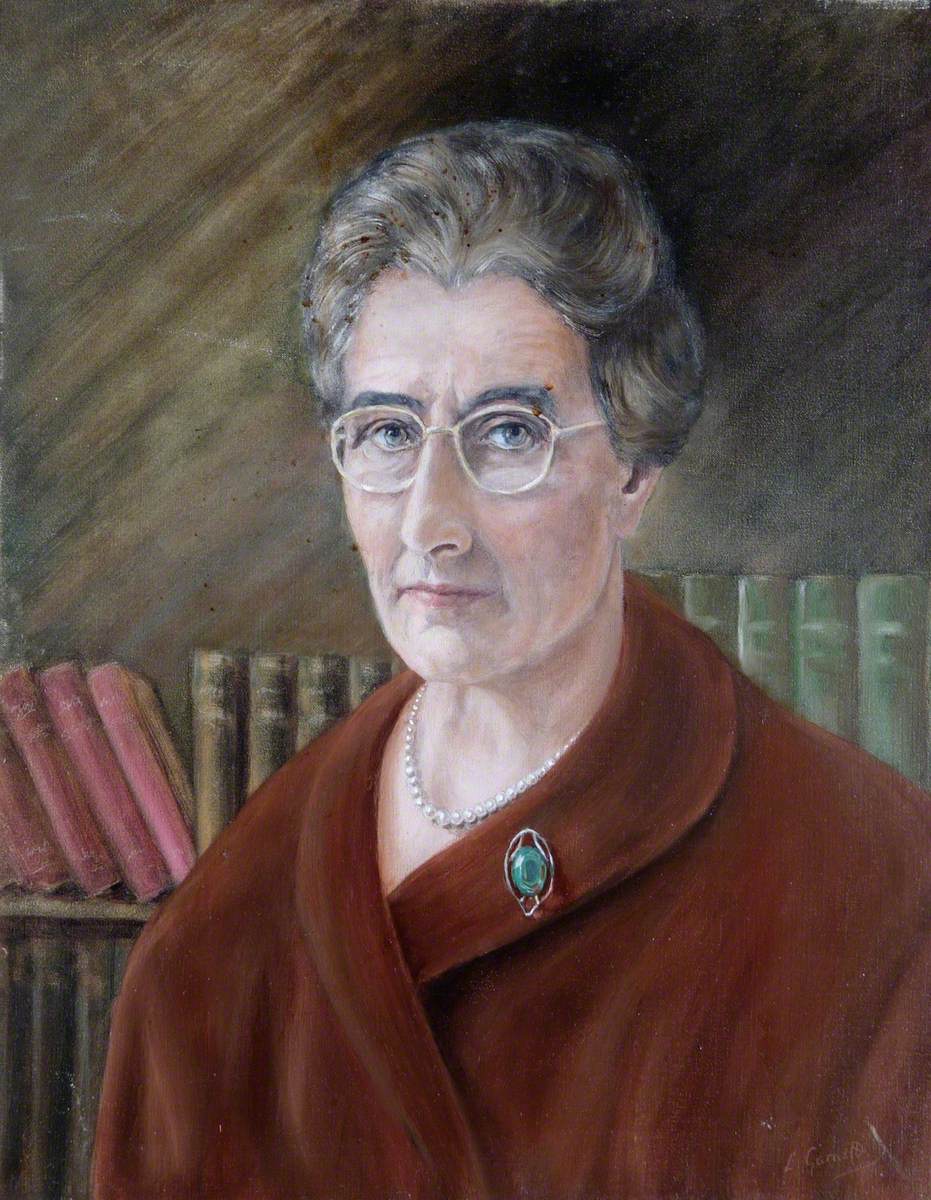
Showing posts with label Alice Garnett. Show all posts

Saturday, 21 October 2023

Complex Locations

I hope that in the blog I have flagged up some important female geographers who played a significant role in the development of the GA. Quite a few of them are featured in this book, which can be downloaded in full from the link below.

Bonus points if you can name the three ladies on the front cover.

Source

https://epdf.tips/complex-locations-rgs-ibg-book-series.html

Sunday, 24 September 2023

The development of Geography

Quite a few GA Presidents are mentioned in this piece by Ivor Goodson, on how geography gained its status as a discipline.

It references several key times in geography's development, including the Madingley lecturers and the emergence of the 'new geography'

Source:

Goodson, Ivor. “Becoming an Academic Subject: Patterns of Explanation and Evolution.” British Journal of Sociology of Education, vol. 2, no. 2, 1981, pp. 163–80. JSTOR, http://www.jstor.org/stable/1393016. 

Monday, 20 December 2021

On the move to Fulwood Road

An interesting article on the move from Park Library and the potential for visitors...

Something that might be returned to perhaps in due course.

Reference

Garnett, Alice. “The Geographical Association.” Geography, vol. 49, no. 1, Geographical Association, 1964, pp. 59–72, http://www.jstor.org/stable/40565765.

Monday, 8 March 2021

International Women's Day

It took from 1893 until 1968 for the first female GA President to be appointed in Alice Garnett. Since then, there have been many more, but still fewer than male Presidents, and we are yet to see the appointment of a person of colour. Keep an eye out for the Trustee elections which are announced towards the end of the year and think about whether you could put yourself forward to follow in the footsteps of previous Presidents. Click to see the full image.

Wednesday, 23 December 2020

Richard Gill

Updated January 2021

Richard Gill retired at the end of  December 2020 as the GA's Business Manager. 

For as long as I have been involved with the GA, Richard has been working at Solly St. He has supported the Association in developing systems which have allowed the GA to weather the Covid storm far better than many other similar charities and businesses have.

The GA has always needed people with some business acumen to keep a steady hand on finances and cashflow. People like Alice Garnett were very good at keeping down costs and negotiating favourable terms for rent etc. for the Association and showing financial prudence.

When I worked for the GA, I regularly sought Richard's advice as his knowledge of the Association went far beyond the financial aspects of his job. He has what Bob Digby described as 'nous', and knows the GA inside out, and always offers sage advice.

Covid-19 delayed Richard's retirement, but also provided a final 'test' for the systems that he had put in place over the previous years. He kindly offered to stay on to help his successor settle in, for which the Trustees have been particularly grateful.

Wishing Richard a long and healthy retirement.

Thursday, 26 November 2020

Sheffield's Rain Shadow

Inspired by work by Alice Garnett, GA President in 1968. The 2nd female Professor of Geography.

Read the story of its creation here.


Worth remembering that Alice also has her photo on the wall at the RGS along with other female pioneers of geographical endeavours. 
See if you can track it down next time you are down there. 
The "home of geography" has been shut to visitors for most of the year, but will be slowly reopening as we move into 2021.

Wednesday, 17 June 2020

1968: Professor Alice Garnett

Last updated August 2023

Alice Garnett.jpg
Alice Garnett was a Professor of Geography at the University of Sheffield.
She was the second British woman to hold the position of Professor of Geography and the first female President of the GA, and very much connected with its growth and influence.

I believe another of the first few female Professors of Geography may have been Joy Tivy, who is mentioned elsewhere on the blog, but there are a number of candidates it seems.

As Head of the Geography Department she rapidly expanded the department- with 401 students being taught in the department by 1967. She left a legacy of the next generation of geographers and one of the biggest departments in the University. She had previously joined the Geography department as far back as 1924. Hers was a life of geography.

She also held the position of Vice-President of the Royal Geographical Society - another former President to have similar connections with the two organisations. There have been plenty of those mentioned on the blog as it has grown, but the connections have not been the same for a few decades which is a pity. Work for future GA Presidents to continue to pursue.

Alice Garnett's name appears on the GA's Annual Report in 'Geography' from around 1950 onwards, when she started to take a leading role, as the association moved to Sheffield, initially into Park Library before moving to Fulwood Road - a move that Alice was very much an integral part of organising and negotiating.

Ivor Goodson talked about this period:
The period following 1945 does seem to have been critical in geography's acceptance and consolidation within the university sector. Professor Alice Garnett explained in 1968 why this period was so important: 'Not until after the Second World War was it widely the case that departments were directed by geographers who had themselves received formal training in the discipline, by which time most of the initial marked differences and contrasts in subject personality had been blurred or obliterated'. At this point geography departments were established in most universities and the subject had a recognizable core of identity. 

Alice had also, significantly been Honorary Secretary of the GA for some years before taking over the Presidential role, and had also produced the Annual reports that were published in 'Geography', so she was a very important person within the Association for many years. 

She was particularly interested in the connection between school and academic geography.


She was mentioned by several former Presidents that I spoke to as being at the very heart of the GA at the time.

Her Presidential Address was called:
"Teaching Geography: some reflections"
and looked back on some of the previous legacies of the GA's work and what she hoped might happen next.

Prior to her taking up the Presidency, Alice had served as the Association's Honorary Secretary for twenty years: 1947-1967, following the retirement of the previous holder of the post, and continued to support the GA after her Presidential year, along with her colleague Professor David Linton. She helped provide a space for the Association's library and a great many other 'backroom' tasks.
During the war, the GA had the use of a room in the High School of Commerce at the University of Manchester, but Alice moved it to Sheffield University, and found a suitable space in the Park Branch Library on Duke Street.

They persuaded the Corporation of Sheffield to give the GA accommodation in a section of the Park Branch Library. In April 1950, the GA moved for the third time. A fund had been put together to celebrate the Jubilee, but as this fell in 1943 it was not felt appropriate, and the money was saved for the removal expenses. However, Alice Garnett and the other officers managed to arrange the move without touching this fund. Mrs. C. D. Mann, the Chief Clerk resigned at this time.

She also insisted on the value of, and reorganised support for Primary Geography.

She also negotiated favourable terms on the lease of 343 Fulwood Road in Sheffield, which became the home of the GA for many years. More on that to come later.

Alice Garnett’s enduring legacy to her department was her lobbying for a purpose built building for Geography which she achieved where the Geography annexe had been on Winter Street. The building which Geography still occupies was opened in 1970 by the then head of department Ron Waters. Terraced houses on Winter Street were demolished for the new Geography building which was integrated into Weston Park. This and other features including the hexagonal teaching rooms earned the building a Civic Trust commendation.
The building, as designed, contained a library, a map library, a physical research laboratory with a huge flume, aerial photograph analysis room and teaching rooms sufficient for all but the biggest first and second year lectures. It also had offices for academic staff, tutorial rooms, a workshop, photographic and cartographic suites.

Sheffield University Geography Department building in 1970

Source: https://www.sheffield.ac.uk/geography/about/history

I visited the Department several times during the early 1980s for talks and a few school-related events. I also visited several times more while working for the GA.

In 1954, Alice published a piece in 'Geography', following the previous year's Diamond Jubilee Celebrations, looking back, taking stock and looking forward. Part of this was to make the most of the GA's stable financial position to pay staff appropriately, so that they were paid in accordance with the work they were doing at HQ. She also wanted to support the Section Committees more, to help them complete the vital work they were doing (and continue to do) to support and push forward the work of the Association. At the time, they were paying their own travel expenses for attending meetings. She reflected on the need to build up a fund. At the time, mostly due to Alice's own persuasion, the GA was given free conference accommodation and also free offices and storage at the Park Library in Sheffield.
She talked about the importance of the 'giving' nature of the Association.


She finished by setting a challenge to the geographers / GA members of 1993.


She was also involved in the GA's role in supporting the development of teacher education. In 1962, for example, 'Geography' featured a piece that she had provided for the Advisory Council to the Ministry of Education on the nature of school teaching for 'average and below average children'. This involved the following GA members, who included teachers. I wonder whether any readers can tell me more about these colleagues.

It concluded as follows:


A piece by Rex Walford, published in 1993 mentioned Alice.
The article was about Mackinder, but included a quote and the follow up listed below:

 Can we now usefully ask of ourselves and of our somewhat fragmented discipline 'Whither the geography of today and tomorrow?' For surely on the answer to this question will depend decision-making regarding the educational value and popularity of our subject in schools and its role as a university discipline and in other institutions of higher education. 
As geographers today probe and strive to expand our frontiers further and further, would our answers now be too disparate to command attention? 

These were the last published words of Professor Alice Garnett (Garnett, 1987). 

She had spent most of her life, beyond her duties in the University of Sheffield, tirelessly working for the Geographical Association, notably serving it as Hon. Secretary in a key period of its life. She had been intimately concerned with the mid-century struggle to make geography an acceptable and widely-available subject in schools. 

A postscript was added by Jo Norcup in late May 2020
She told me that Alice had a sister called Olive Garnett, who was also a prolific geography author. Olive will have her own post on the blog.

Other memories of Professor Alice Garnett are welcome.


Source:
Wikipedia page:
https://en.wikipedia.org/wiki/Alice_Garnett - her maiden name was Crow.

University of Sheffield page: https://www.sheffield.ac.uk/geography/alumni-old/history

Fleure, H. J., and H. M. Fleure. “Alice Garnett: Honorary Secretary 1947-67.” Geography, vol. 53, no. 1, 1968, pp. 93–95. JSTOR, www.jstor.org/stable/40566483.

GARNETT, ALICE. “Teaching Geography: Some Reflections.” Geography, vol. 54, no. 4, 1969, pp. 385–400. JSTOR, www.jstor.org/stable/40567138

https://books.google.co.uk/books?id=8tdurY3CGNQC&lpg=PA97&ots=jiACAnc8q_&dq=pat%20bryan%20leicester%20geography&pg=PA102#v=onepage&q&f=false

Garnett, Alice. “LOOKING AHEAD AND TAKING STOCK.” Geography, vol. 39, no. 1, 1954, pp. 1–4. JSTOR, www.jstor.org/stable/40564668

Garnett, Alice. “Memorandum on Geography Teaching.” Geography, vol. 47, no. 1, 1962, pp. 63–71. JSTOR, www.jstor.org/stable/40565632

Updated November 2020
While researching Stan Gregory and early use of ICT, I came across this by Ron Johnston.

Source:
https://books.google.co.uk/books?id=kVtwDwAAQBAJ&lpg=PA90&ots=AHT4_XIJ21&dq=Geographical%20ASsociation%20Package%20Exchange&pg=PA89#v=onepage&q&f=false

Obituary
Ellis, Ronald, and Arthur Hunt. “The Geographical Association.” Geography, vol. 74, no. 3, 1989, pp. 272–275. JSTOR, www.jstor.org/stable/40571681. Accessed 15 Nov. 2020

Alice Garnett obituary.

Plenty more on her dedication to geography here...

I wonder where the painting might be now.

Updated August 2023

I then came across a few tweets suggesting that Alice Garnett was one of the first person to talk about the Urban Heat Island effect in work she carried out.
She also seems to have been one of the first people to use the term "heat shadow".


I found the first clue in the archives at the Central Library. In a book from 1956, Climate in Sheffield and its Region, there’s a study by Alice Garnett, a Professor of Geography at the University of Sheffield. It contains the earliest mention of a ‘rain shadow’ describing our city’s climate, the reason for its relative dryness in comparison to Manchester and the Peak. As it goes, air filled with moisture reaches a mountain range and gets buffered upwards. There’s less pressure and it’s colder the higher you go, so the water vapour condenses into a liquid as clouds. When the clouds get too heavy, it rains. On the other side of the mountain range, the air descends and warms up again. The water in the clouds evaporates, leaving a ‘shadow’ of rain where it should have fallen before the descent.

https://www.sheffield.ac.uk/geography/department/about-department

https://books.google.co.uk/books?id=tRgrBgAAQBAJ&pg=PA101&lpg=PA101&dq=%22Alice+Garnett%22+geography&source=bl&ots=UIiLPDITPt&sig=ACfU3U2Iv9Yc32l8GWK7XGmDuTWpkQIbVQ&hl=en&sa=X&ved=2ahUKEwjW0O7kzNeAAxUXTkEAHSw_AUQ4RhDoAXoECBgQAw#v=onepage&q=%22Alice%20Garnett%22%20geography&f=false

Saturday, 13 June 2020

Olive Garnett

In 1968, the GA President was Alice Garnett.
Just before I posted the entry for her, I was made aware by Jo Norcup that she had a sister called Olive, who also spent a life involved in geography education, and was also very much involved with the Geographical Association.


This was the tweet that I mentioned.
And this was the response from Jo Norcup.
Olive Garnett (c.1900–1982), BA, DipEd, Head of the Geography Department (1926–1965), Vice-Principal of Froebel College (1947–1961), Deputy Principal of Froebel College (1961–1965) Olive Garnett (c.1900–1982), BA, DipEd, Head of the Geography Department (1926–1965), Vice-Principal of Froebel College (1947–1961), Deputy Principal of Froebel College (1961–1965)

I found a portrait here courtesy of the University of Roehampton. It was painted by Leslie Garnett.

It seems Olive was linked with Froebel College for many years, which was known previously as the Froebel Educational Institute, and had the philosophy that children learn through discovery.

There is an Olive Garnett building at Roehampton.

She is mentioned in Rex Walford's book on School Geography in the UK.

A key book from Olive was her 'Fundamentals in School Geography' - I purchased a copy. This provides a great deal of guidance on the teaching of Geography and much which would be familiar to the geography teacher of today. At the end of each chapter, lists of suggested further reading includes plenty of former GA Presidents: Fairgrieve, C C Carter and Alice Garnett of course.


Source:
https://books.google.co.uk/books?id=p_xfuY8CJ48C&pg=PT115&lpg=PT115&dq=%22marguerita+oughton%22+sheffield&source=bl&ots=xln_U09sEO&sig=ACfU3U0BVaFI8t74PC7xxPHMiijd8QoLyQ&hl=en&sa=X&ved=2ahUKEwjbrsfys43pAhXKQEEAHeGlCCIQ6AEwAnoECAoQAQ#v=onepage&q&f=false

Any other information or images relating to Olive Garnett would be gratefully received.

Saturday, 16 May 2020

1965: Moving to Fulwood Road

Through the 1950s. the GA's premises at  Duke Street Library in Sheffield were getting overcrowed. A donation of oak shelving from the University helped matters in 1959, but the City Fathers, who had granted the GA free accommodation decided that the permises were needed, so the GA had to look for a new home.

In 1959's Annual Report this was explained.

Balchin describes the 1960s as 'an anxious time', as several early options were rejected.

Their tenancy of the library was due to end in September 1964, and notice was served a year earlier. By late 1963, Alice Garnett had been able to secure some assistance from Sheffield University, who had bought land for building student accommodation which included a sizeable Victorian House at 343 Fulwood Road, Sheffield.

This was adopted as the postal address for the GA from September 1964.


Balchin says that the formal opening of the new HQ was on the 11th December 1965, by the Lord Mayor of Sheffield, followed by lunch.

Alice Garnett talked about the impending move in her reflections in 1964 and reported on it in 1965.


After 14 years at the Duke Street Library they had a short move.
It describes the accommodation as having ground-floor accommodation for the library and editorial needs, and first floor accommodation for clerical and administrative work, along with meetings rooms, branch visits and committee meetings.

Here's a floor plan from an estate agent's booklet when it was sold


New staff were also taken on it seems.


Further HQ staff of the time were mentioned in a report from 1966.


References

GARNETT, ALICE. “The Geographical Association: ANNUAL REPORT 1958.” Geography, vol. 44, no. 1, 1959, pp. 54–62. JSTOR, www.jstor.org/stable/40564237
Image taken from Balchin's Centenary, photo is copyright the GA Archives

“The Geographical Association.” Geography, vol. 49, no. 3, 1964, pp. 346–348. JSTOR, www.jstor.org/stable/40566391. Accessed 22 Apr. 2020.

Friday, 15 May 2020

Edith Coulthard


A mention here for Edith Coulhard. She assisted Alice Garnett as honorary secretary of the GA in the early 1950s.
She also wrote in 'Geography' about some experiments linking up with other schools and carrying out some interesting project based learning with students back in the 1940s. She wanted students to have experience of learning which would be useful for "real life".

She also reported on a 9 day study tour of Belgium accompanied by Elsie K Cook

Source: 


https://books.google.co.uk/books?id=p_xfuY8CJ48C&pg=PT115&lpg=PT115&dq=%22marguerita+oughton%22+sheffield&source=bl&ots=xln_U09sEO&sig=ACfU3U0BVaFI8t74PC7xxPHMiijd8QoLyQ&hl=en&sa=X&ved=2ahUKEwjbrsfys43pAhXKQEEAHeGlCCIQ6AEwAnoECAoQAQ#v=onepage&q&f=false

Coulthard, E. M. “EXPERIMENTS IN TEACHING CURRENT AFFAIRS.” Geography, vol. 27, no. 2, 1942, pp. 69–71. JSTOR, www.jstor.org/stable/40562200. Accessed 15 May 2020.

Coulthard, E. M. “A SCHOOL EXPERIMENT.” Geography, vol. 28, no. 4, 1943, pp. 117–118. JSTOR, www.jstor.org/stable/40562328. Accessed 15 May 2020.

Cook, Elsie K., and Edith M. Coulthard. “ACROSS THE EAST OF BELGIUM FROM ARLON TO BEERINGEN.” The Geographical Teacher, vol. 12, no. 2, 1923, pp. 132–135. JSTOR, www.jstor.org/stable/40555387. Accessed 15 May 2020.

Monday, 27 April 2020

1964: Professor David Leslie Linton

Last updated October 2023

"Mankind must be made much more aware of the world it lives in, its rigorous limitations and its limited possibilities. Above all it must be assisted and persuaded to think of the world as a whole"
D. L. Linton

David Leslie Linton was a Professor of Geographer at the University of Sheffield, and a renowned geomorphologist. His name lives on in the form of prizes in this field.


He was a close colleague of Professor Alice Garnett who, we will discover, was the beating heart of the GA for many years, following her taking up the post of Honorary Secretary in 1947 and overseeing the GA's move to Sheffield in 1950.

Alice Garnett later became GA President four years after Linton.

Linton was a geomorphologist, and also did some influential work with another former GA President: Sidney Wooldridge.

He was born, apparently, in a grocers' shop on the Old Kent Road, to Irish parents, and went on from there to Haberdasher's Aske's school. 
He was a gifted musician, and apparently wanted to do a degree in Chemistry originally. 
He was also a keen artist, and sketched the landscape, from where the geomorphological features emerged, waiting to be explained. In the 1930s, he was active with the Le Play Society, leading fieldtrips to locations including Iceland. This Society was very much tied up with the early history of the GA.

Linton went to King's College, London and was persuaded by Sidney Wooldridge (who was working as a Demonstrater at the time) to add geography to his subjects for his degree, and he was drawn into the exciting geomorphology work that was being done at the time. This university has been linked to quite a few GA Presidents, notably another geomorphologist Denys Brunsden.

He spent the war (1940-1945) with the Royal Air Force Volunteer Reserve working in aerial photography interpretation - solid work for a geographer, and which gave him a deep knowledge of landscapes. There is definitely a book here to trace the work of the geographers who were later linked with the GA in the post-war period. It seems that he was rather good at this sort of work as his obituary explained:


After the war, he went over to check out the sites, and was just about tracked down by the University of Sheffield, who wanted to interview him for a post there where he was appointed as Professor of Geography.

Summary of his career:
King's College London, BSc (Geography), 1927, MSc, 1930; DSc 1945; Demonstrator in Geography and Geology, University of London, 1927-1929; Lecturer in Geography, University of Edinburgh, 1929-1945; served in the RAF (Photographic Intelligence), 1940-1945; Professor of Geography, University of Sheffield, 1945-1958; DSc, 1955; Professor of Geography, University of Birmingham, from 1958; William Evans Visiting Professor, University of Otago, 1959; Honorary Editor of Geography, the Quarterly Journal of the Geographical Association , 1945-1965; President of the Institute of British Geographers, 1962, and of the Geographical Association, 1964; Fellow of King's College London (FKC), 1971; received the Murchison Award, Royal Geographical Society, 1943.

What an impressive CV...

At a meeting in Sheffield (with Wooldridge and others) in 1958, he was a founder member of what became the British Geomorphological Research Group, which he chaired in 1961, and also a founder member of the Institude of British Geographers. He became President of the IBG in 1962.

Linton was honorary editor of the GA's 'Geography' journal too, between 1947 and 1965, and his name appears in numerous copies of 'Geography' in the front matter and also in the pages.

He contributed a range of articles to the journal 'Geography' through the 1940s and 1950s. One was on the rise of the million city - I wonder what he would have made of the rapid rise of megacities, particularly in China.


He also wrote a piece on Geography and the Social Revolution in 1957 in 'Geography'.
His Presidential Address. published in 1965 was on 'The Geography of Energy'


The address included some classic illustrations such as this one.


It also finished with an important message for all teachers.


I remember that he also developed a theory of the formation of Tors, and was taken to the quarry where this theory was apparently first visualised when on an undergraduate fieldtrip at Two Bridges on Dartmoor.
I've visited the quarry here. It's on the path to Wistman's Wood.


Tor formation theory is shown below, in an influential textbook of the time by David Waugh, who is mentioned elsewhere on the blog.


In 1964, he became President of the Geographical Association - probably quite a coup for the GA at the time given how prominent and busy he was.

Linton died unexpectedly in 1971, when he was nearing retirement at the end of a long career while in post at the University of Birmingham. He was still very active.


Obituary published in several journals.

A tribute to him was written by Alice Garnett and published in 1966 on the occasion of his retirement as Honorary Editor.


He received the RGS's Murchison Award.

References
Wikipedia
https://en.wikipedia.org/wiki/David_Linton_(geographer)

I amended this to add in his GA Presidency, as I have done to all entries for former Presidents.

Address: LINTON, D. L. “The Geography of Energy.” Geography, vol. 50, no. 3, 1965, pp. 197–228. JSTOR, www.jstor.org/stable/40567042
Obituary:
“David Leslie Linton.” Transactions of the Institute of British Geographers, no. 55, 1972, pp. 171–178. JSTOR, www.jstor.org/stable/621729

Garnett, Alice. “A Tribute to D. L. Linton: Honorary Editor 1947-65.” Geography, vol. 51, no. 1, 1966, pp. 65–66. JSTOR, www.jstor.org/stable/40566046. Accessed 12 Apr. 2020.
LESZCZYCKI, STANISLAW, and David L. Linton. “The Development of Geography in the People's Republic of China.” Geography, vol. 48, no. 2, 1963, pp. 139–154. JSTOR, www.jstor.org/stable/40565574.

LINTON, DAVID L. “Geography and the Social Revolution.” Geography, vol. 42, no. 1, 1957, pp. 13–24. JSTOR, www.jstor.org/stable/40563897

LINTON, DAVID L. “Millionaire Cities To-Day and Yesterday.” Geography, vol. 43, no. 4, 1958, pp. 253–258. JSTOR, www.jstor.org/stable/40564208
Linton, David L. “THE LANDFORMS OF LINCOLNSHIRE.” Geography, vol. 39, no. 2, 1954, pp. 67–78. JSTOR, www.jstor.org/stable/40564569
https://www.ed.ac.uk/geosciences/about/history/school-history


Image of Haytor - copyright Alan Parkinson, shared under CC license
Image of Linton from the Balchin Centenary Book

Update August 2020
In 2017, my own degree tutor and former lecturer at Huddersfield Polytechnic: Professor Tim Burt was awarded the Linton Award
https://www.dur.ac.uk/geography/news/allgeognews/?itemno=31007

Updated October 2023 with a quote at the start of the post.

He worked to locate V1 and V2 launch sites which is a remarkable period of history for him to have been involved with.

Friday, 24 April 2020

1964: XXth International Geographic Congress

The July 1964 issue of 'Geography' was a special issue to celebrate the 20th International Geographical Congress.


1964 also saw the 70th Anniversary of the GA's first AGM, which was commemorated by Alice Garnett, the Honorary Secretary at the time (and the GA President in due course)

It included a reflection on the work of the GA by Alice Garnett with a look ahead to the future move to Fulwood Road.

"we can now have courage to blaze new trails that will be worthy of the founder members of seventy years ago; with, ere very long, some of the guiding reins transferred once more into the trust of younger hands"

Thanks to Brendan Conway for sharing the front cover of a book that was published for this event.

Two GA Presidents were involved here.
Geoffrey Hutchings contribution with SW Wooldridge to one of my collector items 'Guide To London Excursions 1964' produced for the 20th International Geographical Congress in 1964.

I ordered a copy of this from ABE Books.
More on that to come in a future blog post.


In the meantime, Brendan Conway posted over on his Think Geographically blog a repost of an original post from 2014, where he had looked back at this event.

I will post more about this event in another blog post using some of Brendan's research.

I've previously posted about the special stamps which were released for this event, and which I've also got copies of - partly as a result of work by L Dudley STAMP to have these produced.
I did further research to try to find further details and papers.

The Twentieth International Geographical Congress was held in London between 20th and 28th July, being formally opened by H.M. the Queen on 21st July, 1964. It was attended by some 2500 delegates from 68 countries

Monday, 6 April 2020

1961: Changes at HQ

By 1961, there were some important changes taking place at the GA's HQ. There are references here to some important additional people.

The Executive Committee decided that the time has come when we must have a second graduate member of staff at headquarters, and we are glad to report that we have been fortunate in securing the services of Miss A. M. White, a Cambridge University geography graduate, to take over some of the administrative and secretarial work. Miss Oughton remains as head of our office and staff management. 

Mrs. Felkin, the Senior Clerk, well known to many members personally, continues to give invaluable service particularly in matters concerned with our book-keeping and membership records - both most important! - and the service of water and contour pulls of O.S. maps; she is assisted by two junior clerks, and the other member of staff is the library assistant. 

 This staff, double in number what it was a decade ago, combines to give us at headquarters a very hard-working and loyal team and it is a great pleasure to feel able to report to this Annual Meeting, and for the first time, that at last we have been able, as employers, to reach the standards expected for equivalent work in the existing national conditions. 

All of the staff are now on appropriate, if in some cases modest, salary scales, with appropriate contributory pension and insurance schemes and other facilities, and, within the limitations of our present accommodation, they now have adequately furnished working space and essential clerical and labour- saving office equipment. 

This state of affairs, after a decade of financial struggle, and exacerbated by the spiral of inflation, can at last be a matter of pride, and with the increased efficiency that we hope it brings.

Source:
Garnett, Alice. “The Geographical Association.” Geography, vol. 47, no. 1, 1962, pp. 99–109. JSTOR, www.jstor.org/stable/40565641

Monday, 25 November 2019

1951: A Sheffield Conference

L Dudley Stamp welcomed delegates to Sheffield for the GA conference in 1951.
It's been excellent to see Sheffield back as a regular conference venue again more recently, as my home city.
It was pleasing to see delegates arriving from a number of different countries this time round as well.


Reference

Garnett, Alice, and T. W. Brown. “THE INTERNATIONAL CONFERENCE OF TEACHERS OF GEOGRAPHY, SHEFFIELD, AUGUST, 1951.” Geography, vol. 36, no. 4, 1951, pp. 221–231. JSTOR, www.jstor.org/stable/40563129.

Friday, 25 October 2019

1947: Moving to Sheffield

PARK LIBRARY, SHEFFIELD: 1947 - 64 

Post-war developments forced the GA to relinquish its accommodation in Manchester as the area was redeveloped.
Dr. Alice Garnett (the Honorary Secretary at the time) and Professor David Linton (Honorary Editor) were both based in Sheffield, so a move there was agreed, and made possible by the Sheffield City Librarian’s generous offer of free office and library space at Park Library, Duke Street.

This is another on the list of places to visit during my time as President.

In October 1950, the GA’s new offices were officially opened.


Image: Google Earth - copyright is held by the various image providers, and image used under Fair Use.

Margaret Mackintosh RIP

Updated post. Sad news at the end of last week from colleagues who have organised the Charney Conference over the years of the passing of Ma...