Showing posts with label Books. Show all posts

Tuesday, 1 September 2026

2026: Fiona Sheriff

It's time for another new GA President. Another year has passed.

The President for the next year is Fiona Sheriff. She is another female teacher, continuing a welcome trend for the last few years. She is also the youngest ever GA President, having been born in the year when I started teaching.

I sent Fiona the questions that I had given to all other Presidents and used them to create the post below. I'm grateful to Fiona for the level of detail she provided.

When and where were you born? 

"I was born in 1988 in Chelmsford, Essex. I grew up in Braintree in north Essex. My dad is Braintree born and bred, but my mum is a Londoner with Irish heritage."

Image credit: Alistair Hamill

Baby photo - Fiona Sheriff
Where did you go to school / university

"Growing up, my parents didn’t drive so we went to the most local schools to us. At Primary level, I went to John Bunyan Infant and Junior School which I started at in 1992, followed by Tabor High School (now Tabor Academy) which I started at in 1999. 

My memories of Primary school geography are of place-based studies such as completing an enquiry about St. Lucia (a place I have wanted to go to ever since!) and many studies of Braintree as a market town. Our fieldwork always seemed to centre around a walk up and down Bradford Street which has a fascinating history!

At secondary school we started by doing a carousel of humanities subject with Mr Pritchard and Mr Mullender, both of whom terrified me! Mr Pritchard had also taught my dad in the 1970s in the same school. In Year 9 I then had Miss Fox – who still teaches Geography in Essex now and with whom I re-connected with at the GA conference in Oxford. Sadly, at aged 14 I had other aspirations: becoming an interior designer and therefore geography was not one of my GCSE options. 

This is a little rare for GA Presidents, but regular followers of the blog will know that a lot of GA Presidents in the early days had no formal geographical connection.

Instead, I studied Double Art, French and Drama. I did well in my GCSEs achieving 1 A*, 8 Bs and a C, and through my own admission did no revision, despite being targeted lower grades due to the area I lived in. I had some challenging times at school, but enjoyed it nonetheless.

Following my time at Tabor High School, I then studied A Levels at Braintree College from 2004-2007. At this time, the College was undergoing significant change and was about to stop offering A Levels, so the standard of teaching we received was very mixed. A few personal things also happened during my A Level studies, so my attendance became patchy in my first year. 

I studied A Level Geography, Law and AS History and General Studies. 

My Geography teacher Anna Bass was incredible. She’d spent some time in the US and had this fantastic Anglo-US accent. She would say things like “That’s neat, huh!” and she really enjoyed what she did. I probably still need to apologise a thousand times over for throwing up on our field trip to Wales! 

Image: Wales Geography field trip - Fiona Sheriff.

She really encouraged my love and fascination for Geography, but I definitely didn’t realise the importance of this then. 

During my A Levels I completed my UCAS application to study Paramedic Science but was declined as I didn’t have a driving licence! Instead, I turned my sights to joining the RAF as an Intelligence Officer as I had been heavily involved in the Air Training Corps since I was 15. 

Graduation photo - Fiona Sheriff
I didn’t do as well in my A Levels as I wanted and had to resit some modules. I left Braintree College with a B in AS General Studies, a D in AS History, a C in Geography and a D in Law. I didn’t have enough UCAS points for university if I had wanted to go. 

In 2007, a chance watching of an Open University TV ad encouraged me to take a look at what they had to offer so I embarked on my degree just after my 19th birthday and studied a range of courses with them until 2013 when I achieved my Open degree. I undertook courses which were geography based and this included modules about the environmental policy making, international development, and journeys through a changing world. At the time the OU weren’t offering a Geography degree, so I had opted to do the BSc Open instead. I achieved a 2:2 in my degree, but had also worked full time throughout it so I am very proud of my result. I was also the first person in my close family to gain a university degree, so whilst I may not have taken a traditional route it has shaped my approach to education and made me more determined to succeed."

What has your career pathway been?

I never set out to be a teacher and had wanted to join the RAF, however my first job role was as a waitress in a Wimpy burger restaurant during my A Levels. That job taught me a lot about patience, attention to detail and how to wash dishes!

In 2008 I had moved up to Norfolk to be closer to where I was training young people to fly in the Air Training Corps.

Fiona at RAF Watton in a GROB Viking Glider, 2009 - Fiona Sheriff

Fiona in uniform - Fiona Sheriff
I was working as a gliding instructor and spent every weekend training young people on the ‘Gliding Induction Course’ and ‘Gliding Scholarship’ programmes on the GROB Viking at RAF Watton in Norfolk, with 611 Volunteer Gliding Squadron. 

I was passionate about getting more girls into flying and to ‘give back’ for the opportunities that I had been afforded as an Air Cadet. During this time I also worked for Norwich Union – now Aviva, updating customer details and sending letters. 

In 2010 I moved back to Essex and became a learning support assistant at Tabor High School, which was very strange as a lot of my old teachers were still there and now I could call them by their first names. 

I then became a cover supervisor and taught a lot of art, food technology and photography and spent a lot of time teaching students how to use the dark room which had previously been used as a store cupboard. 

I then moved to Honywood Community Science College in 2012 as a cover supervisor before starting my teacher training there with Essex Teacher Training in 2013. At ETT we gained QTS and had the option of completing some extra modules to gain a PGCE through Edge Hill University, which I did – and attended the graduation there despite never going there! 

Edge Hill Graduation - Fiona Sheriff
Kerrie Brinkley-Whittington was my mentor and I was lucky to attend fieldwork trips to Costa Brava and Walton-on-the-Naze during this time. I did my second placement back at Tabor High School and then did my NQT year at Notley High School, another school I knew well due to it being across the road from my Nanna’s house. 

I enjoyed my time at Notley, and only left due to me re-locating to Northampton to move in with my now husband. 

The first school I taught at in Northampton was The Duston School in 2015, where I quickly picked up a promotion to Head of Year 10 in my NQT+1 year. That role taught me huge amounts about pastoral care, safeguarding, working with alternative provisions and the transition to GCSE.

Following this I moved to Kingsthorpe College in 2016 where I started as Director of Learning, this was a Head of House role and I was in charge of Purple House where I remained in this role until 2018 when I had my first child Isabella. 

On my return to work in 2019 I became Lead Practitioner for Vocational Subjects and Community Engagement where I predominantly taught Travel and Tourism. 

In this role I also ran a range of community projects which included setting up a PTFA – sadly due to the global pandemic and lockdown, many of my plans ground to a halt and when we returned to school in September 2020 my role had changed considerably and I then became Head of Geography instead – the role which I have held ever since. 

At both Duston and Kingsthorpe I was also the DofE manager until 2023.

During my time as Head of Geography I have also had two further maternity leaves. 

Outside of teaching, I continued to be a gliding instructor until 2017. I transferred to 616 VGS at RAF Henlow in 2013 following the closure of RAF Watton, and flew the GROB Vigilant which was a motor glider and then had a brief spell at 637 VGS at Little Rissington, before deciding that the good old days of Air Cadet gliding were no more. 

Air cadet gliding went through significant change between 2014 and 2017 due to technical difficulties with the aircraft and the GROB Vigilant went out of service.

I was also a Civilian Instructor on a variety of air cadet squadrons between 2009 and 2014 including 158 (Braintree) Squadron, 1207 (Maldon) Squadron and 231 (Norwich) Squadron. In my time at 1207 I was also an Adult Sergeant. When I became a teacher I found it difficult to balance being on an Air Cadet Squadron and completing teacher training and had to make the challenging decision to leave the Air Training Corps. 

Since 2020 I have engaged in a variety of different geography projects including presenting for the RGS, writing the ‘100 ideas for Secondary Geography Fieldwork’ published by Bloomsbury in 2024 (and which also won a GA Silver Publishing Award in 2025) and leading the UK Polar Network Antarctic Flags project since 2020 where hundreds of schools around the world have had students send artwork down to Antarctica to be photographed. 

I have also worked on a range of projects for Tutor2U including presenting at student revision workshops, creating fieldwork packs and writing a range of resources. I’ve enjoyed writing articles for a variety of publications and blogs included WideWorld, the GA blog and HWRK magazine. "

What was your job when you became President?

"I am currently Head of Geography at Kingsthorpe College in Northampton and I work three days a week there."

What theme did you choose when President, and why did you pick it? What had been your involvement with the GA leading up to that time?

"My theme for my Presidential year is ‘Passionate About Geography’, which I think leads on nicely from Catherine Owen’s theme of ‘Geography Makes A Difference’. 

One of the first things people ask you when you are elected is “what will your theme be?” and I floated between a few ideas but found it really tough to make a decision, until Briley Habib sent me a message one day saying “I think you’ve found your conference theme – Passion!” and that lit the lightbulb for me. My students always say that I am so passionate about what I do and how I want to help them, so this felt like a really good fit. Being passionate about geography feels like a celebration of our subject and gives us the opportunity to share why we really love what we do. It also encourages us to share that with our students. Passion is at the heart of geography. It drives us to explore, question and understand the world around us. Geography helps us make sense of our planet and our place within it, but more than that, it encourages us to care. Passion transforms geographical knowledge into something meaningful, prompting us to make connections and engage with real-world issues.

For many students, that passion begins in the classroom. Through powerful enquiries and meaningful experiences, we can spark curiosity and help shape how young people think about the world. In a time of complex global challenges, from climate change to inequality, geography provides essential understanding, but it is passion that motivates action.

My involvement with the GA started quite late. I have always been a school member, but I didn’t attend my first GA conference until 2021 when it was online and then in 2022 I attended the conference at Guildford where I presented on local fieldwork ideas. 

At the time there were only around 6 people in the room, but one of those was Elaine Anderson who I then worked with closely on the Oak National Academy collaboration with the GA as the curriculum development lead, so that felt like right time, right place. 

I had my second baby, Luna, a few weeks before conference in 2023 so did not attend that year but have since presented in 2024, 2025 and 2026. In 2023 I led my geography department to the Secondary Geography Quality Mark and Centre of Excellence which was a great opportunity to really audit what we do and consider our strengths and areas for development. 

In 2024 I was awarded the GA Excellence Award and the OS Award by the RGS.

I have also authored an article for Teaching Geography on our ‘Golden Threads’ curriculum and an article for the GA magazine on playability and fieldwork. 

In my role as a consultant for the GA I have also undertaken some work with the BBC, auditing their resources on BBC Teach and Bitesize and making re-writing the suite of teachers notes for secondary geography. 

Why does the GA matter to you? How did you get involved, and what roles have you played within the GA?

Fiona in Svalbard
The GA essentially feels like the beating heart of the geography community, it brings together geography teachers from across the world to help improve geography education. I’ve been both a school and a personal member, and whilst I began my support from afar, since 2023 I have tried to become more involved in the GA. I am part of the ‘Fieldwork and Outdoor Learning Special Interest Group’ (FOLSIG) and this has been a great way to help promote fieldwork – especially through the National Festival of Fieldwork. 

The group are a fantastic support, and it is full of really talented, caring and dedicated professionals. 

At the 2024 conference, the then GA President, Denise Freeman came and spoke to me one lunchtime about how I should consider running for GA President and that it had been commented on by a few people. 

One message from her conference was to be ‘Positively Delusional’ and gaining a nomination to run for GA President certainly felt like it fit that message. If elected, I was about to become the youngest ever GA President and possibly had the shortest membership time in comparison to those who came before me. In the election, both myself and Kit-Marie Rackley were in contention for the role. Kit is a phenomenal educator and all round good-egg and even to be standing next to Kit in an election felt like a huge honour, so to be elected blew my mind. 

As part of the presidential role I will also be a trustee for three years. This is a really interesting part of the role and I have learnt a lot about the inner workings of the GA and how charities operate. 

In my role as President, I hope to really celebrate geography and encourage more young people to get involved, study the subject and become advocates for it themselves.  

Best wishes to Fiona for her year as GA President.

Monday, 14 October 2024

Robert Steel and the IBG

I've previously mentioned Robert Steel's involvement with the Institute of British Geographers.

While exploring some of the RGS' archive last week, I came across this copy of his book on 'the first fifty years' of the IBG. Sadly there was no time to  pick it up and take a look.

Image: Alan Parkinson, shared on Flickr under CC license


Wednesday, 17 July 2024

Dudley Stamp - a memorial volume #1

Another discovery while following a few leads.

It's a memorial volume to Professor Dudley Stamp.

Can be borrowed from the Internet Archive.

Image: Dudley and Elsa Stamp

It was published in 1968 by the Institute of British Geographers.

The contents are a Who's Who of prominent geographers at the time, 

The first section of the book was written by another former GA President: Robert Ogilvie Buchanan.

He talks about his first encounter with Dudley Stamp.

It talks about his time at the Geographical Association:

More to come in future posts.

Saturday, 20 January 2024

'Changing the subject'

This book by Eleanor Rawling was flagged up for me by David Lambert in a recent conversation where I talked about some of the curriculum changes I'd seen.

It describes the changes that took place in school geography between 1980 and 2000 - the era when I trained as a teacher and then started teaching.

I purchased a copy from Amazon second hand, which turned out to have been withdrawn from the Edward Boyle Library at the University of Leeds.

Eleanor, a former GA President of course, describes the various policy decisions at national level which influenced the shape of the National Curriculum in the mid 80s, with its many many attainment targets, which were turned into double page spreads by David Waugh and Tony Bushell in the ubiquitous 'Key Geography' series.

The book was published by the Geographical Association, and the acknowledgements section mentions a whole list of former GA Presidents who were also involved in its production, particularly Richard Daugherty and also in the contents as they were a big part of discussions around the time of the development of the National Curriculum.

More to come once I've had a chance to digest it further...

Monday, 6 November 2023

BAAS Publication

It was only when I started reading about the range of GA Presidents who were involved with the British Association (for the Advancement of Science) Section Committees that I remembered a dog-eared publication I bought some time ago from a second hand bookshop in Norwich.

I can't see any names involved in its production that are also closely linked to the GA on this occasion. It includes a nice map of Norfolk though.


Sunday, 27 August 2023

Rachel Bowles

Rachel Bowles is a name closely linked to the GA in many ways, particularly within the area of Primary Geography. She has also been, until recently, a regular attendee of the Charney Manor Primary Conference and a prolific author for many decades, writing for the GA and other publishers and producing a great many books and resource packs.

She was linked with Avery Hill College, and one of several members of that college's staff who contributed to a GA Publication in 1981 for Primary and Middle Schools.

She has also written a number of research papers over the years, during her lengthy work at the University of Greenwich.

She completed an Honours degree in Geography at Bedford College, University of London in 1960. 

Subsequent career : Research Scholarship University of Hull-M.Sc 1962 
PGCE 1962/63 London. 
Teacher geology and geography at The Latymer School 1963-65; 
Senior lecturer Geography in Teacher training first at Edge Hill College, Ormskirk then Avery Hill College, Eltham. 

Honorary Research Associate, University of Greenwich.
Editor and coordinator of the Register of Research in Primary Geography (an independent charity and directory of observations of teaching and learning in the primary classroom and beyond). 

Geographical Association Council member, and an ex- officio member of the GA Early Years Primary Phase Committee (formerly Chair of the Committee) and corresponding member of the GA ICT Special Interest Group

Awarded a GA publication Award 1994
GA Outstanding All Rounder Award 2007
Honorary member of the Geographical Association 2011

Chartered Geographer
Honorary Fellow at Royal Geographical Society with IBG

Here's the citation, when she received her Honorary Fellowship:


From her LinkedIn profile:


Sources:

A research report on Primary education, co-written with a number of former GA President:

https://researchportal.northumbria.ac.uk/en/publications/education-matters-the-state-of-geography-in-english-primary-schoo

https://www.academia.edu/1221105/The_State_of_Geography_in_English_Primary_Schools

Rachel was involved in a series of films for Teachers TV, made by a company called Brook Lapping who I also worked with on three programmes about weather and climate change.

This one on festivals is interesting and you can hear and see Rachel explaining her choice of resources:

https://search.alexanderstreet.com/view/work/bibliographic_entity%7Cvideo_work%7C1781833

Image: Screengrab from Teachers TV (2008), when Rachel was chair of the GA's Primary Phase Committee.

Further information and memories of working with Rachel Bowles would be very welcome. It's been a few years since I last saw her... at Charney.

Monday, 21 August 2023

V C Spary

While writing other entries, e.g. the one for Leonard Brooks (1951 President), I was linked to the William Ellis School.

I found this image on their website - I taught in a room with a similar vibe early in my career, and my own school days were in a room with one of those globes in the corner, which tended to get stuck in position. There were also roller boards, and a raised dais at the front, and heavy dark wood furniture with moldings on the top. I like the addition of explorers names around the top of the walls.


The teacher shown here, wearing a Masters gown in 1939 is identified as V C Spary.
This room was apparently unchanged up to 1972.


He was also connected with the GA for many years.
He organised meetings / conference related events in the 1920s and the 1930s.
Apparently the conference dinner organised by Mr and Mrs. Spary was a very popular social occasion at these events.
He also edited and wrote other books, and wrote book reviews for The Geographical Teacher.

Here's a mention in 1935 below:

“EDITORIAL.” The Geographical Teacher, vol. 13, no. 1, 1925, pp. 1–3. JSTOR, http://www.jstor.org/stable/40556432.


Also published in 1931:


Spary was also involved with the Tours committee. I have blogged separately about the wonderful (and very nicely priced) tours the GA ran across Europe for some years. These would have been to a Europe that has now disappeared and even then, changed after the First World War. Fascinating times!

Here's a mention from the journal 'Nature' in September 1925:


Mr. E. E. Lupton gets another mention here.

Sunday, 23 July 2023

Congratulations to Steve and Stephen

I've previously mentioned a book written by two former GA Presidents who were very supportive of my own Presidency: Stephen Scoffham and Steve Rawlinson.

It was published in 2022 by Bloomsbury, and I was very kindly gifted a copy by the authors to mark my Presidency.

The book has just won a Global Dimension Award 2023 in the Teachers' Choice category.

The citation for the award read:

Sometimes all we need is a quick lesson plan and other times it's helpful to have a real deep dive into a topic. It’s easy to see why teachers favour this guide over other resources as it's just so comprehensive. Written by two highly experienced educators Stephen Scoffham and Steve Rawlinson this book contains advice for teaching sustainability issues across every subject between the ages of 3-14. With 180 age-specific activities, this is a treasure trove of inspiration and advice that every educator should possess.

Well done to Stephen and Steve.


Sunday, 22 January 2023

Geography Book Club at the GA Conference 2023

New for 2023, and incorporating Kate Stockings' idea of having a Book Swap which we introduced at Guildford in 2022.

What books should we discuss?

Please suggest some below.

We'll let you know the results about a month before the conference to give you time to buy, borrow or loan the book and read it.

Sunday, 16 October 2022

Avril

Spotted in an antiquarian book sale... by Hilaire Belloc, former GA President.

Saturday, 20 August 2022

Professor Eva G R Taylor

Updated August 2023

Eva Taylor was the first woman to hold a Chair in Geography in the UK: at Birkbeck.


Eva G R Taylor worked with R J Unstead on work on regions and within the Birkbeck Geography department.

She was a ground-breaking female geographer and historian.

Regional geography was a key idea in geography for many decades, even through to the 1980s when I started my teaching career.


Source:

British Geography, edited by Robert Steel. (PDF download)

PROFESSOR Eva G. R. Taylor, an Honorary Member of the Institute since 1954, died in Wokingham on 5 July 1966, aged 85. She was a Fellow of Birkbeck College and Victoria Medallist of the Royal Geographical Society. From 1930 to 1934 she was Professor and Head of the Department of Geography in the University of London, and in 1944 became Professor Emeritus.

There are links here to a range of former GA Presidents and also A J Herbertson.

Image source:

https://www.cambridge.org/core/services/aop-cambridge-core/content/view/2F941C5513B80DB4D1C8F4BCEF0F6B57/S0373463300042946a.pdf/div-class-title-eva-g-r-taylor-div.pdf

https://en.wikipedia.org/wiki/Eva_Germaine_Rimington_Taylor

According to this, the first woman to hold an academic chair of geography in the United Kingdom.

From the document above:

In a broadcast talk about town-planning, Professor Taylor once said that to plan a new town on the lines she was criticizing was like 'trying to stop Tommy growing by refusing to buy him a new pair of boots'. It was typical of her forthright use of English. 

Many people know and respect her as a geographer and historian, but to many she is endeared by her absolute mastery of language: no stylist in the prissy sense of the word, but a writer in whom two great literary virtues were eminently found. First, the absolute reflection of the writer in the words—so that her tone and personality come through so unmistakably that no other person could have written them. And secondly, so complete a certainty of what she had to say that the language she used took on a natural, unforced, direct form that gave it immense pungency and punch. 

That clarity of mind extended not simply to the construction of each sentence but to the whole plan of the essay or book—an essentially classical virtue even more admirable when found in a person who had a poor opinion of the exclusively classical—to put it in terms that are probably historically out of date and that would (God rest her) perhaps infuriate her, an Oxford rather than a Cambridge virtue. As a historian, Professor Taylor was constantly dealing with movements, inventions, discoveries, manifesting themselves in persons: and no matter which of her writings you turn to, you will find (and this is what gives her writing such ease and clarity) that she never wrote until she had a clear picture of the personality behind the person. There are no lay figures in her work. It is supreme craftsmanship, even supreme artistry. 

RENE HAGU

Updated August 2023

Obituary in Transactions of the IBG

“Eva Germaine Rimington Taylor.” Transactions of the Institute of British Geographers, no. 45, 1968, pp. 181–86. JSTOR, http://www.jstor.org/stable/621401. Accessed 24 Aug. 2023.


She was the President of Section E

She started out as a Chemistry Teacher

In 1905, while attending a vacation course in education at Oxford, she was introduced to geographical field studies. Early in 1906, she moved to a teaching post at a convent school in Oxford in order to complete her study for the Diploma in Education. In October of the same year, she became a student at the School of Geography and two years later obtained the Certificate of Regional Geography and the Diploma of Geography, both with a mark of distinction. 

From 1908 to 1910, she served as a private research assistant to A. J. Herbertson who 'considered her the most brilliant and able of the many women students trained under him at Oxford' (H. O. Beckit, in a testimonial dated 27 April 1916). 

She spent the years 1910 to 1916 writing school text-books and drafting wall-maps (in collaboration with J. F. Unstead whom she first met at Oxford in 1906); and in starting her family. From 1916 to 1918, she lectured in geography and in educational method at Clapham Training College for Teachers and at the Froebel Educational Institute. In 1920, she gave a course of lectures at Queen Mary College (then the East London College).

Also published in 'The Geographical Teacher' - 1916

Taylor, E. G. R. “THE FIRST STEPS IN GEOGRAPHY TEACHING.” The Geographical Teacher, vol. 8, no. 4, 1916, pp. 224–30. JSTOR, http://www.jstor.org/stable/40554496. Accessed 24 Aug. 2023.

Worth a read.

Source:

Beaver, S. H. “Geography in the British Association for the Advancement of Science.” The Geographical Journal, vol. 148, no. 2, 1982, pp. 173–81. JSTOR, https://doi.org/10.2307/633769. Accessed 24 Aug. 2023.

Eva Taylor lectures were started in 1960.
The one described here was chaired by another former GA President: Michael Wise.
Of the speaker here he described his work during the war...


Wise, M. J., et al. “Planning and Geography in the Last Three Decades: Discussion.” The Geographical Journal, vol. 137, no. 3, 1971, pp. 330–38. JSTOR, https://doi.org/10.2307/1797270. Accessed 24 Aug. 2023.

Further memories of Eva Taylor are very much welcome.

"Professor Eva Taylor of Birkbeck College London University, the foremost authority on Tudor geography, arranged a facsimile publication and provided commentary on Forty Plates from John Speed’s Pocket Atlas of 1627.

Professor Emeritus Taylor, 1879–1966, was the first female professor of geography in the U.K., published prolifically, and was also renowned for her unconventional use of a walking stick: 

An academia.edu bio describes how “she used to point it at students when asking a question, as well as using it to hail taxies or even to hook Professor Darby’s leg to join her taxi from a crowd of people waiting.”

“Her writings were characterized by the extensive use of original sources and documentary evidence and they were always a delight to read.” This included “her two monumental volumes of the mathematical practitioners of Tudor and Stuart England (1954), and then those of Hanoverian England (1966)….”

Source: https://simanaitissays.com/2022/03/15/touring-tudor-england-with-professor-eva-taylor-and-google-maps/


And another biography here:

Taylor continued working well into her 80s, dying at Wokingham on July 5, 1966.

https://www.encyclopedia.com/women/encyclopedias-almanacs-transcripts-and-maps/taylor-eva-1879-1966

https://www.hakluyt.com/downloadable_files/Journal/DeClercqTaylor.pdf - an updated version of a lecture given in 2005. Mentions Bill Mead.

She was a partner of one of the Dunhills of tobacco fame it seems.

A Bill Mead mention of her lecturing at the GA Conference here (in 1946 just after WWII)


Another Eva Taylor lecture transcript:

Sunday, 28 November 2021

Norman Graves and the IGU

A few weeks ago, we heard that a sesssion proposal that I put in has been accepted for the IGU.

The International Geographical Union (IGU) has its centenary conference in Paris in 2022.

Its title is: 

Developing a curriculum framework for Geography at national level

The session is described as follows: 

The Geographical Association (GA) has pursued its mission ‘to further geographical knowledge and understanding through education’ since 1893, during which time it has undertaken successive exercises to reframe the school geography curriculum in the UK and further afield. 

One of the GA’s flagship initiatives at present is a fundamental review of curriculum thinking in geography education. 

This initiative has taken a very wide range of evidence and perspectives into account in order to produce a geography curriculum framework that is informed by research and practice, reflects the contemporary world and discipline and can be used by the Association to exert influence on national and international curriculum conversations in the future. 

Its presentation, for discussion, at the IGU’s centennial conference continues a long tradition of GAIGU engagement, involving former GA Presidents including Norman Graves and Sir Dudley Stamp. There will be inputs, possibly remote or pre-recorded from those people involved in the development of the curriculum framework: an initiative led by Eleanor Rawling, Honorary Research Fellow, University of Oxford Department of Education. 

The curriculum framework will be introduced, along with a description of some of the other projects which influenced the thinking. Key issues around such work will be explored, with reference to other national curricula. 

One aim is to create a ‘Curriculum Vitae’ - a curriculum for life: to engage young people and equip them with key questions that they will carry forward with them beyond their schooling. The Climate Emergency and other global issues should be threads running through any new curriculum, but teachers need support in considering how such issues can become objects of study, so that they may be examined in school without the attendant real-world pressures we otherwise face when dealing with complex social, political and environmental challenges. Should this be part of the framework, or the associated guidance? Such questions will be discussed. 

The curriculum framework also creates opportunities for teachers to develop deeper (powerful) knowledge and equip students with choices about whether and how they wish to act, as well as a better understanding of how and why others do/do not act in the same way. 

Current GA President Alan Parkinson was previously the Geographical Association’s Curriculum Leader and is a practising teacher with much experience in developing curriculum artefacts and vignettes to help bring curriculum documents to life. Ideas for breathing life into the framework will also be explored and shared. This will hopefully be the start of a renewed international conversation about curriculum: to reconnect with each other after several years of enforced separation.

If you would like to get involved, please get in touch. The IGU website will be reopened during December and early January for the submission of papers and there will then be a selection process to create the programme for the session that I will chair.

I will be channelling a former GA President who was heavily involved with the IGU for many years, and wrote this excellent book in 1979: Professor Norman Graves. He has his own entry on the blog. It will also draw on the current work of another former GA President: Eleanor Rawling.

Tuesday, 8 June 2021

Fleure on Guernsey

A find in an Oxfam shop in Norwich - the Guernsey edition of 'British Landscapes through Maps', written by H J Fleure.

Friday, 21 May 2021

Tocuaro Revisited

Thanks to Angus Willson for sending me some copies of Tocuaro in a parcel of things from the 80s and 90s and his time as a consultant on a range of projects and working with Worldaware from 2000-2005.

Tocuaro is a Mexican village and a KS2 Case Study of a distant place which sold well.

Its authors included former GA President Wendy Morgan, along with Vincent Bunce, Fiona Gibbs and David Wakefield. The Book was accompanied by a Teacher Guide, and is in full colour and illustrated with lots of photos, maps and diagrams. A large accompanying map is also available.

Barnaby Bear has visited the area too.

The book was published in 1998 and can still be purchased from the GA Store.

This full colour book for key stage 2 children explores the geography, history and environment of the village through the lives of three generations of the Horta family. It also covers the eruption of the nearby Paricutin volcano in 1943, and the pollution of Lake Patzcuaro, an important local issue.


It has previously been picked up and used by QCA as an exemplar: 

http://www.schoolslinks.co.uk/geo22.pdf

A search reveals that a lot of Primary schools have been inspired by the book to complete a range of creative tasks. The Horta family and their masks have inspired some art work as well.

Additional resources already exist on Twinkl.

It occurred to me that it might be time to update the book and see what changes had taken place in Tocuaro in the last 25 years, perhaps with a new edition for 2023. I had a quick look at Tocuaro using some web maps and will see what I can uncover and compare with the way the village was represented in the book.

Monday, 1 February 2021

Barnaby Bear


Image: Bryan Ledgard

Barnaby Bear® is an excellent ambassador for understanding the world for young people and is now well over twenty years old.

Thanks to Paula Richardson, a trustee of the GA, and someone who has been involved with GA Publishing for many years, for sending through some information on the origins of Barnaby, who was licensed to the BBC for a number of animated series and books, and is still around, having adventures.

She told me
I devised BB as a scheme of work back in 1995 when we had to rush out schemes of work for all the nC subjects. This was the most frequently downloaded SOW for quite a long period. I then had the copyright given to me from DfE and the BBC which I passed onto the GA.

Some further background on the origins of Barnaby Bear.

The Barnaby Bear project arising from the QCA Scheme of Work (‘Where in the World is Barnaby Bear’?) has done much to promote new ways of bringing geography alive for younger children. It is a useful tool in involving children in working with geographical concepts which otherwise might be too difficult for them. Using an animal is a way into arousing interest and curiosity in young children and provides a bridge from their own small world to a larger world outside. 

From 1998 – 2002 the BBC filmed 12 programmes for the ‘Watch’ series – 8 were geographically based and 4 were more generally based for showing on ‘Cbeebies’. All these programmes have enjoyed a run /re-run on television which has far out stripped the normal ‘five year ’limit for programmes of this type. 

The geography programmes were then sold to CBeebies and ran for several years on this channel. 

I have a 'hand puppet style' bear. BB also appeared at Michael Bradford's Conference after dinner speech.

Barnaby Bear is due to get a relaunch, so keep an eye out for the cuddly globetrotter...

Several GA Presidents and other staff have also been seen wearing the costume at the GA Conference over the years. Can you guess who this is inside the costume?
Clue - he's the next GA President up on the blog.


Sunday, 3 January 2021

Inside the black box

An influential book, written by David Lambert and Paul Weeden: long-time chair of the GA's Assessment and Examinations Working Group. (now the AESIG)
It followed on from another influential book by Paul Black and Dylan Wiliam.

It is currently chaired by Elizabeth Rynne.

Another example of the GA's involvement in teacher development.


Monday, 9 November 2020

Everson and Fitzgerald

Those geographers of a certain age will remember this book and others by John A Everson and Brian P Fitzgerald.

I remember using it to teach 'A' level geography back in the 1980s.

Their work for the GA was also remembered by many of the GA Presidents I spoke to with regard to their own entries.

Sheila Jones told me that she remembered their influence at this time, with the rise of the Quantitative Revolution and its influence on classroom practice.

Former President (1989) Richard Daugherty also told me something about them as part of the information he passed through to me:

"The chance in 1966 of a GA weekend course in Sheffield, led by Professor Stan Gregory, was too good to miss. Much to my surprise I then found myself invited ("we need young classroom teachers") to join a newly formed GA committee. It must still surely lay claim to have had the longest GA committee title ever - 'Standing Committee on the Role of Models and Quantitative Techniques in Geography Teaching'. I was thus fortunate to find myself learning from an exceptional group - including Rex Walford, John Everson, Brian Fitzgerald and Vincent Tidswell (my own PGCE tutor at Hull University) - who were seeking to translate the academic 'new geography' into approaches appropriate to school level learning. 

My own first book, 'Science in Geography: Data Collection' (OUP 1974), would not have happened if Brian Fitzgerald had not been series editor. "

This diagram will be familiar to former 6th form geographers of a certain age.

Further memories of this and other books from the time welcome.

Friday, 6 November 2020

G Malcolm Lewis

G Malcolm Lewis was mentioned by Richard Daugherty, as sharing the role of Honorary Secretary with him during the 1970s.

He also co-wrote some of the books in the British Landscapes through Maps series, along with others, including one on the Doncaster area that he co-wrote with another former GA President Bryan Coates.

He co-wrote "Geography Beyond A-level: A Student's Guide" for the GA in 1985.

I believe he was an expert in cartography, including that of the Plains Indians and other indigenous peoples. He wrote on Maps of the Americas for the Annals of the Association of American Geographers, and through this article, I discovered he was associated with the University of Sheffield.

From a volume on cartography that he co-edited with Professor David Woodward, it seems he was a Reader in Geography at the University of Sheffield until his retirement.


Mr. Lewis has received numerous awards and fellowships for research interests that include the historical perception of landscape, Native American mapping, and cartographic communication. 

Sunday, 1 November 2020

1985: Patrick (John Mumford) Bailey

PATRICK BAILEY was one of Britain's finest and foremost geographical educators. Over the years, he did much to promote Geography as a school subject and to enhance the teaching of the subject in schools.

Alan Sutton, 'The Independent"


Visitors to the Geographical Association's current headquarters at Solly Street in Sheffield, may well visit the main meeting room at the front of the 2nd floor. It is called the Patrick Bailey room. 

Upated September 2023

When working for the GA between 2008 and 2011 I spent many days in the room named after him, which has his picture and a biography on the wall, and have spent a great many days in there since for meetings and Quality Mark moderation. My forthcoming Presidency will also add to the time I will spend in that room (Covid-19 permitting), and I hope to be visiting it for many years to come for various reasons.)

Patrick Bailey was the first editor of 'Teaching Geography', which was introduced in 1975, at a time when new pedagogies were emerging. He was involved with the GA for the next 25 years.

He was also the editor of an edition of the first modern edition of the Secondary Geography Handbook: one of the most prominent publications of the GA.

To conclude his Editorial of the first issue of Teaching Geography P. J. M. Bailey wrote: 

"The teaching of geography has never been so difficult or challenging as it is today. Unless geographers in the universities and schools help in some measure to interpret the problems of the changing world, geography will neither maintain nor deserve its continuing place in the curriculum. However, many of us believe that geography has important things to say about the human condition and that its distinctive message can and must be made effective in the schools."

The Obituary in the Independent provides a lot more information on Patrick's career. It was written by Alan Sutton.

He was born in London in December 1925.

He studied at Corpus Christi College, Cambridge, and then moved on to McGill University in Canada.

Patrick started his career as a Geography teacher, and he was also linked to Norfolk, and to several teaching jobs, including a school not far from where I live, called Wymondham College. We still play them at sport (Covid-19 has put an end to that temporarily).

He moved on to lecture at Ponteland College in Northumberland in 1964-8.

In 1969, he moved to the University of Leicester to get involved in teacher training and also do some teaching in the University of Geography, and stayed there for well over a decade, lending his knowledge and experience to generations of new geography teachers - something I've always thought of as a privilege when I've spoken to them.

In the late Eighties, he was significantly President of the association at a time when Geography was obliged by the then Secretary of State for Education, Sir Keith Joseph, to justify its place in the school curriculum. 
In A Case for Geography (1987, co-edited with another former President Tony Binns), a spirited advocacy of the subject was argued on behalf of the members of the Geographical Association.


This appeared in a recent blog post.

His Presidential Address was entitled "A geographer's view" contributions of geography to the school curriculum".

In his address, which was relatively rare at the time in focussing on pedagogy and teaching, Patrick suggested that teachers needed to raise awareness in young people of the powerful knowledge of the subject.
He had a particular focus on map-making and map use and the graphical representation of information, mirroring, Billy Balchin's 'graphicacy' work.

From the introduction:

Geography is a view of the world. It is a unique way of observing and recording the features of that world: of analysing our observations and experience and of setting them in order. It is both a body of knowledge and a way of thinking. 
Indeed, the way geographers think determines what they study and also how they study it. It is my conviction that the knowledge and the processes of thought which can be acquired through a study of geography are valuable parts of a general education. They need not, indeed they should not, be confined to lessons labelled 'geography'. 
All geography starts with observation: with somebody, somewhere, going out and looking at a part of the earth's surface. On that surface, two broad categories of phenomena are to be observed: those which are natural and those which Mankind produces. 
Observations show that the two are often closely linked, reminding us that geography is one subject, not two. Sometimes the links between what is natural and what is of human origin are obvious, but more often than not they are subtle, indirect, hard to observe, let alone to explain and understand.

The whole address is well worth reading.
Bailey finished by quoting the legendary H. J. Fleure.

H. J. Fleure once remarked that "Geography is the study of things becoming". 

This, I think, should be our watchword for the modern teaching of geography.

Bailey was a keen photographer, and used his Zeiss camera to explore the 'Orkneys' and wrote a book about the island. A sample of his images are shared on this RSGS project website.

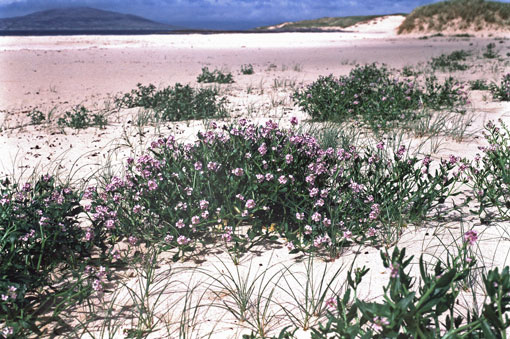
Here's one of his images of Scarista Sands on the Isle of Harris, taken in 1987
Scarista Sands, Harris, Outer Hebrides

Source: https://www.geos.ed.ac.uk/~rsgs/ifa/gems/landformscarista.html

He was heavily involved in the Leicester GA Branch, delivering many lectures and organising other visitors to their meetings.

He was a prolific writer of books, articles and reviews. 

He was the author of The Norwich Area (1971) in the British Landscapes through Maps series - I have a copy of that particular publication -  Orkney (1971), part of the Islands series, and also of Teaching Geography (1974). 

His last major publication for the association, the Geography Teachers' Handbook (1996), which he co-edited with another former GA President Peter Fox, was a mammoth effort. This remained in print for many years until more recent editions were published.

Once Patrick retired from Leicester University, he continued to get involved with the teacher training at nearby Loughborough University.

Patrick is another former President whose involvement with the GA went far beyond his Presidential year, and for which the GA will always be grateful.

Bailey's obituary by Alan Sutton paints a lovely portrait of his enthusiasm for the subject.

Bailey's enthusiasm for his subject was infectious, his love of teaching boundless - sometimes he even found it difficult not to intervene in the classroom when advising and supporting students on teaching practice. He was equally at ease introducing interested lay people into the delights of town trails and countryside walks.

Behind the teacher/scholar, Patrick Bailey was a very compassionate, thoughtful and caring man, generous in his praise of work done well, and very supportive of his close colleagues as well as his tutees. It was a measure of his inner strength and belief - he was a Christian Scientist - that in spite of a very debilitating illness he continued to be stimulating, interested, alert, and active in promoting the cause of geographical education.
 

Following his GA Presidency he became Honorary Secretary and also served as a Trustee for another decade.

Patrick Bailey was awarded an Honorary Fellowship by the Royal Geographical Society shortly before his death.

References
https://www.independent.co.uk/arts-entertainment/obituary-patrick-bailey-1195260.html -Obituary by Alan Sutton

Bailey, Patrick. “A Reply to Sir Keith Joseph's Seven Questions, from the President of the Geographical Association.” Teaching Geography, vol. 11, no. 2, 1986, pp. 64–67. JSTOR, JSTOR, www.jstor.org/stable/23751212.

https://www.geos.ed.ac.uk/~rsgs/ifa/gemlandforms.html - Patrick Bailey's images used in this book

Article on the creation of Teaching Geography: 

Richard Daugherty also mentions Patrick in his article on the origins of 'Teaching Geography'.

King, Russell. “Geography in the School Curriculum: A Battle Won but Not Yet Over.” Area, vol. 21, no. 2, 1989, pp. 127–136. JSTOR, www.jstor.org/stable/20002700. Accessed 31 Oct. 2020.

Bailey, Patrick. “A Geographer's View: Contributions of Geography to the School Curriculum.” Geography, vol. 71, no. 3, 1986, pp. 193–205. JSTOR, www.jstor.org/stable/40571121. Accessed 31 Oct. 2020.

https://www.tes.com/news/geographer-dies?amp - TES mention in 1998

Image of Patrick Bailey room by Alan Parkinson, CC licensed

If anyone has more memories of Patrick Bailey they would be gratefully recieved. This initial post is a little briefer than Patrick deserves.

Updated September 2023

As mentioned before, Bailey was awarded Honorary Fellowship of the Royal Geographical Society in 1999. Here is the transcript of the citation:


Source:
“Meetings: Session 1998-1999.” The Geographical Journal, vol. 164, no. 3, 1998, pp. 365–72. JSTOR, http://www.jstor.org/stable/3060640. Accessed 16 Sept. 2023.

Obituary


Lewis, Gareth. “Obituaries: Patrick J.M. Bailey 1925-1998.” The Geographical Journal, vol. 165, no. 2, 1999, pp. 244–244. JSTOR, http://www.jstor.org/stable/3060432. Accessed 16 Sept. 2023.


Margaret Mackintosh RIP

Updated post. Sad news at the end of last week from colleagues who have organised the Charney Conference over the years of the passing of Ma...