Showing posts with label L S Suggate. Show all posts

Sunday, 17 September 2023

RGS 125th Anniversary Dinner - 1955

There was a strong representation of former GA Presidents at this event, held at the Dorchester Hotel - very posh.

In the speech that followed, the GA gets a mention, alongside the previous explorations and expeditions.


There is also a mention for recent Medallists, including Sir John Russell (another former GA President)


“The 125th Anniversary Dinner.” The Geographical Journal, vol. 121, no. 3, 1955, pp. 392–404. JSTOR, http://www.jstor.org/stable/1790929. Accessed 16 Sept. 2023.

Saturday, 15 May 2021

1945 GA Conference

I am grateful to Alastair Owens, who will be GA President for 2022-3 as many readers will know, for finding and sharing images of this programme from the 1945 GA Conference which he came across earlier.

As shown here, the 1944 conference had had to be cancelled due to falling bombs...


The 1945 Conference was the first for a while. Thomas Cotterill Warrington was the President: he served from 1942-5 so was the last President to serve more than a year. The Conference was held at the City Literary Institute in Holborn, London.

The conference was held in early January, as they used to be before the move to April.


There are some sessions which sound really fascinating, and I would love to have been there... Tea in the refectory sounds fun too.
There are some familiar names there as well, many of whom have featured on the blog already.

The Conference was opened with a lecture on 'Post-War Europe' by Sir Walter Layton.
He was an economist, and lectured at Trinity College.

The lecture is available here, as it was published in a future issue of 'Geography' later that year:
Layton, Walter. “THE FUTURE OF EUROPE.” Geography, vol. 30, no. 2, 1945, pp. 44–50. JSTOR, www.jstor.org/stable/40563426. Accessed 15 May 2021.

This was followed by a lecture on fruit growing from Raymond 'Bush'.

At 2pm a Symposium featured a range of other future GA Presidents: Leonard Sydney Suggate and Leonard Brooks (who would both become President in the 1950s) which was chaired by the legendary James Fairgrieve. 
The first day ended with a session on the Geography of Poland, actively involved in the conflict that had just ended.

Text from Wikipedia:

Equally the 2nd day started with a session which probably referred back to recent military service, with Brigadier Ralph A Bagnold on the sand dune of N E Africa. He had already made a crossing of the Libyan Desert in the 1930s. During the Second World War, he was a soldier in the British Army, in which he founded the behind-the-lines reconnaissance, espionage and raiding unit that was named the "Long Range Desert Group", serving as its first commanding officer in the North Africa Campaign.

After the war Bagnold continued make significant contributions to the understanding of desert terrain such as sand dunes, ripples and sheets. He developed the dimensionless "Bagnold number" and "Bagnold formula" for characterising sand flow, and also proposed a model for "singing sands". In 1971 he received the Wollaston Medal, the highest award granted by the Geological Society of London, and in 1981 the David Linton Award of the British Geomorphological Research Group (named after another former GA President). He lived to the age of 94.

The session on the Future of Primary Geography featured Olive Garnett (see her entry) and also Mrs. Katz (who got a mention in my Charney Primary Geography conference presentation as she chaired the Primary committee when it launched. It was chaired by G J Cons, who had been due to be the President in 1961 but sadly died in 1960.
Here is part of the contribution of Olive Garnett.


“GEOGRAPHICAL ASSOCIATION. Annual Conference Discussions on the Future for Geography.” Geography, vol. 30, no. 2, 1945, pp. 50–62. JSTOR, www.jstor.org/stable/40563427. Accessed 15 May 2021.

The session on the Future of Secondary Geography had some interesting participants.

“GEOGRAPHICAL ASSOCIATION. Annual Conference Discussions on the Future for Geography.” Geography, vol. 30, no. 2, 1945, pp. 50–62. JSTOR, www.jstor.org/stable/40563427. Accessed 15 May 2021.

I looked back at 'Geography' to try to find some outcomes from this conference in the journal and found the report of the conference and links to some of the lectures:

Thomas Cotterill Warrington was also asked to be President for another year at the end of the conference in the business meeting.

References

Wikipedia entry on Sir Walter Layton:
Image Wikimedia
Raymond Bush article:
Bush, Raymond. “FROST AND THE FRUITGROWER.” Geography, vol. 30, no. 3, 1945, pp. 80–86. JSTOR, www.jstor.org/stable/40563438. Accessed 14 May 2021.

Image Wikimedia

“GEOGRAPHICAL ASSOCIATION. ANNUAL REPORT FOR 1944.” Geography, vol. 30, no. 1, 1945, pp. 18–19. JSTOR, www.jstor.org/stable/40562425. Accessed 15 May 2021.


Thanks to Alastair Owens for the images. Hopefully more documents like this will come to life when I can next get to Solly Street and get into the archive.

Wednesday, 22 July 2020

1972: Mr. Alan Durward Nicholls

Updated November 2023

Alan Nicholls
was another of those relatively rare people who was a geography teacher when he became GA President, and a great proponent of Environmental Studies. 


In Balchin's Centenary book, he is described as an "active Head teacher" and in an Annual Report in 1971 as a "revered practising schoolmaster".

I delved and found out that he served on the Secondary Section Committee (as I did for many years) and was a member of the Central London Branch of the GA - which suggests he taught in London, and later found out that he succeeded another GA President Leonard Suggate as the Head of Geography at St. Clement Danes School in Hammersmith, London.

Here's an image from a Facebook page for the school. For a while, the only one I could find.

New Geographies over Forty Years was the name of his Presidential Address, given in January 1973, and by all accounts from the description, a humorous one, although it was not apparently printed in 'Geography' and not available to view unfortunately. I wonder whether a copy exists anywhere?

1971 saw a surge of interest in the quantitative methods, so perhaps he referred to those, and how the might translate into school geography? I would like to guess that he did, given the timing of his address a few years after the Madingley Conferences.

In that year, the GA Spring Conference (as it was called) was held at the London School of Economics, where it was held quite regularly.
Prior to being President, Nicholls was also Assistant Honorary Treasurer of the GA as well - another President to hold that significant (and voluntary) role.

Environmental Studies was one area of interest which he pursued, and this is a reminder of the different strands of geography which are picked up by different Presidents for their theme, address and also perhaps areas of interest while in the Presidency.
This area was also picked up in the Professorial Address of C. A Fischer, I have previously blogged about from my British Library research.

Nicholls article on Environmental Studies was also useful - see the link below


This was featured in a book on the development of this branch of Geography


Nicholls was chosen as the GA's representative on the Inner London Education Authority (ILEA) geography board in 1966, and I assumed from early research that he was more of an academic geographer, but this was not the case.

I presumed from that appointment he taught in London, and that was what Richard Daugherty (another former GA President) thought when I asked him about connections with Presidents who were in post near to his own Presidency.

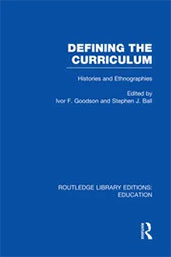
Defining the CurriculumHe is mentioned in this book 'Defining the Curriculum'.

Ten years ago almost to the day and from this platform, Professor Kirk said 'modern geography was created by scholars, trained in other disciplines, asking themselves geographical questions and moving inwards in a community of problems; it could die by a reversal of the process whereby trained geographers moved outwards in a fragmentation of interests seeking solutions to non-geographical problems'. Might not this be prophetic for us today? Could it not all too soon prove disastrous if the trained teachers of geography moved outwards as teachers of environmental studies seeking solutions to non-geographical problems? (Nicholls, 1973, p. 201)

A contribution described here is from Nicholls too.

This quote would also chime with those who explore the value of teacher subject knowledge, a current interest of many.

Following another thread, I found a small obituary tucked away in Geography in 1981.
He was born in 1910 in Cornwall, and died in 1981. He went to Truro School. He was made an Hononrary Member in 1980 just before his death.


I'm grateful to Fiona Hirst, archivist from the Clement Danes School for sending me another image of Alan Nicholls from later in his career.


References

Book link: https://books.google.co.uk/books?id=W9GHPA3zK0IC&lpg=PA1651&dq=mr%20a%20d%20nicholls%20geographical%20association&pg=PA1651#v=onepage&q&f=false 

NICHOLLS, A. D. “Environmental Studies in Schools.” Geography, vol. 58, no. 3, 1973, pp. 197–206. JSTOR, www.jstor.org/stable/40568109.

“The Geographical Association.” Geography, vol. 66, no. 4, 1981, pp. 320–322. JSTOR, www.jstor.org/stable/40570442.

I managed to find some images on a Facebook group page that was dedicated to the school, including an excellent image shared from a field trip back in 1953. This is one of my favourite images on the whole blog.

Thanks to the people who put the website together.
Here's Alan Nicholls on a Geography fieldtrip (presumably to North Wales)
Top of Snowdon, North Wales, 1953. Photograph taken by Jack Harvey and sent in by Geoff Skinner


He is fourth from the right on the front row and is described as "Old Nick" which seems fair. He seems to be having a good time as well. Some good fieldwork wear on display here, and great to see a President actually 'in action' doing some geography.

Thanks to Fiona Hirst for the additional details and image from the school magazine 'The Dane'

Updated November 2023

Revisiting past Presidents to see if I could find updates and came across an obituary in the RGS's Geographical Journal.


This reinforces his links with the RGS as well as the GA. He was the Chairman of their Education Committee and also served on Council. He studied at the University of Exeter. He travelled extensively.
He was a Cornishman.

"Good teachers are keen on their chosen subject and find it stimulating."


“Obituary: Alan Durward Nicholls (1910-1981).” The Geographical Journal, vol. 147, no. 3, 1981, pp. 394–394. JSTOR, http://www.jstor.org/stable/633763. Accessed 1 Nov. 2023. 

Friday, 21 February 2020

1950s - Committees were busy, and plenty of other changes

Balchin's Centenary volume describes some of the work of the GAs Phase Committees during the 1950s, a time when financial pressures forced the GA to raise the annual subscription to a guinea from 1955.

  • Secondary Schools Committee published a new handbook in 1952, then turned to producing school atlases. It's chairman for 25 years, Mr. C B Thurston, stepped down apparently 'reluctantly' in 1953.
  • The Primary Schools Committee revised 'Geography in the Primary School' in 1953.
  • The Public and Preparatory Schools Committee opened its membership to women teachers in 1951.
  • The Training College Section organised a series of one day conferences to meet the criticism that 'much of the geography teaching in secondary modern schools was being undertaken by individuals without any geography training' (Balchin, p.43)
  • Visual Aids Section produced 'The Geography Room in the Secondary School' in 1954, and started to investigate the use of OS Map extracts with aerial photographs which were to become a feature of Geography exams for decades to come.
  • Two new committees were formed: Further Education (1953) and Field Studies (1954)
  • The Executive Committee was continuing discussions with the BBC about geography school programming. At this time, there was a feeling that changes were happening too quickly for textbooks to keep up and that radio and TV could help.
One particular way that the GA tried to keep teachers up to date with the pace of change in the modern world was a feature called 'This Changing World' which was introduced into the 'Geography' journal in 1954, edited by Leonard Sydney Suggate followed by G. J Butland when Suggate retired to New Zealand, as described in his blog post.

The 1950s also saw the passing of several former GA Presidents who have previously appeared on the blog:

  • Dr. Hugh Robert Mill in 1950 (who was closely associated with the GA from its founding)
  • James Fairgrieve in 1953 (over 40 years of service to the GA)
  • Dr O J R Howarth in 1954 (over 40 years of service to the GA)
  • Sir John Linton Myres in 1954

These led to the appointment of other GA Presidents to come to key roles: L Dudley Stamp, E G Bowen and W.G.V Balchin.

Finally, Balchin reminds us that the 1950s were a time when the country was recovering from WWII - rationing had ceased and rebuilding of bombed cities was underway. Membership climbed steadily and the GA was settled in its new home city of Sheffield.

The Annual Conferences were still being organised by the very efficient R. C Honeybone and Dr. J H Bird and attendance was close to 1000.
Professor Emeritus E G R Taylor reached the age of 80 in 1959, and funds were raised for an annual lecture in her name.


Image: early Handbook, on display in Solly St - image by Alan Parkinson

Thursday, 23 January 2020

1955: Leonard Sydney Suggate

Last updated August 2023

Leonard Sydney Suggate, who became GA President in 1955 published several regional Geography books along with L Dudley Stamp.

The 1950s were interesting times for the GA in the post-war period, as with the years following the First World War, when many changes happened as a result of the recovery from war.

Suggate originally worked in the printing trade, but then studied psychology before taking the University of London's Teacher's Diploma in geography.

This led to him becoming a teacher, a fairly rare beast as we have seen so far with the blog. 
Few teachers become GA Presidents historically.

Suggate taught geography at Dorking High School, and later at St. Clement Danes Grammar School during the First World War (eventually retiring from there in 1949), which means he is one of a minority of people who had substantial experience of teaching geography before becoming President.

He took over the Presidency six years after retiring from what seems to have been an outstanding teaching career at a number of schools, and it is great to see that someone who was predominantly in the classroom for their career was able to step up to the role.

He was very much influenced by the 'new' geography of Halford MacKinder, and used these ideas in his teaching as well (although by now they were not as new as they once were), writing about them in his work.

He also attended lectures by Mackinder, Garwood, Lyde and Unstead - familiar names from this blog. The War also provided for him an opportunity to radically rethink school geography. This is great to see someone taking on the chance to hear the important people of the time, and factor those ideas into his practice - something which teachers of today do with some success, building on the evidence of research and taking inspiration from academic geographers and practitioners.

There are several contributions that Suggate made to geography teaching in the post-war period.
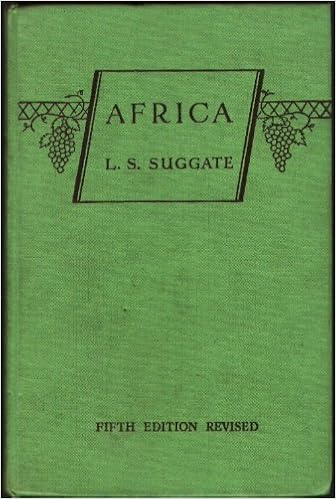
He wrote some of the first textbooks for the new analytical geography, such as 'Africa' - pictured to the right (one of the first school texts on the continent), and which ran to several editions.

He also campaigned for the use of maps and photos to be made available to candidates in school geography examinations, as well as greater use of visual aids in teaching.

He served concurrently on the Council of the RGS as well as the GA, and was elected a Fellow of the Royal Geographical Society in 1921. Another GA President to have a strong connection with the RGS.

He was also a Chief Examiner for the London General School Certificate - another GA President with  significant examining experience as well.
He served on the RGS Education Committee as well, which is of interest as another connection between the two organisations. The work of the RGS's Education Committee continues to be important, and I was involved in supporting the application of several representatives for RGS Council positions in the last few years.

Suggate attended the GA Conference every year apparently, "pipe in hand" - no smoking allowed these days of course.

He was also a Labour party councillor for Hendon.

In 1928, he started to make some changes at Clement Danes School.

When the school moved to a new site, Suggate created a special "Geography room" with a light table (which I remember from geography classrooms I sat in during the 1970s) and cases for equipment and showing artefacts.

I liked the story from his obituary, regarding his apparently indicipherable handwriting. A student asked what he had written at the bottom of their work, to which he replied "you must improve your handwriting, obviously...."

One of the projects that he started (along with another President Leonard Brooks was to develop a scheme where schools could "adopt" ships and send letters to their Captains. It was called the Ship Adoption Society. This has been featured in more detail in the entry for Leonard Brooks, as he mentioned it in his Presidential Address.

Also in 1955, he attended the 125th Anniversary dinner of the Royal Geographical Society, along with other former Presidents such as L Dudley Stamp and J A Steers.

His Presidential year's conference is also described here - in this Nature piece.

Suggate wrote a series of books, which went into several editions.
He described his Presidential election as "at once an exciting and sobering elevation", which I sympathised with.

His Presidential Address was on the theme of geography teaching in Grammar Schools, making it of particular relevance to his audience no doubt.


Two years after completing his GA Presidency, Suggate and his wife emigrated to New Zealand at the age of 67, to join their two sons. 
There, he was also (at that age) Secretary of the Second Triennial Conference of the New Zealand Geographical Association, and continued to write for books. A well deserved and long retirement was enjoyed.


He died in 1970 - another GA President to live to an old age (81) and with 60 years of service to the GA.

I am grateful to Fiona Hirst, Archivist at Clement Danes School for the wonderful image of Leonard from the school magazine at the top of this entry. She very kindly sent me a range of documents and other information to help add detail to what was previously quite a slight entry on the blog compared to some of the previous ones.

An obituary was published in 'Geography' in 1971, written by A D Nicholls, who was a long standing colleagues as well as also being a Former GA President by that time - he is yet to appear here.


References

No Wikipedia entry available. Perhaps a further extension of this project would be to create them for the missing GA Presidents.

Nicholls, A. D. “LEONARD S. SUGGATE, B.Sc., A.K.C. 1889-1970.” Geography, vol. 56, no. 2, 1971, pp. 152–153. JSTOR, www.jstor.org/stable/40567514.

https://archive.org/details/in.ernet.dli.2015.224015/page/n5 - one of Suggate's books

SUGGATE, L.S. Aspects of Geography Teaching in the Grammar School Geography 1956 41 1-14

https://www.questia.com/library/journal/1G1-78392752/oskar-h-k-spate-1911-2000 - a pupil of Suggate's remembers his teaching

“The 125th Anniversary Dinner.” The Geographical Journal, vol. 121, no. 3, 1955, pp. 392–404. JSTOR, www.jstor.org/stable/1790929.

Something in the IoE archives: https://archive.ioe.ac.uk/DServe/dserve.exe?dsqIni=Dserve.ini&dsqApp=Archive&dsqDb=Catalog&dsqCmd=Show.tcl&dsqSearch=(RefNo==%27IE/JUB/B/1%27)

R. J. Harrison Church. “Obituary: Leonard Sydney Suggate, BSC, AKC.” The Geographical Journal, vol. 137, no. 1, 1971, pp. 136–137. JSTOR, www.jstor.org/stable/1795429.
Africa Book: https://archive.org/details/in.ernet.dli.2015.227333

If anyone knows anything else about this President, please get in touch. This is a relatively brief entry.

Thanks to Fiona Hirst for the additional details and image from the school magazine 'The Dane'

Updated August 2023


Margaret Mackintosh RIP

Updated post. Sad news at the end of last week from colleagues who have organised the Charney Conference over the years of the passing of Ma...