Showing posts with label Neville Scarfe. Show all posts

Monday, 30 October 2023

Filmstrip header

E.W. Shanahan was the author of a number of books in the 20s and 30s, including one on South America.

In a review of the book, there is this useful aside on the continent:


Wednesday, 25 August 2021

IGU - CGE

The IGU (International Geographical Union) will have their 100th conference next year in Paris.

This year's IGU-CGE conference was held last week in Prague.

The keynote speakers and several of the other sessions involved people who I have been privileged to work with over the years on ERASMUS+ funded projects including Michael Solem and the third phase of GeoCapabilities is well represented too.
On the IGU site, there is history of the IGU, which was originally co-written by Norman Graves, former GA President and added to by other people. (Downloadable as PDF or Word document)

He talks about the original seminars organised with the UN, which included Neville Scarfe from the UCL IoE.

In 1950, UNESCO organized their first seminar on the teaching of geography in Montreal. This seminar was chaired by Neville Scarfe (1908-1985), who at that time was Head of the Geography Department at the University of London Institute of Education. The result of this seminar was UNESCO’s A Handbook of Suggestions on the Teaching of Geography (Unesco, 1951) mainly drafted by Neville Scarfe.

Following the book, the next stages of the development drew in L Dudley Stamp. This followed the early UK Land User Survey which has appeared on the blog before.

Neville Scarfe reported his association with L. Dudley Stamp, a British geographer at the London School of Economics. Scarfe, a British geography teacher, became senior lecturer at the London Institute of Education in 1935. He was a professional acquaintance of Stamp’s since the London geographers were, in Scarfe’s words, a friendly and sociable group. Both were members of the Royal Geographical Society, which was a further reason for contact. It is likely that Stamp and Scarfe collaborated during the 1930s and 1940s when Stamp organized the school children of the United Kingdom to map the land use near their schools. Scarfe had a network of many geography teachers and students who participated in the mapping. Stamp and Scarfe both participated in the first post war IGU conference in Lisbon, Portugal in 1949, where geographical education and international cooperation were topics being addressed with considerable interest. It was during the Lisbon Congress that the IGU appointed a Committee on the Teaching of Geography under the chairmanship of Neville Scarfe.

The history also talks about the publication of the 1965 UNESCO New Source Book for Geography Teaching.
It features several chapters by Norman Graves on the teaching of geography which make interesting reading, and also a chapter by Tom W Brown who was a teacher at the King's School, Gloucester on the organisation of the geography classroom.


Tuesday, 14 July 2020

Neville Scarfe

Updated August 2023

Neville Scarfe was an influential tutor at the Institute of Education who was connected with several GA Presidents, because of their own association with UCL. Molly Long, President in 1970 was closely connected with the Institute during her career.


A brief biography:

Neville Vincient Scarfe was born in 1909. 
In 1927 he achieved a first-class honours B.A. in Geography, at age 19 heading the honours list. The following year he acquired a teaching diploma, which from 1928 to 1931 he put to good use as senior geography master at Bemrose Grammar School, Derby. Thence he transferred to the University of Nottingham, where for four years he lectured in geography and earned a master’s degree as well. 

From 1935 to 1951 he worked as senior lecturer and head of geography at the University of London Institute of Education. From this last position he took leave of absence on war work (1939-1945), serving as director of press censorship, Ministry of Information, London. 

After the war a visiting professorship (1948-1949) at Syracuse University, New York State, and the task of co-ordinating the UNESCO International Seminar at McGill University preluded his five years (1951-1956) as Dean of Education at the University of Manitoba. From the latter position he submitted his application for the corresponding deanship at University of British Columbia.

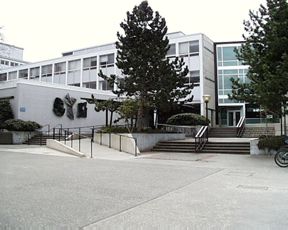
The Neville Scarfe Education Building (University of British Columbia)

The University, in Vancouver, has a Neville Scarfe building and Lecture Theatre. 
He was Dean of Education there for 18 years and achieved a huge amount.
https://studiohub.ca/on-the-boards/ubc-neville-scrafe-lecture-theatre

He contributed an article on games in geography to 'Geography' in 1971.
His son is an actor.
He died in 1985.
I wonder what he may have made of the current status of Canadian Geography. There is an excellent Royal Canadian Geographical Society, but geography doesn't have a high status in the school curriculum in Canada.

Source:
SCARFE, N. V. “Games, Models and Reality in the Teaching of Geography in School.” Geography, vol. 56, no. 3, 1971, pp. 191–205. JSTOR, www.jstor.org/stable/40567554. Accessed 6 July 2020.
Neville Scarfe and British Columbia


Throughout his career, Neville wrote over 100 articles and gave numerous speeches on education around the world. His intuition and progressive understanding of post-war learning instilled in the Faculty the idea that teachers are made, not born. With this spirit in mind, he created rigorous, specialized streams taught by enthusiastic professors to produce dynamic and informed educators. Always an advocate for educational reform, Neville was particularly critical of the findings of the 1960 Report of the Royal Commission on Education (the “Chant Report”), calling it “contradictory and conservative”*. He took particular issue with its recommendations for harsh discipline in classrooms and the assumption that children will behave belligerently unless taught otherwise.

Image source:

Further memories of Neville Scarfe welcome - he was an important geographer on both sides of the Atlantic and I am sure there is plenty more to come.

Updated August 2023


After World War II, Neville Scarfe returned to the Institute of Education of the University of London, where he taught the principles and practices of the teaching of geography. This sparked his interest in the philosophy of education—this was a pursuit he continued for the rest of his life, so it was probably what could be considered his main interest.


They included James Fairgrieve, who he described as 
"a down to earth geographer bent on assisting students to imagine world characteristics accurately, the better to imagine political and social problems"

https://snaccooperative.org/view/64845894

Scarfe was a proponent of play in education.
https://www.tandfonline.com/doi/abs/10.1080/00094056.1962.10726996

Thursday, 10 October 2019

1942: Textbooks - how to use them...

"Ideally a textbook should be an attractive piece of descriptive literature bound together as a story of human life upon some portion of the earth 's surface."

"The region chosen, the particular human life in that region selected, and the kind of detail given, as well as the conclusions drawn, must depend on the age of the children. The descriptive literature must lend itself to study - i.e., properly selected exercises and questions should ensure that the necessary geographical facts can be deduced and organised from it. It will be necessary, therefore, to include many pictures not as illustrations, but as study exercises, so that the descriptive text may take on greater reality. Similarly, there may be statistics and outside references which need graphing or mapping and subsequently investigating. In addition, there should be certain detailed maps not readily available in any school - e.g., a particular farm, a logging camp, a factory, a city, etc., which will require directed study.

The teacher may be able to supply other data, such as samples, specimens, films, wireless talks, but what- ever happens the teacher must use the textbook and see that stimulating exercises and questions are asked, that additional facts are supplied where necessary, and that a proper summary in note and map form is built up by each child."

Neville Scarfe

References

Scarfe, N. V. “GEOGRAPHY TEXTBOOKS FOR SCHOOLS.” Geography, vol. 27, no. 3, 1942, pp. 106–119. JSTOR, www.jstor.org/stable/40562229.

Neville Vincent Scarfe, UBCʹs first Dean of Education, was born in Essex, England in 1908. He attended the University of London graduating with first class honours in geography. After teaching geography until 1935, Scarfe became Senior Lecturer in the Institute of Education at the University of London where he remained until 1951. Internationally recognized for his research work in the teaching of geography and in the principles and philosophy of education, he became Dean of Education at the University of Manitoba in 1951 and remained there for five years. In 1956, Scarfe became the founding Dean of Education at UBC. A consolidation of the Universityʹs School of Education and the Provincial Normal School had given rise to the new Faculty of Education. He continued to guide the faculty until his retirement in 1973. 

Margaret Mackintosh RIP

Updated post. Sad news at the end of last week from colleagues who have organised the Charney Conference over the years of the passing of Ma...