Showing posts with label Academic Geographer. Show all posts

Thursday, 1 September 2022

2022: Professor Alastair Owens

It has been my pleasure to work with Professor Alastair Owens this last year, who has served as Vice President during my term as President. 

He takes over as President today!

He was very much involved in the GA Conference 2022, and has created the theme of 'Collaborative Geographies' for 2023.

More on that later in this post.

I hadn't met Alastair before he was named as the next VP, and he kindly came up to Ely in a gap in lockdown to have a wander and a chat about what the role might involve, and my own personal involvement with the Geographical Association. We have worked well together and he has been very supportive. He also had an important job to do at the GA Conference in April 2022, and introduced me at my Presidential Lecture amongst other things.

I sent Alastair the questions that I had given to all other Presidents and used them to create the post below. I'm grateful to Alastair for the lovely level of detail that he included here:

On his birth:

I was born in a cottage maternity hospital in a small town called Heswall on the Wirral, Cheshire in 1971. My father was a Church of England curate and we lived in village called Pensby; my mother had given up work as a Biology Teacher to start a family (I am the eldest of four, all born between 1971 and 1977).

On his childhood and school memories:

In 1974, aged three, I moved to a small town called Alsager, near Crewe, in south Cheshire. That was a happy time and I joined St Gabriel’s Roman Catholic Primary School for most of my primary education. It was a memorable school, newly-built and very 1970s with an open plan layout with curtained bays at the sides for ‘floor time’ activity and discussions. Mine and my siblings’ attendance caused a minor local stir as my dad was the vicar of an Anglican church and we attended a Catholic School. It was great though, as we were always given sweets on saints’ days! 

Here's Alastair in 1974 showing his fashion sense in a rather fine tank top.

He said:

I don’t have many geography memories from that time, but there was a short-lived acting career. I played Mowgli in a production of the Jungle Book in 1981 – I am the skinny one wearing a sheepskin rug) – an episode for decolonising, I think – and Michael in Mary Poppins. I think it was my ability to sing in tune that got me these roles!


At that point Alsager was being developed as a commuter town, but still felt quite rural and I enjoyed a ‘free-range’ child, pedalling around on a basic but trusty Raleigh bike (rather uncool compared to most of my friends’ ‘Choppers’), riding through fields and down disused railways with my buddies. I wanted to be a farmer (my best friend had a farm and collecting eggs from the henhouse was a favourite highlight when visiting) or a train driver, but had no inklings about becoming a Professor of Geography at the point.

On his parents and their career and family movements, plus links with politics and 1980s Britain:

My parents were quite political, my dad in particular, and in the 70s he occasionally got labelled ‘the Commie Vicar’; they were both members of CND. In fact it was politics that moved him to a new job in a place called Brinnington in Stockport, near Manchester. The move took place in 1983, just before I went to secondary school. The majority of Brinnington was comprised of a large council estate, constructed in the 1960s. It was (and remains) pretty deprived and there were many associated problems such as ill health, low educational attainment, crime and substance misuse. Of course, it was also a place of great warmth and joy, generosity, talent and care and I suppose that’s where I became very aware of the significance of place, including of the ways that certain places get pathologized and demonised.

We lived in a vicarage (one of the few detached homes in the neighbourhood) right in the middle of Brinnington, next to the church, across from a chippy and between an old people’s home and the Labour Club. This was formative. 
Many people come to visit vicarages, looking for food, shelter, money and protection. 
We were all quite adept as teenagers at handling callers, making cups of tea and sandwiches, often for regulars who you would get to know. But others visits were troubling: a night when I was in on my own, a man forced his way in to headbutt his girlfriend, who I had let in for protection; another man turned up on the doorstep with a stab wound; a trans person came exasperated by continuous taunting and discrimination; and a plastic carrier bag full of fivers and tenners was once handed in (‘don’t ask me any questions') for safe keeping.

While living in Brinnington, my father’s work became part of a politicised religious response to the ‘crisis’ of the British inner city in the 1980s. Following in the trail blazed by publications like Faith in the City (1985) and identifying with a Christian Socialist tradition, he used the church buildings to offer a range of community-centred services, from providing access to cheap food and furniture (donated from wealthier parts of Cheshire and South Manchester), to advice and counselling services, drugs advice and even a needle exchange (it was also moment of concern because of the AIDS pandemic). 
I remember this vividly and becoming a bit of an adjunct to parish life. 

One popular weekly event was prize bingo (mainly prizes of groceries bought from Sainsbury’s), and sometimes I used to have the job of placing the balls on the number tray after the caller (usually my mother) had read them out. 
This experience (living as the son of a clergyman in Brinnington not the bingo balls) became the inspiration for a major research project that I am currently completing and on the back of which I am currently writing a book (with Historian David Geiringer), exploring the response of the Church of England to the crisis of the inner city in Britain from the 1970s to the 1990s.

Alastair told me about his secondary school experiences and early interest in geography:

This life in Brinnington contrasted sharply with my schooling. 
One of the problems when moving to Brinnington was finding a place in a secondary school. It went against my parents’ principles at the time but I ended up going to a private school, Stockport Grammar School, supported by a government funded ‘assisted place’ (a scheme that funded children from low-income families to go to a private school). 

Stockport Grammar provided a wonderful education and many opportunities, offering privileges that contrasted sharply with the lives of people in Brinnington.

Through school I became increasingly interested in History and Geography, inspired by some very good teachers. 

A history teacher – Nicholas Henshall – was exceptional. He encouraged us to read academic texts and get enthused by historiographical argument and debate and instilled rigorous skills of analysis and essay writing techniques (which I use with my own students). 

The Geographers at Stockport Grammar were an eccentric and likeable bunch teaching different specialisms at A Level: the EEC with Mr Martin; Africa with Miss Backhouse; methods and techniques with Mr Barr (a north-American trained spatial scientist and product of the ‘quantitative revolution’); and physical geography with head of department, Mr Durnall (aka ‘the Colonel’), who always wore a white coat!

On his university studies, he faced some difficult decisions:

Undecided whether to study Geography or History, in the end I decided to apply for Geography courses at university. 

I got an offer from Cambridge but didn’t get my grades and wound up at my insurance choice, King’s College London. 

This of course has strong links with many former GA Presidents including Laurence Dudley Stamp.

I moved to London in 1990 and have been there ever since. 

King’s was exciting – buzzing, central, right at the heart of what was going on politically and economically. I persuaded them to let switch from BA Geography to BA Geography and History and made the most of a degree that allowed me to study modules across the University of London. 

At King’s I met historical Geographer David Green – at one time a key supporter of the GA and organiser of the annual conference. 

He was my tutor and dissertation supervisor and we’ve been good friends and collaborators ever since.

He’s the reason I ended up an academic Geographer, a model mentor and support, who I have learnt a great deal from. I was taught by several other inspiring geographers in London – Latin Americanist Linda Newson, Political Geographer Keith Hoggart, Cultural Geographer Peter Jackson, and Historical Geographer Richard Dennis. 

But London itself was as much a (historical)-geographical education as the degree course. 

I started out in student digs in Denmark Hill, before spending a year in a grotty student house in Peckham. In the final year, thanks to the early 1990s housing crisis, we lived in a cheap but (fairly) luxury flat on the Thames on the Isle of Dogs. My bedroom overlooked the river.

Alastair pictured in 1993 as a student. I had very similar glasses at the time.

Alastair moved on to telling me about his work and career to date:

I graduated in 1993 fairly convinced that I wanted to do a PhD, but failed to win funding to start straight away. Over the next year I had two jobs: working for a publishing company producing an encyclopaedia with ‘experts’ from the BBC’s Antiques Roadshow, and working as a Research Assistant for David Green at King’s on a project looking at the geography of wealth and inequality in Victorian London.

Victorian London is still a major interest and the focus of the specialist third year course I teach in my current job.

This set the scene for a PhD that I started in 1994 at what was then Queen Mary and Westfield College, over in East London. 

There I was supervised by Geographers Humphrey Southall and Miles Ogborn and undertook research on families, wealth and inheritance in the nineteenth century. 
The PhD was funded through a Teaching Assistant position in the Department of Geography at Queen Mary where I ran tutorial and seminars for undergraduate students and taught on fieldtrips. It was wonderful ‘on the job’ training and Queen Mary offered a warm and supportive working environment, with many inspiring colleagues (and friends of the GA) such as Ray Hall and Roger Lee.

Soon after starting at Queen Mary, in 1995 I moved to Hackney and have lived within a few hundred yards of the place I first rented ever since. 

Hackney is, in my view, the best place on the planet and an education in itself. 

Alastair's Twitter account is @AlastairHackney which reflects this love of the place.

From singing in a community choir to having various voluntary and community roles, I feel deeply embedded in the place. The richness and diversity of experience in Hackney is a constant geographical inspiration. It is also grounding; intellectual flights of fancy only go so far in a place as diverse, complex and unequal as Hackney; it demands a more immediate response.

I was lucky enough to get a job as soon as my PhD funding came to an end in 1998 (I hadn’t actually finished the thesis) and moved to what was then the University of Luton as a Lecturer in Human Geography. It was a small Department and there were only really two of us who taught human geography, so I quickly developed a wide-ranging teaching portfolio. Aside from the longish commute, it was for most of the time a happy institution in which to begin a career and I found Luton as a place very interesting – it felt to me like a bit of the North in the South East! With the different priorities of a ‘new’ university I got diverted from some of my core historical research interests to undertake collaborative projects with university colleagues working in the area of local healthcare provision. 

A particularly successful qualitative research project explored the palliative care needs of South Asian people living in Luton, off the back of which we published a number of articles and at that point I nearly switched my academic focus to work in health and social care services research. 
This was in part triggered by the decision to close the department I was working in (the Department of Environment, Geography and Geology) due to low student recruitment; redundancy or a lectureship in health and social care were my options. It was a painful time for many of my colleagues who had been at Luton for many years. 

In the end I took the former option as I was offered a temporary job back at Queen Mary.

Queen Mary, like Hackney is an important place for Alastair:

I returned to Queen Mary in 2001 and have been there ever since. 

In the early years – as has become the norm in HE – I got by on a number of short-term contracts filling temporary positions, but applied for and got a permanent post in Human Geography in 2005. 
Queen Mary has been a wonderful place to develop a career. Deeply rooted in its East London location, but global in its outlook and high in academic aspirations, it has often felt a privilege to be part of its diverse community. 
It has a very open intellectual culture where I have been free to work across disciplines and with people and organisations outside of the university. 
I’ve worked alongside and with many remarkable geographers at Queen Mary – Alison Blunt, Kavita Datta, Jon May, Miles Ogborn, Catherine Nash, Kate Amis, Marta Timoncini (to name just a few) – but perhaps the thing that has really made my career has been the many collaborations that I have been able to sustain outside of the university, especially with museum, heritage and community organisations. 
Centred around historical research interests spanning the period from the 1800 to the present, and often concerned with the historical geographies of London, these collaborations have included work with: Museum of London Archaeology, the Bank of England, the V&A Museum of Childhood, Spitalfields Music and many more and brought many wonderful people to work with me as PhD students. 

A particularly rewarding and long-lasting series of collaborations – usually with my colleague Alison Blunt – has been with the Museum of the Home (in Shoreditch), where, often following Alison’s discipline-leading interest in ‘geographies of home’, we have worked together to explore aspects of the domestic life and experience in the past and the present (including our current project with geographers Georgina Endfield and Kathy Burrell at the University of Liverpool on COVID-19 and experiences of domestic life).

So, what is Alastair's current role?

I was made Professor of Historical Geography at Queen Mary in 2016 and was in that role and Head of the School of Geography at Queen Mary when I became Vice President of the GA. 

I have since finished my term as Head of School, but am very pleased to be bringing an East London perspective to the GA, not least as we’ve had an active local branch of the GA supported by the Queen Mary and the East London Geography Hub (organised by Vice President elect Denise Freeman).

Alastair is also a keen runner. Here he is taking part in the 2022 Hackney Half Marathon.

What is Alastair's Presidential theme?

My theme is ‘Collaborative Geographies’. 

I chose it for a number of reasons. 

First (and rather indulgently), my own career has often been about collaboration – with my colleagues, with my students and with people and organisations outside of my university – it remains one of the most enjoyable aspects of what I do. 

Second, I think geographers are good collaborators. 
We are used to working together and can see the world from multiple perspectives. 

Collaborating is at the heart of geographical learning – in classrooms and in the field. But I also think collaboration is important as method and as a political strategy. In some political quarters there is a belief that collaboration, co-operation and working together with and across our differences is a bad thing. I profoundly disagree. There are many challenges within and beyond geography where I think collaboration – with its pleasures but also its challenges, its requirement to listen, adapt and compromise – is key to achieving better geographical education, a better professional geographical community, and a better world. 

I hope this can be explored in my presidential year and, as a framework, put to good use in relation to some of our current preoccupations and challenges, such as efforts to decolonise and make more inclusive geographical understanding, education and (professional) practice.

And finally, Alastair explained what the GA means to him:

I have long been inspired by the GA and have worked with geographical educators outside of universities since the very start of my own career as a Geographer. 
We should be working together and learning from one another, across, specialisms, areas of expertise and phases, I think. 
I began to work more with the GA after I sat on the A Level Content Advisory Board (back in 2014), where along with a team of academics, teachers and geography professionals, we devised the content for the A Level qualification that has been taught since 2016. 

My particular area of contribution related to the ‘Changing Places’ theme (loved and loathed in equal measure, I hear) - I love it - and I have contributed to various professional development programmes (associated with the GA and with organisations beyond the GA) relating to that theme ever since. 

I also co-wrote a textbook for the GA’s Top Spec series with Simon Oakes and Emma Rawlings-Smith entitled Changing Places. 

Since becoming Vice President, I have been involved in a range of other things, including the Diversity and Inclusion Group.

Best of luck to Alastair for his Presidential year ahead.

All images copyright Alastair Owens.

Saturday, 18 September 2021

Cath White RIP

I was very sad to hear of the passing of Catherine White today.

Cath was very much involved in the GA's Tyne and Wear branch, being its Chair for many years.

She was involved in Geography education at the University of Northumbria. She was an 
Senior Lecturer in Geography at University of Northumbria until recently having held other positions in the University over the years. She was closely linked with Steve Rawlinson in her work, particularly on developing approaches to fieldwork.

She presented a number of times at GA Conference, including sessions on the use of 8-way thinking for fieldwork (a favourite of mine too) and podcasting. 
I was pleased to be able to support the branch by visiting a number of times, and Cath was always a very welcoming host and involved me in a number of activities while I was there. 

She did a great deal to support geographers, particularly within the NE, and also supported the work of the RGS.

Cath was awarded an Outstanding Service Certificate at the GA Conference earlier this year.

Condolences to Cath's family, friends and colleagues.

References

https://www.researchgate.net/profile/Catherine-White-9 

Rawlinson, Steve, White, Catherine and Kotter, Richard (2009) Living Geography: 8 ways fieldwork - evolution & evalutation. In: Geographical Association Annual Conference, 11-14 April 2009, Manchester, UK. 

https://openlibrary.org/works/OL12646179W/The_geography_of_markets

The Geography & Education Research Group of the Royal Geographical Society with the IBG (formerly the Higher Education Research Group - HERG) also involved Cath in her work.


Thursday, 15 July 2021

2019: Gill Miller

Gill Miller is Senior Lecturer Emerita at the University of Chester. 
She has had a long association with the GA, and been involved in a number of committees and SIGs, and is particularly involved in the promotion of the GA's activity in Wales, and  support for Welsh teachers. 

Her Presidential theme was an important one: "Geography Really Matters!".

As the GA's Conference moved online, Gill's Presidential lecture was also the one that has been viewed by the most people and continues to be viewed. She has been a regular attendee of the Association at Work day, which formed part of GA Conferences for many years and features in many of Bryan Ledgard's photos of those events.
Reference: 2020 Miller, G. Geography really matters! Teaching Geography, 45,2, Summer 2020 
It would also be a good idea to show students during options time to encourgage them to take their geography studies further.
 
The following information was kindly provided by Gill via the Google Form that I set up for all those Presidents who were still able to get in touch.

Gill was born in Tynemouth in 1953. 

She told me:
"It was called Northumberland in those days. Now it’s North Tyneside. I migrated regularly between England and Scotland during my school life. When I was 7 we moved to Milngavie, at the northern outskirts of Glasgow and now the start of the West Highland Way. Then to Surrey, in time to do the 11+ in a small village school with a tiny, freezing outdoor swimming pool. Then back to Bearsden in Glasgow, back to Surrey and finally landing ‘home’ in Tynemouth. Along the way, I had some interesting experiences in the Scottish and English styles of education, notably the rote learning and strict regimes in Scotland. But it was the 1960s!"

"I studied for a BSc in Geography at University of Liverpool, then on to complete a PGCE at St Katherine's College, now part of Hope University. Years later in 2004-5 I returned to Liverpool for an MA in Globalisation and Development, which set me up for my post at Chester University. How much geography had changed in those intervening decades!"

On her career, Gill said:

"What a privilege to have had such a wonderful career. I very rarely got up in the morning not wanting to go to work. In my first post at Upton-by-Chester High I was spurred on by passionate environmentalists and a very supportive Head. I was Head of Geography for a year at Tarporley High before becoming a rather young deputy head there, leading the sixth form. In each post I enjoyed the freedom to try new ideas, especially developing fieldwork, and thrived on students becoming as enthusiastic about geography as I was. 
After our children were born, I lectured at West Cheshire College, teaching A level geography in one year to re-sit students and also a night class with students aged 25 to 70. How hard those students worked and how committed they were! We focused on understanding the really important concepts and understandings and it was a great pleasure to see them applying their own experiences to the geography of the real world. 
I also developed geography modules for the Access course; more pleasure in guiding hesitant late-comers to education and see them flourish as they applied to university. The final stage of my career was a dream role as Programme Leader for International development at the University of Chester. 

I also developed various geography modules such as Emerging Nations, which became the basis for one on my text books. My research area was health in the developing world, and in particular, ageing; the health and welfare of the elderly in Ghana. The caricature of young populations is now out of date, but many countries in the global south still have to address the needs of their ageing populations, in particular conditions such as dementia, diabetes, and other incapacities. As the traditional developing country model of intergenerational living is changing, so older people become more exposed to abandonment and lack of care. 

I became involved with moderating and examining A level Geography when I was at West Cheshire. I met Glennis Copnall, then Chief Examiner for Edexcel A level who went on to work for Ofqual and Curriculum Lead for Geography in Wales. She has been my friend and mentor ever since. Through Glennis I had several writing opportunities, with commissioned work from the Welsh Government. 

I think my most significant work was editing the Atlas for Wales, published with OUP in 2007, which was given to every member of the Senedd and every secondary school in Wales. Preparing the Welsh edition was interesting, especially in find the right translation for geographical terminology. It was a great thrill when the Atlas received Highly Commended at the GA conference in 2009. While I was closely associated with Edexcel geography I led many CPD courses. 
My favourite and most rewarding was ‘Teaching A-level for the first time’. I took so many of these days, and had such a great time giving young teachers the confidence to teach in depth, facing potentially critical 6th form students. If I was to leave one message for them it would be that learning about geography is a shared endeavour. Teachers don’t have to know all the answers, but we can explore and analyse together to increase our knowledge. 

 In 2005 I became Chief examiner of A level World Development. 
We transformed this subject and examination which became enthusiastically received by students, teachers and parents alike. It enabled young people to explore the current environmental and development issues which concerned them, and was really relevant as well as demanding. Sadly we were forced to withdraw the exam in 2016 – a great loss to the sixth form curriculum, but I console myself with the knowledge that several generations of students now have a mature and knowledgeable understanding of the issues facing the world in the 21st Century.

Other than that, over the last 20 years I have written a fair few articles for Geography Review, books about fieldwork, skills and synoptic case studies. I regularly go to GA branches to give lectures – always a delight when I get a second invitation!"

What was your job when you became President? 

"I joined the President’s quartet the year I retired from lecturing at Chester University."

"I have served on the post 16/HE Phase committee for several years, many as Editor of Geog Matters, the annual Post 16/HE newsletter / magazine. It’s an informal conduit for teachers and students to share what they are doing and disseminate case studies, classroom activities and student feedback. 
Colleagues on Post 16/HE were very supportive of my President appointment and one colleague immediately suggested the newsletter as a conference theme. It was only a few moments later that ‘Geography really matters!’ was born. And what a great theme it proved to be. I have a reputation as a forthright speaker, and this theme is me, it’s in my bones: geography really does matter to us all, in every walk of life. It helps us navigate our environment and the economic, social, political and cultural influences we place on it. 

My connections to Welsh Geography reached the dizzy heights of GA HQ and I was summoned to discuss the desirablility of forming a Wales Special Interest Group. We launched at conference in 2012 and since then a small group of us have ‘spread the word’ about the GA in Wales and tried to support Welsh teachers. Our annual bilingual WelshWise quiz has encouraged many teams to find out more about the geography of Wales. Why not test yourselves – all the quizzes are on the GA website here. 

The Wales Geography Forum provides for open discussion with colleagues from all corners of the country. Our latest contribution is to provide curriculum scaffolds for themes in the new Curriculum for Wales."

"Why does the GA matter? It’s a great place to commune with like-minded individuals who share the same passion. It’s also a wonderful way to give something back, to support young teachers and students and encourage them to love geography too. I nearly fell off my chair when I was given the GA Award for excellence in 2013! Geography is sometimes under pressure from the educational trends of the time, so we need a strong voice to represent the geography community at local and national levels. And of course the GA is a place where we never stop learning. There’s always something new and relevant in geography to challenge and excite. 

Conference is a highlight of the year, but being able to contribute in other ways such as GEO or in publications, is very rewarding."

What would you say were the successes / main memories of your GA Presidential year? 

"I would like to think that people ‘got the message’ and that they took to heart that geography really matters! I’m aware that my lecture on Youtube, or bits of it, is still used to encourage students to take geography. I think it helped the geography community come together, and to feel that we’re all involved in a subject which has value and relevance. 
The posters we produced are still available for teachers to help them advocate for geography. 

In governance terms, one success was in encouraging GA trustees to be proactive critical friends of the Association. We changed the governance structure to separate President from Chair of Trustees. In so doing, by sharing the workload, the presidential leadership is more manageable for practising teachers, not just academics or retireds! 

The GA should have leaders from within the profession and I look forward to more practising teachers leading us with their vision and expertise. 

"In August 2017 I joined the Chief Executive at a meeting at Scottish RGS in Perth, with the RGS and SAGT. What wonderful headquarters they have! We had a constructive discussion to work more collaboratively in future. This has yet to bear much fruit but I live in hope." 

On former GA Presidents:

"I knew Michael Bradford - he was always so encouraging, inclusive and generous with his time. Hazel Barrett was our external examiner for IDS at Chester. Hugely supportive. She came to the UN in Geneva with our students during her last year and had a great time. She did some great research on FGM, in the Somali population in Bristol. 

Professional Associations and committees 
2019 - Member, SAGT
2012 - Chair, Special Interest Group for Wales, GA committee 
2012 - Chair, Special Interest Group on Transitions into Higher Education, for the Higher Education Authority – GEES (Geography, Earth and Environmental Sciences) 
2007 - Member/Fellow of Royal Geographical Society 
2009 - Development Studies Association 
2008 - Committee member GA Post 16- Higher Education group 
2007 Member RGS Development Areas Research Group (DARG) 
2001 - Geographical Association (GA) 
2013 - Trustee of Five Talents, microfinance NGO 
2013 - Trustee of Field Studies Council 
2008 - Trustee of Mines Advisory Group (MAG), an international NGO. 
2009 - Member, Chester World Development Forum

Work for Accrediting Bodies 
2014 - QAA member of Subject Benchmark Statement (Geography) review group. 
2014 - University of Cambridge Local Examinations Syndicate: External Reviewer of International A-level in Geography. 
2003 - Chief Examiner of A level World Development Welsh Joint Education Committee (WJEC) 
2012 - Consultant for OCR A level Geography 
2007 - 2008 Consultant for WJEC new A level 
2005 - 2009 External Advisor for Higher Tier Geography International Baccalaureate 
2004 - 2009 Senior Examiner, Advanced Extension Paper, Geography WJEC: 
1998 - 2002 Chief Examiner, Principal Examiner Edexcel Specification A Geography 4. Consultancy 2018 - 2020 Welsh Government, Curriculum for Wales Humanities Stakeholder group 
2012 - Higher Education consultant for WJEC A level Geography 
2012 - Higher Education consultant for OCR A level Geography 
2009 - Visit to Mines Advisory Group (MAG) to review work in progress in Lebanon. 
2009 - Resolve International NGO. External consultant 
2008 - UCAS Subject panel consultant. 
2008 - UCAS/Scottish Advanced and Highers: Tariff Expert group panel 
2007 - National Foundation for Educational Research (NFER) Key Stage Three Geography assessment materials for QCA. 
2004 - Qualifications and Curriculum Authority. Performance Descriptors for A level World Development 
2002 – 2004 - Field Studies Council staff training: Requirements for fieldwork in A level Geography 

Publications 
2020 Miller, G. Geography really matters! Teaching Geography, 45,2, Summer 2020 
2020 Miller, G. Geography really matters! Primary Geographer, 103, 6-7 Autumn 2020 
2017 Miller, G. Global Education Report: So far, so good. Must try harder, Geography Review 29.(tba) 2017 Miller, G. One nation India: the challenges of forging a national identity, Geography Review 29.(tba) 
2016 Whaller, R, Adams, C, Miller, G and Schultz, D. Encouraging students to read beyond the core text, Teaching Geography, 41.3, pp103-106. 
2016 Miller, G. Water shortages in Sao Paulo, Geography Review 29.3. 
2015 Miller, G. what is microfinance? Geography Review 28.3. 
2014 Miller, G. Development and traditional societies: the case of the Jarawa, Geography Review 28.1 2014 Miller, G. Do big media campaigns work? Geography Review 27.3 
2013 Miller, G. Development and the Media, Geography Review 27.1 
2013 Miller, G. The remnants of war, Geography Review, 26.3 
2013 Miller, G. Education for Citizenship: Community engagement between the Global South and the Global North, In Journal of Geography in Higher Education, 37.1 
2013 Miller, G & Elman, E. Improving the quality of education: Kenya’s next challenge, Geography, 98.1. 
2012 Miller, G. Tata: the giant family firm, Geography Review, 26.1 
2012 Miller, G., Bourn. D and Bowes, E. Learning about development at A level A study of the impact of the world development a level on young people’s understanding of international development, Institute of Education, Development Education Research Report no.7 
2012 Miller, G, Brace. S and Walkington H. GEES Transitions Special Interest Group report, Higher Education Academy 
2012 Ribchester, C, Wakefield, K and Miller, G. Examining the impact of pre-Induction online social networking on the student experience, Journal of Geography in Higher Education, 36.3 
2011 Miller, G. Delhi and the Commonwealth Games, Geography Review, 25. 2 
2011 Miller, G. Health in Ghana, Geography Review, 24. 4 
2010 Miller, G and Warn, S. Emerging Superpowers: China and India, Geographical Association. Sheffield 
2007 ‘Atlas for Wales’ OUP. Oxford. Commissioned by Department of Education, Welsh Assembly and Welsh Joint Education Committee (WJEC) 
2007 Changing Wales: the new economy’, a DVD / text of 5 programmes for GCSE, GNVQ and A level Geography. Commissioned by Department of Education, Welsh Assembly, Tinopolis, Llanelli. 
2005 Miller, G and Holmes, D. Welsh Landscapes: skills in practice Key Stage 3 Birchfield Interactive, Cardiff (Commissioned by Department of Education of the Welsh Assembly) 
2005 Multiple Choice questions for AS and A2 Geography, Curriculum Press, London 
2004 On-line A level examination resources, Hodder and Stoughton, London 
2003 AS Landmark Geography 2nd edition with R. Prosser, V. Bishop and M Raw. Collins Educational 2002 Miller, G and Lane, C. Synoptic Exercises for A level Geography, Hodder and Stoughton, London 2000 Miller, G. Fieldwork Ideas in Action Hodder and Stoughton, London 
1999 Miller, G.‘The Global Economic System’ and ‘The Development Process’ in G.Copnall (ed) People Production and Environment. Hodder and Stoughton, London 9.

Conference presentations 
2011 Global Health conference, University of Edinburgh, Centre for African Studies: Developing policies for health and welfare of the elderly in Ghana. 
2011 International Medical Geography Symposium, University of Durham: Developing policies for health and welfare of the elderly in Ghana. 
2011 Royal Geographical Society annual conference: Health and Ageing in Ghana 
2011 British Population Studies conference, University of York: Developing policies for health and welfare of the elderly in Ghana. 
2010 Royal Geographical Society/Institute of British Geographers: Community engagement between the Global North and the Global South 
2010 Geographical Association conference: Introducing new book series Top Spec Geography 
2009 University of Chester staff conference: Engaging new students before induction using social networking. With C. Ribchester. 
2009 Royal Geographical Society/Institute of British Geographers Sixth Form study day: Investigating population change and migration. 
2009 Shropshire branch of Geographical Association, Shrewsbury School; Environmental globalisation: 2008 Royal Geographical Society /Institute of British Geographers: Exploring student learning experiences when incorporating digital newsfilm into the undergraduate curriculum. With D. France. 2008 – 2012 Developing Areas Research Group of the RGS: Development Studies at A level 
2008 Geographical Association: the new A level in World Development 
2008 Chester World Development Forum AGM lecture: China in Africa 
2007 & 2008 Cirencester College ‘Aim Higher’ conference, 
2007 University of Chester staff conference; A levels and the school – HE transition 
2008 North Staffordshire branch of Geographical Association, University of Staffordshire: Food wars; food security 
2008 University of Chester - Connections career teachers conference International Development Studies 2008 NEWI Careers conference; Geography at university 
2008 Neston High School; Food wars and Studying Geography at Chester; 
2002 – 2012 INSET courses for teachers in London / Cardiff / Chester on A level Geography and World Development

As always, if anyone has further memories of Gill's association with the GA, please get in touch.

Monday, 31 May 2021

2013: Professor Hazel Barrett

Hazel Barrett is an academic geographer from Coventry University, specialising in Development Geography.


As with more recent Presidents, much of this entry has been written thanks to contributions from Hazel, who responded to a Google Form which I sent round to as many Presidents as possible and has been updated slightly since the original posting.

Hazel is currently Chair in Development Geography at the Centre for Trust, Peace and Social Relations at Coventry University. 

Hazel is a social scientist who has been undertaking research into the reality of gender and development in sub-Saharan Africa for over 30 years. Her main areas of research are the socio-economic aspects of human development and how these impact on children and women, in particular their livelihood opportunities, education as well as health and well-being.

Hazel has led national and international research projects funded by UK government, UK research councils, UK foundations and the European Union Daphne Fund. She has published books, chapters and over 50 refereed articles relating to gender, health and development in sub-Saharan Africa. Her work has been featured in The Guardian, New York Times, London Evening Standard, the Huffington Post, BBC, ITV and Sky TV as well as UK, US and Singapore radio. 
She has presented her research at the Houses of Parliament, the EU Parliament and at the Girl Summit 2014. 

In 2015 she was named as ‘One of 1000 Most Influential Londoners’ for her research on female genital mutilation. She is a specialist on participatory and community-based action research methods which empower research participants and enables their narratives and views be heard.

Hazel was born in London in 1955.

She told me about her school experiences and employment:
"I failed my 11+ so went to the Secondary Modern School in Maldon, Essex.
I then passed my 13+ so went to the Grammar School in Maldon, Essex.
Two years later the two schools were merged into a large Comprehensive School, renamed The Plume School, Maldon, Essex. I stayed there until I finished my A levels.

From 1973 to 1976 I attended Sussex University where I graduated with a BA 2.1 (Hons) in Geography with African and Asian Studies.
Between 1977-1978 I did an MA in West African Studies at the Centre for West African Studies (CWAS) at Birmingham University.
From 1978 to 1984 I undertook my PhD at CWAS at Birmingham University.
I have spent my career as an academic teaching human geography and development studies and researching social justice issues, mainly in sub-Saharan Africa.
When Hazel became President, she was Associate Dean of Applied Research, Faculty of Business, Environment and Society, Coventry University. She was also Research Professor in Development Geography."

I first met Hazel in October of her Presidential year, when she travelled up to the SAGT Conference. She was there to give the fraternal greetings as is common between the SAGT and the GA at their respective conferences. I have attended the SAGT conference almost every year since 2004 when I was first invited up by Val Vannet when she was conference convenor.


Image: John Vannet

I'd just moved into a new job, and we picked up an award for 'Fieldwork through Enquiry' and I also won one for some work I'd done with Felicity Aston on her 'Pole of Cold' expedition.

Hazel was the editor of 'Geography' from 1997-2003 years. This is a significant role, held for a considerable period.


Hazel's Presidential year reflected her own research interests of course. She told me, "my Presidential theme was:
Geography: Crossing Boundaries.
This refers to the fact that as geographers:
  • We research issues that cross physical and human boundaries
  • We research issues that require an interdisciplinary approach that cross subject boundaries
  • The methodologies and methods we use in our research are constantly pushing back boundaries

Hazel lived in the Gambia earlier in her career. where she undertook data collection for her PhD. In the early part of her research career she carried out research into the HIV/AIDS epidemic in sub-Saharan Africa and has done numerous invited lectures at GA branches on this topic. 

More recently her research has focussed on female genital mutilation (FGM) both in Africa but also in the EU and UK.

Over the last decade her research has been directed at the social and economic aspects of the HIV/AIDS epidemic in sub-Saharan Africa, in particular Kenya, Uganda, Zambia and The Gambia as well as amongst migrant groups in the UK.

An area that she often focusses on in her talks is female genital mutilation (FGM): a topic on which she speaks widely at GA Branches and elsewhere, bringing this important issue to the attention of many students. She has written on this topic, and also period poverty (another current issue) for the Conversation:

Hazel said:
"I focussed on equal opportunities during my time as President. I like to think I contributed to the GA being an open diverse organisation which welcomes people of any gender, ability, ethnicity and religion. My main memories are of camaraderie, support and laughing (a lot!)."

References

University page: https://pureportal.coventry.ac.uk/en/persons/hazel-barrett

https://www.coventry.ac.uk/research/researchers/professor-hazel-barrett/?theme=main

View Hazel's Presidential Lecture here: https://slideplayer.com/slide/6367868/

BARRETT, HAZEL. “Editorial.” Geography, vol. 82, no. 1, 1997, pp. 1–1. JSTOR, www.jstor.org/stable/40572860. Accessed 20 July 2020.


Top Spec, co-written with the previous year's President: Bob Digby

Top image: Copyright Bryan Ledgard / Geographical Association

Any memories of Hazel's time at the GA welcome

Monday, 5 April 2021

GA Branches and their role

Richard Yarwood wrote an article, which was published in the journal 'Area' in 2007 exploring the value of GA branches in connecting schools with academic geographers.
GA Branches are a way in to engaging with the GA. It will be so good to get face to face meetings back as soon as possible, and in the meantime many branches are involved in virtual events and other ways to keep people engaged with the subject.


Yarwood, Richard, and Teresa Davison. “Bridges or Fords? Geographical Association Branches and Higher Education.” Area, vol. 39, no. 4, 2007, pp. 544–550. JSTOR, www.jstor.org/stable/40346076. Accessed 4 Apr. 2020.

Saturday, 20 March 2021

2002: Professor David Lambert

Any blog that is aiming to tell the story of the GA can't help but mention the huge contribution made by Professor David Lambert.

David was appointed at the start of Peter Fox's term as President, and he also helped appoint David, as he has with all the CEOs and also myself as I mentioned in Peter's blog entry.

For three years, I had the great privilege of having David as my boss, and it was a time when I learned more than at any other time. Here is the announcent of his appointment in GA News.

This German lecture from 2015 gives a flavour for the tremendous scholarship around the subject that embodied David's contribution to the new direction and strength

Along with Rita Gardner of the GA, David was successful in gaining ministerial support and government funding for the Action Plan for Geography - 2006-11 - 2 phases of funding.

David's inaugural Presidential lecture was held at the Institute of Education - more on that to come nearer the time.
David has published widely, and his work continues to be influential and will be for many years to come. He has written handbooks for teachers with other colleagues, as well as books on curriculum thinking, and powerful knowledge. He has also made numerous contributions to GA journals, and to content on the GA website.


David started out as a geography teacher before moving into teacher education and ending up at the Institute of Education. For a while, he shared the job of CEO of the GA with his work at UCL, bringing some synergy between the two roles, and the CPD work of the GA and the development of the manifesto.
Here is the actual Manifesto launch at the GA Conference in 2009. David is about to show the film that we made to support the booklet. More on that nearer the time when it was created.


This was the first public screening of the film that I made to go with the manifesto, and which has been viewed thousands of times since on various platforms. You can watch it below. I remember my heart was pounding right about now:

A Different View: Promoting Geography from The Geographical Association on Vimeo.

Ideal to use at open evenings, with parents, governors, your leadership team or at options evenings.

The GA's manifesto for geography A Different View, published in 2009, describes geography as 'one of humanity's big ideas' and makes a compelling case for geography's place in the curriculum. It shows the value of thinking geographically, provides an introduction to 'living geography' and some important reflections on the changing role of fieldwork, demonstrating the practical importance of 'real world' geography. You can use the Manifesto to promote geography and in any context where geography is taught, explained or encouraged. A Different View was produced and funded by the GA, as part of its charitable role to advocate for geography education.

Find out more: https://www.geography.org.uk/GA-Manifesto-for-geography

I helped to create some of the supporting materials for the manifesto, which occupied quite a bit of my time working in Solly Street.
Image: Alan Parkinson

Tuesday, 16 February 2021

2000: Dr. Derek J Spooner

Update July 2024

Dr. Derek J Spooner was the Head of the Geography Department at the University of Hull for many years, which has a strong association with GA Presidents. When he became GA President he was a Senior Lecturer in Geography.
I have a personal connection with the University of Hull as I completed my PGCE there in 1986 under W Vincent Tidswell, so possibly met him back then in one of the sessions we had which involved departmental staff. One of Derek's colleagues was Professor Allan Patmore, who was the GA President in 1979, and other well known geographers have been linked with the University, including some featured on this blog. 

Derek's Presidential Address was entitled 'Odysseys in a Regional World'. This went along with the conference theme that year: "2001: a Spatial Odyssey"


In it, Derek discussed the changing nature of geography.

He was the editor of 'Geography' at a time when the journal changed, and included colour printing. This led to a slight change in the nature of contributions, and forms part of the regular updates that the journal has gone through as the subject's position as an academic discipline has evolved too. The journal has been an important part of the GA's 'credentials' as a professional association.

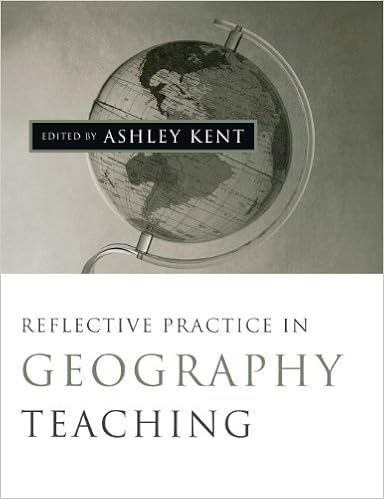
Derek contributed a chapter on Changing Geographies of Energy to another former GA President: Ashley Kent's book on 'Reflective Practice (which also featured contributions from many other GA Presidents) - I have a copy in my library which has grown substantially since the start of this project. Derek and Ashley were also involved in the celebrations of the life of Michael Bradford in 2019 at the University of Manchester. 
See the post on Michael for a link to the video of the celebration where you can see and here Derek in action.

Dr. Spooner is an Honorary Member of the GA. A distinction few have been awarded.


Derek is sat on the floor, third on the right in this image, next to the late Professor Michael Bradford. You should hopefully be able to identify the other Presidents by now. Margaret Roberts MBE is standing in the middle of the group. There are a few GA Trustees in there as well. Derek introduced Michael Bradford's Presidential lecture as well.


Derek in fact also wrote an obituary for the former GA President Michael Bradford in the Guardian, who sadly died in Summer 2019. Michael will have his own post on the blog in due course. He also sent me a significant update to the entry for Allan Patmore, his friend and colleagues for many years.

He told me that:
One thing you might like to note is that three closely-linked Presidents all went to St Catharine's College, Cambridge - Ashley Kent, Mike Bradford and me. This is something which I have developed a little more in some separate blog posts. There were links with other Presidents too, including J A Steers.

Derek kindly responded to my request for more information in a questionnaire that I sent through, and the following information was supplied by Derek.

I was born in Bournemouth in 1943. However I regard myself as coming from Southampton, which is where I grew up. I was born in Bournemouth because my family was evacuated from Southampton during the war, returning there in 1945. I regard myself as coming from Hampshire, though Bournemouth was made part of Dorset in 1974. Dorset is a lovely county (though second-class in cricketing terms) but my allegiance is to Hampshire.

I went to Taunton's School, Southampton, at that time a boys grammar school. It is now a mixed Sixth Form College. My love of Geography was fostered by a brilliant teacher, Ted Colenutt. I went up to St Catharine's College, Cambridge in 1962 and after graduation stayed another three years for my PhD, which was a study of post-war industrial development in Devon and Cornwall.

I then embarked on an academic career spent almost entirely at the Department of Geography, University of Hull, where I stayed until I retired in 2003. I was Head of Department there for eight of those years. I also spent a sabbatical term at the University of Maryland in 1976 and another at the University of West Virginia in 1985.

I was GA President in 2000-2001, and taking my cue from the world of cinema chose the theme 'A Spatial Odyssey'. I have always been interested in Geography as the study of place and space, and my presidential address focused upon three places that had captured my interest - Hull, West Virginia and The Mezzogiorno (Southern Italy). My involvement in the GA was fostered by my colleague Allan Patmore, but my involvement in the work of the Association really took off when I became Editor of 'Geography' in 1989 (until 1995). I regard this as the most important element in my service to the GA. 
It was a particularly challenging time for the journal as it struggled to maintain a flow of articles from university staff who were being increasingly pressurised to concentrate on research publications and grants. 

My main memories are of the sheer professionalism and hard work (not to mention unflagging good humour) of those doing paid or voluntary work for the GA. On a personal level, my main memory is of the stress of preparing my Presidential address, despite having done numerous talks to geography teachers over the years. I vowed never to voluntarily put myself into such a stressful situation ever again!! I'll bear that in mind :)
Derek was also involved in the lead up to the appointment of David Lambert as Chief Executive.

The Annual Conference was held at the University of Sussex in Brighton, the most southerly location for the conference that I can remember, and was I like to think a very successful event. The Coastline 2000 project also ran that year and sought to involve schools in the survey of the coast."

After he retired in 2003, Derek moved to Cornwall and had some involvement with the Plymouth branch of the GA for a few years. 

He also had time to complete 'Discovering Cities: Kingston upon Hull', published in the GA series.


Image: Jeremy Krause and Derek Spooner - image copyright Bryan Ledgard / GA - Jeremy is next up on the blog.

Derek published several articles on coal during the 1980s, ahead of the Miner's strike, and also knew John Fernie, who was one of my lecturers at Huddersfield Polytechnic at that time, who also wrote about the geography of the energy industry.  
Derek told me:
"My interest in the geography of energy was triggered in the 1970s by the development of the Selby coalfield, not far to the west of Hull. I remember writing an article about it in the Geographical Magazine in 1976. That led into a wider interest in the coal industry's changing geography, especially in Yorkshire. I well remember the miners' strike - an awful time. Sabbaticals in the Eastern USA (Maryland 1976) and West Virginia (1985) enhanced my interest in the coalfields of Appalachia."


I also have a letter that Derek sent to Chris Kington who asked him about the spark that had triggered his love for Geography in the first place.

He describes his teacher Ted Colenutt, "a great geography teacher drew a sketch map of Argentina on the blackboard. This representation of a different exotic place caught my interest. I was eleven." He gets a mention in Derek's Presidential address. There are a few of my teachers and colleagues who will similarly get a mention. Their task was to copy the diagram (I had a colleague when I first started teaching who used the same methods 30 years later). After Argentina, they did Chile, then Brazil.

"A favourite lesson among his charges was on Volcanoes, Glaciers and Monsoons. He himself had a passion for sketch maps, drawn on a blackboard with coloured chalks. Social behaviour in and out of school were different in past days. Unlike today's College, Ted said, we had to - and could - make more effort at form room discipline. He had heard of masters throwing chalk at disruptive pupils, while one actually threw six-inch long, inch-thick blackboard dusters at trouble makers in the back row!" 
I remember my teachers doing the same in the 1970s, particularly the DT teachers.

As mentioned earlier in the post, Derek was also a great friend of Ashley Kent, and together he and Ashley were involved in the celebrations of the life of Michael Bradford, about whom much has been added to the blog over the last few weeks and which can be seen on video (see Michael Bradford's entry on the blog for the Vimeo link)
Ashley told me about Derek in an email some weeks ago when he gave me his own biography:

Re Hull...as you probably know Derek was ...for years...head of the geography department at Hull and I remember staying with him and his wife to give GA talks there. Derek was at St Catharines, Cambridge University with Mike Bradford and I and I played quite a lot of college football with him. 
He and I plus Janet Pickering, former head of Withington Girls were the ‘front’ of the farewell to Mike at the University.
Derek was a fine cricketer as well as geographer. He was captain of Hull Cricket Club for many years in the famous Yorkshire League, and edited 'Geography' the journal forever."

It seems there may be a cricketing theme for many Presidents too then, with Sheila Jones and fellow Bristolians also being big cricket fans!

Derek also remembers those times editing 'Geography' fondly, telling me:

"In many ways the time I spent as editor of 'Geography' was the time I enjoyed most with the GA. I was particularly proud of the GA centenary issue I produced in April 1993 (No 339), with mainly invited contributions. The October issue (No 341)  was also a special one, with the text of lectures given at the centenary conference, including some by well-known politicians like David Blunkett. It also included a guest editorial by the GA President Andrew Goudie which focused on the 'Great Divide' between Schools and Universities, which was something that I strove to diminish both in my time as Editor, and during my period as President.  It is perhaps worth noting that I  was the last Editor of Geography from one of the older Universities, until the new arrangement introduced as the Editorial Collective. (I was followed by Hazel Barrett (another former GA President) and Kenny Lynch from Coventry and Cheltenham respectively).

In my time as Editor I was also conscious of the declining input to 'Geography' from physical geographers, and made a conscious effort to rectify that - with some success. Although my career was spent largely as an economic geographer I considered that physical geography was most important to the integrity of the subject."

Derek also told me about his experiences on GA Study Tours:
"After I retired at Hull my wife Christine (another geographer by training) and I went on an extraordinary study tour with the GA - to South Africa. We had never been anywhere in Africa before. And what a fantastic set of fellow travellers - including several other Presidents - Chris Kington, Margaret Roberts and Tony Binns (an Africa specialist). We travelled in a large minibus enabling Tony to give us non-stop commentary, driving from Durban to Cape Town. High spots for me included Robben Island, the Addo Elephant Park and travelling up into the Drakensberg to visit Lesotho. I also remember with pleasure listening to a lecture somewhere near Cape Town which was interrupted by a penguin (they bray rather like a donkey). 
We enjoyed this busman's holiday so much that the following year we went on another equally memorable study tour to Kenya. And finally in 2008 we went on a tour of Mexico, which was overrun with GA Presidents. Chris Kington described it as the Presidents and their WAGs! (For the record Chris, Ashley Kent, Mike Bradford and myself, with partners, plus Margaret Roberts!"

Chris Kington also told me about his memories of that trip:
"I think that South Africa trip secured the ascendancy of digital photography over the reluctant to die traditional SLR cameras and the ubitquitous Kodak film. Always keen on photography Derek - now an absolutely brilliant wildlife photographer - really got very excited by the possibilities of digital and re-doubled his determination to become a photographer rather than a snap shooter. This study tour seemed to mark the tipping point. Thereafter the prolific geographers had tens of thousands of shots by the end of a study tour."

Derek also told me a little more about his cricketing experiences:

"Cricket played a big part in my life - in my youth I played several matches for the MCC, including England (the MCC) v the Isle of Wight! For the MCC v Ampleforth College I came on to bowl after Fred Trueman and Brian Statham! Unfortunately I dropped a catch of Trueman. I played for Hull in the Yorkshire League for nearly 30 years (my last season was 1996) and played several times at Headingley."

References
SPOONER, DEREK. “Odysseys in a Regional World.” Geography, vol. 86, no. 4, 2001, pp. 287–303. JSTOR, www.jstor.org/stable/40573609

North, John, and Derek Spooner. “The Yorkshire, Nottinghamshire and Derbyshire Coalfield: The Focus of the Coal Board's Investment Strategy.” The Geographical Journal, vol. 148, no. 1, 1982, pp. 22–37. JSTOR, www.jstor.org/stable/634240.

Spooner, D. (1981). The Geography of Coal's Second Coming. Geography, 66(1), 29-41. Retrieved September 14, 2020, from http://www.jstor.org/stable/41414463
https://rgs-ibg.onlinelibrary.wiley.com/doi/abs/10.1111/j.1475-4762.2000.tb00131.x - a piece on Larkin and Hull

If anyone has other memories of Derek Spooner's time as GA President please get in touch.

Updated March 2021
A memory of Derek from Jeremy Krause

1998 My good friends Wendy Garner and Elaine Jackson persuading me to stand for election as President, and the embarrassing situation, for all concerned, when it was announced at GA Council that there had been a tie in the voting for President between Derek Spooner and myself. It was resolved in the meeting by a ‘drawing of straws’ which Derek won. I then had to decide whether to continue. It was decided that I would be put forward uncontested for President the following year. 
After the meeting, Derek suggested that we should have gone down the ‘single stump in cricket’ route. I would have still have lost! 

Updated August 2022
Here's an image of Derek with Wendy Morgan.


Updated July 2024

Derek was also listed as an inspiration by Claire Birkenshaw, who has had a lecture theatre named after them.
John Pethick is also mentioned here, and he had a high profile back in the day, presenting schools geography videos.

Saturday, 16 January 2021

1996: W(illiam) Ashley Kent

Updated August 2023

Ashley Kent had a long career as an academic geographer.
As with quite a few other former GA Presidents, Ashley Kent worked at the Institute of Education for many years.

I own a copy of the book whose cover is shown below, which has proved useful in the past, and has several chapters written by a number of other former Presidents as well. Like many of his books, it has run to several editions.

His PhD thesis was on the adoption of CAL (computer assisted learning) and acts as a useful summary of the development of IT in Geography classrooms - this connects with the work of another President: Peter Fox, (and I will discuss his role at the appropriate time). See the link at the end of the post to download a copy if you are interested.

He also wrote an influential book with Michael Bradford (another former President, who sadly died in 2019) called just 'Bradford and Kent' by the many teachers who used it. I mentioned that book in a recent blog post.

He was also part of the authoring team of the Oxford Geography Project, which I used back in the day when I first started teaching. Copies of this can still be obtained second hand.

Ashley proved elusive to track down for some further information for some time, from the start of my blog writing. 

I was able to swap e-mails with Ashley earlier this year, and he provided me with further information, which is now included below:

I was born in 1945. 
I attended St. Catharine's college, Cambridge - as did at least three other GA Presidents including Derek Spooner. 
My teaching career began as a student teacher at St Dunstan’s College, Catford where Brian Fitzgerald was head of department and Neville Grenyer a member of staff…both became HMI’s!

I then taught at Haberdashers’ Aske’s School, Elstree where my colleagues included John Rolfe, Neville Grenyer, Rosie Grenyer and Clive Rowe.

I was then head of department at John Mason School, Abingdon with Eleanor Rawling as a close colleague.
What a powerful department that must have been!

Eleanor and I then moved to the Geography 16-19 Project at the Institute of Education with Michael Naish.
I then became a lecturer and eventually a professor and pro-Director at the Institute of Education.

My major textbooks were the Oxford Geography Project written by the Haberdashers’ team for years 7-9; and two textbooks written with Michael Bradford: Human Geography: Theories and their applications (1977) - and Understanding Human Geography: People and their changing environments (1993). 
Both were aimed at A level and first year university students. 
All published by Oxford University Press…and fortunately sold quite a few copies!?

I joined the GA in 1969 so have been a member for over 50 years!

Further details from his CV:
He has taught in a variety of secondary schools; the University of Wisconsin-Madison; the UK’s
Open University and was Associate Director of the Geography 16-19 Project a nationally funded
curriculum development project.
He has longstanding professional and research interests in: curriculum development and evaluation;
innovation and change (the focus of his PhD work); teaching strategies including fieldwork; the
marketing and image of geography; the school/HE interface; information technology, including
remote sensing; developments in human geography; 16-19 geography; initial teacher education;
stereotyping and bias; and environmental hazards.
He has directed a number of research and development projects including: Project HIT (Humanities
and Information Technology); Remote Sensing in the Geography National Curriculum Project; Centre
for ‘A’ level Curriculum Support; Eurogame Project, a large scale European funded multi media
development; Geography 16-19; Learning Geography with Computers; YoungNet; DUNES; and
pillar leader of the HERODOT Project.

On his involvement with the GA, Ashley sent me this resumé:

He has been fully involved with the Geographical Association (GA) since 1969. He was on GA
Council for 15 years and has been its President. He was a member of COBRIG (Council for British
Geography) and has been its chairman. Over the years, he has been engaged in a number of
geography education research projects, both in the UK and for the International Geographical
Education (IGU), Geography Education Commission. He has presented papers at IGU conferences
across the world and was both a full member of the IGU Geography Education Commission and a
former chair of the British Sub-Committee. He has published widely in geography education and
education both for professional and academic audiences. This has included a number of successful
school and university textbooks.
The common thread in his career has been an involvement and passion for education at a variety of
levels and specifically curriculum development and teacher education.

I tracked down his PhD Thesis from 1996, which was titled:
"Process and Pattern of a Curriculum Innovation".

The innovation in question was introduced at the start:
The innovation in question is the use made by secondary school geography departments of computer assisted learning.
Ashley mentioned 2 key documents that sum up his approach to Geography

‘Geography’ October 1997 ‘Challenging Geography’----my Presidential Lecture presented at the Institute of Education

KENT, ASHLEY. “Challenging Geography: A Personal View.” Geography, vol. 82, no. 4, 1997, pp. 293–303. JSTOR, www.jstor.org/stable/40572948. Accessed 15 Jan. 2021. 

James Fairgrieve featured in the Presidential Address, where Ashley outlined his life and also the strong connections between the IoE and the GA. It is well worth reading to get an idea for the links and the changing nature of Geography. 

Ashley provides additional detail on Fairgrieve's life.

His inaugural professorial lecture in 2004 entitled ‘Windows on Geographical Education’….published by the University of London Institute of Education…2004

He was the tutor on the IoE's MA in Geography Education for many years. This went online from 2001, having been offered at UCL since the 1960s
He contributed to an IoE publication on retired academics in 2009, and was described as follows:

Ashley Kent retired as Professor of Geography Education at the Institute of Education, University of London - the culmination of a lifetime as a geography teacher.

“Exciting demanding, relevant and worthwhile – geography prepares pupils to critically understand and fully participate in the changing worlds in which they live” — Ashley Kent

In 2003, Chris Kington asked a number of former Presidents what had sparked their passion for geography. He lent me the letters and Ashley replied to Chris.
He talked about a "gradual realisation" that geography was for him. His geography teacher at school was described as "rigorous - a bit terrifying and gave us lots of autonomy...". He also remembers taking part in the 2nd Land Use survey, at Pilling Marshes and realising that it was all 'rough grazing'. He remembered his PGCE year and the influence of Walford and Fitgzerald et al. He also remembered his first year teaching at Haberdasher's Aske.
Many thanks to Chris Kington for the loan of the letters.
Ashley told me about his connections with Hull University and Derek Spooner, with whom he led celebrations of the life of Michael Bradford (far more on Mike to come as we get closer to the present day)
He also had memories of my own PGCE tutor at Hull: Vincent Tidswell. He told me:
Vincent I knew through his work and the ‘new’ geography ....his Pattern and Process in Human Geography was followed by Keith Hilton’s Process and Pattern in Physical Geography. 
Keith was a colleague of mine at the Institute of Education....and knew Vincent through working at Hereford College of Education. 
Vincent also had links with Brian Fitzgerald who I met at St Dunstans College. 
That was for me as a keen young man/geographer....a really exciting time...we felt very much at the frontier of the ‘new’ geography, both new in terms of content and pedagogy. 
Oxford Geography Project was really at the leading edge....as were the Schools Council Projects....GYSL and 14-18 ...and the one I was very much part of...the 16-19 Project. 

People like Brian, Rex et al were at the forefront....it was great fun being part of it! 
The first book Mike and I wrote was a direct effort to help teachers to keep up to date with the ‘new’ geography then in several school and university syllabuses. 
Of course Mike and I were helped by being a part of Cambridge and US developments....we went to Madison Wisconsin after Cambridge...where a great deal of that stuff was going on.

Exciting times, and Vincent was very much part of that. I like to think he passed on a little of that love for exciting new approaches and pedagogies to his trainees, of which I am proud to have been one. I remember using GYSL in my first job in January 1988 at John Flamsteed School in Denby, Derbyshire.

Ashley also shared some memories of the next important phase in the GA's History: the move from Fulwood Road to Solly Street, where it has its HQ to this day. Ashley is amongst the Presidents and former staff who were involved in locating the GA's new premises. That story will be told next.

Image from GA News.

Update January 2021

Some memories of his Presidential conference from Ashley Kent.
In my Presidential Year we had the Conference at the Institute on Bedford Way, which I thought was appropriate given the long-standing links between the IOE and the GA. The Presidential Dinner was held at the Imperial Hotel on Russell Square. My guest of honour was the Crown Princess of Thailand: a much revered member of their royal family: very environmentally aware and active. He had been suggested by Professor Philip Scott: an extraordinary and alternative academic from SOAS. 
The assembled diners were kept waiting by the Princess, who had been having tea with Prince Charles at Highgrove and then visiting SOAS.
We were kept waiting by the guest of honour for quite a while...so much so I suggested more booze was supplied to all the waiting guests.
On her eventual entrance/arrival the assembled throng, on the advice we were given, all stood up and did the slow handclap, which apparently in Thailand is a mark of real respect.
She was accompanied by two armed generals and sat next to me at the top table and the generals became anxious ( I was told by folk sitting with them at one of the tables) when I engaged in a lively/animated story involving props, including a scroll given to her in memory of her visit.
It was all right on the night! 

Is there anyone who was there and has their own memories of this event?

References


KENT, ASHLEY. “Innovation, Change and Leadership in Geography Departments.” Geography, vol. 91, no. 2, 2006, pp. 117–125. JSTOR, www.jstor.org/stable/41555403. Accessed 15 Jan. 2021.

Presidential Lecture, exploring the life of James Fairgrieve
KENT, ASHLEY. “Challenging Geography: A Personal View.” Geography, vol. 82, no. 4, 1997, pp. 293–303. JSTOR, www.jstor.org/stable/40572948. Accessed 15 Jan. 2021.

I would be pleased to receive any further details of Ashley Kent's time as GA President.

Updated August 2023

A link with the forthcoming GA President (as I write this) for 2023-24: Denise Freeman.

Margaret Mackintosh RIP

Updated post. Sad news at the end of last week from colleagues who have organised the Charney Conference over the years of the passing of Ma...