Showing posts with label Cambridge University. Show all posts

Monday, 17 May 2021

2011: Fran Martin

Fran Martin worked at the University of Exeter, as a geography teacher and researcher until recently, when she became an independent consultant.

Here's a story about Fran from the GA News 2005. These documents are quite ephemeral, and I am grateful to Aaron Bohlman from the GA for identifying them and letting me have access to them when I was last in Solly Street which seems like a long time ago now.

I was present at Fran's Presidential lecture, where she spoke about the work she had done. Rob Morris was also present, and he gave his thoughts on it here at the time:
http://lodgemeister.blogspot.com/2012/04/ga-conference-lost-bag-and-pre-term.html

Fran's conference theme was Geographies of Difference.

This is an important theme and one which persists of course to this day, with plenty more that all organisations including the GA can do to consider inclusivity and the number of people of colour involved in key roles, as well as issue of gender and representation.

Fran kindly filled in the Google Form that I sent round to all living Presidents and filled me in on some useful additional details for the blog post here.

Fran was born in the 1950s, and educated at Wycombe Abbey school, before heading for Cambridge University.

She had a career as a primary teacher followed by teacher educator and latterly academic/researcher, which was her job when she became GA President in 2011. 

(this was the year when I ended my GA employment sadly)

Fran has also written a number of books for Early Years and Primary geography, including one published by former GA President Chris Kington.

Bob Digby, who was to follow Fran as GA President worked with Fran for a while at Brunel University. He told me of his time there:
"The Brunel years were enjoyable, fun and challenging - just what a job should be. I worked with Fran Martin and Graham Yates, each of whom I love dearly, across a range of primary and secondary courses: undergraduate as well as post-graduate. I worked with school colleagues from a range of school types which were as varied and as interesting as our students. I observed PE lessons (anyone who knows me will splutter at this point) as well as lessons in Geography, English, RE ... whatever teachers taught, I observed. The School of Education was like a school in that it was a real community. PGCE students spend nine months with you and they're gone; with four-year undergraduates you get to know them and how they think just as you would with students in a school. It was rich, exciting, and fun."

Of her chosen conference theme, Fran told me:

"My theme was 'Geographies of Difference'. I chose it because it resonated with my research at the time - Global Partnerships as Sites of Mutual Learning - I learnt a lot about different ways of knowing, critical interculturalism and coloniality and wanted to bring some of that knowledge to my focus for the year. 

I have been a member of the GA since 1989. I had written articles and books for the GA and been an active member of both the Teacher Educators Working Group and the Early Years and Primary Committee. 
I was editor of Primary Geography 2005-2009 and then a member of the editorial board 2009 - 2017."


She feels the GA matters very much to educators:

"I became involved when I was county advisory teacher for the humanities in Buckinghamshire. I had not known of its existence before then. I initially found it to be an invaluable resource. Later I found I had things to say that contributed to that resource. It has been a great professional support and enhanced my career."

Of her time as President she said:
"I continue to have feedback that people loved the conference and still use the pieces I wrote for 'Primary Geography' and 'Teaching Geography' in their work. I tried to live out my values and the values inherent in the theme of geographies of difference and found mixed success in that regard." 


Fran about to speak, with members of the supportive Primary community on the front row...

Simon Catling said of her Presidency that she brought a wider awareness and context through her links and research in intercultural understanding.

Fran has continued her involvement with the Primary Geography community and regularly attends and presents at the Charney Manor Primary Conference and was also involved in the creation of many issues of 'Primary Geography' journal and contributed articles and other content over the years as mentioned previously in her role as Editor. Current work explores ideas of decolonisation, which is particularly significant at the present time.
She has carried out research in the UK, West Africa, India and Canada, particularly with Fatima Pirbhai-Illich from the University of Regina, with whom she has presented at the Charney Manor Primary Conference.

There is a link between Fran and my own chosen conference theme of 'Everyday Geographies'.
In the Autumn 2006 issue of 'Primary Geographer', Fran wrote a piece called 'Everyday Geography' which remains influential to this day. Around this time, the GA was also using the phrase 'Living Geography'.
Everyday Geography  encouraged Primary educators and students to remember and recognise that they think geographically in the course of their daily life.


Images copyright:Bryan Ledgard and the GA (from Flickr account)

References

Martin, Fran. “The Geographies of Difference.” Teaching Geography, vol. 38, no. 1, 2013, pp. 10–13. JSTOR, JSTOR, www.jstor.org/stable/23756981
Google Scholar: https://scholar.google.com/citations?user=sec5vcAAAAAJ&hl=en

Decolonising geography work: https://decolonisegeography.com/explore
Article:

'Caring for our World' - co-written with Paula Owens

As always, any memories of Fran and her time at the GA welcome.

Thursday, 29 April 2021

2008: Margaret Roberts, MBE

Updated October 2023

Well, what is there to say about the legend who is teacher educator
Margaret Roberts?

In her time at Sheffield University, she trained many future teachers and I have worked with quite of those, including my current Vice Principal and some other geography legends that I engage with regularly.

The GA has published Margaret's books on geographical enquiry over the years and they have always been in the top sellers of the GA's catalogue. 

In January 2021 Margaret was awarded an MBE in the New Years' Honours List, and this resulted in lots of messages and appreciation of her work over the decades from people who had valued her thoughtful contributions.

At the GTE Conference in January 2021 there was a celebration of her award which I was pleased to be present at.

Emma Rawlings Smith, another of Margaret's students talked about how important Margaret was in her own life.

This tweet by Bob Digby has a number of others as part of the thread that follows:
To hear Margaret at work, you can go onto YouTube, and hear her debating with Michael Young about Powerful Knowledge, for example and her own perspective on his ideas. You will find other elements of Margaret's work online.

Michael spoke first, and Margaret responded - the IoE recorded the session. I was fortunate enough to be in the audience at this event, and remember it well.


As with other former Presidents, Margaret was kind enough to send me some responses to a series of questions that I asked her, and that forms the next part of this entry:

Of her education, Margaret told me: 
"I was born in Cardiff. I went to Lansdowne Road Primary School, Cardiff and Cardiff High School for Girls before transferring to Colston’s Girls’ School, Bristol." This was the school where, shortly after, former President (1975) Sheila Jones began teaching. Sheila was the first female GA President to be teaching when she became President.

Margaret told me:

"My most vivid memories of school were school trips. I went to Windsor Castle when I was 9, my first visit to England, and to Bordeaux and Hanover, to stay with families on school exchanges, when I was 14 and 17. My parents never had a car or went abroad and we never went far, but I longed to travel. It was my interest in places and people that triggered my interest in geography. 

Unlike other past presidents, I was not inspired by my geography teachers. It was my A level biology teacher whose lessons I enjoyed most; she shared her curiosity and sense of wonder in the subject and we did a lot of practical work. I would have studied biology at university but had stopped studying chemistry at the age of 14. I am perhaps an accidental geographer!  In a gap between school and university I worked for three months in an ice-cream parlour in Hanover washing up dishes. Other holiday jobs included working in a guesthouse in Cornwall, a bookshop in Bristol and cleaning public baths in Bristol.

I went to Cambridge University and was a student at New Hall, then newly established (now Murray Edwards College). It had no buildings and in our first year we lived in Darwin’s old house, now Darwin College. There were only sixteen students in each year and the life-long friends I made were studying different subjects: English; natural sciences; history; maths and economics, a broadening experience. As New Hall had no geography tutors, my weekly supervisions were in other colleges: Newnham, Trinity and in my final year, with Gus Caesar in St Catharine’s College. 

Gus has his own entry on the blog, and was mentioned by a number of other St. Catharine's alumni. This places Margaret in a special group of former GA Presidents.

When Gus Caesar died, Ashley Kent and Michael Bradford (who also feature on this blog of course) kindly contacted Margaret so that she could go to his memorial service with them in Cambridge.

Margaret told me that her time at Cambridge studying geography was exciting:

"...with access to the latest research and thinking; Richard Chorley and Peter Haggett were among the lecturers.  I was struck by how cross-curricular geography was, with most lecturers referring to other disciplines: history, geology, climatology, chemistry, physics and economics. What made the biggest impact on me, however, was getting a geography department travel award to do my undergraduate dissertation in Ghana, studying development in a rural area east of Accra. The time I spent getting there on a French boat where my companions were African students from Senegal and Guinea and the time interviewing subsistence farmers, together with short stays in a school and training colleges in other parts of Ghana, transformed my understanding of development and colonialism. I wanted to get back to Africa and did a PCGE so that I could travel. I never did get to work in Africa but married a South African and visited South Africa many times."

Margaret completed her PGCE at the London Institute of Education and, at her request, did her  teaching practice at Kidbrooke comprehensive school whose first headteacher Mary Green had been head at Colston’s Girls’ School. 

Career

  • 1962-1968 Minchenden School, Southgate, London, where I became coordinator of Sixth Form General Studies
  • 1968-1970 Team member of the Nuffield Foundation Resources for Learning Project  
  • 1970-1976 Countesthorpe Upper School and Community College, Leicestershire (part-time): responsibility for A level geography.
  • 1980-1981 City School, Sheffield (part-time)
  • 1982-2006 University of Sheffield, Lecturer, PGCE geography tutor (part-time until 1987)

Margaret told me of her own teaching experience (remember that not every GA President has this):

"At Minchenden School the head of English, Douglas Barnes, took an interest my teaching and, because of interest in Language across the curriculum, got me involved in conferences of the London Association for the Teaching of English (LATE). Douglas encouraged my use of exploratory talk and writing in the classroom. I devised and taught Sixth Form General Studies courses on South Africa, the Press and Current Affairs.  

The Nuffield Foundation Resources for Learning Project was set up to promote more active learning in the classroom, where students could work more independently at their own pace using resources, with guidance. I was responsible for humanities, supported by Michael Armstrong, Deputy Project Director. The theme I was given was ‘the USA’ and I produced resources and guidelines for use by history, geography and RE teachers in comprehensive schools in London and Oxfordshire on: The First Americans; Black America (including extracts from black writers) and A Nation of Immigrants (white America).

Countesthorpe College, Leicestershire, which opened in 1970, was the vision of Tim McMullen, a former Director of the Resources for Learning Project. Four members of the Resources for Learning team got teaching posts there, keen to put into practice what the project had advocated. There was almost no whole class teaching; students learnt mainly through resource-based learning and investigative project work, often done in small groups. Students received a lot of individual attention. It was an exciting school intellectually for both students and teachers.

Margaret took a career break after the birth of her daughter, but spent her time marking CSE and O Level geography papers and did a ceramics diploma evening course (even considering becoming a potter). She also actually retrained as a Maths teacher (after doing A Level maths) as there was a glut of teachers and she wanted to get back into teaching part-time. She told me:

"I must be the only PGCE tutor ever to have done teaching practice (teaching bottom set maths students in Sheffield comprehensive schools) in the year before starting the job."

She may well be right there...

Margaret spent many years at Sheffield University, also home to the GA.

"I worked as PGCE geography tutor and eventually as Director of PGCE, at Sheffield University from 1982 (part time initially) until my retirement in 2006. My course, influenced by the language across the curriculum movement, included pre-Teaching Practice visits to schools to interview individual students about place, to teach planned lessons to small groups and to carry out a simulated public meeting role play, all emphasising the value of listening and talk. There was a lot of discussion and group work in university-based sessions. My ideas on enquiry-based learning, developed during my experiences with the Resources for Learning Project and at Countesthorpe College, were further influenced by the Schools Council geography projects which were used widely in the partner schools. (see separate blog post on the Schools Council project)

My research, using questionnaire surveys and interviews, focused on the geography national curriculum and learning through enquiry.

Margaret's personal geographical education contained at the same time, she told me:

"In my first three jobs, I had been incredibly fortunate to find myself, by chance, working with such brilliant, stimulating teachers, most notably Douglas Barnes, Michael Armstrong and Pat D’Arcy, each of whom developed my educational thinking. But none of these was a geographer. 

So, the Geographical Association was particularly important for me as it gave me the opportunity to meet inspiring geography educators and to become part of the geography education community. I initially felt overawed at meeting, at GA Teacher education conferences, well known authors such as Bill Marsden, Rex Walford and Frances Slater and people involved in Schools Council Projects: Eleanor Rawling, Ashley Kent and Michael Naish. But I found them approachable, supportive and encouraging. I gradually became more involved with the GA and over the years have been on several committees, including Council, Publications, Teacher Education Working Group and a Research group. The GA gave me opportunities to publish chapters in its secondary handbooks, articles in its journals and ‘Learning through Enquiry’ which was based on my PGCE course. So, it was easy to choose my Presidential conference theme ‘Investigating Geography’.


She told me of her own Presidential year:

"I was fortunate during my Presidential year to have the support of David Lambert, then Chief Executive of the GA. He decided to launch ‘a different view’, the GA's impressive Manifesto for Geography, in my conference slot, but having timed my lecture carefully I was worried about how much of my time he would use up! I was delighted that this conference included, for the first time, a slot for research presentations and a special session for PGCE students, an earlier initiative of Michael Bradford’s that I had strongly supported. I think it is important for new teachers, whatever other networks they can now join, to become members of the professional community of geography teachers, the Geographical Association. My PGCE students were expected to do so and encouraged to go to conference. It has given me enormous pleasure to see former students, including Mark Higginbottom, Richard Allaway, Matt Podbury and Emma-Rawlings Smith, giving presentations at GA conferences."


Since my retirement in 2006, in addition to my year as GA President (2008-2009), I have continued to be involved with the GA and with geographical education generally. I coordinated the GA’s Think Piece project; I edited 'Teaching Geography' journal for a while and went on well-organised GA Study Tours to China, South Africa, Mexico and Poland. I chaired COBRIG (Council for British Geography) for six years and organised its small-scale seminars in Sheffield, Perth and Cardiff. I have contributed to CPD sessions for Teach First, Prince's Trust, Eduqas and a MAT. I was on the IGU Commission for Geographical Education British Committee for many years and contributed to its conferences in Helsinki, South Korea, Brisbane, Melbourne, Stellenbosch, Singapore and Lisbon. I have been a member of the Geography Education Research Collective (GERECO).  I continue to write occasional articles and chapters and to contribute to conferences.


My GA publications, notably, ‘Learning through Enquiry’, led to unimagined further opportunities. I was invited to run courses for teachers on ‘Inquiry’ in Singapore in 2011, the Netherlands in 2014 and Hong Kong in 2015. So, although I never did teach abroad, I did get to travel widely in the end. I developed my second book, 'Geography through Enquiry' (now translated into Korean), from the ten courses I ran in Singapore. My unplanned and surprising career would not have developed in the way it has without my involvement in the Geographical Association. Through the GA I have met and shared ideas with so many inspirational people and feel very grateful to have received so much support and encouragement from the GA community."


You need to get yourself a copy of Margaret's book if you haven't already. One belongs in every departmental library.

"What makes a Geography lesson good?" is one of the most useful pieces of advice she has shared - free download from the GA.
Download as a PDF

For more on Margaret's influence, you should listen to her talking to John Lyon for the second of the GA's GeogPod episodes. She talks about her work with Singapore educators, and also a recent contribution to a book on technology and her career as a whole.


Margaret has contributed numerous articles to GA journals as well as her other writing work. 

I also have a memory of chatting to her and the late Doreen Massey while at the University of Derby about a T-shirt I was wearing saying "I am here" and where exactly I may have been...

Doreen, who has her own post as a former Honorary Vice President of the GA later posed in a hoodie for a recreation of one of our 'Mission:Explore' missions: 'Put OAPs in the Hood'.


Images copyright: Bryan Ledgard / Geographical Association - used with permission

When I'm teaching, to this day, I often think to myself of any lesson "What would Margaret say?"

Another former GA President Derek Spooner also provided me with a great story about he and Margaret...

"Another less serious memory: when I was Editor of Geography I used to attend Publications and Communications Committee at HQ at Fulwood Road. These meetings were held on Saturdays and could be rather long and tedious. Margaret Roberts (another President in due course) was also on the Committee. She was a Sheffield Wednesday fan, and the two of us skived off after lunch from one particularly boring meeting to go to Hillsborough to watch Everton v Sheffield Wednesday. Wednesday won 3-1 and the Everton goalie Neville Southall was sent off. Chris Waddle was playing (brilliantly) for Wednesday. The only time I've been to Hillsborough (though I played cricket several times down the road at Bramall Lane!). I remember a few eyebrows were raised when we left the meeting......"

Margaret told me of her MBE award:

It has been quite humbling receiving such messages from people who themselves have done so much to promote geographical education. I feel particularly fortunate to have worked with people in my first few jobs who encouraged me so much and also to have had the support of the Geographical Association and the opportunities it has given me at conferences and in publications. I consider myself a democrat and have always considered the students in the classrooms I have observed. That is what it was about for me - their engagement and involvement - otherwise geographical knowledge was just inert.

I've had the pleasure of spending time chatting to Margaret many times over the years. I also remember a terrifying occasion in a hotel in York when I was leading a session for the GA's 'Living Geography' events and my session on 'Geographical Enquiry' had Margaret in the audience - she was very kind about it. She also asked to check a chapter of a book I was editing to make sure what we were saying was accurate and included real people and not 'talking heads' invented by the authors. Realism and authenticity is vital in textbooks.

References
'Learning through Enquiry' and 'Geography through Enquiry' -  Margaret Roberts - published by the Geographical Association.

Read this PDF : OU Enquiry resource

Margaret contributed a chapter to a recent book edited by Nicola Walshe and Grace Healy on Geography Education in the Digital World. She also mentions that in the GA Podcast with John Lyon.

Any further memories of Margaret would be very welcome. 

If you were trained by Margaret please say hello in a comment or let me have any further memories of your time on the course.

Updated August 2023

Make sure you sign up to hear about the new edition of Margaret's classic book.

The second edition of the popular Geographical Association title Geography Through Enquiry: Approaches to teaching and learning in the secondary school will be published in autumn 2023.

This updated edition draws on Margaret Roberts’ in-depth experience and knowledge of geographical education, with input from a wide range of practising teachers and educators from around the world.

It takes into account the changes that have taken place since the first edition, both educationally and in the wider context:
  • The many new books, articles and national and international projects focused on geographical education.
  • In England, the changes to the inspection framework and standards and requirements for trainee and early career teachers.
  • The sharper focus on issues related to equity, diversity and inclusion and on the continuing impact of the legacy of empire on both the curriculum and the world that geography studies.
  • The increasingly urgent challenges related to climate change and sustainability.
  • The rapid development of digital technologies and the impact of this on the world studied by geographers and ways in which they study it.

NOW AVAILABLE FOR ORDERING.

Friday, 29 November 2019

1951: Leonard Brooks

Major update March 2026 - see later

On going through the list of past GA presidents, it is rare to just see the two names of the person without them being preceded by Sir or Professor, or followed by strings of letters and awards, particularly during the first fifty years of the Association. 
This has changed a little in recent decades. I am pleased to have broken some recent trends in the Presidency, and I certainly don't have any of those titles (yet)

Leonard Brooks was President in 1951, following Professor L Dudley Stamp. This must have been a challenge in itself to follow on from such a well-known figure, but it seems like Mr. Brooks was up to the challenge, and had a different energy.

He had earlier been involved in a significant event for geography.

In 1945, the new Director of the RGS: Lt Col L. P. Kirwin, aided by Leonard Brooks, established a new era of co-operation between the three geographical societies (the GA, IBG, RGS).

The House of the RGS, which escaped undamaged from the war, was made available to both other societies. It was used for conferences for some years, such as in 1951, when Brooks became the President. This is an interesting moment in the shared history of the two organisations.

Here is Leonard Brooks in an image including some other GA notaries. The gentleman in the black overcoat and white scarf second from the left is Frank Debenham, who was President the following year (it was the 70th anniversary of Debenham's Presidency in 2022 - my own Presidential conference year - and he got a mention).
Third from the left is Leonard Brooks, with the spectacles. On his left is the unmistakeable H J Fleure.
Image from Balchin's centenary volume.


Leonard Brooks served on the GA's council for several years during the 1940s and his name appears in 'Geography' numerous times during this period.


This greater collaboration between the GA and RGS-IBG is something I hope to work on over the years to come, as I did previously as part of the Action Plan for Geography Team, and since on various projects. 

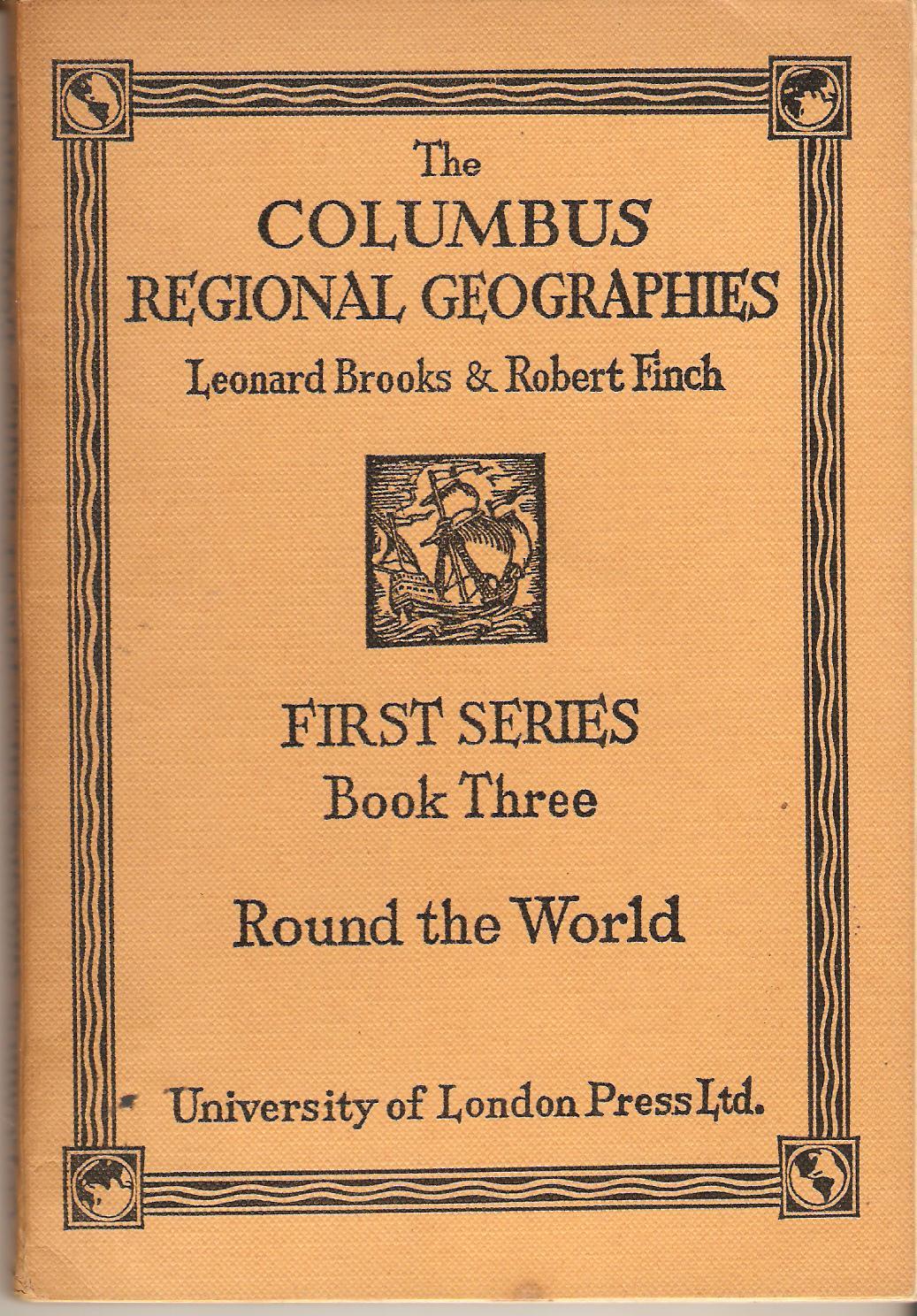
Brooks wrote and co-wrote a series of books on Regional geographies of the World, this one pictured with Robert Finch.
Brooks had a lot of teaching experience, which is also excellent to see, as well as plenty of experience in school inspection.

At the time of his Presidential lecture, Brooks had spent 15 years as a teacher, and 26 years in school inspection.

Brooks' Presidential Lecture was on the theme of 'Some thoughts on the Present day teaching of Geography in schools".


I like how he started by saying that if delegates read Fleure's pamphlet from 33 years earlier on 'Geography in Education' he would find that things had come round full circle. It was ever thus.

He proposes to do 2 things in his Presidential address which would still make a good focus for any CPD session.


The talk is well worth reading. It touches on a great many things which one can hear talked about at teacher conferences today, over 70 years later.

I don't agree with everything he has to say, but nine times out of ten he is fairly spot on.

His obituary talks about the work he did connecting the GA with the RGS, acting as liaison between the two organisations.


One of the projects that Leonard Brooks started (along with another President Sydney Suggate) was  to develop a scheme where schools could "adopt" ships and send letters to their Captains. It was called the Ship Adoption Society.
This provided a chance for students to write to, and receive letters from ships' crews travelling around the world. This was a great initiative.

I was unable to find an image of Leonard Brooks other than the one above, so had to do some digging, and contact various people.

Brooks' obituary by Fleure and Suggate outlines some further details on his earlier life and career, having been born in Lancashire.

In 1955, he was awarded an OBE "for services to Geography".

I think we should see that sort of citation more often in Honours Lists. I can think of a few people who have done a great deal for the subject but haven't been honoured yet (unless they were, and turned it down).

References

Fleure, H. J., and L. S. Suggate. “Leonard Brooks.” Geography, vol. 50, no. 1, 1965, pp. 82–84. JSTOR, www.jstor.org/stable/40567028. Obituary details.

Presidential Address:
Brooks, Leonard. “SOME THOUGHTS ON PRESENT DAY TEACHING OF GEOGRAPHY IN SCHOOLS: Address to the Geographical Association.” Geography, vol. 37, no. 2, 1952, pp. 63–71. JSTOR, www.jstor.org/stable/40564773.

If anyone knows more information about Leonard Brooks, please get in touch, as with other posts on this blog. I'm particularly keen to get a larger image too, as he is one of the very few Presidents I don't have a high quality image of.

I decided to pursue the school route here.
William Ellis School was mentioned in his obituary.

I found this image on their website - I taught in a room with a similar vibe early in my career, and my own school days were in a room with one of those globes in the corner, which tended to get stuck in position. There were also roller boards, and a raised dais at the front, and heavy dark wood furniture with moldings on the top. I like the addition of explorers names around the top of the walls.


The copyright for this image is the London Metropolitan Archive, and the teacher is named as V C Spary. Spary was also connected with the GA, and helped organise the conference for some years.

I was contacted by school archivist/historians after sending an e-mail and they have been very helpful.
My heartfelt thanks to Christopher Willey, Jim Corbett and Fiona McWilliam.

The source of the following section, sent to me by Chris Willey, is principally the school history (T D Wickenden, William Ellis School 1862-1962, privately printed).

It includes something on the purpose built Geography room of 1913. I see that it is recorded as the inspiration of James Fairgrieve, the senior Geography master who preceded Leonard (and another former GA President who has his own entry on the blog)

Imagine following in Fairgrieve's footsteps as a Geography teacher.

The information about Leonard in Wickenden is as below. This also makes a connection with James Fairgrieve:

Appointed by E B Cumberland in 1912 Leonard Brooks succeeded James Fairgrieve as the Endowed school’s Geography teacher. He was ‘… a writer of textbooks, an eminent Inspector of the London County Council and a Fellow and one time Honorary Treasurer of the Royal Geographical Society. In all this and as a Governor, in which capacity he is still with us, the School owes Mr. Brooks a great debt.’ (p75)

‘Early in 1916 the School was asked to join a new Cadet Battalion then being formed in the Borough of St Pancras; for various reasons that was not acceptable but it led to negotiations as a result of which the School threw in its lot with the 1st Cadet Battalion of the Royal Fusiliers, City of London Regiment and constituted ‘D’ Company. Mr Leonard Brooks, the geography master, was an inspiring Captain and Company Commander …’ (p100)


‘Mr. Brooks went to the London County Council in 1920 and was almost immediately engaged with another ex-master, Mr. Beresford Ingram, in organising the new Day Continuation Schools.’ (p116)

During the later 1930s:

‘Partly an outside activity, and partly educational in keeping with the School’s reputation in the teaching of geography was the ‘adoption’ by the School of the S.S. Willesden. 

Mr. Leonard Brooks, then a Senior Inspector of the London County Council, was largely responsible for the ship adoption scheme and for William Ellis being one of the first four schools participating in it. The object was to bring geography ‘alive’ by following the course of the ship in its journeys and its trading – maintaining a chart of the ship’s movements, a logbook of progress, records of cargoes together with their origin, destination, and processing for shipment, and so on. … A steady correspondence between the Captain of the ship and the boys was a principal source of information and interest. 

 Files, charts and posters were kept in the Geography Room and were available there for inspection and use by any boy who wished. The association, first with Captain Anderson and then Captain Martin, was a very happy one for they were good letter writers and went to great pains to answer the host of questions sent them, and in arranging visits to the Willesden; talking with the crew was of special interest to the boys on these occasions. The owners presented a large model of the S.S. Willesden to the School, a gift greatly appreciation. 
Just before the outbreak of war, the P&O liner Stratheden was adopted as a second ship..'

The Stratheden seems to have survived the war: here is a picture of a school visit to the ship led or accompanied by AP Smith in the early 1950s, a revival of the ship adoption scheme, at the least 'in spirit'.


More images to come of the Geography classrooms at WES in due course in a separate blog post... they are really excellent.

Leonard will have taught in the dedicated Geography room at Allcroft Road. 
On the subject of the room itself, Wickenden says the following:

‘… in 1913 the additions were made to the Allcroft Road buildings, namely a special geography room and two new classrooms. … The geography room was the first of its kind in the country, and owed its conception and design to the enthusiasm of Mr. James Fairgrieve, then geography master at the School and a pioneer in modern methods of teaching that subject. He had put forward his proposals first in 1911, and one must applaud the business-like dispatch which saw the three rooms ready for use at the beginning of the 1913-14 school year, the London County Council having provided a building grant of £2,500 towards the cost.’

I am hopeful that there may be another image of Leonard forthcoming as Chris sent details of my request round in a newsletter. The group photo above is currently the only one I have.

Image credit: Balchin's Centenary volume of the GA - the first Hundred Years

Update July 2021

In July I was able to go up to Solly Street and head into the archives, and found that there was a pallet of boxes from the William Ellis School, where Leonard taught.
These were later catalogued.

What I did find was a copy of the World by Leonard Brooks which appeared to have been used by Leonard himself, which was exciting and a connection back to a previous President.


Major update March 2026

I'm extremely grateful to members of Leonard's family for getting in touch with some further information on Leonard having seen this entry, and having completed some work as a family researching their history. 

This included a huge amount of extra detail on both Leonard and his wife which I hadn't discovered from any other source.

One of the things they sent me was a family tree - here's a section of it that features Leonard.


One part of the detail I was given features Beatrice Kennerley. She was born in 1883 near Bolton. At the age of 18 she was a paper bag maker. Her brothers had emigrated to America. She decided to become a school teacher. She gained her Teacher's Certificate from the Board of Education in 1905, and after two years of probation was granted another certificate in 1907 and started work as an elementary school teacher in Farnworth.

She met Leonard Brooks around this time, who was also working as a school teacher and they were married in 1911.


Leonard and Beatrice Brooks - thanks to Leonard's family.

Leonard and Beatrice moved to London after their marriage and lived in the Hampstead Garden suburb in Wildwood Road.
Beatrice moved into property, and helped set up an estate agents called McCraith and Brooks.

Beatrice and Leonard had 3 daughters.

Now onto the detail of Leonard's life:

Leonard was born in December 1884 in Farnworth near Bolton, Lancashire. The family was recorded as living in Market Street in the 1881 Census.

At the age of 16 he was recorded as working as a clerk in a cotton mill, so probably left school at the minimum age. His father was the manager of the Cotton Mill where he worked.

He attended Halshaw Moor Chapel, and in 1905 was recorded as being both a librarian and a pianist. Leonard was an accomplished musician as well as a geographer. This was very helpful.

Despite leaving school so young, he wanted to study geography at Cambridge. He discovered that FitzWilliam Hall was offering an organ scholarship. He studied the organ and music for a year, took the exams and was awarded the scholarship.

He matriculated in 1908 and gained a BA in Geography in 1910.
His first teaching appointment was in 1911, when he was appointed as an assistant master at the boys' municipal secondary school in Leamington Spa in Warwickshire. This was a busy year, as he married Beatrice and his pay was increased from £160 to £170 per annum.

In 1912 he moved to the William Ellis Endowed School at Gospel Oak in North London.

I've mentioned this earlier in the blog as I was able to get some help from the school and discovered that Leonard's predecessor as teacher had been another GA President James Fairgrieve.

He taught geography at the school, where he "pioneered the use of geography as an instrument of humanity".

He was the author of many textbooks - some of which are mentioned earlier on the blog. 

Leonard's family provided lots of useful additional detail of his later career:

In 1919 he had a part time job at Birkbeck College, lecturing on historical geography.

In 1920 he became an Inspector of Schools for London County Council.

He was Honorary Secretary, Honorary Treasurer and Vice-President of the Royal Geographical Society.

Leonard sadly died in 1964, with Beatrice passing away in 1966.

Special thanks to Annie and Andrew Britton and family members for the information in this update.

Margaret Mackintosh RIP

Updated post. Sad news at the end of last week from colleagues who have organised the Charney Conference over the years of the passing of Ma...