Showing posts with label Arctic. Show all posts

Thursday, 13 May 2021

David R Wright

Not a GA President, but someone bound up with the work of the Association in many ways is David R Wright. He produced a series of best selling map books and atlases, and also worked as a PGCE tutor at the University of East Anglia, which was where I first met him in the early 90s. As you can see from the article below, he was also another geographer associated with St Catharine' College (and always remember to spell that with an 'a' by the way...) and to have Gus Caesar as a tutor. Gus was very much connected with a whole range of former GA Presidents including Margaret Roberts.


He contributed to a range of GA publications and articles, always on the theme of mapping.

The last time I saw David was at the Royal Geographical Society in 2008. He was receiving an award, as was I. He was unwell at the time, and sadly died the year after.

The following text and the accompanying image are copyright RGS-IBG

David Wright, who died on 20 November 2009 after a battle with cancer, was a geographer and author whose work inspired children around the world.

David graduated from Cambridge University and then trained as a teacher, undertaking an MA in Geography in Education from London University, Institute of Education. He taught in Stevenage and Pittsburgh before moving to Norfolk in 1969 as a lecturer in Geography at Keswick Hall College of Education, which was later merged with the University of East Anglia, where he worked for 12 years. He took early retirement in 1994 to further his research and writing, becoming a self-employed author, school inspector, adviser and consultant.

Throughout his career David was a champion of the use of equal area maps in teaching and in publications of all types and his (W)Right World Map was launched in 2007. He also advocated the use of stamps in engaging young people with an interest in places and examples of a virtual journey using stamps can be found on Discovering the Arctic 

I have this pencilled in for an activity in my new KS2 Schemes which I am developing with colleagues in a unit called 66 North.

Throughout his career David’s concern has been to stimulate children’s interest in the world by creating pupil-orientated approaches to teaching geography and innovative ways of linking geography, environmental and sustainable development education, all rooted in his experiences of many different parts of the world.

David was a past chairman and president of the Norfolk branch of the Geographical Association and his contribution to geographical education was acknowledged in 2007 when he was awarded the accreditation of ‘Chartered Geographer’ by RGS-IBG. In 2008 he was awarded the ‘Ness Award’ by RGS-IBG for his work championing the wider understanding and popularisation of geography through his work with children.

David's obituary on behalf of the Geographical Association was written by Margaret Roberts and published in 'Geography'. It has often been the job of GA Presidents to have that sad duty.

David also wrote a book in the GA-published series 'Theory into Practice'.
It was called 'Maps with Latitude'

Reference
https://www.geog.cam.ac.uk/alumni/landmark/1/landmark1.pdf - p10


As always, if anyone has memories of David please get in touch, or add a comment. Many people will have used his work and books I am sure.

Monday, 5 April 2021

Cape Farewell

Cape Farewell was a project that grew out of the GeoVisions project. Fred Martin was on the GeoVisions sub group and wrote the pack.

It was a resource pack which was an important part of the work that we used for the OCR Pilot GCSE Geography as it had a focus on extreme environments. It had a spiral bound pack and a CD with a series of resources and images. It had heavy use for three years that we taught the Pilot GCSE. Here's a trailer video for a later phase of the project.

Cape Farewell - An introduction from Cape Farewell on Vimeo.

Cape Farewell changes the way we think about climate change. Climate change is a reality. Caused by us all, it is a cultural, social and economic problem and must move beyond scientific debate. Cape Farewell is committed to the notion that artists can engage the public in this issue, through creative insight and vision.

Artists and authors were taken to the Arctic, and there was also a link with Svalbard, which became a focus for my teaching.

The project itself explores the cultural response to climate change.


References

Mitchell, Alistair. Teaching Geography, vol. 30, no. 1, 2005, pp. 59–59. JSTOR, www.jstor.org/stable/23756577. Accessed 29 Mar. 2021.

Thanks to Fred Martin for his memories of the creation of this pack and the images which brought back a lot of memories for me. I left these packs behind when I left teaching - wished I'd kept a copy now, as there don't seem to be many around...


Thursday, 16 July 2020

1971: Professor W G V Balchin

Last updated August 2023

W. G. V. Balchin (William George Victor) was the author of a book which has been one of the most useful sources when writing this blog, and he finally gets his own entry in 1971, when he was chosen as the President of the GA for that year. He had a very interesting life.

In the intro to the book, he is named as:
MA, PhD
Emeritus Professor of Geography, University College of Swansea, Fellow of King's College London and he was certainly a tremendous geographer.

He was born in Aldershot, and was known as Billy.

"When he went up to Cambridge and found a treasure house of geography books, he described it as an Aladdin's cave and read voraciously." (from Coleman's Obituary)

After graduating he joined the Cambridge academic staff as a demonstrator. The next summer he became an Arctic explorer, based beside a glacier about 600 miles from the Pole at the head of Billefjord in Spitsbergen (another of several GA Presidents to have visited) 
While sailing up the fjord he spotted something that enabled him to test another contemporary speculation - isostasy. This postulated that the immense weight of the Quaternary ice had depressed the land surface and squeezed out some of the plastic sima layer at depth. When the melting ice front retreated, the sima gradually oozed back, raising the land again.

He knew that such recent uplift would not have allowed time to cut wide beach platforms like the Cornish ones but noticed shingle ridges, which are sometimes the product of a single storm. The further from the ice front, the more the returning sima would have lifted the land, so that while the ridges were only at sea level near the glacier, they should fan up southward. He proved this by professionally surveying 50 miles of coast, camping out when it became too far to return to the base at night.

The Norwegian government added his work to the incomplete survey of Spitsbergen and named a 5000-ft mountain after him at 79° North, now called Balchinfjellet.
This makes him, after Debenham, another GA President who literally has his name on the map.

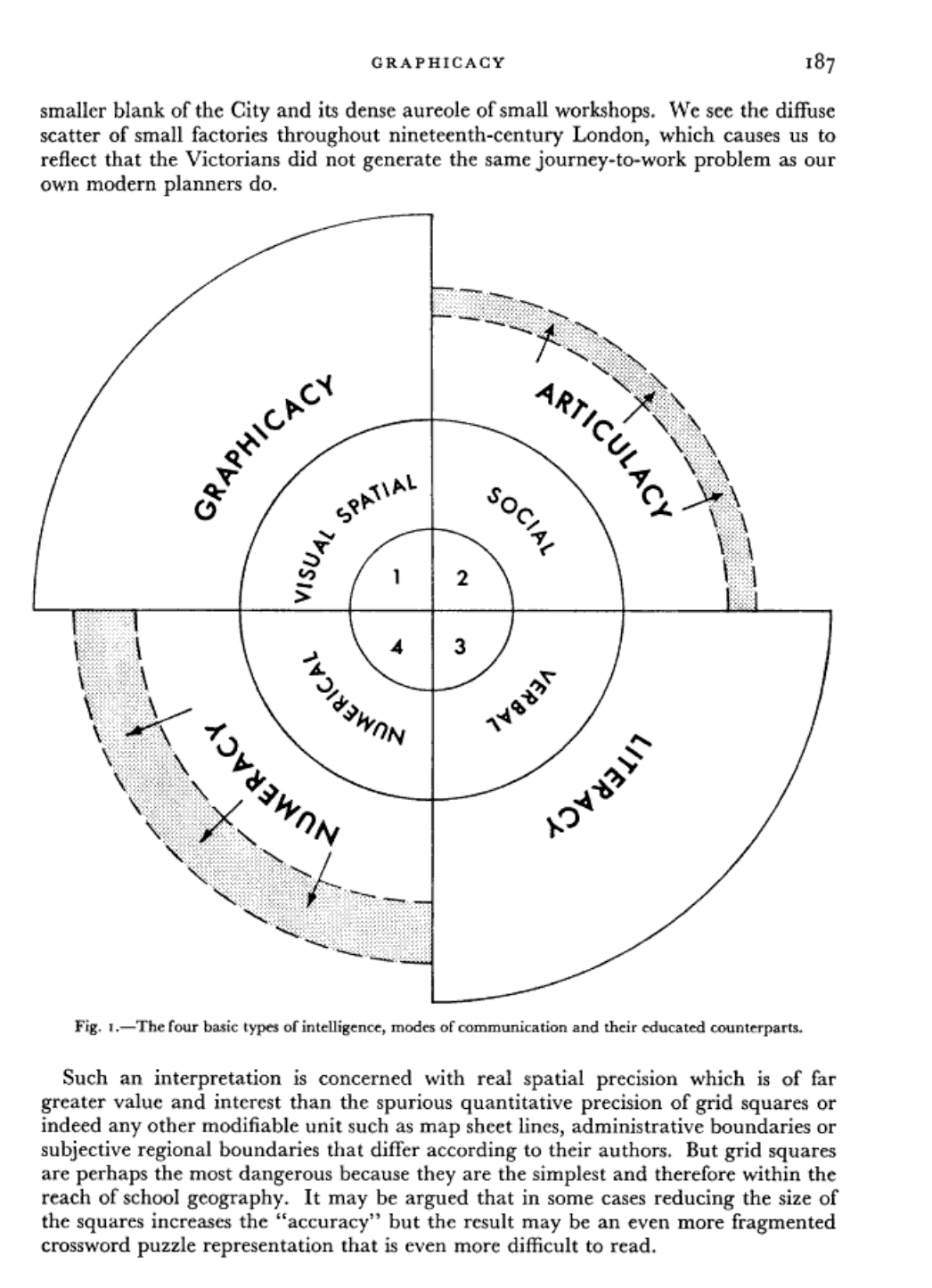
Balchin's Presidential Address, delivered at the London School of Economics was called just 'Graphicacy". It included some useful images such as the one shown here, and has been referenced by other people quite recently and I recommend that you read it.
He had become closely linked with the GA in 1954 when he was first elected as a trustee of the GA, following the death of a number of former Presidents in close succession.


At the end of Balchin's Presidential year, there were proposals for a new Standing Committee on Graphicacy, which was the title of Balchin's Presidential Lecture.

From the obituary listed earlier...

William and Alice Coleman coined the term ‘graphicacy’ and when he was President of the Geographical Association, he chose speakers on this subject for the Presidential day, beginning with his own address. 

He created a warm welcome for the concept, which was taken in the art world also and potentially included engineering. At the time of the National Curriculum, graphicacy was considered an important element for Geography and Rex Walford has recently written that the graphicacy concept ‘… will always remain a defining landmark in the history of geographical education and those articles you [both] wrote about it in the 60s are still regularly quoted today in geographical magazines.’

Graphicacy was still important when I trained as a teacher in Hull in the late 80s. Here's a scan of some notes I typed up during my PGCE course, from October 1986 to be specific.


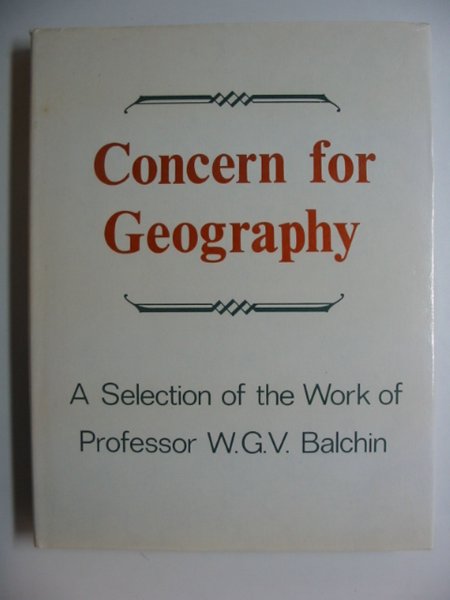
Balchin retired in 1981, and to mark the occasion, a book was published, of which 500 copies were printed.
It is called 'Concern for Geography'.
I got myself a copy, in a different binding. Mine is number 137 of 500.

Here's Balchin's photo from the front of the book.


In 1996, he was guest of honour at a dinner for the Isle of Thanet GA Branch.
Here's a description:
The 40th Anniversary Dinner was celebrated at the Walpole Bay Hotel in December 1996; the guest speaker was Professor Balchin of University College, Swansea. The attendees were welcomed by Elsie Weir, the Chairman. After an excellent meal, everyone was entertained by ‘The Serenaders’ led by Mrs Janice Reagan. This was followed by reminiscences from Alice Coleman, Prof William Balchin, Marjorie Woodward and Fred Fielder

Also a wonderful image: Source and Copyright: https://www.geography.org.uk/write/MediaUploads/Get%20involved/GA_IOT_History_booklet.pdf


From the Balchin Society Obituary

He and Lily retired to her home county of Yorkshire, to the lovely little town of llkley, not far from Leeds where two of their children were working. He continued his work for Geography, supporting the various organizations. In the Royal Geographical Society he won the distinction of serving on the Council for 17 years. Thirteen of these were as Chairman of the Education Committee, when each year he arranged for speakers on a range of careers for geographers to speak to packed audiences of sixth-formers, and as the careers were different every year, the accompanying teachers also found these occasions fascinating. In retirement he helped frame the lecture programme of the Society’s branch in York.

He was also a keen supporter of the Geographical Association. During his years at King’s College he was the organizer of its annual conference, and he was a Trustee for many years. In Yorkshire he joined the committee of the GA’s Bradford Branch.
William always had a great sense of perspective, both looking ahead to the future and relating it to the past. For example, he was well ahead in his recognition of impending anniversaries, such as the 150th of the Royal Geographical Society where he outlined a schedule of celebrations that was closely adhered to in the event. He also wrote a the history of the Geographical Association on the occasion of its centenary and edited a book on the 75 years of the Joint School of Geography – a saga of cooperation between King’s College and the London School of Economics.

For the Royal Geographical Society he prepared an archive of all the geographers who contributed to the success of World War II, with some intriguing revelations. For example, it was a geographer, J F N Green, who cracked the Italian code, using his meteorological knowledge to identify and interpret their weather bulletins. This feat must have been just as impressive as the well-known non-geographical cracking of the German code, but unfortunately it was never written up in similar detail.


I also got hold of a digital copy of an excellent book that Balchin edited in 1970, with contributions from several other Presidents along the way. 
This is from the Internet Archive. 
Check out other books that can be borrowed and read after a download of Adobe Digital Editions.

Balchin died quite recently, in 2007, aged 91 - another GA President to live a very long life.

His obituary was written by Alice Coleman - a familiar name linked with many GA Presidents during her time at the GA.


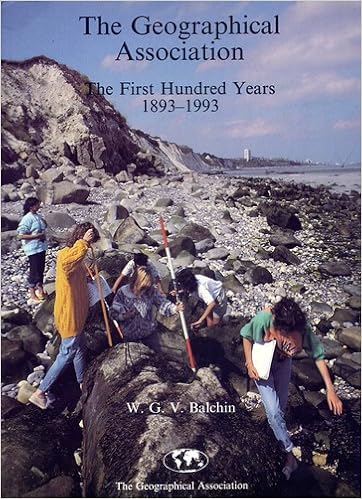
Of course, Balchin has also been influential in most entries so far as he was the author of a centenary history of the Association which is pictured below, and is worth seeking out as a second hand copy as I did.
Image result for w g v balchin

There is a Balchin Family Society, which provided the image for this post.

References

The Internet Archive has scans of several of Balchin's books, and others you can borrow.

No Wikipedia page - perhaps one is needed for Balchin, and several other Presidents too.

Balchin obituary: https://www.questia.com/library/journal/1P3-1521973781/obituary-professor-w-g-v-balchin

Image source: https://medium.com/nightingale/dvs-historic-datavisualization-may2019-6885f80780d5

https://balchinfamily.uk/professor-william-balchin-and-mount-balchin

https://books.google.co.uk/books?id=nbGcAQAAQBAJ&lpg=PA47&ots=FWDWaCsx5p&dq=norman%20pye%20geographical%20association&pg=PA48#v=onepage&q=norman%20pye%20geographical%20association&f=false - Oxford Dictionary of National Biography 2005-8

If anyone has further information on W.G.V Balchin, please get in touch.

Updated October 2020

I've been sent a number of other images featuring Billy Balchin by Sheila Jones. Here he is talking to Sheila at the start of a GA Centenary Quiz in 1993 which will appear in a more detailed report on that event nearer the time. Bill Mead is standing in the background. I am not sure of the identity of the lady in red.


This image above is thanks to Sheila Jones. More to come when I reach 1993.
It shows the longevity of his involvement with the GA that this was over 20 years after he was President and he was still heavily involved.

https://collections.swansea.ac.uk/s/swansea-2020/page/on-our-doorstep - some memories of Balchin are here too, by David Herbert.

One of the features of the Geography course was field-work. Apart from scouring the Gower and adjacent areas, we went off once a year to distant field-week locations. One year it was Devon and Cornwall, based in Exeter, another it was Ireland, based in Dublin. Memorable from the former were a long, seemingly endless trek across Dartmoor looking for tors. Each time our leader, John Oliver stopped at one, Derek Maling would say “Call that a tor” and on we went until he was satisfied. All of this would have been more tolerable if it had not been pouring with rain the whole time. 

In Ireland, we viewed numerous overflow channels and there was a typical Balchin moment. We stopped in an abandoned rural area, walled empty fields and broken down buildings and Professor Balchin asked for comments. As I had been to lectures by Stuart Cousens on the famine and its consequences, I waxed lyrical about the impact on landscape of poverty, starvation and migration. Professor Balchin listened and then said, “That is all very well, but what are the walls made of?” Granite was really the answer he wanted; the course was still mainly seen through the lens of physical geography!

Herbert later says of Balchin:

Bill Balchin was a warm and caring person when I had the chance to know him better; he even turned up from his home in Yorkshire at my retirement dinner when he was in his 90s.

Updated August 2023

From the GA Magazine in 2006 on the occasion of his 90th birthday.


Wednesday, 11 December 2019

1952: Professor Frank Debenham, OBE

Last updated August 2023

Perhaps one of the most illustrious of all GA Presidents was Professor Frank Debenham.


2022 marks the 70th anniversary of his Presidency - a fact that appeared in my Presidential Address.

Frank Debenham was born in Bowral, New South Wales, and educated at the University of Sydney, where he studied geology.

Debenham took part in Captain Scott's Terra Nova expedition, and was a survivor of that fateful trip to Antarctica which ended with the death of the Polar party. He was a geologist on the expedition, surveying the mountains near McMurdo Sound, and also took over from the renowned Herbert Ponting (who took some of the most iconic images of Polar exploration ever) as expedition photographer when Ponting left in 1912.
He is shown on many of the photographs from that expedition, including the one shown here.

A knee injury, from playing football in the snow, apparently partly prevented him from going on the ill-fated Polar journey.
Just let that sink in for a moment...

I also caught him on the Blu Ray I have of 'The Great White Silence', emerging from a hut.
See the screengrab below.
The Epic of Everest & The Great White Silence [DVD & Blu-ray]


Debenham returned to Cambridge to write up his expedition notes, but the First World War intervened and he saw active service in a number of places, rising to the ranks of Major, before being wounded and returned home.

Image source: Public Domain

Image credit:
Herbert Ponting - National Library of New Zealand Reference Number: PA1-f-067-045-2
Frank Debenham and a plane table, during the Terra Nova Expedition 1910-1913 under the command of Robert Falcon Scott


Debenham was also the Director of the Scott Polar Institute in Cambridge between 1926 and 1946.

I have visited here many times, and am hoping to make a visit to see what further connections we can make with the GA during my Presidential year.

Debenham was also a fellow of Caius College, and Professor of Geography. I wonder whether they have further relevant material in their archive?

From the Cambridge University alumnus page:
Debenham was an Australian petrologist who had served on Scott's ill-fated Terra Nova expedition. He had originally arrived in Cambridge in 1914 to begin compiling records of the mission in the attics of the Sedgwick Museum, but then had been on service throughout the war. Debenham arrived at a time when a number of other polar individuals were also present within Cambridge: Charles Wright, who had also been on the Terra Nova, briefly lectured at Cambridge but continued to live in the area for much longer; Raymond Priestley, who had been with Shackleton on the British Antarctic Expedition of 1907-1909 was Assistant Registrar; and James Wordie, who would become Master of St John's College, and who had been a member of the crew of the Endurance. It was Debenham's dream to set up a polar research centre in memory of Scott at Cambridge, and he successfully won over the support of the Scott Memorial Fund to create it in 1920. The Scott Polar Research Institute (SPRI) continues to form an important part of Department life today, from its base on Lensfield Road.
The first candidates for the Geography Tripos sat the exam in 1920, resulting in 2 students receiving a 1st Class for their Part 2 exams, one of whom was JA Steers, who would go on to become Professor of Geography and Head of Department 1949-66.
When Philip Lake retired as Chair of the Department, he was succeeded by Frank Debenham, who became the Department's first Professor of Geography in 1933.
Source:
https://www.geog.cam.ac.uk/alumni/earlyyears/

Debenham travelled extensively in Africa, and published on such subjects as the water resources of arid regions, the construction of small earthen dams, the ecology of the Kalahari, and on David Livingstone.

Between 1951 and 1953 he was also Vice President of the Royal Geographical Society (yet another President who helped to connect the two institutions - this is a common thread through many of the blog posts, as those of you who have been following the blog will perhaps have noted)

Debenham's Presidential address, on the subject of Travel is well worth reading, taking place as it did in the GA's Diamond Jubilee year.
A few quotes from the Address are worth repeating here.

"Travel, either or own or that of others, is the very essence of geography... it can be satisfied to some extent when done by proxy, with the aid of imagination. In fact, both at the beginning of life and at its latter end, that form of travel - armchair travel - is the normal one... It is far more comfortable than real travel and can be just as exciting as your imagination likes to make it."

He follows with some important ideas on the importance of narrative where a book is

"a magic casement (window) through which, at will, they can gaze upon not only perilous seas and faery lands forlorn, but tropic isles and priate lairs..."

He gave some advice which I think would have gone down well with Frank Zappa.

"one can study a country in its biergartens.... nearly as profitably as at its Department of Statistics" (one for the Presidential lecture I think)

He moved on to advice for the traveller.

"In my opinion it is best to do your travelling as slowly as possible.... Shank's ponies by preference. If you must have transport of some time, let it be a donkey rather than a bicycle."

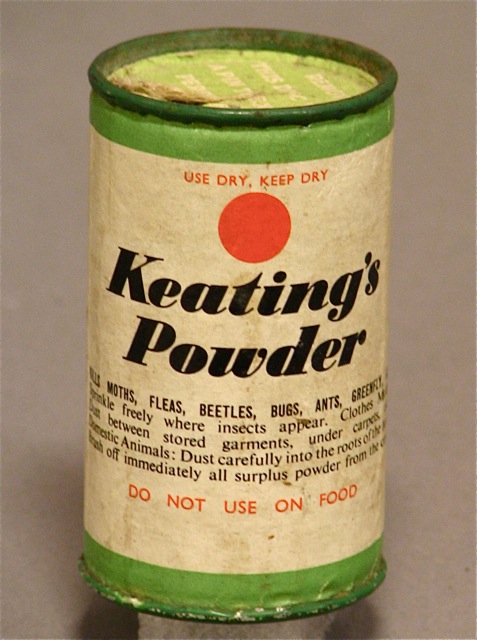
Image result for keating's powder"...it is always wise to travel comfortably, which is an entirely different thing from travelling in luxury.... get a good night's sleep... or even making sure you have a supply of Keating's Powder" 

"I would say that the better informed a man is before he visits a country, the more he will appreciate it; and certainly he will cause less annoyance to the local inhabitants who will not have to answer so many silly questions. I think that most of us could quote instances where fore-knowledge of what one was about to see was very helpful and timesaving..."

Debenham followed this quote by providing an anecdote from his time travelling with Captain Scott.

He was a great fan of sketching, rather than photography.

"It is only when you sketch a thing, be it a mountain or a cathedral or a native hut that you really take in its details and appreciate it fully. To my mind, the artist is the most skilled observer there is, and to observe with care is the duty of every geographer."

It is worth noting that Debenham's name really was put on the map:
Debenham is commemorated in the Antarctic by Debenham Glacier (77°10' S 162°38' E), which flows into the northern part of Wilson Piedmont Glacier, the Debenham Islands (68°8' S 67°7' W), between Millerand Island and the west coast of Graham Land, and by Debenham Peak (67°21' S 50°26' E.) in the Scott Mountains.

A challenge for the readers: which other GA Presidents had landscape features named after them?
Some others appear on this blog, but there may be others...

Debenham was the author of a number of books on the theme of map making, and geography as a discipline. I am going to try to track a few of them down in the next few years. I have a few places to explore to get hold of copies.
I liked this passage from his book on 'Map Making' - which is accessible on the Web Archive site, as are many others of the early Presidents' books.

This is my kind of cartography, taking place on a pub table.

Quote attributed to him here.

Debenham's Ice Pick sold in March 2019 for £22 000.

References
Wikipedia page: https://en.wikipedia.org/wiki/Frank_Debenham

I have edited his Wikipedia page to reflect the fact that he was a President of the GA, as with all Presidents.

Debenham, F. “TRAVEL: Address to the Geographical Association.” Geography, vol. 38, no. 3, 1953, pp. 117–124. JSTOR, JSTOR, www.jstor.org/stable/40564829

Obituary: Steers, J. A. “Obituaries: FRANK DEBENHAM.” Geography, vol. 51, no. 2, 1966, pp. 150–151. JSTOR, www.jstor.org/stable/40566075.

Cambridge University Page: https://www.geog.cam.ac.uk/alumni/earlyyears/

Scott Polar Institute page: https://www.spri.cam.ac.uk/people/debenham/ with some biographic details - they will also presumably have some Archived material relating to his work and associations with the SPRI.

Books published: https://www.abebooks.co.uk/servlet/SearchResults?sts=t&cm_sp=SearchF-_-home-_-Results&an=Frank+Debenham&tn=&kn=&isbn= (ABE Books search)

Image: https://www.davidrumsey.com/luna/servlet/detail/RUMSEY~8~1~247001~5515217:View--Solar-System?sort=Pub_List_No_InitialSort%2CPub_Date%2CPub_List_No%2CSeries_No&qvq=q:space;sort:Pub_List_No_InitialSort%2CPub_Date%2CPub_List_No%2CSeries_No;lc:RUMSEY~8~1&mi=366&trs=470#
Image

As always, if you know more about the work of Frank Debenham while President of the GA, please get in touch.

I'll finish this entry with the final paragraph from Frank Debenham's Presidential Address

"Even though the geographer... has the ability to see more than others on his travels because he has cultivated special faculties for seeing, he will, I hope, remain a normal person. Though his work will give him infinite satisfaction, his keenest pleasure in travel will still come through his senses. 
Travel, to a geographer, should be a richer experience than it is to other people..... 
Bon Voyage, Good Travelling to you all..."

Update December 2019

There was a useful piece mentioning Frank Debenham that I came across in an unpublished thesis called 'A Frozen Field of Dreams'.
He was educated in Sydney, and had connections with the work of James Wordie and Raymond Priestley.

Extract from thesis above by Peder William Chellew Roberts and online here: https://purl.stanford.edu/qh833rs4632 (PDF) - start reading from around p.200 - p.220 contains a lot of information about Debenham's work at the RGS, SPRI and Cambridge University, as their first Professor of Geography.

More here too: https://www.amazon.co.uk/British-Geography-1918-1945-Robert-Steel/dp/0521067715 - I may need to get a copy of this to add some more detail to the early part of the century over time.
This has a lot more information about the work of Frank Debenham

Update June 2020
An excellent film from the East Anglian Film Archive (in 1961) was added to the SPRI Facebook page. It includes a clip with an interview with Frank Debenham - 50 years on from the Terra Nova expedition.


Lovely to hear the voice of a former GA President from almost 70 years ago.

Updated November 2020

Centenary of SPRI was in November 2020

The Scott Polar Research Institute was founded in 1920, in Cambridge, as a memorial to Captain Robert Falcon Scott, RN, and his four companions, who died returning from the South Pole in 1912. When Scott's last words, "For God's sake look after our people" were made known to the British nation, the response was tremendous. Scott himself had emphasised the importance of science and from this plea, the Institute was born.

Polar Museum

Frank Debenham, Geologist on the British Antarctic Expedition 1910-13 (Terra Nova), was the driving force behind the founding of the Scott Polar Research Institute. He wanted to establish a place that brought together polar researchers and resources for the improvement of polar expeditions and scientific investigation. Debenham asked that the new institute perform two roles: it should be a centre of study, preferably as part of a university, and it must also stand alone as a national memorial to Captain R. F. Scott and the men who died with him in the Antarctic. As Debenham and other veterans of the British Antarctic Expedition 1910-13 (Terra Nova) had found themselves in Cambridge writing up their findings, and, as Debenham argued, because Cambridge had 'furnished more polar scientists than all the other English universities put together', a home within the University of Cambridge was the obvious choice.


Source: https://www.spri.cam.ac.uk/centenary/past/

In November 2020, a Grace was granted by the University of Cambridge Senate, formally establishing the new Scott Polar Research Institute.

In its early years, the Institute occupied rooms above the Sedgwick Museum, where Frank Debenham was based as Emeritus Professor of Geography for the University of Cambridge Department of Geography. 


Updated April 2022 - following the GA Conference.

I used a few quotes and images of Professor Frank Debenham in my GA Presidential Address.

I also visited the Scott Polar Research Institute and found this book which I hadn't seen before and which was very useful in giving details of his career, although it doesn't mention his GA Presidency or anything that he did while holding the office.


More to come on this once I've read the book.

Here is the surveying equipment that Deb used in the Antarctic.


Plenty here on the origins of the Scott Polar Research Institute by Isobel Williams - loads of detail and images here.

Updated April 2023

A book that Debenham compiled on his time in the Arctic.


June 2023

Via the Facebook Sir Ernest H Shackleton Appreciation group.
Visit the post - why not join the group if interested.

The book is also available to purchase.


Updated August 2023

A mention in this piece on Cold War travels by Geography:

It references his GA Presidential lecture - which I also quoted from in my own:

Travel in mid-twentieth century British geography was the subject of Frank Debenham's 1952 Presidential Address to the Geographical Association, with travel presented as 
'the essence of geography' (Debenham 1953, 117), though not as 
'mere roaming . . . pleasant as roaming can be' (118). 
The geographer had the urge to 'travel intelligently' (119), and 'the ability to see more than others on his travels because he has cultivated special faculties for seeing' (124). Intelligence did not however preclude field pleasure: 'it is possible to be too earnest about one's purpose in travelling and to forget that one can study a country in its biergartens or at sundowner parties nearly as profitably as at its Department of Statistics' (119).


Margaret Mackintosh RIP

Updated post. Sad news at the end of last week from colleagues who have organised the Charney Conference over the years of the passing of Ma...