Showing posts with label Schools Council Project. Show all posts

Thursday, 5 February 2026

RIP

As you know, we try to mark the passing of significant people in the GA's history on this blog - not all of whom were Presidents of course.

The Spring 2026 edition of the GA Newsletter also contained details of the passing of three people who were very much involved with the GA: Michael Naish, Russell Feaver and Marjorie Woodward.


Images copyright: Geographical Association

Thursday, 29 April 2021

2008: Margaret Roberts, MBE

Updated October 2023

Well, what is there to say about the legend who is teacher educator
Margaret Roberts?

In her time at Sheffield University, she trained many future teachers and I have worked with quite of those, including my current Vice Principal and some other geography legends that I engage with regularly.

The GA has published Margaret's books on geographical enquiry over the years and they have always been in the top sellers of the GA's catalogue. 

In January 2021 Margaret was awarded an MBE in the New Years' Honours List, and this resulted in lots of messages and appreciation of her work over the decades from people who had valued her thoughtful contributions.

At the GTE Conference in January 2021 there was a celebration of her award which I was pleased to be present at.

Emma Rawlings Smith, another of Margaret's students talked about how important Margaret was in her own life.

This tweet by Bob Digby has a number of others as part of the thread that follows:
To hear Margaret at work, you can go onto YouTube, and hear her debating with Michael Young about Powerful Knowledge, for example and her own perspective on his ideas. You will find other elements of Margaret's work online.

Michael spoke first, and Margaret responded - the IoE recorded the session. I was fortunate enough to be in the audience at this event, and remember it well.


As with other former Presidents, Margaret was kind enough to send me some responses to a series of questions that I asked her, and that forms the next part of this entry:

Of her education, Margaret told me: 
"I was born in Cardiff. I went to Lansdowne Road Primary School, Cardiff and Cardiff High School for Girls before transferring to Colston’s Girls’ School, Bristol." This was the school where, shortly after, former President (1975) Sheila Jones began teaching. Sheila was the first female GA President to be teaching when she became President.

Margaret told me:

"My most vivid memories of school were school trips. I went to Windsor Castle when I was 9, my first visit to England, and to Bordeaux and Hanover, to stay with families on school exchanges, when I was 14 and 17. My parents never had a car or went abroad and we never went far, but I longed to travel. It was my interest in places and people that triggered my interest in geography. 

Unlike other past presidents, I was not inspired by my geography teachers. It was my A level biology teacher whose lessons I enjoyed most; she shared her curiosity and sense of wonder in the subject and we did a lot of practical work. I would have studied biology at university but had stopped studying chemistry at the age of 14. I am perhaps an accidental geographer!  In a gap between school and university I worked for three months in an ice-cream parlour in Hanover washing up dishes. Other holiday jobs included working in a guesthouse in Cornwall, a bookshop in Bristol and cleaning public baths in Bristol.

I went to Cambridge University and was a student at New Hall, then newly established (now Murray Edwards College). It had no buildings and in our first year we lived in Darwin’s old house, now Darwin College. There were only sixteen students in each year and the life-long friends I made were studying different subjects: English; natural sciences; history; maths and economics, a broadening experience. As New Hall had no geography tutors, my weekly supervisions were in other colleges: Newnham, Trinity and in my final year, with Gus Caesar in St Catharine’s College. 

Gus has his own entry on the blog, and was mentioned by a number of other St. Catharine's alumni. This places Margaret in a special group of former GA Presidents.

When Gus Caesar died, Ashley Kent and Michael Bradford (who also feature on this blog of course) kindly contacted Margaret so that she could go to his memorial service with them in Cambridge.

Margaret told me that her time at Cambridge studying geography was exciting:

"...with access to the latest research and thinking; Richard Chorley and Peter Haggett were among the lecturers.  I was struck by how cross-curricular geography was, with most lecturers referring to other disciplines: history, geology, climatology, chemistry, physics and economics. What made the biggest impact on me, however, was getting a geography department travel award to do my undergraduate dissertation in Ghana, studying development in a rural area east of Accra. The time I spent getting there on a French boat where my companions were African students from Senegal and Guinea and the time interviewing subsistence farmers, together with short stays in a school and training colleges in other parts of Ghana, transformed my understanding of development and colonialism. I wanted to get back to Africa and did a PCGE so that I could travel. I never did get to work in Africa but married a South African and visited South Africa many times."

Margaret completed her PGCE at the London Institute of Education and, at her request, did her  teaching practice at Kidbrooke comprehensive school whose first headteacher Mary Green had been head at Colston’s Girls’ School. 

Career

  • 1962-1968 Minchenden School, Southgate, London, where I became coordinator of Sixth Form General Studies
  • 1968-1970 Team member of the Nuffield Foundation Resources for Learning Project  
  • 1970-1976 Countesthorpe Upper School and Community College, Leicestershire (part-time): responsibility for A level geography.
  • 1980-1981 City School, Sheffield (part-time)
  • 1982-2006 University of Sheffield, Lecturer, PGCE geography tutor (part-time until 1987)

Margaret told me of her own teaching experience (remember that not every GA President has this):

"At Minchenden School the head of English, Douglas Barnes, took an interest my teaching and, because of interest in Language across the curriculum, got me involved in conferences of the London Association for the Teaching of English (LATE). Douglas encouraged my use of exploratory talk and writing in the classroom. I devised and taught Sixth Form General Studies courses on South Africa, the Press and Current Affairs.  

The Nuffield Foundation Resources for Learning Project was set up to promote more active learning in the classroom, where students could work more independently at their own pace using resources, with guidance. I was responsible for humanities, supported by Michael Armstrong, Deputy Project Director. The theme I was given was ‘the USA’ and I produced resources and guidelines for use by history, geography and RE teachers in comprehensive schools in London and Oxfordshire on: The First Americans; Black America (including extracts from black writers) and A Nation of Immigrants (white America).

Countesthorpe College, Leicestershire, which opened in 1970, was the vision of Tim McMullen, a former Director of the Resources for Learning Project. Four members of the Resources for Learning team got teaching posts there, keen to put into practice what the project had advocated. There was almost no whole class teaching; students learnt mainly through resource-based learning and investigative project work, often done in small groups. Students received a lot of individual attention. It was an exciting school intellectually for both students and teachers.

Margaret took a career break after the birth of her daughter, but spent her time marking CSE and O Level geography papers and did a ceramics diploma evening course (even considering becoming a potter). She also actually retrained as a Maths teacher (after doing A Level maths) as there was a glut of teachers and she wanted to get back into teaching part-time. She told me:

"I must be the only PGCE tutor ever to have done teaching practice (teaching bottom set maths students in Sheffield comprehensive schools) in the year before starting the job."

She may well be right there...

Margaret spent many years at Sheffield University, also home to the GA.

"I worked as PGCE geography tutor and eventually as Director of PGCE, at Sheffield University from 1982 (part time initially) until my retirement in 2006. My course, influenced by the language across the curriculum movement, included pre-Teaching Practice visits to schools to interview individual students about place, to teach planned lessons to small groups and to carry out a simulated public meeting role play, all emphasising the value of listening and talk. There was a lot of discussion and group work in university-based sessions. My ideas on enquiry-based learning, developed during my experiences with the Resources for Learning Project and at Countesthorpe College, were further influenced by the Schools Council geography projects which were used widely in the partner schools. (see separate blog post on the Schools Council project)

My research, using questionnaire surveys and interviews, focused on the geography national curriculum and learning through enquiry.

Margaret's personal geographical education contained at the same time, she told me:

"In my first three jobs, I had been incredibly fortunate to find myself, by chance, working with such brilliant, stimulating teachers, most notably Douglas Barnes, Michael Armstrong and Pat D’Arcy, each of whom developed my educational thinking. But none of these was a geographer. 

So, the Geographical Association was particularly important for me as it gave me the opportunity to meet inspiring geography educators and to become part of the geography education community. I initially felt overawed at meeting, at GA Teacher education conferences, well known authors such as Bill Marsden, Rex Walford and Frances Slater and people involved in Schools Council Projects: Eleanor Rawling, Ashley Kent and Michael Naish. But I found them approachable, supportive and encouraging. I gradually became more involved with the GA and over the years have been on several committees, including Council, Publications, Teacher Education Working Group and a Research group. The GA gave me opportunities to publish chapters in its secondary handbooks, articles in its journals and ‘Learning through Enquiry’ which was based on my PGCE course. So, it was easy to choose my Presidential conference theme ‘Investigating Geography’.


She told me of her own Presidential year:

"I was fortunate during my Presidential year to have the support of David Lambert, then Chief Executive of the GA. He decided to launch ‘a different view’, the GA's impressive Manifesto for Geography, in my conference slot, but having timed my lecture carefully I was worried about how much of my time he would use up! I was delighted that this conference included, for the first time, a slot for research presentations and a special session for PGCE students, an earlier initiative of Michael Bradford’s that I had strongly supported. I think it is important for new teachers, whatever other networks they can now join, to become members of the professional community of geography teachers, the Geographical Association. My PGCE students were expected to do so and encouraged to go to conference. It has given me enormous pleasure to see former students, including Mark Higginbottom, Richard Allaway, Matt Podbury and Emma-Rawlings Smith, giving presentations at GA conferences."


Since my retirement in 2006, in addition to my year as GA President (2008-2009), I have continued to be involved with the GA and with geographical education generally. I coordinated the GA’s Think Piece project; I edited 'Teaching Geography' journal for a while and went on well-organised GA Study Tours to China, South Africa, Mexico and Poland. I chaired COBRIG (Council for British Geography) for six years and organised its small-scale seminars in Sheffield, Perth and Cardiff. I have contributed to CPD sessions for Teach First, Prince's Trust, Eduqas and a MAT. I was on the IGU Commission for Geographical Education British Committee for many years and contributed to its conferences in Helsinki, South Korea, Brisbane, Melbourne, Stellenbosch, Singapore and Lisbon. I have been a member of the Geography Education Research Collective (GERECO).  I continue to write occasional articles and chapters and to contribute to conferences.


My GA publications, notably, ‘Learning through Enquiry’, led to unimagined further opportunities. I was invited to run courses for teachers on ‘Inquiry’ in Singapore in 2011, the Netherlands in 2014 and Hong Kong in 2015. So, although I never did teach abroad, I did get to travel widely in the end. I developed my second book, 'Geography through Enquiry' (now translated into Korean), from the ten courses I ran in Singapore. My unplanned and surprising career would not have developed in the way it has without my involvement in the Geographical Association. Through the GA I have met and shared ideas with so many inspirational people and feel very grateful to have received so much support and encouragement from the GA community."


You need to get yourself a copy of Margaret's book if you haven't already. One belongs in every departmental library.

"What makes a Geography lesson good?" is one of the most useful pieces of advice she has shared - free download from the GA.
Download as a PDF

For more on Margaret's influence, you should listen to her talking to John Lyon for the second of the GA's GeogPod episodes. She talks about her work with Singapore educators, and also a recent contribution to a book on technology and her career as a whole.


Margaret has contributed numerous articles to GA journals as well as her other writing work. 

I also have a memory of chatting to her and the late Doreen Massey while at the University of Derby about a T-shirt I was wearing saying "I am here" and where exactly I may have been...

Doreen, who has her own post as a former Honorary Vice President of the GA later posed in a hoodie for a recreation of one of our 'Mission:Explore' missions: 'Put OAPs in the Hood'.


Images copyright: Bryan Ledgard / Geographical Association - used with permission

When I'm teaching, to this day, I often think to myself of any lesson "What would Margaret say?"

Another former GA President Derek Spooner also provided me with a great story about he and Margaret...

"Another less serious memory: when I was Editor of Geography I used to attend Publications and Communications Committee at HQ at Fulwood Road. These meetings were held on Saturdays and could be rather long and tedious. Margaret Roberts (another President in due course) was also on the Committee. She was a Sheffield Wednesday fan, and the two of us skived off after lunch from one particularly boring meeting to go to Hillsborough to watch Everton v Sheffield Wednesday. Wednesday won 3-1 and the Everton goalie Neville Southall was sent off. Chris Waddle was playing (brilliantly) for Wednesday. The only time I've been to Hillsborough (though I played cricket several times down the road at Bramall Lane!). I remember a few eyebrows were raised when we left the meeting......"

Margaret told me of her MBE award:

It has been quite humbling receiving such messages from people who themselves have done so much to promote geographical education. I feel particularly fortunate to have worked with people in my first few jobs who encouraged me so much and also to have had the support of the Geographical Association and the opportunities it has given me at conferences and in publications. I consider myself a democrat and have always considered the students in the classrooms I have observed. That is what it was about for me - their engagement and involvement - otherwise geographical knowledge was just inert.

I've had the pleasure of spending time chatting to Margaret many times over the years. I also remember a terrifying occasion in a hotel in York when I was leading a session for the GA's 'Living Geography' events and my session on 'Geographical Enquiry' had Margaret in the audience - she was very kind about it. She also asked to check a chapter of a book I was editing to make sure what we were saying was accurate and included real people and not 'talking heads' invented by the authors. Realism and authenticity is vital in textbooks.

References
'Learning through Enquiry' and 'Geography through Enquiry' -  Margaret Roberts - published by the Geographical Association.

Read this PDF : OU Enquiry resource

Margaret contributed a chapter to a recent book edited by Nicola Walshe and Grace Healy on Geography Education in the Digital World. She also mentions that in the GA Podcast with John Lyon.

Any further memories of Margaret would be very welcome. 

If you were trained by Margaret please say hello in a comment or let me have any further memories of your time on the course.

Updated August 2023

Make sure you sign up to hear about the new edition of Margaret's classic book.

The second edition of the popular Geographical Association title Geography Through Enquiry: Approaches to teaching and learning in the secondary school will be published in autumn 2023.

This updated edition draws on Margaret Roberts’ in-depth experience and knowledge of geographical education, with input from a wide range of practising teachers and educators from around the world.

It takes into account the changes that have taken place since the first edition, both educationally and in the wider context:
  • The many new books, articles and national and international projects focused on geographical education.
  • In England, the changes to the inspection framework and standards and requirements for trainee and early career teachers.
  • The sharper focus on issues related to equity, diversity and inclusion and on the continuing impact of the legacy of empire on both the curriculum and the world that geography studies.
  • The increasingly urgent challenges related to climate change and sustainability.
  • The rapid development of digital technologies and the impact of this on the world studied by geographers and ways in which they study it.

NOW AVAILABLE FOR ORDERING.

Wednesday, 2 September 2020

1978: Professor Norman Graves

Last updated January 2025

Norman Graves' name will be known to many for his involvement in the authoring of school textbooks over many years. His other significant contribution was in the development of the IGU.

Norman taught in a number of secondary schools in his career.
He was also involved with the University of Liverpool and latterly the Institute of Education, from where he retired 30 years ago.

He will turn 100 in January 2025. 
There is a comment at the end of the blog post providing details of how you can send Norman best wishes on his birthday.

Norman told me in an e-mail that: "I am conscious that the year of your birth, 1963, was the year I arrived at the Institute of Education to head the Geography Department."

He was also mentioned early on in David Mitchell's PhD thesis:

In 1979 Norman Graves produced a model of ‘curriculum planning’ in geography which places the responsibility for the ‘curriculum problem’ with the teacher. 

‘Essentially a teacher’s curriculum problem should be that of deciding what he is going to try to get his students to learn.’ (Graves, 1979: 1)

Norman attended a seminar at the Institute of Education during my time working for the GA, as part of a seminar series organised by the late Duncan Fuller, which also had inputs from Andrew Bonnett and Michael Young. That was a good day of learning for me.

Here are just a small selection of some of the books that Norman authored during his long career:

Geography in Education;
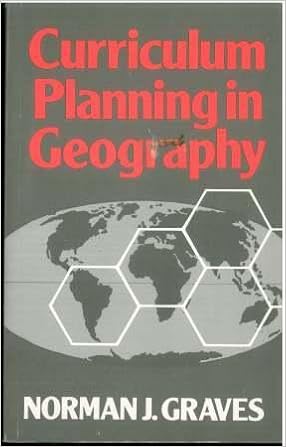
Curriculum Planning in Geography;
Geography in Secondary Schools,
The Education Crisis;
School Textbook Research: the case of geography;
Editor: Teaching Geography 
Series; New Movements in the Study and Teaching of Geography; 
New Unesco Source Book for Geography Teaching;
Initial Teacher Education;
Learner Managed Learning;
Working for a Doctorate;
Education and the Environment.

Norman Graves was GA President at a time when there were some financial issues for the Association. It had a deficit of around £10 000 and efforts were made to try to reduce expenditure to cope with the situation at the time.
https://www.jstor.org/stable/40569009?seq=1#page_scan_tab_contents

I contacted Norman by e-mail in August 2019, and he passed through the following information to me, along with the image which is included at the top of the blog post. The image shows Norman speaking at the 1976 IGU Conference in Leningrad, Russia.

Thanks to Norman for the following information on this entry, which he provided for me. He is the 2nd 'oldest' GA President to be alive, (and also the oldest as it happens I believe) and therefore able to offer me his own personal perspectives, following Sheila Jones' memories from her time as President in 1975 in an earlier blog post.

Norman was born in Sainte Adresse, Seine Inférieure (now Maritime), France, and lived there briefly before moving to the UK.

Education:
Ecole Communale de Garçons de Sainte Adresse,1931-35
London: Finsbury Park Junior School, 1935-36;
Tollington Park Central School, 1936-38;
Highbury County Secondary School, 1938-41;
The Polytechnic, Regent Street 1945-46 (part-time);
The London School of Economics and Political Science, 1946-49 (2 years part-time, 1 year full-time) - the LSE links with the GA are very strong
The University of London Institute of Education, 1949-50 (full-time). Subsequently, part-time study for higher degrees, 1952-63.

Employment
Norman started working life in 1941as a "Youth in Training" in the Post Office Engineering Department, then as a Technical Officer in the Engineer in Chief's Circuit Laboratory until 1948.

Teacher of Geography and Economics at East Ham Grammar School for Boys, 1950-54; responsible for Geography at Borough Beaufoy Secondary Technical School in Lambeth, 1954-58; Head of Geography and housemaster at Malory Secondary Comprehensive School in Lewisham,

Good to see another GA President who had spent time as a teacher of geography.

1958-60: Lecturer in Education at Department of Education University of Liverpool 

1961-63: Senior Lecturer in Education

1963-74: Reader in Education at the Institute of Education.

In an e-mail communication, Norman told me that he
1974-78: Professor of Education
1978-80: Robert Ogilvie Professor of Geography Education
1980-90: Pro-Director Professional Studies

When he became GA President he was working as Professor of Education at the IOE (UCL)


Norman told me:
"I entitled my Presidential Address "Contrasts and contradictions in Geographical Education". In the 1970s, I expressed the tensions which existed between the scientific nomothetic approach manifest in the then conceptual revolution, and the ideographic and humanistic approach epitomised in Yi Fu Tuan's book 'Topophilia'. "

He also said:
"Contradictions were evident in the attitudes of teachers who had difficulty in reconciling the instrumental aims of education, for example, coaching students to pass examinations, and the intrinsic mind-opening aims of guiding students to question the validity of certain theories, for example the Davisian view of landscape evolution."

This is an ongoing issue for many - dealing with the question of "is this on the test?" and making time for those additional discussions and criticality which helps build geographical thinking.

Norman told me: "I joined the GA as a student and maintained my membership throughout my career. I found it useful to read its publications and attend its meetings and Annual Conferences where I could discuss with other teachers our teaching problems."

Here's Norman's Curriculum Planning Model, which has stood the test of time as far as I can see.


Here's a publication that Norman produced for the GA during this period.
Of his association with the GA Norman said:

"The GA was a professional association of geography teachers whose meetings and publications provided me with in service development, which at that time was not provided by my first employers. I subsequently participated in the "training college" section and contributed occasional lectures, but my main contributions were to the GA's publications. For example: articles in" Geography"; A Tropical Peasant Holding in Ceylon in Asian Sample Studies (169); Geography in Secondary Education (1971); Geography in Education: a Bibliography of British Sources (with Clare Lukehurst, 1972); Geographical Education in Secondary Schools (1980); I also edited the series "Teaching Geography" (1968-72)."

Norman told me of his wider work in the field of Geographical Education which included his chairmanship of the Commission on Geographical Education of the International Geographical Union, his membership of the Schools Council Geography Committee and its Geography 16-19 Project led by his colleague, Michael Naish. 

A report on the work of the Commission on Geographical Education was written by Norman as Chairman and published in 'Geography' in 1980


Graves, N. (1980). THE COMMISSION ON GEOGRAPHICAL EDUCATION. Geography, 65(3), 230-231. Retrieved August 26, 2020, from http://www.jstor.org/stable/40569278
He also recalls being asked to lecture to various GA local branches in Oxford, Bristol and Leicester, and attending the Scottish Geography Teachers Association conference in Edinburgh - something I've done many times myself, and now with a reciprocal arrangement with the SAGT for our conferences.

He also sent some memories recently about his links with the previous GA President Stan Gregory:

Stan Gregory and I were students in the Joint School of Geography which was then shared by Kings College and the LSE, though he did a straight Geography degree while I did a BSc (Econ) which actually included a course in statistics which proved useful during the quantitative revolution. 
Our paths crossed again in Liverpool when I joined the Education Department, while he was in the Geography Department headed by Professor Steele at that time.

Along with Michael Naish, he wrote an important publication for the GA called 'Profiling in Geography', which was published in 1986.

Norman was awarded the RGS's Victoria Medal in 1993.

A picture of Norman Graves still hangs in the office at UCL which is used currently by Alex Standish, previously used by David Lambert and John Morgan. Alex kindly took a photo of it for me some time ago and shared it with me for use on the blog.


And here's the book that perhaps will be most well known to many of a particular age: the classic textbook that was used in schools and which was part of my own 'A' level studies. This is my own personal copy which is part of my growing library of textbooks which I have been collecting as part of this project.


References
Norman Graves (2008) Reflections on a Life in Geographical Education, International Research in Geographical and Environmental Education, 17:1, 1-5, DOI: 10.2167/irgeeed171.0

https://www.ucl-ioe-press.com/books/history-of-education/school-textbook-research/

https://link.springer.com/article/10.1007/BF02736948

REF: https://impact.ref.ac.uk/casestudies/CaseStudy.aspx?Id=44328 - mentions how the APG that I worked on, and the work of David Lambert built on Norman's work:

It develops Norman Graves's innovative work at the IOE in the 1970s and 1980s on the theory and application of `rational curriculum planning' in school geography.

Also a mention from Brian Hobbs: https://www.asdan.org.uk/blog/2013/02/19/a-geog-down-memory-lane as part of the GA's work to create an ASDAN course.

IGU:
http://www.igu-cge.org/wp-content/uploads/2018/02/The-IGU-Commission-on-Geog-Education-modified-0915.pdf

GRAVES, N. (1978). Changes in Attitude towards the Training of Teachers of Geography. Geography, 63(2), 75-84. Retrieved August 25, 2020, from http://www.jstor.org/stable/40568886
Non-GA book publications may be grouped into three groups: 
1 Text books: 
North America and Asia 1966 (with R C Honeybone), Geography of The British Isles 1971 (with John White), People and Environment 1987 (with John Lidstone and Michael Naish) 
2 Academic books on geographical education: 
eg Geography in Education (1975), Curriculum Planning in Geography (1979), School Textbook Research: The case of geography (2001); New Movements in the Study and Teaching of Geography (Editor, 1972); New Unesco Source book for Geography Teaching (Editor 1982) 
3 Academic books on education: 
eg The Education Crisis: Which way now, (1988); Initial Teacher Education: policies and progress (Editor 1990); Working for a Doctorate (Editor 1997); Education and Environment (Editor 1998)

Image: top image supplied by Norman Graves, office photo by Alex Standish, textbook image by Alan Parkinson

Please pass through any other memories of Norman Graves influence on your own practice.

Update September 2020
Norman kindly sent me a range of items to help this (and other) posts, including a copy of his article Reflexions on his career and on geography education, which was published in IRGEE journal in 2008. It contains further thoughts which has its own blog post in October 2020.

Additional details added in November 2020.

Simon Catling sent me the following memory:

"I have enjoyed reading your blog on Norman Graves, the inspiration for many of us. When I did my MA in geography education at the Institute in 1971-3 (the 3rd or 4th year it ran, I think) I was one of a group of 4 students. We had superb seminars where one of us would read our essay for that week (we wrote 24 essays over the 3 terms of the year, weekly) and then it would be debated. Alongside Norman, Molly Long, Bertie Roberson and Michael Naish were our tutors. It was a fascinating, invigorating, rigorous and very informative first year of the MA. Mick Naish supervised my MA thesis. I think that was, part-time on a Monday late afternoon, an invaluable course for my geographical education. The reading, thinking and writing was a very real education, demanding but just right.

While a young primary teacher I did two week long courses which were influential. In early 1975 I did a Place, time and Society 8-13 course run by Ray Derricot, Hazel Sumner and Gordon Elliot at an ILEA centre. In early 1978 I did an environmental course at Avery Hill College in Eltham, run by Colin Ward. Both were influential in my thinking. 

Gordon Elliott introduced me to a producer at the BBC which led from the autumn of 1975 to me being an adviser, alongside Michael Storm (who had just become the geography adviser in the ILEA), to a new series of primary geography programmes."

Check out Michael Storm's entry on the blog as well.

Updated July 2022

I prepared a paper for the IGU 2022 in Paris - the centenary event and was invited to chair a session. A link back to the work of Norman.

Archive material is also available apparently at the IoE - I wonder whether I might be able to get access to this material in the new academic year.


It includes handwritten notes by Elisie Beaver (the wife of Stanley?) and also mention of James Fairgrieve and also Robert Ogilvie Buchanan in these papers. They include handwritten notes on lectures related to curriculum development.

Updated August 2023

A family photo on Facebook showed Norman is still around and enjoying another French summer with family. Good news.

Updated January 2024

Again via Facebook, January 28th was Norman's 99th birthday. The oldest living GA President. Coincidentally I started a presentation at the Geography Teacher Educators' Conference with a messsage Norman sent me when I started writing this blog.

Margaret Mackintosh RIP

Updated post. Sad news at the end of last week from colleagues who have organised the Charney Conference over the years of the passing of Ma...