Last updated July 2023
Hugh Robert Mill was a Scottish Geographer and meteorologist, and a very important figure in the history of the GA and the RGS, as well as a Polar historian.
He was born in Thurso in Caithness, and educated in Edinburgh.
Follow this link to see an image
As with other
Presidents of the GA, there is a strong connection with other organisations, notably the
RGS, where he was Librarian from 1892. At this time, the RGS was based at 1, Savile Row in London.
There was also a strong
exploration link as well, as with several other GA Presidents.
He was particularly linked with the
Royal Scottish Geographical Society as well, when it was founded in 1885. This brought him into contact with all the main travellers of the day, as Mill was particularly involved with the RSGS throughout this time.
He held the post of secretary to the Royal Geographical Society during the Society's involvement with the leading British Antarctic expeditions of the late 19th and early 20th centuries.
He was a friend and confidant to Scott, Shackleton, and especially to William Speirs Bruce, who led the Scottish National Antarctic Expedition, 1902–04 (Wikipedia entry)
Early in the century he also became President of the
British Rainfall Association. That's an Association I could get behind.
He published a very useful compilation called
'Hints to Teachers of Geography on the Choice of Books for Research and Reading' in 1897. He actually gave copyright of this book to the GA, which started off the GA's publishing work.
This can be
read on this Internet Archive entry along with other of Hugh Robert Mill's books.
Here's a spicy little entry.


In 1921, he gave the Herbertson Memorial Lecture to the Manchester Branch of the GA. I have also had that privilege - in 2008. His was on the Value of Regional Geography.

Herbertson himself (see my
earlier blog post on Herbertson in 1915) was grateful for Mill's help with his own work on the Oxford OS Sheet which formed part of his courses. He used the approach that Mill had used on his own local area of SW Sussex, which was the first to do an in-depth study of an OS sheet "from the viewpoint of the teachers' requirements".
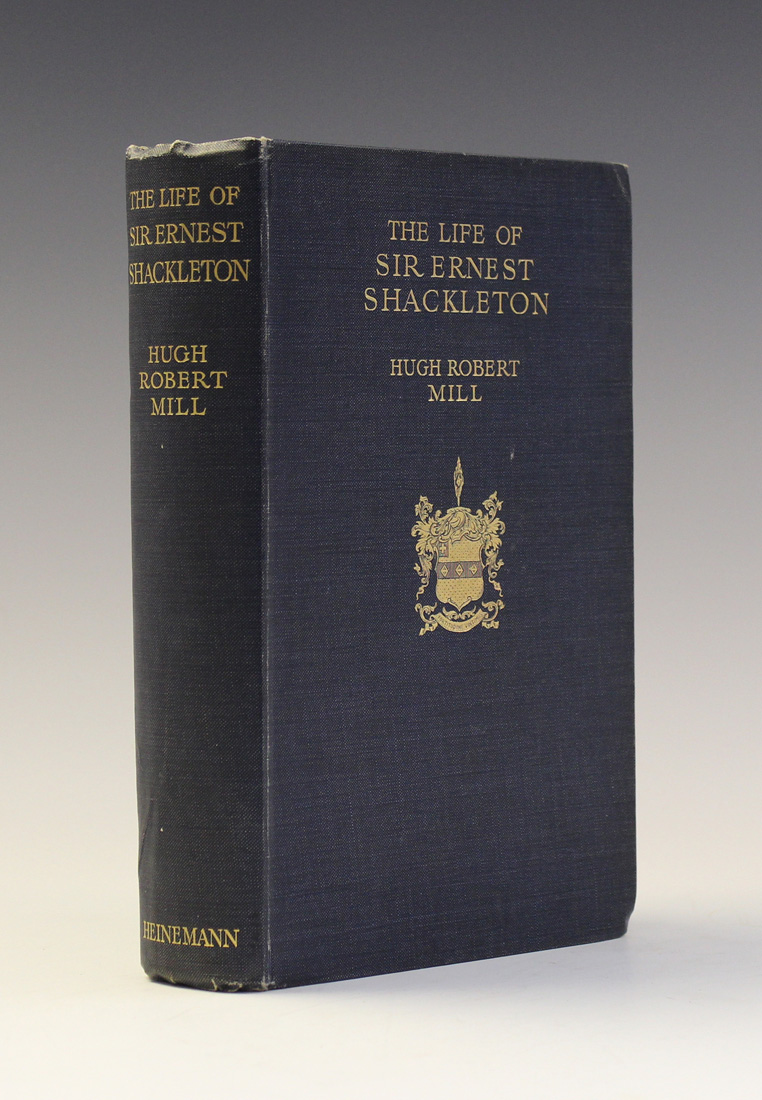
In 1923 he produced the first full-length biography of
Sir Ernest Shackleton, a noted explorer and who was also connected with the RSGS. If you can find a copy be prepared to pay around £500. He wrote this with the assistance of Shackleton's widow.
He also wrote the introduction to Shackleton's book "The Heart of the Antarctic' about the 1907-9 expedition.
In his
Presidential Address, he started with a nice image of the significance of geography.
The Address was called
"An Approach to Geography", and he described geography as being like a picture of the world in the opening lines.

In 1934,
Hugh Robert Mill gave another address to conference which is well worth reading. This time he had a focus on Scotland.
He was also connected with Imperial College.
He also had a connection with Antarctica, and the SPRI.

 He has a glacier named after him in Antarctica
, a branch of the
Beardmore Glacier.
Frank Debenham, who we will meet in several decades time, also had some land named after him in Antarctica.
His likeness is also shown on a medal which is awarded by the Royal Meteorological Society for research into rainfall.
Mill died in 1950, in his 89th year: another GA president to live to an old age. I hope he set a precedent for future Presidents.
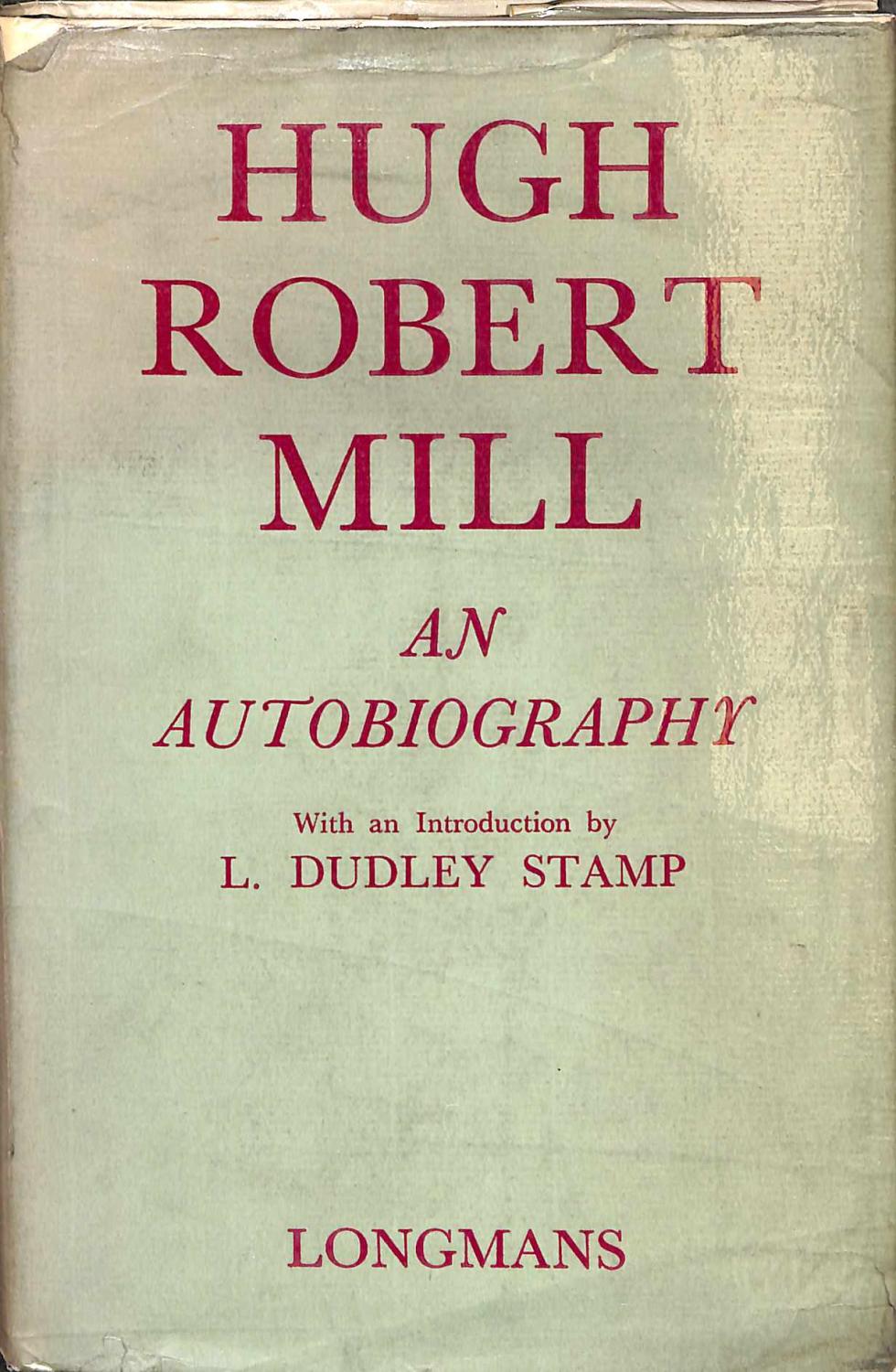
He also published his autobiography, which would be worth obtaining to find out even more about his time at the GA.
There is apparently a copy in the Fleure collection that he donated to the GA.
He also left a legacy to the GA, which helped ensure its financial stability at a crucial time.
When he died, Balchin reminds us, he had been associated with the GA from the start - over 50 years of service to the Association.
References
Wikipedia:
https://en.wikipedia.org/wiki/Hugh_Robert_Mill - shared under CC license and extracts used on this page.
Edited to add the GA Presidency role.
MILL, HUGH ROBERT. “ADDRESS TO THE GEOGRAPHICAL ASSOCIATION.” Geography, vol. 18, no. 1, 1933, pp. 1–16. JSTOR,
www.jstor.org/stable/40560362.
Internet Archive searches. http://www.archive.org
Archibald Geikie:
https://babel.hathitrust.org/cgi/pt?id=umn.31951000910377x;view=1up;seq=7
Obituary: Brown, R. N. Rudmose, and H. J. Fleure. “OBITUARY: Hugh Robert Mill.” Geography, vol. 35, no. 2, 1950, pp. 124–127. JSTOR,
www.jstor.org/stable/40563009
From the above:

Mill, Hugh Robert. “The Value of Regional Geography.” The Geographical Teacher, vol. 11, no. 2, 1921, pp. 7–19. JSTOR,
www.jstor.org/stable/40555902
Please get in touch if you have anything further to add.
Updated October 2019
While investigating some resources for the entry on a later president, Percy Maude Roxby, I came across a chronology of Geography in the 20th century written by G. R. Crone, at the time the librarian of the RGS, and it had an image of Hugh Robert Mill as shown below.... a fine moustache - perhaps I need to grow one for my Presidential year...
The article also outlines how Mill wrote the entry on Geography for the 11th edition of the Encyclopaedia Brittanica, which means that he could provide his own thoughts on what the subject actually was...
Source of image:
Crone, G. R. “British Geography in the Twentieth Century.” The Geographical Journal, vol. 130, no. 2, 1964, pp. 197–220. JSTOR,
www.jstor.org/stable/1794582. - available to read with a free JSTOR account.
Mill wrote an autobiography which was called
'The Life Interests of a Geography - an experiment in Autobiography'.
This was published privately by friends in the USA. A copy was presented to the Association - I tracked it down in the archive. A signed copy.
Details of this are provided in an article by another former GA
President T C Warrington. Update: I found some letters related to this in the GA archive.

It seems his final years were one of reflecting on what he had achieved against a variety of challenges.

Warrington, T. C. “THE AUTOBIOGRAPHY OF HUGH ROBERT MILL.” Geography, vol. 32, no. 4, 1947, pp. 166–168. JSTOR, www.jstor.org/stable/40562610.
Not only was he a connection right back to the early days of the GA, when he died in 1950, he also left what is described by another future President: Alice Garnett as a bequest made from Mill's will which helped reduced anxiety about rising costs, and staff salaries
Source: Garnett, Alice. “GEOGRAPHICAL ASSOCIATION.” Geography, vol. 36, no. 1, 1951, pp. 57–62. JSTOR, www.jstor.org/stable/40563090.
JSTOR articles:
https://www.jstor.org/action/doBasicSearch?Query=hugh+robert+mill&filter=

Mill, Hugh Robert. “Proposed Geographical Description of the British Islands Based on the Ordnance Survey.” The Geographical Journal, vol. 7, no. 4, 1896, pp. 345–356. JSTOR,
www.jstor.org/stable/1773547
and discussion afterwards
Wilson, Charles, et al. “Proposed Geographical Description of the British Islands Based on the Ordnance Survey: Discussion.” The Geographical Journal, vol. 7, no. 4, 1896, pp. 356–365. JSTOR, www.jstor.org/stable/1773548.

Updated November 2019
https://books.google.co.uk/books?id=N81mDwAAQBAJ&lpg=PT67&ots=RtCfAEEQvA&dq=charles%20close%20OS%20geographer&pg=PT79#v=onepage&q=charles%20close%20OS%20geographer&f=false
 Updated December 2019
I found another reference to his autobiography while researching
Frank Debenham
H.R. Mill, Life interests of a geographer 1861-1944: an experiment in autobiography, self-issued 1946, 122.
In print Mill felt compelled to refute media characterizations of the expedition as an
“advertising stunt” as “quite unjust” – although the presence of two Boy Scouts on its crew – chosen
from a nationwide competition in cooperation with the tabloid Daily Mail – might truly be described as
one aspect of the expedition that was ahead of its time.
Mill, The life of Sir Ernest Shackleton (London:
Heinemann, 1923), 271. The competition to attract the Scouts is described in Frank Wild and Alexander
H. Macklin, Shackleton’s last voyage: the story of the Quest (New York: Frederick A. Stokes, 1923),
14-15

In it, he described Shackleton's last voyage to the Antarctic.
ABE BOOKS has a wide range of books written by Mill. He seems to have been prolific
https://www.abebooks.co.uk/servlet/SearchResults?an=hugh%20robert%20mill&cm_sp=det-_-bdp-_-author
Mill and Debenham seem to be tied up in a number of things connected with the SPRI.
The thesis by Peder William Chellew Roberts in 2010 features a number of references to Mill.
A book by Charles Withers quotes Mill's memories of his childhood, which perhaps shows an early interest in Geography.
https://books.google.co.uk/books?id=DGRrF0CV8BYC&lpg=PA194&ots=ALTTdk_XQs&dq=Life%20interests%20of%20a%20geographer%201861-1944%3A&pg=PA194#v=onepage&q=Life%20interests%20of%20a%20geographer%201861-1944:&f=false
 New image
Updated April 2021
A book that I came across...
Last updated August 2021
I found a copy of a self-published autobiography in the archive of the GA which had lots of interesting snippets on Shackleton, the 'Titanic' and his time at the RGS, including how he funded the payment for the statue of Shackleton that sits outside the RGS.
https://victorianweb.org/sculpture/jagger/1.html
Last updated August 2022
I discovered a bath of letters which had been written to 'Mill' as he seems to have been referred to in most of the letters from the great and the good of the GA. These were passed to the GA in 2000 and now reside in the archive. There are pictures of quite a few of them in this Flickr album.
There are quite a few from the time that he was asked to be the GA President for 1932 and he seems to have been quite reluctant at first.
This letter from B B Dickinson sent in 1931 expresses his thanks when Mill finally said that he would take the role on.
And here's one from Fleure in May 1931 asking him to come and talk about his proposed Presidential theme and mentioning some of the people who had been invited and others who couldn't make it.
One was Professor Gerhard Schott who it turns out was a renowned German oceanographer.
Also a famous geologist Percy Fry Kendall.
Apparently Sir Wilfred Grenfell was out of the country - probably in Newfoundland.
A prolific letter writer and who travelled a great deal it seems.
Mill was GA President 90 years before my own tenure.
Updated April 2023
Some more detail on Mill in this post on the Facebook group I am a member of called 'Sir Ernest H Shackleton Appreciation Society'. Mill has featured a number of times in fact.
Updated July 2023
The RMetS Award named after Hugh Robert Mill was awarded to Ed Hawkins this year, originator of the important Climate Stripes.