Showing posts with label "New geography". Show all posts

Saturday, 10 October 2020

W Vincent Tidswell - PGCE tutor

Updated September 2023

Vincent Tidswell was never a GA President, but he gave a great deal to the Association, and wrote many articles for the GA journals.

He has been referenced in a range of articles that I've read while researching Presidents, and there's a personal reason for adding Vincent to the blog as well. My blog, my rules after all.

Vincent was a geography teacher before moving into teacher education, and was Head of Geography at the King's School, Peterborough, which I had the pleasure of visiting several times during my time working with the Geographical Association. After his teaching career, he moved into higher education and teacher education.

He was my tutor when I completed my PGCE at the University of Hull between 1986 and 1987. He interviewed me and gave me a place on the PGCE course, and was the person who visited me during my first time in the classroom - at both Primary and Secondary school level.


Here's a picture I took a few years ago of the house where we had our PGCE meetings.
The room to the left of the door was Vincent's office, where I had my interview for PGCE. I had already been turned down by Bath and Coventry, and Hull was one of my options, and Vincent took a punt on me as a teacher.
Vincent I remember wasn't convinced I had what it takes to be a teacher, as I was perhaps a little quiet and self-effacing. I still am of course.

Following my PGCE, I had many interviews, and spent some time doing supply in Rotherham, before getting a first job at John Flamsteed School in Denby, Derbyshire. I shall be talking about my journey during my Presidential lecture of course.

Canon Pyon Farm will be familiar to many from the Herefordshire Farm Game that Vincent developed.
This was a regular part of my teaching for many years, and the students enjoyed the use of games. He also wrote a series of books which grew from the quantitative revolution a little, but were always concerned with the way that geography was changing, and to help teachers upskill themselves to prepare for these changes.

In 1990, Vincent had a piece published in 'Geography' called 'Capes, Concepts and Conscience: Continuity in the Curriculum", which still has a lot of useful things to say.
In the article, he talks about the changing nature of the geography curriculum, but shows that some ideas have persisted through all the changes. He went back to the idea of subject knowledge, and it is a piece worth re-reading thirty years on.

He also worked with Chris Kington, a former GA President.

I was sad to hear of Vincent's death some years after qualifying as a teacher and starting my professional journey. He hadn't been the best of health in that year when I qualified, and retired at the end of that year.
His obituary was published in 'Teaching Geography' and written by Brian Fitzgerald, one of the people he worked closely with.


Source:
FitzGerald, Brian P. “Obituary: Vincent Tidswell 1930-1997.” Teaching Geography, vol. 22, no. 4, 1997, pp. 195–195. JSTOR, www.jstor.org/stable/23755758. Accessed 22 Jan. 2021.

I've also been delighted over the years to have been invited back to work with the new generations of PGCE colleagues at Hull University, and to talk about the legacy of my time there, and some further ideas. I call my session "I've been to Hull and back" - thanks to Justin Woolliscroft for the invitations over the years.

References

Tidswell, V.W and Barker, S.M: "Quantitative Methods: An approach to Socio-Economic Geography" (University of London Press, 1971)

TIDSWELL, W. V. “Agricultural Land Use and the Local Environment.” Geography, vol. 58, no. 4, 1973, pp. 343–350. JSTOR, www.jstor.org/stable/40568166.

Tidswell, Vincent. “Capes, Concepts and Conscience: Continuity in the Curriculum.” Geography, vol. 75, no. 4, 1990, pp. 302–312. JSTOR, www.jstor.org/stable/40571878.

FitzGerald, Brian P. “Obituary: Vincent Tidswell 1930-1997.” Teaching Geography, vol. 22, no. 4, 1997, pp. 195–195. JSTOR, www.jstor.org/stable/23755758.

Tidswell, Vincent. “An Exercise from the Atlas of Nebraska.” Teaching Geography, vol. 6, no. 2, 1980, pp. 82–82. JSTOR, www.jstor.org/stable/23752276.

If anyone has any other memories of Vincent's time supporting the GA, or any images, I would be very pleased to have them.

I was very interested to hear of a strong connection with another President.
I went to see Chris Kington to talk about his own Presidential year, and he said that he had Vincent's archive in his loft...

Also check the earlier updates on what Justin Woolliscroft was doing to try to find out more about Vincent in March 2020.

Update

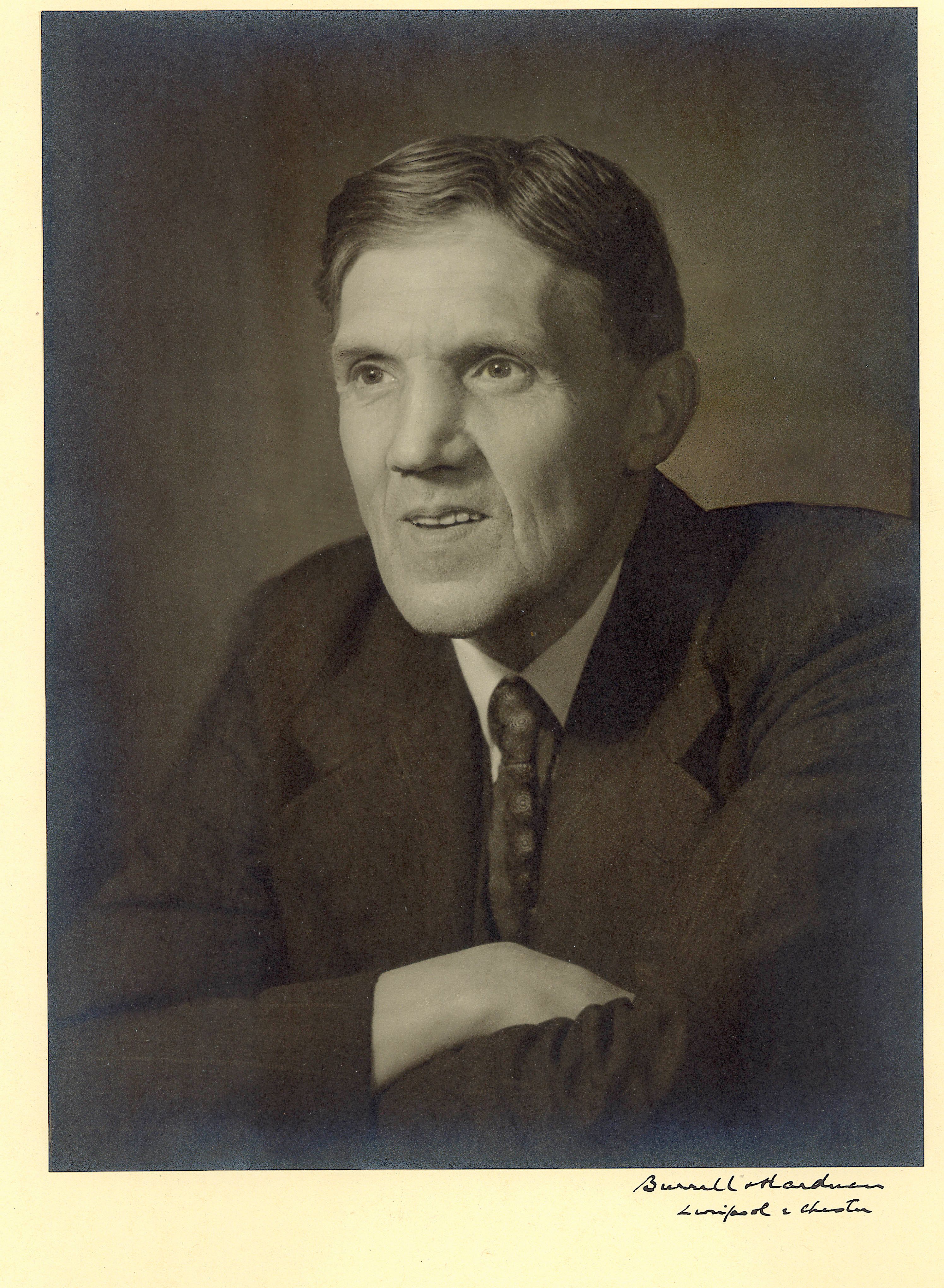
The image that I have now added to the top of the post was sent to me by former President Sheila Jones in October 2020, as part of a pile of images taken in 1993. Lovely to have an image... Keep the memories coming.

Update 2021

Thanks to Ashley Kent, GA President for 2006 for sending me some memories of Vincent as part of his own blog post. He was a great friend of Derek Spooner, who I guess I must have seen at the time I was training.
He told me:

Vincent I knew through his work and the ‘new’ geography ....his Pattern and Process in Human Geography was followed by Keith Hilton’s Process and Pattern in Physical Geography. 
Keith was a colleague of mine at the Institute of Education....and knew Vincent through working at Hereford College of Education. 
Vincent also had links with Brian Fitzgerald who I met at St Dunstans College. 

That was for me as a keen young man/geographer....a really exciting time...we felt very much at the frontier of the ‘new’ geography, both new in terms of content and pedagogy. 

Oxford Geography Project was really at the leading edge....as were the Schools Council Projects....GYSL and 14-18 ...and the one I was very much part of...the 16-19 Project. 

People like Brian, Rex et al were at the forefront....it was great fun being part of it! 
The first book Mike and I wrote was a direct effort to help teachers to keep up to date with the ‘new’ geography then in several school and university syllabuses. 
Of course Mike and I were helped by being a part of Cambridge and US developments....we went to Madison Wisconsin after Cambridge...where a great deal of that stuff was going on.

Exciting times, and Vincent was very much part of that. I like to think he passed on a little of that love for exciting new approaches and pedagogies to his trainees, of which I am proud to have been one.

Update February 2021

Vincent was mentioned in the Presidential Address of Chris Kington, described as "a teacher trainer who had published one title which had barely troubled the scorers". He convinced Chris to publish "Pattern and Process in Human Geography" based on the work of Haggett and Chorley. It took a while to create apparently but has proved influential.

Updated September 2023
Thanks to Brendan Conway.


In the mid 70s, Vincent served on the GA's Standing Committee on the role of Models and Quantitative Techniques. Sheila Jones also served on the committee. Also Everson and Fitzgerald there, who wrote a very popular 'A' level text that I certainly used. Rex Walford was also on that committee.

This was chaired by Richard Daugherty.


Updated April 2025

Thanks to Brendan again for sharing an image from one of Vincent's books which prompted Andy Day to share a memory of Vincent - a neighbour in Cherry Burton near Beverley - on the road from Hull to York and one I've driven many times.


Thursday, 23 April 2020

1964: Crone's article on Geography in the 20th Century

In 1964, the librarian of the RGS, G R Crone wrote a chronology of geography in the 20th Century with some excellent details on the development of the subject, and prominent mentions for quite a few former GA Presidents.


There are references to many GA Presidents and their contributions, including Herbertson and Mill, Steers, Stamp and Roxby.
Also some familiar diagrams on the development of the region, and some images of people from the time.
Well worth a read.

References

Crone, G. R. “British Geography in the Twentieth Century.” The Geographical Journal, vol. 130, no. 2, 1964, pp. 197–220. JSTOR, www.jstor.org/stable/1794582.

Monday, 2 September 2019

1933: Professor Percy Maude Roxby

Image result for percy maude roxbyLast updated June 2024


Percy Maude Roxby was  an academic geographer connected with the University of Liverpool, and an expert on the geography of China.

He was born in 1880, and educated in History at Oxford University, but was appointed as lecturer in Regional Geography at the University of Liverpool in 1906.

He was one of the many people who were influenced by, and responded to, the work and teachings of A. J. Herbertson, who has featured previously on the blog.

He wrote a paper called "What is a natural region" in response to Herbertson's work and set out ideas for organising how geography could be taught in secondary schools. This connection with school geography has been an important part of many GA President's roles and legacies, and Roxby was particularly important in this regard.

He was also involved with the GA for a considerable period of time before being President, and so became one of the group of GA Presidents who were being 'rewarded' for their service to the Association during this period in its history.

The honours school of Geography at the University was formally approved in 1917-18, when Percy Maude Roxby was appointed as the first named chair of Geography in the British Isles.

Roxby visited China several times and wrote a book on the country as well, at a time when relatively little was known about the country. This is one of his great contributions to the work of the GA.

He traveled extensively in China, and both studied and wrote about Chinese geography. This was his particular passion.
Meanwhile, he promoted mutual understanding between China and Britain through geography. He also supervised the Department of Geography at Liverpool University and trained Chinese geographers. 
Overall, Percy Maude Roxby played a significant role in Chinese geography including his own research, the internationalization of Chinese geography, and cultivation of Chinese scholars, all of which should be included in the history of modern Chinese geography.
This becomes even more significant now, given the growing power of China on the world stage.

He wrote a whole series of articles for GA journals. His Presidential Address was on the theme of China as an Entity, compared with Europe, as one would have expected.


Roxby died in 1947, and a prize in his name was introduced at the University of Liverpool after his death. This was to pay for a geographer to travel - something Roxby was a big promoter of.

His name was also connected with another, later President, who will have his own entry in due course.

Dick Lawton was inspired by lectures from Roxby to pursue his own geographical career at the University of Liverpool and become involved with the GA in due course.

He was also mentioned by another GA President, Roger Carter in his Presidential address:

"I came across the details of the Staffordshire Geographical Exhibition of 1934. The Exhibition gave rise to an account, edited by Jasper H. Stembridge. Here is an extract from Stembridge's account:

 'The Staffordshire Geographical Exhibition proved that the popular press and the general public are deeply interested in education. On the second day the Exhibition was thronged. On the third and subsequent days it was so crowded in the afternoons and evenings that it was often difficult to make one's way round the rooms. Owing to requests received from all parts of the country it was decided to keep it open for a further three days' (Stembridge, 1934, p. 12). 

 The then President of the GA, Professor PM. Roxby, was equally enthusiastic about the event: 

'Here was the new geography - pulsating with life - presented with a freshness of outlook, but with a deep conviction of the importance of the subject and its underlying principles' (Roxby quoted in Stembridge, 1934, p. 13).

References

No Wikipedia entry exists. Perhaps one needs to be written.

There is an archive of his lectures and notes held at the University of Liverpool.
https://discovery.nationalarchives.gov.uk/details/c/F58505
https://www.liverpool.ac.uk/geography-and-planning/about/
https://www.nature.com/articles/159462a0
Lei ZHANG. Percy Maude Roxby and Chinese geography[J].Acta Geographica Sinica, 2015, 70(10): 1686-1693.
Available in Chinese it seems... anyone able to translate?


In May 2017, his centenary was announced in a Tweet from the Liverpool University account, including his portrait.
Roxby, Percy Maude. “CHINA AS AN ENTITY: THE COMPARISON WITH EUROPE. ADDRESS TO THE GEOGRAPHICAL ASSOCIATION.” Geography, vol. 19, no. 1, 1934, pp. 1–20. JSTOR, www.jstor.org/stable/40558758.

https://www.jstor.org/stable/40563887?seq=1#page_scan_tab_contents - details of Roxby Prize

Liverpool University Facebook page: https://d.facebook.com/livunigeog/photos/a.579114048787869/1640924519273478/?type=3&__tn__=EH-R

A prize winning essay from 1902 while studying at Christchurch, Oxford: https://archive.org/details/henrygrattanbein00roxb/page/n10

As always, if anyone knows anything more about Percy Maude Roxby, or has a contribution to make to the blog, please get in touch... 

Major update October 2019
Quite a lot of additional detail on Roxby and his work is included in an article by Professor H C Darby, who was also a Professor at Liverpool University. He talks first about the time following the First World War.


I like the idea of Roxby's long cycling tours, particularly in East Anglia and like to think that I have travelled along the same routes as Roxby. He wrote a chapter in a volume on Great Britain.
When searching for this book, I found this biographical reference in another book.


This told me the book was called 'Great Britain' and edited by A. Ogilvie (1928) and that he also contributed chapters to other publications. such as 'The Geographer's Craft'.

H C Darby then talked about the time when he succeeded Roxby at Liverpool University.


I also found an obituary of Roxby, which I hadn't found previously, written by H J Fleure.


References
Darby, H. C. “Academic Geography in Britain: 1918-1946.” Transactions of the Institute of British Geographers, vol. 8, no. 1, 1983, pp. 14–26. JSTOR, www.jstor.org/stable/622271.


https://archive.org/details/henrygrattanbein00roxb/page/n10 - prize-winning essay

https://archive.org/details/chinaproper0002grea/page/n425 - China manual for naval intelligence - showing his great knowledge of the city

Crone, G. R. “British Geography in the Twentieth Century.” The Geographical Journal, vol. 130, no. 2, 1964, pp. 197–220. JSTOR, www.jstor.org/stable/1794582.

Fleure, H. J. “OBITUARY: PROFESSOR P. M. ROXBY.” Geography, vol. 32, no. 1, 1947, pp. 36–36. JSTOR, www.jstor.org/stable/40562545.

CARTER, ROGER. “Connecting Geography: An Agenda for Action.” Geography, vol. 84, no. 4, 1999, pp. 289–297. JSTOR, www.jstor.org/stable/40573334. Accessed 22 Nov. 2020.

Update: December 2020
In 2003, Chris Kington asked a number of former Presidents what had sparked their passion for geography. 
He lent me the letters and Dick Lawton mentioned the influence of Roxby and other geographers including Clifford Darby and Bill Mead on his own academic career at the time.
He says they taught him not only about geography, but how to be a geographer...
Upated July 2022
Roxby contributed to some guides to China written for military intelligence, found on the Internet Archive. Another wartime contribution by a former GA President.
Updated August 2023
As with many Geographers, Roxby was involved with the British Association's Section E committee meetings. He became the President in the 1930s and spoke about his work. He had many interests aside of his trips to China.
Finally found his Biogeographical volume description:


On his links with the GA it has this to say:


Updated June 2024

From 'The Geographer's Craft' by T.W. Freeman (1967) 
Available from the Internet Archive

A superb half chapter all about Roxby and his life and career. 


Saturday, 1 June 2019

1916: Sir Halford J Mackinder MP

Original post last updated September 2023

Halford Mackinder (1).jpg
Halford Mackinder was another of the original members of the Geographical Association, who helped set it up.

He was present at the first meeting of the nascent association in the Common room of Christchurch College, Oxford University. I have previously blogged about this meeting, and the Presidency of Douglas Freshfield, who was also present at the meeting.

Halford Mackinder was a real giant of early 20th century Geography, although his legacy is certainly problematic and needs criticising.

At the time when he became President of the Association, during the First World War, he was already the Chairman of the GA Council, and Member of Parliament (for the constituency of Glasgow Camlachie), and doubtless was sitting on lots of committees and chairing meetings across London. He was also a qualified Barrister.

As with many of the GA's Presidents, he was an influential and tireless promoter of Geography, but also worked in other spheres. He was a prolific author as well. I shall list some of his publications later.

He was born in Gainsborough, Lincolnshire - there is a location I will need to visit on my tour of GA places of interest. The house he was born in has a plaque which describes him as a:

GEOGRAPHER, ADMINISTRATOR, AUTHOR,
EXPLORER, POLITICIAN, PUBLIC SERVANT.


Here's an image of the plaque.


Source: John Spooner.

In 1895, he was also one of the founders of the London School of Economics - another very significant achievement, and was Professor Geographer there from 1923.
He was a Scottish Unionist MP (1910-1922)

He was the British High Commissioner in Southern Russia for some time.

It's just as well that I don't compare myself with some of the exploits of former Presidents, as I've not got quite as impressive a CV, although I did work in King's Lynn for 20 years.

Prior to that, Mackinder had travelled the country expounding his "new geography". He had also travelled in Africa and other parts of the world at the end of the 19th Century (see later for more on this period.)

In 1911, Mackinder spoke at the Board of Education's Imperial Geography Conference. 
This was a time of Empire, which naturally influenced the nature of Geography, both in the UK, but also in those countries which Britain administrated. The lecture was later published in 'The Geographical Teacher' but introduced the idea that Geography involves... "a special mode and habit of thought... a special kind of visualisation" which he referred to as "thinking geographically" (a phrase we still use today - the idea of 'thinking like a geographer'. Although Mackinder would have thought like an Imperialist too.

During his Presidency, Mackinder set the Association back on a stronger footing, following the previous Presidency of Hilaire Belloc's, and this despite the fact that the First World War was now in its second year (it had not been 'all over by Christmas', and many more men had signed up to fight in the trenches.

He referred to Belloc's time as President in his address the following year as being undertaken "very brilliantly, but perhaps with a little of the waywardness of the literary artist... I am not sure that we all feel that he wholly carried out his purpose."

It will be interesting to see if more recent Presidents have a habit of talking about their predecessors in quite the same way. (Perhaps not in public anyway...)

In 1914, following Keltie's Presidential Address, Mackinder also talked about some of his early geographical memories. This can be read using the references in the blog post on Keltie's time as President.

During the time that Mackinder worked with the GA, he had his 'lieutenant' to support him: A. J. Herbertson, who had a great influence on the GA. I have blogged previously about Herbertson's work, and the gratitude that Mackinder had for his work for the Association. One of the things he did was to reflect on the contributions made by Andrew John Herbertson, in a long and emotional tribute to one of the founders of the GA, who died in July 1915, and who has his own entry in this blog, despite never having been President.

His own Presidential Address doesn't have a stated title and was fairly brief and unfocussed. He does start it by giving a perfectly reasonable excuse though:
"My good intentions were to have a printed text of what I am going to say to put before you. But this is a time of war, and an important Treasury Committee has, of late, occupied my time". I won't have that same excuse I'm sure. It was delivered at University College, on Gower Street in London on the 6th of January 1916. He suggested that "I think we may say that in this war the geographer has come into his own."
This was in reference to the need for the general public to follow the events taking place in the war, and realising the value of maps to understand what was happening in locations around the globe, and where they were in relation to the UK.

In 1919, Mackinder published a book which was very influential in geopolitics and introduced some key ideas that were adopted by many geography teachers and academics. The book, Democratic Ideals and Reality explored some global risks for the future.
He was knighted in 1919, as reported in the GA's Annual Report of that year.

This New Statesman article from a year ago, outlines the prescience of Mackinder in recognising some possible future threats to the stability of the world order, and describes him as the "father of geopolitics". He would have got on well with Tim Marshall no doubt with his views on how the world developed.

Halford Mackinder's name is commemorated in a Professorship chair at Oxford University: a position held, at the time of writing, by the most excellent Professor Danny Dorling. There is also a lecture theatre named after him at the University. This sounds like another place I need to try to get to visit during my Presidential year of visiting places associated with the GA.
Mackinder was influential in his teaching, and many other GA Presidents owe him a debt of gratitude for the work that he did during the early decades of the Association, and for setting out some of the expectations of the role, and a benchmark for how it might be performed.

Mackinder's Presidential year ended with the GA in a stronger position than when he took it on, but the First World War was still raging, and there were some fresh challenges ahead for the GA, as we shall explore in future posts.

Update
He also had a remarkably long lasting career in Geography, and was active in the GA even through into the 1940s.
He presented at the GA Conference in 1943, where he said:

 Has not the time come when we should base at least the secondary stage of our teaching on a global outlook? Is not the entire planetary surface now, for many purposes, the only 'natural' region, but with the advantage that, being a closed area, it admits of the accurate comparison of many orders of pattern?

He was Chair of Council until 1946. The IBG itself was founded in 1933, and eventually joined with the RGS.

He published a great many books - a partial list is shown here:
Books and Publications - taken from Wikipedia

Mackinder, H.J. "On the Scope and Methods of Geography", Proceedings of the Royal Geographical Society and Monthly Record of Geography, New Monthly Series, Vol. 9, No. 3 (Mar. 1887), pp. 141–174.

Mackinder, H.J. Sadler, M.E. University extension: has it a future?, London, Frowde, 1890.

Mackinder, H.J. "The Physical Basis of Political Geography", Scottish Geographical Magazine Vol 6, No 2, 1890, pp. 78-84.

Mackinder, H.J. "A Journey to the Summit of Mount Kenya, British East Africa", The Geographical Journal, Vol. 15, No. 5 (May 1900), pp. 453–476.

Mackinder, H.J. Britain and the British Seas. New York: D. Appleton and company, 1902.

Mackinder, H.J. "An Expedition to Possil, an Outpost on the Frontiers of the Civilised World", The Times. 12 October 1903.

Mackinder, H.J. "The geographical pivot of history". The Geographical Journal, 1904, 23, pp. 421–37. Available online as Mackinder, H.J. "The Geographical Pivot of History", in Democratic Ideals and Reality, Washington, DC: National Defence University Press, 1996, pp. 175–194.

Mackinder, H.J. "Man-Power as a Measure of National and Imperial Strength", National and English Review, XLV, 1905.

Mackinder, H.J. "Geography and History", The Times. 9 February 1905.

Mackinder, H.J. as editor of The Regions of the World series which includes the 1902 Britain and the British Seas mentioned above—which included The Nearer East by D.G. Hogarth London, Henry Frowde, 1902 and 1905

Mackinder, H.J. Our Own Islands: An Elementary Study in Geography, London: G. Philips, 1907

Mackinder, H.J. The Rhine: Its Valley & History. New York: Dodd, Mead. 1908.

Mackinder, H.J. Eight Lectures on India. London : Waterlow, 1910.

Mackinder, H.J. The Modern British State: An Introduction to the Study of Civics. London: G. Philip, 1914.

Mackinder, H.J. Democratic Ideals and Reality: A Study in the Politics of Reconstruction. New York: Holt, 1919.

Mackinder, H.J. 1943. "The round world and the winning of the peace", Foreign Affairs, 21 (1943) 595–605. Available online as Mackinder, H.J. "The round world and the winning of the peace", in Democratic Ideals and Reality, Washington, DC: National Defence University Press, 1996, pp. 195–205.

Taken from Wikipedia.

Looking at a few sources it's clear that Mackinder's works are still valuable as they command high second hand prices.

References

https://en.wikipedia.org/wiki/Halford_Mackinder
Source of image at the top of the entry

https://www.britannica.com/biography/Halford-Mackinder

Edited to include Mackinder's GA Presidency, as I have with all the Presidents' Wikipedia entries during this project.

Appreciation of A.J. Herberton:

Mackinder, H. J., et al. “ANDREW JOHN HERBERTSON.” The Geographical Teacher, vol. 8, no. 3, 1915, pp. 143–146. JSTOR, www.jstor.org/stable/40555835.
Image credit: Royal Geographical Society / Geographical Association

Presidential Address: KELTIE, J. SCOTT. “THIRTY YEARS' PROGRESS IN GEOGRAPHICAL EDUCATION.” The Geographical Teacher, vol. 7, no. 4, 1914, pp. 215–227. JSTOR, www.jstor.org/stable/40555979.

New Statesman: https://www.newstatesman.com/halford-mackinder-father-geopolitics

Critique of Mackinder's idea of the geographical 'pivot': https://www.cairn-int.info/article-E_HER_146_0139--the-geographical-pivot-of-history.htm

Dodds, Klaus, and James D. Sidaway. “Halford Mackinder and the 'Geographical Pivot of History': A Centennial Retrospective.” The Geographical Journal, vol. 170, no. 4, 2004, pp. 292–297. JSTOR, www.jstor.org/stable/3451459.

Entry in Dictionary of Geographical Biographies: https://www.sciencedirect.com/science/article/pii/B9780080449104006283

Presidential Address:
https://www.jstor.org/stable/40544791

https://journals.sagepub.com/doi/abs/10.1177/147447409400100203?journalCode=cgja

Image of Mackinder's house with plaque: http://tonyshaw3.blogspot.com/2013/02/halford-mackinder-in-gainsborough.html

If anyone has further information relating to Mackinder which you think would improve this post, please get in touch.

Update (June 2019)

Perhaps the definitive account of this era of the GA, when Mackinder was president, was written by H. J. Fleure, and can be read on the JSTOR by subscribers to 'Geography'

Access it here.

Thanks also to Carl Lee for, first of all being one of the few people actively reading the blog at the moment, and secondly for suggesting some other links to update me on some of Halford Mackinder's other travels, and some more controversial elements of those. I will be adding some further information here, relating to his ascent of Mt. Kenya, and the associated expedition once I've had a chance to do a bit more reading. There are some additional sources mentioned below which weren't included in the original thinking and research, showing how he led to poor treatment of local people on his African journeys.

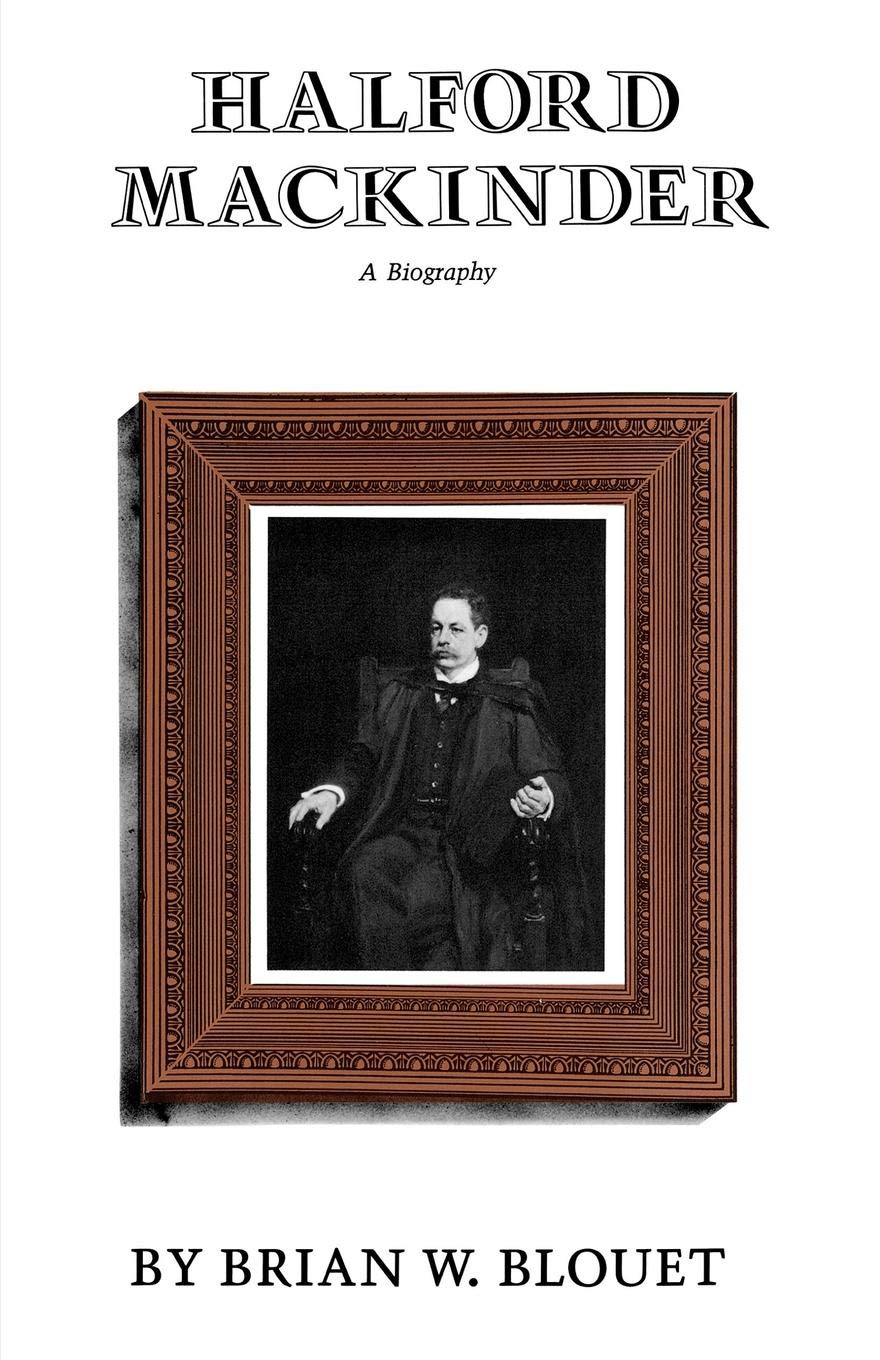
There is a biography of Halford Mackinder written by Brian Blouet, which Carl refers to, and which I shall try to get access to.
I also found this related article on Mackinder on the Perspectives on Africa blog.
It's written by Simone Pelizza of the University of Leeds
A few extracts...
"...he also became famous in his era for the first successful ascent of Mount Kenya in 1899, when he reached the peak of this great African mountain after three months of dramatic efforts. Indeed, this achievement is still highly debated among biographers of the character, due to the obscure events surrounding its lucky conclusion."

and also, Mackinder and his travelling companions:
"...did not show any humanitarian concern in the fulfilling of their ambitious African project, sharing the crude racial prejudices of their time. In this sense, the expedition to Mount Kenya perfectly represent the spirit of European imperialism at the end of the nineteenth century, full of violence, greed, and psychological obsession. A toxic mixture well captured by Joseph Conrad in his great novel Heart of Darkness, published some years later as part of the wide international campaign against Belgian atrocities in the Congo.'

Mackinder also has a rare species of owl named after him: Bubo capensis mackinderi - possibly the only GA President to have an owl named after him - unless you know different...
Also this article readable on JSTOR:

Blouet, Brian W. “The Imperial Vision of Halford Mackinder.” The Geographical Journal, vol. 170, no. 4, 2004, pp. 322–329. JSTOR, www.jstor.org/stable/3451461.

Update - June 2019
A big addition to the post...
On the impact of 'On the Scope and Methods in Geography'
Drawn from Emily Hayes' PhD
Geographical projections: lantern-slides and the making of geographical knowledge at the Royal Geographical Society c.1885 – 1924
Read more at https://ore.exeter.ac.uk/repository/handle/10871/23096#PSdvQPc7baSCXDiL.99


http://hdl.handle.net/10871/23096
Emily describes the lecture, and the impact that it had. It predates the GA.

Mackinder is described by Hudson as "one of the fathers of modern geography". Hayes describes it as a "multi-media lantern slide lecture performance". 

Lantern slides were the keynote of their day.

Clements Markham said the lecture was...

"a brilliant production, most suggestive, and calculated to establish geography’s place among the sciences. I read it with great interest."

Additional references
Gilbert, The Right Honourable Sir Halford J. Mackinder, P. C., 1861-1947, 93; Cosgrove, Geography and Vision, 125 and 133-34.

Hudson, The new geography and the new imperialism, 1870-1918, Antipode 9 (2), (1972), 12-13; Stoddart, Geography and war, 87; Scargill, The RGS and the foundations of geography at Oxford.

Update: late June 2019
While researching some other Presidents, I came across a Rex Walford article on the GA, and Mackinder in wartime. I haven't read the article yet, but I think it is going to provide a wealth of additional detail on this period of the GA, and the work of the Presidents.

Walford, Rex. “Mackinder, the GA in Wartime and the National Curriculum.” Geography, vol. 78, no. 2, 1993, pp. 117–123. JSTOR, www.jstor.org/stable/40572493.

Another update Late June 2019

Writing the blog post for Edmund William Gilbert in 1922, and came across reference to Mackinder's Seven Lamps of Geography.

These need to be added in here, and I will do that shortly.

Update, early July 2019

The seven lamps are referred to in the article by V. W. Tidswell from 1990.

They are the areas which are mentioned in a paper by Gilbert (another GA President) in 1951 called 'The Seven Lamps of Geography'.
These are described by Tidswell as 'burning on today' as the attainment targets in the National Curriculum.
"The idea of the region was fundamental to all Mackinder's teaching. He was concerned with distributions in space and their inter-relationships, and aimed to answer the same questions as we pose today: Where? How? Why there? But not, where ought..."

Seven Lamps of Geography
The Region
The Homeland and the Empire
World Geography
The Unity of Geography
The Map
Applied Geography
The Philosophy of Geography

References
Coones, Paul. “The Centenary of the Mackinder Readership at Oxford.” The Geographical Journal, vol. 155, no. 1, 1989, pp. 13–23. JSTOR, www.jstor.org/stable/635377.
https://www.sciencedirect.com/science/article/pii/096262989290021K?via%3Dihub

Capes, Concepts and Conscience: Continuity in the Curriculum, V. W. Tidswell - Geography, Vol 75 No. 4 (1990)
https://www.jstor.org/stable/40571878

MACKINDER, H. J. “THE TEACHING OF GEOGRAPHY FROM AN IMPERIAL POINT OF VIEW, AND THE USE WHICH COULD AND SHOULD BE MADE OF VISUAL INSTRUCTION.” The Geographical Teacher, vol. 6, no. 2, 1911, pp. 79–86. JSTOR, www.jstor.org/stable/40554112.

Update
Additional image, found on Twitter.
Image


Also found some details of the exhibition that Mackinder curated in London in 1932.

Also some BBC videos.

Orford, E. J. “THE 'TEACHING OF GEOGRAPHY' EXHIBITION.” Geography, vol. 17, no. 3, 1932, pp. 216–218. JSTOR, www.jstor.org/stable/40558338.


Update August 2019 - from Brotton's book.

Mackinder is also mentioned in "A History of the World in Twelve Maps" by Jerry Brotton (Penguin, 2012)
There is a chapter called 'Geopolitics' which mentions him, and also Colonel Sir Thomas Holdich, who was also President, at a time when they were linked with the RGS. Brotton says that Mackinder "would almost single-handedly both transform the study of geography in England, and create a whole new way of understanding and using the subject: geopolitics".

Brotton says that Mackinder recalled, at the age of 82, hearing news about Napoleon III. He was also caned at school "for drawing maps instead of writing Latin prose". His boyhood games apparently included "being King of an island on which 'civilised its usually backward inhabitants'."

He became the President of the Oxford Union in 1883.

Brotton describes the travels in 1886-7 when Mackinder lectured on his "New Geography" apparently with the aim of 'gradually familiarising intelligent people throughout the country with the idea that geography consisted neither of lists of names nor of traveller's tales".

He also added some detail on Mackinder's lecture on Geography at the RGS in 1887 when he presented his ideas. He said 'a worthy Admiral, a member of Council, sat in the front row and kept muttering "Damn cheek" throughout the lecture, particularly when Mackinder suggested the RGS might close as tales of adventure grew fewer.

He concluded by saying, that geography might represent a study of the classics as "the common element in the culture of all men, a ground on which specialists could meet".

Sir Francis Galton, a council member was not sure about Mackinder's claim that geography was a science.

Mackinder's 'Presidential address' to the GA in 1895 according to Brotton, which is impossible of course, as he wasn't President.
It was called 'Modern Geography, German and English", explaining how our maps were ahead of the German, but with von Humboldt and Ritter, we were behind the Germans in other respects.

For Mackinder, "a map was not the territory it claimed to depict, but an interpretation of the geological, biological and anthropological elements which made up that territory".

When he climbed Mt. Kenya in 1899, he was invited by Colonel Sir Thomas Holdich to speak at the RGS.

Pivot of history: https://en.wikipedia.org/wiki/The_Geographical_Pivot_of_History


Image from the 1940s

Another of Mackinder's contributions was a slogan:

Who rules East Europe commands the Heartland
Who rules the Heartland commands the World Island
Who rules the World Island commands the World

Updated August 18th 2019


A BBC Radio 4 programme from today.

What can the ideas of two long-dead geopolitical thinkers tell us about relations between Russia, China and America today?

Documentary-maker Phil Tinline traces how, in the late 19th century, an American sea captain turned scholar, Alfred Thayer Mahan, drew on the historic successes of Britain’s Royal Navy to argue that sea power was a decisive force in world history, and that the rising United States should establish its own permanent naval forces.

But then a British geographer, Sir Halford Mackinder, spotted the revolutionary potential of the new Trans-Siberian Railway, and argued that land power, in the form of the Eurasian Heartland could now mobilise its resources to outdo British sea power.

Both men’s ideas have had profound influence on geopolitical thinking ever since. Today, as the post-war international order falters, Phil talks to leading scholars and strategists to discern what influence Mahan’s and Mackinder’s ideas are having on our new era of great power rivalry – between NATO and Russia in the Black and Baltic Seas, between Russia and China in the Eurasian heartland as the Belt and Road stretches westward, and between China and the USA, in the hotly-disputed waters of the South China Sea.

And he asks whether, in a globalised world, ends that were once pursued by military means are now being achieved through commerce, but in pursuit of the same hard geopolitical aims.


With contributions from: Professor James R. Holmes, Professor Charles Kupchan, Dr Nick Megoran, Professor Rana Mitter, Air Chief Marshal Sir Stuart Peach, Professor Angela Stent, Dr Dmitri Trenin

October 2019

A contribution in Darby's recollections of the period.


Darby, H. C. “Academic Geography in Britain: 1918-1946.” Transactions of the Institute of British Geographers, vol. 8, no. 1, 1983, pp. 14–26. JSTOR, www.jstor.org/stable/622271.

https://books.google.co.uk/books?id=UI7020CCNsoC&lpg=PA7&ots=NHbnZgpoRx&dq=the%20british%20isles%20ogilvie%201928&pg=PA6#v=onepage&q&f=false

the development of the REGION as a concept

Update: December 2019

https://journals.openedition.org/cybergeo/2966 - a reference in a journal by Hugh Clout

Updated January 2021
Within the context of the current Black Lives Matter movement and the emergence of the Black Geographers group, the GA is reassessing previous connections and involved with moves to decolonise the curriculum.
An article in 'Geography' by Gerry Kearns in Spring 2021 edition explores Mackinder's role in this, and some of his actions which were racist:
It can be read here by subscribers:
It was the 2nd article in a series.
To find out more about the series, check out the Uncomfortable Oxford webpage which describes a lecture that Kearns gave in Oxford, in what was called the Halford Mackinder Lecture Theatre.


Description:
The first in Oxford Geography's 'All School Seminar Series' tackled the uncomfortable history of the School's founder, Halford Mackinder. Halford Mackinder, practised Geography as an 'aid to statecraft.' Statecraft required the geographical knowledge and geographical claims that came from the tradition of Exploration. However, the institutionalisation of Geography as a subject in universities and schools gave it a more modern purpose. 
In large part this was an educational mission, evangelising British people to think 'imperially'. And this bequeaths us a troubling legacy. It is a legacy of force and racism; and we need to be honest about this.

Updated May 2021
Readers of Tim Marshall's 'Prisoners of Geography' will know that Halford MacKinder is mentioned several times. Having read a good chunk of the new book 'The Power of Geography' which came out a week or so ago, I can confirm that MacKinder is mentioned once again...

Updated January 2022

This thread appeared in my feed earlier.


Updated July 2022

A search on Twitter will currently bring up a whole range of tweets mentioning Mackinder's Heartland theory because of the situation in the Ukraine and other recent geopolitical events.

Mackinder is also mentioned in an essay on Aberystwyth University's Geography department, which was co-edited by Emrys Bowen and also features H J Fleure.

In 1917-18 it was MacKinder who asked H J Fleure to be the Honorary Secretary of the GA.

Updated August 2023

References to MacKinder and Herbertson and early days of geography in universities.


Charles W. J. Withers, et al. “Geography’s Other Histories? Geography and Science in the British Association for the Advancement of Science, 1831-c.1933.” Transactions of the Institute of British Geographers, vol. 31, no. 4, 2006, pp. 433–51. JSTOR, http://www.jstor.org/stable/4639988. Accessed 24 Aug. 2023.

Margaret Mackintosh RIP

Updated post. Sad news at the end of last week from colleagues who have organised the Charney Conference over the years of the passing of Ma...