Showing posts with label St. Catharine's College. Show all posts

Saturday, 12 October 2024

Oskar Spate

Oskar Spate is a name that has been mentioned a few times in the documents that I read through while writing my history of the GA alongside the biographies of the Presidents.

A Wikipedia entry here explains a little of his connections with Geography.

I also came across a more recently published biography on his connections, and discovered he was another geographer who came through St. Catharine's College, Cambridge.


Thursday, 18 July 2024

Michael Chisholm - RIP

St. Catharine's College, Cambridge has close connections with a great many prominent geographers, former GA Presidents amongst them.

We heard earlier of the passing of another former lecturer and Fellow Michael Chisholm.

Professor Chisholm was admitted to St Catharine’s to read Geography as an undergraduate in 1951. He went on to make fundamental contributions to economic geography and its translation into public policy, including serving on several government commissions. He returned as a Professorial Fellow in 1976, following his election to the 1931 Chair of Geography at the University of Cambridge in 1975. On his retirement in 1996, he became an Emeritus Fellow and turned his attention to advancing our understanding of the drainage and navigation of the Fens throughout history.


Thursday, 13 May 2021

David R Wright

Not a GA President, but someone bound up with the work of the Association in many ways is David R Wright. He produced a series of best selling map books and atlases, and also worked as a PGCE tutor at the University of East Anglia, which was where I first met him in the early 90s. As you can see from the article below, he was also another geographer associated with St Catharine' College (and always remember to spell that with an 'a' by the way...) and to have Gus Caesar as a tutor. Gus was very much connected with a whole range of former GA Presidents including Margaret Roberts.


He contributed to a range of GA publications and articles, always on the theme of mapping.

The last time I saw David was at the Royal Geographical Society in 2008. He was receiving an award, as was I. He was unwell at the time, and sadly died the year after.

The following text and the accompanying image are copyright RGS-IBG

David Wright, who died on 20 November 2009 after a battle with cancer, was a geographer and author whose work inspired children around the world.

David graduated from Cambridge University and then trained as a teacher, undertaking an MA in Geography in Education from London University, Institute of Education. He taught in Stevenage and Pittsburgh before moving to Norfolk in 1969 as a lecturer in Geography at Keswick Hall College of Education, which was later merged with the University of East Anglia, where he worked for 12 years. He took early retirement in 1994 to further his research and writing, becoming a self-employed author, school inspector, adviser and consultant.

Throughout his career David was a champion of the use of equal area maps in teaching and in publications of all types and his (W)Right World Map was launched in 2007. He also advocated the use of stamps in engaging young people with an interest in places and examples of a virtual journey using stamps can be found on Discovering the Arctic 

I have this pencilled in for an activity in my new KS2 Schemes which I am developing with colleagues in a unit called 66 North.

Throughout his career David’s concern has been to stimulate children’s interest in the world by creating pupil-orientated approaches to teaching geography and innovative ways of linking geography, environmental and sustainable development education, all rooted in his experiences of many different parts of the world.

David was a past chairman and president of the Norfolk branch of the Geographical Association and his contribution to geographical education was acknowledged in 2007 when he was awarded the accreditation of ‘Chartered Geographer’ by RGS-IBG. In 2008 he was awarded the ‘Ness Award’ by RGS-IBG for his work championing the wider understanding and popularisation of geography through his work with children.

David's obituary on behalf of the Geographical Association was written by Margaret Roberts and published in 'Geography'. It has often been the job of GA Presidents to have that sad duty.

David also wrote a book in the GA-published series 'Theory into Practice'.
It was called 'Maps with Latitude'

Reference
https://www.geog.cam.ac.uk/alumni/landmark/1/landmark1.pdf - p10


As always, if anyone has memories of David please get in touch, or add a comment. Many people will have used his work and books I am sure.

Wednesday, 27 January 2021

St. Catharine's College, Cambridge

I have previously mentioned St. Catharine's College, Cambridge, and have heard a lot about it via Presidents who went there themselves.

Ashley Kent told me something about this, as being one of the 'hotspots' for Geography - something I'm going to develop a little more perhaps, by focussing on some of these other hotspots such as Hull and Bristol.

A number of Presidents can connect themselves to this college in some way, and I have previously blogged about them.

The St Catharine's College website is here.

There is an archive of magazines dating back many decades, and in which one can find mentions of the GA Presidents who have been connected with the college. I had a quick look and 

Here's Ashley Kent with some memories of St. Catharine's:

My college...St Catharine’s College Cambridge....has always been a Geography ‘hotspot’....a great place where quite a few people who were prominent in the GA...attended.
These include...Steers, Balchin, Spooner, Kent, Bradford, Keeble et al. Many of us were very fortunate to have been tutored by ‘Gus’ Caesar.......arguably the ‘source’ of an extraordinary group of geography professors across the world.....Haggett/Dury/Hall/Randall/ et al...a remarkable ‘father figure’ to many.

Someone who Ashley mentions is 'Gus' Caesar.

More on Gus was added in a separate blog post previously.

J A Steers was someone who was very definitely linked with the college.

His memorial has been mentioned as well. It can be seen in the college magazines, which would also reveal other details on the geographers who passed through the college. This was a signed silver salver presented to J A Steers in 1966 on the occasion of his retirement:

Wednesday, 20 January 2021

Gus Caesar

Updated August 2023

Gus Caesar was described by former GA President Ashley Kent as arguably the ‘source’ of an extraordinary group of geography professors across the world: Haggett / Dury / Hall / Randall et al...a remarkable ‘father figure’ to many.

He was a tutor at St. Catharine's college, University of Cambridge. (Twitter account link)

He came up on a £20 Exhibition to St Catharine's College in 1933, gained double Firsts in Geography and was elected to a postgraduate scholarship in 1936. After the war he returned to a university lectureship and fellowship at Selwyn College and in 1951 moved back to his old college. For the next 30 years he was to hold almost every senior college post except that of Master.

He was Senior Tutor for Geography, working with Dr Keeble.

The above text is taken from his Obituary, written for the Independent newspaper by the famous geographer Peter Haggett.

Peter Haggett also said of Gus:

No one who experienced the hour-long inquisitions in his rooms on Main Court at St Catharine's, delivered through a haze of Three Nuns pipe smoke, will forget the process. Essays were disassembled, the reasonable parts retained, new components added, and the whole reassembled into something that was well ordered, logical and, above all, geographically sound. 
He had an innate sense of what gave coherence to a geographical point of view and drove that relentlessly into those he taught.

A story from the memorial address for J A Steers, who taught Gus:

Gus Caesar's splendid story of his own undergraduate days, when he was woken one morning, admittedly somewhat late, by a severe pain in his chest. Opening bleary eyes, he discovered that the cause of this pain was a walking stick, jabbing him in the ribs. And at the other end of the stick was, of course, Alfred, immaculately dressed as usual, with hat and briefcase, exclaiming "get up, get up, I'm lecturing to you in ten minutes!" 

References

https://www.independent.co.uk/news/obituaries/obituary-gus-caesar-1600981.html - obituary in the Independent newspaper

With growling voice and the massive bulk of a second-row forward, Gus Caesar appeared ferocious. And as a Dean on the warpath after a rowdy boat-club supper, this image could stand him in good stead. But the reality was of a gentle and ever kindly man for whom the individual undergraduate (particularly if from St Catharine's) could always ask for support. 

His college house on Grantchester Meadows was a haven through which hundreds of visitors passed each year. 

His wife, Margaret, and daughter, Pat, could calculate to a nicety the strength of undergraduate appetites after the towpath walk back from Grantchester.

https://www.society.caths.cam.ac.uk/home/?m=page&id=1923 - St. Catharine's Society Journals

Image above is taken from the St. Catherine's Society Journal

https://www.society.caths.cam.ac.uk/Public_Magazines/1971r.pdf 

https://www.society.caths.cam.ac.uk/Public_Magazines/1987r.pdf 


Updated August 2023

Sir Peter Hall - Town Planner

https://discover.ukdataservice.ac.uk/assets/qualibank/6226themext016.pdf

I was taught by an outstanding teacher in economic geography, a guy called Gus Caesar, whose full name was almost unbelievably Alfred Augustus Levi Caesar, and he was a legendary figure in British geography...  He was not a researcher, he’d got a very poor research record, I don’t think he’d have got tenure nowadays, but he was an absolutely inspiring teacher in close supervision, because the style was, you would write an essay every week, of course, and he would read it, and he would tear the essay to pieces!  He’d say, “Look, old lad” – his favourite term – “Look, old lad, you’re putting the conclusions before the evidence.  Say what you think the hypothesis is, and then produce the evidence carefully, in logical order, and then the conclusions”.  He absolutely [analysed] your essay.  Everyone who was taught by Gus, has this extraordinary kind of intellectual discipline of being able to argue A to B to C to D, which none of us ever lost, I think.

https://discovery.ucl.ac.uk/10042912/3/Hebbert_PH%20for%20GBS%20final%20ms.pdf

His path was determined by the offer of a geography scholarship at St Catharine’s College. Hall found Cambridge initially uncongenial, what with the snobbery of privately educated undergraduates towards provincial grammar schoolboys, the relatively low 3 academic esteem of his chosen discipline, and the bias of first year teaching towards the physical geography he least enjoyed. 

But in 1951 the situation was transformed by the college's appointment of A.A.L. Caesar (an alumnus) to be Fellow and Director of Studies in Geography. 

As the only Cambridge college offering geography scholarships, St Catharine’s attracted the pick of the crop and for the next 29 years Gus Caesar was their academic mentor. The weekly supervisions in which Caesar deployed his ‘formidable powers of critical dissection and logical rearrangement’ (Haggett 1965, ii) nurtured many rising stars of the discipline (Johnston and Williams 2003, 309) and Hall recollected them as the high point of his undergraduate career (2003b, 2014f). 

He had already learned from George Orwell how to write clearly without resort to jargon; now he learned how to construct arguments, marshal empirical evidence, and submit to relentless self-criticism—‘progress is a mistake-making business’ was one of Gus’s aphorisms. 

More than this, Caesar was a committed advocate of geography as an applied science, with regional planning as its practical outcome. He had coauthored the chapter on the ‘North-east of England’ and written those on ‘Gloucester–Wiltshire–Somerset’ and ‘Devon and Cornwall’ in G.H.J. Daysh’s Studies in Regional Planning: Outline Surveys and Proposals for the Development of Certain Regions of England and Scotland (1949). The authors conceived regional planning to be a self-contained policy process in which the geographer ascertained trends, constraints, and requirements so that planner might devise proposals for administrators to implement. 

For his presidential address to section E of the British Association for the Advancement of Science at Southampton in August 1964, A.A.L. Caesar spoke on ‘Planning and the geography of Great Britain’. He emphasized the inexorable geographical trends of economic centralization on South-east England and the midlands, the decline of peripheral regions, road transport growth and extensive railway closures. ‘The Twentieth Century pattern must be accepted—there is need to contemplate that of the Twenty first Century. 

If Megalopolis is coming, let us at least be aware of it and let us plan for it’—a challenge for geography indeed (1964, 240). 

Caesar himself had little direct involvement in public policy, but his teaching of geography as an applied science was profoundly influential, as seven of his distinguished former students—Michael Chisholm, Peter Haggett, Peter Hall, David Keeble, Gerald Manners, Ray Pahl and Kenneth Warren—acknowledged in their Spatial Policy Problems of the British Economy (1971).

Memories from the late David R Wright - another legend who has appeared on the blog

https://www.geog.cam.ac.uk/files/alumni/landmark/landmark1/landmark1.pdf

Sunday, 8 March 2020

1959: Professor J A Steers, CBE

Updated August 2023

Professor Steers is probably the definitive expert on coastal processes and landscapes, particularly those which have influenced the coastline of England and Wales. He was one of several GA Presidents to be associated with St Catharine's College, Cambridge and Gus Caesar.

His book on the coastal landforms of the UK is one that sits on my shelves to this day. I have a nice old edition with a green binding which dates back to the 1950s, and which I referred to quite recently to answer a question on Chesil Beach that someone asked.

He sits alongside Denys Brunsden, who will appear in the blog several decades hence, as key coastal geographers, who have shaped how we understand and teach these dynamic landscapes.

Steers was linked to the University of Cambridge, and also with a previous President: Frank Debenham. This, from the University of Cambridge alumnus page, describing the introduction of the Geography Tripos to the university following GA an RGS campaigning which has been well covered in earlier posts near the start of the 20th Century:

The first candidates for the Geography Tripos sat the exam in 1920, resulting in 2 students receiving a 1st Class for their Part 2 exams, one of whom was JA Steers, who would go on to become Professor of Geography and Head of Department 1949-66.

Source: https://www.geog.cam.ac.uk/alumni/earlyyears/

This piece from Nature in 1949 announced the arrival of Steers at the University of Cambridge, where he replaced another former GA President: Frank Debenham. (who had his own extensive entry in the blog a few months ago)

MR. J. A. STEERS, who, in September, is to succeed Prof. F. Debenham as professor of geography in the University of Cambridge, was one of the first generation of geographers to take the newly constituted Geographical Tripos after the First World War. After a short spell of teaching at Framlingham, Mr. Steers returned to Cambridge to join the staff of the Geographical Department under Philip Lake. His College elected him to a fellowship, and before many years St. Catharine's became the first men's college to offer scholarships in geography. This led to a remarkable concentration of able geographical students in the College, which has resulted in a rapidly lengthening list of St. Catharine's geographers entering university posts–fifteen in the last ten years. In his College, Mr. Steers has served successively as dean, tutor, senior tutor, and president.

Professor Steers' address was on the subject of Physiography (also known as geomorphology) and he spoke about the importance of this aspect of geography.


Steers wrote many books on coastal landscapes, several of which I used for my own teaching over the years.
This quote is taken from Rex Walford's book, and dates to 1944, when Steers was campaigning to help "save the coast" by educating the public about its value. This sort of policy work was vital following the war.


This campaigning of Steers was mentioned by G. R. Crone in his chronology of 20th Century geography.


There are some references to J A Steers in a piece by D Stoddart in a piece on the founding of the IBG. I love this image, showing J A Steers talking, and which was apparently taken around the year 1938.

Source: Stoddart, D. R. “Progress in Geography: The Record of the I. B. G.” Transactions of the Institute of British Geographers, vol. 8, no. 1, 1983, pp. 1–13. JSTOR, www.jstor.org/stable/622270

I have some lovely memories of Professor Steers from a former student of his, who would later become a GA President himself: Derek Spooner. 

In July 2019, he shared his memories of Professor Steers to me in an e-mail.

I first encountered this name in 1960, when I was in the sixth form and was given Steers' 'The Sea Coast' as a school prize. A marvellous, inspiring book in the wonderful New Naturalist series, which hooked me at the time on physical geography. Two years later I found myself at Cambridge studying Geography in the Department where Steers was Professor, and in St Catharine's College where he was a Fellow....

Truth to tell his lectures were rather disappointing - he was rather a shy man and certainly not a showman. He was very tall and bespectacled. He had been Head of Geography since 1949. He had been extremely influential in developing Geography in my College to an outstanding position within the University. By the time I arrived in Cambridge, Steers had become the leading coastal geomorphologist of his era. His studies of Scolt Head Island on the Norfolk coast were famous and the student trips he took there were legendary, with students getting stuck in the mud - certainly wouldn't have passed a risk assessment! I was not aware that he had just been President of the GA, or that he was also very active in the RGS, or indeed had become a leading figure in conservation policy.

'Alfie' was his nickname. He retired in 1966. I had started doing postgraduate work and I can remember being invited to a sherry party at his house in the posh western suburbs of Cambridge. His wife, Harriet, was also a Geography lecturer. Her speciality was the regional and historical geography of the USSR......

In his retirement I believe he continued his coastal studies. Ron Martin, another lecturer in the Department, told me that some times he would get a call from 'Alfie' asking him to drive him up to Scolt Head Island. Sounded as if he never really retired.

Here's a image from the copy of one of Steers' books that sits on my shelf. It has some lovely plates in it.


His author profile on the Harper Collins site is useful as well.
(1899–1987). Geomorphologist, Cambridge geographer, graduate and later Fellow of St Catherine's College. Professor of Geography at Cambridge 1949–66 and the authority on the moulding of coastlines.
Member of expeditions to coral reefs Australia 1928, 1936 and Caribbean 1939.

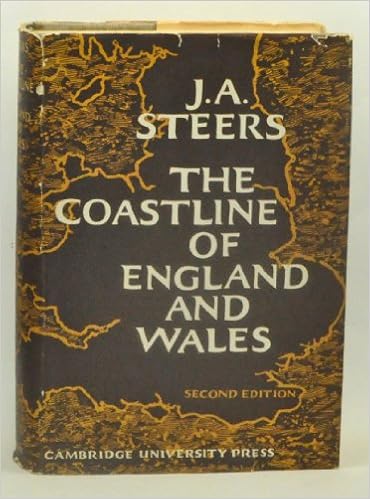
Concerned above all with surveys of British coast from a classic study of Scolt Head Island (1934) to the standard work The Coastline of England and Wales (1946). Much involved with coastal protection and a keen exponent of coastline preservation on Nature Conservancy, National Parks Commission and National Trust’s Enterprise Neptune.

He was awarded a CBE in 1973.

He was also involved in the committee which was established to ensure that an event like the 1953 East Coast Floods could not happen again in the same way.

His wife was also a geographer and published her own books, although I was interested to see that in this ad for one of her books in 'Geography' that she also added 'Mrs. J. A. Steers' in brackets after her own name Harriet Wanklyn. See image opposite.

An obituary was published in 'Geography' in 1987, written by David Keble.

References
Wikipedia - Professor Steers has no entry - he surely deserves one given his significance

STEERS, J. A. “Physiography: Some Reflections and Trends: Address to The Geographical Association.” Geography, vol. 45, no. 1/2, 1960, pp. 1–15. JSTOR, JSTOR, www.jstor.org/stable/40565103.

Cambridge University alumnus page: https://www.geog.cam.ac.uk/alumni/earlyyears/

Crone, G. R. “British Geography in the Twentieth Century.” The Geographical Journal, vol. 130, no. 2, 1964, pp. 197–220. JSTOR, www.jstor.org/stable/1794582

The RGS-IBG present an annual prize for the best undergraduate dissertation named in Steers' honour.

Referenced here for his work on Scolt Head Island: http://archive.jncc.gov.uk/pdf/gcrdb/GCRsiteaccount2038.pdf

STEERS, J. A. “Physiography: Some Reflections and Trends: Address to The Geographical Association.” Geography, vol. 45, no. 1/2, 1960, pp. 1–15. JSTOR, www.jstor.org/stable/40565103

Stoddart, D. R. “Progress in Geography: The Record of the I. B. G.” Transactions of the Institute of British Geographers, vol. 8, no. 1, 1983, pp. 1–13. JSTOR, www.jstor.org/stable/622270

As always, if anyone has further information on J A Steers or images, please don't hesitate to get in touch.

Updated June 2020

When writing a post on Tim Burt and Des Thompson's book 'Curious about Nature' I found a picture of J A Steers taken in Oxford in 1954 by E W Gilbert - shown here.... at a meeting of Section E of the BAAS.


Source: https://books.google.co.uk/books?id=2onPDwAAQBAJ&lpg=PA80&dq=cuchlaine%20king%20nottingham&pg=PA79#v=onepage&q&f=true


Updated November 2020
There is a prize in his name for geomophology


Updated January 2021

From the St Catharine's college magazine - the text of a memorial address.


The magazine of the College society has details of his memorial address by Dr David Keeble, who was also linked with the GA:

https://www.society.caths.cam.ac.uk/Public_Magazines/1987r.pdf

Find it on p.31 here.

Each of us brings to this celebration our own personal memories of Alfred: of a tall, dignified presence crossing the College court, walking-stick in hand; of the personal warmth yet directness of his greeting in the Senior Combination Room - "sit down, sit down, have a glass of sherry"; of lectures in the semi-darkness of the Department of Geography's lecture theatre, where Alfred's impressive expositions of slides of coastal landforms sometimes demanded careful listening for those seated beyond the second row; of his famous field trips to Scolt Head Island, where an immaculate dark suit would be exchanged for shorts in the warden's hut, followed immediately, and to the horror of inappropriately dressed visitors, by a plunge into the muddiest and roughest salt marsh!

He was Church warden of St. Botolph's Church

As postwar governments grappled with growing planning pressures on Britain's precious but vulnerable coastline; as Britain's coastal defences crumbled under the 1953 North Sea surge; as the National Parks Commission, the Nature Conservancy, and the National Trust sought to devise effective and appropriate management policies for their coastal areas, it was to Alfred that they turned for scientific advice and informed appraisal. So too did the Council of Europe, who appointed him Coastal Consultant to their Conservation Committee. Alfred could be forthright in his condemnation of bad coastal management, criticising the War Office for example for such coastal eyesores as derelict huts, looking, as he scathingly remarked, "like a lot of false teeth sticking up!" But his writings and lectures on coastal problems - especially a major Royal Geographical Society lecture he gave in 1944 - were enormously influential in shaping the thinking of such ministers as W. S. Morrison

Updated August 2023

Margaret Mackintosh RIP

Updated post. Sad news at the end of last week from colleagues who have organised the Charney Conference over the years of the passing of Ma...