Wednesday, 18 November 2020

Oxford Geography Project

In a piece by Rex Walford on textbooks.

References

Walford, Rex. “On the Frontier with the New Model Army: Geography Publishing from the 1960s to the 1990s.” Geography, vol. 74, no. 4, 1989, pp. 308–320. JSTOR, www.jstor.org/stable/40571739. Accessed 16 Nov. 2020.

John Rolfe was a key author on this project.

Tuesday, 17 November 2020

Thought for the Day

"Few people visit East Anglia by accident. It is still a region of comparative isolation. There is no main railway and no main road which passes through East Anglia on its way to other parts of the country."

L Dudley Stamp from his 'The Face of Britain' (1940)

Learning Geography with Computers 1988

Made by MESU. This has now disappeared since I screen grabbed it a while back... this was an early film on the use of computers in classrooms.

First part of film:

Hypothesis Testing - Cleeve School, Cheltenham - Derek Plumb - 0'10" - 12'44"
Hold the Front Page - Worsley Wardley High School, Salford - Alan Szymanski 12'45" - 19'31"
Planning Tourism - West Hatch High School, Essex - Val Brett - 19'32" - 25'15"
Hydrology Fieldwork - ILEA Advanced Field Study Centre, Abergavenny - Mike Penny - 25'16" - 35'18"
Negotiating for a Game Park - Knowles Hill School, Newton Abbott - Doreen Bennett - 35'19" - 51'31"
Individual Studies - Cleeve School, Cheltenham - 51'32" - end


https://en.wikipedia.org/wiki/Microelectronics_Education_Support_Unit

Deryn Watson wrote a book in this area:

1988: GA Awards began

1988 saw the first GA Awards. This was a new initiative for the GA, but continues to this day, and I have been fortunate to have quite a few of these over the years, including a number of Silver Awards.

Here were 1988's winners, which included a former President.

Sunday, 15 November 2020

1987: Changes at Fulwood Road

The Annual Report of 1987 showed the work of Graham Humphrys in prioritising some changes at Fulwood Road, the HQ of the GA, to improve the working conditions for staff. There was also a Meeting room for the first time, and the old lino was stripped out.

Reference is made to Margaret Barlow (who will have her own blog post in due course) as the new...


Thanks also go to Bryan Coates here, for his work navigating some tricky financial times.

It was interesting to see the particular stocks and shares that the GA held back then. The GA still has investments of course, and trustees need to financially prudent, and also consider the types of stocks and shares that are held - these are very careful decisions.

Back in 1987, here's where the GA was investing some of its reserves:

Reference

Humphrys, Graham, et al. “Annual Report of The Geographical Association 1987.” Geography, vol. 73, no. 2, 1988, pp. 162–178. JSTOR, www.jstor.org/stable/40571395. Accessed 14 Nov. 2020.

1987: Progress on many fronts

1987 saw a period of plenty of activity, with the Case for Geography, ongoing discussions over a National Curriculum, the 5-16 document from DES and responses and other activity. The GA was now on a sound financial footing.

There was also reference to the Education Standing Committee (ESC), now known as Education Group, and the work of the other committees. Members of GA committees work away, often in the background, providing valuable support for this sort of work.

References

Humphrys, Graham, et al. “Annual Report of The Geographical Association 1987.” Geography, vol. 73, no. 2, 1988, pp. 162–178. JSTOR, www.jstor.org/stable/40571395. Accessed 14 Nov. 2020.

2nd Land Use Survey

As part of the blog project, I have been collecting a few books that have piqued my interest along the way, and are of reasonable value and price. There are quite a few that have been outside my price range. This cost £3 and is a bargain.

It's a copy of the handbook that was used for the 2nd Land Use Survey in 1968, and is a First edition (although I'm not sure there was a 2nd edition) of the booklet for teachers to ensure that their entries were accurate. The coding system would probably stand up even now, although there are some land uses which are probably not needed any more, and some others which couldn't be plotted using the existing key from the 1960s: I don't suppose the idea of a solar farm had occurred to people, for example.


The inner pages included a colour code for all the different land uses. It's interesting that Dan Raven Ellison brought this up to date in his 'UK in 100 Seconds' video, and will shortly film his UK National Parks version of the concept.

Saturday, 14 November 2020

1986-8: Geography 5-16

The DES / HMI published a paper in 1986 exploring the shape of school geography.

The GA published a response to the paper.

This paper is an outcome of GA Task Force' discussion meetings held at Leicester (8th November 1986) and London (7th February 1987) and with HMI representatives at the DES in London (11th November 1986). All these Task Force meetings were under the chairmanship of Patrick Bailey. Other Task Force members - David Boardman, Simon Catling, Graham Corney, Peter Fox, Paul Gwilliam, Paul Machon, Derek Mottershead and Tony Pearce - also contributed to the discussion on which this paper is based. 


References

Rawling, Eleanor, et al. “Comments from the Geographical Association on the HMI Discussion Paper Geography from 5 to 16.” Geography, vol. 73, no. 1, 1988, pp. 41–46. JSTOR, www.jstor.org/stable/40571340. Accessed 14 Nov. 2020.

Thursday, 12 November 2020

1987: Dr. Graham Humphrys

Updated February 2021 with a major update from Graham himself...

Dr. Graham Humphrys was the Head of the Geography department and previously sub-Dean of the Faculty of Economic and Social studies at the University of Swansea.

He served as the Chair of the GA's Publications and Communications Committee during the late 1970s and into the 1980s.

I was unable to find a decent image of Graham, close-up. When I first started the project I did come across a small image on a Flickr account by Tehmina Goskar.

She sent me the image here and told me:
It's not that high res but in the photo he is talking about the Lower Swansea Valley Project which was one of the first post-industrial reclamation projects. 
The symposium took place in November 2010 at the National Waterfront Museum, Swansea. All the best with the project.
Tehmina

From the GA Annual Report of 1983:
Dr. Graham Humphrys completed six years as Chairman of the Publications and Communications Standing Committee. Under his chairmanship this committee has been responsible for the recent surge in GA publications and the organisation of successful national and regional conferences.

In this capacity, he wrote reviews of quite a few publications which were published in GA journals - have been looking at journals from this period to try to get some images.
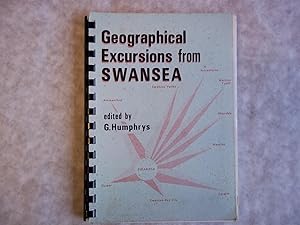
Geographical Excursions from Swansea.: Humphrys. G.He also edited and wrote or co-wrote a series of books related to his geographical work, which included economic and industrial geography and heritage a subject about which he was obviously passionate according to this account of an event in the year 2000.

He was an expert on Swansea and Cardiff's industrial heritage and the restoration of old industrial landscapes and gave regular talks on this theme.
His fieldwork excursions publications series ran to several editions and were a good seller as well apparently.
Graham contributed an article on Swansea Bay City to the 'Geographical' magazine in 1971.

A special edition of 'Teaching Geography' in 1986 was all about economic and industrial geography, and Humphrys contributed to this, as well as other journal articles on this theme as part of his Presidential year.

He is also remembered here, from a former student who remembers his lectures on industrial change and the development of the S Wales area as a city region.

Graham's GA Presidential Address was on a theme which has gained recent currency: 'Changing Places'.


The idea of Changing Places is now more significant than it was back then.
In his Address, Graham explored the factors that influence places.

A former student, David Herbert reflected on that time and his influence here:

I was away from the Department of Geography for six years during which time I completed a PhD at Birmingham University and had my first academic appointment at Keele University. During the early summer of 1965 a post of Lecturer in Human Geography was advertised at Swansea and it was suggested that I should apply. This I did successfully and after a semester at Toronto University I returned to Swansea in the Autumn of 1965. 
My former teachers were still there but there had been new arrivals, most notably Graham Humphrys, the first South Wales-based staff member. His interests were in Economic Geography focused on South Wales and often his concept of the Swansea Bay City.

At Swansea University, Graham was following on from the legacy of W. G. V. Balchin.

In 2015, a journal article said:

Graham Humphrys has degrees from the universities of Bristol, McGill and Swansea, and is a former Senior Lecturer in Geography and former Dean of the Faculty of Social Sciences at Swansea University. His research interests focus on economic geography, the environment and geographical education. He is currently acting chairman of the Canadian Studies in Wales Group.

Updated February 2021

Thanks to Richard Daugherty for putting me in touch with Graham, who provided the following significant personal details to add to the post:

I was born in 1934 in the town of Maesteg in the middle of the South Wales Coalfield. 
I went to the local Grammar School and then in 1953 I won an entrance scholarship to Bristol University to study for an Honours Degree in Geography. In my second year Bill Birch, one of my lecturers, persuaded me to take out a student membership of the Geographical Association.

I graduated in 1956 and then spent a year working at the McGill Subarctic Research Laboratory in Schefferville, northern Quebec to start working towards a Masters degree. The next two years I was at McGill University in Montreal as a Teaching Assistant and finishing my M.A.. As part of this I spent the summer of 1958 in the West Indies looking into the alumina industry in Jamaica, Trinidad and what was then British Guiana. I also visited the research centre that McGill had in Barbados. I gained my MA in 1959 and was then appointed as an Assistant Lecturer in Geography at Edinburgh University for the academic year 1959-60.

In 1960 I was appointed as an Assistant Lecturer in Geography at Swansea University. 
I gained my Ph.D. in 1967, and then stayed until I retired as a Senior Lecturer in 1997. 
My Head of Department at Swansea was Professor W.G.V. Balchin who was a keen member of the GA and very active in the Swansea GA Branch. (He served on the GA Council from 1949 until 1976, was a Trustee 1955-76, and President in 1971.
I re-joined the GA as a full member when I came to Swansea, and was active in the local Branch until the early 1990s. I was a Committee Member throughout that time, and at various times I was Chairman and Secretary of the Branch. During my career I gave lectures at other Branches whenever I was invited. I also contributed to various GA publications. In the early 1970s I was one of the leaders on two field excursions to North America for Geography Teachers organised under the GA banner. 
The first was Trans Canada in 1971 and the second down the western Cordillera in 1973. (Bill Balchin and Alice Coleman were the main organisers for both and I think they may have been based in the Isle of Thanet GA Branch)

I was elected as an ordinary member of the GA Council in 1976. The GA at Headquarters was reorganising at the time and in 1977, much to my surprise, I was invited to Chair the newly formed Publications and Communications Committee. (The Honorary GA Secretary for that committee was Michael Williams).
At the time he was in the Education Department at Manchester University but subsequently he was appointed to a Chair in Education in Swansea where he still lives. We met regularly until the lockdown.

The Publications Committee was worked hard. The GA urgently needed a publications policy which it did not have previously, and this had financial implications. For example, there were shelves stacked with unsold publications which, if my memory serves me rightly, went back to pre-war days. Until then decisions on occasional publications were very ad hoc which had resulted in further accumulation of unsold stock. I also remember that there were decisions to be made to get Primary Geography published.

Fortunately the Headquarters staff provided tremendous support. They were very professional and well organised and got through an enormous amount of work. I stayed as Chairman until 1983 but remained on the Council until my year as President : 1987-8. 
During my year as President it was the GA’s turn to Chair the joint meetings of representatives of British Geography organisations. At the time the three main national organisations were the RGS, the IBG and the GA, but there were others on the committee representing the Heads of University Geography Departments, The Royal Society, The Royal Scottish Geographical Society and so on. By the end of 1988 it had been decided to reform the Committee into The Council of British Geography which I believe still meets. 
My involvement with the GA reduced after my year as President. At the Swansea level, restructuring of local schools had reduced the number of geography school teachers involved and it was difficult to maintain a programme. By this time there was little support for the local GA from the staff of the University Geography Department. I was away from Swansea for a couple of semesters in the 1990s, at Rhodes University in South Africa and at a University in Hokkaido and the Swansea GA Branch faded away, which was very sad. To end on a more cheerful note. Swansea did make a useful contribution to the GA at the local and national level in the second half of the twentieth century, with three national Presidents - Bill Balchin, Richard Daugherty and me, and an Honorary Secretary – Michael Williams, and three of us are still here. 
All happy memories. 
Good luck with your year as President.

Thanks so much to Graham for sending that through.

References

HUMPHRYS, GRAHAM. “Japanese Industry at Home.” Geography, vol. 80, no. 1, 1995, pp. 15–22. JSTOR, www.jstor.org/stable/40572605.

https://ucl.scienceopen.com/hosted-document?doi=10.14324/111.444.ljcs.2015v30.002 - from 2015

Humphrys, Graham. “Changing Places.” Geography, vol. 73, no. 4, 1988, pp. 298–307. JSTOR, www.jstor.org/stable/40571462.
https://www.iwa.wales/click/2010/11/making-our-past-work-for-the-present/

https://www.researchgate.net/publication/240442920_The_economic_development_of_the_British_coal_industry_From_industrial_revolution_to_the_present_day

Humphrys, Graham. “Recent Trends in Industrial Geography.” Teaching Geography, vol. 11, no. 3, 1986, pp. 120–121. JSTOR, www.jstor.org/stable/23751638

Humphrys, G. (1972) South Wales: An Industrial Geography, David and Charles, Newton Abbot.

https://collections.swansea.ac.uk/s/swansea-2020/page/on-our-doorstep - memories by David Herbert, who was associated with the University of Swansea for over 40 years.


Updated December 2020

In 2003, Chris Kington asked a number of former Presidents what had sparked their interest in geography. He lent me the letters and here is the response that Graham sent. At the time he was living in Swansea.

He talked about the place in which he was born and grew up in: Maesteg, and how he came to appreciate the importance of the physical geography of this place on the people who lived there, and the rise of the coal industry He didn't appreciate this until he got into the 6th form of the local Grammar School. 
"What made this all click academically was good teaching. I had two good geography teachers, a man who taught physical geography and a woman who taught human geography...."

GA Publications 
The regional distribution of Growth Industries in Britain, Geography, V 39, 1964. 
Industrial change; Lessons from South Wales, Geography, V 61, 1976
What University Geographers expect from their new students, Teaching Geography, V 3, 1977
Patterns on the map: Land utilisation survey maps as resources for teaching and learning, (with Alice Coleman, H. A. Sandford and J Bale), Geographical Association, Sheffield, 1982. 
Trends in Textiles, Geography, V. 69 (2), pp. 150 ‑ 153, 1984. Recent trends in Industrial Geography, Teaching Geography, V. 11, No. 3, 120 ‑ 121, 1986

Thanks to Chris Kington for the loan of the letters.

As always. further memories of Graham Humphrys would be welcome.

Updated August 2025

Graham also received the RGS Gill Memorial award in 1994.

Wednesday, 11 November 2020

Keith Orrell

Keith Orrell attended the 1993 Centenary event, and was featured in one of the images that Sheila Jones sent me. Here he is, saying something perhaps at one of those events.

Keith wrote a series of books in the 1970s and 80s which reached a large audience while working as a University lecturer. They included:

Evaluation and Assessment in Geography Paperback – 1 May 1984 - written with Patrick Wiegand

He was also involved in the GA's Worldwise Challenge for some years.


From an article in the Wakefield local paper:
"Keith was well respected in his local community.
Keith Orrell made such a huge contribution to Wrenthorpe, near Wakefield that he was awarded an MBE for his efforts in 2012.
He also found time to be a governor at Jerry Clay Academy, serving the school for 25 years.
Last year the school even named their outdoor learning area after him.

Originally from Sheffield, Keith’s working life was spent as a teacher and a university lecturer in geography.

His daughter Jo Orrell said: “From an early age and throughout his life, dad was driven to achieve and make the world a better place."

He sadly died in July 2018 as reported here after suffering from Parkinson's Disease.

On the right of that photograph is an image of another person from this period who will get his own post on the blog: Bob May.

If anyone has other memories of Keith and his association with the GA, please get in touch.

Reflexions on Geography Education

A piece kindly passed to me by the GA President in 1978: Norman Graves, who got in touch with me just after the first lockdown.

Reflexions on a Life in Geographical Education by Alan Parkinson on Scribd

Tuesday, 10 November 2020

Alice Coleman

Upated February 2023

Alice Coleman
has been a great supporter of the GA throughout her long life and particularly associated with the Isle of Thanet GA Branch.
She is now aged 99 and an Emerita Professor of Geography from King's College, London, according to her Wikipedia entry.  There is also another GA link with King's College.

Alice is particularly noted for directing the 1960s Second Land Use Survey of Britain and for analyses of land use planning and urban design which have influenced the design of residential developments since the 1980s.

The 2nd Land Use Survey of Britain followed on from that led by Dudley Stamp, but was more detailed in its approach.

As I have previously reported from the Thanet Branch Centenary document: (PDF download from this link)

"In late 1955, Alice Coleman, of King’s College London came to the now defunct Medway Towns branch of the Geographical Association to speak about the then unexplored aspects of the Moon. Marjorie Woodward at the time was the Secretary of the branch. Both had been educated at Clarendon House Grammar School (Photo 2 in Appendix A) for Girls and both Marjorie and Alice had their roots in the Isle of Thanet. After a geographical discussion, each promised one another that if ever either of them should return to live there, they would form a branch of the Geographical Association. After the meeting of these 2 ladies, the birth of the Isle of Thanet Geographical Association was quite sudden. A pilot committee was set up in November 1955 where it was decided that the new GA Branch would be open to all who were interested in the post-war developing world. Students would be particularly welcome and take part in the increasingly popular fieldwork with excursions to a wider area and that a magazine would be published."
After many meetings of the committee consisting of Alice Coleman and Marjorie Woodward, George Wooster and Ken Girkin of Chatham House Grammar School, Peggy Hopkins of Clarendon House Grammar School, Ken Maggs, then in the Army, and Alan Kay of Margate, the first meeting of the Branch took place at Charles Dickens School in Broadstairs on 30th January 1956. A classroom had been booked but so many people arrived at the meeting that chairs had to be hastily removed to the Assembly Hall for the meeting to convene. Friends were quickly co-opted as committee members to help with the collection of the subscriptions; 80 signed on as members on that first night. Despite the inclement snowy weather, a triumphant Committee celebrated next day at the “Little Vienna” café on Broadstairs Jetty.

She was President from 1955 onwards and her name is scattered throughout the Branch history for the next 60 years!
She attended the 1993 Centenary weekend of the GA as well. I have looked through the batch of photos that Sheila Jones sent on but can't see her shown there.

I purchased a copy of the 2nd Land Use Survey Handbook, which Alice Coleman wrote along with Ken Maggs from the Thanet Association.

The full story is told in the Thanet Centenary document:

In 1975, Alice Coleman won an award: "Woman in a Man's World", which is an award of its time, but very well deserved - hopefully there was some champagne involved.

Alice is an urban geographer, and I was very interested to see that she was also the subject of an article by one of the urbanists I most admire: Jane Jacobs, and that she actually popularised the idea of defensible space in urban planning in the UK.

What a service to the Association, and a life well lived.

References

https://en.wikipedia.org/wiki/Alice_Coleman

https://onlinelibrary.wiley.com/doi/abs/10.1111/1468-2427.12047 - Jane Jacobs article on defensible space.

“The Geographical Association.” Geography, vol. 60, no. 2, 1975, pp. 146–152. JSTOR, www.jstor.org/stable/40568383. Accessed 8 Nov. 2020. - her award mentioned in the Annual report for 1975

Updated section

This will be Alice Coleman's centenary year which will hopefully be marked in some way.

This article from Create Streets talks about her work with Margaret Thatcher to influence housing policy in the 1980s. (PDF download)

There are some images here (licensed) and here (Shutterstock) showing her at work.

Further research articles:

https://escholarship.org/uc/item/9sw3c9vf - details on her urban research
Her books can still be located:


Monday, 9 November 2020

Everson and Fitzgerald

Those geographers of a certain age will remember this book and others by John A Everson and Brian P Fitzgerald.

I remember using it to teach 'A' level geography back in the 1980s.

Their work for the GA was also remembered by many of the GA Presidents I spoke to with regard to their own entries.

Sheila Jones told me that she remembered their influence at this time, with the rise of the Quantitative Revolution and its influence on classroom practice.

Former President (1989) Richard Daugherty also told me something about them as part of the information he passed through to me:

"The chance in 1966 of a GA weekend course in Sheffield, led by Professor Stan Gregory, was too good to miss. Much to my surprise I then found myself invited ("we need young classroom teachers") to join a newly formed GA committee. It must still surely lay claim to have had the longest GA committee title ever - 'Standing Committee on the Role of Models and Quantitative Techniques in Geography Teaching'. I was thus fortunate to find myself learning from an exceptional group - including Rex Walford, John Everson, Brian Fitzgerald and Vincent Tidswell (my own PGCE tutor at Hull University) - who were seeking to translate the academic 'new geography' into approaches appropriate to school level learning. 

My own first book, 'Science in Geography: Data Collection' (OUP 1974), would not have happened if Brian Fitzgerald had not been series editor. "

This diagram will be familiar to former 6th form geographers of a certain age.

Further memories of this and other books from the time welcome.

Sunday, 8 November 2020

1986: Professor Denys Brunsden

Last updated January 2024, with some sad news.

"Field time is your most precious time - how precious you will know only when its days are past" 
(Sauer, 1956)

Emeritus Professor Denys Brunsden is a legendary geomorphologist, whose work will be familiar to many, particularly with respect to coasts. He has also collaborated frequently with another former President: Andrew Goudie.

He was a leading person in the successful campaign for the designation of the Jurassic Coast as a World Heritage Site, acting as a Trustee for many years, and is now a Patron of this classic Coastal location - a venue for generations of geography fieldtrips, and classic case study in many textbooks. This has been a coastline which has been part of his life for decades.

Denys is still active, and this video is one that I have used each year for my teaching, looking at the potential impact of coastal erosion on the town of Lyme Regis, and the need to manage it. I try to get to Lyme Regis at least once a year, and we just managed it this year... Denys has written about this area in a large number of books and other papers.


The International Association of Geomorphologists, which Denys helped to instigate, has a Brunsden medal which is awarded annually for work in this area.

Denys was born close to the Jurassic Coast area as well, in Torquay in 1936.

He was educated at Torquay Boys Grammar School, before earning a place at King's College, London.

Here he is talking about his life at this time, and the influence of another GA President Sidney Wooldridge.

In 1956 I went up to Kings College, London, and was advised to study under Sidney Wooldridge, at that time the great geomorphologist. Geomorphology is the study of the shape of the earth, the landforms, and the processes that create them. I was mesmerised by his teaching, and being a bit more mature than the other students I worked harder and got a good degree. When I finished my degree, Wooldridge asked me if I’d like to join as a junior member of staff—straight out of graduation—and I jumped at it, teaching 6 hours of tutorials a week and completing my PhD at the same time. 

And there I stayed, for the rest of my working life, finishing up as Emeritus Professor and Fellow of the College. It has been my place.

I am sure that I remember Denys speaking about the Karakoram trip at Sheffield University when I was doing my 'A' level Geography around 1982 and we visited to hear the talk. I had the article clipped out of a magazine for some years.

Denys was a Professor of Geography when he became GA President. He has also worked as a consultant in Engineering Geomorphology.
From 'Bridport Life' in 2015:

"I was part of the British Geomorphological Research Group, a new growing group of “young Turks”. We were creating a new subject, writing all the textbooks, each one of us a specialist—one on deserts, one on glaciers, me on landslides. I was one of four people who started a company called Geomorphological Services Ltd—later we went on to create the International Association of Geomorphologists—and that took me to consultancies in some 28 countries and incredible situations; the Ok Tedi gold mine landslide disaster in Tibet; Papua New Guinea, the Dharan to Dhankula Highway in Nepal; all the work in Dubai surveying for the new airport and dry dock infrastructure, at a time when only 18,000 people lived there, there was no high-rise, and dhows were going back and forth across the creek. Even now I’m working for BP offshore looking at the sea bed for pipelines and well sites."

His Presidential Address was called 'The Science of the Unknown' and referred to the importance of fieldwork as well as other things.


There are quite a few quotes from this address relevant to my own proposed conference theme.

Denys explored some ideas that I've also used over the years when teaching CPD courses for the GA on fieldwork, local studies (heimatkunde) - which goes back to Keltie and Mackinder, and Physiography.
He also mentions Wooldridge who was a geologist turned geographer and had a great interest in fieldwork, which is something woven through the history of the GA. 
He also refers directly to some of the themes that had occupied his time as President of the Association with regard to the well-being of the subject.


Denys told me some other things about his time at the GA.

Denys told me about his various involvement in the GA, which is very impressive.
1956-9 Student Member 
1960-to date Member 
1962-7 Assistant Conference officer. All conferences and the annual Conference were held at the London School of Economics
1968. Published Dartmoor in the 'Geography through Maps' Series 
1968-74 Honorary Conference Officer. Annual at LSE. 
1968-74 Member Executive Committee. 
1974-79 Member of Council. 
1973-76 Member of the Organisation and Development Committee which re-organised the whole committee structure of the GA and much remains to this day. We also proposed the Council for British Geography (CoBRIG) and set up the new publications such as Primary Geography: Great movers in this period were Sheila Jones and Pat Cleverley. 
1975-78 Representative on the Council for Environmental Education for the GA
1984-6. Vice-President
1986-7. President
1987-8 Senior Past-President
1988 GA representative on the Nature Conservation Working Party for Science at the Dept. Educ. Science. 
Denys also organised the GA Consultation on the 'Future of Geography' with J. K. St Joseph, Minister for Education at the time.

I also asked Denys about his memories of other GA Presidents at the time. 

The longest serving was probably Alice Garnett. She 'owned it". The most faithful supporters were Robert Steele and all the Presidents of that time. 
The most influential in my time was Michael Wise (also a fabulous Treasurer), before that S.W.Wooldridge was a monumental presence and Dudley Stamp put the GA on a sound financial course especially with his advice to Michael and in many 'hidden' ways.

Denys also pointed out the particular influence that King's College, London has had on the development of the GA, in the same way as other key institutions which have kept cropping up through the last century or so that I have been blogging about. Those include LSE, Oxford University, Aberystwyth University, Manchester University and Sheffield University amongst others.

Denys told me:

You should mention the important role of the KCL/LSE contribution during the 1950-1990 period. The annual conferences were always held at LSE. 
The successive members of staff who did the work of organising conference included the following people, who I will try to find out more about.

Tom Elkins - Professor of Geography at the University of Sussex
Jim Bird
Peter O'Dell (or Odell)
Denys Brunsden 
David Jones
Barrie Morgan - strongly linked to King's College, London
https://www.strandlines.london/2012/08/01/memories-of-the-strand-dr-barrie-morgan/
David Green
A massive un-recognised contribution. Something for me to pursue further. 
We also all served on the lecture circuit, all of the academics (all universities) lectured to the branches and to school conferences. The link to Universities at that time was very strong.

Sheila Jones told me of the importance of the GA conference organiser in her messages to me, and mentioned that Denys helped organise her own conference.

Denys also got involved in the production of a Channel 4 TV series called Landshapes, which I remember using when I first started teaching as I had the series on video. It also included Rita Gardner - Director of the RGS-IBG, David Jones and Professor Andrew Goudie.
It was presented by Tim Preece.

It was made in 1988.

A series of seven programmes looking at the geomorphology of Britain and Ireland.

Part 1: The stiperstones of Shropshire, which are representative of some of the most ancient rocks found in the British Isles.
Part 2: The landscape created since the last Ice Age, concentrating mainly on Norfolk where the sands and gravels represent some of the youngest and weakest rocks of the British Isles.
Part 3: How the ice sheet influences land shapes in the mountainous regions of Britain, showing the glacial cradles of North Wales and the rivers estuaries of Ireland and Cornwall.
Part 4: The landscapes created by the melting waters of the Ice Age. Shows some spectacular scenery such as Devil’s Dyke, Cheddar Gorge and the waterfalls of Teeside.
Part 5: The erosion of the coastline caused by the sea undermining the soft rocks. Concentrates on southern and eastern England where land is being reclaimed by the sea.
Part 6: Because the British Isles lie on the edge of one of the earth’s plates, the 10,000 miles of coastline are very varied. The shoreline is shaped by the constant battle between the waves and the rocks.
Part 7: The effects of man’s actions on the landscape since his earliest ancestors used ‘slash and burn’ techniques to clear the ancient forests. Soil erosion caused by agriculture in places where the forest was completely felled created the wetland landscape. Human activity has thus changed the landscape sometimes for better, sometimes for worse.

The episodes in bold are ones I remember using in my teaching. The music was very memorable as well.

References
Denys doesn't have a Wikipedia page, although he certainly deserves to have one. More recent GA Presidents don't have pages yet, perhaps that will be a follow up to this project.

Jurassic Coast website: https://jurassiccoast.org/trustees/prof-denys-brunsden/

http://www.marshwoodvale.com/people/2015/12/denys-brunsden/

http://www.bridportlife.co.uk/people/denys-brunsden/ - this has a range of fascinating information on Denys from his own words, including the fact his son plays bass in 'Hothouse Flowers'.... also goes into more detail on his work on the Jurassic Coast.

"Education is key; if people understand what they’re observing then they respect it, and from respect comes a sense of ownership, a stake in something which then has a far better chance of being looked after and conserved for the future."

Presidential Address: https://www.jstor.org/stable/40571619 - "The Science of the Unknown" (1987)


A classic book here:

Denys has written and contributed to a great many books, papers and articles.
I have a copy of this particular guide book of the Jurassic Coast he was involved in creating.

Denys also worked on a number of projects with another former GA President Andrew Goudie, who will be featured on the blog in a few weeks' time. He wrote an Atlas of the Environment of the UK with Andrew.

As always, if anyone has further information relating to Denys Brunsden please let me know so that I can expand on this post.

Top image: provided by Denys Brunsden, taken by Professor Jesse Walker of Louisiana State University

Update November 2020
Alan Kinder let me know that Denys first joined the GA in 1956, when Lord Nathan was the GA President - a very different era of Presidents to now.

A report on Deny's Conference was published in 'Geography' in 1988
Source:

Humphrys, Graham, et al. “Annual Report of The Geographical Association 1987.” Geography, vol. 73, no. 2, 1988, pp. 162–178. JSTOR, www.jstor.org/stable/40571395. Accessed 14 Nov. 2020.

Some tweets:
Advice to young geomorphologists in his #IAG2013 keynote 'Think outrageously, be unconstrained'.

Update March 2021


Updated July 2022

A lovely piece written for the KCL Geography newsletter by Denys, now 85.

It provides a nice potted biography of his life and achievements, sixty years on from doing his degree.


Here's a lovely interview with Denys too:


Updated August 2023

New out in November 2022 from Denys and Andrew Goudie.


A sad update in January 2024.


Saturday, 7 November 2020

Hilaire Belloc

Updated June 2021

A mention for Hilaire Belloc, GA President in 1915 in a letter in the i newspaper earlier in the week on the risk of pubs closing due to the latest lockdown:

"When you have lost your inns drown your empty selves for you will have lost the last of England."

This article from a Sussex newspaper, where Belloc based himself in later life provides more detail on this quote (and whether Belloc actually said it), and Belloc's love of English pubs.

I like this description from the article:

His highest praise for Sussex inns was contained in his book “The Four Men: A Farrago” in which he recounts a memorable journey made across the county in the company of three delightfully eccentric companions - “Grizzlebeard”, “The Poet” and “The Sailor”. For three days and nights they largely subsist on Sussex beer as they make their way from Robertsbridge in the east to West Harting on the other side of the county, taking in Heathfield, Uckfield, Ardingly, Ashurst and Amberley en route. At one point Belloc is horrorstruck to observe a grumpy old man drinking tea in beer’s inner sanctum: the bar of an old inn.

A fuller version of the quote:


From the towns all inns have been driven; from the villages most … Change your hearts, or you will lose your inns, and you will have deserved to have lost them. But when you have lost your inns, drown your empty selves – for you will have lost the last of England.”

Image: Alan Parkinson, shared under CC licensed

He was also featured in my local village newsletter in June 2021


Submit your GA Conference 2027 proposals now

If you have some head space over the summer, now is the time to submit your proposal to speak at the GA Conference 2027.  This will take pla...