Biographies of all the Presidents of the Geographical Association since the founding of the Association in 1893. Researched by Alan Parkinson (GA President 2021-22), with contributions from others, including the former Presidents themselves where possible.
Tuesday, 16 July 2019
Sad news about a former President
This sad news appeared on social media earlier today. Michael was an inspirational teacher and great supporter of the GA, particularly the Manchester Branch, and a great lover of the city itself. Michael was very supportive of other GA Presidents, as well as the association. A great many tributes have been coming in via social media.
Condolences to friends and family of Michael.
Many students of the time, like me, will have used Bradford and Kent as one of their main 'A' level textbooks - a proper textbook full of scholarship and depth and passion for the subject it covers.
Update
An obituary of Michael, by another former GA President, Derek Spooner, published in the Guardian.
It was Michael’s love of teaching that was the hallmark of his career. His skill as a teacher and role in the enhancement of teaching quality were its defining elements, both within the University of Manchester and beyond. Unlike many academics, he retained an involvement with the teaching of geography in schools, emphasised by his presidency of the Geographical Association in 1999-2000. His outstanding abilities as a teacher were recognised by awards from the University of Manchester and the Royal Geographical Society, and a national teaching fellowship.
It also mentioned this video performance of YMCA, which had passed me by.
Monday, 15 July 2019
1924: Statutes and Standing Orders
References
“STATUTES AND STANDING ORDERS OF THE GEOGRAPHICAL ASSOCIATION.” The Geographical Teacher, vol. 12, no. 4, 1924, pp. 244–247. JSTOR, www.jstor.org/stable/40556481.
Sunday, 14 July 2019
1924: A Geography Classroom
Looks good to me...
Source: “A GEOGRAPHY CLASS ROOM.” The Geographical Teacher, vol. 12, no. 6, 1924. JSTOR, www.jstor.org/stable/40555157.
Saturday, 13 July 2019
1923: Sir (Edward) John Russell DSc, FRS
Last updated September 2023He was the Director of the Rothamsted Experimental Station for over 30 years, between 1912 and 1943. He was the son of a Vicar, and born in Gloucestershire in 1872.
He spent a lot of time exploring issues relating to crop science, and agriculture. He had previously given an address at the GA Annual Meeting in 1921, so was known to the Association, and this was perhaps why he was in their thoughts when they needed to choose a new President. He published a great many books in his area of expertise.
In his Presidential Address, he considered the Influence of Geographical Factors in the Agricultural Activities of a Population"
This included agricultural land of course.

The article describes how soil types influence the people who live in an area, and the changes that took place in agriculture from the start of the 19th century. He explores the various regions of the UK, looking at how farmers specialise to maximise production.
He visits an area I know well, where I used to live.

I like this connection. A spot of research also shows that current generations of George Thompson's family are still active as a potato farmer, perhaps still being "chipped and fried for the northern operative" (we have a lot chips up north). Some areas are still important for the same crops over 100 years later.
The report concludes with some very helpful images:

His address ends with a few important and relevant lines:
Source: http://www.plantphysiol.org/content/plantphysiol/19/3/391.full.pdf (PDF download)

He had a long career working in the field of soil science.

He died in 1965, aged 92 - another President to live to a ripe old age.
An obituary was published in 'Geography' in 1965, in an issue of the journal celebrating the centenary of A. J. Herbertson. It was written by H J Fleure and L Dudley Stamp (a great pair themselves).
It describes his work for the Association briefly.
He was described, in a small piece in 'Geography' as:
At a time when food production and the food of the future is such an issue for the planet, it's good to know that GA Presidents have been at the forefront of work in this area for many decades.
Image credit from the top of the blog post - a good one).
Sir (Edward) John Russell
by Bassano Ltd
bromide print, 18 July 1936
NPG x84654
© National Portrait Gallery, London
References
Wikipedia: https://en.wikipedia.org/wiki/E._John_Russell - a dapper chap in his youth...
Source of the image above
I edited this entry to add the fact that he had been the President of the GA, as I have with all the Presidents on this blog.
Fleure, H. J. “SIR E. JOHN RUSSELL, F.R.S. (1872-1965).” Geography, vol. 50, no. 4, 1965, pp. 380–381. JSTOR, www.jstor.org/stable/40565967. Accessed 12 Apr. 2020.
http://www.harpenden-history.org.uk/page_id__203.aspx
http://www.plantphysiol.org/content/plantphysiol/19/3/391.full.pdf
Books
Soil conditions and plant growth (1912, 1915, 1917, 1921)
Lessons on soil (1912)
The Fertility of the Soil (1913)
A student's book on soils and manures (1921)
The micro-organisms of the soil (1923)
Manuring for higher crop production (1916)
As always, if anyone has further information relating to this President, please get in touch. This is a relatively short entry.
Meanwhile Russell encouraged Edwin Gray, Field Superintendent, to record his reminiscences of life as an assistant worker over a long career at Rothamsted (Personal Reminiscences of Rothamsted Experimental Station, 1872-1922).
Thursday, 11 July 2019
Magic Lantern Slides
One of the facts that is often quoted about the formation of the Geographical Association's origins is that is was founded in part because of the desire for teachers to share resources in the form of lantern slides, which were accompanied by lesson materials. The GA worked with a company called the Diagram Company, which started by loaning slides, and moved on to selling them. I have a few lantern slides, which are not of any great age, and there used to be a large selection down in the warehouse at Solly Street for a while. Some of these were donated by Presidents, such as Vaughan Cornish, and others. H J Fleure and his assistant in the library also used to coordinate the loan of these slides from Aberystwyth (see Fleure's entry for more details)A later blog post will outline some of the work that this company did, and influences on Pedagogy.
There are some connections here with the Royal Geographical Society once again, of course, as they also have a large collection of lantern slides.
Emily Hayes has been researching the different views on the use of magic lantern slides, which mirror some of the debates currently being had around the use of traditional and progressive pedagogies.
I am grateful to Emily for sending me a copy of her paper, which made good reading. The events here predate the blog largely, as they took place in the run up to the formation of the Association in 1893, but the role of the RGS is mentioned.

The role of women within the RGS was significant of course, as previous blog posts have outlined.
Emily's thesis broadens out the use of lantern slides into the 1920s, but from the title and synopsis focusses on the role of the RGS rather than the Geographical Association.
The chapters below explore how these innovations in visual technologies and practices arose, how they circulated knowledge and their effect on geographies of geographical knowledge making. By harnessing the lantern the RGS attracted an expanding and diversifying audience demographic. The thesis demonstrates the interactive nature of RGS lantern-slide lectures and audiences' important role in shaping the Society’s practices and geographical knowledge. The chapters below argue that it was via the use of the lantern that geography was disseminated to new places. The thesis therefore brings additional perspectives and dimensions to understandings of the circulation of geographical knowledge.
Read more at https://ore.exeter.ac.uk/repository/handle/10871/23096#PSdvQPc7baSCXDiL.99
I read about the way that slides turned some lectures into a type of 'performance', the forerunner to the Powerpoint driven sessions that many of us will have given, or sat through.

COVIC is the Colonial Office Visual Instruction Committee. It was set up in 1902, and lasted through the First World War. Mackinder was associated with its work.

As Emily goes on to say:
"The Map Room accepted lantern-slide donations from 1888. 543 Donations increased from 1892-93 when the GA was founded. The Society advertised the fact that it was seeking to acquire lantern-slides in the Year Books throughout the late 1890s. From 1918 Fellows or their executors, family and friends offered the sale of lantern-slide collections to the RGS."
When following up on this, I came across reference to an article by Professor Joan Schwarz, which sounded like it might be useful. I contacted Joan, who works at the Queens University in Ontario, Canada and she kindly sent me a copy of the article, and showed interest in the blog project.
More on this to come in a future blog post.

References
Emily Hayes: 'Geographical light: the magic lantern, the reform of the Royal Geographical Society and the professionalisation of geography c.1885-1894
https://www.sciencedirect.com/science/article/pii/S0305748817300427
Thesis:
https://ore.exeter.ac.uk/repository/handle/10871/23096
Fleure, H. J. “SIXTY YEARS OF GEOGRAPHY AND EDUCATION. A RETROSPECT OF THE GEOGRAPHICAL ASSOCIATION.” Geography, vol. 38, no. 4, 1953, pp. 231–264. JSTOR, www.jstor.org/stable/40564702.
The Nineteenth-century Visual Culture Reader
https://books.google.co.uk/books?id=JAuPcgxiT0QC&lpg=PA149&ots=1Klyeu0FxB&dq=canadian%20high%20commission%20COVIC&pg=PA145#v=onepage&q=canadian%20high%20commission%20COVIC&f=false
MACKINDER, H. J. “THE TEACHING OF GEOGRAPHY FROM AN IMPERIAL POINT OF VIEW, AND THE USE WHICH COULD AND SHOULD BE MADE OF VISUAL INSTRUCTION.” The Geographical Teacher, vol. 6, no. 2, 1911, pp. 79–86. JSTOR, www.jstor.org/stable/40554112
Image: Lantern Slide from my collection, image CC licensed by Alan Parkinson
Update
You can buy a postcard set of lantern slide images from the GA shop.

Wednesday, 10 July 2019
Thought for the Day
This echoes an idea about the curriculum as music (from Margaret Roberts) which is brought to life when it is performed (Benjamin Britten). This has been part of my presentations for many years, and it is good to see a link through to some other related thoughts. One for the Presidential Lecture I think.
Dr. Edward Thring, founder of the Headmasters' Conference seems to have been an interesting person worth following up on as well.
I like his motto as well: "Honour the work and the work will honour you"
Reference
MACKINDER, H. J. “THE TEACHING OF GEOGRAPHY FROM AN IMPERIAL POINT OF VIEW, AND THE USE WHICH COULD AND SHOULD BE MADE OF VISUAL INSTRUCTION.” The Geographical Teacher, vol. 6, no. 2, 1911, pp. 79–86. JSTOR, www.jstor.org/stable/40554112.
Tuesday, 9 July 2019
1922: Right Hon. Lord Robert Cecil PC, KC, MP
Updated April 2021Lord Robert Cecil was an MP and held other roles of importance in his long career. He had an extraordinary, and long, life with a huge variety of contributions to different parts of society.
Like Gilbert Murray before him, he was linked with the work of the League of Nations.
This association was to end with him being awarded the Nobel Prize for Peace.
In 1920, a message that Lord Robert Cecil had sent to the GA regarding the establishment of the League of Nations was included in 'The Geographical Teacher'. This perhaps brought him to the attention of the Association, and he was earmarked for a future role.
He was known as 1st Viscount Cecil of Chelwood. He was born in London, son of the 3rd Marquess of Salisbury, who had been Prime Minister three times, so from a background of political involvement and high standing within London society. He attended Eton College.
He studied Law at University College, Oxford and was then called to the Inner Temple.
In 1906, he became the Conservative MP for Marylebone East, serving for 4 years, before unsuccessfully contesting the seats at Blackburn and Wisbech.
He was apparently very concerned about the increasing social problems and public dangers associated with growing car ownership, and became the first President of the Pedestrians Association in 1929.
This is still in existence and is now known as Living Streets. The UK Charity for Everyday Walking. It is celebrating its 90th birthday this year.
He had earlier drawn the GA members attention to the role of the League of Nations, in 1921, as mentioned before:

He was announced as President in this piece from 'The Geographical Teacher' in 1921
He started by saying "Geography, when I was young, was of all the subjects of my education the least inspired and the least inspiring", which I'm sure got the room on his side, especially when he continued to talk about its "devastating dullness".
However, "nowadays, Geography is a very different thing (he went on to say). He referred to the conflict that had recently ended, and areas such as Poland, Silesia and Albania. He described the need for the League of Nations.
"Peace is not only the first of British interests, it is the greatest interest of all other countries as well."
Following his earlier work, the 1930s were taken up with efforts to develop the League's work to secure peace in Europe.
The Wikipedia entry provides a lot of details on his efforts at appeasement, following Hitler becoming the Chancellor of Germany. These discussions occupied him for another decade, but not without reward.
In 1937, Cecil was awarded the Nobel Peace Prize.
This is one of the most remarkable of the 'hidden' stories of past GA Presidents.
A Nobel Prize has to be the pinnacle of achievement for a life lived in the service of others.
Cecil lived to see the birth of the United Nations.
Following his long public service, he served for many years in the House of Lords.
Hansard can be searched to find the contributions he made to debates.
Lord Home paid tribute to him in the House of Commons a few days after his death.
He was one of the first people, perhaps, in the modern world...to foresee the absolute need for nations to meet round the table in discussion of their national affairs in the interests of peace. He was one of the architects of the League of Nations. And your Lordships will recall the unflagging enthusiasm with which he pursued the cause of peace wherever he went. His vision of a world disarmed, where conciliation would hold the day, was time and again disappointed...all since have been convinced of the rightness of his ideal, although the world has not proved itself yet great enough to match his great conception. In the United Nations, which was the successor of the League of Nations, there is many a living monument to Lord Cecil. Many of the committees which do great work in the international field were the result of his conception and are daily drawing people closer and closer together in interdependence. I, myself, because my father was very keen and with him did much in the League of Nations field, remember Lord Robert Cecil coming to stay at home; and many a time at dinner, when I was a comparatively young man, I would watch him, with his long figure, slide more and more under the table, until only the distinguished head was left above his plate, and he would tell us of all his plans for the future peace of the world. Ever since then I have felt that so long as he was alive there was one among us who, however bitter the strife and however blind the world, never despaired of finding peace in our time
He left no heirs sadly, and his Viscountcy became extinct.
References
Wikipedia page: https://en.wikipedia.org/wiki/Robert_Cecil,_1st_Viscount_Cecil_of_Chelwood - also the source of the image. This is a detailed and lengthy entry.
I edited the Wikipedia article to add the fact that he had served as the President of the GA, as I have done with each President.
The Nobel Peace Prize 1937. NobelPrize.org. Nobel Media AB 2019. Sun. 16 Jun 2019
Search Hansard for his speeches here:
e.g.
https://api.parliament.uk/historic-hansard/lords/1958/nov/26/the-late-viscount-cecil-of-chelwood has the 1958 speeches remembering his involvement
As always, if anyone has further information relating to this President, please get in touch.
Sunday, 7 July 2019
1922: Geography's position in Secondary schools
This work has had to continue, and as we shall see later in the 1970s and 80s, Geography was threatened again and the GA played a major role in safeguarding its place on the curriculum.
In 1922, following lots of contact and lobbying of the Board of Education, along with other organisations and individuals, the Board of Education sanctioned geography courses to run in the upper forms of secondary schools.
This was the culmination of years of effort by GA Officers, and a reminder of the role that the GA has had in school Geography for well over a century.
Support those efforts by being a member of this subject-specific community of practice.
1922: Wegener's Theories

This is a great insight into the changing thinking behind this theory at a time when it was by no means accepted by all. Some scientists found discrepancies between what Wegener suggested might be the case and what they had observed on a more local scale (although at this stage, the work was only available in German as a translation had yet to be done)

It ends with a quote from Philip Lake... "He has suggested much, he has proved nothing."

Image source: https://www.nationalgeographic.org/thisday/nov1/happy-birthday-alfred-wegener/
Used under Fair Use.
Reference
Platt, John I. “The Displacement of Continents—The Wegener Theory.” The Geographical Teacher, vol. 11, no. 6, 1922, pp. 367–369. JSTOR, www.jstor.org/stable/40556630.
Saturday, 6 July 2019
1922: The "touring" branch
I got out my copies of Balchin and Walford to find out more, and also did some searches through the Notes and minutes section of the relevant issues of 'The Geographical Teacher'.
Walford talks about the obvious attraction of fieldwork to geographers, so the idea of a branch excursion was an obvious extension of this.
It seems that there was a Touring Branch set up in the early 1920s, which offered "continental tours and domestic excursions". These involved luxury coaches (a charabanc no doubt) and various hotel stays. As the branch developed, there were more and more tours to different parts of the country, and then finally into Europe.
There will be another post on the Touring Branch later in the blog, as it develops towards the middle of the 1920s.
Here's a sample tour itinerary with prices.
In 1926, there was a slight issue with the RGS, when a typo in one of the brochures said they were offered by the Geographical Society rather than Geographical Association. This apparently didn't go down well.
There's an ad here from the same year's issue of 'The Geographical Teacher', showing some of the tours, which conveniently started from Bradford very often.

The branches had to end due to a tax issue. It appears that there were some concerns that the commercial nature of these activities might conflict with the Association's Charitable status.
2022 will be my Presidential year, and it would be nice to perhaps reintroduce the Touring Branch for that year, and for me to set up my stall in locations around the country to do a talk which will be linked to my Presidential lecture.
Perhaps this will be our anthem...
References
Various issues of 'The Geographical Teacher'
Balchin's Centenary book
Rex Walford's 'Geography in British Schools, 1850-2000'
Thursday, 4 July 2019
Taking things further
As time permits over the next few years, that's what I plan to do.
1.
The National Archives.

There are the collections in the main building to begin with.
The website also has a range of links through to documents on GA Presidents of the past which are stored in a number of locations, depending on the person.
e.g. L. Dudley Stamp
University of Sussex has a range of his papers and also an unpublished autobiography, which would no doubt have the definitive information on his time as President, and what he did during his time working with and for the Association
I guess that many other University Geography departments would also have archives which may be accessible in some way.
2.
British Library
I've been meaning to get my British Library Readers' Pass for some time now. I filled in the details a while back, but haven't been down to formalise it and pick up my actual Pass.

It's a place which I have visited quite a few times for meetings over the years, and it's also very straightforward for me to get to from where I live in Norfolk.
Image: Alan Parkinson, shared under CC license
3.
Royal Geographical Society - Foyle Reading Room
The third and obvious place to look is the Royal Geographical Society's collections.
The Foyle Reading Room has an excellent collection of materials, and with so many of the past Presidents having links to the RGS I am sure there are plenty of relevant documents and books in their catalogue.
The RGS has over 2 million items in their collection.
Online catalogue

What other possible sources of documents might be helpful?
Update
Went down to London on the first day of the summer break, for a concert, so took the opportunity to get my Reader's Pass. I'd already pre-filled in the online part, so just had to validate that in person.It only took about 15 minutes, and I am now the proud owner of a British Library card. This allowed me to request a few items, so I did that, and adjourned to the Betjeman Arms for a drink while I was waiting for them to be collected from the shelves. There are over 150 million items in the library apparently, but just over an hour later I was sat in the Humanities 1 reading room with two documents which I was probably the first person to see for some time... More on those to come later in the blog, as they have helped flesh out several posts. I will be back...
Wednesday, 3 July 2019
1920: The GA goes international
1920: GA membership is opened to geographers overseas and members recruited from every inhabited continent in the World. One objective of this internationalisation is to provide up-to- date articles for the journal.
1921: International Branches are founded in Canada, West Africa and Ceylon. The first Spring Conference is held in Southampton.
The Annual Report of that year, and for several years afterwards, shared progress in branches and other activity taking place overseas.
There has been a growth in the GA's activity both in the UK and overseas, but the number of GA Branches has not necessarily kept pace with this growth.
Check out the GA Initiatives Fund
The GA Initiatives Fund (GAIF)
The GA Initiatives Fund (GAIF) is a charitable fund for geography teachers and educators which aims to provide them with opportunities they would not otherwise have to further geographical knowledge and understanding through education.Catherine Owen and other members of the GA's International Special Interest Group have worked tirelessly to promote the benefits of cooperation.
They have recently been involved in the development of a GA Branch in Kampala, which is a satisfying return to the early 1920s.
Tuesday, 2 July 2019
GA Chronology
126 years old
Last year, for the 125th Anniversary, a booklet was produced and printed, and it is reproduced here for those who may have missed it at the time. It includes a chronology, some historical images of members from decades past, and of course images of several of the Presidents who will appear on this blog in due course. See who you can spot in the booklet - there are plenty still to come.
It is also available, along with many hundreds of other resources on the GA website.
There are plenty of benefits to being a member of the GA, quite apart from being part of this specialist community of practice, which is being increasingly recognised as a vital part of every teacher's professional development.
Monday, 1 July 2019
1921: Professor Gilbert Murray, LLD, FBA, MA, OM
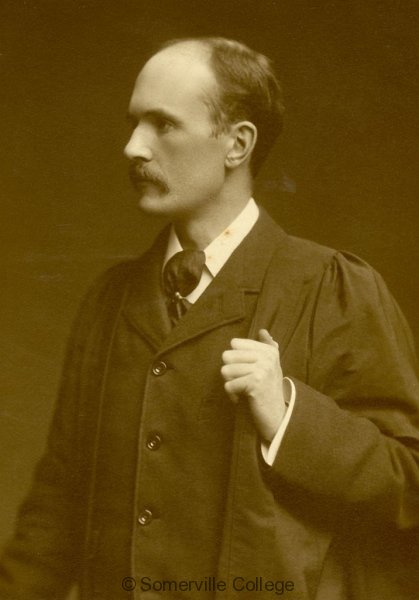
Gilbert Murray, speaking at a dinner held on 13 February 1936 in honour of his 70th birthday.
Professor Gilbert Murray was an important figure in philosophy and classics, and Greek in particular, and from the biographies I have discovered, he had a remarkable life and varied career, although he was not particularly a geographer, and is well remembered even today as well as being honoured during his lifetime.
He was born in Australia, but was sent to study in the UK, with some time spent being educated at the Merchant Taylor's School.
As with several Presidents I have written about at this time, he didn't have an obvious connection with geography and education. He was another person involved in this period of change in the Association, when the plan was to bring in distinguished outsiders with geographic interests to strengthen the standing of the Association.
Murray was the Regius Professor of Greek at Oxford (Somerville College) from 1908 to 1936 (so was in post during his time at the GA), and also a Professor of Greek at Glasgow University. They have a Gilbert Murray Memorial Lecture which is held every three years.
His Presidential Address also had a 'Classical' feel to it.On #IWD2022 I'm thinking of all the women who, though 'certainly more remarkable and interesting than the average of the men,' were held back in their education simply because they were women. The quote is from Gilbert Murray, professor of Greek at Oxford. pic.twitter.com/AymPwuIumq
— Dr Daisy Dunn (@DaisyfDunn) March 8, 2022
It was called
Orbis Terrestris
Source: https://archive.org/details/geography11a12geoguoft/page/n33/mode/2up
This is an interesting address, which has very little actual 'geography' in it to begin with, but explores some ways in which the Earth was conceived of by early scholars.
He uses less than PC language about 'foreigners", although he says that some of our views on them comes from not really understanding the differences and the similarities between us.
"With increased knowledge of the world", he says, "we get to see the reasons for the differences of custom, and they cease to be so upsetting."
However, the next section is not quite as forgiving. "It is the same with physical characteristics. Europeans are often conscious of the smell of negroes and dislike negroes accordingly."
And then redeems himself again.
"But a very little anthropology teaches us that all human beings smell.... a Japanese waiting maid is apt to fall in a faint at the smell of a number of Europeans... When knowledge and understanding come in, the peculiar sense of horror connected with the unknown vanishes."
He continues by speculating on relations between countries which may be to come, referring to the League of Nations, and possible relationships between Africa and Europe with regards to "exploitation".
I came across this film of Murray speaking, on YouTube.
This is very early stuff.... Hilaire Belloc's clip on his post from 1915 is slightly earlier, but there is only audio of him.
Could this be the first of the GA Presidents for whom some video footage remains? I think it must be!
Not sure when this was filmed, but obviously quite a long time ago, and when Gilbert Murray was older.
One of his lasting legacies is that he was an original and active member of the Oxford Committee for Famine Relief, founded in 1942, which later became Oxfam.
References
https://wikivisually.com/wiki/Gilbert_Murray
https://gilbertmurraytrust.weebly.com/about-gilbert-murray.html - Gilbert Murray Trust
Somerville College: http://blogs.some.ox.ac.uk/archive/2011/09/22/gilbert-murray/ - source of the image, to which they hold the copyright - used here under Fair Use.
https://universitystory.gla.ac.uk/biography/?id=WH2276&type=P
- Glasgow University
His papers are held at the Bodleian Library: http://www.bodley.ox.ac.uk/dept/scwmss/wmss/online/modern/murray/murray.html
GA Presidential Address:
“Orbis Terrestris.” The Geographical Teacher, vol. 11, no. 1, 1921, pp. 5–14. JSTOR, www.jstor.org/stable/41553245.
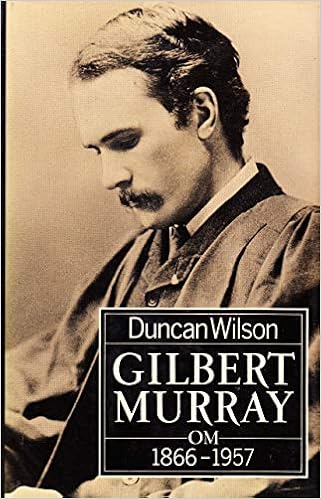
Biography of Gilbert Murray, written by Duncan Wilson

As always, if anyone has anything else to add about Murray's contributions to the GA, particularly during his time in office, get in touch.
In 1920, the University relented. Emily Penrose became one of the first five women to receive their Oxford degrees, presented to her by staunch ally and President of the Somerville Council, Professor Gilbert Murray. pic.twitter.com/lvdRVXMgrj
— Somerville College (@SomervilleOx) January 26, 2023
Shelleyan 57: Regius Professor of Greek and humanist @Humanists_UK Gilbert Murray (1866–1957). He corresponded with the Shelley editor Neville Rogers on matters Shelleyan. Murray wrote that ‘to a man who has once read himself into Shelley, the world never looks the same again’. pic.twitter.com/EOMa9Cw2hE
— Bysshe Inigo Coffey (@shelleyscholar) December 3, 2022
Our friends in Glasgow are pleased to announce an upcoming Gilbert Murray Lecture on 6th October.
— Classical Association of Scotland (@CAScotia) September 20, 2022
Poet, critic and translator A. E. Stallings will deliver the fifth triennial lecture in honour of Gilbert Murray, Professor of Greek at the University of Glasgow from 1889 to 1899. pic.twitter.com/0zqVMmPAEc
An intriguing connection here with the Second World War and anti-Nazi activity.
Bloomsbury, 1933, and each week my father & his pals were going to meetings & marches to try to do something, anything, about the rising anti-semitism in Germany. Everyone was fully aware of what was happening. Fully aware. This was six years before the outbreak of war. pic.twitter.com/mXJ8ICnVGO
— Anne Louise Avery (@AnneLouiseAvery) October 28, 2018
And an even more interesting (perhaps) link here is to the formation of the charity Oxfam. This started as the Oxford Fund for Famine Relief, and Gilbert Murray was in the group that founded it, along with Vera Brittain and Edith Pye.
Oxfam began from the Oxford Committee for famine relief, setup by professor of Greek, Gilbert Murray, to help the starving Greeks in WWII.
— Pavlos (@pavlosant) November 27, 2014
I looked at this in more detail:
On January 27, 1942, George Bell, the bishop of Chichester, spoke to the House of Lords in support of an appeal for Greece. Later that day the House of Commons announced that a shipment of wheat would be sent from Egypt, through the Allied blockade, and on to Greece. Within several weeks, regular shipments of supplies began to reach the devastated nation.
Writer Vera Brittain, who had been involved in humanitarian issues as well, believed that a relief campaign by pacifists Pacifism would not be taken seriously by the British parliament. She encouraged the development of an organization, which would convey a sense of seriousness and focus. Members of the Friends’ Service Council Friends’ Service Council[Friends Service Council](the permanent relief organization of the Quakers) met on April 22 to discuss forming a national famine relief committee; the planned organization was announced on May 29. Longtime Quaker activist Edith M. Pye was named the fledgling committee’s honorary secretary, and she worked to ensure the group’s success by securing supporters.
On October 5, the Oxford Committee for Famine Relief had its first meeting.
Source: https://wikisummaries.org/oxford-committee-for-famine-relief-is-founded/?utm_content=cmp-true
Margaret Mackintosh RIP
Updated post. Sad news at the end of last week from colleagues who have organised the Charney Conference over the years of the passing of Ma...