Biographies of all the Presidents of the Geographical Association since the founding of the Association in 1893. Researched by Alan Parkinson (GA President 2021-22), with contributions from others, including the former Presidents themselves where possible.
Hilaire Belloc was GA President in 1915. He was a bit of an 'outsider' President.
While in Devon I found a second hand copy of one of his 'geographical' books: The Road. He was a great traveller and quite a few of his books are on the theme of travel, and this was one of the reasons he was asked to be President (you can read his own entry on this blog)
I light my lamp in the evening: My work is left behind; And the great hills of the South Country Come back into my mind.
The great hills of the South Country They stand along the sea; And it's there walking in the high woods That I could wish to be, And the men that were boys when I was a boy Walking along with me.
July sees the end of the school term and the start of the summer holidays which are a particular focus for teachers.
For me, the month started with a flurry of activity and continued to be busy for most of it.
The first main event was the PTI Subject Enrichment Residential.
This is an annual event (now back after several years when it could not take place).
It is hosted by Cambridge University, and takes place at Downing College, which is close to the city centre, and runs across three days.
Claire Kyndt, my colleague also presented her ideas which were based on the Dear Data project: data visualisation.
This was followed by a trip to Parker's Piece to carry out some fieldwork. This included a range of options for collecting data or interacting with the place.
Interestingly, the area was occupied by the stalls, stage and other elements of a free weekend Mela event. This included an observation wheel which Claire and I went on for a good view of the area, across the city, and with a distant view of Ely Cathedral on the horizon. There was some good feedback from the delegates.
It was then down to Stansted to catch a flight to Madrid. Thanks to Claire for giving me a lift to the airport. Thanks also to Miguel-Angel for picking me up.
I was there for 4 days to lead a course for the GI Pedagogy project. We were hosted by UNED.
The GI Pedagogy project had received an extension of four months from the British Council.
I've previously blogged about the nature of this project, and the one that predated it. I co-presented the introduction to the 3 day course, and multiplier event with my colleague Michaela Lindner Fally from Borg Obendorf school in Austria.
The training course at UNED took place on Monday to Wednesday.
We are grateful to the delegates who joined us from a number of countries. There were also quite a few online delegates.
Luc Zwartjes, one of my colleagues was leading quite a few of the sessions, and was then heading off to the ESRI User Conference in San Diego where he also presented our project to a good audience.
Final days of term then followed, which were also hot, and included the Powerhouse Games with John Willis and the team.
A Governance Working Group meeting also took place, where there were several important items to consider for next year. This is part of the strategy work which the President is involved in. It took place in London as a 'central' location for most of us.
There were also plenty of submissions to look at from the GA's two Quality Marks: Primary and Secondary. This has been part of my summer routine for over ten years now. There were plenty of entries, which is great to see.
The PGQM is the Primary Geography Quality Mark which schools can apply for. I have been moderating applications for some years now, and this year there were a growing number of schools as some had deferred
I was involved in a Zoom meeting with a school which had opted to go straight to an application for Gold. This was a lovely chance to find out more about the way that a few individuals can make such an impact within a school.
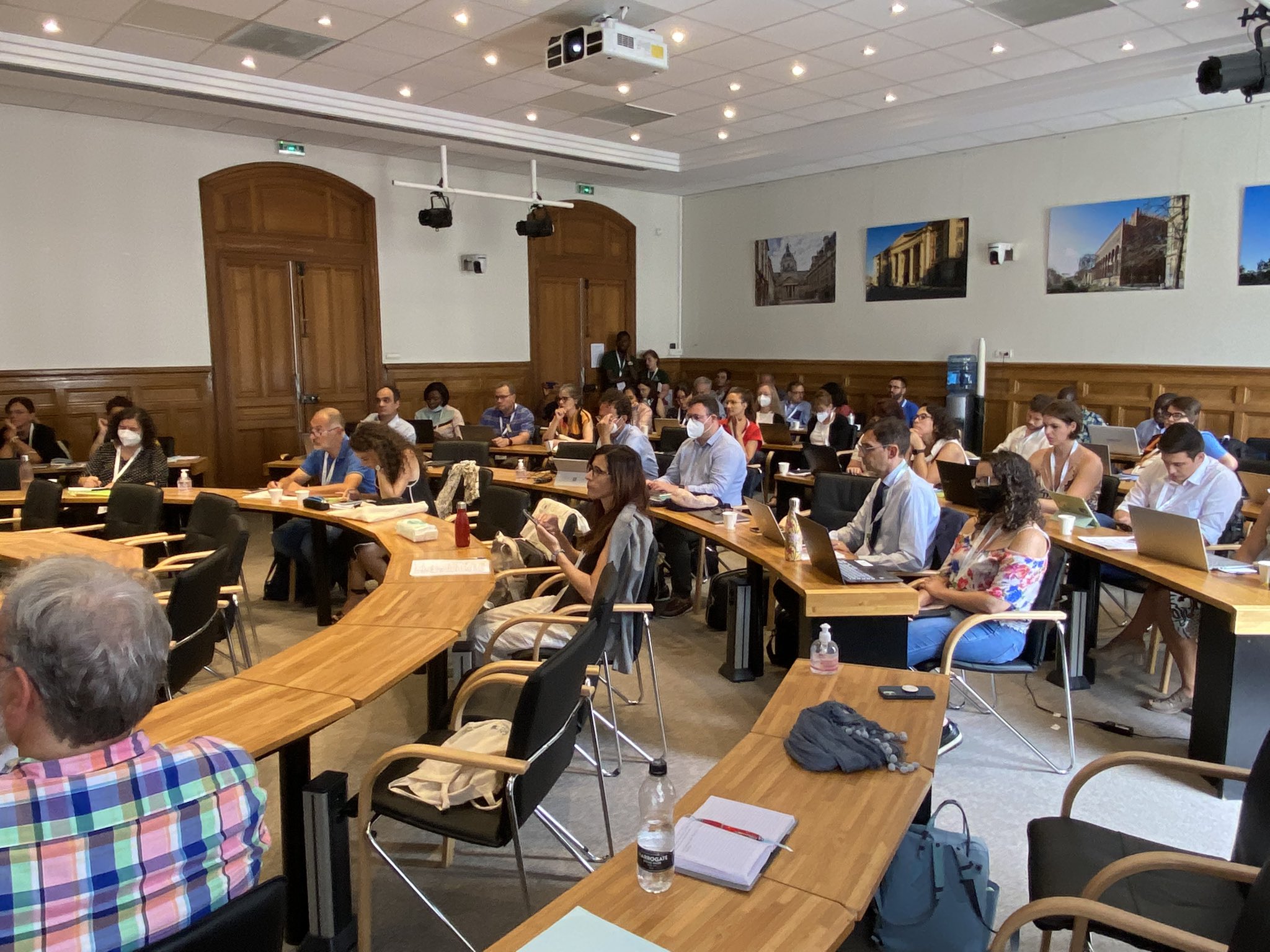
The IGU Centenary Congress took place in Paris, following another related event in Rennes the week before.
The GA has been connected with the IGU for some time now, with the work of former GA Presidents such as L Dudley Stamp and Norman Graves.
Sadly, this coincided with a heatwave and unprecedented heat and my travel plans were thwarted at the last minute as trains were delayed and I missed the Eurostar, which it then turns out was delayed by over three hours and took about six hours to make the journey. The heat in Paris was a factor, along with vandalism of the power lines.
The return journey also looks like being problematic.
This was a bit of a disaster as I'd spent weeks working out my itinerary of various adventures around the IGU sessions that I was involved in, with some Georges Perec fieldwork to carry out.
It was great to see that our GI Pedagogy project was presented at the IGU however, and with a great turn out for the session.
We also had some unprecedented heat, so instead of suffering 40 degrees in Paris I was present to experience 40 degree heat in the UK instead, which led to fires destroying houses just 20 miles from where I live.
This map highlights the places that are forecast to be hotter than the UK on Tuesday.
looking at applications to be added to the GA's list of consultants and checking the references and credentials
working on ideas linked to the GA Conference 2023 and tweaking the format to reflect changing nature of CPD and the wishes of teachers
further work linked to the Governing Body and following other strategy meetings - much of this work goes on behind the scenes and is not really public but is important
contacting new trustees to welcome them to the Governing Body
work on website developments - this is ongoing work
continuing work on projects related to the GA's Strategy: Advocate, Connect and Empower.
started the moderation of SGQM with a meeting of the moderation team. I've been involved with this since the start of the Award.
some final work on the D3 ERASMUS project
more work on the GI Pedagogy project.
I also had some good news towards the end of the month.
I have been successful in my application to receive a Fawcett Fellowship for 2022-23 from the UCL Department of Geography/Institute of Education.
This will involve me in some research and writing and offers a fund to pay for related expenses. My focus will be on the everyday and how it forms part of curriculum making.
I also met up with Denise Freeman, who will be GA President in 2023-24 to talk through some of the work that Presidents have to do.
The month ended with a long awaited holiday.
Topsham in Devon is a place which we have been visiting as a family for many years and we generally stay in the same place, which sits right on the River Exe. It was great to be back again.
Here's the Cobb at Lyme Regis:
The month ends with the usual Twitter stats, which show a busy month but one which had fewer tweets than usual - a pattern likely to be continued next week.
This leaves just one month to go and then my year as President will be over all too quickly.
I hope to pass on my experiences to future Presidents and I hope my Presidents blog project will be a legacy that I will add to when I get the chance to visit the GA Archives.
Images: Alan Parkinson, Sophie Wilson, Luc Zwartjes
A name to conjure with and someone who worked at the Institute of Education and later in Tanzania and also presented at the GA Conference in the past.
An obituary written by Norman Graves was published in Geography
He was trained by James Fairgrieve and also served on GA committees including the Standing Committee for Visual Aids in the teaching of Geography. He worked with Brian Roberson and I Molly Long, who were of course heavily featured on the blog back in the day, with Molly being a former President of the Association.
I was pleased to hear yesterday that I have been awarded one of the Fawcett Fellowships for 2022-23
Fawcett Fellowships are awarded each year by the UCL Institute of Education.
Edith Fawcett endowed annual Fellowships in the Department of Geography at UCL in 1987 in memory of her father, Professor C B Fawcett, who was head of the department between 1928 and 1949.
Charles Bungay Fawcett had a link with the early years of the Geographical Association in that he joined the staff under A. J Herbertson at the then-new School of Geography at Oxford University. He was later a lecturer at University College, Southampton, and Leeds University. In 1928, he was appointed Professor of Geography at University College London, where he remained until his retirement in 1949.
The Fellowships were originally designed to enable UK-based teachers and other professional geographers in mid-career to spend a sabbatical term studying at UCL. The teaching Fellows continued to be paid their full salary and the scheme funded replacement geography teaching.
In 2018, a second option was added, which provided a format based around twilight workshops and a focus for research rather than the sabbatical term. Fellows are given access to research libraries and the experienced staff of UCL IOE.
I wrote a statement outlining my proposed focus of Everyday Geographies and their place within the curriculum, to allow me to pursue the thinking I had already completed in preparation for my GA Presidential year, the lecture and related sessions through that year.
This classic book by C B Fawcett is still in print. He also wrote a Political Geography of the British Empire first published in 1933.
I shall be sharing my progress and thinking here, so that others can see what is involved and perhaps considers putting themselves forward for a Fellowship next year.
While researching a number of updates for other Presidents I came across the papers of Charles and Frank Fenner and their travels to the UK.
Describing a visit to the BAAS Section E committee in the 1930s...
2 to 3 September 1937, Nottingham, BAAS Meeting
Professor Fawcett (London) gave his Presidential address on World Movements of Population. He stressed the fact, and supported it with unanswerable figures, that the Southern Hemisphere could never be of any great importance in world history. Have often stressed to my students the same thing, based on the same facts, but presented differently. He brought out many other remarkable facts about world tendencies in population. It was a very fine effort, indeed, one of the best I’ve heard at any time.
I am just back from the Geography dinner. A most excellent and pleasant meeting. I was seated by the President as an honoured guest, with Mrs Haile, wife of the Trent waterworks engineer, who has made all those wonderful flood models, on my right. And Mrs Roach, sister of Brigadier General Winterbottom, who has had charge of surveys all over the world, on my left. Both were very pleasant and we talked freely so that the hours went by without noticing. Next on the left was Dr Bews, of Natal, South Africa, who has written a geographical book that I must get hold of.
Next on the right was, of course, Professor Fawcett.
Fawcett, London, is a very fine man, and I have told you of his excellent Presidential address. Opposite was Dudley Stamp, who has written geographies of all the world, and all its countries. We talked of possible Land Utilization mapping in Australia. He it was, I suspect, who gave the President material for the remark in his speech of the quiet-spoken man from Australia whose books they knew and who had lately travelled 35,000 miles at the rate of 150 miles per day. A bit of a stretch of my figures. Just before I left a young man of the London University came up and said he must meet me, as he gave two lectures every year from my books! And, in general, everyone was very friendly and nice. Saw Stevens and Maclaren to say goodbye. General Winterbottom is the most charming fellow, fine after-dinner speaker.
She has been looking at slides with accompanying sketch drawings which also exist within the Oxford HEIR archive (e.g. record 49990 here http://heir.arch.ox.ac.uk/pages/search.php) and trying to source their provenance, which she believes may be with us.
“From my research I am increasingly of the opinion that the typed caption slides were the result of the work of the Lantern Slide Committee of the GA."
G.W. Palmer of Bristol was instrumental in setting this up and first proposed this in 1906
Source:
GEOGRAPHICAL LANTERN SLIDES / G. W. PALMER : The Geographical Teacher , Spring, 1906, Vol. 3, No. 4, pp. 177-178.
This was taken up by B.B. Dickinson, who compiled a set about the Rhine Valley & arranged an Exhibition of these slides at the annual meeting of the G.A. that year LANTERN SLIDES OF THE RHINE BASIN / B. B. DICKINSON : Geographical Teacher , Autumn, 1907, Vol. 4, No. 3, pp. 133-141.
His introductory remarks to that exhibition refer to the work of the Lantern Slide Committee, esp p. 161 THE USE OF LANTERN SLIDES IN TEACHING / B. B. DICKINSON : Geographical Teacher , Spring, 1908, Vol. 4, No. 4, pp. 161-163
This will then tie in with the 1910 article which mentions the construction of the catalogue I am trying to trace and the fact that the Diagram Co. was responsible for the sale & hire of the slides. I understand that this arrangement lasted until 1939.
NEW VIEW SLIDES PREPARED FOR THE GEOGRAPHICAL ASSOCIATION / Anon : Geographical Teacher, Vol. 5, No. 6, pp. 294-295.
Some very useful information here to follow up on. Any thoughts welcome.
Our Geographers Gaze project is launching soon hopefully, in time for the new academic year.
I started in on a rereading of J B Priestley's classic 'English Journey' (published in 1934) yesterday, and on the very first page, there is a mention of a book by two former GA Presidents: L Dudley Stamp and Stanley Beaver.
June is the final major month of the school year - for me at least - there are others who have to go on for quite a long way into July, or who have perhaps largely finished by then depending on which country they teach in, and the relative importance of the exam season to their timetable.
The first part of the month was during my half term, which included the Jubilee weekend, but it was certainly back with a bang to the final half term of the year.
National Fieldwork Week ran from 6th-10th of June. We hope it may be back next year.
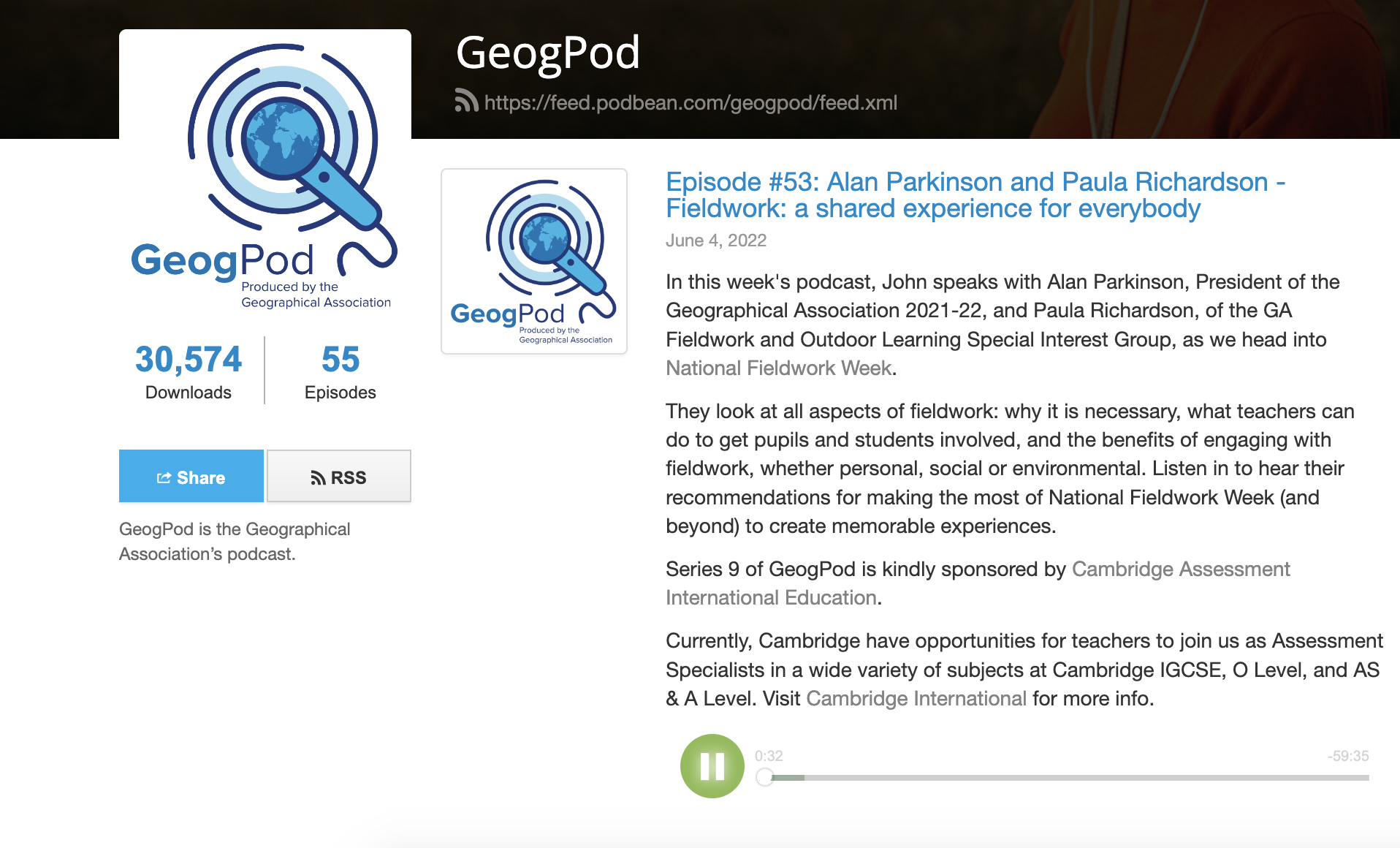
The latest GeogPod was released on the 4th of June, and features Paula Richardson and I talking about the GA's National Research Report and how that fed into the development of the National Fieldwork Week.
Thanks to John Lyon for hosting - see if you can spot the question I wasn't expecting... :)
Day by Day
6th of June
The RGS-IBG AGM, followed by the Awards Ceremony was on my original agenda, but the tube strike led me to have to cancel these plans unfortunately.
And then the weather on Monday morning was torrential rain followed by a lull when I managed to get outside with one group.
Colleagues in other years also got involved.
7th of June
The sun shone and I went outside with all of my groups.
8th of June
The weather changed back to rain, which started to clear by mid morning. This time I was able to get out with a group and explore changes in Ely.
9th of June
Three groups went out today.
I went on a Cambridge GA Branch Walk through the CB1 redevelopment in the evening.
This was organised by the Cambridge GA Branch and led by former GA President Chris Kington - it was very entertaining and informative. Also attended by another former GA President: Keith Grimwade.
Former GA President Chris Kington led a superb @CambGA tour last week giving geography teachers the inside scoop on redevelopment in the CB1 area. Want to be more involved with your local GA? Get in touch. We'd love to hear from you 😊 #geography#geographyteacherpic.twitter.com/hOJvOgdNRE
— Cambridge Geographical Association (@CambGA) June 13, 2022
10th of June
Southwold
Chris Webster has run the Southwold-based Geography Fieldwork Academyfor a number of years, although he returned to the classroom during the lockdown and mothballed the operation. It is now back up and running and offering NEA and other sessions for students.
They have also created the GeogIt app.
I visited them for the day.
This included a quick tour of Southwold with Chris where I ended up seeing a few new developments in the town and talking to the Mayor as well as seeing the classroom spaces which Chris makes use of when he has groups of varying sizes.
At the end of the day, we had a picture taken with the group he was helping that day. It turned out to be the college where my own children went! (although they didn't do Geography...)
In between this I also found time to have a lovely lunch and a pint of Adnams (of course) in the Sole Bay Inn.
There were many other Presidential bits and pieces that happened in the middle part of the month. I'm missing out all the usual tweets
On the 17th of June it was the start of the planning for Conference 2023 with the first Conference Planning Board meeting for 2023. This lasted for two hours, and as President I chaired this particular meeting. The next meeting will be chaired by Alastair Owens as he will have started his Presidential term by then. Next year's conference will take place in Sheffield between the 13th and 15th of April. The theme is 'Collaborative Geographies'.
GA Governing Body meeting was next up.
This took place at Queen Mary University, London
I travelled down to London on the train on the hottest day of the year so far and ended up (after a detour to Hammersmith) at my hotel in Brick Lane. The evening before was a meeting followed by a curry and drinks at Aladin restuarant on Brick Lane itself.
Can I recommend the Premier Inn Hub hotels if you are staying in the area for an evening.
This was followed by a Governing Body meeting with a very full agenda on a very hot day. There are three GB meetings a year. It was the final meeting for several trustees, including Susan Pike, whose term as Past President is also coming to an end at the same time as my Presidency will. I have three more GB meetings to attend in that capacity before ending my term. There are also co-opted and named trustees and I could also put myself forward for election. We heard the results of the recent Trustee election, which will be revealed later in the year.
I also spent an afternoon talking to the PGCE colleagues at Homerton College.
This was a useful taster of my Prince's Teaching Institute session, which also includes my colleague Claire Kyndt. Booking details were here.
Events continued to appear in my calendar:
- GI Pedagogy meeting where we discussed the progress made so far and planned for the next phase of the project - this also culminated in planning for an event next month in Madrid which took a great deal of my time
- Additional meeting at Homerton College for mentors as well as students to look at fieldwork - this was sadly disrupted by the train strike, so I had to do it virtually for an hour which was a little more stilted as a consequence than a face to face event but I'm told by a few people there that it was well received and very useful for their future roles
- Consultancy over a new resource on the theme of disasters, with an educator currently based in Australia - this follows an earlier resource based on Hurricane Maria in Puerto Rico.
- Discussions over a new Primary resource coming in 2024 which I will work on over the summer, along with a new GIS resource
- Edits for an article that is going to appear in the next issue of the British Cartographical Society's magazine Maplines
- Small input to GeogLive!9 on the topic of fieldwork - mostly to thank everyone who had put together some inputs and who had contributed to the Fieldwork Week itself. It's been great to see the support of the EYPPC in particular for this event.
- Reading minutes of the various phase committees and other groups who meet several times a year to discuss how they can support the Association and fellow members - it's important as President to try to keep across all this activity, and there is a lot of it.
I was going to say hello in person, but instead I had to record a hello message to the student presenters.
- Travelled down to London to see Pat Metheny at the Eventim Apollo - the first time I've seen him since a trip to Hull City Hall before lockdown during the city's time as City of Culture - it was a remarkable concert - I also took the opportunity to wander a bit of West London that I hadn't been to before (or at least for a while) It was a superb concert as well.
We also had a whole late flurry of activity:
- discussions on the ongoing work on the GA website
- ideas for further support for members as the year progresses
- planning for further strategy meetings
The final bit of good news for the month arrived on the last day of the month. We had been waiting for the final report from EPOS: the Belgian agency for ERASMUS projects, on our D3 Project.
The objectives of the D3 project were to: 1. Promote the use digital technologies and open data tools in learning and teaching. 2. Increase the capacity of learning and teaching to integrate democratic engagement considerations into educational plans and strategies. 3. Establish suitable styles of learning to access and integrate open data into schools and 4. Improve educational stakeholders’ response to the need for data and information literacy in schools and teacher training.
We had a very positive final report on the project, and I was particularly pleased to have written a series of lesson blueprints which were featured here, and animated by Greg Donert.
Ending with the usual Twitter stats for the month - a lot of National Fieldwork Week tweeting has upped the number again, and also the impressions - I had almost 100 000 impressions of my tweets during that week alone.
Looking at my stats in the last ten months, it's clear that being President of the GA increases your followers. Since I opened up my tweets from their previous private status at the start of my Presidential year, I've added over 2000 new followers.
I'll be closing my tweets again on August the 31st and weeding out any accounts that aren't authentic.
Just two months to go now. Next month looks just as busy as this one to be fair.
The latest GeogPod has been released and it features Paula Richardson and I talking about the GA's National Research Report and how that fed into the development of the National Fieldwork Week.
May can be a bit of an anti-climax after the GA Conference which is held in April, but it also marks the start of the final third of the Presidential term, when thoughts turn towards legacy and also transition for the incoming President as well.
I started the final third of my GA Presidency this month. The work continues though for all GA Presidents (and also the Vice and Past President)
I started the month by checking 2nd proofs of an article I had been asked to contribute to one of the GA's Journals: Teaching Geography, which began in 1975 with Patrick Bailey as the Editor. This will be published in the Summer 2022 edition.
The GA's Governance Working Group meets ahead of the GA Governing Body, to set the Agenda and also consider some strategic decisions and thinking. We decided on a date for meetings later in the month and year.
The Geographers Gaze project moved on with web pages being built and captions added from the work I completed with Peter Fox.
I had a CPD meeting with Guy Nunnerley - the Head of Geography at Wisbech Grammar School - regarding my own PDR (Professional Development Review) - an annual or biannual obligation for many teachers - focussing on KS2-3 transition. Thanks to Guy, who I used to work with when he started out in his career - for giving up the time to meet with me and share what he and his department are doing, and their plans for next year. It's important as teachers that we get to see what other schools are doing and I've been very fortunate to visit hundreds of schools over the years in various roles.
Open Day was held on the 7th of May at school - we welcomed visitors and parents who were thinking of joining the school. I then headed home to join the Charney Online Conference.
This was an excellent one-day event with good conversations. I used the presentation here:
Thanks for the kind words. I also learned a lot from the other presenters and have access to their presentations as well.
The following week was a D3 Multiplier Event.
The GI Pedagogy project had been presented at the EuroGeo Conference in Mytiline in Greece the weekend before but I was unable to be there. We heard that the British Council had approved an extension due to COVID preventing a lot of our work, which was good news, so thanks to them. Another ERASMUS project involving my school: Rise the Life was also able to carry out its long delayed residential mobility to Turkey as well.
The ESRI UK User Conference returned to a face-to-face format, and I had permission to make my way down there. Sophie Wilson and Brendan Conway from the GI Pedagogy team were there. I also had the chance to meet up with the ESRI Education folks, Steve Brace from the RGS, Shanique Harris (who is leading a new RGS project called Geography for All) and Francisca Rockey from the Black Geographers group.
There was also a meeting of the GI Pedagogy project the following week.
Other things that I did this month:
- Completed some consultancy for a VR firm who are building scenes for students to explore with additional educational content.
- A day working at the Forum library in Norwich
- Attending part of a meeting of the GA's Post 16 and HE Committee - one of several who support the work of the GA and give up time to meet at weekends and also complete work according to a Work Plan which is then reported to Education Group.
- Discussions with Alastair Owens: the GA Vice President, about the format of the GA's Awards and preparations of papers for Governing Body
- Working on some resources for TeachIt Geography
- Working on a forthcoming book project which I can't mention
- Consultancy with a design agency
- Worked on some materials for the BBC to accompany a film made by De'Graft Mensah, which is part of a series on Empire and Ghana (where his family is from).
COBRIG is the Council of British Geography and has been in existence for many years.
The Council seeks to include representatives of all major geographical organisations in the UK. It invites representatives from the following organisations:
Alan Kinder was unable to attend and asked me to stand in for him. We had several papers which were included in the agenda and I gave an update on activity largely based on the National Research Report.
Image: Alan Parkinson, shared under CC license
The final week brought some more projects:
- an article for a cartography magazine, which looks good
- some consultancy with a design agency and others
- preparing for the next Governing Body meeting in June by writing some papers
- many personal emails and DMs on social media to share resources and ideas
- discussions around GIS use in the profession
GeogPod is the GA's Podcast, which is hosted by John Lyon. There have been over 50 episodes of the podcast so far, and remarkably I hadn't been asked to do one until now.
The month ended with the start of half term holiday. Just another half term to go before a much needed summer break, when I hope to progress some projects but also decompress as we approach the end of my Presidential term, and support those stepping up to the next stage: Alastair Owens and Denise Freeman.
I was also interviewed on the morning show on BBC Radio Guernsey.
The usual Twitter stats at the end of the month. Quite a lot down on the previous month which had all the tweets relating to the GA Conference which were all amplified.
That's three quarters of my Presidential year done.
"to
advance the interests of geography, and is made up of all the main organisations of
geographers and geographical educationists in Britain."
Prominent among its
initiatives in the educational context has been the recent COBRIG-inspired
Geography into the Twenty-First Century (Rawling and Daugherty, (1996)), which
has at its heart the central issue to which this article has been addressed: putting the geography back into geographical education. This offers the basis of a fruitful
agenda as represented, among other things, in Haggett’s delineation of ‘the central
and cherished aspects of geographical education: a love of landscape and of field
exploration, a fascination with place, a wish to solve the spatial conundrums posed
by spatial configurations’ (Haggett, 1996, p. 17); in Johnston’s advocacy of a
refreshed, dynamic, and distinctive place geography (pp. 73-4); and in Jackson’s
concern for developing sensitivity to place connections at a variety of scales (p. 91);
or, as Allen and Massey have put it:
‘We live local versions of the world and in so doing we have to locate ourselves
within a wider global context. We only understand the changes taking place in our
own backyard when we begin to understand how changes taking place elsewhere
affect our world’ (1995, p. 1)
Neil Simmonds and Eleanor Rawling were originally involved from the GA's perspective, along with Richard Daugherty.
COBRIG previously ran seminars for geographers as well through the 1990s in particular.
This meeting was held at the Royal Geographical Society - the first time I'd been there for about three years and it was good to be back in such a historic location.
It was lovely to meet some old friends - particularly Erica Caldwell who was representing SAGT / RSGS, and also to make new acquaintances.
If you were present at the GA Conference 2022, you will have seen Shaun Flannery, the official photographer for the event, who was very busy moving from one event to the other and capturing the variety of sessions that were on offer.
Here's a couple featuring me - if you were there, see if you can find yourself:
Me opening the GA Teachmeet in the evening of the first full day - copyright: Shaun Flannery / Geographical Association 2022
At the Public Lecture and GA Awards we announced the next Vice President (and future President) of the GA: Denise Freeman - copyright: Shaun Flannery / Geographical Association 2022
Now if you missed out on coming along to the conference and booking but are now regretting it, we also have an offering for you.
Around half of the overall conference sessions were streamed live or recorded on the day.
This is the big month for any GA President since 1976 (prior to that the GA Conference was held over the New Year and the first week of January to kick off the President's year and allow them to set out their stall.)
The first part of the month was obviously dictated by the preparations for the GA conference, and ensuring that as many people as possible were able to attend in a format which suited them. This resulted in a number of late changes to the programme - inevitable when there are so many hundreds of people involved and their circumstances change.
We were also keeping a wary eye on COVID cases rising and the need to avoid unecessary contact with others - although guidance had also changed. Some people reconsidered their plans to attend the conference.
As always, the approach to the Easter holidays meant a great deal of extra work for the team at Solly Street and building excitement with late bookings pinging in minute by minute towards the deadline for registration, which was then extended for a few more days as there was a rush of last minute bookings.
April started with me already on holiday, and there was plenty of pre-conference organisation and admin to do. It was time to complete my GA Presidential address, which I thought I had done, but kept tinkering with until a week or so before the time.
I updated my Chirpty circle diagram ready to put into my Presidential lecture, which shows the people I interact with on Twitter.
There are many elements to draw together for a conference and they all came together well. I am so grateful to everyone who took part, and particularly to Isabel Richardson, Becky Kitchen and everyone at the GA, many of whom came along in person.
I prepared my presentation for the GEOLive event, which was based around my book 'Why Study Geography'.
My Presidential lecture was also finalised, and then tweaked endlessly, and there were still things that I remembered I was going to say.
On the 10th of April, I headed over to Guildford - first long drive for a while and first time on the M25 since before the pandemic.
I got involved in a few things:
- Arriving on Sunday and spending four hours helping to set up the GA reception desk and stand, stuff delegate bags, prepare lanyards etc. Also finally got my GA Presidents badge.
- Meeting the team who were going to be live streaming sessions, including Maddie Duggan who I had met before
- A lovely Italian meal in Guildford the evening before everything started, up on the High Street.
April 11th-13th was the actual GA Conference. It was really wonderful.
- Talking to exhibitors and welcoming delegates - I spoke to as many people as I could
- Welcoming and chairing the Public Lecture by Professor James Cheshire
- Attending the wine reception and also the conference dinner on the first evening
- Sorting accommodation
- Chairing a number of sessions, including Professor Ian Cook's excellent Follow the Things session,
- Trying to speak to as many of the attendees, exhibitors and delegates as I could
- Doing my Presidential Address to a large crowd - a little down on previous years, but there were people joining online and I was very pleased with how it went - thanks to Alastair Owens for the introduction
- Chairing a discussion with the author Cal Flyn - her book 'Islands of Abandonment' was one of my favourite reads of recent years and has been nominated for (and won) a whole range of awards. It was lovely to see Cal, although there were a few technical issues on the day which meant she couldn't see us.
- Attending a number of sessions including those presented by Sharon Witt and Helen Clarke, Alan Kinder and Eleanor Rawling
- Lunch sat in the sun with my department from King's Ely Geog, who had come out in force to supprt me. Particular thanks to Claire Kyndt for stepping up and presenting a workshop on her fieldwork ideas based on the 'Dear Data' book
- Up to the Teachmeet at the end of the day, at Seasons Restaurant near the Cathedral. Some wonderful presentations, particularly the one from Iram Sammar. You can watch a recording of the Teachmeet here.
- Food at the networking and board games evening - a chat to Peter Vujakovic of the British Cartographic Society
- Down to the Beermeet - a bit of a walk - some great conversations and thanks to those who bought me a drink
- Chairing a session on Follow the Things by Professor Ian Cook
- Watching several excellent sessions, and also presenting my own session at the GEOLive event.
- Helping to take down some of the conference elements that I had helped to set up on the Sunday
- Chairing the final session of the day: the Rex Walford Lecture
A few images from the day - there are many more to come, but I haven't been given the links to view them just yet.
Delegates will be able to access copies of the recordings now.
Thanks to all the GA Solly Street HQ staff:
Copies of presentations will also be appearing on the GA Conference webpage.
Some other things I got up to this month:
- continuing to work on ERASMUS projects, including contributing to the GI Pedagogy project
- liaising with the various schools that I work with in a number of ways
- creating some materials for the MAT that I am supporting for the next term and a bit
- setting up multiplier events for ERASMUS
- pencilling in meetings at the Council of British Geographers (COBRIG) at the RGS-IBG
- working on my paper for the 100th IGU in Paris - my session has been scheduled for the Wednesday of the IGU.
- heading down for a day wandering London, visit to RGS-IBG and then an amazing conference
- setting up a D3 multiplier event on Eventbrite
My Ordnance Survey webinar needed preparing for the end of April, and this was on the theme of fieldwork. Thanks to those who came along. The recording will be available for that soon as well.
Also preparing a suite of resources for a Prince's Teaching Institute event in June.
April 29th saw the GA going green...
Make sure that you start planning for the National Fieldwork Week.
I rounded off the month by sharing the news that we have a new elected Trustee vacancy and also have a new co-opted trustee who will
I also visited Cambridge and got a copy of a number of new books, and saw some excellent art from Ai Wei Wei, and David Hockney.
As usual, here are the month's Twitter statistics - a bumper month with a quarter of a million impressions.
I'm also closing in on 7000 followers having added over 1200 in the 8 months since I made my Tweets open for my Presidential year, and 200 in the last month alone.






.jpg)


.png)


