Wednesday, 3 December 2025

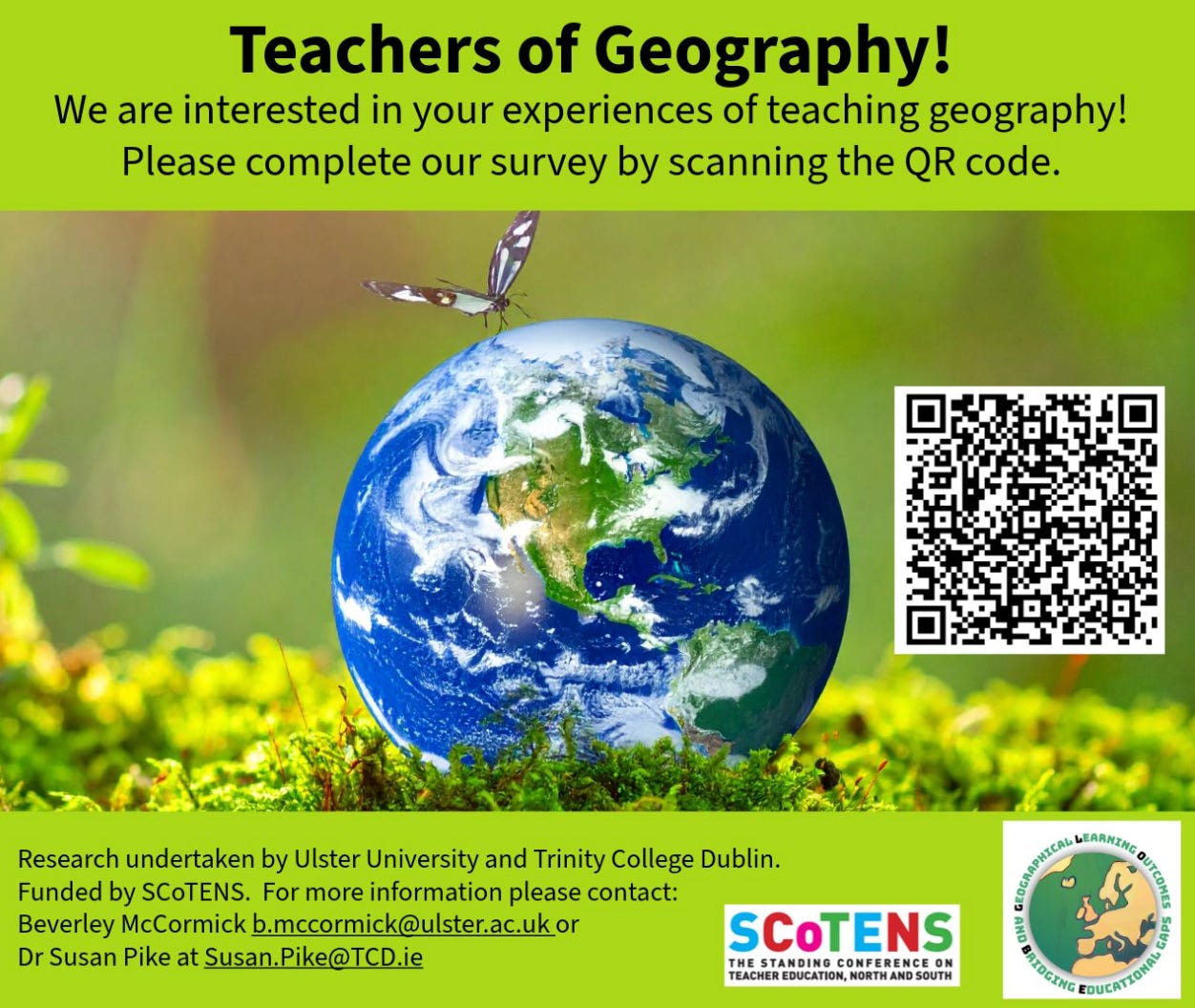
Your views on teaching geography...

Your views are needed by Dr Susan Pike and her fellow researchers. Details below and scan the QR code to find out more.

Thursday, 27 November 2025

25% Discount in the GA Shop

The Budget may have impacted your spending plans, but here's something to enjoy.


The GA has brought some Christmas cheer with our end of the year sale. With a 25% discount on all GA shop items, you can treat yourself to a special teacher present this holiday season.

This discount applies whether you are a GA member or not so everyone get the chance to make some holiday savings.

Use code EOY25 at check out to access this discount.

Monday, 24 November 2025

Coastcraft in use

Good to see the Coastcraft game that I helped create educational materials for (on behalf of the GA) was featured on ITV regional news. Thanks to the students and teachers who trialled the game and provided feedback.

Headache relief from the GA's SPC

I served on the GA’s Secondary Phase Committee for over 10 years, joining in 2004 and learning from a whole range of people from previous eras of the GA’s work, and many familiar names from textbooks and other influential stages of school geography. 

The current committee have been producing videos to help subject leads with issues which might be giving them headaches. 

Check out their page on the GA website for more details.

Here's an example video from the series:

Wednesday, 5 November 2025

Musical Geographies at the GA Conference 2026

So Matt Podbury and I are putting the band back together...


Our session at the GA Conference 2026 has been accepted and we've teamed up for some musical improvisation... this one's in 9/8....

Here's the details, we submitted, which will appear in the programme in due course:

Musical Geographies: Sense of Place and Storytelling in the curriculum

Music is a dynamic, everyday phenomenon that connects billions of people, places, and cultures. It offers a powerful lens through which to understand the world and our place within it. From local rhythms to global genres, music, and its associated visuals provide students and teachers with meaningful insights into diverse environments which help shape their worldview. 

For this collaborative lecture, Matt Podbury and Alan Parkinson are putting the band back together!

Matt will share how an idea to showcase his vinyl collection evolved into a rich, three-week unit on the Geography of Music for KS3 students. This explores themes such as sense of place, landscape and emotion, and the role of music in shaping our cultural identity, and addresses how music can be both a unifying and divisive force. Students design and produce their own vinyl LPs to end the unit.


Alan will share his new collaborative World of Music blog, which charts a year long journey through curriculum resources and collaborative pedagogy around music and its meanings; a playlist of ideas for teaching everyday geographies.

You will gain practical ideas, resources and inspiration for incorporating music into your own geography curriculum.

This one goes up to 11!


Thanks to those who have already sent their contributions.

Curriculum and Assessment Review - the report and DfE response

We finally have the outcome of the Curriculum and Assessment Review with the publication of the final report today. Many thousands of educators have been waiting for months.

In July 2024, the government commissioned Professor Becky Francis CBE to convene and chair a panel of experts to conduct the Curriculum and Assessment Review.

The report has taken on board the many consultation responses from individuals and organisations.

These are available in a summary document which is separate to the main final report - this is also worth looking at.

The RGS's original response to the call for consultation is here. It was referenced in the final report, along with the GA's, and reports from UCL's Centre for Climate Change and Sustainability Education.

The report has been almost a year in the making, and runs to 197 pages.

The recommendations for Geography are as follows:

We recommend that the Government: 

Makes minor refinements to the Geography Programmes of Study and GCSE subject content to respond to the issues identified, including by: 

• Refining content to support progression better to further study, deepen children and young people’s understanding of key geographical concepts, make content more relevant and inclusive, and remove unnecessary repetition across topics. 

• Embedding disciplinary knowledge more explicitly at Key Stage 3, such as geographical enquiry, spatial reasoning, use of digital tools, human  geography and use of evidence, to ensure all children and young people have access to high-quality geographical education. 

• Clarifying and reinforcing requirements for fieldwork to demonstrate its role more effectively in supporting content and the developing of disciplinary knowledge, ensuring changes remain proportionate and inclusive. 

Embeds climate change and sustainability more explicitly across different key stages, including across the physical geography, geographical applications and human geography sections of the curriculum, ensuring early, coherent, and more detailed engagement with climate education. This should be done without risking curriculum overload. 

There is also an element of media literacy here for climate change education in particular, where there is a lot of misinformation and disinformation. There is a need for pupils to be aware of AI and its value and issues.

There is also mention of the need for diversity and for all students to "see themselves in the curriculum" - something which I was particularly keen to see.

And these will ultimately form part of changes to the national curriculum (will this be compulsory for all schools?) and GCSE subject criteria. These will be consulted on again and no changes will happen before 2028 in any case.

On the purpose of the review itself:

National curriculum content must be kept up to date, fit for purpose and reflective of the needs of wider society. Periodic holistic reviews of the national curriculum are therefore essential for ensuring these aims are achieved, as well as for maintaining overall curriculum coherence. Reviews are also a valuable mechanism for addressing curriculum shape in the round. Reviews can evaluate whether the breadth and depth of different subjects and their content remains appropriate, as well as determining the overarching aims of schooling and the time needed for the different activities required to meet these aims. Reviews can also address the build-up of content in particular areas to ensure that the curriculum remains deliverable for teachers and ambitious for students.

The Oak National Academy is also mentioned as being further involved in the development of curriculum materials which are up to date.


The DfE has responded to the Curriculum review and that is published here. This is just over 60 pages long and has a little more useful detail on the implications.

We agree with the Review that the national curriculum and the resources that support it, should reflect our modern society and diverse communities. Our aim is for the curriculum to be both a mirror, in which every child can see themselves and their communities reflected, and a window through which every child is connected to the world beyond their existing horizons and perspectives

On the topic of GCSE Natural History

Equipping children and young people to thrive in a rapidly changing world therefore means enabling them to understand and meet the global challenge that climate change presents. We will take the opportunity to enhance the climate education content which is already present in the national curriculum, in the subjects of geography, science and citizenship. We will also include sustainability within the design and technology (D&T) programme of study and sustainable practices within the citizenship primary curriculum. We agree with the Review that key concepts on climate education should be introduced earlier in the curriculum and will ensure that the relevant programmes of study contain this at primary level. We also want to go further on this and ensure that more people can engage with and develop respect for the natural world.
 
We will therefore consult on the subject content for the natural history GCSE, as confirmed earlier this year.

The Review noted that changes to curriculum content are only part of the picture and that teaching also has an important part to play through the use of climate-related examples and resources to teach existing curriculum content. The National Education Nature Park, funded by DfE, has a website which hosts free resources and activities for all education phases across a wide range of subjects. These are aligned to the curriculum and quality assured by experts, giving educators trusted information that allows them to teach about sustainability and climate change with confidence, in subjects where climate education is a core part of the curriculum content and in other subjects.

On the topic of Geography

We agree with the Review that the subject does not need significant change, and we will update and refine the programme of study and GCSE subject content with modest changes, to support pupils and teachers. As recommended, changes will support a better understanding of the disciplinary requirements in the national curriculum and in the GCSE, ensure the content is updated where needed, including in relation to climate education, and clarify and integrate the fieldwork requirements. We will also improve the GCSE subject content to support better progression, deepen understanding and remove unnecessary repetition across topics.

Some videos have also been produced on LinkedIn featuring Becky Francis.

"We will follow the curriculum principles of coherence, subject mastery and depth – making sure that programmes of study and subject content are grounded in relevant and important knowledge and disciplinary skills."

A document with some notes I put together today has been shared on Scribd. See the bottom of the post.

Others have shared their thoughts on LinkedIn, or Substack (such as Mark Enser).

There will also be a fully digital and easily navigable version of the national curriculum - we will create a rich, connected online version of the curriculum which visually represents the links within and between subject areas and gives connections to prior learning, helping teachers to contextualise learning across traditional subject boundaries in the classroom. 
Some final initial thoughts:

When a long-awaited Government document such as this appears there will be lots of different perspectives on it: from teachers to senior leaders, to those working in Trusts (who will need to adapt what they teach). 

As the Review recommends, we intend to retain a single national curriculum which serves as a core entitlement which every pupil can access. We are legislating through the Children’s Wellbeing and Schools Bill so that academies will be required to teach the refreshed national curriculum alongside maintained schools. This will ensure that parents and carers have certainty over the core concepts in their child’s education and that there is a floor beneath which this cannot slip. The national curriculum is not the entire curriculum but an underpinning of what every child is entitled to know, which schools build on locally. Schools will continue to remain responsible for deciding how their school curriculum brings those core concepts to life in their choices of historical events, physical and human geography, and novels, for example. This will allow them to create dynamic learning environments where pupils can flourish. 

From those who feel too much has changed to those who don't think the changes have gone long enough.
Some involved in climate change education will be pleased to see it referenced several times, others will feel it doesn't go far enough.
Some commentators e.g. the Daily Mail will see it's mentions of diversity, social justice and students 'seeing themselves in the curriculum' as lacking the 'rigour' that was promised in the previous iteration. 
Some will say that achieving the aims for some will be possible, but not perhaps 'for all'?
Some will ask where the money is coming from.
Some will focus on the assessment element of the review and question
Some will delve into the data that was included in the review and question some of the findings.
Some will be interested in the wording of "nature and adventure".
Some will ask about the continuing lack of take-up for GIS despite the availability of free tools such as ArcGIS and its related apps.
Some will be thinking about the place of AI in this...
Some will be considering the powerful pedagogies (echoing the work of Margaret Roberts) that are required to turn the words on the page of new documentation into the enacted curriculum. I've written about that before.

"Music excites when it is performed" - Benjamin Britten

Some will say nothing today as there is much to emerge over the next two years ahead of any impact in schools.
Some will wonder about the impact on option numbers and job security, or the state of the teaching workforce.
Some will not know any of this is happening because they're getting on with the day job... and that's fine...

What are you thinking?

Here's an implementation timeline...


Pearson are one of the Awarding bodies, and they have responded already.
Others will respond over the coming months.

The RGS and the GA will swing into action once things become clearer to support geography teachers through the changes ahead.
Thanks in advance to everyone who is going to be involved in that work.

Curriculum and Assessment Review Report by Alan Parkinson

Green Skills Report from the GA

A new report from the Geographical Association in time for Green Careers week.


Geography shapes who we are, how we view the world and how we live within it. It enhances everyone’s learning, livelihoods and lives, and has a vital role to play in supporting the next generation to develop their green skills.


Geography and Green Skills aims to highlight:
  • how geography enhances young people’s understanding of climate change and sustainability and develops their environmental awareness and green skills
  • the good practice of schools and the perspectives of employers and industry sectors
  • the future opportunities and challenges for geography, and where further action is needed.
There is also an accompanying Powerpoint presentation.

Wednesday, 15 October 2025

What facts shall we teach?

 A nice article in an early edition of 'The Geographical Teacher' from 1918....


As we wait for the report of the Curriculum and Assessment Review, what facts should we teach?

Source:

Orford, E. J. “GEOGRAPHY : WHAT FACTS SHALL WE TEACH ?” The Geographical Teacher, vol. 9, no. 5, 1918, pp. 212–15. JSTOR, http://www.jstor.org/stable/40554678. Accessed 15 Oct. 2025.

The Hopkin Review of School Geography 1991-2023

A new research report has been published today by the Geographical Association. Thanks to Steve Brace for sending me a copy.

It has been written and compiled by Dr. John Hopkin, who was President of the GA in 2010. There were also contributions made by Dr. Paula Owens.

Thanks also to Iain Freeland and members of the GA Assessment and Examinations Special Interest Group for reviewing the report.


It analyses evidence from Ofsted reports and other sources to explore standards in the geography curriculum, teaching, achievement and leadership. 

The report identifies changes in standards over time, including:
  • periods when school geography was flourishing and standards were improving, as well as other times when the subject was under widespread pressure in particular key stages
  • notable strengths in managing the curriculum, high-quality teaching and positive achievement in many schools across key stages 1 to 4. Between 2000 and 2025 alone, over 6 million students in England, Northern Ireland and Wales sat a GCSE geography exam
  • a number of weaknesses, some enduring through the period, including the systematic study of contemporary places, the development and use of geographical skills to investigate the world, and opportunities to engage with fieldwork, ICT and, in secondary schools, GIS.
I shall have a read when I get the chance and post some thoughts as an update here.


Friday, 3 October 2025

Coastcraft - now out and ready to play...

This is a project which I worked on through 2024 and into 2025.

It's finally out there for you to download and play. 

And we can finally share it as it's had the official Government Press Release today!!

You'll need the Education version of Minecraft - which is free to download in various formats. The project is also free to download.

CoastCraft places the player in the role of managing the coast and making decisions for the needs of the community and the environment. The player can explore and visualise the future impacts of the decisions made and evaluate varying approaches to managing the coast.

CoastCraft is an educational game designed for students aged 9-14 (in England - Upper Primary Key stage 2 and lower secondary key stage 3.). 
This game transports players to the coastal town of Bude in North Cornwall, modelled in Minecraft Education™ by BlockBuilders. Playing CoastCraft introduces students to the dynamic processes shaping coastal areas and challenges them to make decisions that balance the needs of various stakeholders while protecting the environment.

It was great to work with Tom Collins and colleagues from the Environment Agency. I learned a great deal from the coastal experts that were also involved in the project.


Learning objectives
General

  • Learn about the features of coastal landscapes along with coastal processes.
  • Understand the characteristics of sand dune ecosystems, sand dune succession and how sand dunes are used as a nature-based solution for flooding and coastal erosion.
  • Explore a range of coastal management strategies to respond to predicted changes resulting from climate change and sea level rise.
  • Explore and visualise a range of potential futures influenced by the interactions with communities and stakeholders and the choices made by coastal managers.
Stage 1: Mini-games
Mini-game 1: Storm Tower Erosion:
1. Learn about the processes of weathering and erosion acting on the coast.
2. Understand the impacts of coastal erosion on people and the environment.

Mini-game 2: Dune Rollback and Succession:
1. Learn about the processes of sand dune formation.
2. Understand the characteristics of sand dune ecosystems, the process of sand dune succession and how healthy dune ecosystems develop.
3. Learn how sand dunes are used as a nature-based solution for flooding and erosion at the coast.


Stage 2: Main Game
1. Understand the concept of sustainability in relation to sustainable decision making in coastal locations.
2. Learn about the strategies and complexities of coastal management and how experts make informed decisions to manage coastal challenges.
3. Model how climate change, physical processes, and human decision-making interact to shape and transform coastal landscapes over time.
4. Explore and visualise a range of potential futures influenced by the interactions with communities, stakeholders and the choices made by coastal managers.


Please refer to the CoastCraft Teachers Pack in Supporting Files for more information. 

I worked on this and I'm really pleased with how it's turned out. Here's the front cover. This can be downloaded from the link above and acts as a guide to coastal erosion as well as providing guidance on how the game works.


Finally, here's an excellent video guide made by Block Builders.


This follows on from the Rivercraft projects that I worked on previously. They are also on the Minecraft Education website.


Some quotes from the press release...

Caroline Douglass, Executive Director for Flood and Coastal Risk Management at the Environment Agency, said:

Coastal erosion is a natural and ongoing process and England’s coastline has never been static, but we know climate change is increasing the risks.

CoastCraft inspires young people to use their creativity to experiment with solutions to real world problems within the virtual Minecraft world, ensuring the next generation has the knowledge they need to face challenges now and in the future.

Floods Minister Emma Hardy said:

As a former teacher, I’m thrilled that CoastCraft will help young people understand the impacts of our changing climate, empowering a new generation of scientists.

This virtual Minecraft world brings coastal change in communities like Cornwall to life, to show how the risk of flooding and coastal erosion is increasing due to climate change.

We’re investing a record £7.9 billion in capital funding over 10 years to better protect these coastal communities and are committed to making sure flood risk management is fit for the challenges we face now and in the future.

Loic Rich, Cornwall Council’s cabinet member for environment and climate change, said:

We’re really proud that our coastal community of Bude serves as the backdrop to this innovative game that teaches young people about coastal and flood resilience.

We want to say a big thank you to students at Sir James Smith School in Camelford and Windmill Hill Academy in Launceston, both of whom worked with our climate adaptation team to help develop and test CoastCraft which can now be played by young people across the globe.

Pity our contribution didn't get a mention...

Monday, 29 September 2025

Christine Speak RIP

In this blog, I have tried to feature people who may not have had the same public profile as others, but who in their own way were particularly supportive of the Geographical Association.

The Autumn 2025 issue of GA Magazine featured an appreciation for the memory of Christine Speak, a former chair of the GA's International Committee, active in Hong Kong, author of articles for GA journals and a long standing member of the association.

It also included a link to a video with Christine, which can be viewed on this link.

Embedding not permitted...


Could you be the GA President for 2027-28?

You have until October to put yourself forward...


There is also a position for an Elected Trustee.
This is the current Governing Body, with Alastair Owens as Chair.


Thursday, 25 September 2025

ALCAB

Remembering the work of ALCAB. This was set up to advise on the content of reformed 'A' level specifications. Their work resulted in a number of new subjects appearing on specifications.

Our role was to provide advice to Government and to the Office of Qualifications and Examinations Regulation (Ofqual) on the content of A-levels in the subjects of particular importance for preparation for the leading universities. We were funded by a grant from the Department for Education.

Our detailed work in respect of individual A-level subjects was undertaken by specialist subject panels made up of experienced academics. Our work focused on the ‘facilitating subjects’ identified by the Russell Group, which are mathematics, further mathematics, English literature, physics, biology, chemistry, geography, history, and modern and classical languages.

Our work built on the findings of the A-level subject content review conducted by the awarding organisations and Ofqual. ALCAB established expert subject panels to review the content of A-levels in mathematics, further mathematics; modern foreign and classical languages; and geography. The panel reports were published in July 2014.

We will also contribute to the review process for A-levels that Ofqual will establish in the longer-term. Through this process, we will consider the content of the remainder of those facilitating subjects not identified for detailed consideration by subject panels in the first phase of our work, providing advice and drawing on relevant expertise as appropriate.

The Geography Subject Panel.

The Geography Panel is chaired by Professor Martin Evans who is a Professor of Geomorphology at University of Manchester and Head of Geography in the School of Environment, Education and Development.

Geography Panel members are:

Dr Pippa Chapman, University of Leeds

Professor Klaus Dodds, University of London

Professor Richard Harris, School of Geographical Sciences

Professor Anthony Long, University of Durham

Dr Emma Mawdsley, University of Cambridge

Professor Richard Phillips, University of Sheffield

Ms Bridget Oeppen, Hills Road 6th Form College, Cambridge

Dr Alistair Owens, Queen Mary, University of London

Dr Ruth Weaver, Plymouth University

Dr Rita Gardner, Royal Geographical Society

Mr Alan Kinder, Geographical Association

ALCAB ended in January 2015.

I wonder, ten years on, whether the Curriculum and Assessment Review will require similar panels to advise on subject content updates, rather than such changes coming as part of the Review document itself.


Thursday, 18 September 2025

A few new updates

I've tickled away at the site over the summer and updated the entries for quite a few people. 

I'm keen to keep the site up to date as the years progress since my own Presidential year. 

If you are reading this and you have been a GA member for a while or have a story (or pictures) from a previous GA Conference, or anecdotes relating to past GA Presidents,  please get in touch.

GA Conference - 2001 - University of Sussex

Thanks to Joseph Kerski for the image

Your thoughts on 'Teaching Geography'

Teaching Geography journal is 50 years old this year, having appeared for the first time in 1975 under the editorship of Patrick Bailey. I have blogged about the journal many times here.


The Teaching Geography editorial board invites you to complete a short survey to share your thoughts on the journal. 
This is an opportunity to express what you enjoy, what you feel could be improved, the topics you'd like to see covered in future articles, and your ideas for the journal’s direction.

Send your thoughts here.

Tuesday, 9 September 2025

Geographer for Hire

As regular readers of my LivingGeography blog will know, I've been reducing my time in the classroom - partly as a way to ensure that teaching stays sustainable for me at my advanced age, but also because I've been fortunate to have a range of interesting external projects in the last couple of years, including books, curriculum making with the Oak National project, BBC Bitesize work, work with the Environment Agency and my ongoing role at the Royal Geographical Society. I've shared this work in my Worldly Wednesdays posts during the year.

This year, I have gone down to three days teaching a week.

Most of those projects mentioned above have now come to an end, although a few new things have already been pencilled in for this year. This means that I have some time free some weeks this academic year to get involved in further projects and am always interested in something new.

If you think I could help you with a project, even if it's just for a few hours or days then feel free to get in touch and tell me more about what you have in mind. Below you can see some of the organisations and publishers I've worked with over the years. 

I haven't added the Geographical Association and the Royal Geographical Society because they're obvious.


My email is a DOT parkinson AT gmail.com

Also find me on LinkedIn.

Message me on BlueSky @geoblogs

Image: Alice Griffiths

250 000 page views

I always like to mark significant milestones of page views. A little surge of visitors in the last few months across my blogs. Wondering whether it's AI scraping text to train itself...  Thanks for visiting the blog.

Thursday, 4 September 2025

Early bird booking now available for GA Conference 2026

Early bird booking is now available for the GA Conference 2026.


More tickets will be released but the price will be higher.

The GA Annual Conference and Exhibition 2026 will be held from 8–10 April at the new and exciting venue of Sheffield College.

Day one will begin at 12.00 on Wednesday 8 April including your choice of a range of field visits, Awards ceremony, Public Lecture and Conference Dinner, plus special opportunities to talk to the GA and hear more about what we do and how to get involved.

Days two and three will feature the usual diverse range of lectures, workshops, Teacher-to-Teacher and research paper sessions. Join for all three days and receive a discount on the daily rate, or choose the best days for you, with special daily pathways dedicated to ECT and primary colleagues.

Make the most of your time in Sheffield by engaging with our networking events, talking to our special interest groups and maybe proposing your own talk for the annual Conference TeachMeet.

Visit the exhibition to speak with representatives from around the geographical community: exam board representatives, sustainable travel companies, field studies centres, publishers, charities and more.


Sunday, 31 August 2025

2025: Catherine Owen

For the fourth year out of the last five, the GA President will be a teacher, and a female state-school teacher for the third year in a row - and with a fourth to come next year. Quite a turnaround from the long-established pattern.

Catherine Owen is the new GA President for 2024-25

I sent Catherine the questions that I had given to all other Presidents and used them to create the post below. 
I'm grateful to Catherine for the level of detail she provided and taking the time to help create this entry on the blog.

When and where were you born?

I was born in Bristol in 1972. Both of my parents are Cornish and my Cornish heritage is an important part of my identity.

Where did you go to school / university?

I grew up in Yatton, a village outside Bristol which had been chosen for rapid expansion from the 1960s onwards. There was such a rapid influx of children into Yatton Infants School in the late 1970s that all the classrooms were Portakabins, with the old stone school building reserved for assemblies and lessons such as cooking. 

Aged seven we moved to the Junior School next door, which had four classes in each year group. 

Graduation day

It was wonderful to grow up in a village full of families with young children, but the rapid growth also
meant a lack of facilities and services.
We were bussed to the village of Backwell for secondary school on a fleet of around 13 coaches. I was a quiet, hard working student and appreciated the opportunities that Backwell School gave me, including learning to play the clarinet and saxophone and to go on visits including to France and The Netherlands. 

I studied maths, physics and geography for my A levels whilst also working at a local supermarket and taking part in the guiding movement as a Ranger Guide and as the Young Leader of a Brownie pack.
I wanted to be a teacher from pre-school, but initially thought I would study history. 

It was my amazing GCSE and A level geography teacher, Mr George, who changed my mind. 

I applied to study geography and physics at Lancaster University, but was horrified to find on results day that I had only achieved an E in geography, despite being predicted an A! 
At this time you applied to Universities and Polytechnics separately, so I called my first choice Polytechnic and was delighted to be
accepted to study Geographical Sciences.

By the time I arrived, Plymouth Polytechnic had become Polytechnic South West, then I actually graduated from the University of Plymouth in 1993 with a 2:1. I stayed in Plymouth to complete my PGCE at Marjon University, including placements in Plymstock and Bodmin.

What has your career been?

I would have loved to stay in Plymouth to teach, but no suitable jobs came up. 

My first teaching position was at Holyrood School in Chard, Somerset, where I taught yr 7-13 geography and also GNVQ Intermediate Leisure and Tourism. After a year I was given responsibility for the National Curriculum theme of Environmental Education, which came with a small pay rise. 
I also completed a MEd in School Effectiveness and Improvement with a group of teachers from Somerset – my PGCE had included little theory and I felt that I needed to learn more about the art and practice of reaching.

After four years and a term in Chard I moved to The King Alfred School, picking up the Head of Geography role in January 1999. 26 years later I am still Head of Geography at King Alf’s – I fell for the school and haven’t found another role I would rather do. 

King Alf’s is the only school serving the communities of Highbridge, Burnham on Sea and surrounding villages, so it is a true community school with wonderful staff. We have been through some difficult times over the years, but always look after each other. Whilst I may have been in the same school role for a long time, I have had many opportunities to be involved in different projects and adventures, often through the
Geographical Association

My first foray into writing was an article based on my MEd research for ‘Teaching Geography’ back in 2000. 
I have since written a range of articles, including co-authoring an article for ‘Primary Geography’, and have also written toolkit books,  and a chapter in the ‘Secondary Geography Handbook’ along with other resources. 
Most recently, in 2024 my book on 'Teaching Climate Change' written with Andrew Taylor, was published by the GA. 

I have also presented CPD for the GA, including the ‘Quality Geography for Non-Specialists’ course
which I currently lead twice a year.

My work for the GA led to other opportunities, including contributing to a GCSE textbook for OUP, a KS3 textbook for Hodder and a GCSE revision guide for Clear Revise. 

I have written many resources for Tutor2U and thoroughly enjoy presenting some of their Revision Blasts
on YouTube. 

I am also very active on social media with the handle @GeogMum reflecting
the importance of geography, teaching and my family to me.

The project which has meant most to me is my work with a group of schools in Uganda. When Seb Witts joined my department in 2014 he told me about St Charles Lwanga School in Kampala, where he had worked for 18 months. We gained funding from the GA Initiatives Fund (GAIF)  to bring the Headteacher, Benedict Ssaazi, to the UK in 2015, then gained funding from the Royal Geographical Society and King Alf’s to visit Uganda in 2016. 

This was the first of three visits, during which we worked with a group of schools on projects including questioning in the classroom and teachers observing each other and providing constructive feedback. In 2018 we held a one day Geographical Association conference at Good Times Primary School, with speakers from the Education Department and workshops hosted by local teachers as well as me and Seb. The Kasubi group of schools continues to collaborate on a wide range of projects and Seb took students from his current school to visit them in 2025.

We are also proud as a department to have achieved the Secondary Geography Quality Mark and Centre of Excellence from the GA.


What was your job when your became President?

I am currently Head of Geography at The King Alfred School an Academy on a 0.8 contract, doing consultancy work on my non-teaching day each week.

What theme did you choose when President, and why did you pick it? 
What had been your involvement with the GA leading up to that time?

I joined the GA as a PGCE student in 1993 and attended my first GA Conference in Southampton in 1995 – I have only missed a handful of conferences since then. I wanted to get more involved in the GA, so when I saw an advertisement for members for a working group on Leisure and Tourism in GA News I expressed interest. 
This group was ably led by Alan Marvell and I was a member for several years, until qualifications moved on and the group was no longer needed. I wanted to be involved with the GA, but found it hard to get a toehold. Following a lecture by Eleanor Rawling at a GA conference in 2007, where she encouraged members to become more active in the GA, I approached Eleanor, sharing my frustrations. Eleanor took me out of the lecture theatre and up to the first working group stand – the International Working Group. 

She introduced me to the Chair, Kevin Cook, asking if I could join. 

GA International SIG - Kevin Cook far left

I am so grateful to Eleanor for this, as I not only became more involved with the GA, but also met my ‘Geography Uncles’ Kevin Cook and Adam Nichols, who have given me so much support and encouragement. I became the Secretary of the group, then Vice-Chair, then Chair. Becoming Chair meant I joined the Education Group, learning more about the GA as a whole and having the opportunity to be involved in more discussions and projects. Throughout this time I had also become more involved as a  consultant to the GA, as described previously.
I also sit on the Publications Board and joined the Board of Trustees when I became Vice-President.

Kevin and Adam always joked that I was a future GA President, but I couldn’t see how I could take on the role whilst also being a classroom teacher. The increase in the use of technology from meetings and communication during COVID times solved the problem of being closely involved with an organisation based in Sheffield whilst being based in Somerset myself. 

L-R: Denise, Hina, Susan and Catherine

I was delighted when first Denise, then Hina, were elected as President whilst still in the classroom. With my children becoming adults, I felt it was time to put myself forward. 

I chose the theme of ‘Geography makes a Difference’ for three reasons:
  • Learning about the world makes a difference to our students. Some will be fascinated to learn about concepts and processes which enable them to make sense of the complex world around them. Others will be frustrated when they learn about issues and inequalities, developing a passion for tackling challenges which may shape the direction of their lives. Gaining knowledge of the world whilst developing geospatial, green and transferable skills can also make a difference to students by increasing their employability.
  • A high quality geography education is particularly important for students who experience disadvantage in education. Students who haven’t had the opportunity to travel, learn about different people and places and the geography curriculum can be designed to enhance cultural capital. Fieldwork takes students to contrasting locations where they can learn how to work in different contexts as well as developing their geographical skills. This learning can make a difference to our students life chances, giving them confidence to navigate their way through the world.
  •  Issues facing us can seem scary and the future uncertain. Geography makes a difference by giving students a space to learn about and discuss issues, supporting their well being. This is particularly important in relation to the Climate Crisis – geography allows us to explore the causes of this crisis and its different impacts, but also empowers us to ask questions and make choices to work towards tackling it.
I hope that this theme will encourage geography educators to reflect on their practice and consider the difference geography makes. 
How can we maximise the benefits of studying geography? How do we share ideas about how to make a difference through geography?

Why does the GA matter to you?

The GA matters to me because it encourages geography educators to work together to be the best they can be. It provides a voice for geography educators – we are stronger together.

Past Presidents Susan Pike and Gill Miller have been extremely supportive of my decision to put my name forward to be President and Gill helped me come up with my Presidential Theme. It is such a shame that both of their conferences had to be online due to COVID – they are both such great geographers, leaders and role models.
Hina and Denise have also been wonderful in showing me the ropes, and with Fiona to come after me, we make a great team!


Denise, Catherine, Hina and Fiona - the Presidential team


Friday, 22 August 2025

8 years ago today

The view opposite Solly Street has changed a lot since. I remember watching foxes in the grounds of the old church....


Saturday, 16 August 2025

Dudley Stamp's "Geographical Agenda'"

I've been reading around the future of geography and came across a piece by Michael Wise in a collection which was edited by Russell King for the GA back in 1985.

He referred to Dudley Stamp's "Geographical Agenda" which was laid out in his Presidential address when he was President of the Institute of British Geographers in 1957 before they joined up with the RGS.

Available on JSTOR.

LivingGeography - another milestone passed

Thanks to everyone who has visited the blog over the years and/or subscribed to the Substack. I started this blog when I heard that I had got my job working for the Geographical Association as Secondary Curriculum Leader back in 2008. A lot of things have happened since, and millions of words written.


Wednesday, 6 August 2025

Oak KS3 Curriculum - coming soon

I've just completed my last contribution to the Oak National Geography Curriculum project for KS3. I helped to work on the Primary Geography curriculum which is already available on the Oak website free of charge to use it as you see fit.


The Curriculum Plan can be downloaded from here.

14 units are already available, and the rest will be available for the upcoming Autumn Term.

Oak National - geography curriculum complete

I've been involved with this project for several years and it's finally at an end with the final bits of the curriculum to be uploaded ready for September. I wrote a bit, and reviewed quite a lot of both the primary and the KS3 along with a whole team of people.


You can find the Primary resources here.

Monday, 21 July 2025

Submission open for the 2026 GA Conference

Time to submit something to feel a bigger part of the event... and develop yourself professionally...


Here's another opportunity for you...


Friday, 18 July 2025

The ultimate GA souvenir

If anyone wants the ultimate Geographical Association souvenir, one has come up for sale...


This blog has provided details of all the previous homes of the GA.... from Aberystwyth, to Manchester to Sheffield and others...

The second picture shows the stacks I delved into for days to help produce this blog, and the third shows the mysterious lower floor which few have explored...

It will be interesting to see where the Association moves next. Interesting times, and a good decision given the nature of the GA's current work and education generally.

Your views on teaching geography...

Your views are needed by Dr Susan Pike and her fellow researchers. Details below and scan the QR code to find out more.