Saturday, 13 December 2025

Updated Presidents image

Every year, I need to update the word cloud of previous Presidents.

Here's the latest version, made with WordArt.


Geography and the Creation

There's an interesting 'dilemma' for some teachers who have a religious belief, when teaching about the origins of the Earth and the way it has been shaped since.  The Bible is quite clear on how the Earth was created. All faiths have some sort of creation story.

I was interested to come across this piece about an interview with Sarah Buckland.

An early GA President was very much connected with theology.

Sir William Mitchell Ramsay (1851–1939), was a skeptical Scottish archaeologist and Geographical Association president in 1918.

After reading the geographical locations of Paul’s travels (named in Acts), Ramsay tried using them to disprove the Bible’s accuracy. 

With extensive excavations in the Middle East, he tested the existence of variously mentioned New Testament places. But every single detail was so accurate when Ramsay retraced Paul’s journeys that he became a little more convinced in the stories being told.


Ramsay’s fieldwork took him to various locations such as Galatia, Phrygia, and Lycaonia (regions frequently referenced by the Apostle Paul). He meticulously followed ancient roads, recorded inscriptions, and studied the ruins of cities mentioned in the New Testament. His expeditions resulted in critical site identifications and discoveries, including:

• Confirmation of ancient city locations (e.g., Antioch in Pisidia) that aligned with Luke’s geographical references (Acts 13:14).

• Findings of inscriptions that supported political and cultural details recorded in the Book of Acts (e.g., local governance structures, official titles, and the presence of synagogues).

These archaeological contributions provided robust contextual evidence that lent credibility to the historical details in Scripture, causing Ramsay to describe Luke as a historian “of the first rank.”

Major Publications and Impact on Biblical Studies

Among Ramsay’s notable works are “St. Paul the Traveller and the Roman Citizen” (1895) and “The Church in the Roman Empire” (1893). In these volumes, he presented detailed arguments for the historical trustworthiness of biblical records, particularly regarding the missionary journeys of Paul. Drawing on inscriptions, architectural remains, and ancient documents, he provided corroborating data that supported the reliability of the narrative found in Acts.

His findings have been frequently cited as evidence that Luke was intimately acquainted with the political and cultural realities of the Roman world. Scholars across various theological traditions have referenced Ramsay’s work to fortify claims that the New Testament is grounded in legitimate historical events rather than merely religious speculation.

50 years of 'Teaching Geography'

The final episode of GeogPod for 2025 (and the 96th in total) is out now on your preferred podcast platform.

In another special episode to round off 2025, John talks with three members of the editorial board for the GA's journal Teaching Geography to celebrate 50 years of the publication.

Listen to conversation with Eleanor Rawling, Dr Emma Rawlings Smith and Katie Richardson and find out what makes Teaching Geography such an important publication for teachers and the GA community, with personal stories about getting involved with the GA, their favourite articles, and what's next for the journal.


Thursday, 11 December 2025

PTI Geography Symposium - July 2026

News of an exciting joint event that's being organised jointly between the Prince's Teaching Institute, the RGS and the GA.

It's called the PTI Geography Symposium.


It will take place at the RGS on the 9th and 10th of July 2026.

The event's co-chair, the ebullient John Wilkinson - here he is introducing the event in his inimitable style.

It's great to see that my GA Presidential theme of "Everyday Geographies" is front and centre here.

More details:

Our first-ever Geography Symposium is designed to empower and inspire teachers to be advocates for their subject inside and outside of the classroom for a curriculum that is challenging, innovative and enriching for all learners.

Through academic talks, workshops and sharing of best practice, the Symposium will celebrate Geography, enrich and develop your knowledge and love of the subject, and motivate you to consider how to inspire your leaners through engagement, enjoyment and empowerment. 

In celebrating Geography's interdisciplinarity, this event captures how Geography's cross-curricular core can ignite learners’ enthusiasm across a diverse cross-section of subjects at schools and colleges. This Symposium will capture, cultivate and celebrate the zeitgeist.

Themes:
  • Everyday Geographies
  • Supra-curricular concept capture
  • Fieldwork
Confirmed guest speakers include:
  • Dr Olivia Taylor
  • Professor Iain Stewart MBE
  • Dr Jonathan Higham
Many more speakers and details to be announced...

Central London accommodation, meals (including a formal dinner on Thursday 9th July) and course materials are included in the course fee.


£100 discount for RGS members, so it's worth becoming a member just for that... and gain all the other benefits of membership.

Wednesday, 3 December 2025

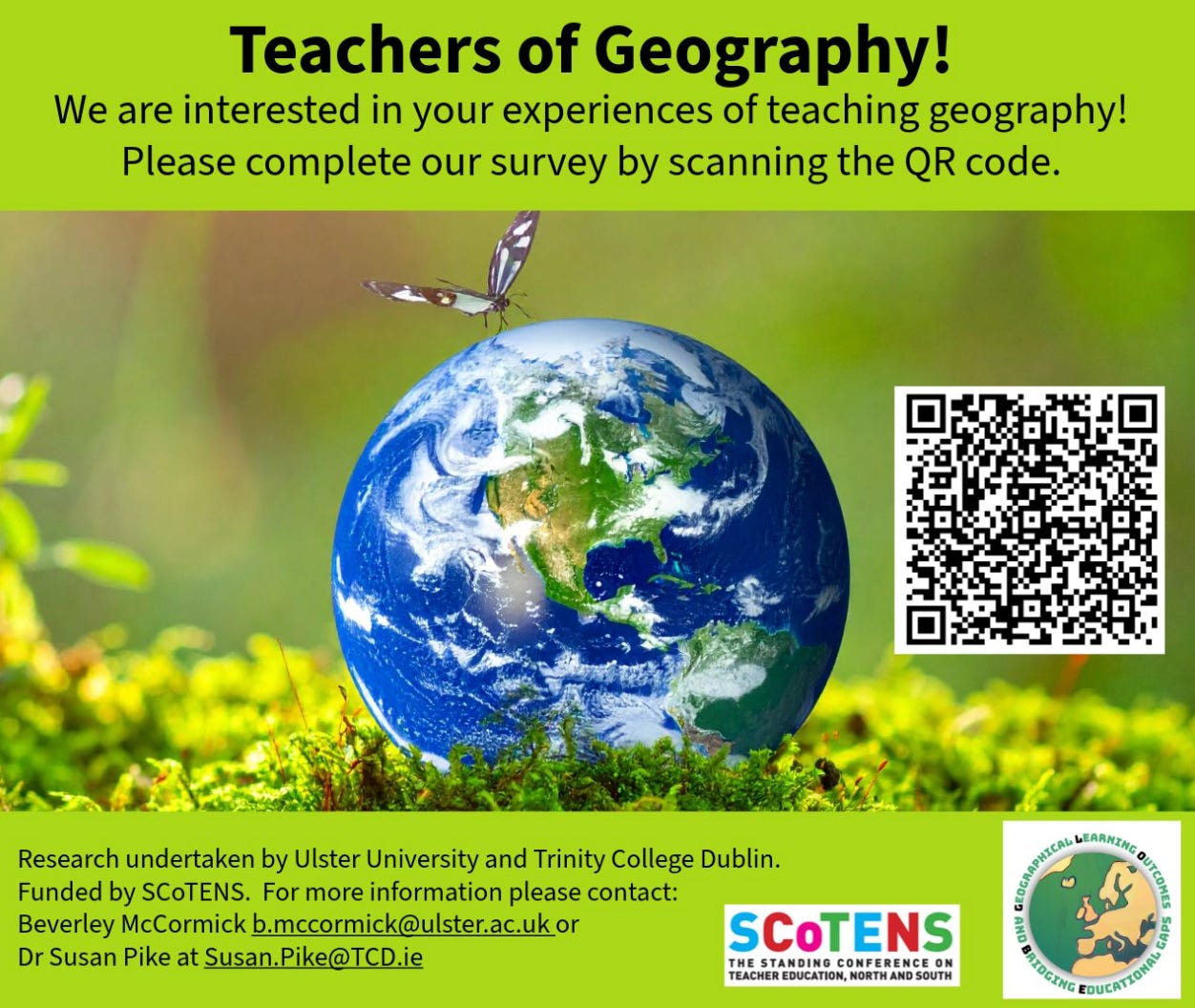
Your views on teaching geography...

Your views are needed by Dr Susan Pike and her fellow researchers. Details below and scan the QR code to find out more.
Thursday, 27 November 2025

25% Discount in the GA Shop

The Budget may have impacted your spending plans, but here's something to enjoy.


The GA has brought some Christmas cheer with our end of the year sale. With a 25% discount on all GA shop items, you can treat yourself to a special teacher present this holiday season.

This discount applies whether you are a GA member or not so everyone get the chance to make some holiday savings.

Use code EOY25 at check out to access this discount.

Monday, 24 November 2025

Coastcraft in use

Good to see the Coastcraft game that I helped create educational materials for (on behalf of the GA) was featured on ITV regional news. Thanks to the students and teachers who trialled the game and provided feedback.

Headache relief from the GA's SPC

I served on the GA’s Secondary Phase Committee for over 10 years, joining in 2004 and learning from a whole range of people from previous eras of the GA’s work, and many familiar names from textbooks and other influential stages of school geography. 

The current committee have been producing videos to help subject leads with issues which might be giving them headaches. 

Check out their page on the GA website for more details.

Here's an example video from the series:

Wednesday, 5 November 2025

Musical Geographies at the GA Conference 2026

So Matt Podbury and I are putting the band back together...


Our session at the GA Conference 2026 has been accepted and we've teamed up for some musical improvisation... this one's in 9/8....

Here's the details, we submitted, which will appear in the programme in due course:

Musical Geographies: Sense of Place and Storytelling in the curriculum

Music is a dynamic, everyday phenomenon that connects billions of people, places, and cultures. It offers a powerful lens through which to understand the world and our place within it. From local rhythms to global genres, music, and its associated visuals provide students and teachers with meaningful insights into diverse environments which help shape their worldview. 

For this collaborative lecture, Matt Podbury and Alan Parkinson are putting the band back together!

Matt will share how an idea to showcase his vinyl collection evolved into a rich, three-week unit on the Geography of Music for KS3 students. This explores themes such as sense of place, landscape and emotion, and the role of music in shaping our cultural identity, and addresses how music can be both a unifying and divisive force. Students design and produce their own vinyl LPs to end the unit.


Alan will share his new collaborative World of Music blog, which charts a year long journey through curriculum resources and collaborative pedagogy around music and its meanings; a playlist of ideas for teaching everyday geographies.

You will gain practical ideas, resources and inspiration for incorporating music into your own geography curriculum.

This one goes up to 11!


Thanks to those who have already sent their contributions.

Curriculum and Assessment Review - the report and DfE response

We finally have the outcome of the Curriculum and Assessment Review with the publication of the final report today. Many thousands of educators have been waiting for months.

In July 2024, the government commissioned Professor Becky Francis CBE to convene and chair a panel of experts to conduct the Curriculum and Assessment Review.

The report has taken on board the many consultation responses from individuals and organisations.

These are available in a summary document which is separate to the main final report - this is also worth looking at.

The RGS's original response to the call for consultation is here. It was referenced in the final report, along with the GA's, and reports from UCL's Centre for Climate Change and Sustainability Education.

The report has been almost a year in the making, and runs to 197 pages.

The recommendations for Geography are as follows:

We recommend that the Government: 

Makes minor refinements to the Geography Programmes of Study and GCSE subject content to respond to the issues identified, including by: 

• Refining content to support progression better to further study, deepen children and young people’s understanding of key geographical concepts, make content more relevant and inclusive, and remove unnecessary repetition across topics. 

• Embedding disciplinary knowledge more explicitly at Key Stage 3, such as geographical enquiry, spatial reasoning, use of digital tools, human  geography and use of evidence, to ensure all children and young people have access to high-quality geographical education. 

• Clarifying and reinforcing requirements for fieldwork to demonstrate its role more effectively in supporting content and the developing of disciplinary knowledge, ensuring changes remain proportionate and inclusive. 

Embeds climate change and sustainability more explicitly across different key stages, including across the physical geography, geographical applications and human geography sections of the curriculum, ensuring early, coherent, and more detailed engagement with climate education. This should be done without risking curriculum overload. 

There is also an element of media literacy here for climate change education in particular, where there is a lot of misinformation and disinformation. There is a need for pupils to be aware of AI and its value and issues.

There is also mention of the need for diversity and for all students to "see themselves in the curriculum" - something which I was particularly keen to see.

And these will ultimately form part of changes to the national curriculum (will this be compulsory for all schools?) and GCSE subject criteria. These will be consulted on again and no changes will happen before 2028 in any case.

On the purpose of the review itself:

National curriculum content must be kept up to date, fit for purpose and reflective of the needs of wider society. Periodic holistic reviews of the national curriculum are therefore essential for ensuring these aims are achieved, as well as for maintaining overall curriculum coherence. Reviews are also a valuable mechanism for addressing curriculum shape in the round. Reviews can evaluate whether the breadth and depth of different subjects and their content remains appropriate, as well as determining the overarching aims of schooling and the time needed for the different activities required to meet these aims. Reviews can also address the build-up of content in particular areas to ensure that the curriculum remains deliverable for teachers and ambitious for students.

The Oak National Academy is also mentioned as being further involved in the development of curriculum materials which are up to date.


The DfE has responded to the Curriculum review and that is published here. This is just over 60 pages long and has a little more useful detail on the implications.

We agree with the Review that the national curriculum and the resources that support it, should reflect our modern society and diverse communities. Our aim is for the curriculum to be both a mirror, in which every child can see themselves and their communities reflected, and a window through which every child is connected to the world beyond their existing horizons and perspectives

On the topic of GCSE Natural History

Equipping children and young people to thrive in a rapidly changing world therefore means enabling them to understand and meet the global challenge that climate change presents. We will take the opportunity to enhance the climate education content which is already present in the national curriculum, in the subjects of geography, science and citizenship. We will also include sustainability within the design and technology (D&T) programme of study and sustainable practices within the citizenship primary curriculum. We agree with the Review that key concepts on climate education should be introduced earlier in the curriculum and will ensure that the relevant programmes of study contain this at primary level. We also want to go further on this and ensure that more people can engage with and develop respect for the natural world.
 
We will therefore consult on the subject content for the natural history GCSE, as confirmed earlier this year.

The Review noted that changes to curriculum content are only part of the picture and that teaching also has an important part to play through the use of climate-related examples and resources to teach existing curriculum content. The National Education Nature Park, funded by DfE, has a website which hosts free resources and activities for all education phases across a wide range of subjects. These are aligned to the curriculum and quality assured by experts, giving educators trusted information that allows them to teach about sustainability and climate change with confidence, in subjects where climate education is a core part of the curriculum content and in other subjects.

On the topic of Geography

We agree with the Review that the subject does not need significant change, and we will update and refine the programme of study and GCSE subject content with modest changes, to support pupils and teachers. As recommended, changes will support a better understanding of the disciplinary requirements in the national curriculum and in the GCSE, ensure the content is updated where needed, including in relation to climate education, and clarify and integrate the fieldwork requirements. We will also improve the GCSE subject content to support better progression, deepen understanding and remove unnecessary repetition across topics.

Some videos have also been produced on LinkedIn featuring Becky Francis.

"We will follow the curriculum principles of coherence, subject mastery and depth – making sure that programmes of study and subject content are grounded in relevant and important knowledge and disciplinary skills."

A document with some notes I put together today has been shared on Scribd. See the bottom of the post.

Others have shared their thoughts on LinkedIn, or Substack (such as Mark Enser).

There will also be a fully digital and easily navigable version of the national curriculum - we will create a rich, connected online version of the curriculum which visually represents the links within and between subject areas and gives connections to prior learning, helping teachers to contextualise learning across traditional subject boundaries in the classroom. 
Some final initial thoughts:

When a long-awaited Government document such as this appears there will be lots of different perspectives on it: from teachers to senior leaders, to those working in Trusts (who will need to adapt what they teach). 

As the Review recommends, we intend to retain a single national curriculum which serves as a core entitlement which every pupil can access. We are legislating through the Children’s Wellbeing and Schools Bill so that academies will be required to teach the refreshed national curriculum alongside maintained schools. This will ensure that parents and carers have certainty over the core concepts in their child’s education and that there is a floor beneath which this cannot slip. The national curriculum is not the entire curriculum but an underpinning of what every child is entitled to know, which schools build on locally. Schools will continue to remain responsible for deciding how their school curriculum brings those core concepts to life in their choices of historical events, physical and human geography, and novels, for example. This will allow them to create dynamic learning environments where pupils can flourish. 

From those who feel too much has changed to those who don't think the changes have gone long enough.
Some involved in climate change education will be pleased to see it referenced several times, others will feel it doesn't go far enough.
Some commentators e.g. the Daily Mail will see it's mentions of diversity, social justice and students 'seeing themselves in the curriculum' as lacking the 'rigour' that was promised in the previous iteration. 
Some will say that achieving the aims for some will be possible, but not perhaps 'for all'?
Some will ask where the money is coming from.
Some will focus on the assessment element of the review and question
Some will delve into the data that was included in the review and question some of the findings.
Some will be interested in the wording of "nature and adventure".
Some will ask about the continuing lack of take-up for GIS despite the availability of free tools such as ArcGIS and its related apps.
Some will be thinking about the place of AI in this...
Some will be considering the powerful pedagogies (echoing the work of Margaret Roberts) that are required to turn the words on the page of new documentation into the enacted curriculum. I've written about that before.

"Music excites when it is performed" - Benjamin Britten

Some will say nothing today as there is much to emerge over the next two years ahead of any impact in schools.
Some will wonder about the impact on option numbers and job security, or the state of the teaching workforce.
Some will not know any of this is happening because they're getting on with the day job... and that's fine...

What are you thinking?

Here's an implementation timeline...


Pearson are one of the Awarding bodies, and they have responded already.
Others will respond over the coming months.

The RGS and the GA will swing into action once things become clearer to support geography teachers through the changes ahead.
Thanks in advance to everyone who is going to be involved in that work.

Curriculum and Assessment Review Report by Alan Parkinson

Green Skills Report from the GA

A new report from the Geographical Association in time for Green Careers week.


Geography shapes who we are, how we view the world and how we live within it. It enhances everyone’s learning, livelihoods and lives, and has a vital role to play in supporting the next generation to develop their green skills.


Geography and Green Skills aims to highlight:
  • how geography enhances young people’s understanding of climate change and sustainability and develops their environmental awareness and green skills
  • the good practice of schools and the perspectives of employers and industry sectors
  • the future opportunities and challenges for geography, and where further action is needed.
There is also an accompanying Powerpoint presentation.

Wednesday, 15 October 2025

What facts shall we teach?

 A nice article in an early edition of 'The Geographical Teacher' from 1918....


As we wait for the report of the Curriculum and Assessment Review, what facts should we teach?

Source:

Orford, E. J. “GEOGRAPHY : WHAT FACTS SHALL WE TEACH ?” The Geographical Teacher, vol. 9, no. 5, 1918, pp. 212–15. JSTOR, http://www.jstor.org/stable/40554678. Accessed 15 Oct. 2025.

The Hopkin Review of School Geography 1991-2023

A new research report has been published today by the Geographical Association. Thanks to Steve Brace for sending me a copy.

It has been written and compiled by Dr. John Hopkin, who was President of the GA in 2010. There were also contributions made by Dr. Paula Owens.

Thanks also to Iain Freeland and members of the GA Assessment and Examinations Special Interest Group for reviewing the report.


It analyses evidence from Ofsted reports and other sources to explore standards in the geography curriculum, teaching, achievement and leadership. 

The report identifies changes in standards over time, including:
  • periods when school geography was flourishing and standards were improving, as well as other times when the subject was under widespread pressure in particular key stages
  • notable strengths in managing the curriculum, high-quality teaching and positive achievement in many schools across key stages 1 to 4. Between 2000 and 2025 alone, over 6 million students in England, Northern Ireland and Wales sat a GCSE geography exam
  • a number of weaknesses, some enduring through the period, including the systematic study of contemporary places, the development and use of geographical skills to investigate the world, and opportunities to engage with fieldwork, ICT and, in secondary schools, GIS.
I shall have a read when I get the chance and post some thoughts as an update here.


Friday, 3 October 2025

Coastcraft - now out and ready to play...

This is a project which I worked on through 2024 and into 2025.

It's finally out there for you to download and play. 

And we can finally share it as it's had the official Government Press Release today!!

You'll need the Education version of Minecraft - which is free to download in various formats. The project is also free to download.

CoastCraft places the player in the role of managing the coast and making decisions for the needs of the community and the environment. The player can explore and visualise the future impacts of the decisions made and evaluate varying approaches to managing the coast.

CoastCraft is an educational game designed for students aged 9-14 (in England - Upper Primary Key stage 2 and lower secondary key stage 3.). 
This game transports players to the coastal town of Bude in North Cornwall, modelled in Minecraft Education™ by BlockBuilders. Playing CoastCraft introduces students to the dynamic processes shaping coastal areas and challenges them to make decisions that balance the needs of various stakeholders while protecting the environment.

It was great to work with Tom Collins and colleagues from the Environment Agency. I learned a great deal from the coastal experts that were also involved in the project.


Learning objectives
General

  • Learn about the features of coastal landscapes along with coastal processes.
  • Understand the characteristics of sand dune ecosystems, sand dune succession and how sand dunes are used as a nature-based solution for flooding and coastal erosion.
  • Explore a range of coastal management strategies to respond to predicted changes resulting from climate change and sea level rise.
  • Explore and visualise a range of potential futures influenced by the interactions with communities and stakeholders and the choices made by coastal managers.
Stage 1: Mini-games
Mini-game 1: Storm Tower Erosion:
1. Learn about the processes of weathering and erosion acting on the coast.
2. Understand the impacts of coastal erosion on people and the environment.

Mini-game 2: Dune Rollback and Succession:
1. Learn about the processes of sand dune formation.
2. Understand the characteristics of sand dune ecosystems, the process of sand dune succession and how healthy dune ecosystems develop.
3. Learn how sand dunes are used as a nature-based solution for flooding and erosion at the coast.


Stage 2: Main Game
1. Understand the concept of sustainability in relation to sustainable decision making in coastal locations.
2. Learn about the strategies and complexities of coastal management and how experts make informed decisions to manage coastal challenges.
3. Model how climate change, physical processes, and human decision-making interact to shape and transform coastal landscapes over time.
4. Explore and visualise a range of potential futures influenced by the interactions with communities, stakeholders and the choices made by coastal managers.


Please refer to the CoastCraft Teachers Pack in Supporting Files for more information. 

I worked on this and I'm really pleased with how it's turned out. Here's the front cover. This can be downloaded from the link above and acts as a guide to coastal erosion as well as providing guidance on how the game works.


Finally, here's an excellent video guide made by Block Builders.


This follows on from the Rivercraft projects that I worked on previously. They are also on the Minecraft Education website.


Some quotes from the press release...

Caroline Douglass, Executive Director for Flood and Coastal Risk Management at the Environment Agency, said:

Coastal erosion is a natural and ongoing process and England’s coastline has never been static, but we know climate change is increasing the risks.

CoastCraft inspires young people to use their creativity to experiment with solutions to real world problems within the virtual Minecraft world, ensuring the next generation has the knowledge they need to face challenges now and in the future.

Floods Minister Emma Hardy said:

As a former teacher, I’m thrilled that CoastCraft will help young people understand the impacts of our changing climate, empowering a new generation of scientists.

This virtual Minecraft world brings coastal change in communities like Cornwall to life, to show how the risk of flooding and coastal erosion is increasing due to climate change.

We’re investing a record £7.9 billion in capital funding over 10 years to better protect these coastal communities and are committed to making sure flood risk management is fit for the challenges we face now and in the future.

Loic Rich, Cornwall Council’s cabinet member for environment and climate change, said:

We’re really proud that our coastal community of Bude serves as the backdrop to this innovative game that teaches young people about coastal and flood resilience.

We want to say a big thank you to students at Sir James Smith School in Camelford and Windmill Hill Academy in Launceston, both of whom worked with our climate adaptation team to help develop and test CoastCraft which can now be played by young people across the globe.

Pity our contribution didn't get a mention...

Monday, 29 September 2025

Christine Speak RIP

In this blog, I have tried to feature people who may not have had the same public profile as others, but who in their own way were particularly supportive of the Geographical Association.

The Autumn 2025 issue of GA Magazine featured an appreciation for the memory of Christine Speak, a former chair of the GA's International Committee, active in Hong Kong, author of articles for GA journals and a long standing member of the association.

It also included a link to a video with Christine, which can be viewed on this link.

Embedding not permitted...


Updated Presidents image

Every year, I need to update the word cloud of previous Presidents. Here's the latest version, made with WordArt.