Showing posts with label Tony Binns. Show all posts

Monday, 21 June 2021

2016: Mary Biddulph

I have had the privilege of working with Mary Biddulph
on a range of projects over the years.
Mary worked for many years in teacher education at the University of Nottingham.

We worked together on the Young People's Geographies project, which ran from 2006-2011. I started as a teacher, but was involved with the final stages of the project as a GA employee.

Mary has kindly filled in the Zoom form that I created for the recent Presidents.

Mary was born in Brighton in 1960.
She started school in the West Midlands, her family having moved there when she was four years old. However, she then moved to Maidstone in Kent when she was 12 and went to school there until she finished her A levels.
Of her time in education she said:
"My geography education was relatively uninspiring...except for the fieldwork at A level - geography made so much sense after the field week in Swanage. I did my degree at the University of Sussex, where there was a lot of emphasis on International development (many thanks to (former GA President) Tony Binns for his enthusiastic teaching) and historical geography (many thanks to Brian Short for his wisdom and insight). It was here I first read 'Topophilia' by Yi Fu Tuan - this changed my view of geography for ever. I recommend it to everyone. 
I did my PGCE at the University of Nottingham and have lived in the East Midlands ever since. Harry Tolley and Frank Molyneux were my tutors, and it is fair to say they were both, in very different ways, inspirational."

This is a reminder of the importance of those previous generations of ITE trainers who trained the current generations of teachers - people like Vincent Tidswell who I was fortunate to have had train me.... I may need to investigate these two gentlemen next...

Mary responded next to this question, which I have asked all the available Presidents: "What has your career been e.g. teacher / academic / author / other work outside the obvious geography sphere?"
Mary said:

"I feel I have done bits of all of the above in my time. However, I started my career in geography education as a young (and very naive) teacher in an inner-city school in Derby. The students there were magnificent - so skilled at running rings round me!

I had to learn fast. I became a PGCE tutor at the University of Nottingham after eight years in the classroom. The transition was just luck - right place at the right time - Harry Tolley needed a part-time colleague and I was lucky enough to be it. 

Working alongside Harry was wonderful, and I learnt so much from him during my early years as a PGCE tutor. His boundless enthusiasm for and commitment to geography education made him an excellent role model for this early-career PGCE tutor. I worked in ITE Geography at the University of Nottingham for nearly 30 years. It sounds like a long time, but it isn't. The time flew by. The University afforded me many professional opportunities for which I am forever grateful. Yes, the chance to travel to many interesting places was a benefit of working at the University, but there were three other and much more significant benefits: 
1. The freedom to think / read / reflect on geography education and its significance to children's education. 
2. The opportunity to work with many wonderful hard-working PGCE students and their subject mentors in schools - this was a real privilege. 
3. The chance to be part of a wider community (including the GA) of committed geography educationists who fed my ideas and challenged my thinking. 

Part of the freedom of working in the University was being able to seize opportunities as they came along. For me, an example of such an opportunity was my involvement in the Young People's Geographies (YPG) project. The project comprised a unique combination of teachers, academic geographers and school students all working together developing the geography curriculum - it was both great fun and so inspiring. The school students involved in the project had such rich ideas about geography and were so perceptive about what the curriculum could be. We need to listen to them more than we do."

As one of those teachers I certainly learned a great deal from my involvement in the project.

She told me more about her Presidential theme.

Inclusive Geographies? was the theme I selected. 
I chose this theme because I wanted the geography community to think about the extent to which school geography, and geography more generally is (or is not) inclusive of a diverse range of students and teachers. The question mark is significant to the theme. 

I am convinced that there was then, and there still is, important work to be done to ensure all young people access the kind of geographical education that will serve them well in their current and future lives. I also think there is work to be done in ensuring the geography teaching profession better reflects the communities it serves. 

These are complex issues and there are no simple answers, but nonetheless they are issues not to be sidestepped. Prior to being president I edited the journal 'Teaching Geography' for three years, and while in this role served on the GA's Education Committee. I was also a member of the YPG project team (the project was funded by the Action Plan for Geography) and had also been involved in the evaluation of a couple of other GA projects. Since being president I have stepped back a bit but am currently on the Geography Education Research Working Group (GERWG) and am also a member of a group looking at developing a curriculum framework for geography."

I ask all former GA Presidents why the GA matters:

"The GA matters to me because it provides me, and many others, with membership of a community of practice committed to high quality geography education. It is home to, and even a refuge for, a wide range of geography education professionals who debate, discuss, argue and pontificate on the question: What exactly is a 'high quality geography education'. It provides a place where assumptions about school geography are challenged and where teachers can be sure of the quality of the ideas it encourages. School geography has not always had a secure place in the school curriculum, and the GA has been crucial in advocating for the subject in policy circles where the significance of geography to young people's education has been often been completely misunderstood. The GA continues to play an essential and ongoing role in ensuring geography is part of the education project. I'm not really sure how I got involved. It just seemed to happen a gradually.

I asked her about any successes of her Presidential year:
"I think it's difficult to judge 'successes', but my sense of achievement just came from working with the excellent staff at HQ and working with the 'team' of presidents to support the mission of the GA. Whilst the presidential lecture is the big public event for the president, it is really a small part of the presidential year - the rest of the year is really a team effort and HQ staff and the vice presidents and the past-president are key to that effort. Having said this, being president is good fun and it does mean that you get to engage with a wide range of enthusiastic geographers - attending the final weekend of Worldwise quiz in Blencathra, seeing the hard work of the different committees and enjoying the less formal aspects of the annual conference are all special parts of the role that I remember with great affection."

She also trained the current Nottingham University PGCE tutor Mal Kerr, just as she herself was trained by the previous generation.
Thanks to Mary for answering the questions so thoughtfully, and thanks in advance for the ongoing curriculum work which will be one feature of my own Presidential year.

"I still think there is work to do in helping a wider range of teachers and educators to get involved in the work of the GA. In particular, we need to think about how to engage the enthusiasm of early career teachers before they are no longer 'early career'."

References
Academic writing: https://www.tandfonline.com/author/Biddulph%2C+Mary - some very recent papers.


'TG' editorials feature in many issues too of course.

YPG has its own blog posts which includes some of the references, particularly a paper Mary co-wrote with Roger Firth and a special issue of 'Teaching Geography'.

Images - Copyright: Bryan Ledgard / Geographical Association

Friday, 1 January 2021

1994: Professor James Anthony (Tony) Binns

Tony is currently the Ron Lister Professor of Geography at the University of Otago in New Zealand, and still working, in fact he was planning to come over to the GA Conference in Guildford in 2020 before it was cancelled.

This entry includes information provided by Tony himself, via the Google form questionnaire I created.

Tony was born in Prestwich in 1948.

Education:
Stand Grammar School, Whitefield, Lancashire. 
In 1967 I went to Sheffield University to study Single Honours Geography. I graduated in July 1970 and then stayed at Sheffield to Study for a Diploma in Education, which I gained (with distinction) in July 1971. I joined the GA in 1969 in my second year as an undergraduate at Sheffield and made good use of the GA library which was then in the ground floor of a large house at 343, Fulwood Road.

Career - quite a varied one:
I taught at Adwick High School in Doncaster in 1971 and 1972. 
I became fasciated with Africa through my studies at Sheffield and also from teaching a Sixth Form General Studies course at Adwick High School. So in October 1972 I went to the Centre of West African Studies at Birmingham University to study for an MA and then a PhD. 
I spent the whole of 1974 in Sierra Leone researching on the relationships between rural development and diamond mining. 
I took up a position as Research Fellow at the University of Sussex in October 1975 and stayed at Sussex as Lecturer, Senior Lecturer and Reader until September 2004 (30 years). 
In October 2004 I took up the position as Ron Lister Professor of Geography at the University of Otago in Dunedin, South Island, New Zealand where I still work. I have published 21 books and over 160 book chapters and journal articles. 
My writing has focused mainly on development issues in Africa, South Asia and the Pacific, and also on aspects of geographical education.

An impressive output, similar to the previous 2 Presidents who have also had long academic careers in the field of geography education.

Of his own GA Presidential year, Tony told me that at the time he was Reader in Geography in the School of African and Asian Studies at the University of Sussex, Brighton.

"My theme focused on understanding processes of development in poor countries and, in particular, appreciating indigenous knowledge and perceptions."


This is important work which still needs to be done.
He told me about his appreciation for the work of the GA.

"The GA plays a vital role as guardian of the school Geography curriculum. Among GA members there is a vast amount of knowledge and expertise on all aspects of geographical study. It is vital that the strength of Geography in our schools is maintained and indeed enhanced, to ensure the success of Geography in higher education and the contribution of the discipline to understanding so many aspects of the world we live in."

Tony co-produced the GA's response to Keith Joseph's questions following the 1985 speech to the GA special event I have blogged about previously, working with Patrick Bailey. 


Mike Morrish told me that he was good friends with Tony, who ran a number of GA Study Tours to China and one to the Gambia.

Tony also told me about his memories of his Presidential cycle:

"We achieved a membership of 11,000 during my time as President. The GA primary initiative was gaining momentum and the national curriculum had been launched. 
In 1988, as GA Hon Secretary (1985-1989), I played a key role in setting up the Teacher Education Working Group, the International Committee, the International Fund and the New Initiatives Fund. 

I also played a key role in launching the GAs overseas study tours through the International Committee, and I took part in the first study tour to China in 1988. 

In 1993, we had a very succesful tour to Pakistan and China to celebrate the centenary of the GA. 

My Annual Conference in April 1995 was the first and only conference to be held in Lancaster. 

The theme of the conference at Lancaster University was 'Developing Geography'. We had a memorable President's Evening held in the splendid Victorian edifice of Lancaster Town Hall with the Mayor of Lancaster hosting us. After the dinner I had arranged for an African band to come up."

Recently, Tony co-wrote a paper with Alan Kinder, which can be obtained from the Geo-Ed website.


In 1993, Tony attended the Centenary conference events and was featured in several photos which were sent to me by Sheila Jones and have been appearing on the blog in recent years. Several of those have appeared on previous posts.
 
I'd hoped to have an image taken with Tony at the 2020 GA Conference, as Tony was coming over to lead a session. He had to cancel of course, before the whole event went virtual.
He did, however still take part by offering a session. This can be accessed via the GA website.

Tony has travelled widely in Africa, leading trips for other geographers and involving himself in projects.
Here he is in Freetown , Sierra Leone in 2011


Image credit: Kenny Lynch

Thanks to Tony for answering my questions and contributing to this post.

You can find out more about Tony's work in supporting Geography, which mentions his GA Presidency in the introduction to the Ron Lister Lecture in October 2020. He talks about his work in Sierra Leone, and ideas of place.


Professor Binns has been visiting and researching in Sierra Leone, West Africa, for 46 years and has developed strong links with the remote community of Kayima in the north-east of the country. The United Nations ranks Sierra Leone as one of the world’s poorest countries, where development has been constrained by political and economic instability, a decadelong civil war, an Ebola epidemic and now COVID-19. In this lecture, Tony will draw on his experiences since 1974 to examine the changes the community has experienced and to appreciate the underlying causes of poverty in Kayima. Very few longitudinal studies have been undertaken in Africa, and this study reveals a remarkable level of community resilience and ability to adapt to changing scenarios.

References
Wikipedia: https://en.wikipedia.org/wiki/Tony_Binns
Image taken from Otago University newsletter.


If anyone has other memories of Tony and his time as GA President please get in touch.

Sunday, 15 November 2020

1987: Progress on many fronts

1987 saw a period of plenty of activity, with the Case for Geography, ongoing discussions over a National Curriculum, the 5-16 document from DES and responses and other activity. The GA was now on a sound financial footing.

There was also reference to the Education Standing Committee (ESC), now known as Education Group, and the work of the other committees. Members of GA committees work away, often in the background, providing valuable support for this sort of work.

References

Humphrys, Graham, et al. “Annual Report of The Geographical Association 1987.” Geography, vol. 73, no. 2, 1988, pp. 162–178. JSTOR, www.jstor.org/stable/40571395. Accessed 14 Nov. 2020.

Saturday, 14 November 2020

1986-8: Geography 5-16

The DES / HMI published a paper in 1986 exploring the shape of school geography.

The GA published a response to the paper.

This paper is an outcome of GA Task Force' discussion meetings held at Leicester (8th November 1986) and London (7th February 1987) and with HMI representatives at the DES in London (11th November 1986). All these Task Force meetings were under the chairmanship of Patrick Bailey. Other Task Force members - David Boardman, Simon Catling, Graham Corney, Peter Fox, Paul Gwilliam, Paul Machon, Derek Mottershead and Tony Pearce - also contributed to the discussion on which this paper is based. 


References

Rawling, Eleanor, et al. “Comments from the Geographical Association on the HMI Discussion Paper Geography from 5 to 16.” Geography, vol. 73, no. 1, 1988, pp. 41–46. JSTOR, www.jstor.org/stable/40571340. Accessed 14 Nov. 2020.

Friday, 30 October 2020

1985 - Keith Joseph on geography in schools

Updated October 2020

In 1985, the Secretary of State for Education addressed the GA's Conference and talked about some proposed changes to the school curriculum.

This resulted in a response from the GA, which was concerned at the implications for Geography's position on the school curriculum. I have blogged that previously, slightly out of sequence perhaps.

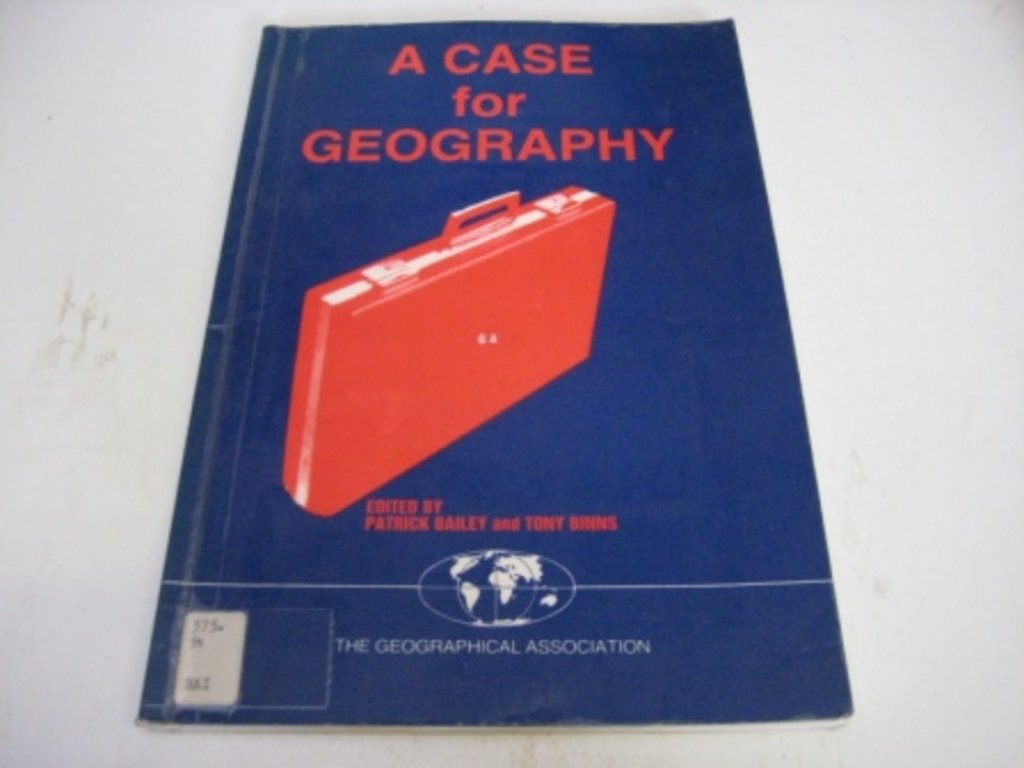
In his book on UK School geography, Rex Walford talks about his involvement in the response, and also the work of Patrick Bailey and Tony Binns (who are coming up on the blog shortly) in writing 'A Case for Geography'.

Keith Joseph asked 7 questions and Patrick Bailey responded, sort of calling his bluff according to Rex Walford.


There was also a response from Denys Brunsden, who was Senior Vice President of the GA at the time, on behalf of the BGRG.

This was all part of an ongoing process starting with a James Callaghan speech in the 1970s which opened up the 'secret garden' of curriculum. It became known as the 'Great Debate'.

Geography was a popular option under a 'free market', but the emergence of the TVEI (I used to have a TVEI tie back in the day) was an element in cutting down choice. It also led to the founding of COBRIG in 1988 and closer working with the RGS-IBG.

This was about getting "a place in the sun".

References

"A Case for Geography" - published by the GA, edited by Patrick Bailey and Tony Binns

https://www.jstor.org/stable/pdf/40571306.pdf?seq=1#page_scan_tab_contents

https://www.jstor.org/stable/pdf/23751212.pdf?refreqid=excelsior%3A6ebe5211589a8ba858eec7824db86441 - responses to Keith Joseph from Patrick Bailey

Bailey, Patrick. “A Reply to Sir Keith Joseph's Seven Questions, from the President of the Geographical Association.” Teaching Geography, vol. 11, no. 2, 1986, pp. 64–67. JSTOR, www.jstor.org/stable/23751212. Accessed 31 Oct. 2020.

Monday, 12 October 2020

1980s: A Case for Geography

Updated October 2020

Keith Joseph was the Secretary of State for Education when this document was created. It was a response to comments that he had made at the GA Conference 1985 and was a defence of the subject to his successor (as it turned out). The defence was collated by Patrick Bailey and Tony Binns.

References
Hansard
https://api.parliament.uk/historic-hansard/written-answers/1989/may/05/geography

A working party was set up and its membership is referred to here
  • Mrs. Kay Edwards—Head of Geography, Penglais Comprehensive School, Aberystwyth
  • Mr. Richard Lethbridge—Former chairman, Tower Steel (Holdings) plc, now a branch secretary of the Country Landowners' Association
  • Mrs. Wendy Morgan—Recently retired headmistress of Elmsett Primary School, Suffolk
  • Dr. Keith Paterson—Senior Lecturer in Geography, Liverpool Institute of Higher Education
  • Mrs. Eleanor Rawling—National Co-ordinator, Geography Schools and Industry Project
  • Mr. Michael Storm—Staff Inspector for Geography and Environmental Studies, Inner London Education Authority
  • Mrs. Rachel Thomas—Member of the Countryside Commission and Exmoor National Park Committee
  • Mr. Rex Walford—Lecturer in Geography and Education, University of Cambridge

Also published by the GA as a separate publication once it had been delivered.

Bailey, Patrick, and Tony Binns. “A Case for Geography: A Response to Sir Keith Joseph.” Geography, vol. 72, no. 4, 1987, pp. 327–331. JSTOR, www.jstor.org/stable/40571306. Accessed 14 Nov. 2020.


More to come on this nearer the time.

Tuesday, 26 May 2020

Gladys Hickman

Updated October 2023

Another influential person in the life of the GA was Gladys Hickman.

She was described in this piece in the GA Magazine as "an inspirational enthusiast for geographical education". She was made an Honorary member of the GA.
She was born in 1912 in East Sussex and grew up on a sheep farm on Romney Marsh.
She gained a first in Geography from UCL and took part in the first land use survey of Great Britain, becoming a close friend of former GA President Dudley Stamp.
Gladys was linked with the Bristol GA branch, having worked in teacher education at Goldsmiths and then Bristol University.
She worked on the Schools Council 14-18 project.
She was a well travelled geographer, and chaired the GA's Field Group in the 1960s and helped launch the Study Tours which the GA's International SIG still runs to this day.

She was also the tutor of former GA President Sheila Jones who told me in a personal communication:
Education year (1950-51), was a revelation with Dr. Gladys Hickman who introduced us to fieldwork opportunities and was a great innovator. Many of her students owe much of their success in teaching to her.

Sheila also wrote a history of the GA Bristol branch. This piece in the GA Magazine gives a flavour of her work.
She attended the 1993 Centenary Celebration of the GA, and Sheila Jones remembered her being there and wrote a little note in the letters she sent to me.


She was working into her 90s in retirement in Edinburgh, and supporting the work of the RSGS.


She wrote a book about Africa which stayed in publication for many years.


She died in 2006, and an appreciation was featured in the GA Magazine and an obituary in the Geographical Journal.


I read about Glady's life in this book as well.


Source:
https://books.google.co.uk/books?id=p_xfuY8CJ48C&pg=PT115&lpg=PT115&dq=%22marguerita+oughton%22+sheffield&source=bl&ots=xln_U09sEO&sig=ACfU3U0BVaFI8t74PC7xxPHMiijd8QoLyQ&hl=en&sa=X&ved=2ahUKEwjbrsfys43pAhXKQEEAHeGlCCIQ6AEwAnoECAoQAQ#v=onepage&q&f=false

An Obituary, written by her son Richard, was published in The Guardian
https://www.theguardian.com/news/2006/oct/19/obituaries.mainsection

https://onlinelibrary.wiley.com/doi/abs/10.1111/j.0028-8292.1975.tb00753.x

https://books.google.co.uk/books?id=6xWsAgAAQBAJ&lpg=PA1913&ots=Tsc_l8fz68&dq=gladys%20hickman%20geography&pg=PA1915#v=onepage&q=gladys%20hickman%20geography&f=false


Updated August 2021
Found this in my Flickr account. It's a book in the Victorian Schoolhouse at Gressenhall Rural Life Museum a few miles from where I live in Norfolk.

Source:


Professor Norman Graves - RIP

A cross posting from my Living Geography blog.   I received sad news today from Frances Slater, via GA President Fiona Sheriff about the sad...