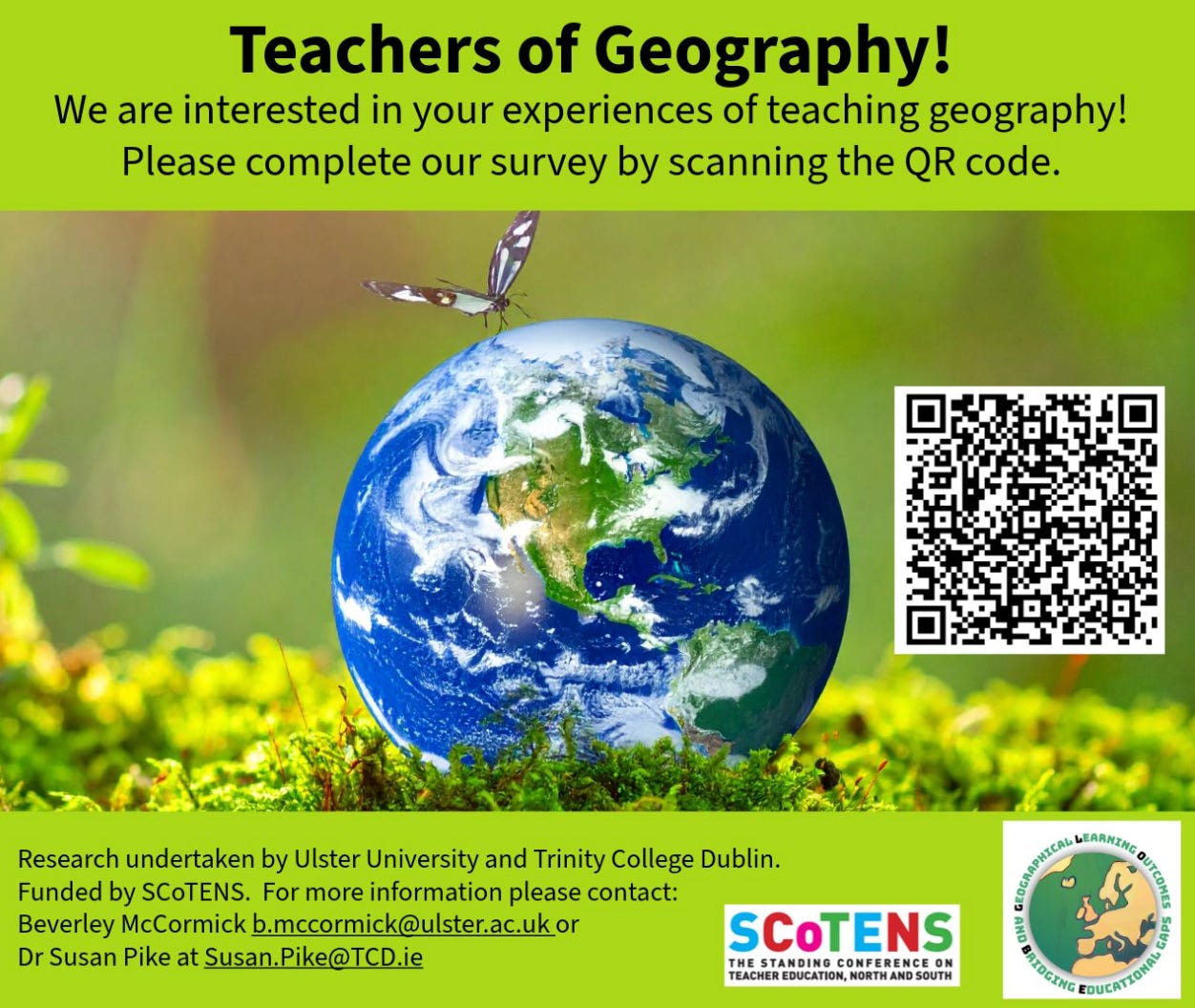
Your views are needed by Dr Susan Pike and her fellow researchers. Details below and scan the QR code to find out more.
Biographies of all the Presidents of the Geographical Association since the founding of the Association in 1893. Researched by Alan Parkinson (GA President 2021-22), with contributions from others, including the former Presidents themselves where possible.
Showing posts with label Ireland. Show all posts
Wednesday, 3 December 2025
Friday, 27 August 2021
2020: Dr Susan Pike
Updated August 2025

Dr Susan Pike is Assistant Professor (Education) at Trinity College Dublin (TCD) and was previously Lecturer in Geography Education in the School of STEM Education, Innovation and Global Studies at the Institute of Education in Dublin City University, in the Republic of Ireland.
She moved to Ireland from England in 2000.
School and University
Susan had a shaky start with geography.
She remembers copying off the board in primary school in Scotland and learning off examination answers and standing up when getting questions wrong in secondary school in England. Luckily for her last year of A level, she had an inspiring teacher Mrs Fairclough, as she remembers
"Jane was amazing, she realised very quickly we had pretty poor experiences of Geography so far. She listened to our complaints, and acted upon them! She took is out on fieldwork, passing on her passion for Geography and the environment. She was so caring, she also persuaded me to apply for university, something I had never considered before. For this I remain so grateful to her."
Susan attended Nottingham University's School of Geography from 1987. One of her lecturers was Professor John Cole. Susan had lovely memories of him:
"As geography students we were a social lot, most of the class went out on Thursday nights to Rock City. But we were all there at 9 am on Fridays for his 'Developing World' lectures. He was so interesting, teaching us geography through story. I was very lucky to have him as my tutor in 2nd Year, through his stories and questions, he never failed to get us thinking geographically".
Her other memorable lecturers were numerous, and included Dr Catherine Delano-Smith and Professor Louise Crewe. Over the past 20 years Susan has designed and taught on a range of modules in Geography,
Teaching
After graduating, Susan worked for Compassion in World Farming for three years, hence the idea for her GA Conference theme in 2021. She worked in all sections, from despatch to campaigns but also knew that she wanted to move on and teach.
She gained a place on the PGCE at the University of Southampton, and her tutor was Professor Nick Foskett. She had very positive experiences at Southampton.
"I was so fortunate on the PGCE. My tutor was Nick, who was so dedicated to his role. he really cared for us all. At Bournemouth School for Boys, we were treated with such care, as we were the first PGCE students there and at Oaklands Community School in Southampton, the same was so as they always took students."
During this time Susan realised the importance of her subject association:
"I was always aware of the GA, having read Geography at university. But on the first day of our PGCE, Nick told us to join the GA and that the Conference would be in Southampton that year, so I joined and went the Conference. I remember being 'star-struck' by meeting so many of the people whose work I had read. And they were all so lovely!"
Susan worked at King Richard School in Paulsgrove, Portsmouth, then back to Oaklands Community School in Southampton. All whilst completing her Masters in Geographical and Environmental Education at Southampton. She then became Head of Geography at Hayling School near Portsmouth. She fondly remembers all the roles she held as well as the students and teachers she worked for.
"I was so fortunate to work in great schools, with such dedicated teachers. All the school I worked in were challenging in terms of the issues some students' experiences, but luckily as a geography teacher you were able to link the learning to the students' lives and engage them. Most of them eventually liked geography and many did better than they thought they would at GCSE! We also went on many trips, working out the very cheapest ways to travel, from down to the local beach or shops and all the way to EuroDisney and the Christmas Markets in Germany."
Working in teacher education.
Susan continued to be a member of the GA, and on moving to Ireland and working in teacher education, she started writing for the GA. She first wrote about research on children's national identity in Primary Geography in 2001. She went on to become more involved in the work of primary geographers, presenting at several GA Conferences, Geography Teacher Educators' Conferences and Charney Primary Geography Conferences.
During this time Susan completed her doctorate in education at Queen's University Belfast as well as other published research in geography education and teacher education. As can be seen from her DCU profile, she has written numerous books, papers, chapters and resources all related to geography and geography teacher education. She is also on the Committee of the Geography Society of Ireland, a member of the Geography Education Research Collective (GERECO), the editorial board of International Research in Geography and Environmental Education (IRGEE).
Susan and the GA Presidential Role
Over time, Susan became more involved in the work of the GA. In 2016 Susan's first book was published, 'Learning Primary Geography: Ideas and Inspirations from Classrooms', featuring theory and practice in primary geography. Over this time Susan wrote articles, many with teachers for Primary Geography.
She received the Geographical Association Award for Excellence in 2016.
She worked extremely hard as Secretary of the GA’s Early Years and Primary Phase Committee from 2017. She then became Junior Vice President in 2018.
Over the past two years she has chaired the GA’s Education Group meetings for the last year in her role as GA Vice-President and President, and is currently a GA Trustee. Susan’s 2021 Presidential theme of ‘Compassionate Geographies’ grew in significance and resonance since it was first announced, as we all became increasingly aware of our own personal geographies and connections with others.
The Conference, held online, was a great success. Session downloads are still available to obtain by those who attended, and can be purchased by those who didn't attend the event. Susan was delighted about how the Conference went:
"Thanks to all the GA member and staff who got involved, the event went as well as it could! The keynote speakers, the workshops and lectures as well as the Wonder Room were all wonderful."
The online format of the conference allowed those who could not normally attend the event to come along. As Susan says:
"My original reasons for wanting to become President were to encourage more people to get involved in the Association, as the restrictions this year has actually helped this process. I think people are more likely to say they can volunteer for the GA, as it's been easier to meet up online. However, I also know folk are really looking forward to seeing each other for real! There's also more to do to make the GA more diverse and inclusive, but we are all working on that as you can see in each issue of GA News. It's been a strange year to be GA President, but I've enjoyed every moment of it. It has been a privilege everyday. Luckily I was in the presidential cycle for the two years before, working with Education Group and Governing Body before our movements were restricted. However, there are many GA members I've only really got to know online, many of whom have become more involved in the Association. All of them are so dedicated to the Association and promoting and developing geography in their settings. So, like many of us, I am really looking forward to Conference in 2022, for many missed cups of coffee and chats, as well as the quiz, BeerMeet and other events in Guildford!"
As she steps down from being GA President, she is looking forward to continuing her work for the GA, as a member of Governing Body and working on various projects for the Association. Most of all she is looking forward to linking up her students with schools, principals, teachers and children again, something that has been impossible recently.

Images copyright: Bryan Ledgard / Geographical Association - the next images were provided by Susan Pike.
Susan with teachers involved in Learning Primary Geography, and Dr Harold Hislop, Chief Inspector of Schools in Ireland in 2016
Some of Susan's BEd2 students 2011, out of fieldwork with Barnaby Bear
Rethinking risk by making fire with BEd3 students at DCU, 2018
References
https://scholar.google.com/citations?user=_PFcqb8AAAAJ&hl=en - Google Scholar
Wednesday, 19 June 2019
1919: Professor Grenville A J Cole, FSA
Updated September 2023
The president 101 years ago this year was a geologist, and a cyclist.
Grenville Arthur James Cole took over the Presidency of the Association just after the end of the First World War. He had been involved with the Association for some time, and there are several articles of his in the GA journal JSTOR archives.
This must have been a time of turmoil and change as soldiers returned to their previous life as teachers, and families were reunited, and the GA moved back into peace time. However, it was also a time of great growth in terms of numbers of new members and activity following years of semi-dormancy, and a desire to be creative and 'keep busy'.
Grenville Cole was a geologist by background and was apparently known as the "cycling geologist". You can perhaps guess why.
He undertook many cycling tours around continental Europe and Ireland. These trips were recounted in two early travel books. The Gypsy Road: a Journey from Krakow to Coblentz, published in 1894, which apparently provides a delightful account of a tour undertaken by him on a tricycle and his companion on a penny farthing, across what is now Poland, the Czech Republic, and eastern Germany.
Details here: https://sp.lyellcollection.org/content/287/1/135
In a later slim volume entitled 'As We Ride', co-authored with his wife, a number of expeditions to France and the Balkans are eloquently described. I am going to endeavour to get some copies of those books, certainly the first one at least.
Cole also campaigned for the inclusion of geography in the curriculum of the Universities. He realized that no improvements could come about in the schools unless teachers were properly trained in the new methods. He proposed a motion to that effect in 1923, at a meeting of the Irish Geographical Association, stating that "this meeting instructs the committee of the IGA to take steps to bring the need for higher geographical teaching in Ireland before the authorities responsible for the curriculum of courses for degrees in the several Irish Universities, and to urge the inclusion of Geography among the subjects that may be selected by undergraduates as the principal study of their fmal years for degrees both in science and the arts."
His work had only really begun, when he sadly died in 1924.
Source, where you can read the whole book:
https://files.eric.ed.gov/fulltext/ED331742.pdf
A piece in the Irish Naturalist journal discovered by another sweep of JSTOR.
The president 101 years ago this year was a geologist, and a cyclist.
This must have been a time of turmoil and change as soldiers returned to their previous life as teachers, and families were reunited, and the GA moved back into peace time. However, it was also a time of great growth in terms of numbers of new members and activity following years of semi-dormancy, and a desire to be creative and 'keep busy'.
Grenville Cole was a geologist by background and was apparently known as the "cycling geologist". You can perhaps guess why.
He undertook many cycling tours around continental Europe and Ireland. These trips were recounted in two early travel books. The Gypsy Road: a Journey from Krakow to Coblentz, published in 1894, which apparently provides a delightful account of a tour undertaken by him on a tricycle and his companion on a penny farthing, across what is now Poland, the Czech Republic, and eastern Germany.
Details here: https://sp.lyellcollection.org/content/287/1/135
In a later slim volume entitled 'As We Ride', co-authored with his wife, a number of expeditions to France and the Balkans are eloquently described. I am going to endeavour to get some copies of those books, certainly the first one at least.
Between 1902 and 1908, Cole organised a week-long geological excursion to various parts of Ireland for his students, and transport was by train and bicycle.
His links to the Geographical Association started at this time, and he became involved with their work in many ways, particularly in the area of Geology. He wrote a good many books on geology, as well as a rare guide to Dublin, which is going for £300 on eBay.
In 1919, his Presidential Address was called “The Narrow Seas and the Arctic Route to Muscovy.” As is customary at the time (before the Bank Holiday arrived and the conference moved to Spring) it was held in the first week of the year.
Not surprisingly he started by talking about the geology of the seas around the country, and the role that they had played in shaping the country's history and destiny.
He also talked about the little-known expedition in the 1550s by Sir Hugh Willoughby and Richard Chancellor, where they headed North into Muscovia, to try to find a great circle route over the Pole to Cathay, and "secure that route for the English."
It didn't end well for Willoughby, with his fate being told in his journals. They were found on the ship in 1554 after he and the crews of the Bona Esperanta and the Bona Confidentia had perished, ice bound in the Varzina River during the winter. Chancellor was separated in a storm off the Lofoten Islands and found safety in Norway. The adventures of Chancellor were recounted in the address, along with 'what happened next'. There were echoes in Willoughby's Arctic disappearance of the tale of 'Erebus' told so well most recently by Sir Michael Palin.
His links to the Geographical Association started at this time, and he became involved with their work in many ways, particularly in the area of Geology. He wrote a good many books on geology, as well as a rare guide to Dublin, which is going for £300 on eBay.
In 1919, his Presidential Address was called “The Narrow Seas and the Arctic Route to Muscovy.” As is customary at the time (before the Bank Holiday arrived and the conference moved to Spring) it was held in the first week of the year.
Not surprisingly he started by talking about the geology of the seas around the country, and the role that they had played in shaping the country's history and destiny.
He also talked about the little-known expedition in the 1550s by Sir Hugh Willoughby and Richard Chancellor, where they headed North into Muscovia, to try to find a great circle route over the Pole to Cathay, and "secure that route for the English."
It didn't end well for Willoughby, with his fate being told in his journals. They were found on the ship in 1554 after he and the crews of the Bona Esperanta and the Bona Confidentia had perished, ice bound in the Varzina River during the winter. Chancellor was separated in a storm off the Lofoten Islands and found safety in Norway. The adventures of Chancellor were recounted in the address, along with 'what happened next'. There were echoes in Willoughby's Arctic disappearance of the tale of 'Erebus' told so well most recently by Sir Michael Palin.
Cole was unwell in 1920 after his Presidency ended, but took up the post of President of the Irish Geographical Association
He delivered a series of Summer lectures entitled "Ireland the Outpost" and these were later turned into a book.
His Presidential Address to the Irish Association was published in 'The Geographical Teacher' in 1920. In this one, he suggested that every geography teacher should "receive a grant for travel... as the world at large is our laboratory"

This is a reminder that there are many national Geographical Associations, and I hope during my Presidency to connect with as many of these as possible.
Grenville Cole sadly died in 1924, relatively young compared to many of the Presidents.
References
http://sp.lyellcollection.org/content/287/1/135 - detail on Cole's career as the cycling geologist
Image copyright: Geological Society of London
Citation:
Grenville Arthur James Cole (1859–1924): the cycling geologist
P. N. Wyse Jackson
Geological Society, London, Special Publications, 287, 135-147, 1 January 2007,https://doi.org/10.1144/SP287.11
Wyse Jackson, P.N. ‘Grenville Cole (1859 – 1924): cycling geologist’ Four centuries of geological travel: the search for knowledge on foot, bicycle, sledge and camel Wyse Jacskson, P.N., ed. London: The Geological Society, 2007: p143
Other images can be seen from this source, including some of the routes that Cole cycled
Presidential Address
Cole, Grenville A. J. “The Narrow Seas and the Arctic Route to Muscovy.” The Geographical Teacher, vol. 10, no. 1, 1919, pp. 4–8. JSTOR, www.jstor.org/stable/40555794.
https://www.jstor.org/stable/40555643?seq=1#page_scan_tab_contents - Irish connections outlined
Cole, G. A. J. “Presidential Address to the Irish Geographical Association.” The Geographical Teacher, vol. 10, no. 6, 1920, pp. 276–279. JSTOR, www.jstor.org/stable/40555713.
Books for sale on ABE Books: https://www.abebooks.co.uk/servlet/SearchResults?sts=t&cm_sp=SearchF-_-home-_-Results&an=Grenville+Cole&tn=&kn=&isbn=
https://en.wikipedia.org/wiki/Grenville_Cole - Wikipedia entry
I edited the Wikipedia entry to add the fact that he was the President of the Geographical Association. I shall do that for each President, as hardly any of their entries mentioned that before I started the blog.
Poetry about Cole by Michael McKimm: https://writtenintherocks.wordpress.com/2012/07/04/the-cycling-geologist/
As always, if anyone know any more information about Grenville Cole, please get in touch.
POSTSCRIPT
1919 was also the year that the GA looked to organise a memorial to Professor Herbertson, who was the subject of a previous post.
This was the Herbertson Memorial Lecture, and an endowment meeting the expenses of a lecture and printing.
Update - June 2019
An appreciation, published in 1924 in 'The Geographical Teacher'
“EDITORIAL.” The Geographical Teacher, vol. 12, no. 5, 1924, pp. 329–332. JSTOR, www.jstor.org/stable/40556361.
Updated August 2020
While looking for something else, I came across a book called 'Geography and Education' exploring the development of fieldwork education.
It describes Grenville's attempts to bring the same sort of opportunities for fieldwork to Ireland that were being developed in the UK by the GA and other organisations.
Grenville gets a chapter almost to himself, alongside the efforts of John Scott Keltie.
It pulls in mentions for many other former GA Presidents along the way:
Born in London and with a solid background in geology he visited Ireland for the first time in 1884, the year Keltie undertook his eclectic survey on the state of geography education in England and Wales.
In 1890, Cole took a position in the Royal College of Science in Dublin. As a geologist he was a practical field worker, and he conducted many practical geological surveys in Ireland. In 1911, accompanied by Davis the celebrated American Geomorphologist, he undertook an expedition incorporating the Munster Blackwater River Valley. Davies, lecturer in Geography at Trinity College Dublin, said "They went there to see the sininge bend in the Blackwater described by Jukes in l862." Though working and residing in Dublin, Cole maintained a close contact with the Geographical Association in Britain.
His contribution to that organisation culminated in his election as its president in 1919. He worked in close harmony with the guiding intellectuals of the Association in England: Mackinder, Fleure, Roxby, Freshfield and Geddes.
Cole consequently spearheaded a movement to set up and establish an Irish version of the Geographical Association.
The I.G.A. was affiliated with its British counterpart and many ideas and methods which had originated in England were introduced in Dublin by Cole. In 1921, he utilized the Mackinder and Herbertson Summer School idea to promote in-service courses for teachers.
Davies recorded the eleven-day summer school organised by the Irish Geographical Association in that year for geography teachers.
"The programme for that school looks surprisingly modern. There were lectures on landforms and scenery, maps and map reading, field work in biogeography, historical cartography, Ii Industry and power resources, and geographical modelling together with field-excursions to Howth, Dunsink Observatory, the Dublin and Wicklow mountains, Killiney and the Dublin Docks." Indeed the program looked surprisingly modern in the Irish context, yet, on a comparative note, those methods and activities had been integral parts of geography education at third level institutions in Britain for a decade or more.
He delivered a series of Summer lectures entitled "Ireland the Outpost" and these were later turned into a book.
His Presidential Address to the Irish Association was published in 'The Geographical Teacher' in 1920. In this one, he suggested that every geography teacher should "receive a grant for travel... as the world at large is our laboratory"

This is a reminder that there are many national Geographical Associations, and I hope during my Presidency to connect with as many of these as possible.
Grenville Cole sadly died in 1924, relatively young compared to many of the Presidents.
References
http://sp.lyellcollection.org/content/287/1/135 - detail on Cole's career as the cycling geologist
Image copyright: Geological Society of London
Citation:
Grenville Arthur James Cole (1859–1924): the cycling geologist
P. N. Wyse Jackson
Geological Society, London, Special Publications, 287, 135-147, 1 January 2007,https://doi.org/10.1144/SP287.11
Wyse Jackson, P.N. ‘Grenville Cole (1859 – 1924): cycling geologist’ Four centuries of geological travel: the search for knowledge on foot, bicycle, sledge and camel Wyse Jacskson, P.N., ed. London: The Geological Society, 2007: p143
Other images can be seen from this source, including some of the routes that Cole cycled
Presidential Address
Cole, Grenville A. J. “The Narrow Seas and the Arctic Route to Muscovy.” The Geographical Teacher, vol. 10, no. 1, 1919, pp. 4–8. JSTOR, www.jstor.org/stable/40555794.
https://www.jstor.org/stable/40555643?seq=1#page_scan_tab_contents - Irish connections outlined
Cole, G. A. J. “Presidential Address to the Irish Geographical Association.” The Geographical Teacher, vol. 10, no. 6, 1920, pp. 276–279. JSTOR, www.jstor.org/stable/40555713.
Books for sale on ABE Books: https://www.abebooks.co.uk/servlet/SearchResults?sts=t&cm_sp=SearchF-_-home-_-Results&an=Grenville+Cole&tn=&kn=&isbn=
https://en.wikipedia.org/wiki/Grenville_Cole - Wikipedia entry
I edited the Wikipedia entry to add the fact that he was the President of the Geographical Association. I shall do that for each President, as hardly any of their entries mentioned that before I started the blog.
Poetry about Cole by Michael McKimm: https://writtenintherocks.wordpress.com/2012/07/04/the-cycling-geologist/
As always, if anyone know any more information about Grenville Cole, please get in touch.
POSTSCRIPT
1919 was also the year that the GA looked to organise a memorial to Professor Herbertson, who was the subject of a previous post.
This was the Herbertson Memorial Lecture, and an endowment meeting the expenses of a lecture and printing.
Update - June 2019
An appreciation, published in 1924 in 'The Geographical Teacher'
“EDITORIAL.” The Geographical Teacher, vol. 12, no. 5, 1924, pp. 329–332. JSTOR, www.jstor.org/stable/40556361.

Updated August 2020
While looking for something else, I came across a book called 'Geography and Education' exploring the development of fieldwork education.
It describes Grenville's attempts to bring the same sort of opportunities for fieldwork to Ireland that were being developed in the UK by the GA and other organisations.
Grenville gets a chapter almost to himself, alongside the efforts of John Scott Keltie.
It pulls in mentions for many other former GA Presidents along the way:
Born in London and with a solid background in geology he visited Ireland for the first time in 1884, the year Keltie undertook his eclectic survey on the state of geography education in England and Wales.
In 1890, Cole took a position in the Royal College of Science in Dublin. As a geologist he was a practical field worker, and he conducted many practical geological surveys in Ireland. In 1911, accompanied by Davis the celebrated American Geomorphologist, he undertook an expedition incorporating the Munster Blackwater River Valley. Davies, lecturer in Geography at Trinity College Dublin, said "They went there to see the sininge bend in the Blackwater described by Jukes in l862." Though working and residing in Dublin, Cole maintained a close contact with the Geographical Association in Britain.
His contribution to that organisation culminated in his election as its president in 1919. He worked in close harmony with the guiding intellectuals of the Association in England: Mackinder, Fleure, Roxby, Freshfield and Geddes.
Cole consequently spearheaded a movement to set up and establish an Irish version of the Geographical Association.
The I.G.A. was affiliated with its British counterpart and many ideas and methods which had originated in England were introduced in Dublin by Cole. In 1921, he utilized the Mackinder and Herbertson Summer School idea to promote in-service courses for teachers.
Davies recorded the eleven-day summer school organised by the Irish Geographical Association in that year for geography teachers.
"The programme for that school looks surprisingly modern. There were lectures on landforms and scenery, maps and map reading, field work in biogeography, historical cartography, Ii Industry and power resources, and geographical modelling together with field-excursions to Howth, Dunsink Observatory, the Dublin and Wicklow mountains, Killiney and the Dublin Docks." Indeed the program looked surprisingly modern in the Irish context, yet, on a comparative note, those methods and activities had been integral parts of geography education at third level institutions in Britain for a decade or more.
Cole
simply transferred the techniques and experience to the
Dublin Summer School.
Cole also campaigned for the inclusion of geography in the curriculum of the Universities. He realized that no improvements could come about in the schools unless teachers were properly trained in the new methods. He proposed a motion to that effect in 1923, at a meeting of the Irish Geographical Association, stating that "this meeting instructs the committee of the IGA to take steps to bring the need for higher geographical teaching in Ireland before the authorities responsible for the curriculum of courses for degrees in the several Irish Universities, and to urge the inclusion of Geography among the subjects that may be selected by undergraduates as the principal study of their fmal years for degrees both in science and the arts."
His work had only really begun, when he sadly died in 1924.
Source, where you can read the whole book:
https://files.eric.ed.gov/fulltext/ED331742.pdf
References
https://www.lyellcollection.org/doi/abs/10.1144/SP287.11 - Lyell Collection
Updated August 2023
Many illustrations from this book have been shared on Flickr. They can be downloaded.
Updated September 2023
From 1924 - a new image of Cole.
Wright, W. B., and M. C. Wright. “Grenville Arthur James Cole, F.R.S.” The Irish Naturalist, vol. 33, no. 6, 1924, pp. 57–60. JSTOR, http://www.jstor.org/stable/25525353. Accessed 16 Sept. 2023.
And some more description of his work.
It describes his travels and wider involvement, including with the British Association.
What's unusual in a piece like this is that the GA is mentioned as part of his work... he "took a keen interest" in the development of geography.
He also wrote poetry it seems, as did a few other Presidents.
Subscribe to:
Posts (Atom)
Margaret Mackintosh RIP
Updated post. Sad news at the end of last week from colleagues who have organised the Charney Conference over the years of the passing of Ma...


